Wednesday, March 18, 2026

Blood “Democracies” Bomb Iran

Source: Originally published by Z. Feel free to share widely.

The US has again illegally bombed the Islamic Republic of Iran during negotiations. While agreeing to give up entirely its nuclear enrichment, making every concession to avoid war, Iran couldn’t prevent the bombing of over a hundred cities by US and Israel. The genocidal US-Israel alliance murdered Iran’s spiritual Supreme Leader Sayyid Ali Khamenei, killing his wife, daughter, grandchildren, and 40 Iranian officials during the holy month of Ramadan in a single strike by Israel with CIA’s help.

The deadly February 28 attack on Iran has received broad support from western governments for another war of annihilation in West Asia (the Middle East). Canada, Australia, New Zealand (settler-colonial supporters of Israel, like the US), along with most European allies (except for Spain), have either condemned Iran, or simply looked the other way. NATO chief during his visit to North Macedonia also endorsed the war, saying, Iran poses “an existential threat to Israel.”

As with most Israeli wars across West Asia, European and N. American leaders remain defiantly Zionist. The compelling reasons for wars in the region always point to Iran’s support for Palestine and opposition to US and Israel since 1979.

However, since 1776, a constitutional democracy founded by a slave-owning elite, the United States, has brought people across the region and the world unprovoked wars and genocide, expanding its territory and global military bases. Similarly, Israel since 1948 has brought destruction, ethnic cleansing, and genocide to Palestinians, Arabs, and Muslims, with “Greater” Israel’s wars of expansion in an explicit colonial objective to rule over the Arab world as another European settler-colonial state. What do western democracies represent when they fund and enable wars and mass killings of civilians overseas, decade after decade, especially across West Asia, and North and East Africa?

Blood Democracies

Stained with the blood of non-Europeans, western democracies are blood democracies. The book, American Holocaust, outlines in detail the “glorious” voyages of Christopher Columbus (a fanatical, racist, greedy entrepreneur, and eerily similar to Donald J. Trump), who paved the way for centuries of genocide and bloodbath against non-Europeans. Germany, France, England, Belgium, and countless European powers, barely representing 7% of the world, spent centuries subjugating and bleeding the rest of humanity in the name of capitalism, only to emerge as so-called liberal democracies.

Blood democracies will continue to spill blood around the world, because the racist, fascist politics at home have empowered their ruling elite to continue the colonial racist subjugation of the global South into the 21st century. The very existence of these blood democracies can and will mean only more death and destruction to come. If any type of government poses a threat to the world, it is these western blood democracies that owe their existence to spilling the blood of non-Europeans for gold, silver, oil, diamonds, precious minerals, land, and enslaved workers and taxpayers.

Blood Politics

The US has made war now for 25 years in the 21st century against Arabs and Muslims, costing over $8 trillion and nearly five million lives. Iran and its handful of allies in the region have come nowhere close to the US-Israel deadly achievements, often facilitated by many American proxies and client-states in the region (Israel, Saudia Arabia, UAE, Kuwait, Bahrain, Qatar, Türkiye, and now Syria, which shows Al Qaeda’s historical connection to blood democracies).

Since its founding in 1776, the settler-colonial United States has made war for most of its glorious 250 years: genocides against natives to steal land and resources; enslavement and violence against black bodies; an unprovoked war of annexation with Mexico, grabbing land consisting of Utah, Arizona, Texas, New Mexico, and California; wars with Spain; the forceful and deadly annexations of Puerto Rico and Hawaii, along with Guam and a number of island-nations in the Pacific; war and occupation of the Philippines; the pillaging and destruction of Haiti; and the bombing of Hiroshima and Nagasaki using nuclear bombs that killed hundreds of thousands of civilians. But it didn’t stop there.

Since WWII, the US war on Korea killed nearly 3 million Koreans; the Cold War spread across South and Central America toppling many socialist governments; war in Vietnam, Cambodia, and Laos, killing 3.1 million people in Vietnam alone; support for deadly anti-communist military regimes around the world, such as Indonesia that killed a million people, and hundreds of thousands in Latin America; the 1989 invasion of Panama to kidnap Noriega; recent attack and kidnapping of Venezuela’s President Nicolás Maduro and his wife; the 8-year proxy war against Iran in the 1980’s through our friend Saddam Hussein, extinguishing the lives of one million Iranians and over half a million Iraqis; war in 1991 against Iraq, then devastating sanctions killing half a million Iraqi children, accompanied by continued weekly bombings until the invasion of 2003, killing a million Iraqis (a carbon copy of sanctions-then-invasion in action currently targeting Iran); the invasion and 20-year occupation of Afghanistan, taking the lives of a million poor people; the wars in Somalia, Syria, Libya, N. Waziristan (Pakistan), and Yemen that killed about 400 thousand impoverished Yemenis; under Trump, the assassination of Iran’s General Qasem Soleimani; proxy genocidal war against Palestinians through American funding and arming of Israel supported by all western governments; and the 12-day war against Iran in 2025.

After a western-backed CIA’s successful regime change operation in 1953 against Iran’s democratically elected government, to facilitate the theft of Iranian oil by British Petroleum (BP) over 26 years, Zionist West has continued to seek regime change following the popular revolution of 1979. Western oil companies and governments, losing their strategic and lucrative control over Iranian oil, have remained locked in a forever war against Tehran. The late Robert Fisk in his magnum opus, The Great War for Civilization, shows US’s planning and initiation of the Iran-Iraq war (1980-88): the US helped Saddam Hussein build chemical and biological weapons factories; Germany provided the chemicals for the weapons; and Saudia Arabia and Kuwait funded it to the tune of $250 million. The war killed over a million people in Iran.

Fisk also details the downing of an Iranian passenger plane in 1988 by USS Vincennes, killing all 290 civilians, including 20 members of a family attending a wedding in the Gulf. Vice President George H. Bush defiantly said, “I will never apologize for the United States—I don’t care what the facts are.” That longstanding jingoism of the US continues under a fascist Christian supremacist administration, which torpedoed an unarmed Iranian naval ship engaged in routine maritime exercises with other countries in the Indian ocean. In this context, one must understand why Iran’s enduring patience has run thin with blood democracies and their allies in the region.

Moreover, the attack on Iran and killing of Iran’s Supreme Leader has been called “historic” by the US. One finds nothing historic about another unprovoked deadly American war unleashed on Muslims fasting during the month of Ramadan. Israel and the US have done that repeatedly to Palestinians and the region over the last 25 years. Indeed, the war on Iran could be historic if the US hadn’t spent 250 years engaged in wars of expansion and domination. Only an absolute and habitual distortion of history would render the war on Iran as “historic.”

The history of American war-making, regime change, overthrow, and the assassination of political leaders and opponents has marked America’s glorious 250 years of history, which the settler-colonial blood democracy will proudly celebrate on July 4, 2026.

“Only [Blood] Democracy in the Middle East”

Since the founding of another blood democracy in 1948, Israel has followed in the footsteps of its great patron-saint, the US, who has since the assassination of JFK, armed and funded Israel, making it the most powerful military and only nuclear power in the region. Israel’s founding paralleled America’s post-Independence violence: the many wars of expansion and annexation, which began with the forced removal of 700,000 indigenous people in the land of Palestine, an undeniable resemblance to the Trail of Tears the American blood democracy let loose on the natives in N. America.

“Our friend, Israel,” has forced Palestinian off their land throughout its history, deploying armed Israeli settlers, backed by US and Europe. Israel has and continues to kill tens of thousands of Palestinians across Gaza, assassinating Palestinian leaders, massacring women, children, aid workers, refugees sheltering in tents, using highly explosive MK-84 bombs that evaporate bodies, all supported by western blood democracies.

Israel’s egregious violations of international law and human rights have never elicited condemnation, let alone intervention or sanctions, from western democracies. Israel bombed and assassinated the president of Yemen in 2025. It bombed and assassinated Hezbollah leaders in Lebanon, preceded by 3,000 pager bombs let loose on civilians, which the UN condemned. It bombed and assassinated Iranian leaders in Iran which later started the 12-day war in June 2025. Israel and US have now bombed an elementary girls’ school in Iran, killing over 165 children – an enormous crime against humanity foreseen by the IDF killing of 6-year-old Hind Rajab and her family in Gaza during the ongoing genocide.

The murderous Israeli operations that have carried out the 3-year-long ongoing genocide against Gaza and bombings and killings across Lebanon, Syria, Iraq, and Qatar, have once again expanded to Iran, globalizing Zionist genocides aided and abetted by blood democracies. Iran will continue its resistance, as the anti-colonial struggle of the global South against blood democracies continues across Cuba, Venezuela, Haiti, and West Asia.

Our Last Hope

Blood democracies, riddled with divisive politics of mutual hate, racism, classism, elitism, and sexism, have given way to national borders, militarism, wars, poverty, climate catastrophes, and a deadly world marching swiftly toward a nuclear holocaust.

We Americans, living inside a blood democracy, have gained a clear understanding that the coterie of corporate elite (the Epstein class, ExxonMobil, Chevron, Raytheon, Boeing, Lockheed Martin, Northrop Grumman, Google, Microsoft, Palantir, Meta, Oracle, Tesla, Amazon, Wall Street, Goldman Sachs, JPMorgan Chase, Trump Organization, etc.) will starve the people here at home and massacre people abroad, committing genocide and ecocide, as their corrupt rule lays waste to the world in search of endless profit and lucre. (How little things have changed since the arrival of Christopher Columbus in 1492.)

Our only hope lies in our humanity, that final refuge, that messiah, which unites us across nations and religions against war and mutual annihilation. A new internationalism, with many movements of people of conscience around the world resisting war, fascism, greed, and genocide will continue to fight back in solidarity with the oppressed everywhere (Gaza, Venezuela, Cuba, Haiti, Puerto Rico, Iraq, Afghanistan, Yemen, Sudan, Somalia, Iran, et al.).

May this holy month of Ramadan bring peace and justice to the world.Email

Khalid A. Afsar is a writer and educator.

We Went on Rent Strike and Won

Source: Inequality

Most of the time, landlords win. When I was evicted from my Chicago apartment in 1999, I had no legal rights to defend myself against all my furniture being thrown to the curb, leaving me, my daughter, and baby grandchild out in the cold.

This year though, my fellow tenants and I at Bowen Tower Apartments in Raytown, Missouri won. 

After a four-month long rent strike where we withheld over $110,000 in payments, our union was able to secure lower rents and utility bills along with commitments to fix long-term issues in the 10-story building.

I don’t want to mislead anyone though: the fight wasn’t easy. I was intimidated, bribed, and almost forced out of the building. But we didn’t budge, and now I hope our victory will inspire tenants elsewhere to fight.

I first moved to Bowen Tower in April of 2023. My situation seemed good at the start – the building was accommodating for older tenants, close to transportation, and had a responsive manager.

Things started to turn toward the end of 2024, especially in September when my apartment flooded. The water ruined my furniture and most of my clothes — the total damages were around $13,000 — but all management would do is come up and put towels on the floor.

At this point I was smelling mold everywhere but they still wouldn’t help. Around the same time I got really sick and I lost my job. I had been carefully documenting all the problems in my apartment, calling every city service, but nothing was changing.

Thankfully, I wasn’t the only person in the building with issues. I’d hear other tenants complaining in the elevator and eventually I started inviting them to meetings upstairs. We managed to get city employees to come look at the building by coordinating our calls, but they didn’t do anything either. 

Around that time I came across a video of tenants celebrating at Independence Towers after a  successful eight-month long rent strike. I had already been personally withholding rent for a few months at that point but realized we needed to do something similar at Bowen Tower. So I contacted KC Tenants.

The tenant union helped us get organized, and then, in October of 2025, we went on rent strike. The response from management was harsh — 27 eviction notices were filed, including for me. Some of our neighbors dropped the strike because of intimidation and harassment or straight-up bribery. 

Me personally though, I’m not scared of anything but mice and God. They never intimidated me, even when the cops were called on me four times. I was attacked in the building. Sometimes I’d come back to my apartment, shut the door and just cry. But I was never going to give up. It just made me angry. And with my anger, I wanted to fight more.

The building’s owners, a company from California called Alta/CGHS Real Estate Investments, folded before we ever would.

We’re only going to have to pay back 35 percent of what we withheld, we won good cause eviction protections, two-year leases, and they promised to make major repairs to the building.

But the fight doesn’t end here. I’m going to keep fighting not only for myself, not only for the tenants at Bowen Tower, but for tenants all around Missouri and around the country.

It’s time for landlords to take accountability for their actions. As tenants, the only way we can make sure they do is by forming unions and sticking together, no matter how tough the fight gets.\\\\\\Email

Cynthia Barlow is a tenant organizer based in Raytown, Missouri.


Source: Garden Earth - Beyond Sustainability

Again and again I hear proponents of a new and better farming system explain how it will improve agriculture, the environment and the climate, and at the same time increase profits in farming. Today, it is regenerative agriculture, yesterday it was market gardens and permaculture. The day before it was organic agriculture. But the advocates are not really understanding how commodity markets work.

In the Wealth of Nation, after the famous example of how the pin factory radically increases the productivity in pin making, Adam Smith continues to discuss how division of labour and markets are tied together: ”As it is the power of exchanging that gives occasion to the division of labour, so the extent of this division must always be limited by the extent of that power, or, in other words, by the extent of the market”. I believe this observation is correct, and that it explains why a globalised food system never can work in favour of organic or regenerative farms.

The problem with a (globalised) commodity food system is not that the food from “other countries” is bad or that “they have lower standards than us”. Of course that could be true (It is said in most countries so there must also be some logical gap there….), but it can also be the opposite. No, the problems are on another level:

Those are relevant objections. I will not discuss them here, however.

What I do want to discuss are three other aspects of commodity markets, which work against the principles of regenerative/organic/agroecological (take your pick) farming:

  • A global food system can not be circular; you can’t close nutrient cycles and return all those nutrients embedded in the food to the land from where it came.
  • The global (the bigger) market drives increasing division of labour, which drives increasing specialisation, mechanisation and larger scale. This makes it very hard to compete with a regenerative organic production.
  • The global market disconnects and alienates people from the rest of the living, replacing lived experiences and wisdom with theoretical information and abstract knowledge.

While they, seemingly, have little to do with each other, they are essentially three sides of the same coin.

A global food system can not be circular.

While there are many ways, by which a farmer can activate nutrients tied up in the soil and get nitrogen from the air by nitrogen fixing bacteria, there is a real challenge to get sufficient nutrients to plants. Most organic or regenerative farms have some level of nutrient import to the farm. It can be compost materials from outside, manure from conventional farms, some feed or mineral feed to livestock etc. On a larger scale and longer term, it is absolutely critical that most of the nutrients shipped away from the fields is recycled back to the fields (I am well aware of that as sewage systems are working now a lot of nutrients are wasted and the rest is mostly contaminated, so you don’t want the sludge anyway – it is also not allowed in organic farming). But this is hard enough to accomplish on a local scale, and simply not practical on a global scale.

The global market drives specialisation and increasing scale.

For some, this might be a truism which merits no further explanation. However, I realise from many interchanges in person, in lectures and on social media that many people don’t see to see this logic.

The division of labour is a fundamental principle of the modern industrial society. It is based on that each individual person makes a narrow set of work with the assistance of machinery of some kind (a tractor, a drill, a truck or a computer). As Adam Smith notes with his pin factory example, this increases the productivity per man-hour tremendously. The twin to this specialisation and division of labour is a bigger market. With a bigger market, division of labour and specialisation can increase and with more specialisation you need a bigger market.

If you grow fifty different crops, it is incredibly hard to mechanise the production as each crops needs some special technology, storage facility, even skills and knowledge. In addition, each crop needs special packaging materials and logistics and perhaps different markets as well. If you want to be efficient you need to narrow the number of crops, and you will also narrow the “qualities” of these crops. It makes no sense to grow twenty varieties of tomatoes. The same goes for livestock

According to the same logic of division of labour, you will also specialise within the production. Instead of regenerating the fertility of the soil, you will buy bagged fertilisers, instead of spending energy on increasing bio-diversity on the farm, you buy pesticides to manage the increase in pests caused by the narrow number of crops. Instead of raising and training your children (or the neighbour’s children), you buy labour. Instead of being a jack of all trades you have to become a wheat/carrot/chicken producer. And so it goes on and on. Note that it is the scale and kind of the market that is relevant here, not if it is national, regional or “global” per se. What counts is the competition and volumes traded. A global market is just the worst because it is the biggest with the fiercest competition.

Some seem to believe that “the problem” is big companies, big food industries or big supermarkets. For sure they are problematic. But they are largely a result of the big market. Some say there is too little competition in the market as the markets are dominated by a few actors. But the reality is that the more competition and transparency there is in a market, and the bigger it is, fewer actors will dominate. The internet is of course the best place to verify this statement. In terms of services over the internet, such as online shopping, movie streaming, translation services or audiobooks there will be a few actors that take most business. The same goes for the digital infrastructure where companies like Google, Microsoft, Meta and Apple dominate their respective slots. I recently wrote an article about this phenomenon in the farm input industry.

Of course, there will be the odd farm that will survive in niches of the (global) market. There will be the extraordinary cheese or wine that can be exported to another continent. There was a demand for exclusive products already thousand years ago. There will always be some space for extraordinary products for an elite, and that is fine for those engaged in it, but it has very little relevance here.

For other small and diverse producers, the global market has no opportunities. They can only survive in special niches. e.g. there can be the producers of vegetables that supply a particular high end restaurant (here I would recommend this entertaining video on the farm-to-table movement, by Morgan Gold, even if I don’t fully agree with the conclusion/solutions in the end). Or a farm with grass-fed chicken that delivers directly to consumers. Or a CSAa farming club, a Reko-ring or similar. All of them are intentionally shielded from the large anonymous mass market. Some believe that they should be scaled up, but that will not work. They could be scaled out, though.

I talk mostly about small scale, but what about diverse and large scale? Also here I am sure you can find the odd example that is working. Before you point to one of those farms, please check how they make their living. In my experience if such a farm is an organic, regenerative exemplary farm it will most certainly have external income, or being owned by someone rich enough (did I say King Charles?) or selling their services as advisors or selling their story on social media or whatnot. On big farms the logic of specialisation is the same, or even stronger, as the rate of mechanisation will be higher on a larger farm.

Commodity markets disconnect and alienate people from the rest of the living.

This is not a bug, no negative side-effect, but an inherent feature of commodity markets. The whole point with bigger markets is to break the tie between consumers and producers, between the people and the land. The only relationship that is supported in these markets are transaction with money, a fetish devoid of any meaning. Exchange of goods is not only about the goods themselves, equally important are the social connections and the meaning conferred in the exchange.

This is also one major reason for why so much of the food debate is mistaken and based on very theoretical discourses. The conscientious global consumer tries to avoid palm oil from Indonesia, beef from Brazil and a few more symbolic products. But, by and large, there is no way to assume responsibility of your footprint in a global market place. It is also a reason for why some people, without blinking, can recommend you to eat stuff that is produced on another continent, without contemplating what that really implies.

There is also a system scale objection to the idea that farms will be profitable once they do everything right. For sure, if one farmer adopts a unique technology, it can give her an advantage, but when everybody adopts it, prices will fall and you are back to square one. One agriculture economist in Sweden once stated that prices of agriculture products is determined by the lowest compensation where there still will be people willing to farm. This will continue to be the case as long as there is over-production in the farm sector, which most likely will continue also in the future. The opposite, under-production, may be a good deal for farmers, but socially and morally repulsing.

Therefore, it is better to realise that the anonymous mass-market, the commodity market, the global market – call it what you want – is not at all conducive for a diverse, organic, regenerative, agro-ecological farming, and to realise that converting the food system is as important as converting how you farm. It is essential to re-connect food to the land and the process of farming. This will give food an enhanced value not only as a supplier of energy and essential nutrients, but also as a source of meaning and experience of the land, of the living and of the people producing food.Email

Gunnar Rundgren has worked with most parts of the organic farm sector. He has published several books about the major social and environmental challenges of our world, food and farming.

Neurotic Killer Clowns Attack Public Forests


 March 18, 2026

Clearcut, Gifford Pinchot National Forest, Washington Cascades. Photo: Jeffrey St. Clair.

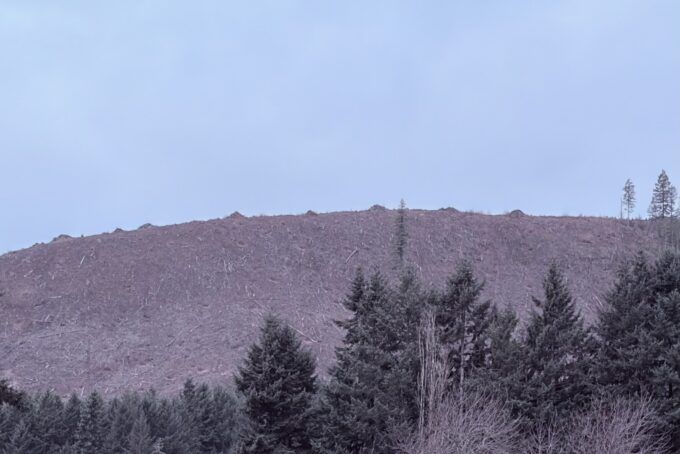
Americans who love the great outdoors are witnessing Trump’s “Plunder America First” public forest liquidation program – up close and personal. National forests are on the chopping block to ‘make them healthy.’

Hunters and local rural residents are disgusted with the rapid loss of secure habitat for elk, deer, bears and moose on public land caused by massive clearcuts and too many (‘spaghetti’) logging roads.

When the first shot rings out on opening day, big game herds pack up and leave home territories on U.S. Forest Service and Bureau of Land Management lands and seek refuge on private tracts where guided hunts cost more than local Montanans are able or willing to pay.

Trump’s Executive Orders decreeing environmental deregulation and higher production targets (hyper-logging) represent a throwback to 15th century enclosure laws.  Hyper-logging devalues secure habitat and displaces wildlife from public forests, while handing timber companies below-cost logs and windfall benefits.  The local peasantry pays in triplicate.  They’re forced to subsidize forest destruction, denied the experience of ‘fair chase’ hunting, and robbed of their historic source of wild meat that fed Montana’s working families for generations.

The conversion of forest ‘commons’ into single-use fiber plantations is a new form of privatization, annihilating what remains of the public trust doctrine. Trump, Inc. has subverted the original intent of the Multiple-Use, Sustained Yield Act of 1960.  Deregulation circumvents all attempts to protect and restore the sustainable rural cultural and biological diversity wild forests provide.

Excessive clearcutting and bulldozing roads into public forests transforms natural forestland into commercial public-private plantations (monopolies), just as medieval ‘common land’ was transformed into profit seeking, rent-seeking capital assets. It’s essential to remember that capital has no moral, no ethical, no ecological purpose, none.  Capital never compensates wildlife or nature for theft (‘taking’) of territory.  Liquidation, profit, and accumulation of wealth defines capital’s raison-d’etre.

Trickle-down fascism is a throwback to medieval feudal systems when serfs were run off the land and rural populations declined. Those who stayed behind were starved into submission, using similar aims and methods (control/deterrence) as intended with sanctions, war and genocide today in Gaza, Ukraine, Syria, Sudan, Yemen and now, Iran.

Government sophistry and mass deception rule deforestation/desertification programs. Only a handful of scientists push false narratives touting mechanical “thinning” as an effective wildfire containment strategy – funded, of course, by the BLM, Forest Service, and industrial sawmills and logging companies.

Honest scientific inquiry reveals that mechanical thinning increases wind velocity, dries out soils and warms the local microclimate. These factors often increase fire intensity and the rate of spread in high winds. Tree mortality, blowdown, and carbon emissions increase after ‘thinning’ interior forests.  Deserts expand.

Fear-mongering based on wild, unsupported assumptions about the extreme risk, or high probability of a catastrophic wildfire are repeated ad nauseam.  The agency’s own research, however, indicates:

Fire likelihood, or burn probability (BP), is the Fsim-modeled annual likelihood that a wildfire will burn a given point or location.

The average BP for catchments (in Gallatin County) ranges from 0 to 0.0098, with a mean of 0.0021. Thus, a given catchment has about a 1 in 476     chance of burning in any given year. (See: Gilbertson-Day, et al. (2017) Northern Region Wildfire Risk Assessment Internal Report; unpublished.)

Mechanical thinning is very costly.  Thinning is commercial logging. Thinning and clearcut logging consistently lose money.  Our wild forests and rural residents deserve better.  Fight back directly or consider sending the Alliance for the Wild Rockies and CounterPunch a small gift so their excellent advocacy continues on your behalf.

We can experience Mother Earth with gratitude as a vibrant living whole. Wild forests grace us with great joy and wisdom. To live responsibly in and among wild forests is possible, even essential to our well-being.

Steve Kelly is a an artist and environmental activist. He lives in Bozeman, Montana.