Saturday, March 28, 2026

Israel, US have armed themselves for the wrong war
Israel, US have armed themselves for the wrong war
America has the biggest and best weapons in the world but in an asymmetric war it's not about having the best weapons it's about having the right weapons. Israel and the US have armed themselves for the wrong war. / bne IntelliNewsFacebook
By Ben Aris in Berlin March 27, 2026


Hezbollah published footage of striking an Israeli Merkava tank in the town square of Taybeh, southern Lebanon on March 26.

The Israeli Army took its heaviest tank losses in over 40 years after Hezbollah ambushes destroyed 21 Merkavas main battle tanks in a single day on March 26.

Multiple ambushes launched against Israeli forces in southern Lebanon caught them off guard and destroyed the tanks using a mixture of drone and infantry attacks. Independent verification of the scale of damage and weapons used remains limited.

According to local reports, cheap anti-tank guided missiles and drones were effectively used to destroy the large main battle tanks valued at several million dollars each.

It was an engagement strongly reminiscent of the opening stages of the war in Ukraine, Russian forces were also wrong-footed by lightly-armed Armed Forces of Ukraine (AFU) using US-supplied Javelin missiles that “popped the tops” or Russia’s heavy tanks in fast moving but devastating attacks.

Hezbollah’s weapons have been upgraded, and in addition to shoulder-fired missiles it has gone straight to the drone phase of the war using its advanced drone technology and that supplied by Russia.

Other footage released on social media has shown Iranian forces flying First Person View (FPV) drones, guided by an unjammable fibre optic wire controls system that have stuck and destroyed US Black Hawk helicopters inside a US Gulf base.


The fibre optic guidance system was a Russian innovation that was initially scorned by the AFU, then adopted wholesale by the Ukrainian forces. Since these technological advances both Russia and Ukraine have developed myriad new systems and countermeasures, but it appears that both the US and Israel are still relying on old school thinking and armed themselves with heavy mechanised armour that is increasingly helpless in the rapidly evolving modern warfare techniques developed in the wheatfields of Ukraine.

As bne IntelliNews reported, in a modern asymmetrical war it is not about having the best and most powerful weapons, but having cheap, but “good enough” weapons in massive numbers. The old school “Command of the Commons” military doctrine that emphases military “primacy” that has been standard for decades, has given way to the “Command of the Reload” since the short war between Azerbaijan and Armenia in 2020 pioneered drone-use, where the emphasis is on overwhelming your opponent with an almost limitless supply of cheap but deadly drones.

Iran and its proxies like Hezbollah have adopted these tactics and have largely been able to negate the US and Israeli advantages in the sophistication of their weapons.

As Ukraine’s former commander-in-chief General Valerii Zaluzhnyi wrote in an editorial recently: “The large-scale changes that have occurred on the battlefields of the Russian-Ukrainian war have changed the paradigm of how warfare is waged… Today, in a relatively cheap way, any country can have combat capabilities that completely outstrip its economic or demographic situation if there is a desire and political will for it.”

Israel found this out to its cost after Hezbollah destroyed 21 Merkava main battle tanks in less than a day between the towns of Taybeh and Qantara on March 26. Other reports claim Hezbollah destroyed more than 100 tanks in total in 48-hours, according to Iran’s state-run Press TV.

Hezbollah artillery units also targeted Israeli command positions in the Taybeh region, Rab Thalathin and Oudaiseh, while also firing on Israeli reinforcements that were dispatched to evacuate casualties, Military Watch reports. Hezbollah attacks were supported by longer-range missile strikes against Israeli positions by Iran.

As bne IntelliNews reported, Israel launched a large scale invasion of southern Lebanon after Hezbollah fired rockets in retribution for the assassination of Supreme Leader Ayatollah Ali Khamenei. The IDF has been targeting civilians as part of a drive to depopulate the region and take complete control up to the Litani river. More than one million people have already been displaced as Israel adopts tactics similar to those used in Gaza by flattening residential buildings and destroying local infrastructure.

The success of the Hezbollah counterblow represents the most extreme losses Israeli armour has suffered in over 40 years since the early stages of the Lebanon War when Merkavas and older US-supplied tanks engaged newly supplied Syrian Army Russian-made T-72 tanks and anti-tank guided weapons.

Ammo running low

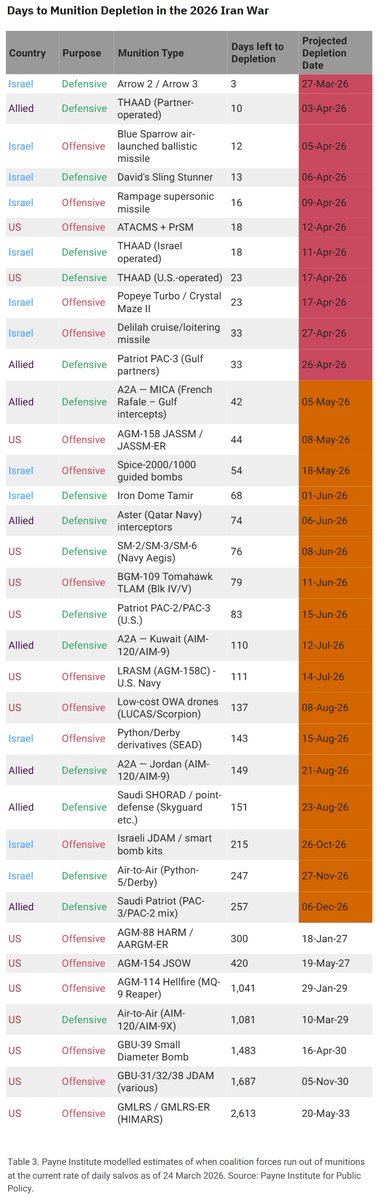
To compound the attacking coalitions problems, they are already running low onf the very powerful ammunition they put such store in. A new report from the Royal United Services Institute for Defense and Security warns that Israel has used most of its Arrow 2 and 3 interceptors, while U.S. THAAD missiles protecting Gulf allies are heavily depleted.

previous report from The Foreign Policy Research Institute (FPRI) and the Payne Institute also identified critical shortages in 14 of the 35 munitions used in Iran after just the first 96 hours of fighting.

The Royal United Services Institute for Defence and Security estimates that Israel has already fired 80% of its Arrow 2 and Arrow 3 interceptors, 54% of its David’s Sling missiles, and 45% of the American-made THAAD interceptors it operates. By contrast, only 20% of Iron Dome interceptors have been used. The institute estimates that 60% of the THAAD missiles deployed to protect Gulf states from Iranian attacks have already been expended.

Israel’s stockpiles of offensive weapons remain in better shape; for instance, only half of its Rampage missiles have been launched, Haaretz reports.

Israel’s interception capabilities are finite and cannot match the rate at which Iran is launching missiles at Israel and the Gulf states. Each Arrow interceptor costs between $2mn and $3mn, limiting how many Israel can afford. The cost of the missiles and the size of the stockpile — which cannot be expanded quickly — put a mathematical limit on how long the war can run using the current mix of weapons and methods.

The institute estimates that it could take the United States up to five years to restore its Tomahawk missile reserves.

IDF sources responded last week to reports suggesting Israel’s interceptor stockpiles are running low, but did not give any details.

In addition to running short of interceptors, Iran’s latest missiles have received a technological upgrade and have proven able to evade interceptors and hit their targets. All 13 of the US Gulf bases have been badly damaged by Iranian strikes, and most are now largely without staff.
IDF under pressure
Israel’s military leadership has warned the government that after roughly 900 days of near-continuous conflict, the army is approaching a breaking point. In remarks delivered to ministers, the IDF Chief of Staff set out a picture of a force stretched across too many fronts, with too few people, and no clear relief in sight.

Reservists are now deployed simultaneously across Gaza, Lebanon, Syria, the West Bank and, increasingly, in preparation for a direct confrontation with Iran. Senior IDF officials have warned of a “manpower crisis” as repeated call-ups stretch the system beyond its design limits. What was once a surge force has become a standing one. The system was not designed for that.

At the same time, a structural gap remains unresolved. No ultra-Orthodox conscription law has been passed, leaving thousands effectively outside the draft. Israeli defence officials have warned that without changes to conscription policy, “the model will not hold”. The political compromise that sustained this arrangement in peacetime is colliding with wartime reality.

Pressure is also being generated internally. The cabinet’s decision to legalise dozens of additional outposts and farms in the West Bank has created new security obligations, each requiring troops on the ground. Parallel to this, a rise in Jewish nationalist violence in the territory has already forced the deployment of an additional battalion, with the prospect of more to follow. Military officials have described the current operational tempo as “unsustainable over time”.

And then there is a manpower problem. Mandatory service is set to fall to 30 months from January 2027, moving in the opposite direction to the military’s request to extend it to 36 months. Fewer soldiers, staying for less time, entering a system already under strain. Former and current officials have warned of an “erosion of readiness” if forces remain continuously deployed.

Key legislation covering conscription, reserve mobilisation and service length has been delayed, in large part due to tensions surrounding exemptions for the Haredi community. The issue has been described internally as “no longer tenable in wartime conditions”. The result is a widening gap between operational demand and legal supply. The commitments are expanding faster than the force that sustains them.

The warning from the Chief of Staff is stark: without a reduction in operational scope, the system will begin to fail under its own weight.


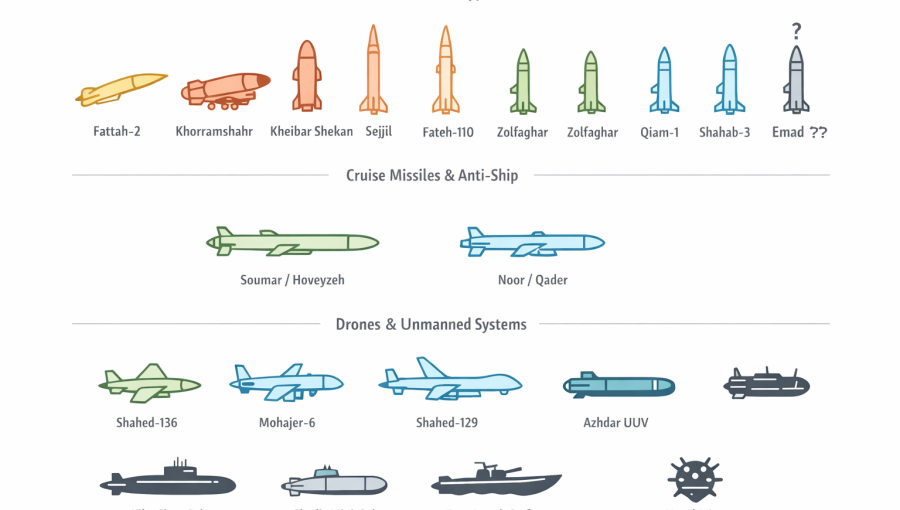
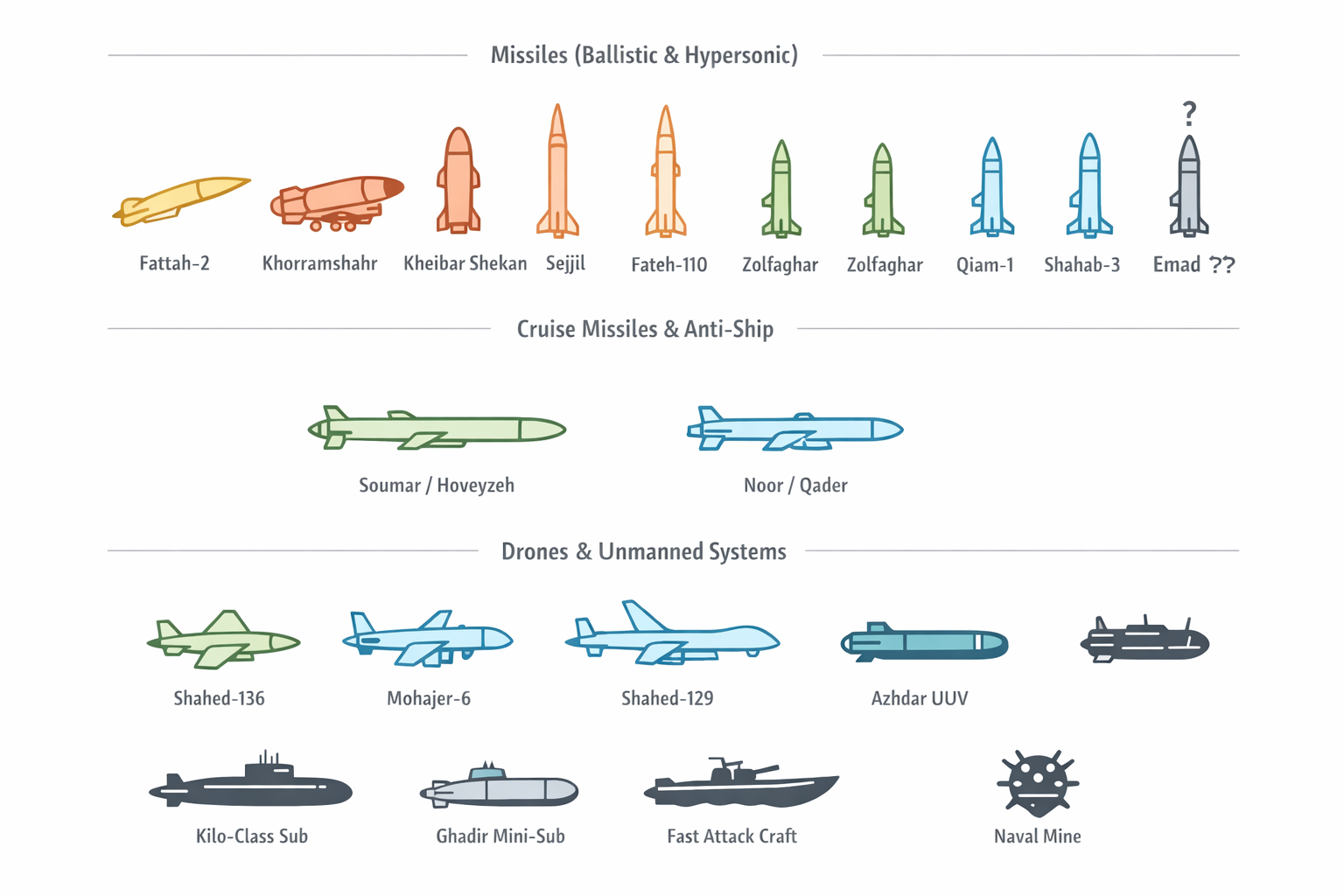
Selected leading Iranian weapons systems

Missiles (ballistic and hypersonic)

Fattah-2 hypersonic missile: Iran’s Fattah-2 is presented as a next-generation hypersonic system designed to evade air defences through high speed and manoeuvrability, using a glide vehicle that can adjust its trajectory in flight.

Khorramshahr intermediate-range ballistic missile (IRBM): A heavy missile capable of carrying a 2-tonne cluster munition warhead, prioritising payload over precision and designed for high-impact strikes over intermediate ranges.

Kheibar Shekan: Unveiled in 2022, this newer-generation ballistic missile carries a one-tonne warhead and reflects a shift towards greater accuracy and mobility.

Sejjil missile: A solid-fuel ballistic missile offering faster launch times and greater survivability compared with liquid-fuel systems, forming part of Iran’s more modern strategic capability.

Fateh-110 family: A highly accurate, short-range ballistic missile and one of the most widely used systems in Iran’s arsenal, forming the backbone of its regional strike capability.

Zolfaghar: An extended-range variant of the Fateh family, with a range of around 700km, designed for precision strikes and used in operational deployments.

Qiam-1: A liquid-fuel missile derived from Scud designs but modified for greater efficiency, notably lacking stabilising fins, and used in several real-world strikes.

Shahab-3: One of Iran’s earliest medium-range ballistic missiles, with a range of up to 2,000km, forming a core part of its long-standing deterrent despite being less advanced.

Emad missile: An upgraded version of the Shahab-3 with improved guidance systems, marking a transition towards more precise targeting capabilities.

Nasrallah system missile: A newly identified system reportedly used in a strike on the Haifa refinery in Israel, signalling continued development of Iran’s strike arsenal, though details remain limited.


Cruise missiles and anti-ship systems

Soumar / Hoveyzeh cruise missiles: Long-range land-attack cruise missiles, believed to be derived from older Soviet designs, capable of flying at low altitude and evading radar.

Noor / Qader anti-ship missiles: Key components of Iran’s naval strategy, designed to target vessels in the Gulf and the Strait of Hormuz, reinforcing its ability to threaten maritime traffic.

Drones and unmanned systems

Shahed-136 MS series: A loitering munition equipped with an improved eight-channel, jam-resistant satellite navigation system known as Nasir, reflecting upgrades made following recent conflicts.

Mohajer-6: A surveillance and strike drone capable of carrying precision-guided munitions, widely used in regional operations.

Shahed-129: A longer-range unmanned aerial vehicle designed for reconnaissance and strike missions, comparable in role to US Predator-type systems.

Azhdar underwater drone: An unmanned underwater vehicle intended for reconnaissance and potential attacks on maritime infrastructure, forming part of Iran’s asymmetric naval toolkit.

Naval platforms and asymmetric warfare

Kilo-class submarines: Russian-built diesel-electric submarines known for their relative stealth, providing Iran with a conventional undersea warfare capability.

Ghadir mini-submarines: Smaller, domestically produced submarines optimised for shallow waters, suited to ambush tactics and operations in the Gulf.

Fast attack craft (IRGC Navy): Small, heavily armed boats designed for swarm tactics, central to Iran’s strategy for confronting larger naval forces in confined waters.

Naval mines: A critical but often overlooked capability, allowing Iran to disrupt shipping lanes and potentially close chokepoints such as the Strait of Hormuz.

Beyond Technology: The ‘Way Of War’ In The Iran Conflict – Analysis


March 28, 2026 
 Observer Research Foundation
By Rahul Rawat


The ongoing US-Israel-led military operation against Iran has expanded significantly both in terms of the scope of battlefield operations and strategic objectives of the war. What began as a short-term, decisive, high-intensity operation by the Trump administration has now lasted for three weeks. The conflict has observed the use of a diverse set of military capabilities, predominantly modern technology, adding a degree of sophistication to conventional military power.

However, military power is an aspect of military strategy characterised by an interplay of means, ways, and ends. To secure the ends, it is important to get both means (capabilities) and ways (organised application) right. The Iran war shows that the ‘way of war’ is critical for determining and subsequently framing the engagement in relation to the nature of the adversary. The US military’s Operation Epic Fury and Iran’s subsequent response demonstrate that technological superiority alone does not guarantee strategic victory. But how states organise capabilities and employ military power as a subset of military strategy helps determine decisive victory (beyond the battlefield).
Differing Battlefield Technologies and Targeting

The US-Israel front, as part of an ongoing military contestation, has observed demonstrations of costlier and more sophisticated technological systems on the battlefield. On the other hand, Iran, drawing lessons from the 12-Day War, has framed a relatively time-sensitive and asymmetric counter-response. Iran has translated the lessons to use military technologies for attrition and tilt the overall cost economics of war against the US interests.

On the battlefield, drones have been central to the debate over their effects, tilting the balance of power in favour of the aggressor. There is a clear shift in the use of drones from the ‘War on Terror’ era, thanks to lessons learnt from the Ukraine war. The US deployed the Low-Cost Uncrewed Combat Attack System(LUCAS) as a solution; however, it remains a short-term measure against the cost-effective and scalable Shahed drones. Iran has developed the ecosystem of Shahed drones and cluster munitions to traffic as well as infiltrate the US and Israeli air defence mechanisms.


Specifically, a Shahed-136 costs a fraction of a cruise missile or ballistic missile, between US$20,000 and US$50,000 per unit, has a range of up to 2,000 kilometres, and has precision guidance. The Iranian drone element carries an element of precision mass to cater to the changing character of warfare. Through targeted drone attacks, the Iranian military has reduced the cost of offence for maintaining its campaign cost while simultaneously raising the cost of defence for the US and Israel (led partners).

Even though most of the drones have been intercepted at a decent rate of 80-85 percent, Iran’s use of drones with a few ballistic missiles has been able to strain the resources as well as hit targets in Israel, the US military and its allies in the region. The cost of interception for the US-Israel front through the use of costlier Patriot-like systems multiplies exponentially against cheap Shahed drones and relatively inexpensive ballistic missiles based targeting by Iran. Washington, in other words, despite its lead in developing and deploying sophisticated capabilities, lacks low-cost, increasingly autonomous drones for surveillance and short- and long-range strikes.

Figure 1: The extensive US and Israeli strikes on Iranian Retaliatory Capabilities

Source: ISW


The US and Israel have hit targets, including those inside Iran, with both precision and depth. It has degraded Iranian capabilities to a substantial extent but has not eliminated its bases of power. On the other hand, the US military’s long-range vector power, along with the associated cost elements (as shown in Figure 2 below) and industrial base production capabilities to scale products, has emerged as a serious limitation.

Figure 2: Estimated Munitions Usage (figures in USD millions)
Source: CSIS

Finally, Iran has relied on the Chinese BeiDou network for real-time military targeting. The US military, through its cyber operations and the deployment of AI, has enabled real-time targeting and prioritisation across a range of assets. Primarily, the US military has been using AI to support decision-making purposes. This element has remained the key advantage of the US military, not just in capabilities but also in how it has adopted and integrated AI into its doctrinal and warfighting philosophy.
Differing Ways of War

The way of war is determined by how military power is organised and employed to achievethe objectives in a conflict. The US-Israel and Iranian ways of war differ in several ways.


First, the US-Israel war against Iran is centred not on Iran’s intentions but its potential to enhance its ballistic missiles and nuclear capabilities. To this end, the conflict has showcased the decapitation strikes against the apex leadership and precision-based targeting of missile facilities across the geographical expanse of Iran. Iran, however, is not Venezuela and is in a war for (regime) survival against the US-Israel-led united front. Unlike the 12-Day War, Iran framed a quick response and so far, has relied on vertical as well as horizontal escalation-based response against the US and Israel-led military front.

Second, Trump-led American military thinking is premised on hitting hard to deliver a decisive blow against the adversary. This thinking also stems from an overreliance on technological superiority, however, this approach to warfare faces a challenge with the threat of attrition to the US military. Iran, on the other hand, has, since day one, adopted calibrated retaliation to spiral escalation against its adversaries.

Third, apart from the use of force backed by technological capabilities, the US could not secure clear support from its partners in the Middle East and the Western Hemisphere. This takes the form of higher costs on the battlefield and beyond, as fissures emerge in political support for the US-led military operations. To this end, Tehran has led a war of attrition by widening and deepening the conflict by targeting Israel as well as the US military assets in the Middle East region.

Fourth, against a multi-domain US military-led operation against the political regime, Iran, in the aftermath of the death of Ayatollah Khamenei, made a swift transition from a ‘unity of command’ to a ‘unity-of-effort’ led model. This model created multiple yet simultaneous decision-making centres, enabling the IRGC to continue warfighting while divesting resources and diluting the focus of its adversaries.

Fifth, the US had to ensure there was no geographical spillover of the conflict, as it would hurt the interests of its partners and allies in the region and beyond. To this end, the Iranian blockade of the Strait of Hormuz was an ultimate test of resolve, pressuring the US to the point of reaching out to its European allies without any credible commitments in return.

Sixth, the determined use of military power by the US amid its maximalist, shifting strategic goalposts, over time, has made it difficult to claim a decisive victory against Iran. On the other hand, Tehran has so far maintained internal cohesion, which has supported its resilience and will to fight the US-Israel-led military alliance. For Iran, in a war of survival, prolonging the military conflict and denying the US victory through ‘regime change’ becomes no less than a strategic victory for Iran.

The above factors reveal that, while rapidly evolving military technology offers advantages, it has encountered limitations in achieving strategic objectives due to differing ‘ways of warfare’. Iran is fighting for regime survival and its significance in an emerging regional order in the Middle East. Military technology has not enabled the surrender of the adversary or a decisive victory for the US military.
Conclusion

Notwithstanding the potential and demonstrable effects of battlefield technologies, the Iran war shows that differing ways of war remain critical in the conduct of war and in decisive outcomes. This war is yet to push Iran to surrender and present a decisive victory to its adversaries. Herein, the limitations of military technology and power are reflected against the lack of a way of war towards the strategic endgame. Iran has targeted the US military assets with an expanding targeting list to bring a second-order coercion to bear on the US’s allies and partners in the Middle East. The expansion of territorial and political limits of war has led the European and Indo-Pacific allies to lend support to the Trump administration-led conflict against Iran. Iran’s staggered use of drones and missiles amid a prolonged war, with some reserve of capabilities, is likely to be meant to gain political momentum in the war.


For the US, a decisive end to the conflict seems elusive from the battlefield viewpoint, along with the goal of regime change. However, the sustainment of attrition and the will to fight by either party would become influential factors in concluding the conflict on terms and conditions of their choosing. Whether and to what extent the war against Iran to degrade its nuclear and ballistic missile programmes would put a stop to Tehran’s long-term ambitions remains a dilemma for the Western technology-fueled military power. The drivers of real change on the battlefield to yield strategic outcomes lie more in doctrine, warfighting culture, and operational concepts, not in tech gadgets. The bottom line is that technology remains only an enabler and cannot, by itself, become the way of warfare.


About the author: Rahul Rawat is a Research Assistant with the Strategic Studies Programme at the Observer Research Foundation.


Source: This article was published by the Observer Research Foundation.

Observer Research Foundation

ORF was established on 5 September 1990 as a private, not for profit, ’think tank’ to influence public policy formulation. The Foundation brought together, for the first time, leading Indian economists and policymakers to present An Agenda for Economic Reforms in India. The idea was to help develop a consensus in favour of economic reforms.


Explained: U.S. Policy Toward Lethal Autonomous Weapon Systems


March 28, 2026 
CRS 
The Congressional Research Service 
By Kelley M. Sayler

Lethal autonomous weapon systems (LAWS) are a special class of weapon systems that uses sensor suites and computer algorithms to independently identify a target and employ an onboard weapon system to engage and destroy the target without manual human control of the system. Although these systems are not yet in widespread development, it is believed they would enable military operations in communications-degraded or -denied environments in which traditional systems may not be able to operate.

Contrary to a number of news reports, U.S. policy does not prohibit the development or employment of LAWS. Although senior Department of Defense (DOD) officials have not publicly confirmed whether the United States is developing or has developed LAWS, they have stated that the United States may be compelled to develop the systems if U.S. competitors choose to do so. (DOD is now “using a secondary Department of War designation,” under Executive Order 14347 dated September 5, 2025.) At the same time, a growing number of states and nongovernmental organizations are appealing to the international community for regulation of or a ban on LAWS due to ethical concerns.

Developments in both autonomous weapons technology and international discussions of LAWS could hold implications for congressional oversight, defense investments, military concepts of operations, treaty-making, and the future of war.

U.S. Policy

Then-Deputy Secretary of Defense Ashton Carter issued DOD’s policy on autonomy in weapons systems, Department of Defense Directive (DODD) 3000.09 (the directive), in November 2012. DOD has since updated the directive—most recently in January 2023.


Definitions. There is no agreed definition of lethal autonomous weapon systems that is used in international fora. However, DODD 3000.09 provides definitions for different categories of autonomous weapon systems for the purposes of the U.S. military. These definitions are principally grounded in the role of the human operator with regard to target selection and engagement decisions, rather than in the technological sophistication of the weapon system.

DODD 3000.09 defines LAWS as “weapon system[s] that, once activated, can select and engage targets without further intervention by a human operator.” This concept of autonomy is also known as “human out of the loop” or “full autonomy.” The directive contrasts LAWS with human-supervised, or “human on the loop,” autonomous weapon systems, in which operators have the ability to monitor and halt a weapon’s target engagement. Another category is semi-autonomous, or “human in the loop,” weapon systems that “only engage individual targets or specific target groups that have been selected by a human operator.” Semi-autonomous weapons include so-called “fire and forget” weapons, such as certain types of guided missiles, that deliver effects to human-identified targets using autonomous functions.

The directive does not apply to autonomous or semi-autonomous cyberspace capabilities; unarmed platforms; unguided munitions; munitions manually guided by the operator (e.g., laser- or wire-guided munitions); mines; unexploded explosive ordnance; or autonomous or semi-autonomous systems that are not weapon systems, nor subject them to its guidelines.


Role of human operator. DODD 3000.09 requires that all systems, including LAWS, be designed to “allow commanders and operators to exercise appropriate levels of human judgment over the use of force.” As noted in an August 2018 U.S. government white paper, “‘appropriate’ is a flexible term that reflects the fact that there is not a fixed, one-size-fits-all level of human judgment that should be applied to every context. What is ‘appropriate’ can differ across weapon systems, domains of warfare, types of warfare, operational contexts, and even across different functions in a weapon system.”

Furthermore, “human judgment over the use of force” does not require manual human “control” of the weapon system, as is often reported, but rather broader human involvement in decisions about how, when, where, and why the weapon will be employed. This includes a human determination that the weapon will be used “with appropriate care and in accordance with the law of war, applicable treaties, weapon system safety rules, and applicable rules of engagement.”

To aid this determination, DODD 3000.09 requires that “[a]dequate training, [tactics, techniques, and procedures], and doctrine are available, periodically reviewed, and used by system operators and commanders to understand the functioning, capabilities, and limitations of the system’s autonomy in realistic operational conditions.” The directive also requires that the weapon’s human-machine interface be “readily understandable to trained operators” so they can make informed decisions regarding the weapon’s use.

Weapons review process. DODD 3000.09 requires that the software and hardware of covered semi-autonomous and autonomous weapon systems, be tested and evaluated to ensure they

Function as anticipated in realistic operational environments against adaptive adversaries taking realistic and practicable countermeasures, [and] complete engagements within a timeframe and geographic area, as well as other relevant environmental and operational constraints, consistent with commander and operator intentions. If unable to do so, the systems will terminate the engagement or obtain additional operator input before continuing the engagement.


Systems must also be “sufficiently robust to minimize the probability and consequences of failures.” Any changes to the system’s operating state—for example, due to machine learning—would require the system to go through testing and evaluation again to ensure that it has retained its safety features and ability to operate as intended. The directive also notes that “the use of AI capabilities in autonomous or semi-autonomous systems will be consistent with the DOD AI Ethical Principles.”

Senior-level review. In addition to the standard weapons review process, a secondary senior-level review is required for covered autonomous and semi-autonomous systems. This review requires the Under Secretary of Defense for Policy (USD[P]), the vice chairman of the Joint Chiefs of Staff (VCJCS), and the Under Secretary of Defense for Research and Engineering (USD[R&E]) to approve the system before formal development. USD(P), VCJCS, and the Under Secretary of Defense for Acquisition and Sustainment (USD[A&S]) must then approve the system before fielding. In the event of “urgent military need,” this senior-level review may be waived by the Deputy Secretary of Defense. DODD 3000.09 additionally establishes the Autonomous Weapon System Working Group—composed of representatives of USD(P); USD(R&E); USD(A&S); DOD General Counsel; the Chief Digital and AI Officer; the Director, Operational Test and Evaluation; and the chairman of the Joint Chiefs of Staff—to support and advise the senior-level review process.

Congressional notification. Per Section 251 of the FY2024 National Defense Authorization Act (NDAA; P.L. 118-31), the Secretary of Defense is to notify the defense committees of any changes to DODD 3000.09 within 30 days. The Secretary is directed to provide a description of the modification and an explanation of the reasons for the modification. Section 1066 of the FY2025 NDAA (P.L. 118-159) additionally requires the Secretary to “submit to the congressional defense committees a comprehensive report on the approval and deployment of lethal autonomous weapon systems by the United States,” annually through December 31, 2029. Section 1061 of the FY2026 NDAA (P.L. 119-60) amends the U.S. Code to require congressional notification of any waiver issued under DODD 3000.09.
International Discussions of LAWS

Since 2014, the United States has participated in international discussions of LAWS, sometimes colloquially referred to as “killer robots,” under the auspices of the United Nations Convention on Certain Conventional Weapons (UN CCW). In 2017, these discussions transitioned from an informal “meeting of experts” to a formal “Group of Governmental Experts” (GGE) tasked with examining the technological, military, ethical, and legal dimensions of LAWS. The GGE has considered proposals by states parties to issue political declarations about LAWS, as well as proposals to regulate them. Relatedly, on November 9, 2023, the State Department issued the “Political Declaration on Responsible Military Use of Artificial Intelligence and Autonomy,” with 58 states endorsing the declaration, as of November 27, 2024.

In addition, approximately 30 countries and 165 nongovernmental organizations have called for a preemptive ban on LAWS due to ethical concerns, including concerns about operational risk, accountability for use, and compliance with the proportionality and distinction requirements of the law of war. The U.S. government does not currently support a ban on LAWS and has addressed ethical concerns about the systems in a March 2018 white paper, “Humanitarian Benefits of Emerging Technologies in the Area of Lethal Autonomous Weapons.” The paper notes that “automated target identification, tracking, selection, and engagement functions can allow weapons to strike military objectives more accurately and with less risk of collateral damage” or civilian casualties.


Although the UN CCW is a consensus-based forum, the outcome of its discussions could hold implications for U.S. policy on lethal autonomous weapons.

Potential Questions for Congress

What is the status of U.S. competitors’ development of LAWS? Is the United States adequately investing in counter-autonomy capabilities?

To what extent, if at all, should the United States slow or accelerate its own development of LAWS?

How should the United States balance LAWS research and development with ethical considerations?

What, if any, restrictions should there be on DOD’s development or employment of LAWS (e.g., restrictions on the use of LAWS without human involvement)?

Are current weapons review processes and legal standards for LAWS sufficient?


About the author: Kelley M. Sayler, Specialist in Advanced Technology and Global Security
Source: This article was published by the Congressional Research Service (CRS)

The Congressional Research Service (CRS) works exclusively for the United States Congress, providing policy and legal analysis to committees and Members of both the House and Senate, regardless of party affiliation. As a legislative branch agency within the Library of Congress, CRS has been a valued and respected resource on Capitol Hill for nearly a century.

FUCKING STUPID!

Second attack on Iran’s Bushehr nuclear power station raises Chernobyl radiation cloud spectre

Second attack on Iran’s Bushehr nuclear power station raises Chernobyl radiation cloud spectre
A direct hit on Iran's Bushehr nuclear power plant raises the spectre of a Churnobly-like radioactive cloud drifting over several other Gulf states. / US House Foreign Affairs CommitteeFacebook
By Ben Aris in Berlin March 28, 2026

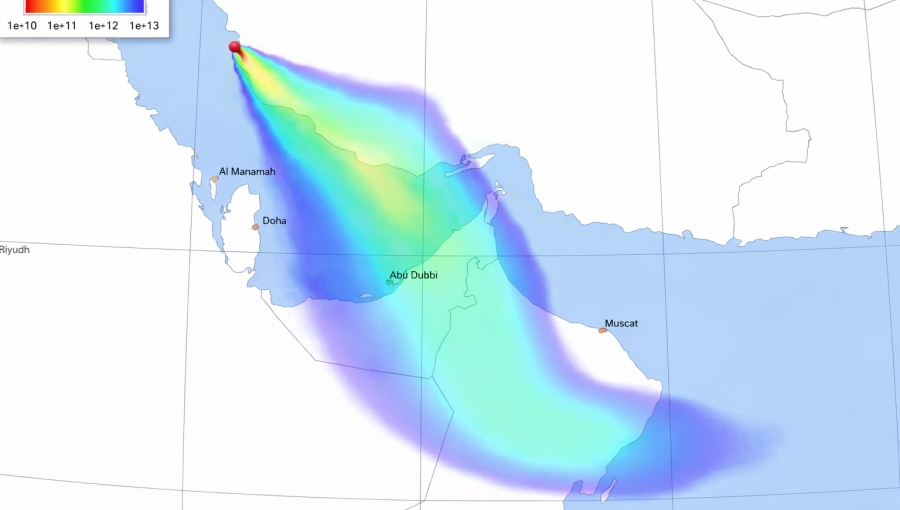
A second missile attack in the proximity to Iran’s Bushehr nuclear power plant (NPP) has raised the spectre of a Chernobyl-like cloud of radiation drifting over the Gulf region, making some countries uninhabitable for decades and poisoning the water in the Persian Gulf that would shut down many of the desalination plants that produce most of the region’s drinking water.

Israel struck at the nuclear power plant on March 18 with missiles landing 350m away from the main buildings, in what was seen as a warning shot at the time.

The International Atomic Energy Agency (IAEA) reported there was a second strike at the NPP on March 27, according to Iranian authorities, which said there was no damage to the operating reactor and no radiation release.

IAEA chief Rafael Grossi warned that any strike damaging a reactor could trigger a major radiological incident, urging “maximum military restraint.”

Experts warn that if Bushehr takes a direct hit, radioactive clouds could disperse beyond Iran’s borders. According to an internal emergency planning exercise prepared by Russian engineers that operate the plant, “the radiation would reach the UAE within 24 hours” and due to prevailing winds continue to cover most of Oman as well before heading out to sea.

A secondary danger is the radioactive fuel and cooling water could spill into the shallow Persian Gulf poisoning the sea water that the hundred-odd desalination plants along the shore use to provide most of the region with drinking water.

The Russian exercise modelled the trajectory and speed of a radioactive plume following a hypothetical major accident. The Persian Gulf’s prevailing wind patterns are a key factor in determining the direction and concentration of such a plume. “It is not the only possible trajectory, and other exercises show different trajectories, although they usually head across the Persian Gulf,” the Russian assessment says.

Bushehr, Iran’s only operational nuclear power plant, is located on the country’s southern coast, directly across the Gulf from several densely populated urban centres, especially in the UAE. In the event of a direct hit on Bushehr, Dubai, the UAE’s commercial capital, would probably empty out as it lies directly in the path of a possible radioactive plume. Doha, the capital of Qatar, would also probably see an exodus, as although it is not in the expected direct path, it is one of the closest capitals to Bushehr.

Bushehr puts sanctions Rosatom sanctions off limits

So far, the West has refrained from putting sanctions on Russia's nuclear business, which could force Rosatom from withdrawing from Bushehr.

Russia’s nuclear exports have been booming after it upgraded its technology from the failed RBK reactors of Chernobyl and uranium is the new gas, used by the Kremlin to create an energy dependence on Moscow amongst its power-hungry new friends in the Global South.

A US congressional briefing on March 12 warned that sanctions on Russia’s state nuclear corporation Rosatom could heighten safety risks at Iran’s Bushehr nuclear power plant by disrupting technical support and fuel supply arrangements critical to its operation.

In testimony submitted to the House Foreign Affairs Committee, Institute for Science and International Security President David Albright stated that Rosatom plays an ongoing role in ensuring the reactor’s safe functioning, including the provision and removal of nuclear fuel and specialised engineering services.

The document noted that any interruption could increase the likelihood of a meltdown at the reactor. Bushehr, a Russian-designed VVER reactor – its state-of-the-art design - located on Iran’s southern coast, depends on Russian expertise for maintenance and safety oversight as part of a 60-year supply and maintenance deal signed with Moscow.

Albright cautioned that sanctions targeting Rosatom without carve-outs for civilian nuclear cooperation could have “unintended consequences.” In the case of Bushehr, he indicated that a breakdown in cooperation could “increase the risk of an accident,” given the plant’s reliance on Russian technical assistance and fuel cycle management.

In particular, Russia is in charge of spent fuel removal and is a key non-proliferation and safety measure. Disruptions could lead to on-site accumulation of spent fuel, compounding both safety and security risks.


Hungarian government files criminal charges against investigative journalist who exposed Budapest-Moscow ties

Hungarian government files criminal charges against investigative journalist who exposed Budapest-Moscow ties
Szabolcs Panyi says espionage accusations against an investigative journalist were unprecedented in an EU country. / YouTube/Klubradio
By bne IntelliNews March 27, 2026

The Hungarian government has filed criminal charges against investigative journalist Szabolcs Panyi, accusing him of spying in cooperation with foreign intelligence services, state news agency MTI reported on March 26, citing the weekly press briefing by Gergely Gulyas, the minister heading the Prime Minister's Office. On another controversial issue, Gulyas accused Tisza Party IT experts who uncovered a covert intelligence operation against the opposition party of spying for Ukraine.

Hungary's domestic politics have been boiling in the final leg of the pre-election campaign, with fresh scandals emerging daily. Last weekend, the Washington Post revealed, citing EU intelligence sources, that Russia's SVR considered staging an assassination attempt against Prime Minister Viktor Orban to tilt the election in his favour.

European security officials also told the Washington Post that Foreign Minister Peter Szijjarto regularly conferred with his Russian counterpart before and after EU meetings to exchange updates and discuss policy. Szijjarto acknowledged coordinating with Sergei Lavrov but dismissed reports alleging wrongdoing, denied sharing sensitive information, and rejected any suggestion of interfering in other countries' domestic policies, insisting it was part of normal diplomacy.

A few days after the report, Panyi, working for Vsquare and Direkt36, published transcripts of a February 2020 conversation between the two, in which Hungary's chief diplomat was lobbying for a meeting between then Slovak prime minister Peter Pellegrini and Russian Prime Minister Mikhail Mishustin to boost the electoral chances of Slovakia’s Smer-SD party, an ally of Orban.

The release came just after a wiretapped conversation appeared on pro-government media in which Panyi is heard talking to one of his sources inquiring about phone numbers used by the foreign minister.

The journalist explained that he wanted to verify whether Szijjarto was using a secret third device for sensitive exchanges with Moscow, while the government framed the incident as evidence that the investigative journalist was working with foreign intelligence services and providing them with Szijjarto's phone numbers, a rather dubious claim.

Orban called on his justice minister to launch an investigation, describing the wiretapping of the foreign minister as a serious breach, accusing Panyi without naming him.

Years ago, Panyi was targeted with Pegasus spyware, used by Hungarian authorities against journalists, lawyers, and opposition figures.

Responding to comments by Gulyas, Panyi said the espionage accusations against an investigative journalist were unprecedented in an EU country, calling the situation comparable to Russia or Belarus. He denied cooperating with any foreign intelligence services and said the Hungarian government lacks independent institutions capable of investigating high-level official espionage.

He also declined to publicly disclose his sources, citing journalistic source protection. Panyi, who has spent over a decade investigating Russian influence in Hungarian politics, vowed to release further evidence of collaboration between the Hungarian political elite and Moscow and said the Szijjarto-Lavrov files were just the "tip of the iceberg”.

In a fresh Facebook post, he wrote that his ongoing research since 2016-2017 suggests that large sums of cash and precious stones may have been transported from Russia to Hungary on government and private aircraft. He said that at least six foreign officials had confirmed these operations, and noted that the intelligence reports did not originate from surveillance of Hungarian targets or infrastructure, but from intercepted communications of Russian officials or logistical personnel.

The Hungarian government is also facing serious allegations in another high-profile case that it deployed its intelligence services against the Tisza Party in 2024-2025, according to Telex.hu.

Bence Szabo, a senior investigator at the Cybercrime Department of the National Bureau of Investigation (NNI), told Direkt36 in a lengthy interview that his team came under pressure from Hungary's domestic intelligence agency (AvH) overseen by Fidesz strongman Antal Rogan, during an investigation into two people working on the Tisza Party's IT team.

The inquiry began following an anonymous tip in July 2025 alleging the men were involved in child pornography. While those allegations proved baseless, the investigation uncovered hundreds of communications between the two and an unknown individual.

Investigators were reportedly prevented from pursuing evidence against unidentified operatives who allegedly attempted to infiltrate the Tisza Party to sabotage its IT infrastructure through blackmail or financial inducements. Szabo said intelligence services applied pressure to derail the police investigation.

The anonymous tip coincided with the day the two Tisza Party associates had planned to deploy a hidden camera to expose the operatives, which, according to Szabo, confirms they had been under surveillance throughout the period when recruitment attempts were made. 

After the video interview was published, police carried out searches at Szabo's workstation and home, he was questioned as a suspect for abuse of office. He said he had submitted his resignation but remained in the police force at the time of the interview.

At the press briefing, Gulyas accused the Tisza IT people of working for Ukraine, insisting they had been trained abroad and were "constantly in and out of the Ukrainian embassy”.

Espionage activities had picked up ahead of the Hungarian parliamentary election, he said, calling on Ukraine and President Volodymyr Zelenskiy to "stop state-sponsored espionage in the Hungarian election campaign”. This echoed a similar message from the prime minister, as the government is resorting to playing the Ukraine card.

Opposition leader Peter Magyar called the intelligence operation the biggest scandal since the regime change and compared it to Watergate. He warned the government that if any harm comes to Bence Szabo, whom he called a hero, it will have to answer to the Hungarian people. 

In a video, Magyar claimed that Hungary’s intelligence services deployed Candiru in its latest operation, an Israeli spyware program, of the most sophisticated spyware tools available, known for its advanced surveillance capabilities, Nepszava writes.


Researchers move closer to preventing pandemics


Researchers have developed an AI tool that can help determine whether unfamiliar bacteria carry genetic features linked to disease. By enabling the detection of harmful bacteria before they infect humans, this could transform pandemic preparedness


Technical University of Denmark

Alfred Ferrer Florensa and the Bacterial pathogenic Landscape 

image: 

Alfred Ferrer Florensa and the Bacterial pathogenic Landscape. Photo: Lene Hundborg Koss.

view more 

Credit: Lene Hundborg Koss.


Researchers have developed an AI tool that can help determine whether unfamiliar bacteria carry genetic features linked to disease. By enabling the detection of harmful bacteria before they infect humans, this could transform pandemic preparedness. Researchers have developed an AI tool that can help determine whether unfamiliar bacteria carry genetic features linked to disease. By enabling the detection of harmful bacteria before they infect humans, this could transform pandemic preparedness.

PathogenFinder2 is a new AI tool developed by researchers at DTU in Denmark, in collaboration with international partners, to determine whether an unfamiliar bacterium possesses genetic characteristics associated with the ability to cause disease. The research has been published in Bioinformatics, one of the world’s leading journals in bioinformatics and computational biology. The research could significantly strengthen pandemic preparedness.

“The purpose of PathogenFinder2 is not only to characterise bacteria already known to be associated with disease, but also to assess the potential threat posed by new bacteria, even before the first infection has emerged. This could give authorities better opportunities to prevent outbreaks rather than simply reacting to them,” says Professor Frank Møller Aarestrup, Head of the Research Group for Genomic Epidemiology at the DTU National Food Institute.

The new AI tool forms part of the Global Pathogen Analysis Platform (GPAP) and is publicly available as a free online service.

“PathogenFinder2 can be used to investigate sewage, healthy humans and animals, and identify bacteria with pathogenic potential before they have caused their first infection, providing a basis for developing tests, vaccines, and treatments much earlier,” says researcher Alfred Ferrer Florensa, who carried out his PhD project on PathogenFinder2 at the DTU National Food Institute.

Why identifying risky bacteria is difficult

Most bacteria around us are harmless, and many support human health by aiding digestion, protecting the skin, or contributing to food production. Yet a small fraction can cause serious infections.

Climate change, expanding ecosystems, and growing exploration of microbial diversity mean that researchers are encountering more bacterial species than ever before, including many with no prior documentation. Assessing which of these may pose a risk is therefore a growing challenge.

Determining whether a bacterium can cause disease traditionally requires laboratory experiments that are slow, expensive, and often inconsistent. Computational approaches have helped speed up this process, but most rely on comparing a new organism to known pathogens, a method that breaks down when no close relatives exist.

“It was essential not only to make accurate predictions about bacterial threats resembling those we already know, but also to be prepared for the emergence of a completely new and previously unknown disease-causing bacterium,” says Alfred Ferrer Florensa.

What PathogenFinder2 does differently

PathogenFinder2 introduces a fundamentally new strategy. Instead of relying on similarity to known species, the model uses protein language models, advanced AI systems trained on millions of protein sequences. Much as text prediction tools learn patterns in human language, these models learn the language of proteins, allowing them to detect biochemical signals that traditional approaches miss.

“PathogenFinder2 is one of the first models to interpret whole bacterial genomes by leveraging the massive potential of language models. It performs significantly better than all previous models, particularly when it encounters bacterial species we have never seen before. In addition, it provides explanations for its predictions,” says PhD Alfred Ferrer Florensa.

The researchers emphasise that the model can identify interesting patterns and potential risks, but the results must be further examined before any final conclusions can be drawn.

Understanding why a bacterium looks risky

PathogenFinder2 does more than produce a prediction. It highlights the specific proteins that most strongly influence its assessment.

These may include known virulence factors, such as toxins or attachment structures (features that help bacteria attach to human cells), as well as completely uncharacterised proteins that could play a role in disease.

This interpretability provides new avenues for research into diagnostics, vaccine targets, and mechanisms of infection, including proteins not previously linked to disease.

A map of bacterial disease potential

Using protein language models to represent full genomes also enabled the researchers to build the first Bacterial Pathogenic Capacity Landscape, a map showing how thousands of bacteria relate to one another based on their disease-linked features.

The landscape reveals clusters of bacteria that infect similar tissues or share metabolic strategies, offering a new way to explore microbial evolution and interactions.

“The Bacterial Pathogenic Capacity Landscape provides the first overview of all the disease‑causing bacteria that humans can be infected by. It reveals patterns and can, for example, show which bacteria tend to infect the same body sites or potentially rely on similar nutrients. This gives us new opportunities to investigate how bacteria evolve and interact,” says Alfred Ferrer Florensa.

Trained on 21,000 bacterial genomes

The researchers assembled the largest dataset to date of bacterial genomes with known disease-causing potential or known non-pathogenic behavior.

The dataset consisted of more than 21,000 bacterial genomes from international databases, including bacteria isolated from human infections, the healthy human microbiome, probiotic cultures, food production, and extreme environments, such as organisms capable of surviving in very hot or very cold conditions.

This gave the model a unique foundation for distinguishing between harmful and harmless bacteria, even when encountering previously undescribed species.

Read more

The study, entitled “Whole-genome prediction of bacterial pathogenic capacity on novel bacteria using protein language models with PathogenFinder2”, has been published in Bioinformatics.

The project is funded by the EU Horizon 2020 programme (grant 874735), the US National Institute of Allergy and Infectious Diseases under NIH (award U24AI183840), and the Novo Nordisk Foundation (grant NNF26SA0109818). It is also supported by the HPC RIVR Consortium and EuroHPC JU through access to computing resources.