Saturday, March 28, 2026

'One in 1,000': Gabon eco-rangers battle for baby sea turtles' survival against the odds

Despite sometimes going without wages for months at a time, Gabon's eco-rangers continue to patrol the African nation's beaches to protect the nests of sea turtles against seagulls, crabs and encroaching sea levels.


Issued on: 27/03/2026 - 
By: FRANCE 24

Gabon's 900 kilometres of coastline is home to four species of sea turtles. © Cyril Villemain, AFP


Small enough to fit in the palm of your hand, newly hatched sea turtles scramble across a 10-metre stretch of Gabonese beach to reach the waiting waves. Many don't make it.

"The survival rate for turtles is one in 1,000," François Boussamba, a Gabonese turtle expert and head of the NGO Aventures Sans Frontieres (Adventures Without Borders), told AFP, scouring for nests.

Conservationists from NGOs and the national parks agency patrol Gabon's beaches daily during the nesting season to protect the turtles' nests.

Those under threat are moved to a hatchery, a fenced enclosure near the sea, where the eggs are kept safe until they are ready to hatch.

Nests under threat are moved to a hatchery, a fenced enclosure near the sea, where the eggs are kept safe until they are ready to hatch. © Nao Mukadi, AFP


On Pongara National Park's white sandy beaches, about 30 minutes by boat from the capital Libreville, conditions are optimal for nesting: wild coastline, a favourable equatorial climate and an open ocean beach with gentle slopes, ideal for the females.

But danger is never far away. Nests are threatened by coastal erosion due to encroaching sea levels, or predators such as crabs and birds that prevent the eggs from reaching their 60-day incubation period, Boussamba said.

"The chances of survival are tiny," he said.

Hatching of baby turtles in south of France puzzles scientists
DOWN TO EARTH © FRANCE 24
04:58


Muscle up

In Libreville, every morning around 7am, volunteers from the Project Turtles Tahiti Gabon association crisscross the beach and check the nests in the hatchery.

After one has hatched, the baby turtles have to be moved so they can reach the sea – but they are never put straight into the water.

"They need to build up their muscles so they can swim in the ocean," volunteer Clémence said.

'If there are turtles, it means our ecosystem is sound and healthy,' said François Boussamba, a Gabonese turtle expert. © Nao Mukadi, AFP

Four species of turtles – green, olive ridley, hawksbill and leatherback – come to nest along Gabon's 900 kilometres of coastline from October to April.

It has the highest nesting density on the African continent, according to the US-based NGO Wildlife Conservation Society.

Gabon is the world's leading nesting site for the leatherback turtle, the largest of the species and listed as threatened by the International Union for Conservation of Nature (IUCN).


In addition to predators, sea turtles are also threatened by human activities, from plastic pollution to industrial fishing and poachers.

By watching over the eggs, the rangers in Pongara help ensure "the survival of this species", Edouard Moussavou, Pongara park's deputy director, said.
Unpaid wages

Since 2013, Gabon's conservation efforts had received funding from the United States, notably through the US Fish and Wildlife Service, an agency responsible for biodiversity.

"If there are turtles, it means our ecosystem is sound and healthy," Boussamba said.

But since the suspension of grants by the administration of US President Donald Trump, "turtle monitoring activities have stopped or slowed down drastically", Moussavou said.

"There will be fewer staff, less data, and that really creates difficulties for us," he said.

Additionally, there have been delays in paying the staff of the National Agency for National Parks (ANPN), which manages the country's 13 parks, according to Sosthene Ndong Engonga, secretary-general of the National Union of Gabonese Ecoguards.

The around 580 eco-rangers regularly go unpaid.

"Even when there is money, we have to make a big fuss to get our salaries," he said, adding he battled with the treasury last month for back pay.

The eco-rangers, who are crucial for the conservation of Gabon's biodiversity, face having "to give everything up", Engonga warned. "We have expenses we can no longer cover," he said.

Turtle nests are threatened by coastal erosion due to encroaching sea levels, or predators such as crabs and birds. © Cyril Villemain, AFP


On Pongara beach, 40-year-old Alain Banguiya carries out night patrols, hoping to see a leatherback turtle emerge from the water to lay her eggs in the sand.

An eco-ranger since 2015, he has not been paid for two months but says that giving up is out of the question.

"We have a duty to fight to the end, to keep our spirits up," he said. "Despite the obstacles, we stay the course: conservation."

(FRANCE 24 with AFP)
As high seas treaty takes shape, Galapagos proves that protection pays off

A global treaty designed to protect the high seas is entering a decisive phase, as countries meet in New York this week to work out how to turn it into action. At the same time, a real-world example in the Galapagos shows what effective ocean protection can look like – from cutting illegal fishing to protecting key migration routes for endangered species.


Issued on: 27/03/2026 - RFI


An aerial view of Sombrero Chino island in the Galápagos, part of a vast marine reserve where strict protections have helped reduce illegal fishing and safeguard migratory species. AP - Dolores Ochoa

For decades, vast areas of ocean beyond national borders have been governed by weak and fragmented rules. These waters – known as the high seas – cover nearly half the planet and support rich but fragile ecosystems.

That changed in January, when the High Seas Treaty – also known as the Biodiversity Beyond National Jurisdiction or BBNJ Agreement – came into force, creating the first global legal framework to protect marine life in international waters.

One of its main tools is the creation of marine protected areas – zones where human activity can be limited or banned so ecosystems can recover. Countries have set a target of protecting 30 percent of the ocean to tackle biodiversity loss.

But while the treaty is now in force, many of its institutions still need to be built. That is the focus of a preparatory meeting which began on Monday and runs until 2 April at the United Nations in New York.

This is expected to be the final preparatory session before the first Conference of the Parties – or Cop – which must be held by January 2027. The aim is to agree on how the treaty will work in practice.

Discussions include governance structures, a scientific body, funding mechanisms and rules of procedure. The International Union for Conservation of Nature, attending as an observer, says the goal is to ensure the system is operational and ready to take decisions from day one.

The stakes are high. Less than 1 percent of the high seas is currently protected, even as pressure from fishing, pollution and climate change continues to grow.

To see what real protection looks like, RFI spoke to two experts in the Galapagos – Susana Cárdenas from the University of San Francisco de Quito and Diana Vinueza from the WildAid Foundation.

RFI: Why was the decision made to expand the Galapagos reserve in 2022? What is the ecological value of this new reserve?

Susana Cárdenas: The scientific data are extremely important here. In the Pacific, there are important marine protected areas, but they are isolated. One of the main questions was connectivity – whether it was possible to extend the Galapagos marine reserve so that it would connect with other key areas, such as the protected area around Cocos Island in Costa Rica.

There is already scientific evidence showing that threatened migratory species use these corridors, especially between the Galapagos and Cocos Island. But they were not protected.

This includes hammerhead sharks, which are critically endangered, as well as sea turtles and several species of whale. That is the main reason the Hermandad reserve was created – to connect with the Bicentenario protected area around Cocos Island, in Costa Rica, which was created at the same time as Hermandad in Ecuador.

RFI: There are different levels of protection. Even in some marine protected areas, fishing is allowed, sometimes using very aggressive methods such as trawling or longline fishing. What is allowed and what is banned in the Hermandad reserve?

SC: The Hermandad marine reserve provides protection across 60,000 square kilometres. This means that no extractive activity can take place there, either artisanal or industrial.

In addition, there are two outer bands that provide another 30,000 square kilometres of protection, where only industrial purse-seine fishing is allowed because it causes fewer accidental catches than longline fishing.

RFI: What are accidental catches?

SC: Accidental catches happen when fishing gear catches not only the target species, for example tuna, but also other species that are not being targeted: sharks, seabirds and sea turtles. Longline fishing uses a line with thousands of hooks. This increases the mortality of threatened and endangered species.

A sea turtle glides through the Galápagos marine reserve, where protected waters help species feed, migrate and reproduce safely. ASSOCIATED PRESS - Manu Mielniezuk


RFI: To make sure these protected areas are not just “paper reserves”, there needs to be enforcement at sea. Can you explain how the monitoring software works, and how it supports Ecuador’s naval forces?

Diana Vinueza: We spent a long time looking for the most effective platform to monitor fishing activity, and we found the Themis platform, developed by a French company, CLS, based in Toulouse.

We have used it for nearly eight years to monitor both the Galapagos marine reserve and the Hermandad marine reserve. The platform shows maps on screen that let you see all the collaborative vessels navigating in the marine reserve.

Collaborative means these vessels are equipped with VMS, or Vessel Monitoring System, and AIS, or Automatic Identification System, which allow authorities to track them remotely. Ecuador’s fishing fleet is required to use them so it can be monitored by the relevant authority.

RFI: What does this tool look like in practice?

DV: It is a dynamic map viewed on a screen that allows you to observe maritime traffic crossing our exclusive economic zone.

Ocean’s survival hinges on finding the billions needed to save it

RFI: Do you sometimes detect suspicious vessels, or vessels engaged in activities they should not be carrying out, such as trawling?

DV: Yes, the platform allows us to observe vessel behaviour. In the case of industrial fishing, for example purse-seine fishing, a vessel’s average navigation speed is eight knots. But when it reaches fishing speed, it cuts its engines because it is drifting in order to carry out the fishing manoeuvre.

The platform helps us observe this kind of behaviour. It also sends alerts if a vessel enters an area where it has no right to go, which gives you intelligence to detect illegal activity, such as illegal fishing in the Hermandad marine reserve or the Galapagos marine reserve.

RFI: Are there still cases of boardings, or do vessels generally respect the rules?

DV: In 2010, when we began using satellite surveillance technology in the country and in the Galapagos marine reserve, that was the year we recorded the highest number of boardings and seizures of fishing vessels carrying out illegal activities.

Since 2010, logically, because they now know there is an authority watching, these activities have decreased enormously.

The country’s law, which was strengthened in 2015, has also helped us a great deal. If a vessel enters the Galapagos marine reserve, it can be fined 300, 5,000 or 10,000 dollars for entering a protected area where it should not be carrying out activities without justification.

Satellite surveillance platforms are therefore essential both to ensure people respect the rules and for enforcement. We work in the same way for the Hermandad reserve.

RFI: Can fishing vessels pass through the Hermandad reserve?

DV: Yes. Hermandad lies in an exclusive economic zone, in the Galapagos island region. We are signatories to the UN Convention on the Law of the Sea. We must grant the right of “innocent passage” to all vessels travelling through our exclusive economic zone.

RFI: Protecting the water also allows fish stocks to recover. There's what is known as a “spillover effect”, meaning fish stocks also increase in areas near marine reserves. This has been observed in the Mediterranean for lobster and in the Atlantic for cod. Has something similar happened in the waters around the Galapagos reserve?

DV: It has been proven that, thanks to the creation of this protected area in the Galapagos, fishing has been maintained in Ecuador, for example tuna fishing. This is the “spillover effect” generated by the protected area in the Hermandad marine reserve. It has allowed that area to maintain high fishing productivity.

Fishing activity is concentrated in an area known as the west of the Galapagos Islands, but outside the protected zone. They are there precisely because of everything the Galapagos does. Marine protected areas benefit fishers and guarantee food security for all the peoples of the planet. What Ecuador’s tuna fleet catches feeds the world.

This interview was adapted from the original version in French by Raphaël Morán.
France denies excluding South Africa from G7 summit under pressure from US

French officials have denied claims by the office of South Africa's President Cyril Ramaphosa's that France has excluded South Africa from the list of invitees to June's G7 leaders' summit in Paris under pressure from Washington, saying Kenya has been invited instead.


Issued on: 27/03/2026 - RFI

Presidents Macron and Ramaphosa at the G20 summit in Johannesburg in November 2025, during which France invited South Africa to join the G7 summit in Paris in June, according to Pretoria. © Ludovic Marin / AP

South Africa, a regular guest at previous G7 summits, said on Thursday that it had been excluded after initially being invited around two weeks ago, saying the US had threatened to boycott the summit if South Africa was invited.

"We've accepted the French decision and appreciate the pressure they've been subjected to," said Vincent Magwenya, a spokesperson for Ramaphosa, on Thursday.

But Ramaphosa backtracked a few hours later, saying according to "his information" there had been "no pressure from any country", whether the US or another.

French Foreign Minister Jean-Noël Barrot said that his country had “not yielded to any pressure” but had opted for a “streamlined G7”, inviting Kenya instead, given that France is holding a major Africa summit in Nairobi in May.

A White House official backed France's account, saying the decision to invite Kenya came after talks among G7 members. "We have not asked the French to exclude South Africa from the G7 summit," the official said, adding Washington "welcomes Kenya’s participation".

Strained US-South Africa relations

Relations between Washington and Pretoria have fractured over a range of issues, from South Africa’s genocide case against US ally Israel to President Donald Trump's discredited claims that white Afrikaners are being persecuted..

Trump also imposed 30 percent tariffs last year on most South African exports, though the US Supreme Court has since overruled his tariff policy.

Washington snubbed last year's G20 summit in Johannesburg and excluded South Africa from meetings of the G20 meetings, for which it holds the rotating presidency this year.

It was during last November's G20 summit that French President Emmanuel Macron personally invited Ramaphosa to take part in the G7, Pretoria recalled.

The Group of Seven industrialised nations often widens its work to other invited countries.

In addition to Kenya, France announced earlier that it will host the leaders of India, South Korea and Brazil at the summit to be held in Evian-les-Bains on 15-17 June.

“This will have no impact on the strength and close nature of our bilateral relationship with France,” presidency spokesperson Magwenya said.

“Notwithstanding all of these developments, South Africa remains committed to engage constructively with the US,” he said.

“The diplomatic relationship between the USA and South Africa predates the Trump administration and it will outlive the current White House term of office.”

(with newswires)
'Divide among MAGA men above and under 35': CPAC highlights generational GOP split


Issued on: 28/03/2026 - 


For the first time in nearly a decade, President Donald Trump did not attend one of the biggest annual meetings of conservatives. But even in his absence, the Conservative Political Action Conference revolved around him as well as the Iran war which has divided Trump supporters. "The real divide is among men above and under 35 years oid", said Todd Belt, professor and director of Political Management Program at George Washington University, citing a recent poll. Belt said men above 35 remain firm supporters of Trump while those younger no longer are. "It's breaking up the Republican Party," he added.

Video by: FRANCE 24


What I Saw in Cuba? Resilience

What I witnessed over those days was not the Cuba of Western propaganda. It was a country enduring a 66-year siege, and a people who, against all odds, continue to build, create, and care for one another.


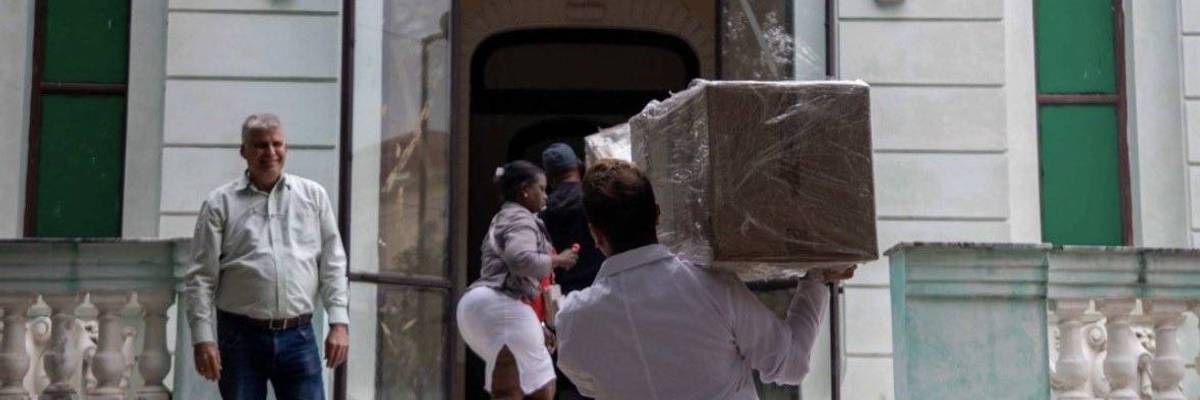
A medical worker carries a box of aid supplies delivered by the Nuestra America Convoy on March 18, 2026 in Havana, Cuba.
(Photo by the Progressive International)

Gerargo Delgado
Mar 28, 2026
Common Dreams


I traveled to Cuba this month. As a Cuban American, that sentence carries the weight of longing born of an estrangement from my roots. For much of my life, Cuba existed as a distant story, a place I knew only through descriptions from my father.

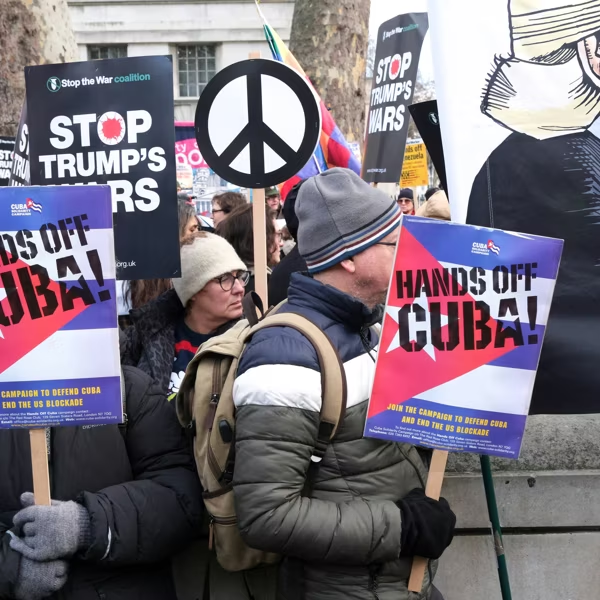
I was there as part of an international solidarity convoy; over 500 representatives from more than 30 countries, united by a simple conviction: No country has the right to strangle another simply because it chose a different path. I cannot stand by while the island of my family’s heritage is suffocated.


Cuban President Vows ‘Impregnable Resistance’ to Any Trump Attempt to Seize the Island

What I witnessed over those days was not the Cuba of Western propaganda. It was a country enduring a 66-year siege, and a people who, against all odds, continue to build, create, and care for one another.

A Public Health System Under Siege

One of the most profound visits was to a neighborhood polyclinic in Havana. These clinics are the backbone of Cuba’s public health system. Doctors live on the second floor, above where they work. They know every patient in their community by name. They treat physical and psychological health alike, and they embody a model of care that prioritizes people over profit.

I saw a people who are already free—free to define their own destiny, even under the weight of a siege designed to break them.

But the doctors I met face heartbreaking constraints. They are highly trained professionals who know exactly what their patients need, and they know those treatments exist. Due to the US embargo, they cannot access them. Imagine living every day with the skill to heal and being blocked by a political and economic siege.

We brought what we could: 6,300 pounds of medical supplies delivered by our delegation, including neonatal equipment, analgesics, catheters, and other critical materials, valued at $433,000 and more still in unquantifiable amounts stuffed into carry-on and personal bags, sacrificing space for our own clothing and toiletries. Cuban doctors told us about nights when the power goes out, and medical students rush to respirators, manually pumping air for hours until electricity is restored. They save lives with their bare hands.
Community and Creativity in the Face of Scarcity

Everywhere we went, I saw people organizing to survive. In a central Havana neighborhood, we helped refurbish a crumbling playground. We brought paint and new swings. A local man who maintains the park offered to take the swings down each night so they wouldn’t be taken, then put them back up each morning for the children. That kind of mutual care was everywhere.

We met an artist named Lázaro, who collects garbage and old newspapers to create recycled art. He teaches neighborhood kids to do the same. His studio walls are covered in vibrant works that double as expressions of resistance and creativity.

On another day, we set up a table outside Lázaro’s studio with construction paper, markers, and glue. Children from the neighborhood gathered to write letters to pen pals in Singapore. I translated letters from English to Spanish, helping each child respond in Spanish and illustrate their replies. Parents played drums and danced while the kids painted and wrote. It was a profound moment of cross-border connection—kids building relationships through art and translation, across continents, across the blockade.

For Cuban Americans, there is something like a spiritual cost that is paid for quietly going along with the status quo in the face of the many injustices we have grown up with for decades, which seem to us to have intensified in these recent years. But the children I saw in Havana had their spirit intact.


The Human Cost of the Embargo

The blockade is not an abstraction. Poverty is real. I gave what I could, but as individuals, we cannot meet that scale of need brought upon by a systemic crisis created by US policy.

I came back with a deeper sense of what solidarity looks like: showing up, listening, sharing what we can, and staying connected to the work.

Rolling blackouts on the island are the result of a strategy of siege warfare intensified in January. Cuba has gone months without fuel imports due to sanctions and naval pressure aimed at stopping oil shipments to the island. Power plants cannot run consistently. Hospitals cannot perform necessary surgeries. Water pumping infrastructure fails. This is not a natural disaster. It is man-made violence; it is a silent war.

And yet, the Cuban people do not wait for rescue. They organize. They adapt. They invent.

Solidarity and a Call to Action

As a Cuban American, I have heard all my life that Cuba is a country ruled by capricious autocrats. That the Cuban people are waiting to be liberated. That their strangulation is meant to help them. But standing on that island, talking to doctors and artists and children and families, I saw something else entirely. I saw a people who are already free—free to define their own destiny, even under the weight of a siege designed to break them.

Cuba is open to dialogue and investment with respect for its sovereignty. But the US continues to enforce a policy that even much of the world condemns. Year after year, the United Nations General Assembly votes overwhelmingly to end the embargo. Year after year, the US ignores it.

I came back with a deeper sense of what solidarity looks like: showing up, listening, sharing what we can, and staying connected to the work. But solidarity cannot end after a single delegation. We need to break the siege. We need to end this decades-long economic warfare.

Cubans have a right to self-governance. They have a right to medicine, to electricity, to water, to dignity. My father chose to leave Cuba in the face of poverty brought on by a cruel sanctions regime. I chose to return for the same reason.

Let Cuba live.


Our work is licensed under Creative Commons (CC BY-NC-ND 3.0). Feel free to republish and share widely.


Gerargo Delgado
Gerardo Delgado is a Cuban-American educator in Miami, Florida. Working with the Miami Coalition to End the US Blockade of Cuba. He recently was a delegate on CODEPINK’s delegation to Cuba as part of the Nuestra América Convoy.
Full Bio >

Cuba holds civilian military drills amid deepening fuel crisis


Issued on: 28/03/2026 -


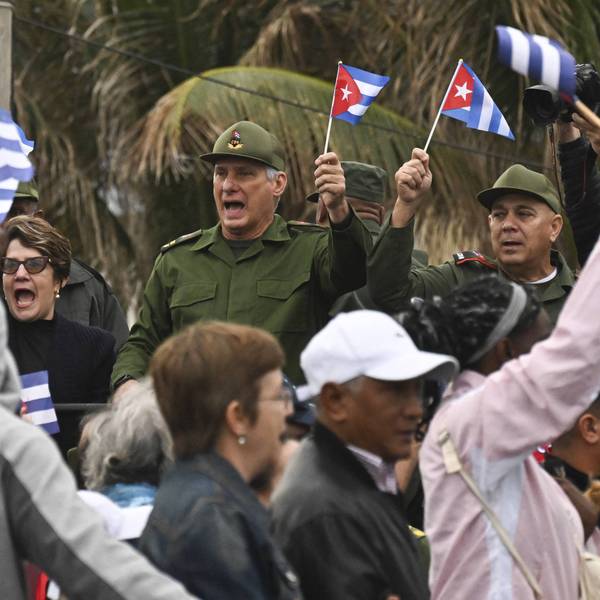
Cuba held a nationwide civilian military exercise Friday involving weapons training and combat drills, part of a broader push to expand militarisation to youth under its “war of the entire people” doctrine, which authorities describe as a collective patriotic duty. The drills came amid a deepening humanitarian crisis for the island as it faces chronic fuel shortages due to a US oil blockade.

Video by: FRANCE 24


Jayapal-Meeks Bill Would Block Trump From Using Federal Funds for Military Attack on Cuba

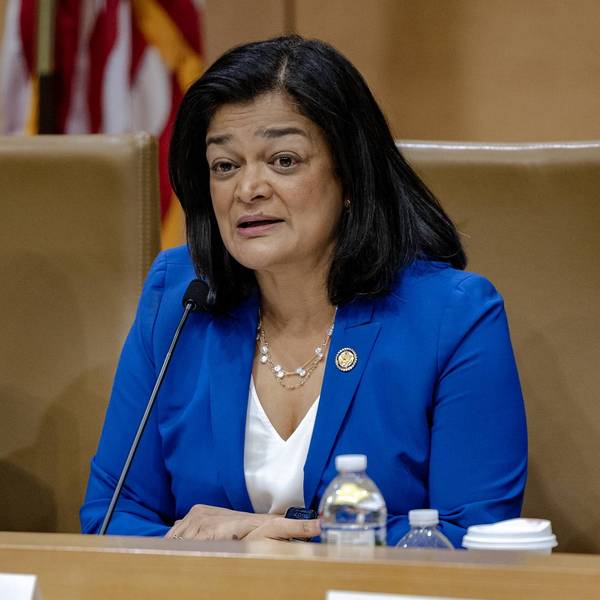
“Trump has started illegal regime change conflicts in Venezuela and Iran and is now threatening Cuba,” said Rep. Pramila Jayapal. “We must pass this legislation to block him from acting on a whim.”


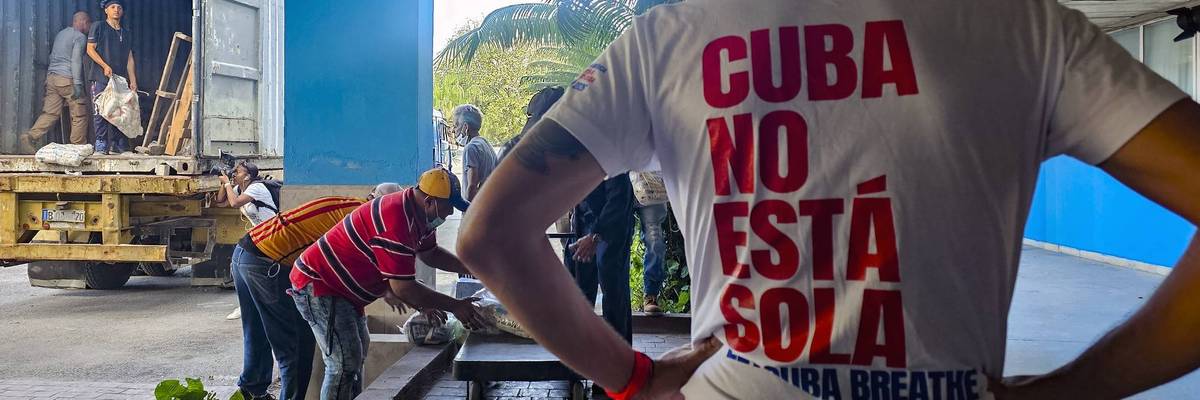
Aid brought by the Nuestra América Convoy from Mexico is unloaded at the William Soler Pediatric Cardiocenter in Havana, Cuba on March 25, 2026.
(Photo by Lisandra Cots/AFP via Getty Images)


Jessica Corbett
Mar 26, 2026
COMMON DREAMS

Amid calls for Congress to “do something—before it is too late,” a pair of US House Democrats on Thursday introduced the Prevent an Unconstitutional War in Cuba Act to block President Donald Trump from using any federal funds to take military action against the island nation without congressional authorization.

The proposal from Reps. Pramila Jayapal (D-Wash.) and Gregory Meeks (D-NY), ranking member of the House Foreign Affairs Committee, comes after Trump ramped up the United States’ decades-long economic blockade, cutting off Cuba from Venezuelan oil. The fuel shortage has led to island-wide blackouts, and disrupted everything from healthcare to transportation. As Jayapal put it earlier this month, the “cruel and failing policy... has caused incredible harm to the Cuban people.”


Jayapal Rips ‘Cruel and Failing’ US Policy After Trump Says ‘Cuba Is Gonna Fall’


Warning of Another ‘Disaster’ Like Iran, Senators Introduce War Powers Resolution on Cuba

Trump has also repeatedly threatened a US takeover of Cuba. His other misadventures abroad—such as joining Israel in waging war on Iran without authorization from Congress, bombing boats allegedly being used to smuggle drugs in the Caribbean Sea and Pacific Ocean, and abducting President Nicolás Maduro from Venezuela in an operation that killed dozens of Venezuelans and Cubans—have fueled fears that he may act on those threats, as Jayapal signaled in a Thursday statement.

“Trump has started illegal regime change conflicts in Venezuela and Iran and is now threatening Cuba. These military attacks put our troops in danger, endanger innocent civilians, waste billions of taxpayer dollars, and are not what the American people want,” she said. “Trump promised to end forever wars—he lied. Congress alone has the power to declare war, something Trump clearly does not respect. He has no plan to improve conditions for the Cuban people or promote democracy, and we must pass this legislation to block him from acting on a whim.”

The bill’s prohibition on funding military action against Cuba does not apply to any use of force that is consistent with the section of the War Powers Act that empowers the president to respond to a “national emergency” created by an attack on the United States or its armed forces. In January, Trump notably signed an executive order declaring a national emergency with respect to Cuba and authorized new tariffs on imports from countries that supply oil to the island.

As with Iran pre-war, the Trump administration is currently engaged in negotiations with the Cuban government. Those talks are being led by US Secretary of State Marco Rubio, a son of Cuban immigrants and longtime supporter of regime change in the country, who said earlier this month that “the embargo is tied to political change on the island... They’re in a lot of trouble, and the people in charge, they don’t know how to fix it, so they have to get new people in charge.”


Predictions over whether Trump will actually bomb or invade Cuba, which is located just 90 miles south of Florida, remain mixed.

“I think once Donald Trump gets an economic agreement that opens the island to US business, he will have fulfilled his transactional aims in Cuba. I don’t think he cares about political transition. He doesn’t seem to care about it in Venezuela,” American University professor and Back Channel to Cuba coauthor William LeoGrande told USA Today this week. “And so, I think once there’s an economic agreement that’s to the advantage of the United States and US businesses, the president will move on to the next thing.”

Current Affairs editor-in-chief Nathan Robinson, who’s reported on the Nuestra América Convoy from Havana this week, declared on Wednesday that “they WILL run the Venezuela playbook on Cuba.”

“They want a Republican donor imperial viceroy who will privatize the Cuban healthcare and school systems, and hand all the waterfront property to developers, with the Cuban people serving as cheap labor building a playground for Miami’s rich,” said Robinson.


Meeks—who is facing pressure to force a vote on his Iran war powers resolution—said Thursday that “Cuba is not for Donald Trump to take, and today we stand firm against the illegal use of the US military to pursue turning Cuba into another playground for Trump’s chaotic adventurism.”

“Such a reckless course would risk American lives, cost taxpayers billions, and, in all likelihood, leave the underlying political and economic conditions unchanged,” he said. “The United States cannot bomb Cuba out of economic collapse or political repression—lasting change must come through empowering the Cuban people, not doubling down on a failed approach that disproportionately harms them.”

The new bill is backed by Democratic Reps. Gabe Amo (RI), Joaquin Castro (Texas), Sara Jacobs (Calif.), Jesús “Chuy” García (Ill.), Hank Johnson (Ga.), Sydney Kamlager-Dove (Calif.), Jim McGovern (Mass.), Eleanor Holmes Norton (DC), Mark Pocan (Wis.), Jan Schakowsky (Ill.), Melanie Stansbury (NM), Dina Titus (Nev.), Rashida Tlaib (Mich.), and Nydia Velázquez (NY). However, like legislation aimed at stopping Trump’s boat strikes, aggression toward Venezuela, and war on Iran, it is unlikely to be passed by the GOP-controlled Congress.

Still, earlier this week, Velázquez also introduced a war powers resolution to prevent US involvement in military hostilities against the island. She said in a statement that “Donald Trump’s belligerent foreign policy is creating new wars and conflicts across the world.”

“This administration’s foreign policy is totally out of control and is putting countless American and foreign lives at risk,” Velázquez warned. “Trump’s military blockade, his threats, and his track record this term show that Congress must reassert its constitutional authority and stop another disastrous war before it’s too late.”
Spanish woman dies by euthanasia in case that drew national spotlight

A 25-year-old woman underwent legal euthanasia in Spain on Thursday after a nearly two-year protracted legal battle and struggling with psychiatric illness since she was a teenager. Noelia Castillo's case was closely followed in Spain, which passed legislation in 2021 enshrining the right to euthanasia and medically assisted suicide for patients meeting certain conditions.


Issued on: 27/03/2026 
By: FRANCE 24

Noelia Castillo, a young Spanish woman, died on March 27, 2026 after winning a long court fight for her right to euthanasia. © LaSexta

Noelia Castillo, a Spanish woman who sought euthanasia and fought a protracted legal battle with her family over her right to do so, received life-ending medicine on Thursday in Barcelona. She was 25.

For nearly two years, Castillo pursued her right to die after her father put up a lengthy legal battle when a medical body in Catalonia approved her request for euthanasia in 2024.

As the family's struggle unfolded, Castillo’s case was closely followed in Spain, which passed legislation in 2021 enshrining the right to euthanasia and medically assisted suicide for patients meeting certain conditions. Castillo's young age, the public battle waged by her family to stop her and the circumstances that led her to seek euthanasia animated public opinion as the courts ultimately ruled in favour of her right to end her life.

READ MORE Spain's parliament legalises euthanasia and assisted suicide

“At last, I’ve managed it, so let’s see if I can finally rest now,” Castillo told Spanish broadcaster Antena 3 in an interview that aired Wednesday. "I just cannot go on anymore."

Castillo's parents opposed her decision up until the end, and were represented by the conservative Catholic organisation Abogados Cristianos. The Catholic organisation on Thursday confirmed that she had died at a Barcelona hospital outside of which a small group of people had gathered.

Attorney Polonia Castellanos, president of Abogados Cristianos, said Castillo's family was deeply disappointed with the outcome, and believed the Spanish government had abandoned and failed their daughter by allowing her to die.

“Death is the last option, especially when you’re very young," Castellanos said.

Castillo struggled with psychiatric illness since she was a teenager, and tried taking her life twice, she said, the second time after she was sexually assaulted. The injuries she suffered from her second suicide attempt in 2022 left her unable to use her legs and in a wheelchair.

In April 2024, Castillo solicited euthanasia with an independent body in Catalonia made up of doctors, lawyers and bioethics experts who deliberate on the application of Spain’s law.

The body approved Castillo’s request based on assessments that evaluated her condition as serious and incurable, and that the 25-year-old had severe, chronic and debilitating suffering.

Spain legalised physician-assisted suicide and euthanasia in 2021 for those suffering from terminal illness and for people with unbearable permanent conditions. The process involves submitting two requests in writing followed up by consultations with medical professionals not previously involved in the case. The law faced intense criticism from conservative political parties and the Catholic Church.

Castillo’s father appealed the Catalan body’s decision, and a court in August 2024 suspended the euthanasia request while it deliberated. Through Abogados Cristianos, Castillo's father argued that his daughter's mental illness rendered her incapable of making the decision to end her life.

When a Barcelona court ruled in favour of Castillo’s right to euthanasia, her father’s lawyers appealed again, with the case eventually reaching Spain’s Supreme Court. In January, the court upheld Castillo’s rights. Abogados Cristianos made a final attempt to halt the procedure by appealing to the European Court of Human Rights, which denied the request earlier this month.

READ MORE Slovenians reject assisted-dying law in national referendum

Before Castillo died Thursday, Castellanos repeated her client's view that Castillo had a personality disorder, and said the case was an example of the euthanasia law failing citizens.

“I think this is proof of the failure of the law and that it has to be urgently repealed," she said. “We’ve been told it was a law for very extreme cases, for people who were very ill, who were practically dying. Here we see that it’s being used to end the life ... of a girl of only 25 years who has her whole life ahead of her and who has a treatable illness.”

Speaking to Spanish TV, Castillo said she did not want her family to be around when she died, claiming that she was misunderstood. She acknowledged the glaring media spotlight that her case had drawn.

“None of my family is in favour of euthanasia, obviously, because I'm another pillar of the family," she said, adding, “but what about the pain that I've suffered all of these years?”

A disability rights group in Madrid called for a review of Spain's euthanasia law, adding that it was essential to improve resources for those with disabilities, chronic illnesses or situations of high dependency.

“Before facilitating death, the system must effectively guarantee the conditions for living with dignity," said Javier Font, president of the Federation of Associations of People with Physical and Organic Disabilities of Madrid, in a statement.

Spain is among nine European countries with laws that allow people experiencing unbearable suffering to access assisted dying, according to Dignity in Dying, a UK-based rights group that advocates in favor of euthanasia and medically assisted suicide. The criteria vary by country.

Medically-assisted suicide involves patients themselves taking a lethal drink or medication that has been prescribed by a doctor while euthanasia involves doctors or health practitioners, under strict conditions, actively killing patients who meet certain conditions by giving them a lethal injection at their request.

Since Spain adopted its euthanasia law, 1,123 people have been administered life-ending medicine through the end of 2024, according to the country's health ministry.

Castillo said she never questioned her decision as she had to reassert her desire to end her life. The calculus for her was simple.

“The happiness of a father or a mother should not supersede the happiness of a daughter."

This story includes discussion of suicide. If you or someone you know needs help, international helplines can be found at www.iasp.info/suicidalthoughts.

(FRANCE 24 with AP)
#MeToo and the French farming sector

FRANCE24
27/03/2026 
12:24 min


In this edition, we meet French farmer Laura Chalendard, who reported a sexual assault in 2023 and when no charges followed, launched a #MeToo movement in the agricultural sector to empower women to speak out against sexual violence. Also how perimenopause and menopause in female employees are worsening Germany's labour shortage and prompting a number of companies to confront what has long been one of the last workplace taboos. Plus how a team of elderly women in eastern Uganda use cricket to ease stress and field loneliness while staying on the front foot against health challenges.


War in Lebanon 'was imposed upon us', PM Nawaf Salam says

MIDDLE EAST


Issued on: 27/03/2026 - 
Play (12:05 min)


In an interview with FRANCE 24 in Beirut, Lebanese Prime Minister Nawaf Salam discussed the Israeli offensive in Lebanon, amid the ongoing war in the Middle East. "This war was imposed upon us," the Lebanese leader said, adding that Lebanon "could have avoided it" had Hezbollah not fired rockets in retaliation for the US-Israeli assassination of Iran's supreme leader Ayatollah Ali Khamenei.

Israel responded to Hezbollah's March 2 rocket fire with intense air strikes and has sent ground troops into south Lebanon, where it wants to take control of a zone up to the Litani River, around 30 kilometres (20 miles) from the border.

Salam called this "buffer zone" that Israel want to establish in southern Lebanon "completely unacceptable", stating that it constitutes a "flagrant violation of Lebanese sovereignty" and of "Lebanon's territorial integrity".

Asked about possible negotiations with Israel that were recently mentioned by Lebanese President Joseph Aoun, Salam stated that these were still "on the table" and that Lebanon remained "in favour of negotiations with Israel to put an end to this war".

Since March 2, more than 1,000 people have been killed in Lebanon and more than 1 million have been forced to flee their homes.

Financial analysts move to counter Trump’s Middle East war uncertainty with ‘TACO’ index

Faced with financial instability caused by the US President Donald Trump’s unpredictable policy changes, analysts have created the “TACO” index — based on the premise that Trump Always Chickens Out – to rationalise the president’s decision-making process and mitigate the financial shocks caused by the war in the Middle East.


Issued on: 27/03/2026
FRANCE24
By: Sébastian SEIBT

The “TACO” index aims to provide investors with a tool to better predict shifts in Donald Trump's policy. © Studio graphique France Médias Monde

Can US President Donald Trump’s thought process be summed up in a mathematical equation?

Financial markets have been searching for a formula to help predict the erratic US president’s next move during periods of major political upheaval, and may have hit upon a result.

Analysts from Germany’s Deutsche Bank have published the “TACO stress index” as a measure of anticipating when Trump might change his mind, financial media reported on Wednesday.

“TACO” has become a popular acronym in the financial world since it was coined nearly a year ago by a Financial Times editorial as a way of describing an emerging pattern of behaviour within the White House: Trump Always Chickens Out

‘Lost in Trumplation’

The "TACO" theory suggests that Trump systematically reverses his major policy decisions – such as imposing hefty tariffs on other countries – as soon as the consequences become too negative.

The president has denied the claim and chided reporters for asking him “nasty” questions about taking a "TACO" approach to tariff policies.

But war in the Middle East has ratcheted up global tensions and increased the potential for a Trump volte-face to have a devastating financial impact.

“For much of my career, the impact of geopolitical events was often limited and quite fleeting in that financial markets would get over it fairly quickly. Now, we're starting to see, in a world that is being unpicked geopolitically, financial markets being knocked off balance by geopolitical events,” says Alex Dryden, a specialist in financial markets at SOAS University of London and former employee at investment bank JP Morgan.

Hence, the "TACO" index was created by analysts at Deutsche Bank.


With investors increasingly "Lost in Trumplation", the "TACO" index aims to impose “something that's rational on what may otherwise be irrational-looking behaviour”, says David McMillan, a specialist in international finance at the University of Stirling in the UK.

The "TACO" index uses four factors to measure negative impacts and evaluate the probability that Trump will change his opinion.

These are: one-year inflation expectations, changes in Trump’s approval ratings in the month prior, the performance of the S&P 500 stock market index (which tracks stocks from the 500 leading Wall Street companies) and the evolution of US Treasury yields (interest rates that the government pays to borrow money).

“These are factors that stock market analysts were already examining separately, so it makes sense to combine them into a single index to assess the level of political and economic pain that Donald Trump is likely to be able to withstand,” says Alexandre Baradez, an analyst for the broker IG France.

Pricing uncertainty

The criteria used to measure the index “are all things that Trump himself has talked about”, says McMillan. “We know that Trump, because he said this himself, measures his own success by what's happening in the stock market … He talks about inflation and how his approval ratings prove he’s the greatest president ever, even if they don’t.”

The "TACO" index takes the leap of assuming that Trump himself follows these criteria and reacts to their movements.

The theory goes that the higher the results from these indicators, the more likely it is that Trump will announce a policy reversal.

Currently the index is at the highest level it has ever been since Trump’s return to the White House – which could account for the president’s sudden insistence on pushing Iran to negotiate a deal to end the war in the Middle East.

Even so, the very existence of such an index raises questions.

Trump is the first US leader to require such decoding. “I haven't seen this for another president. Most leaders are consistent in their messaging because they want to provide stability,” McMillan adds.

But the war in the Middle East and the economic fallout of the conflict have amplified the risks for investors of the impact on financial markets of Trump’s seemingly impenetrable decision-making process.

“He can give alarmingly different indicators as to where this conflict in Iran is going. One minute, he could be declaring victory, the next, he could be calling on allies for support,” Dryden adds.

“The logic of being unpredictable to keep your adversaries off balance might work in the business world, but it doesn't work for an administration trying to instil calm or ensure orderly functionality in financial markets, which thrive on a clear and concise narrative.”

Even more problematic is the fact that “Donald Trump is one of the US presidents whose words and actions have the greatest impact on financial markets. It’s impossible to ignore what he says on social media if you don’t want to be caught off guard as an investor,” adds Baradez.

Under Trump’s second presidency, the markets have become volatile as investors don’t know which way to bet.

“The financial markets are very good at pricing risk, but what we’re dealing with is not risk. It's uncertainty. When we don't know what's happening we have no way of pricing it. We do not have models for that,” Dryden adds.

Predicting the unpredictable

If the "TACO" index is a natural response from the markets to want to reduce everything to numbers and equations, it is also endemic of the “troubling” way in which markets now must take into account – and even be “influenced and shaped” – by what is happening in political circles, Dryden says.

Even so, the “TACO” index should be taken with a grain of salt, experts say.

“It’s interesting metric to consider, much like how social media sentiment indicators can be useful to investors,” says Baradez.

But “there is certainly a bit of reverse-engineering going on”, says Peter Tillmann, a specialist in monetary and financial politics at Giessen University in Germany. “There is no chance to validate the quality of such an index. To do so, we would need many TACO moments.”

“Predicting the unpredictable seems a bit futile,” he adds. “I think Trump wants to be destructive and self-enriching. We should not try to rationalise this.”

Doing so could bring its own risks. “There's a danger that you overly rely on the statistics and make serious mistakes,” McMillan says. “Prior to the financial crisis, people had risk models that they believed in and then they all failed and there was a huge recession.”

The "TACO" index might be a “nice indicator”, he adds, “but don't bet your house on it”.

The Far-Reaching Implications Of Israel’s Caspian Sea Strikes – Analysis

By 

By Luke Coffey

With much of the world’s attention on the Arabian Gulf and the Strait of Hormuz, there is another body of water that has become a focal point of the war with Iran: the Caspian Sea. Earlier this month, Israeli fighter jets carried out an audacious and long-range air operation to target Iranian naval vessels and buildings on the Caspian Sea.

The Caspian Sea has long been an important body of water for Iran, especially in terms of its trade and transit connections into the heart of Eurasia and the possibility of oil and gas resources there. During Soviet times, the Caspian was shared between Iran and the Soviet Union, but after 1991, with the emergence of three new littoral states — Azerbaijan, Kazakhstan and Turkmenistan — the question of which country controls what portion of the sea has remained unsettled.

Azerbaijan and other littoral states prefer control of the Caspian to be decided by the length of each state’s coastline. Meanwhile, Iran, with the shortest Caspian coastline, believes that the body of water should be divided evenly among the five littoral countries.

Complicating matters further, much of the Caspian’s deepest waters lie off Iran’s coast, making hydrocarbon extraction more difficult with current technology. This reality has long shaped Tehran’s desire to gain access to shallower, resource-rich areas elsewhere in the sea.

According to reports, the Israeli strikes took out a number of Iranian ships, including a corvette, multiple missile boats and smaller patrol vessels. Naval infrastructure onshore was also hit, including command centers and shipyard repair facilities in and around Iran’s main Caspian port of Bandar Anzali.

There are two primary reasons why Israel chose to strike assets in the Caspian. First, there is a legitimate concern that Iran has been receiving resupplies from Russia, with the Caspian serving as a key transit route. Second, Israel likely sought to send a clear message to Tehran that no part of Iran is beyond its reach, including the distant Caspian coastline.

These strikes are already having geopolitical consequences beyond Iran. While they directly impact the ongoing airstrikes against Iran, they are also creating opportunities for regional Caspian states and even Ukraine.

Azerbaijan is a prime example of how regional dynamics are shifting. Although relations between Baku and Tehran have often appeared cordial on the surface, they have long been strained beneath. Tensions have flared up in recent weeks, especially with the Iranian drone strikes in Azerbaijan’s Nakhchivan enclave. Azerbaijan has tried to strike a careful balance, making clear that it does not want the war to spill over into the South Caucasus, while also signaling that it will not tolerate attacks on its territory.

One long-standing source of tension between Iran and Azerbaijan is their unresolved maritime boundary in the Caspian Sea. This dispute has persisted since Azerbaijan gained independence in 1991. In July 2001, the situation nearly escalated into open conflict when Iranian warships and aircraft entered an area believed by Azerbaijan to contain a significant gas field within its sector. The standoff was serious enough to prompt Turkiye to deploy F-16 fighter jets to Azerbaijan and send its commander of Turkish ground forces to Baku as a show of support, after which Iran backed down.

This maritime dispute has been one of the key obstacles for Baku for further oil and gas exploration, particularly in areas such as the Alov and Araz fields. While Azerbaijan has taken a cautious approach to the current conflict involving Iran, it will likely benefit from the degradation of Iran’s Caspian naval capabilities. A weakened Iranian presence provides Baku with greater operational freedom in the Caspian at a time when it is also strengthening its own maritime capabilities. The Trump administration’s recent pledge to provide additional boats to Azerbaijan further reinforces this trend. With Iranian naval capabilities now diminished, Azerbaijan becomes the second-most-capable maritime power in the Caspian after Russia.

Israel’s strikes will also have implications for Ukraine. Since Russia’s full-scale invasion in 2022, Kyiv has closely monitored the logistical and military connections between Iran and Russia, particularly regarding the transfer of drones, hundreds of thousands of artillery shells and other equipment. The Caspian Sea has played a central role in facilitating this cooperation.

Until recently, Ukraine had limited options to respond in this domain. However, Ukrainian forces have demonstrated increasing reach, including long-range drone strikes targeting Russian assets far from the front lines. Reports from the past year indicate that Ukrainian drones have struck Russian naval targets and infrastructure associated with the Caspian Flotilla in the port city of Kaspiysk. Even though Russia was not the target of Israel’s recent strikes, Kyiv will undoubtedly welcome any reduction in Iran’s ability to support Moscow via the Caspian route.

Finally, these developments could have significant implications for regional energy security. For years, there has been discussion about constructing a trans-Caspian pipeline to transport Turkmenistan’s vast gas resources westward, linking them to the Southern Gas Corridor through the South Caucasus and onward to European markets. However, this idea has repeatedly stalled due to political opposition from Russia and concerns about potential Iranian interference.

At the same time, Kazakhstan has been exploring alternative routes to export its oil and gas while reducing its dependence on transit through Russian territory. The weakening of Iran’s position in the Caspian, combined with Russia’s strategic focus on Ukraine, may create a window of opportunity for Azerbaijan, Turkmenistan and Kazakhstan to advance new energy infrastructure projects across the Caspian.

Israel’s recent strikes in the Caspian Sea may not have dominated global headlines, but they underscore the multifaceted nature of the conflict with Iran and its far-reaching consequences. Developments in the Caspian will not remain isolated. They will shape regional security dynamics, energy markets and the broader geopolitical landscape. Policymakers would be wise to pay close attention.

  • Luke Coffey is a senior fellow at the Hudson Institute. X: @LukeDCoffey