Tuesday, April 28, 2026


US not funding Congo’s $100 million mine guard, embassy says


Congolese soldiers. Stock image.

The United States said on Tuesday it is not funding any security units tasked with policing or guarding mines in Democratic Republic of Congo after Kinshasa announced plans to launch a paramilitary force to secure mining sites.

Congo’s General Inspectorate of Mines (IGM) said in a statement on Monday that the paramilitary guard would be funded by a $100 million budget and created under strategic partnerships with the US and the United Arab Emirates.

The US embassy said that Washington remained committed to advancing economic growth and stability in Congo through the strategic partnership, but it was not involved in funding mine security units.

“The US government is not currently funding any units to patrol or guard mines in the Congo,” it said in a statement.

Congo’s mining regulator also said on Tuesday that plans for the mining guard, while developed with multiple international partners, would not involve direct funding by any single country.

“Discussions are ongoing to structure a mechanism that is consistent with national priorities,” it said in a statement.

The central African nation has been battling a Rwanda‑backed rebellion in its mineral‑rich east and security support and investment form part of a minerals partnership it signed with the US to improve access to Congo’s vast copper, cobalt and lithium resources.

The new unit will be rolled out across mining regions nationwide and is expected to exceed 20,000 personnel by the end of 2028.

Congo, the world’s top cobalt supplier and second-largest copper producer, has said it is seeking to strengthen security around strategic mineral assets, part of wider efforts to attract investment and reduce armed group activity in mining regions.

The government last month signed a separate deal with China aimed at strengthening investments as geopolitical competition for its minerals deepens.

(By Ange Kasongo and Maxwell Akalaare Adombila; Editing by Tomasz Janowski)

Ghana mineworkers warn local outsourcing rule will cut wages, jobs

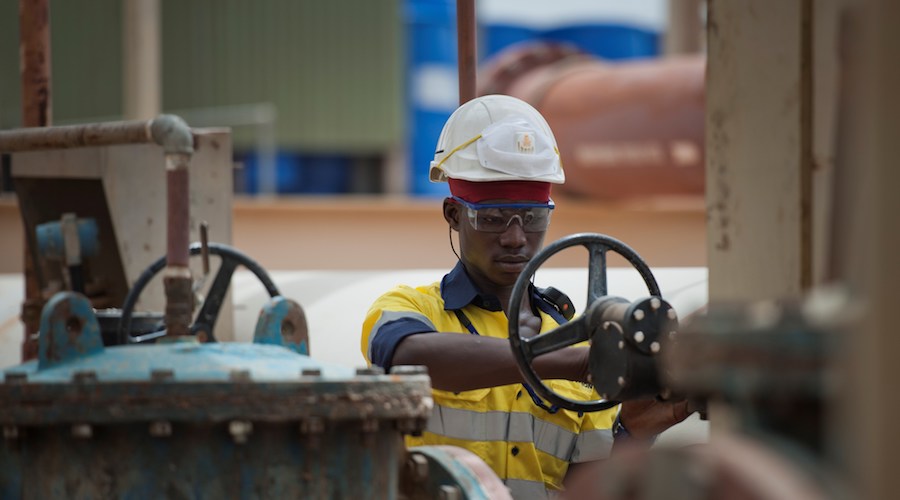
Ghana mine operations. Photo by David Tejada, Newmont.

Ghana’s union of mineworkers has warned it would continue to oppose a government policy that requires international companies to hire local firms as mining contractors, even though many large miners have already complied with the regulation introduced last year.

The union president, Abdul Moomin Gbana, told Reuters on Friday that local contractors pay lower rates to workers and offer less job security than foreign firms, and that the legislation will hurt ordinary miners.

The union, which represents about 14,000 workers, vowed to mount stiff resistance to the policy, including possible strikes and protests.

Africa’s top gold producer has directed companies, including Newmont, Zijin and AngloGold Ashanti, to fully shift mining activities – blasting, loading, hauling and dumping – to local contractors by December 2026 or face sanctions, as part of reforms to boost local participation, Reuters reported.

Rules introduced in January 2025 require surface mining to be carried out by fully Ghanaian‑owned firms, while underground mining must be handled by companies with at least 50% local ownership.

Mining executives have criticized the policy as anti‑business and unlawful, arguing it conflicts with Ghana’s mining law, which allows leaseholders to determine how mining is conducted.

Previous resistance failed

Ghana’s mineworkers in 2017 to 2018 failed to stop Gold Fields’ voluntary shift from owner mining to local contract mining, including through a court challenge, Gbana said. This opened the door for more companies.

The mineworkers’ union was not consulted on the current regulation, he said. He accused authorities of sidelining labour concerns.

“The growing reliance on contract mining is reversing hard‑won labour protections,” he said, adding that the changes would have a “huge impact on workers.”

The group has petitioned the mining regulator and the lands ministry, according to a letter seen by Reuters on Friday.

“Any attempt to proceed with this policy in its current form will be met with strong, coordinated and sustained resistance,” the letter said.

Wage gap fuels worker concerns

Gbana said local contractors typically pay lower wages and offer weaker job security, with some workers already raising concerns over unpaid statutory deductions such as pensions and provident funds.

Contractor workers typically earn around 50% less in basic pay than employees directly hired by mine operators, a staff member at a local contractor told Reuters.

Gbana said even if staffing levels were maintained, wages and benefits would fall, eroding gains secured over years of collective bargaining.

He added that some established local contractors, including E&P, Rabotec, BCM, Electrochem and Rocksure, had failed to meet workers’ expectations.

Rocksure is up to date with salaries and pensions paid to workers and statutory payments to the state, the company’s head of human resources, Nina Lamptey, said. She added that it pays strictly according to the terms of its contracts. E&P, Rabotec, BCM and Electrochem did not immediately respond to requests for comment.

The Minerals Commission said it plans to tighten oversight of contractors to prevent undercutting that drives down wages and operating standards.

Chief executive Isaac Tandoh said miners often slash rates to local contractors – citing cases where mining costs fell from $3 per ton to below $2.50 – leaving workers worse off.

He said the government agency would use regulations to set clearer pricing benchmarks and support local firms through guidance and joint ventures, adding that unions were right to push for the welfare of workers.

(By Maxwell Akalaare Adombila; Editing by Jessica Donati and Matthew Lewis)


China's Push Beyond the First Island Chain

Daishan Dao
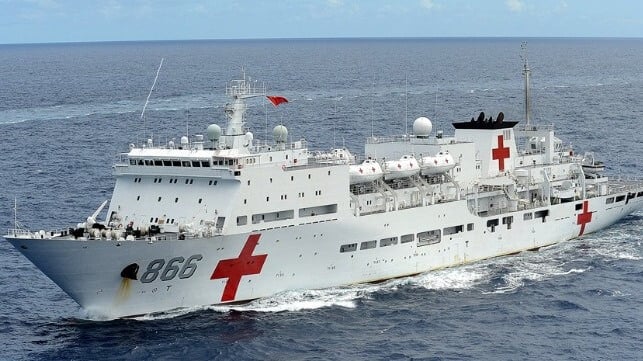
Chinese hospital ship Peace Ark (USN file image

Published Apr 27, 2026 10:47 PM by The Strategist


[By Joe Keary, Raji Rajagopalan and Linus Cohen]dd

China’s defense and security presence beyond the Western Pacific is set to intensify over the next decade, expanding its access, influence and operational reach across the Indo-Pacific.

In the Southwest Pacific, Beijing is likely to build its position through security cooperation, infrastructure development and a more regularised presence, while activity across the Indian Ocean and Australia’s maritime approaches is likely to become more frequent, capable and strategically purposeful.

We are not likely to see sudden military breakthroughs or dramatic shows of force. Rather, Beijing has a deliberate, long-term strategy – one that prioritises persistence and gradual advantage. China is seeking to normalise its presence across the Indo-Pacific in ways that expand its freedom of action, complicate the calculations of others and incrementally shift the strategic balance in its favour.

These judgments draw on ASPI war gaming in March that explored how China’s defence and security agencies might extend influence out to 2036. The exercise examined two pathways: one in which activity grew steadily over time, and another where it accelerated more rapidly in response to opportunity or crisis. The details of these war games will be unpacked in this and three further articles this week.

China’s push beyond the first island chain

For much of the past decade, analysis of China’s military rise has focused on its actions within the first island chain. Yet beyond this immediate theatre, a quieter but significant shift is underway. Beijing is expanding its defence and security engagement across three interconnected regions: the Southwest Pacific, the Indian Ocean and Australia’s maritime approaches.

This outward push reflects a strategy. Rather than seeking rapid breakthroughs or dramatic shows of force, China is pursuing a long-term effort to extend operational reach, build familiarity and shape regional environments in ways that favour its interests. The goal is not to displace the United States or its partners overnight but to challenge the status quo and ensure that China’s military and paramilitary presence becomes a normalised feature of the Indo-Pacific security landscape.

At the centre of this effort is the modernisation of China’s navy. Over the past two decades, it has evolved from a largely near-seas force into a highly sophisticated navy capable of sustained blue-water operations. Regular deployments into the Indian Ocean for counter-piracy missions, long-range task group operations and increasingly complex exercises demonstrate a growing capacity to operate far from China’s shores. These capabilities underpin Beijing’s ability to maintain a persistent, if still carefully calibrated, presence across the wider Indo-Pacific.

But naval power alone does not define China’s approach. Beijing increasingly relies on a layered toolkit that combines military, paramilitary and civilian instruments. The China Coast Guard, now the world’s largest, plays a central role in projecting presence while maintaining a law-enforcement narrative. Maritime militia vessels, research ships and survey ships further expand China’s reach, often operating in ways that are difficult to categorise as purely civilian or military.

What might the region look like by 2031?

Results of the ASPI wargame suggest that this pattern of activity will intensify over the coming five years. In the Southwest Pacific, Chinese engagement is likely to focus on building access and influence through security cooperation, infrastructure development and more regularised presence. Port visits, training programs and maritime enforcement cooperation will be framed as responses to local needs, such as disaster relief, fisheries protection and capacity building. Over time, however, these activities will create the conditions for more consistent access, including storing supplies and rotational deployments, in which one ship or another will always be present.

In Australia’s maritime approaches, the emphasis is less on access and more on operational familiarity and signalling. Naval flotillas, intelligence collection vessels and survey ships are likely to operate with increasing frequency in waters to Australia’s north and west. These deployments will allow Beijing to map seabed infrastructure, monitor communications routes and better understand Australian and allied responses. The presence of increasingly capable naval task groups will also serve as a clear signal to Australia as one of the US’s primary regional allies. Crucially, such operations can be conducted within the bounds of international law, enabling China to apply pressure without crossing clear red lines.

Across the Indian Ocean, China’s approach will continue to centre on protecting sea lines of communication, particularly for oil and gas supply from the Middle East. What is changing is the scale and permanence of its presence. A network of port access arrangements, logistics hubs and strategic partnerships is gradually emerging, from Djibouti to Pakistan and potentially beyond. While these facilities are typically framed as commercial or dual-use, they provide the foundation for sustained naval operations and, over time, a more enduring military footprint.

What unites these three regions is not a single operational plan but a common method. Chinese activity is persistent but measured, incremental rather than abrupt, and almost always framed in cooperative or non-threatening terms. Individually, many of these actions, such as port visits, research missions and coast guard patrols, appear routine. Collectively, however, they expand China’s operational freedom, deepen its regional ties and complicate the strategic calculations of other actors.

This approach reflects consideration of escalation risk. Beijing has strong incentives to avoid actions that would trigger a unified or forceful response from the US and its allies. Permanent overseas bases, large-scale combat deployments and overtly coercive military operations will likely continue to be approached with caution in the near term. Instead, China will seek to operate below the thresholds that would provoke crisis, using ambiguity and legal framing to manage perceptions and strengthen its relative position.

The result is a form of strategic competition that unfolds in the grey zone between peace and conflict. It is characterised not by decisive moments but by the accumulation of presence, access and influence. Over time, this accumulation can reshape regional environments in ways that are difficult to reverse.

For Australia and its partners, the challenge is not simply responding to individual Chinese activities but understanding how they fit into a broader pattern of gradual expansion. A port visit here, a survey mission there, a new security agreement with a Pacific Island state –each may seem manageable in isolation. But together they point to a long-term effort to shift the balance of presence and influence across the Indo-Pacific.

Joe Keary is a senior analyst, Raji Rajagopalan is a resident senior fellow and Linus Cohen is a researcher at ASPI.

This article appears courtesy of The Strategist and may be found in its original form here.

The opinions expressed herein are the author's and not necessarily those of The Maritime Executive.

 

Workboat Hits and Damages Moored Fast Ferry Near Trondheim

 
Aslak Berge / social media

Published Apr 27, 2026 2:07 AM by The Maritime Executive


[Brief] On Friday, a service vessel struck a moored fast ferry at a small port on the island of Froya, northwest of Trondheim, penetrating the ferry's hull.

Video from the scene shows that a service vessel - identified by AIS as the Multi Power - approached the port side of the moored fast-ferry catamaran Froyfart at low speed, then made contact. 

Local outlet Hitra-Froya obtained imagery showing the hull damage to the fast ferry from the inside. The impact tore open a large gash at the waterline and partially flooded the port-side catamaran hull. The rails and deck plating of the upper deck were also significantly damaged next to the pilothouse, photos show. 

Salvage operations began later the same day and managed to quickly stabilize the vessel, operator Oya Shipping told local media. The situation is under control, but Oya said that it would be canceling an upcoming voyage due to the damage. 

Multi Power is a small 90-foot workboat with twin deck cranes and a deadweight capacity of 200 tonnes. She is part of a large fleet that serves the region's thriving aquaculture industry. 

As of Sunday, Multi Power was under way and operating in the island archipelago northwest of Trondheim. 


ABS, Marinteknik, Seatech, & VINSSEN Hydrogen Fuel Cell Harbor Craft Study

ABS
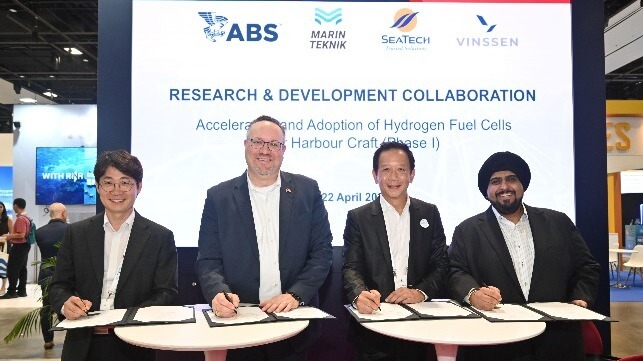
(L-R): Chil Han Lee, CEO of VINSSEN International; Patrick Ryan, ABS Senior VP & Chief Technology Officer; Alex Wong, General Manager of Marinteknik; Prabjot Chopra, SeaTech Solutions International VP of Technology, at 2026 Singapore Maritime Week

Published Apr 27, 2026 6:15 PM by The Maritime Executive


[By: ABS]

In an important step to lowering emissions in one of the world’s busiest ports, ABS, Marinteknik Shipbuilders (S) Pte. Ltd., SeaTech Solutions International (S) Pte. Ltd., and VINSSEN Co., Ltd., signed a research collaboration agreement to advance the development of a hydrogen fuel cell-powered harbor craft in Singapore.

The agreement brings together complementary expertise across vessel ownership, ship design, fuel cell propulsion and marine technology to advance hydrogen as a viable marine fuel for harbor operations.

“ABS is uniquely positioned to support this promising pilot. Our Singapore office is one of our largest, reflecting years of investment to deliver advanced technology and engineering services and survey operations in the Pacific. This concentration of capability in Singapore makes ABS a true innovation teammate for a project of this ambition. We look forward to working with Marinteknik, SeaTech, VINSSEN and the MPA to help prove out hydrogen fuel cell technology as a viable pathway for harbor craft and the broader maritime industry,” said Patrick Ryan, ABS Senior Vice President and Chief Technology Officer.

“The Port of Singapore is home to about 1,600 harbor craft. Decarbonizing the fleet requires solutions that can meet different vessel types and operating profiles. MPA is working with ABS and industry partners to develop and pilot new technologies under this project. These efforts will build capabilities and support the adoption of practical, lower-emission solutions across the sector,” said Ng Yi Han, Senior Director, Innovation, Technology and Talent Development/Chief Transformation Officer, Maritime and Port Authority of Singapore.

In phase one, the consortium will conduct desktop studies covering the feasibility of implementing hydrogen-powered harbor craft in Singapore, including vessel concept design, design evaluation and optimization, techno-economic analysis, risk assessment and mitigation and commercial viability for broader adoption. Depending on the outcomes from phase one, a second phase could include construction and sea trials of the vessel.  

“Having delivered two fully electric harbor crafts, Marinteknik is thrilled to embark on this milestone project: the first hydrogen-powered vessel for the Singapore maritime sector. We are conducting in-depth studies with local harbor craft operators, analyzing their specific operating profiles and requirements so that we can tailor our vessel’s design to meet the practical, real-world demands of the industry,” said Alex Wong, General Manager of Marinteknik.

“Through this collaboration, we look forward to working closely with our partners to optimize vessel design, integrate hydrogen fuel cell systems safely and in full compliance, and enhance operational efficiency. This project marks a significant milestone in sustainable maritime solutions, and we are proud to contribute to Singapore’s decarbonization efforts and the broader global energy transition,” said Prabjot Singh Chopra, SeaTech Vice President Technology.

“At VINSSEN, we deliver hydrogen fuel cell systems paired with battery solutions through our integrated power management system (i-PMS), enabling optimized performance, efficiency and operational reliability. We believe this pilot will serve as a meaningful reference for the wider adoption of hydrogen-powered vessels across the region and beyond,” said Chilhan Lee, CEO of VINSSEN.

ABS’ Singapore office is home to the global ABS Electrification Center to support and explore battery and hybrid sources of energy, as well as the ABS Singapore Innovation and Research Center. It is also one of the global Operations Centers for ABS, focused on expanding remote survey capabilities, and one of the five global ABS Sustainability Centers, supporting marine and offshore clients with comprehensive sustainability solutions.

The products and services herein described in this press release are not endorsed by The Maritime Executive.


Aging Vessels are Driving Rise in Major Claims as Fire Risk Worsens

ShipIn Systems
Osher Perry, CEO, ShipIn Systems

Published Apr 27, 2026 6:06 PM by The Maritime Executive


[By: ShipIn Systems]

A sharp rise in major marine insurance claims involving older vessels should be seen as a warning sign for the industry, with ShipIn Systems arguing the trend reflects growing operational risk onboard ageing ships rather than insurance market conditions alone.

New data from Nordic marine insurers’ association, Cefor, shows a significant increase in claims above $10m, driven primarily by machinery damage and fire. As part of its own analysis of ten years of casualty data from vessel fleet tracking software, SeaSearcher, ShipIn has analysed what is causing this increase in claims, pointing to a clear deterioration in outcomes as vessels age.

Fire, rather than machinery damage, emerges as the more dangerous of the two main loss drivers identified. On vessels more than 25 years old, a fire results in a total loss in around one in eight cases and is closer to one in 30 on vessels under 20 years old. Over the ten-year period analysed, fire incidents involving older vessels also tripled.

ShipIn Systems says the data also supports the view that serious casualties are often the result of smaller problems building up over time rather than one isolated failure. Its analysis found the same machinery failure is six times more likely to destroy a vessel over 25 years old than one under 20, suggesting that age increases not only the likelihood of technical weakness, but the severity of the outcome when standards slip or warning signs are missed.

Osher Perry, CEO of ShipIn Systems, said: “Cefor’s figures show the market impact, but our own research into casualty analysis helps explain what is actually driving it. The issue is not vessel age on its own. It is whether owners and managers have enough visibility of onboard conditions and day-to-day execution to detect where risk is building before it becomes a safety, compliance or financial loss. As fleets age, that visibility becomes more critical because the consequences of missing early warning signs become much more severe.”

ShipIn Systems says the findings reinforce the need for stronger operational visibility across ageing fleets, particularly as technical stress, maintenance pressure and procedural drift become harder to manage through traditional oversight alone. In its view, the industry is now dealing with a fleet that has aged materially in a relatively short period, making it more important for owners and managers to identify weak execution and emerging risk before they appear in a casualty report, detention or major claim.

The products and services herein described in this press release are not endorsed by The Maritime Executive.


Turkish Boxship Arriving from Russia Breaks Down and Blocks Bosphorus

Containership aground Turkey
Containership grounded just meters from some of the wealthy homes of Istanbul (KEGM)

Published Apr 28, 2026 1:22 PM by The Maritime Executive


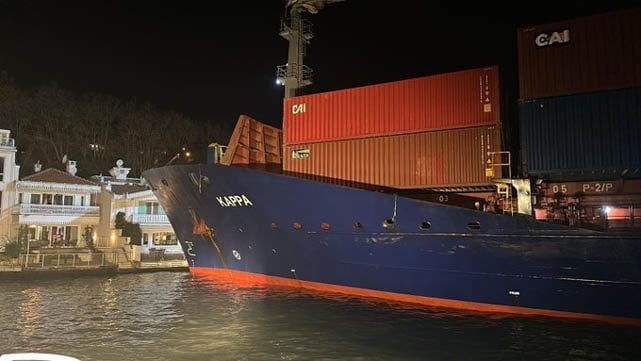
A Turkish-owned containership that regularly travels the Black Sea from Russia broke down overnight while transiting the Bosphorus. It came to rest, according to the reports, just meters from some of the wealthy homes of Istanbul in the Yenikoy district.

The ship named Kappa (13,700 dwt) is Turkish-owned and managed and was reported to be coming from Novorossiysk, Russia, to Körfez, Turkey, east of Istanbul on the Sea of Marmara. Built in 2007, the vessel is 148 meters (485 feet) in length with a capacity of 1,118 TEU.

The reports are that the ship experienced a steering issue and lost control. It was driven onto the northern shore of the waterway in a heavily populated district. The waterfront is lined with some of the wealthier homes of Istanbul. 


The Turkish authorities reported that two rescue tugs and a high-speed boat were dispatched along with a dive team to survey the area. Traffic on the Bosphorus was suspended from about 0200 until 0750 on April 28, according to the report.

The tugs were able to refloat the vessel and accompanied it to an anchorage south of the Bosphorus. Divers also inspected its hull, and it was later moved to a berth in Izmir, Turkey.

The Turkish safety authority, KEGM, reports frequent mechanical issues on vessels transiting the busy waterways. Two days earlier, it said its tugs had to tow the containership Med Beykoz (41,667 dwt) after it had a problem in the Canakkale Strait (Dardanelles) without having to suspend traffic in the region. 


ONGC Cancels Rig Tender, Alleging "Collusive" Bidding Practices

The ONGC rig Sagar Ratna off India's eastern coast (ONGC file image)

Published Apr 27, 2026 10:05 PM by The Maritime Executive


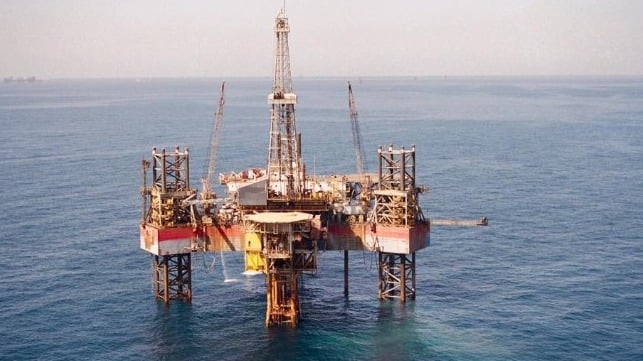
Indian state oil company ONGC has canceled a tender for four jackup rigs, alleging anticompetitive practices and an "unusually steep escalation" of prices offered.  

ONGC said that rates had jumped from about $35,000 per day to about $56,000 within the span of nine months. The company said that it was not just a price movement determined by global market factors, but also a sign of possible "collusive practices" among bidders. 

"The organization identified pricing escalation patterns that deviated substantially from reasonable market behaviour, forcing a critical decision point that would impact both immediate procurement outcomes and broader industry integrity standards," ONGC said in a statement. 

The company did not say whether it would launch a rebid process to attempt to find better-priced options. In its statement, it emphasized "adherence to established public procurement principles" like transparency and competition. 

ONGC has canceled tenders and contracts with a high degree of publicity before. Last year, the state company reportedly canceled a $100 million tender for engineering work on a project to replace 24 legacy wellhead platforms in shallow waters off the western coast. It was its largest contract of 2025, according to Upstream. Earlier in the year, the company denied media reports that it had canceled a big contract with BP for the revamp of its Mumbai High offshore oil field. In 2024, it canceled a tender for another four jackups. 


U.S. Agrees to Deal to Cancel Two More Offshore Wind Farm Leases 

STUPID IS AS STUPID DOES


offshore wind farm
U.S. agreed to reimburse two more offshore wind leases in exchange for investments in conventional energy (file photo)

Published Apr 27, 2026 5:22 PM by The Maritime Executive


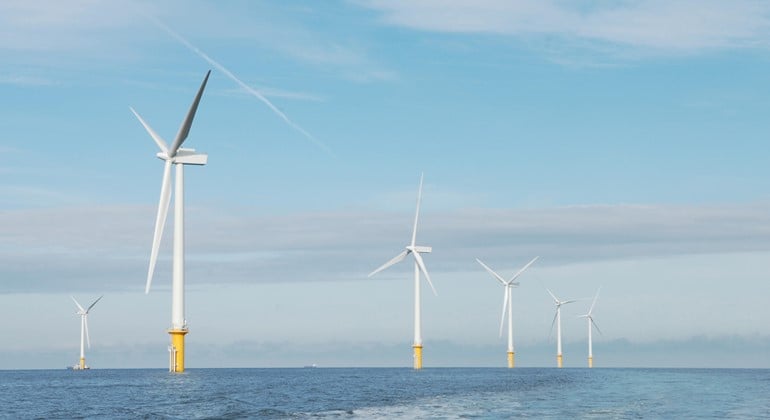
The U.S. Department of the Interior announced today that it has reached agreements to redirect the planned investment for two offshore wind farm projects into the oil and gas sector, and in exchange, it will reimburse the fees paid for the wind leases. The Trump administration has been pursuing this strategy with early-stage offshore wind projects that were still in the permitting stage, having already reached a similar deal valued at nearly $1 billion with TotalEnergies for its U.S. offshore wind portfolio.

Today’s agreements are with two of the lease sites owned by Ocean Winds, a joint venture between EDP Renewables and ENGIE, which was co-investing with Global Infrastructure Partners, which was acquired in 2024 by BlackRock. Details of the agreements are vague in the announcement, but it appears GIP agrees to make investments into U.S. LNG and U.S. oil and gas assets, and the U.S. will refund the total lease payments to Ocean Winds up to the amount of the investments made by GIP.

The larger of the two agreements is for a track in the New York Bight, which Ocean Winds won in the hotly contested 2022 auction. The company had proposed two projects located approximately 38 nautical miles off the coast of New York and 53 nm off the coast of New Jersey. At full capacity, the lease area, they said, would be able to generate 2.4 GW. Known as Bluepoint Wind, it was in the early stages of development, but had been proposed to New York and New Jersey.

GIP agrees to invest up to $765 million, the original bid amount for the Bluepoint lease, into a U.S.-based LNG facility. The Department of the Interior says that, after the accelerated investment, it will cancel the offshore wind lease and reimburse the company.

The second agreement is with Gold State Wind, the lease for a project near Morro Bay, California, that was in the early planning stages. It had also won the lease at the end of 2022 and said it could support up to 2 GW of power. The company is agreeing to invest in U.S. oil and gas assets and will receive a reimbursement of up to $120 million for the offshore wind lease.

“The companies that bid for these offshore wind leases were basically sold a product in 2022 that was only viable when propped up by massive taxpayer subsidies,” asserted Secretary of the Interior Doug Burgum. He calls the wind projects “intermittent, higher-cost energy sources,” highlighting that the investments will be shifted to conventional energy.

Engie’s CEO, Catherine MacGregor, had said last week that the company was in discussions with the U.S. regarding its offshore wind portfolio. Ocean Winds is a global offshore wind developer reporting it is present in eight countries with 19 projects, five of which are currently under construction in France, Poland, and the UK. Like others in the U.S. market, it had cited its investments as stranded assets due to the change in policy with the Trump administration.

Ocean Winds has a third offshore wind lease in the U.S., which is more developed, having gained its COP approval in the last days of the Biden administration. Called Southcoast Wind, it would be 2.4 GW located off the coast of Massachusetts. It had reached power agreements to split its output between Massachusetts and Rhode Island, and had expected to start construction in 2025. It is not cited in today’s announcement with the Department of the Interior.

The announcement references the potential of “protracted litigation,” which it says would benefit neither the developers nor the United States. The Trump administration is already in court fighting the under-construction projects, asserting national security issues due to radar interference, and challenging approved construction plans for other projects.

The Department of the Interior struck the first deal with TotalEnergies to buy back offshore leases and said it would explore a similar method for other leases. Critics are questioning the administration’s legal right to buy back the leases and how it will fund the payments. Today’s announcement seems to seek to blunt some of the critics, calling the deals for the two Ocean Winds leases “voluntary” agreements and a “dollar-for-dollar reimbursement.”


One Step Forward, One Step Back for U.S. Navy's Next Carrier-Based Drone

MQ-25A
Courtesy USN

Published Apr 27, 2026 11:20 PM by The Maritime Executive


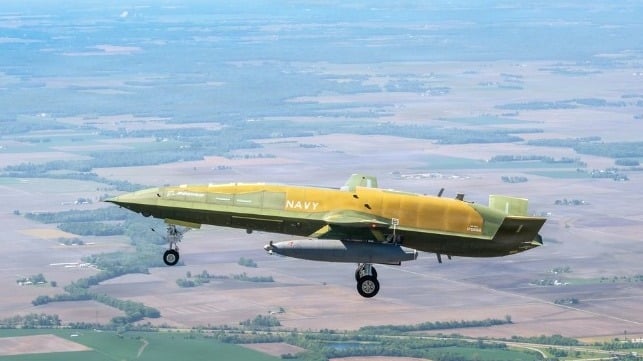
The U.S. Navy's next attempt at an unmanned carrier-borne aircraft took its maiden flight on Saturday, soaring over the skies of southern Illinois. Boeing's first MQ-25A Stingray drone aircraft is now airborne, but it will not be arriving soon: initial operational capability has now been pushed back by three years, from 2026 to 2029, according to USNI. 

The Navy has been working towards adding drones to the carrier air wing for decades. Conceptual planning began in 2000, and a Northrop Grumman X-47A demonstrator took flight for the first time in 2003. A navalized and evolved version, the Northrop X-47B, had its first test flight in 2011. It progressed swiftly to sea trials, and came aboard a carrier for a trial integration in 2014; while declared successful, the test program ended in 2015 without progressing to procurement, and the two demonstrator airframes are in storage. 

The MQ-25A was developed for non-lethal requirements, initially for surveillance and then later for tanking. The tanker mission takes up about a third of a carrier's F/A-18 fighter force, just for aerial refueling; offloading that task onto an unmanned aircraft would free up fighter airframe hours and pilot hours for higher-value tasking. 

The first flight of Boeing's MQ-25 test airframe happened in 2021, and five years later, the Navy and Boeing are celebrating the launch of the first test airframe intended for Navy ownership. Under Navy remote pilotage, the first engineering and development model variant of the MQ-25A took off on Saturday. Three more are planned. 

"Watching our first Navy aircraft complete an autonomous flight underscores what disciplined teamwork and rigorous testing deliver," said Troy Rutherford, VP of the Boeing MQ-25 program, in a company statement. "Together, we are redefining the future of naval aviation and pushing the boundaries of what's possible with autonomy."

The objective is to progress the aircraft's development towards carrier qualifications, which will require relocating the team to Naval Air Station Patuxent River in Maryland. 

There is still much work to be done, according to USNI. The MQ-25A has been slowed down by production issues, the outlet reports, and by scheduling. It was supposed to achieve IOC this year, but will now be pushed back until 2026. 

The U.S. Air Force's foray into manned-unmanned teaming is moving more quickly, and contemplates designs for direct combat roles. There are three contenders for the USAF's first collaborative combat aircraft: the Anduril Fury "loyal wingman" drone, which had its first fight with weapons attached in February; General Atomics' YFQ-42; and Northrop Grumman's Project Talon collaborative combat aircraft.


US Navy Wants to Spend $2B on Foreign Shipbuilding "Study and Procurement"

Hanwha
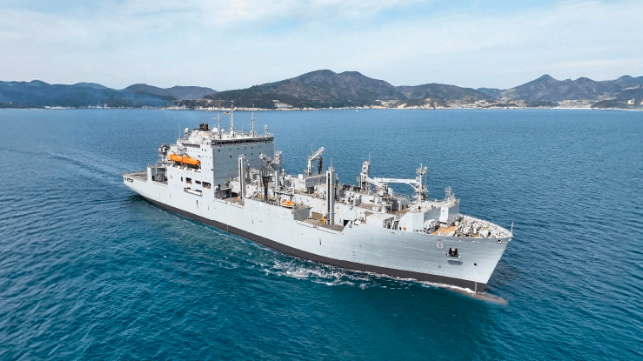
A Military Sealift Command dry stores auxiliary recently restored by Hanwha Ocean at its yard in Korea (Hanwha Ocean)

Published Apr 27, 2026 5:16 PM by The Maritime Executive


The U.S. Navy's next annual budget is going to contain an unheard-of line item: a pair of multibillion-dollar studies of foreign shipbuilding options, USNI reports. The budgets for these "study and procurement efforts" are priced so high that they could easily pay for design, long-lead-time materials and initial construction contract awards, if the Navy were to progress them into a "procurement" effort. The department's detailed plans for the program have not yet been disclosed. 

According to USNI, the FY2027 budget includes $1.85 billion for a pair of R&D studies on the future construction of frigates or destroyers in foreign shipyards, as well as joint foreign-domestic ventures. The general model is that of the Coast Guard's Finnish/Canadian/American icebreaker procurement program, which is buying two different classes of medium icebreakers from two different Finnish shipyards. The first vessels of each design will be built overseas, then the remainder will be built in the U.S. with assistance and technology transfer from foreign partners. The model is intended to attract investment and expertise from overseas, boosting U.S. shipbuilders' ability to produce complex designs with higher efficiency. 

The dismissal of former Navy Secretary John Phelan last week is said to have hinged on the service's perceived lack of progress on getting its shipbuilding programs back on track. All newbuild classes are behind schedule; the next-generation frigate, the Constellation-class, has been canceled; and future orders in the new Ford-class carrier series are reportedly under review. Defense Secretary Pete Hegseth was reportedly frustrated with Phelan's rate of progress in turning the ship around on procurement, and the president is said to have shared his views. 

Just last week, shortly before his ouster, Phelan alluded to the Navy's willingness to look overseas for construction options. At Sea-Air-Space, he told reporters that "everything's on the table," and that the skilled labor shortage in the U.S. required the service to look abroad for help. In Japan and Korea - the two allied nations most qualified to secure contract awards - the same labor shortage problem exists, but the issue is solved by the importation of immigrant labor with guest-worker visas.  

Both Korea and Japan have successfully completed maintenance periods for Military Sealift Command, and both hope to leverage that experience into larger contracts for newbuilds. Korea has experience in delivering Aegis-equipped destroyers, similar if not identical to the U.S. Navy's Arleigh Burke class, and wants to attract orders for high-margin hulls like surface combatants.