It’s possible that I shall make an ass of myself. But in that case one can always get out of it with a little dialectic. I have, of course, so worded my proposition as to be right either way (K.Marx, Letter to F.Engels on the Indian Mutiny)
Saturday, April 05, 2025
Cruise Passenger Charged with Assault After “Barefoot Dancing” Incident
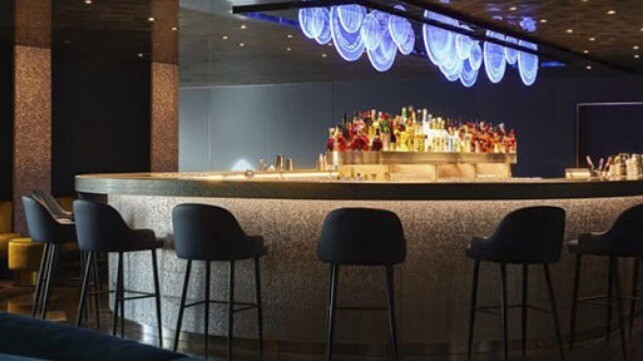
A passenger dancing on the bar reportedly started the incident (Virgin Voyages)
In recent years there have been many reports of passengers acting badly and even a few brawls aboard cruise ships. Agents from the Federal Bureau of Investigations (FBI) and lawyers are confirming the CEO of a California-based title insurance company was charged in San Juan, Puerto Rico this week after an altercation that started with a fellow passenger dancing barefoot on a bar aboard Virgin Voyages’ ship Resilient Lady.
The widely reported incident took place last Monday night, March 31, approximately 70 nautical miles west of Martinique in the Caribbean after the cruise ship had departed bound for San Juan. The exact time was not reported, but it was said to happen in a cocktail lounge called “On The Rocks,” a venue Virgin Voyages bills as a martini and cocktail bar on Deck 6. On its website Virgin Voyages writes, “On the Rocks is the perfect place to make bold choices.”
A passenger only identified by initials in the complaint reportedly was on the bar dancing when Nichol DeGiorgio, made a remark to the order of “Look, we are all grown-ups here – can you put your shoes on?” The irony of course is that the cruise line is associated with Sir Richard Branson, famous for dancing on furniture, and other antics.
The unidentified passenger reportedly responded making crude remarks and an obscene hand gesture to Ms. DeGiorgio. This was later confirmed by the ship’s closed-circuit security cameras with the video handed over to the FBI as evidence.
According to the FBI statement and the complaint filed in the court in Puerto Rico, Kenneth DeGiorgio, age 53, CEO of First American Financial Corporation, confronted the individual who he did not know. He put his hands around the man’s neck and reportedly said he was going to kill the man.
The cruise ship’s captain later confined DeGiorgio to his cabin and handed the matter over to the FBI when the ship reached Puerto Rico. Crimes aboard cruise ships fall under federal jurisdiction.
The reports go on to say that DeGiorgio refused to answer questions from the FBI and requested a lawyer. In a statement, the lawyers are now asserting that he was responding to the actions of an individual who harassed his wife, making her feel threatened and intimidated.
DeGiorgio was charged with a simple misdemeanor. However, if convicted of assault, The New York Times reports he faces up to one year in prison. His lawyers said DeGiorgio “looks forward to being absolved of any wrongdoing.”
Global Cruise Outlook: Building Momentum
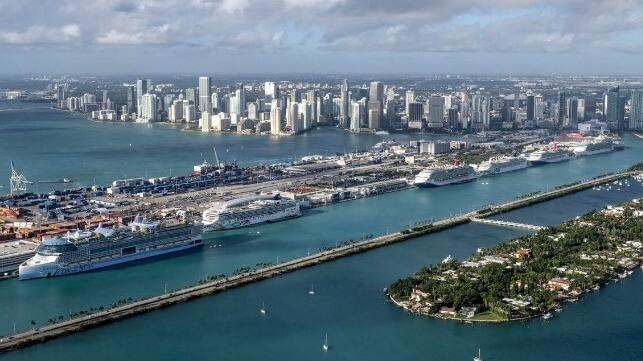
PortMiami set a new record handling more than 8.2 million passengers in FY2024 (PortMiami)
(Article originally published in Jan/Feb 2025 edition.)
Fueled by strong demand, record bookings and higher pricing, the cruise industry soared to new heights in 2024. This year looks even better.
The momentum has been building since the industry’s restart in 2021. After exceeding 2019’s record 30 million passengers in 2023, industry trade group Cruise Lines International Association (CLIA) forecast nearly 10 percent growth or a total of 34.7 million passengers in 2024.
Analysts now believe the industry exceeded 35 million passengers last year, which led CLIA to increase its forecast to 37.3 million passengers in 2025 on the way to approximately 40 million by 2027.
“The industry has experienced a remarkable uplift,” says Dean Van Es, Founder & CEO of Fast Cover Travel Insurance, an Australian-owned and run travel company. “The cruise industry has been going from strength to strength in recent times as many of the sector’s lines have successfully pivoted from an older target market to a younger and more adventurous demographic.”
Something For Everyone
While most analysts believe there continues to be an element of “revenge travel” with people seeking to make up for lost time, most believe cruising is benefitting from consumers prioritizing experiences. The cruise lines have invested heavily in developing their product to compete with land-based resorts and theme parks in order to attract more first-time cruisers and different segments of the market.
Family cruising and multi-generational cruising have become a key part of the market that targets the broader demographics.
Royal Caribbean International, for example, introduced the world’s largest cruise ship, the 248,663-grosston Icon of the Seas in January 2024 with eight “neighborhoods” focused on different segments. In July, it followed with another mega cruise ship, the 5,700-passenger Utopia of the Seas (236,473 gross tons), entering the three and four-day Caribbean market to provide quick escape vacations from Port Canaveral, Florida.
“While a large portion of potential customers once saw cruises as just an excuse to drink by the pool of a fancy ship, an increasing number of travelers now perceive cruises as a way to engage with immersive cultural experiences,” observes Van Es.
The growth has come in all the major segments from the broad market to niches such as expedition voyages to exotic destinations and river cruising. Many travel advisors report a strong increase in interest in the luxury segment of the market.
“Cruises are no longer just for ‘lanyard-clad crowds’ wandering buffet decks,” says LaDell Carter, Founder of Royal Expressions Travel, a travel consultant that helps travelers craft unique experiences. “Today’s ships are redefining sophistication, catering to affluent, discerning travelers seeking exclusivity and convenience. The cruise industry is sailing into an ultra-luxury renaissance,” noting that the experiences are rivaling and surpassing the finest hotels.
The strength of the market has not gone unnoticed by the leading hotel brands.
Ritz-Carlton’s first cruise ship, the Evrima (25,400 gross tons), entered service in October 2022 while the investment group backing it is building two more ultra-luxury cruise ships for the brand. Another investment group is working with Four Seasons, which will launch the first of two yacht cruise ships in 2025. Meanwhile, France’s Accor Group has ordered the world’s largest sailing ship, Orient Express Silenseas (25,600 gross tons), due to launch in 2026.
Higher Prices & Cabin Scarcity
The cruise lines built strong momentum in 2024 with travelers finding ships fully booked and no longer offering last-minute escapes at steep discounts. The booking window also elongated with many travelers reserving trips earlier, prompting the cruise lines to release itineraries scheduled for 2026. Many of the major lines have already published schedules at least into the early part of 2027.
At mid-year 2024, Matt Boss, research analyst at J.P. Morgan, noted, “Demand remains robust with not a single historical lead indicator in the business, notably the booking curve and onboard spend, signaling any softening.”
“If 2025 looks anything like 2024, that is a good thing,” wrote analyst C. Patrick Scholes of Truist Securities in his mid-January report on the outlook for the industry. Based on conversations with industry executives, he stated, “At a high level, the booking and pricing environment remains strong heading into 2025 with early wave season demand by and large described as ‘steady Eddie’ to 2024.”
Scholes says Truist believes the industry is about 20 percent ahead of where it typically is at the start of the year. Historically, he says, the industry was 60 to 65 percent booked by January for the coming year, but this year he estimates it’s closer to 75 percent booked.
One factor that all the industry analysts note is “cabin scarcity” after the industry retired older ships during the pandemic and delayed replacement orders. Scholes says this has contributed to a sense of urgency and a recognition that the longer travelers wait to book, the higher prices will go.
“Post-pandemic, the cruise industry is now looking at a lower supply growth rate across the industry,” adds Robin Farley, senior industry analyst at UBS, in her January 2025 industry outlook report. “We believe it is likely that growth will come in even further below historic rates.”
Capacity Constraints
The capacity constraints, coupled with strong demand, were good news for shipbuilders.
CLIA says member lines introduced eight large ocean-going cruise ships in 2024, adding approximately 26,000 berths to an industry with approximately 600,000 berths. All the ships were orders placed before 2020 and the COVID-19 pandemic. Carnival Corporation, for example, added the first of two large LNG-fueled cruise ships for Princess Cruises and the first newbuild to the Cunard Line brand in 14 years while noting its final pre-pandemic order would be delivered in 2026. Then the brand expects a pause in growth.
The industry is projected to add just four percent to capacity in 2025 – a total of 16 cruise ships – including the first orders placed after the pandemic.
MSC Cruises and Royal Caribbean International will continue the rollout of their mega-ship classes, and in December Disney will put the first mega-ship in Asia, Disney Adventure (208,000 gross tons), into year-round service from Singapore. Japan’s NYK will also introduce the first newly built cruise ship to the Japanese market in more than 30 years.
Driven by renewed confidence, the industry contracted for 35 new ships in 2024 with orders from Carnival Cruise Line, MSC Cruises, Royal Caribbean International and Viking. Disney placed its largest order which will add four company-owned ships plus a fifth from its Japanese partner that owns and operates Tokyo Disneyland and the Tokyo Disney resort.
Both Carnival Cruise Line and Norwegian Cruise Line will build ships exceeding the 200,000-gross-ton mark and, showing long-term confidence, placed orders due for delivery in the early 2030s.
Technology and Sustainability
“The sector is poised for significant evolution, shaped by technological advancements, a growing emphasis on sustainability and shifting consumer preferences,” highlights Columbia Cruise Services, the cruise management business within the Columbia Shipmanagement Group. Columbia points to the use of technology to create “smart ships” which will offer improved efficiency and personalization through AI, and improved onboard experience with high-speed Internet access via satellite systems.
Seeing an opportunity with the increased focus on sustainability, shipbuilder Concordia Damen is expanding from its traditional base of inland shipping to the river cruise segment.
The builder delivered its first river cruise ship, Arosa Sena, in 2022, and recently announced the first of a new generation of hybrid vessels that are more efficient and produce lower emissions for a Swiss luxury river cruise operator. The vessel features lower deadweight to provide a shallower draft, diesel-electric propulsion with smart, peak-shaving battery technology, and the integration of solar panels in the railing to charge the batteries.
Concordia Damen says its confidence in the market is demonstrated by its decision to build stock hulls to provide river cruise companies the ability to introduce a new vessel in nine months while also customizing it to their specifications. The company also recently expanded its facilities in the Netherlands so that it has the capacity to construct up to four river cruise vessels annually and conduct vessel refits.
In addition to newbuilds, it sees retrofit opportunities for making vessels more sustainable in areas such as propulsion systems, “recyclable interiors,” heat recovery and energy systems. Another part of the group, Damen Shiprepair, plays a similar role, providing overhaul and refit services for ocean-going cruise ships.
Good Vibes
The cruise industry enters 2025 with momentum. Truist’s Scholes reports continuing to feel “good vibes” after a January meeting with management at the Florida-based companies. He looks for the industry to move forward with the development of its private island destinations to drive growth and financial results. He notes the industry also continues its focus on debt reduction to improve its post-pandemic balance sheets.
“All signs point to another strong year for cruise fundamentals,” reports Brandt Montour, research analyst at Barclays. “We think the cruise recovery is in the 6th or 7th inning and expect another year of share outperformance in 2025.” – MarEx
Allan Jordan is the magazine’s Associate Editor. The original article appears in The Maritime Executive annual cruise edition.
The opinions expressed herein are the author's and not necessarily those of The Maritime Executive.
Seahaven: Redefining Cruise Ship Safety and Unlocking Revenue Potential
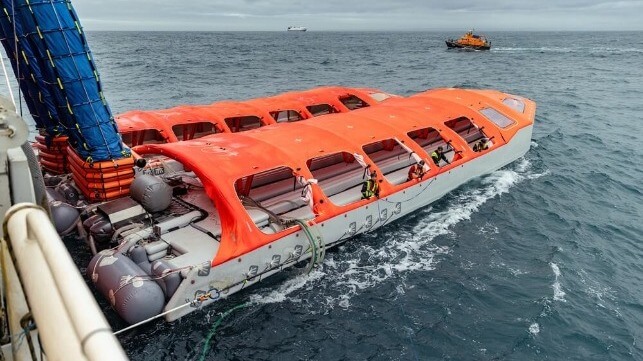
In an era where safety, efficiency, and commercial viability define the cruise industry's trajectory, Survitec's Seahaven system emerges as a groundbreaking innovation. The world's largest inflatable lifeboat, Seahaven, is setting new benchmarks in passenger safety, vessel optimisation, and operational effectiveness.
The Future of Cruise Ship Safety and Efficiency
Cruise ship design has long been constrained by the bulk and complexity of traditional davit-launched lifeboats. While these lifeboats fulfil regulatory safety requirements, they often limit vessel design flexibility and consume valuable deck space that could be better utilised for passenger accommodations and entertainment. Enter Seahaven—a fully automated evacuation system that ensures unparalleled safety compliance and enables cruise operators to rethink how they use space aboard their vessels.
Survitec’s white paper, "Seahaven Application Study," delves deeply into the impact of integrating this revolutionary lifeboat system into modern cruise ship designs. Conducted by the naval architect firm Foreship, the study evaluates four primary configurations for implementing Seahaven, assessing its ability to enhance vessel layout, optimise weight distribution, and improve operational efficiency.
Transforming Ship Design: More Space, More Revenue
One of Seahaven's most significant advantages is its ability to free up deck space. Unlike traditional lifeboat systems, which require extensive vertical and longitudinal space, Seahaven's compact design minimises bridge overhang and enhances visibility. This feature is particularly beneficial for vessels navigating constrained waterways such as the Panama Canal.
For shipowners, the repurposing of space enabled by Seahaven presents lucrative opportunities. With bulky davit-launched lifeboats removed, operators can introduce additional balcony cabins, extend entertainment areas, or incorporate new leisure facilities—all of which enhance the guest experience and generate additional revenue. For medium-sized cruise ships, the transformation could mean converting interior cabins into sought-after balcony staterooms. At the same time, larger vessels could utilise the space savings to redesign public areas and incorporate innovative onboard attractions.
Safety and Compliance: Meeting the Highest Standards
Beyond the commercial advantages, Seahaven represents a significant leap forward in maritime safety. With the capacity to evacuate up to 1,060 passengers in under 22 minutes, this system eliminates the complexities of traditional davit and release-hook mechanisms. It has undergone extensive heavy-weather sea trials, successfully operating in conditions exceeding Beaufort Scale 6, reinforcing its reliability under real-world emergency scenarios.
In addition, Seahaven aligns seamlessly with SOLAS (Safety of Life at Sea) regulations. The system has been tested for deployment on vessels with up to a 20-degree heel, ensuring compliance with international safety standards. The white paper presents a detailed capacity analysis confirming Seahaven’s suitability for various ship sizes, demonstrating its adaptability and effectiveness across different cruise vessels.
Reducing Operational Costs and Streamlining Crew Training
Seahaven improves ship design and streamlines operational processes. Traditional lifeboat systems require extensive maintenance, regular inspections, and complex crew training for safe operation. By contrast, Seahaven’s automated deployment mechanism significantly reduces maintenance costs and minimises the need for intensive crew training. This translates to lower long-term operational expenses and enhanced safety assurance.
“Beyond delivering safety performance, Seahaven enables shipowners to optimise their fleets with improved design flexibility, greater operational efficiencies, and enhanced commercial potential,” says Claude Sada, Chief Operating Officer at Survitec.
Adapting to the Evolving Needs of the Cruise Industry
The cruise industry is continuously evolving, with an increasing emphasis on safety, sustainability, and guest experience. Since achieving Lloyd’s Register type approval in 2022, Seahaven has gained traction among shipbuilders and operators seeking to future-proof their fleets. As regulations become more stringent and passengers demand more luxurious onboard experiences, Seahaven represents a smart investment in both compliance and competitiveness.
The study also highlights Seahaven's adaptability across multiple deployment configurations, including hybrid solutions that integrate Marine Evacuation Systems (MES) and tender lifeboats. This level of flexibility enables cruise operators to tailor their safety solutions while maintaining operational efficiency.
Conclusion: The Time to Act is Now
Seahaven offers an unprecedented opportunity for shipowners and operators looking to stay ahead in an increasingly competitive and regulated industry. By enhancing safety, unlocking additional revenue potential, and improving operational efficiency, this innovative system is paving the way for the future of cruise ship design.
Download the white paper today to explore the full findings of the Seahaven Application Study and understand how Seahaven can transform your fleet.

No comments:
Post a Comment