Crazy Flows the Don
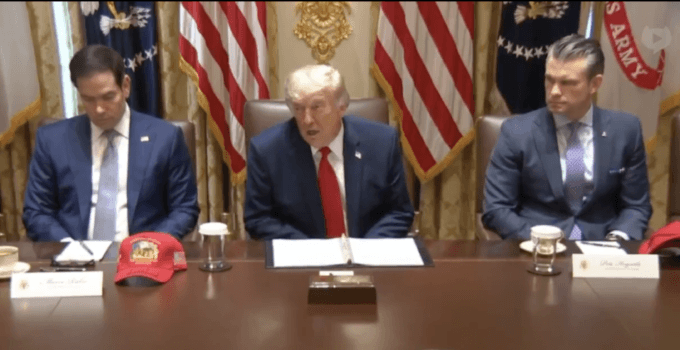
Screengrab from White House video posted to X.
Leaving aside the amen choir in hard-core MAGA circles, is there anyone out there who doesn’t think Donald Trump is bat-shit crazy? How much more evidence is needed before he is gold-chained to the wall of a padded cell?
The midnight tweets of himself as a cartoon action figure are sufficient proof of cognitive disorientation, but at the state level, we have the course of the war in Iran, which, if laid out on a medical chart, would indicate that American foreign policy is being dictated by someone capable of hiding their own Easter eggs.
+++
The war in Iran did not begin after a new Iranian threat or after a congressional resolution; it began as everything does in Trumptopia—with either a billionaire whispering bizarre sweet nothings into Trump’s ear (between DJ sets at Mar-a-Lago) or as a result of a ninety-minute phone call with Vladimir Putin or Benjamin Netanyahu.
It was Netanyahu who dog-whispered Trump into an air campaign over the Persian Gulf, and subsequently, Trump’s reasons for the Iranian war have bounced from regime change and dealing with terrorists to destroying Iran’s nuclear capability to opening the Strait of Hormuz.
Despite waging such a war, you can be sure—given Trump’s addled brain—that he remains clueless about the geography of the Middle East, the alignment of the various coalitions, or the strategic dilemmas now facing the United States as it tries to put the oil genie back in the $2 gallon of gasoline.
As happens with persons suffering from dementia (and there are many forms, as all of us know from our families), Trump’s earlier impulses have become more exaggerated, the further his mind drifts down the rabbit hole. (I bet that on some bad days, he does not remember that there’s even a war going on.)
Trump was always impulsive (sexually and mentally), but now his impulses come with aircraft carriers and cruise missiles.
+++
In the negotiations to end the war in Iran, the only frame of reference in Trump’s mind is some long-ago Manhattan real estate deal where, if you shout loud enough and long enough, you might just end up with the corner lot at a discount price.
At the same time, we know from Trump’s legacy of bankruptcies that, more often than not, his style of negotiation has led him to failure. And that was when he was in his fifties; now in his eighties, with his mind in free fall, for the most part Trump is negotiating with himself.
When Trump first sent family retainers JD Vance, Jared Kushner, and Steve Witkoff to Islamabad to negotiate with the Iranians, he telephoned Vance some 12 times during the talks (in the middle of the night, Washington D.C. time), which I am sure is one reason why those negotiations and those that have followed have never gone anywhere.
Imagine on one hand, having to negotiate with the Iranians, and on the other, get instructions from Trump. In the latest go-round, Trump has sent the draft peace plan to all “concerned parties,” including Israel, an easy way to ensure it fails.
+++
It does not help the American cause (justice and liberty, not what we have now, which is rape and pillage) that the addled Trump cannot keep straight our friends and our enemies.
He somehow thinks that Israel is helping the United States in the Middle East (not simply wagging its own dog), just as he’s in a muddle about Oman (a traditional ally) and the long game of the Saudis (which is to turn Trump into an off-balance sheet asset of its sovereign wealth fund).
In many ways, the president is another Donny (from The Big Lebowski—itself a film about American ineptitude in the Middle East), to whom Walter Sobchak says: “So you have no frame of reference here, Donny. You’re like a child who wanders into the middle of a movie and wants to know…”
All Trump really can keep in focus is who has promised to pay him money, and my guess is that the short list includes Qatar, Israel, Saudi Arabia, and Russia. The rest of the world might just as well be plumbers in Atlantic City who can easily get stiffed on payday.
+++
Without either memory, a frame of reference, core values, or access to history, the demented Trump clings to his “notions” as if they were toys on his nursery floor—something to throw around for a while at the other kids until he gets bored or Daddy’s chauffeur comes to collect him.
Take these examples of how often the president has indulged in changing whims:
—In 2024 Trump ran for the presidency as a Woodrow Wilson Democrat (“He kept us out of war…”) but then once in office behaved like a cross between William McKinley and William Randolph Hearst (“You furnish the pictures, and I’ll furnish the war…”);
—In the Iranian war, Russia’s intelligence agencies helped Iran to target U.S. troops in the field, but then Trump rewarded Putin’s Russia by lifting sanctions on its oil exports and withdrawing American support for Ukraine and NATO;
—In the broader Middle East—because Trump senses a chance for a few golf resorts in Gaza—he has aligned American policies with Israel’s genocide and then, for good measure, made American customers hostage to the fortunes of the OPEC cartel (which, lest we forget, has Trump and his sons in its deep pockets).
+++
None of these positions adds up to a calculated policy, for the simple reason that Trump himself is incapable of coherent thought. Call it frontotemporal dementia, malignant narcissism, or old style psychosis, but whatever Trump has, his mind no longer functions.
He can send out tweets at midnight of himself as Jesus or a Jedi knight; he can march around a parade ground with Putin, Xi, or King Charles; and he can answer a few questions with airplane engines running in the background, but, despite gambling with the future of American civilization by threatening nuclear war in Iran, he cannot discuss Seven Pillars of Wisdom, Mohammad Mosaddegh, or the Treaty of Sèvres and Sykes-Picot.
Trump can neither read nor write (other than his name with a Sharpie), and I suspect that the day after he has met a world leader (take the dance extravaganza in Beijing) he recalls no details of the meeting, and a week later will say to some aide: “Why don’t we ever have a summit with the Chinese?”
Even more amazing is that Washington D.C. is full of people earning fat salaries to govern the nation, and yet a majority in Congress or on the Supreme Court refuses to act, even when the president spends most of his days and nights barking/tweeting at the moon.
Donald (Disaster) Trump And the Fight for a Humane Future
Image by charlesdeluvio.
Donald Trump’s America is a scary place in significant part thanks to an unholy alliance of MAGA devotees who don’t believe in science and see intellectuals as public enemy number one, and a gaggle of Silicon Valley militarists who think that they’re the smartest people in the room, if not the universe. Add in White Christian nationalists who abuse religious precepts to sow hatred and division and you have the foundations of the political base that elected Donald Trump (twice!). And worse yet, those groupings are likely to be with us long after our current president has gone off to that great cheeseburger stand in the sky.
Still, it’s worth reflecting on whether such an odd coalition of allies can survive without Donald Trump, or even with a president whose policies have become so harmful and irrational that they’re doing severe human and economic damage even to his most loyal supporters (not to mention the rest of us). And it’s also worth considering whether the pillars of the MAGA movement can manage to stick together in the ever-grimmer Trumpian years to come, not to speak of the post-Trumpian ones, or whether the rest of us can organize a powerful, humane alternative to his politics of hatred and division that could transform this country and the world.
The Know-Nothings Meet the Know-It-Alls
As a start, we have the latter-day “Know Nothings,” a term borrowed from a nineteenth century political movement. It’s not that members of that group literally know nothing. Some of them are quite skilled in their given professions and astute at assessing certain kinds of situations. Some are intelligent but woefully misguided. Trump supporter and former Secretary of Housing and Urban Development Ben Carson, for example, is a brain surgeon.
Members of the anti-science crowd are also often very good at communicating their messages, however wrongheaded or offensive they may be. The problem isn’t that they can’t take in information; it’s that they are distinctly anti-knowledge when it comes to, among other things, separating compelling conspiracy theories from well-documented facts.
The results of their ingrained antagonism toward basic knowledge are profound, making them a threat to public health and democratic practices. After all, we now live in a country where millions of people are against vaccinating their children to prevent potentially deadly diseases and don’t believe that perhaps the gravest threat to continuing life on this planet — climate change — is caused, or even influenced, by human activity or perhaps is even happening at all.
The dangerous delusions of Trump Secretary of Health Robert F. Kennedy, Jr., now have the stamp of government approval and the power of the U. S. government behind them. There is no way to estimate how many people have already fallen sick or even died unnecessarily due to the implementation of his crackpot theories, but the numbers will undoubtedly be significant. The American Public Health Association captured the grim mood of our moment perfectly in an April 2025 press release entitled “Secretary Kennedy and His Policies Are a Danger to the Public Health.”
On a different spiritual plane, tens of millions of Americans believe in the rapture — the notion that they and their kind will be called up to heaven in the end days, while the rest of us will be left behind, presumably to burn in hell (but not a climate-change version of the same). A 2022 Pew poll found that 39% of Americans believe “we are in the end times.” Already! And such a belief, of course, has an impact on how or even whether one wants to devote time and energy to fixing problems here on Earth.
Such an amalgam of opponents of science and skeptics about basic reality bears a distinct resemblance to the “Know Nothing” movement of the nineteenth century that thrived on anti-immigrant sentiments and half-baked conspiracy theories.
The anti-intellectual faction on the right has been propagandized for decades to believe that the biggest obstacle to a better life for them and their families isn’t the predatory corporations hollowing out our economy and manipulating our democracy, but a group of liberal intellectuals clustered on both coasts who allegedly want to replace this country’s bedrock beliefs with a set of “politically correct” prescriptions about how they should live their lives, especially when it comes to DEI or diversity, equity, and inclusion. In such a rendering of reality, that “new class” is seen as sapping the country’s strength and undermining the basic values that would make America great (again!).
The use of that “new class” as a political epithet emerged from the neoconservative movement of the 1960s and 1970s, as Andrew Hartman has explained at his blog on American intellectual history:
“Out of their political repositioning in the late 1960s and 1970s, neoconservatives developed a critical theory (co-opted from anti-Stalinist thinking) about a so-called ‘new class’ of intellectuals, broadly defined to include all professionals tasked with manipulating language — although more narrowly applied to humanists and social scientists. Members of this ‘new class,’ so the theory went, had turned their backs on the society to which they owed their high-ranking status.”
However, the current Trumpian war on DEI should be considered an extension of a longstanding conservative effort to distract Americans from the real sources of their problems by promoting a politics of division and hatred. Mainstream accounts of the drive to eradicate concerns about diversity, equity, and inclusion from public life rarely point out that fighting DEI can fairly be characterized as fighting to make racism, misogyny, and anti-gay and anti-trans discrimination ever more acceptable in the sort of open, unapologetic fashion that prevailed before the modern-day civil rights, women’s rights, and gay rights movements gained strength.
The crusade — and it’s nothing less than that — against DEI needs to be called out for what it is, not treated as some sort of skirmish over language. And rather than DEI programs that stop at raising tough questions about America’s long history of systematic discrimination, what’s needed are programs that truly change people’s lives by creating better-paying jobs and affordable, quality health care for all, regardless of race, gender, class status, or faith. Getting there will, however, require a flowering of faith of another kind — not religious faith, but faith that we can construct an accountable government that serves the public interest, rather than, as in the present age of Donald Trump, the interests of corporations and inhumane ideologues.
Silicon Valley Saviors
In contrast to the “know nothing” faction of the political right in America is the “know it all” faction — Silicon Valley billionaires like Peter Thiel, Alex Karp, Elon Musk, and Palmer Luckey. They view themselves not just as business executives cashing in on the latest trend, but as superior beings who should be running the planet. They promise better living through technology and, as new age militarists, see robotic weapons as the future of warfare. But the idea that such new technologies will inevitably change our lives for the better or protect us from the worst has, at best, a mixed record. It depends, of course, on just who is using such technologies and for what purpose.
In addition to owning companies that create new systems grounded in artificial intelligence and machine learning, the new age militarists are angling to shape our foreign policy, our federal budget, and the future of our democracy. They literally want to become masters of the universe by figuring out how to live forever and promote the colonization of space. They dream of video games in which, as Palmer Luckey put it, “if you die in the game, you die in real life.”
The political reach of the Silicon Valley crowd has grown dramatically in the age of Donald Trump. JD Vance, his vice president, was, of course, groomed and financed by Peter Thiel, the founder of the omnipresent firm Palantir, which provides technology to patrol the border, helps ICE identify suspects, and has provided software to Israel that its leaders have used to step up the pace of bombing in their genocidal war in Gaza. After a stint at one of Thiel’s venture capital firms, Vance won a Senate election in Ohio with major financial backing from him and his allies.
When Trump chose Vance as his running mate, champagne corks popped in Silicon Valley and the money started flowing to help Trump get elected, including up to a quarter of a billion dollars in dark money from Elon Musk. As a result, Silicon Valley now has its man in the executive branch.
Nor is Vance alone. Former employees of tech firms like SpaceX and Anduril are now embedded in key agencies of the federal government, and Secretary of — yes! — War Pete Hegseth has gone all in on integrating AI into U.S. military planning and practice to the delight of the billionaire tech moguls and their hangers-on.
To say that Thiel, Musk, Palmer Luckey, Alex Karp, and their financiers like Marc Andreessen of the venture capital firm Andreessen Horowitz have a high opinion of themselves — and of the potential of the technology their companies produce — would distinctly be an understatement.
Kathryn Boyle of Andreessen Horowitz, a self-appointed chief ideologist and cheerleader for the Silicon Valley tech takeover of America, gave a speech to the conservative American Enterprise Institute in February 2025 that analyst Gil Duran described as an effort to “equate most government actions with communist dictatorships… while positioning tech bros as the ordained saviors of the traditional family.” Boyle’s bread and butter argument — call it a potentially fatal kind of narcissism — was that only the “founders” (yes, they call themselves that!) are serious enough, skilled enough, and endowed by their creator with enough persistence to solve and reverse America’s imperial decline. The rest of us should just get out of the way and let the new techno-gods do their work.
Will Trump’s Patchwork Quilt Come Apart at the Seams?
The Trump coalition is a strange kaleidoscope of confusing views and contradictory cover stories: the know-nothings; the know-it-alls; the false prophets of White Christian nationalism, the billionaires and millionaires, the people who (once upon a time) watched too many episodes of The Apprentice and think Trump is a good businessman; those who want yet another tax break; those men among us who want to control what women do with their bodies, and the (mostly) men who feel liberated because Trump openly and repeatedly makes racist, sexist, anti-gay, and anti-trans statements, legitimizing vocal expressions of prejudice in a way not seen in decades.
Yes, his is a motley crew, but so far they have rallied around the president, no matter the promises he breaks or the harmful policies he jams down all of our throats (policies that could ultimately hit many diehard Trump supporters who aren’t billionaires as hard or harder than they will hit his opponents). Fortunately, there are at least signs that his ability to thrive politically (even as his policies drive America into a ditch) may be fading. His brutal, illogical, illegal, ill-defined war on Iran — complete with genocidal rhetoric about ending an entire civilization — may be the beginning of the end of his grasp of our politics and our psyche.
Unfortunately, he may be as much a symptom of what’s wrong with America as he is a producer of deep damage to the future prospects of democratic governance and human cooperation in this country and on this planet.
Which Way Out?
Any resistance to such know-nothingism and incipient technofascism must start on a human scale. If we are ever going to build a tolerant, welcoming nation that meets the basic needs of its residents, while leaving ample room for scientific inquiry and creative endeavors of all sorts, we need to get off our machines and start talking to — and crucially, listening to — each other.
This is already happening more widely than you might imagine if you’re a prisoner of your news feed. And it’s happening not just in large gatherings like the No Kings rallies, but in local organizing around schools and housing, voter registration and education efforts, and attempts to help communities survive the double-injury of runaway capitalism and the shredding of the social safety net thanks, at least in part, to Donald Trump’s “Big Beautiful Bill” (which is the ugliest, most inhumane piece of legislation in living memory).
We need to fight on at least three fronts — economically, politically, and culturally. Senator Bernie Sanders has shown just how a truly populist economic program could draw support even among diehard MAGA backers, and such a program is a necessity if we are ever to dig our way out of our current predicament.
But economics is hardly the only problem we have. There’s also the reality of racism to contend with, not to speak of a thriving anti-immigrant sensibility, and misogyny, as well as anti-gay and anti-trans discrimination — all deeply embedded in a nation that was founded as a colonial enterprise fueled by slavery and genocide. Such a history has to be transcended by embracing the values and elevating the leadership of the people most impacted by the legacy of America’s repressive past, while building a new culture based on tolerance, respect, and (yes!) love for our fellow human beings.
To be clear (as President Barack Obama would often say), by “transcend” I don’t mean ignore. We must fully acknowledge and seriously commit our society to repairing the crimes embedded in our development as a nation, not to speak of those being committed right now in Donald Trump’s America against so many of us and our planet as well.
And sadly, it’s all too obvious that coming together to save this planet and retain our basic humanity will not be easy. People are messy and, frankly, can be a pain to deal with (yours truly included). We are, however, all we have, and making the effort will matter.
I believe in the saying, attributed to leaders of the Wobblies (the radical union founded in 1905 and known formally as the Industrial Workers of the World), that we must sow the seeds of any new society in the shell of the old one. The way we treat each other in our homes, workplaces, schools, sites of worship, and other public and private spaces will determine whether we can build a better world or are fated to live in a never-endingly Trumpian one. In that context, it’s important not just to speak truth to power, but to begin trying to create alternative sources of power and good ideas aren’t enough for that. (If they were, we would already be living in a far better world.)
Building alternative power and charting a path to such a world will be a distinctly collective undertaking. A handful of charismatic leaders or courageous organizers can’t do it for us. We all need to be leaders since we are all experts (in the sense of knowing our communities and our bits of the world).
There are no guarantees in life, but in this disastrous Trumpian universe of ours, fighting the power should feel far more fulfilling than bending the knee, and if enough of us join that fight, we at least have a shot at building a society and a world worth sustaining for generations to come.
What are we waiting for?
This piece first appeared on TomDispatch.

No comments:
Post a Comment