Gen. Strangelove or: How I Learned that DC Never Changes and Almost No One Understands Russia’s War in Ukraine
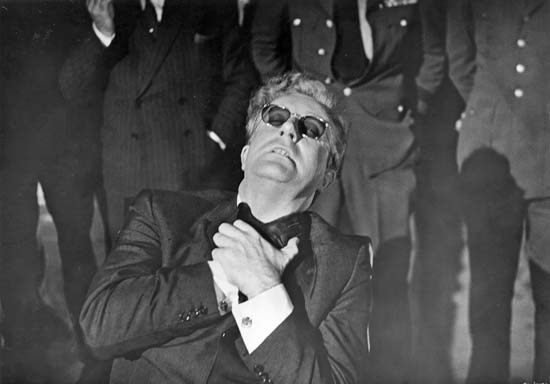
Dr. Strangelove trying to resist his alien hand – Public Domain
Last month, I had the opportunity to give a talk at a US university as part of a conference where many of the speakers were dredged directly from the gelatinous goop that produces each successive generation of State Department apparatchiks and DC think tank flunkies. I was something of an outlier as I came with a presentation all about the decline of US power in the age of so-called “multipolarity” and the ways in which US criminality over the last 40 years has created the conditions for it.
As you might imagine, the right-wing Republicans with whom I was on the panel had little interest in anything I had to say. They were veterans of the George W. Bush, Trump 1, and Biden administrations whose views seemed to range from neoconservative to stridently neoconservative with very little in the way of analysis of US power abroad, the alleged theme of the panel discussion. Be that as it may, I’d like to provide some basic observations about the human beings that form the machinery of the US state and the decaying imperial apparatus in 2026, and how we should understand US power today.
First, there was the featured speaker, a retired Brigadier General in the US Army. This extremely forgettable man — literally his name would easily escape me had I not written it down for later use — stood in a lecture hall of about 75 people to deliver a presentation on the war in Ukraine that managed to discuss neither the actual war in Ukraine nor any of the political context that surrounds it. Instead, he spent roughly thirty minutes proudly showing photos of the medical equipment he bought for Ukrainian troops with money bagged from his wealthy golf pals and fawning Wall Street donors. From there, he proceeded to spend about fifteen more minutes describing the battlefield, Ukrainian materiel and their needs, and the ways in which the US could do much more to help.
But then he spent a little time discussing the ineptness of the Russian military, its outdated and poorly maintained equipment, and the general disorganization of the Russian armed forces. No argument from me.
From there, he waxed moronic about China and their growing military capabilities which this strategic genius regards as paling in comparison with the US. I could see where this was going…
Then came the mineshaft gap; the moment when the comically stupid becomes inconceivably dangerous.
This general – a man who reached the highest echelons of the US military – calmly and nonchalantly proclaimed that the US could “easily take out both Russia and China if it wanted to.” As I picked my jaw off the floor and restrained myself from screaming out, I listened intently as he described the nuclear double-strikes required to take out reinforced Soviet era nuclear silos, and the alleged ability of the US to mitigate the risk of nuclear retaliation and global war through first strikes and diplomacy.
This military pre-vert was describing a global war scenario instigated by the US that would devastate most of humanity; he was gleefully painting the picture of a postwar world of peace. Such is the thinking of the truly depraved ladder-climbers that become “Our Trusted Military Leaders.” These are the creatures that the delusional Liberal fantasizes will one day march into the Oval Office and remove the degenerate-in-chief on 25th Amendment grounds.
The basic takeaways from this presentation were:
1. Neocon millenarianism is alive and well throughout the military leadership and broader institutions of the State. Despite the old cast of ghouls like Cheney and Rumsfeld thankfully dying out, their proteges and intellectual descendants continue to infect the US establishment.
2. Military experts whose entire career is now discussing the war in Ukraine don’t understand the first thing about the war. They know nothing of the internal politics in the years leading up to the war. They have little understanding of post-Soviet history, the 1990s, the development of post-Soviet states, the oligarch class and the intra- and trans-national oligarchic struggle that forms a major part of the context for the war, etc.
3. Today’s undergraduate and graduate students being groomed for the machinery of Empire have absolutely no concept or fear of global war and nuclear annihilation. Those fears, which represented the core of Cold War anxiety, were in many ways a useful residue of the carnage of World Wars I and II. In the years since those generations have died out, the collective memory of what global war actually means seems to have faded to the point where, today, the suggestion of nuclear first strike against both Russia and China barely register a comment, let alone angry protests. This lack of fear is worrying, to say the least.
The next day was the panel discussion. As I mentioned, my presentation focused on the concept of the “Multipolar World” and the ways in which the decline in US power abroad has been driven by the US’s criminality in how it has expressed and projected its power over the last 35 years. But that’s perhaps a discussion for another day. Instead, I’d like to give brief sketches of the other presenters:
+ Speaker 1 was a State Department flunky (uh, I mean, adviser) whose stated career achievements seemed to be attending cocktail parties and being a highly placed middleman who only occasionally wiped the asses of highly placed neocon ideologues in the Bush, Trump and Biden administrations; all the while masquerading as a diplomat while lobbying for Gulf monarchies.
Speaking in a some undefinable WASPo-European accent that accurately captured the pompous arrogance of the man, he managed to stand before a group of graduate students for about 15 minutes and tell them nothing at all beyond how to wade through shit and call it a career. He’s now one of the leading
pro-Zionist“anti-antisemitism” figures today, a senior adviser to the State Department’s office “combatting antisemitism.”[Aside: You should’ve seen the look on his face and the way he reacted when I told him I have written and produced podcasts for CounterPunch for many years. If nothing else, I can attest to the fact that CounterPunch pisses off all the right people.]
+ Speaker 2 was a woman from a right-wing think tank whose primary career accomplishments were working for Nikki Haley while she was UN Ambassador. While she was less insufferable than Speaker 1, her understanding of global affairs was no less dim.
At one point, she discussed US policy in Africa and counterterrorism in the Sahel. So, naturally, I mentioned the abject disaster and crime of the US-NATO war on Libya and how the repercussions of that are still being felt, and that it is a direct origin for most of the regional instability today. She was taken aback that I pushed back on her nonsense at all and then attempted to make a point that sounded like someone talking underwater. So, I then said “Yes, well, I and many others predicted at the time that all this would happen, that the region would go up in flames after they toppled Gaddafi and destroyed Libya, plunging it into more than a decade of civil war.” Silence for a moment.
Then her priceless response. “Well, if you have such powerful insights, why aren’t you inside the Government?” I don’t think she was prepared for me to respond with derisive laughter or a comment like “Same reason I don’t go to work for the mob despite my love of gambling.”
At which point I proceeded to explain to her about the Movement for the Liberation of Azawad and the relationship between the Tuareg peoples and the Gaddafi regime, and how anyone could predict that a war that ended the Libyan Arab Jamahiriya of Gaddafi would also lead to mass expulsion of Tuaregs who were afforded some state protections under Gaddafi’s state. While still victims of discrimination and lacking full citizenship rights, the Tuaregs carved out a productive existence in Gaddafi’s Libya, able to work throughout the country and send money to their families.
“A basic understanding of these facts,” I told her, “made the outcome of all this the easiest thing in the world to predict.” I don’t think she liked my answer.
At the panel discussion, this “Latin America and Africa specialist with years of experience at the United Nations” admitted she speaks neither Spanish nor French and that she knows very little about either region. It was the most honest thing I heard all day.
+ Speaker 3 was so forgettable I’ve basically forgotten everything about him. He mentioned his time at the National Security Council and dished out some inside baseball tips for the grad students about policy and process and bureaucracy and how it worked under Bush and Biden versus Trump. Mostly, he seemed liked a stuffy bureaucrat who knew how to smile and shake my hand and be polite without making much of an impression or letting on his hatred for people like me.
To be clear, the only reason I’m being intentionally vague about these people is because I was invited by a good friend on the faculty who wished to counter the conference’s center-right ideological bias but who could potentially face professional repercussions from some of the things I’ve written above.
In the end, it was a positive experience, one that reminded me exactly what kind of political space I inhabit, and what state power in the US actually looks like in human form.
Who’s Really Calling the Shots in Washington?

Photo by Uladzislau Petrushkevich
Who is actually running the government?
That is no longer a rhetorical question.
As America’s war with Iran lurches from escalation to ceasefire to renewed threats of military force, Americans are being asked to trust that someone, somewhere, knows what they are doing.
But who?
This is the constitutional crisis hiding in plain sight.
The question is not merely whether Donald Trump is fit to lead. The question is whether any president still leads in any meaningful constitutional sense once the permanent war government gets moving.
The Iran war is merely the latest test case.
If the war machine keeps moving even when the public cannot tell who is steering it, then what remains of constitutional government?
This is the nightmare Rod Serling warned about in Seven Days in May.
Seven Days In May : Bailey, Charles : Free Download, Borrow, and...
Released in 1964, Seven Days in May imagined a dramatic military coup: generals plotting in secret to overthrow an unpopular president because they believed they knew better than the American people what was best for the nation.
The coup is eventually foiled. The republic is saved. The Constitution survives.
At least on screen.
In the real world, the plot has thickened and spread out over decades.
The old fear was that the military might seize power from the civilian government.
The modern reality is that the permanent government does not need to seize power.
It already has it.
The coup no longer requires generals in smoke-filled rooms plotting to overthrow the president at midnight. It does not require tanks on Pennsylvania Avenue or soldiers storming the Capitol. It does not even require an official suspension of the Constitution.
All it requires is secrecy, fear, endless war, executive power, emergency declarations, classified intelligence, compliant courts, cowardly legislators, corporate profiteers, militarized police, and a public too distracted, exhausted or frightened to resist.
That coup has been underway for decades.
It is the coup that occurs when Congress surrenders its war powers to the president.
It is the coup that occurs when presidents of both parties wage war without meaningful constitutional authorization.
It is the coup that occurs when intelligence agencies spy on the American people and then hide behind national security.
It is the coup that occurs when federal agencies arm themselves like military units.
It is the coup that occurs when local police are transformed into extensions of the military.
It is the coup that occurs when whistleblowers are punished, dissenters are surveilled, protesters are treated like enemies, and the public is told to trust whatever version of events the government chooses to release.
It is the coup that occurs when unelected bureaucrats, contractors, data brokers, intelligence analysts, defense executives and crisis managers exercise more practical control over government policy than the voters do.
This is how freedom disappears: not all at once, not in one dramatic seizure of power, but incrementally, bureaucratically, profitably and in the name of national security.
Dwight D. Eisenhower warned us about this in 1961.
A five-star general who understood war better than most modern politicians ever will, Eisenhower cautioned Americans to “guard against the acquisition of unwarranted influence, whether sought or unsought, by the military industrial complex.” The danger, he warned, was that “misplaced power” would endanger liberty and democratic processes.
He was right.
The military industrial complex has become one of the most powerful governing forces in America.
This is not a left-right problem.
Both parties built this.
Republicans and Democrats alike have funded the wars, renewed the surveillance powers, armed the police, expanded executive authority, protected intelligence agencies, rewarded defense contractors, and treated the Constitution as an inconvenience whenever fear could be used to silence dissent.
One president abuses power. The next one inherits it. The next one expands it. The next one normalizes it. The next one weaponizes it.
This is how emergency powers become everyday powers.
This is how temporary measures become permanent law.
This is how the president becomes a king in all but name.
And this is how the people become spectators in their own government.
This is exactly where we are.
We have allowed the government to wage war without declarations of war.
We have allowed intelligence agencies to operate behind walls of secrecy.
We have allowed presidents to rule by executive order.
We have allowed Congress to become a spectator.
We have allowed the courts to defer to national security.
We have allowed police to become soldiers.
We have allowed corporations to profit from fear.
We have allowed unelected officials to make decisions that alter the course of the nation.
And then we act surprised when no one seems to know who is actually in charge.
The answer is as obvious as it is disturbing.
The permanent war government is in charge.
This is the coup that does not end.
This is the lesson of our age: the greatest threat to freedom is not always a madman seizing power in a single moment of crisis. Sometimes it is a bureaucracy that never sleeps, a war machine that never stops, a security state that never shrinks, and a political class that never says no.
So what do we do?
We stop allowing the government to turn every crisis into a blank check for more power.
And we start insisting, relentlessly, that those who claim to defend the United States must defend it with the tools the Constitution supplies.
If the government wants war, make Congress vote on it.
If the government wants surveillance, make it get a warrant.
If the government wants to police dissent, make it answer to the First Amendment.
If the government wants to spend trillions on war, make it explain why the American people are being robbed blind to enrich defense contractors.
If the government wants emergency powers, make it prove the emergency and surrender the powers when the crisis passes.
If the Pentagon wants to run foreign policy, remind it that in a constitutional republic, the military answers to civilian authority, and civilian authority answers to the people.
The permanent war government has given us endless wars, bankrupting debt, militarized police, mass surveillance, constitutional erosion, fear-driven politics, and a republic that increasingly resembles an occupied territory.
If we are to remain free, the war machine must be brought back under constitutional control.
The generals, bureaucrats, contractors, intelligence agencies, police forces and presidents must all be reminded of the same truth: They do not own this country.
As I make clear in my book Battlefield America: The War on the American People and in its fictional counterpart The Erik Blair Diaries, they do not rule us.
They work for us.

No comments:
Post a Comment