It’s possible that I shall make an ass of myself. But in that case one can always get out of it with a little dialectic. I have, of course, so worded my proposition as to be right either way (K.Marx, Letter to F.Engels on the Indian Mutiny)
Friday, May 15, 2026
Report: Vessel Captured off Fujairah is a Floating Armory
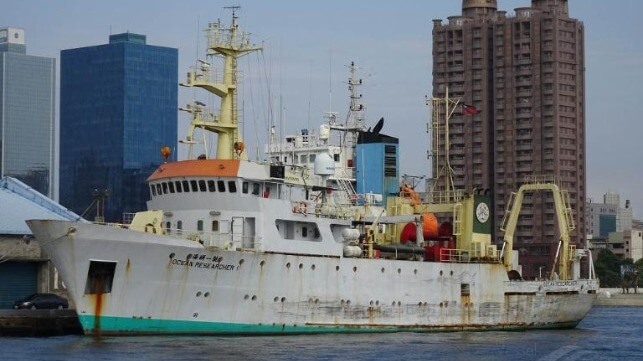
Hui Chuan in apparent layup at Kaohsiung, 2020 (Ya Ray Yang / VesselFinder)
The vessel off the port of Fujairah was a floating armory, according to maritime security consultancy Vanguard Tech.
The consultancy identified the vessel as the Honduran-flagged "fishing support vessel" Hui Chuan, which - per a report from the company security officer - had been operating as a floating armory in the Gulf of Oman. The vessel was boarded by unauthorized personnel while anchored about 38 nm to the northeast of Fujairah, towards the eastern entrance to the Strait of Hormuz, then diverted into Iranian territorial waters. Contact with the vessel has been lost, and its AIS signal has disappeared from tracking.
Floating armories are used by maritime security contractors as a practical solution for the storage of arms, ammunition and personnel in between embarked security missions; this avoids the need to stage weapons and people in nearby coastal states, a legally fraught proposition that occasionally ends in weapons confiscation, arrests and criminal charges. Local firearms laws do not always contain exceptions for security contractors or personnel in transit, and enforcement varies - but at sea, in international waters, the contractor can store and maintain their equipment without interference.
By the nature of their business, floating armory operations tend to be opaque, and the ownership and management of the Hui Chuan are not clear. The 1984-built vessel is flagged in Honduras and owned and operated by a letterbox company in the Marshall Islands. The holding company owns one other vessel, the 1993-built fishing vessel Sunny Ocean.
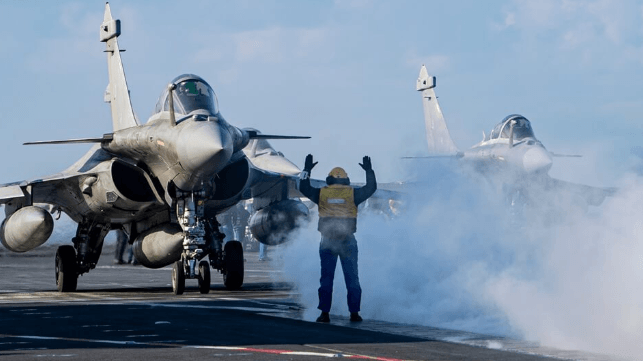
The French Navy FS Charles de Gaulle (R91) Carrier Strike Group (CSG) appears to have come safely through the Strait of Bab el Mandeb and is now at the French naval base in Djibouti.
The French Navy operates a tighter release of operational information than most other Western navies, creating a news vacuum which fake news generators seem keen to create confusion with. However, there was no disguising the FS Charles de Gaulle as it went through the Suez Canal on May 6, accompanied by a Jacques Chevallier-class replenishment oiler, probably FS Jacques Chevallier (A725), and an Aquitaine-class anti-submarine warfare destroyer. There is likely to be at least an additional air defense frigate and a nuclear submarine with the CSG. Pictures have subsequently shown the carrier anchored off Djibouti, with a Djibouti coastguard boat standing by.
The transit of the French CSG through the southern Red Sea and Bab el Mandeb appears to have attracted no comment in Houthi-controlled media, although the transit cannot have been missed by the Houthi coastal watch system.
This lack of adverse comment ties in with other indications that the Yemeni civil war is winding down. A drone was intercepted over Eilat on May 12, but unusually neither the Israelis nor the Houthis made any comment regarding the incident, leaving who might have been responsible for the intrusion in some doubt. The last acknowledged Houthi drone attack on Israel was on April 6, which brought to an end a series of six Houthi drone and missile attacks on Israel starting on March 30, none of which did any damage, and which did not attract Israeli reprisals.
Yemeni analyst Mohammed al Basha also notes that the Houthi leader AbdulMalik al Houthi has recently given up his weekly addresses to the nation, which had been used to fire up Houthi military resolve. Instead, the Yemeni press has been more concerned with a successful break-through in long-running negotiations, chaired by the UN in Amman, which has resulted in an agreement between the Houthis and the Internationally Recognized Government (IRG) for the exchange of 1,643 prisoners, scheduled for May 14.
Although skirmishes are still going on along the border between Houthi and IRG forces, an important element in the overall reduction in tension has been the re-ordering of political forces in southern Yemen, which has seen the IRG, backed by the Saudis, stepping up to exert more authority in the area of Yemen it controls and to impose unity, at the expense of the Southern Transition Council and its Emirati sponsors. This sets the scene for a better-based negotiation between the Houthis and the IRG over a final settlement of the civil war, which the Houthis are hoping will be bankrolled by the Saudis. There is no desire at the moment on either side to upset this steady progress.
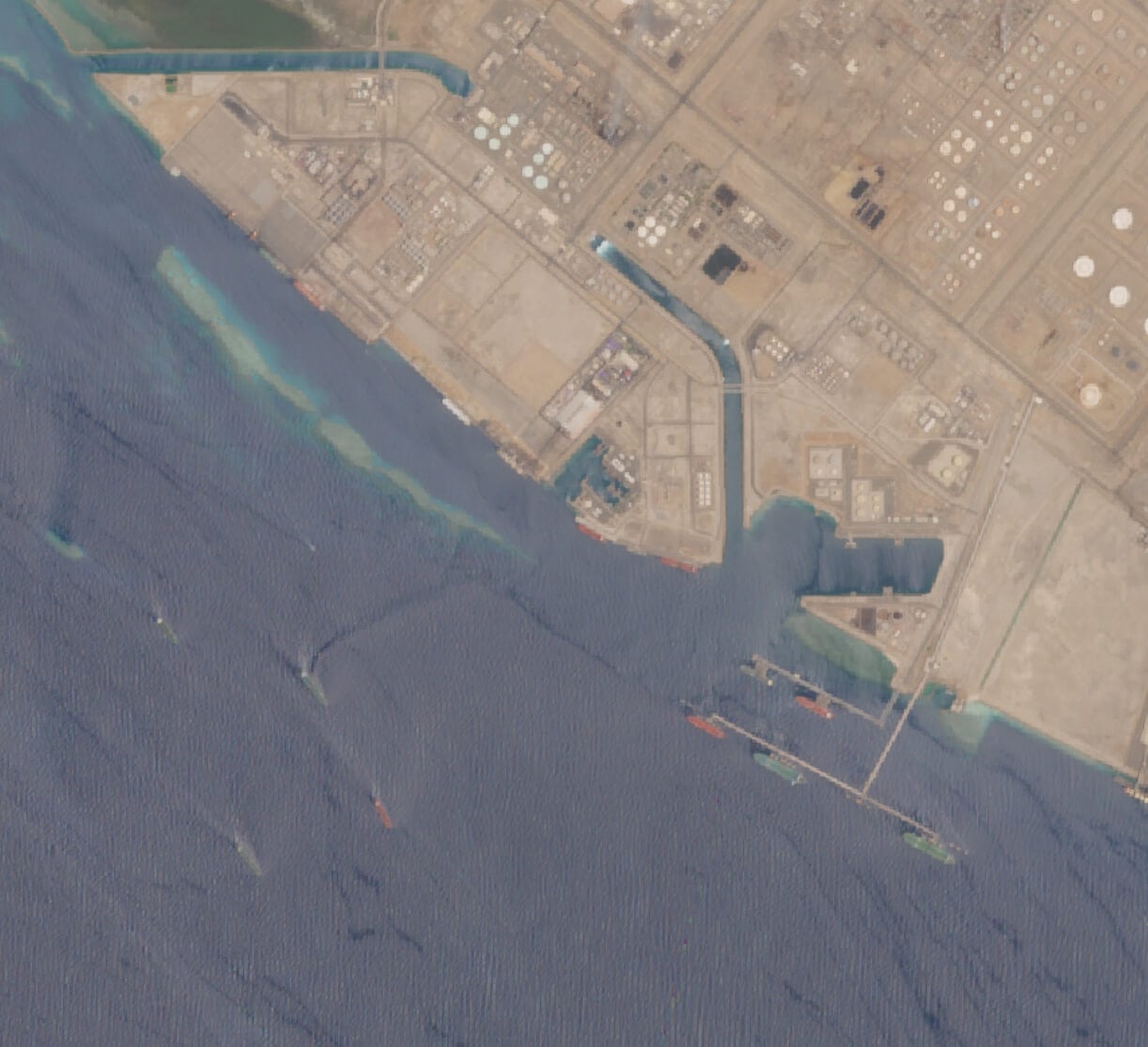
In this improving security climate, Saudi exports of crude from the southern Red Sea port of Yanbu have risen steadily. In March, Kpler estimated that Yanbu crude loadings averaged ?3.3 million bpd, up from a pre-war 800,000 bpd in February, mostly headed south through the Strait of Bab el Mandeb. Notwithstanding damage done to the East-West pipeline by an Iranian drone attack on April 8, throughput over the whole of last month averaged 4 million bpd, and is on track to reach maximum export capacity of 5 million bpd by the end of this month. Saudi Aramco President and CEO Amin Nasser Al Muajjiz said on May 11 that there are plans to increase the pipeline capacity and to boost exports even further. About 20 million bpd of exports from Gulf countries were lost in April because of the closure of the Strait of Hormuz.
All jetties occupied and an orderly queue waiting off the Aramco oil export terminal at Yanbu, amongst 33 arrivals logged by VesselFinder on May 13 (Sentinel-2)
The situation remains volatile. But for marine traffic in the Red Sea, this seems to look like good news, with the chances of a resumption of Houthi attacks on shipping now somewhat diminished.
Shipping Companies Leverage Arabian Peninsula Truck Routes to Bypass Hormuz
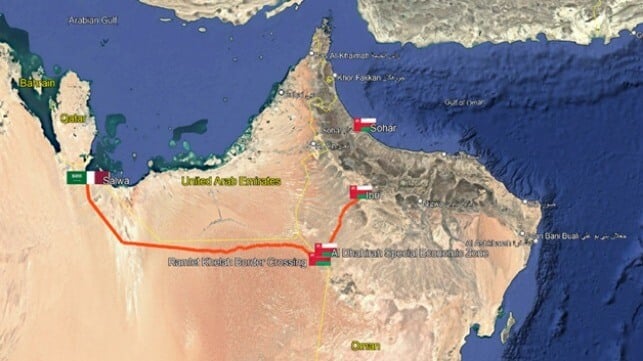
Route 95, from the Saudi-Qatar border to Ibri in Oman, and thence to Sohar, Duqm and Salalah (Google Earth/CJRC)
With the Strait of Hormuz remaining closed, logistics operators are working out how to get consignments to and from Gulf destinations previously served by ports that are now in effect blocked to external traffic. Without extensive state direction, entrepreneurs are opening up new routes and increasing capacity on existing routes.
One immediate beneficiary has been traffic flow on Route 95, which starts from the Saudi town of Alkwifiriah close to the Saudi-Qatari border crossing at Salwa. The route then crosses through the Shaybah oilfield and enters Oman at the Ramlet Khelah border crossing point, which was opened in January 2023. The route had been long in the planning, and its opening was delayed not by the COVID pandemic, but by the engineering difficulties of pushing a highway through the shifting sands of the “Empty Quarter.” The route has cut the travelling time between the start and end points by 16 hours, cutting out the old road across the sand or the necessity of diverting through the UAE with the inevitable delays at customs points.
According to the Oman Public Authority for Special Economic and Free Zones, the value of goods crossing the border almost tripled to $830 million in March, from $300 million in February. The main categories moving through the Ramlet Khelah border crossing point are fertilizers, construction materials, food, medicines, and machinery. One trucking company, Ramool Transportation, told AGBI that it had earned more in March 2026 than in the whole of 2025.
Back in 2021, Oman and Saudi Arabia agreed to set up a joint economic zone twelve miles into Oman to take advantage of the new route and border crossing point. The Special Economic Zone at Al Dhahirah (EZAD) opens for business next year, with a land port to be operated by the Omani integrated logistics company Asyad. But the focus for EZAD will be manufacturing units rather than logistics.
Saudi Arabia Railways is launching five new freight corridors linking West and East coasts (SPA)
Saudi Arabian Railways is developing five new logistics routes, based on a pre-war plan to get traffic off roads and onto the railway. Now it is placing a greater emphasis on improving access from rail hubs at Dammam, Jubail, Ras Al Khair, Al Kharj, and Hail through to Red Sea ports.
The Kingdom will also need to develop further the capacity of the heavily used Northern International Highway Route 85, which stretches from Dammam, through Riyadh, and then along the northern border following the course of the old Trans-Arabian Pipeline to Al Hadithah on the Jordanian border. With the civil war in Syria largely over, the route can now be used with much greater facility through to Tartus and Latakia on the Mediterranean. Considered historically to be something of a death-trap, the route is now a continuous dual highway engineered to modern standards.
Shipping companies are also looking to offer combined sea and land routes. MSC Mediterranean Shipping Company is launching a new service from Antwerp in May 2026, which will ship to Jeddah and King Abdullah Port on the Red Sea, container transfer to trucks to Dammam on the East coast, and then use of feeder services to move freight further forward to Jebel Ali, Khalifa Industrial Zone, and other ports within the Gulf. Hapag-Lloyd is also launching overland options via Saudi Arabia and Oman.
The main challenge to developing new logistic routes has been a shortage of trucks and drivers, a problem which no doubt will be solved quickly by the attractions of winning extra revenues for those already in the business. The other major issue is the throughput capacity of the ports now being brought into the new logistics networks. Both Khor Fakkan and Fujairah have limited capacity, with Khor Fakkan never having operated at more than three million TEUs in comparison to Jebel Ali’s 25 million TEUs. Both Sohar and Salalah are efficient port operations, with Salalah being ranked as the second most efficient container port in the world in 2023. But both ports are suffering capacity issues, which will take considerably longer to solve than the lack of trucks and drivers.


No comments:
Post a Comment