Monday, January 24, 2022

Thousands of Sudanese brave tear gas to protest military rule


Sudanese protesters block a street in Khartoum in anti-coup protests, seen here on January 20 (AFP/-)

Mon, January 24, 2022, 6:07 AM·3 min read


Sudanese security forces fired tear gas Monday at crowds calling for civilian rule and demanding justice for the scores killed in crackdowns since a military coup nearly three months ago.

Thousands of protesters in the capital Khartoum chanting slogans against the army headed toward the presidential palace, an area which security forces had sealed off ahead of the march.

Police forces later fired tear gas to disperse the protesters, according to an AFP correspondent.

Protests were also held in cities including Wad Madani, south of the capital, the Red Sea city of Port Sudan, and the eastern state of Gedaref, according to witnesses.

"No, no to military rule," and "civilian (rule) is the people's choice" protesters shouted in Wad Madani, according to witness Emad Mohamed.

Sudan has been rocked by regular protests since the October 25 military power grab led by general Abdel Fattah al-Burhan.

The coup derailed a civilian-military power-sharing deal, that had been painstakingly negotiated after the 2019 ouster of autocrat Omar al-Bashir, stalling a planned for transition to civilian rule.

Anti-coup demonstrations have left at least 73 people killed and hundreds wounded, according to medics.

Sudan's authorities have repeatedly denied using live ammunition against demonstrators, and insist scores of security personnel have been wounded during protests.

A police general was stabbed to death during the unrest earlier this month.

- Mass arrests -


On Sunday, Sudan's key Umma party vowed "to remove all traces of the coup".

It however warned that the "coup leadership" will "persist with its brutality and come up with new ways to commit violent massacres and launch mass arrests of revolutionaries."

Hundreds of pro-democracy activists have been arrested in the crackdown on anti-coup activists.

On Saturday, a leading women rights activist Amira Othman was arrested following a raid on her home in Khartoum, according to a statement by the "No to Women's Oppression" initiative which she leads.

UN special representative Volker Perthes slammed Othman's arrest saying the "arrest and pattern of violence against women's rights activists severely risks reducing their political participation."

Other activists from the "resistance committees", informal groups which have been instrumental in organising anti-coup protests, were also arrested late Sunday, according to members who requested anonymity fearing reprisals.

On Friday, Sudanese authorities requested delaying the arrival of UN expert on human rights in Sudan, Adama Dieng, who was appointed in November and had been due to make his first official visit.

Last week, senior US diplomats visited Sudan in a bid to bolster UN-led efforts to cajole the military into restoring a transition to full civilian rule.

Perthes earlier this month launched individual talks with various Sudanese factions in a push to resolve the crisis.

The ruling Sovereign Council -- formed by Burhan following the coup with himself as chairman -- has welcomed the UN-led dialogue, as have the United States, Britain, neighbouring Egypt, the United Arab Emirates and Saudi Arabia.

The Forces for Freedom and Change, Sudan's main civilian bloc, also joined consultations "to restore the democratic transition".

bur/pjm

Imperfect Creatures: Vermin, Literature, and the Sciences of Life 1600-1740 (University of Michigan Press, 2016)

249 Pages
This is the full, published version of Imperfect Creatures, made available through the open access program Knowledge Unlatched. It contains chapters on George Wither, Abraham Cowley, Thomas Shadwell, John Wilmot, and Daniel Defoe, among others, read within the context of early modern science and ecology. Introduction Reading beneath the Grain Chapter 1. Rats, Witches, Miasma, and Early Modern Theories of Contagion Chapter 2. Swarming Things: Dearth and the Plagues of Egypt in Wither and Cowley Chapter 3. “Observe the Frog”: Imperfect Creatures, Neuroanatomy, and the Problem of the Human Chapter 4. Libertine Biopolitics: Dogs, Bitches, and Parasites in Shadwell, Rochester, and Gay Chapter 5. What Happened to the Rats? Hoarding, Hunger, and Storage on Crusoe’s Island Afterword We Have Never Been Perfect


Cryptocurrency Is a Giant Ponzi Scheme

Cryptocurrency is not merely a bad investment or speculative bubble. It’s worse than that: it’s a full-on fraud.

Tether prices listed on the Kraken website.
 (Tiffany Hagler-Geard / Bloomberg via Getty Images)

LONG READ

BYSOHALE ANDRUS MORTAZAVI
JACOBIN
01.21.2022


Cryptocurrency is a scam.

All of it, full stop — not just the latest pump-and-dump “shitcoin” schemes, in which fraudsters hype a little-known cryptocurrency before dumping it in unison, or “rug pulls,” in which a new cryptocurrency’s developers abandon the project and run off with investor funds. All cryptocurrency and the industry as a whole are built atop market manipulation without which they could not exist at scale.

This should surprise no one who understands how cryptocurrency works. Blockchains are, at their core, simply append-only spreadsheets maintained across decentralized “peer-to-peer” networks, not unlike those used for torrenting pirated files. Just as torrents allow users to share files directly, cryptocurrency blockchains allow users to maintain a shared ledger of financial transactions without the need of a central server or managing authority. Users are thus able to make direct online transactions with one another as if they were trading cash.

This, we are told, is revolutionary. But making unmediated online transactions securely in a trustless environment in this way is not without costs. Cryptocurrency blockchains generally don’t allow previously verified transactions to be deleted or altered. The data is immutable. Updates are added by chaining a new “block” of transaction data to the chain of existing blocks.

But to ensure the integrity of the blockchain, the network needs a way to trust that new blocks are accurate. Popular cryptocurrencies like Bitcoin, Ethereum, and Dogecoin all employ a “proof of work” consensus method for verifying updates to the blockchain. Without getting overly technical, this mechanism allows blockchain users — known as “miners” in this context — to compete for the right to verify and add the next block by being the first to solve an incredibly complex math puzzle.

The point of this process is to make adding new blocks so difficult that meddling with the blockchain is prohibitively expensive. Though the correct answer to these puzzles can be easily verified by anyone on the network, actually being the first to find the answer requires an enormous amount of processing power — and thus electricity — and outcompeting the rest of the network is impractical.

For their troubles, miners collect a reward for being the first to verify the next block. The Bitcoin blockchain adds a new block every ten minutes, and the block reward is currently 6.25 newly minted bitcoins, worth nearly a half million dollars at Bitcoin’s last all-time high. Competition for block rewards has led to a computing power arms race as prices have risen. Mining bitcoins on a personal computer is no longer feasible. The majority of cryptocurrency mining is now conducted in commercial mining farms, essentially huge warehouses running thousands of high-powered computer processors day and night. The electricity expended mining Bitcoin and other cryptocurrencies is rapidly approaching 1 percent of global usage, which is famously greater than the total electricity consumption of many smaller developed nations.

Given that cryptocurrencies don’t produce anything of material value, this enormous waste of resources renders the whole enterprise a negative-sum game. Investors can only cash out by selling their coins to other investors — but only after the miners and various cryptocurrency service providers take the house’s rake. In other words, investors cannot — in the aggregate — cash out for even what they put in, as cryptocurrencies are inefficient by design.

This makes them a poor and costly form of currency and absolutely ludicrous as a long-term investment. We could dismiss them as a doomed experiment in the “greater fool” theory of investing, in which investors attempt to profit on overvalued or even worthless assets by selling them on to the next “greater fool” — think of it as gambling on a high-stakes game of musical chairs — if the rising price of Bitcoin and other cryptocurrencies were simply a function of demand.

This isn’t the case. Price manipulation plays as much or more of a role than demand in driving prices higher.

The Central Bank of Crypto


This isn’t some big secret. In a widely circulated 2017 paper, researchers attributed over half of the then-recent rise in Bitcoin’s price to purchases made by a single entity on Bitfinex, a cryptocurrency exchange headquartered in Hong Kong and registered in the Virgin Islands. These purchases were timed to buoy the price of Bitcoin during market downturns in a way that so strongly indicated market manipulation, the authors found it inconceivable that such trading patterns could occur by happenstance.

Critically, these purchases were not made with dollars, but with Tether, another type of cryptocurrency known as a “stablecoin” because its price is pegged to the dollar so that one tether is always worth one dollar. Many offshore cryptocurrency exchanges lack access to traditional banking, presumably because banks deem doing business with them too risky. Bitfinex, which shares a parent company and executive team with Tether Ltd (the issuer of its namesake cryptocurrency), struggled to find US banking partners after Wells Fargo abruptly stopped processing wire transfers between the exchange’s Taiwanese banks and their American customers in 2017 without giving reason.

This was a problem. Without traditional banking relationships for issuing wire transfers, exchanges cannot easily facilitate trades between buyers and sellers on their platforms — someone has to pass cash between buyers and sellers. Stablecoins solve this problem by standing in for actual real dollars. They allow cryptocurrency markets to maintain ample liquidity — the ease with which assets can be converted into cash — without actually having to have cash on hand.

Tether has become integral to the functioning of global crypto markets. The majority of Bitcoin trades are now conducted in Tether, 70 percent by volume. By comparison, only 8 percent of trade volume is conducted in real dollars, with the remainder being other crypto-to-crypto pairs. Many industry skeptics, and even proponents, see this as a systemic risk and ticking time bomb. The whole system relies on traders actually being able to exchange tethers for real cash or — far more commonly in practice — other traditional cryptocurrencies that can be sold for cash on banked exchanges like Coinbase or Gemini, both headquartered in the United States.

Should faith in Tether falter, we could see its peg to the dollar collapse in a flash. This would be a doomsday scenario for crypto markets, with investors holding or trading crypto assets on unbanked exchanges unable to “cash” out, since there was never any cash there to begin with, only stablecoins. This would almost certainly cause a liquidity crisis on banked exchanges as well, as investors rush to cash out their crypto anywhere possible amid cratering prices, and banked exchanges processing far less volume would almost certainly not be able to pick up the slack.

There is no reason to have any faith in Tether. Tether’s peg to the dollar was initially predicated on the claim that the digital currency was fully backed by actual cash reserves — a dollar held in reserve for every tether issued — though this was later shown to be a lie. The company has since continuously revised down claims about how much cash they keep in reserve. Their latest public attestation on the matter, from March of last year, claimed to be holding only 3 percent of their reserves in cash. The rest was held in “cash equivalents,” mostly commercial paper — essentially IOUs from corporations that may or may not exist, given that reputable actors trading in commercial paper don’t appear to be doing any business with Tether.

While even these modest claims about their reserves may be a lie, as Tether has never undergone an external audit, none of this really matters, since Tether’s own terms of service make it clear that they do not guarantee the redemption of their digital tokens for cash. Should the market suddenly lose faith in Tether and exchanges become unable or unwilling to exchange them one for one with dollars or the respective amount of cryptocurrency, Tether accepts no obligation to use whatever reserves they may or may not have to buy back tethers.

And in practice, Tether rarely buys back or “burns” their tokens (sending the tokens to a receive-only wallet so as to remove them from circulation and decrease the supply, in an attempt to raise the price), as one would expect if the purpose was simply to provide market liquidity as claimed. If that were the case, we would expect the overall supply of Tether to closely track daily crypto trading volumes. Exchanges would only keep enough Tether on hand to cover trading volume and presumably sell off or redeem excess Tethers for cash when fewer people are actively trading crypto.

Instead, the Tether supply has been growing exponentially for years, exploding during crypto market bull runs and continuing straight through years-long downturns. There are now over 78 billion tethers in circulation and rising, about 95 percent of which was issued since the latest cryptocurrency bull market started in early 2020.Cryptocurrency is not merely a bad investment or speculative bubble, but something more akin to a decentralized Ponzi scheme.

There is no conceivable universe in which cryptocurrency exchanges should need an exponentially expanding supply of stablecoins to facilitate daily trading. The explosion in stablecoins and the suspicious timing of market buys outlined in the 2017 paper suggest — as a 2019 class-action lawsuit alleges — that iFinex, the parent company of Tether and Bitfinex, is printing tethers from thin air and using them to buy up Bitcoin and other cryptocurrencies in order to create artificial scarcity and drive prices higher.

Tether has effectively become the central bank of crypto. Like central banks, they ensure liquidity in the market and even engage in quantitative easing — the practice of central banks buying up financial assets in order to stimulate the economy and stabilize financial markets. The difference is that central banks, at least in theory, operate in the public good and try to maintain healthy levels of inflation that encourage capital investment. By comparison, private companies issuing stablecoins are indiscriminately inflating cryptocurrency prices so that they can be dumped on unsuspecting investors.

This renders cryptocurrency not merely a bad investment or speculative bubble but something more akin to a decentralized Ponzi scheme. New investors are being lured in under the pretense that speculation is driving prices when market manipulation is doing the heavy lifting.

This can’t go on forever. Unbacked stablecoins can and are being used to inflate the “spot price” — the latest trading price — of cryptocurrencies to levels totally disconnected from reality. But the electricity costs of running and securing blockchains is very real. If cryptocurrency markets cannot keep luring in enough new money to cover the growing costs of mining, the scheme will become unworkable and financially insolvent.

No one knows exactly how this would shake out, but we know that investors will never be able to realize the gains they have made on paper. The cryptocurrency market’s oft-touted $2 trillion market cap, calculated by multiplying existing coins by the latest spot price, is a meaningless figure. Nowhere near that much has actually been invested into cryptocurrencies, and nowhere near that much will ever come out of them.

In fact, investors won’t — on average — be able to cash out for even as much as they put in. Much of that money went to cryptocurrency mining. Recent analysis shows that around $25 billion and growing has already gone to Bitcoin miners, who, by best estimates, are now spending $1 billion just on electricity every month, possibly more.

That money is gone forever, having been converted to carbon and released into the atmosphere — making cryptocurrencies even worse than traditional Ponzi schemes. Most of the money lost in Bernie Madoff’s infamous Ponzi was eventually clawed back and returned to investors. Much of the money put into cryptocurrency, even if courts could trace back tangled webs of semi-anonymous cryptocurrency transactions, can never be recuperated.

Regulatory Failure

Ponzi schemes of this scale typically target other financial firms, banks, elite institutions, and other wealthy investors. Cryptocurrency, by comparison, is the people’s Ponzi. Cryptocurrency exchanges with user-friendly interfaces, as well as financial services companies like Square and PayPal, allow retail investors with few assets and little financial literacy to buy cryptocurrency on their smartphones.

The minimum purchase on Coinbase is only $2. On Robinhood, it’s a buck. A recent Pew survey found that one in three adults under thirty have bought or used cryptocurrency. It is everyday working people who will suffer most when their savings inevitably evaporate overnight.

Regulators and policymakers have been slow to protect the public. Ponzi schemes can remain solvent for years while flying under the radar of law enforcement and regulators. Madoff ran his hedge fund as a Ponzi for at least seventeen years. While the Securities and Exchange Commission (SEC) failed to heed multiple warnings from an industry whistleblower for seven years, regulators acted quickly once Madoff was turned in by his own children. He was, after all, defrauding the wealthy, bankers, celebrities, and elites.Large Ponzi schemes typically target other financial firms, banks, elite institutions, and other wealthy investors. Cryptocurrency, by comparison, is the people’s Ponzi.

The cryptocurrency Ponzi scheme has its own whistleblowers, but they’re hardly necessary. Tether is built atop and hosted on other public blockchains, predominantly Ethereum and Tron at the moment. Every time Tether prints another round of stablecoins, now by the hundreds of millions or billions at a time (always in suspiciously round numbers), sometimes several times a week, literally anyone can see. There are Twitter bots analyzing cryptocurrency blockchains and posting large or suspicious transfers of new stablecoins that make this as easy as clicking follow. Tether is cooking the books right out in the open. Skeptics have been pointing this out for years, but regulators and policymakers did virtually nothing until cryptocurrency went mainstream and wildly overvalued cryptocurrency companies began posing a risk to traditional financial markets.

Their response is a case of too little too late. The SEC and US Commodity Futures Trading Commission subpoenaed Tether and Bitfinex in 2017. In 2018, the Justice Department launched a broad probe into cryptocurrency price manipulation and quickly homed in on Tether. Tether was ultimately fined $41 million for lying about their reserves, among other wrongdoings, and also settled a suit with the New York attorney general for $18.5 million for the same reason. But these actions are a slap on the wrist given the level of fraud and have not slowed down Tether’s money printer in the least.

Meanwhile, regulators haven’t even tried to stop cryptocurrency from infecting broader financial markets. The SEC let Coinbase go public in April, and several other US-based cryptocurrency exchanges, including Kraken and Gemini, are planning to do the same. The first cryptocurrency futures ETFs have debuted in recent months, giving traditional investors indirect exposure to cryptocurrency by investing in a range of cryptocurrency companies. Fidelity Investments also launched a spot cryptocurrency ETF in Canada that would actually hold cryptocurrencies, which would allow investors to make direct investments in cryptocurrency on the same platform where they manage retirement savings; Fidelity is seeking the green light from US regulators to allow Americans the same direct access.

While a few listed companies, most notably Tesla and MicroStrategy, have taken multibillion-dollar gambles on cryptocurrency with company money, most of these companies are simply offering custodial or transactional services rather than investing into cryptocurrencies themselves. They are operating parasitically, profiting off investments into the crypto Ponzi while rushing toward IPOs before the whole thing collapses.

These companies hold precious little cryptocurrency themselves and thus little risk. Even MicroStrategy, though initially spending $250 million in company money on Bitcoin in August 2020 while the CEO shilled crypto on Twitter, proceeded to raise billions more in repeated rounds of fundraising.

Policymakers have done little to curb any of this. Even those paying attention to problems with unregulated stablecoins seem hell-bent on trying to preserve the wider cryptocurrency industry. A recent report from the Biden administration assesses the risk of stablecoins without investigating their primary role in market manipulation. SEC chair Gary Gensler wants to regulate stablecoins as either securities or money market mutual funds accounts. The STABLE Act, a bill languishing in Congress since last year, would require stablecoins be fully backed and regulate issuers and anyone offering related services.

These efforts are as insufficient as they are misguided. Governments won’t be able to keep unregulated stablecoins from being traded on exchanges operating outside their jurisdiction. Tether is not the only stablecoin game in town. Tether has printed more than $8 billion in stablecoins since November. Meanwhile, South Korean crypto firm Terraform Labs, which few people have even heard of, minted another $8 billion of their own stablecoin (TerraUSD). There are others behaving similarly. Shut these operations down and there’s nothing to stop them or a copycat from setting up shop elsewhere.

The problem extends beyond unregulated exchanges and issuers. Coinbase also has its own stablecoin pegged to the dollar, USDC, managed by partner company Circle, which is also looking to go public with an SPAC deal that would exempt it from the scrutiny of a traditional IPO. There are now 45 billion USDC stablecoins in circulation, most of them issued since 2020, just like with Tether. Coinbase and Circle also lied about their stablecoin being fully backed by cash when in fact reserves are mostly composed of yet more mysterious commercial paper, which is less liquid and far riskier. As Amy Castor, who has long reported on cryptocurrencies, put it, “Despite efforts to distance itself from Tether, Circle is starting to look more and more like a similar scheme, only with a different critter on the wildcat banknotes.”

Ban Them All

Going after fly-by-night stablecoin issuers will devolve into a hopeless game of whack-a-mole. The only real solution is to ban the trade of private cryptocurrencies entirely. We cannot stop foreign actors from issuing unbacked stablecoins and manipulating crypto prices on unregulated exchanges. But we can make it illegal to sell cryptocurrencies on banked exchanges, such as Coinbase, operating entirely legally while they cash people out of the Ponzi scheme.

This would, of course, kill off cryptocurrency almost entirely, relegating it back to an oddity of the tech enthusiast. No one should shed a tear. Cryptocurrencies have virtually no legal use case. They’re great for facilitating ransomware, laundering money, distributing narcotics and child porn, running Ponzi schemes, and… not much else. They fail as currencies due to high transaction costs. They fail as “digital gold” or a “store of value” because they consume ludicrous amounts of energy to run what is essentially a glorified spreadsheet.

China already banned cryptocurrencies entirely, and India and Pakistan are poised to do the same. Other countries have also made moves to prohibit or constrain cryptocurrencies, but Western liberal democracies are notably permissive. This is in no small part due to aggressive industry lobbying, which includes hiring former financial regulators and compliance officers into the industry to influence policymakers.The only real solution is to ban the trade of private cryptocurrencies entirely.

Among their ranks is Brian Brooks, who was the chief legal officer at Coinbase before serving as acting Comptroller of the Currency in the Trump administration. Now CEO of blockchain mining company Bitfury, which is also purportedly looking to go public, Brooks joined other crypto CEOs to testify before the House in December. Predictably, they oppose meaningful stablecoin regulation, as they understand that it would kill the industry and render their companies worthless.

These people and everyone else in the cryptocurrency industry are complicit in the Ponzi scheme and actively misleading the public. They understand that fraud is the engine driving their industry and fueling their profits — and that is perhaps the most damning indictment of private cryptocurrencies and the industry surrounding them.

The 2008 financial crisis made clear why the financial sector must be brought under public control. Cryptocurrency and “decentralized finance” aren’t special — they’re just more of the same privatization and deregulation masquerading as high-tech “solutions” we’ve seen in other industries. Unregulated, privatized financial markets pose the same risks to the public whether or not they are “on the blockchain.”

In the case of cryptocurrency, regulation is an existential risk precisely because regulatory loopholes and fraud are the only reason the industry appears profitable despite being wholly unproductive and a waste of energy resources. The same applies to private cryptocurrencies as a whole. The longer governments take to ban them, the worse normal people will be hurt.

ABOUT THE AUTHOR
Sohale Andrus Mortazavi is a writer based in Chicago.


New York Times logo
Tressie McMillan Cottom

January 24, 2022

Diana Ejaita

Why the appeal of cryptocurrencies and NFTs crosses borders of class and race


By Tressie McMillan Cottom

My family managed to get together for a small Thanksgiving dinner this year. It was our first gathering since April 2020. After a big meal, my cousin only wanted to talk about one thing: cryptocurrency. He is a middle-aged Black man from New York, just a few years older than I am, but those years make a huge difference in his job security. When he came of age, he got a blue-collar job working for the city. He has worked at that job since he was 17 years old, so he will be able to retire as a relatively young man. And since the job is unionized, my cousin will retire with a pension and health benefits — the kind of pathway to economic security that is becoming increasingly rare.

These days, ours is an information economy that likes credentials, which involves going to some kind of postsecondary school. Even with high wages for skilled trades, like the one my cousin used to get that union job straight after high school, blue-collar trades are a hard sell to young workers. My cousin is not exactly a dinosaur, but he is not the kind of guy you imagine day-trading or actively managing an investment portfolio.

Yet he is absolutely enthused about Bitcoin. While he is figuring out his second act, he views crypto as the way to build “generational wealth” and “freedom.” I put those words in quotes because you hear them a lot in conversations around financial-sector schemes, and I am not sure they mean anything in those contexts. This week, the New York mayor, Eric Adams, is living up to his campaign promise to get his first three paychecks converted to cryptocurrency. My blue-collar cousin has a lot in common with his mayor. The allure of the next American frontier crosses all kinds of lines, including class lines. I’ll get to that in a second.

Bitcoin is the most well-known cryptocurrency, but there are many others, like Ethereum, Dogecoin, and Tether, which come up a lot among my peers. Some people talk about crypto as being revolutionary because it promises to democratize access to financial markets and give individual investors control of their destiny. In an adjacent space, nonfungible tokens — or NFTs — promise something similar. NFTs are like coupons that represent an underlying object, like a piece of artwork, although they could represent almost anything.

For my part, the discussion over Thanksgiving leftovers brought home a data point about women’s and people of color’s interest in cryptocurrency. A 2021 survey found that the people who trade crypto are a far cry from the young, white, male image of a techbro:

The average cryptocurrency trader is under 40 (mean age is 38) and does not have a college degree (55 percent). Two-fifths of crypto traders are not white (44 percent), and 41 percent are women.

That survey captured a lot of people, like my cousin.

What fascinates me is how widely crypto and NFT talk has diffused, and so quickly. It is not often that I hear the same branding from lower-income people of color that I also hear from high-earning white peers with advanced degrees. Depending on your consumer profile — biographical data like your age, race and gender, plus your purchasing habits — you probably hear about these financial instruments from online ads, social media groups, and peers who are early adopters.

I hear about crypto from my educated, high-income academic and writing friends who also shop at Target a lot. I also hear about crypto from financial advisers and college classmates who share stories about making a lot of money mining crypto and trading NFTs. But because of my racial and geographic identities, I also hear about crypto from my working-class friends and family. They are getting messages about crypto from Facebook and Instagram and their friends who have moved on from candle-leggings-timeshare-jewelry multilevel marketing schemes to trading Dogecoin. Crypto and NFTs might be the only thing these diverse groups share in common. For that reason alone, the explosion of these technologies deserves some sociological attention.

All of the branded cryptos and NFTs were born out of the invention of the blockchain. I don’t think of blockchain as a technological innovation so much as it is a cultural iteration. Blockchain is about solidarity among strangers. That’s the kind of thing we have been striving for since the first mechanical age. On a purely technical level, blockchain is a ledger. That ledger is decentralized (although we will complicate that a bit in future discussions) and that decentralization makes it hard to manipulate. Now, the point of decentralization is that ideally no one who records information in the ledger has to trust anyone else when they exchange information based on that ledger. If I buy something, I can list my ownership in the ledger that assigns my ownership rights a unique identifier. If someone challenges my ownership, the ledger’s record is the god tier of ownership. I have something that no one can take away from me! You start to see why this idea would appeal to a lot of people, but especially to groups of people whose right to ownership has been encoded in legal precedent and cultural norms for generations. If I live in a community where the police absolutely use eminent domain to claim my private property and I cannot do anything about it, that sense of everyday powerlessness would make the promise of blockchain sound pretty good. To me, though, it presents more questions than answers.

Those questions are about the culture of blockchain, not about its technical innovation. Blockchain promises to decouple trust in our financial transactions from institutions. I do not have to trust that someone owns something, or trust that an institution will defend my ownership of something. Blockchain says trust moves from institutions — like banks and regulators — to the apolitical ledger. In theory, no one owns the ledger. That means no one can undermine your bargaining power in an exchange. But is that actually how the ledger works? Is an apolitical platform possible in a world where everything we do has a political cause and effect? I’m skeptical on that front. And healthy skepticism is a good place to start when deciding whether something is a scam or merely risky.

Last week I did something I wish I had done before that Thanksgiving dinner conversation. I talked with some people about cryptocurrencies and NFTs. First was a far-ranging conversation with Anil Dash, a writer and entrepreneur best known, perhaps, as the C.E.O. of Glitch, a software development company. He has taken a lot of heat for having a nuanced assessment of blockchain, crypto and NFTs. We used to write together on a culture and technology vertical on Medium, where Anil has blogged about tech for years now. Anil is thoughtful and erudite on the cultural history of internet technologies. He is also pragmatic and has a keen interest in inequality. That mix of expertise and sensibility made him the first person I wanted to talk to about the intersection of citizen consumers and the alternative financial technologies infiltrating our everyday lives. The conversation was so rich that I will write about it in a two-part discussion starting next week.

My friend Darrick Hamilton, an economist, has warned that we shouldn’t be too aggressive on replacing the danger of unjust financial systems with wildly risky alternative currencies. That sounds about right to me. It reminds me of another legitimate scheme in higher education, which I researched and wrote about for years: Telling people that their very expensive, low-quality degrees from these schools may not be a good solution for them rarely worked. That is the power of culture. And that’s the reasoning behind my first question to Anil: What social problem is blockchain trying to solve? I’ll ask this time and time again as we talk about the idea of institutional failures and the unsatisfying stop-gaps we create to navigate them.


PG&E’s criminal probation to end amid ongoing safety worries

By MICHAEL LIEDTKE

1 of 5
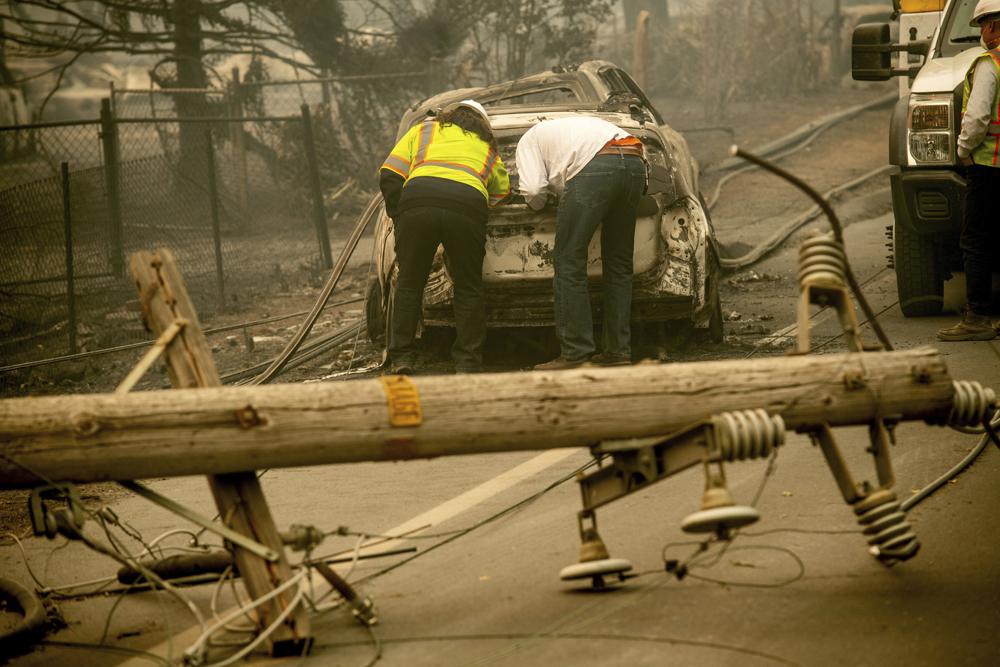
FILE - In this Nov. 10, 2018 file photo, with a downed power utility pole in the foreground, Eric England, right, searches through a friend's vehicle after the wildfire burned through Paradise, Calif. The nation's largest utility, Pacific Gas & Electric is poised to emerge from five years of criminal probation amid worries that it remains too dangerous to be trusted. Over the five years, the utility became an even more destructive force. More than 100 people have died and thousands of homes and businesses have been incinerated in wildfires sparked by its equipment in that time. (AP Photo/Noah Berger, File)


SAN FRANCISCO (AP) — Pacific Gas & Electric is poised to emerge from five years of criminal probation, despite worries that nation’s largest utility remains too dangerous to trust after years of devastation from wildfires ignited by its outdated equipment and neglectful management.

The probation, set to expire at midnight Tuesday, was supposed to rehabilitate PG&E after its 2016 conviction for six felony crimes from a 2010 explosion triggered by its natural gas lines that blew up a San Bruno neighborhood and killed eight people.

Instead, PG&E became an even more destructive force. Since 2017 the utility has been blamed for more than 30 wildfires that wiped out more than 23,000 homes and businesses and killed more than 100 people.

“In these five years, PG&E has gone on a crime spree and will emerge from probation as a continuing menace to California,” U.S. District Judge William Alsup wrote in a report reviewing his oversight of the utility.

While on probation, PG&E pleaded guilty to 84 felony counts of involuntary manslaughter for a 2018 wildfire that wiped out the town of Paradise, about 170 miles (275 kilometers) northeast of San Francisco. Now PG&E faces more criminal charges in two separate cases, for a Sonoma County wildfire in 2019 and a Shasta County fire in 2020. PG&E has denied any criminal wrongdoing in those fires.

Even more potential criminal charges loom. California regulators already have linked PG&E to the massive Dixie Fire last year, when a tree is believed to have hit the utility’s distribution lines in the Sierra Nevada — part of a sprawling, often rugged service territory covering 16 million Northern Californian customers.

During its probation, PG&E also plunged into bankruptcy for the second time in less than 20 years. Before emerging from bankruptcy last year, PG&E reached settlements of more than $25.5 billion, including $13.5 billion earmarked for wildfire victims that may fall short of doling out the amount initially promised.

PG&E’s conduct prompted its court-appointed monitor, Mark Filip, to raise alarms about the utility’s wildfire prevention efforts, though he applauded the “sustained and substantial” improvements in its natural gas operations.

“We doubt anyone would seriously contend PG&E’s performance has been adequate, or that substantial improvement is not still imperative,” Filip’s team wrote in a report filed with Alsup late last year.


PG&E, a 117-year-old company, generates about $20 billion in revenue annually while serving a 70,000-square-mile (181,300-square-kilometer) service area in the northern and central part of California that includes farmland, forests, big cities and the world’s technology hub in Silicon Valley.

Alsup, who repeatedly excoriated PG&E during its probation, last year signaled he was interested in keeping the utility under his watch. But he dropped the idea earlier this month after the U.S. Attorney’s Office filed documents saying it didn’t plan to seek an extension of PG&E’s probation, citing the “unique history and circumstances” of the case.


“We have tried hard to rehabilitate PG&E,” Alsup wrote in his final report. “As the supervising district judge, however, I must acknowledge failure.”

Alsup declined an interview request from The Associated Press to elaborate on his concerns about PG&E.

Catherine Sandoval, an energy professor at Santa Clara University and a former California power regulator, believes Alsup was far too hard on himself, although she agrees PG&E hasn’t proven it should be freed from supervision. She blames federal prosecutors for backing off an attempt to extend PG&E’s probation because “there appears to be no binding case law on this point,” according to the U.S. attorney’s report.

“If there was ever a test case for whether a company’s probation can be extended, PG&E is it,” Sandoval asserted during an interview. She also unsuccessfully fought to hold a hearing to extend the utility’s probation in 58-page brief filed with Alsup earlier this month.

Noah Stern, the federal prosecutor handling PG&E’s probation, didn’t respond to a request for comment.

While acknowledging its problems, PG&E claimed in a report to the judge that its electricity grid is “fundamentally safer” now than in January 2017. It also defended the roughly 40,000 employees and contractors who maintain its operations.

“Vilifying them and threatening to criminalize the exercise of professional judgment or the making of honest mistakes serves neither safety nor fairness, and instead severely detracts from PG&E’s efforts to bring the skills of the best and brightest to bear on stopping wildfires,” PG&E lawyers wrote. “We are all in this together.”

As signs of its progress, PG&E cited the more than 3.3 million trees near its equipment that were either trimmed or removed in the past two years.

The utility says it now spends $1.4 billion annually to trim or remove trees, up from $400 million annually in 2017. But Alsup estimated PG&E still has a seven-year backlog of high-risk trees that need trimming or removal.

The company also cited a sweeping overhaul of its board and management, including bringing in Patricia Poppe as its new CEO last year. Poppe, a former Michigan utility executive, became PG&E’s fifth CEO in five years, part of an unusually high turnover rate that the company’s federal monitor said makes reform more difficult.

“We know there is more to do,” PG&E’s lawyers told Alsup in their final probationary report. “These are not just words on a page or a poster, they are a commitment to make it right and make Californians safe.”

PG&E declined further comment about the end of its probation.

Sandoval, who was among the regulators overseeing PG&E as a commissioner for the California Public Utilities Commission from 2011 to 2017, accused PG&E officials of being mired in a pattern of “cognitive immaturity” and “lazy thinking” that should require its executives and board to submit to counseling.

“PG&E, the corporation, needs the training an individual criminal defendant would have received in prison to break the cycle of criminal thinking that endangers public safety,” Sandoval wrote in her in brief to Alsup.

In his separate report, Filip suggested California consider regulatory changes or new approaches to keep PG&E in check.

The federal monitor cautioned that in PG&E’s service territory, the consequences of a single misstep — a missed hazard tree, the failure to replace corroded hardware on power lines — can be “death and destruction.”
Could Automation of Jobs Replace 12 Million Workers in Europe by 2040?


David Paul
20 January 2022,


New research has found that millions of workers could lose out to autonomous robots over the next 20 years.

Workers across Europe could find that the automation of jobs will replace them by 2040, according to new research.

Around 12 million jobs will be automated over the next 20 years, with roles that consist of simple, routine tasks the most at risk of being replaced.

Forrester’s Job Forecast 2020-2040 found that the market will begin to decline because Europe’s biggest economies will have millions fewer people of working age.

The research also indicated that the automation industry would create nine million jobs in Europe’s five biggest economies over the same period.

In the analysis of European countries, the UK, France, Germany, Italy, and Spain, Forrester found that the retail, food services, and leisure and hospitality sectors would see the most automation.

Commenting on the report, Forrester analyst Michael O’Grady said that the pandemic will also be a catalyst for this change: “Lost productivity due to Covid-19 is forcing companies globally to automate manual processes and improve remote working.

“The pandemic is just one factor that will shape the future of work in Europe over the next two decades, however.”

O’Grady added that EU firms can make use of robotics for job replacement as the working-age population begins to decline, and routine low-skilled jobs become more easily automated.

According to the report, Europe’s five biggest economies will have 30m fewer people of working age in 2040 than last year.

Mid-skilled jobs, which make up 38% of the workforce in Germany, 34% of the workforce in France, and 31% of the workforce in the UK, will see the biggest automation rates. Around 49m jobs in Europe were at risk from automation, Forrester said.

“As a result, European organisations will invest in low-carbon jobs and build employees’ skills. Soft skills such as active learning, resilience, stress tolerance and flexibility – something robots aren’t known for – will complement worker automation tasks and become more desirable,” said Forrester.

Discussions around the increase in automation to replace skilled workers have been a point of contention over the last few years as work on robotics and artificial intelligence continues.

As far back as October 2020, a report by the World Economic Forum (WEF) indicated that millions of jobs done worldwide could be carried out by some type of machine by 2025.

WEF’s Future of Jobs Report 2020 commented that machines could ‘eliminate’ around 85m jobs usually carried out by workers by the quarter century, and highlighted the importance of reskilling of staff to ensure they are prepared for the future of work.

Sectors like oil and gas have already begun discussing plans to replace workers with robots by 2030.

A report from Rystad Energy in March 2021 said that the sector could saving billions of dollars on reduced labour costs if positions were filled by existing technology like robotics.

One of the main area for consideration was drilling, where companies could not only see enormous savings but protect workers from highly labour intensive and dangerous tasks.


50% Rise in Cyberattacks in 2021 Compared to 2020


Michael Behr
24 January 2022


Software vendors were hit by the greatest increase in attacks as hackers saw the benefits of hitting software supply chains.

Organisations around the world experienced 50% more weekly cyberattacks in 2021 than in 2020, a new study has revealed.

According to Check Point Research’s (CPR’s) upcoming 2022 Security Report, 2021 saw software vendors in hit by the largest year-on-year growth in cyberattacks at 146%.

It also found that cyberattacks against the top 16 industries increased by an average of 55%, with the education/research sector suffering the most attacks. It was hit with an average 1,605 weekly attacks, a 75% increase compared to 2020.

Other key industries targeted by hackers include government/military organisations, which saw an average of 1,136 weekly attacks (47% increase). Communications saw an average of 1,079 weekly attacks (51% increase).

“In a year that began with the fallout from one of the most devastating supply chain attacks in history, we’ve seen threat actors grow in confidence and sophistication,” a CPR statement read.

2021 saw some major cyberattacks, many of which hit third party software suppliers. Supply chain attacks like SolarWinds, Microsoft Exchange, Kaseya, and Log4j were able to hit organisations that used their software, putting thousands of organisations at risk.

Furthermore, attacks on critical infrastructure disrupted the lives of individuals. This includes the Colonial Pipeline attack, which led to fuel shortages on the East Coast of the US. Some, such as the attempted Florida wastewater attack, could have potentially put lives at risk.

In terms of the ransomware ecosystem, botnets were the leading attack category worldwide. They beat out infostealers and cryptominers.

In particular, notorious botnet Emotet returned in November. Despite multiple attempts to shut it down, the malware made a comeback, albeit reduced to at least 50% of the level seen in January 2021.

This rising trend continued throughout December with several end-of-year campaigns, and is expected to continue well into 2022, at least until the next takedown attempt.

However, CPR noted that cracks are appearing in the ransomware ecosystem. The major cyberattacks that took place in 2021 prompted governments and law enforcement agencies to change tactics for dealing with organised ransomware groups. They shifted from pre-emptive and reactive measures to proactive offensive operations against the ransomware operators, their funds and supporting infrastructure.

This year saw a REvil, a major ransomware group behind the Kaseya attack, effectively dismantled after US agencies provided Russian authorities with intelligence. This led to the arrests of multiple individuals connected with the cybercrime organisation.

“The recent arrests made in Russia of the REvil ransomware gang is a unique event in the history of cyber as it is the first time that the US Administration has collaborated with the Russian authorities to track down and arrest members of a ransomware group,” CPR said in a statement.


Cybercriminals use new tactics to attack industrial organisations – all in a hunt for corporate credentials, report

24-01-2022 08:17:00 | by: Nixon Kanali 

Kaspersky experts have uncovered a new, rapidly evolving, series of spyware campaigns, attacking more than 2,000 industrial enterprises across the globe. Unlike many mainstream spyware campaigns, these attacks stand out due to the limited number of targets in each attack, and the very short lifespan of each malicious sample. The study identified more than 25 marketplaces where stolen data is being sold. These and other findings were published in the new Kaspersky ICS CERT report.

During the first half of 2021, Kaspersky ICS CERT experts noticed a curious anomaly in statistics on spyware threats blocked on ICS computers. Although the malware used in these attacks belongs to well-known commodity spyware families such as Agent Tesla/Origin Logger, HawkEye and others, these attacks stand out from the mainstream due to the very limited number of targets in each attack (from a handful to a few dozen) and the very short lifetime of each malicious sample.

A closer analysis of 58,586 samples of spyware blocked on ICS computers in H1 2021 revealed that around 21.2% of them were part of this new limited-scope and short-lifetime attack series. Their lifecycle is limited to about 25 days, which is much less than the lifespan of a ‘traditional’ spyware campaign.  

Although each of these “anomalous” spyware samples is short-lived and not widely distributed, they account for a disproportionately large share of all spyware attacks. In Africa, for example, every seventh computer attacked with spyware was hit with one of the “anomalous” spyware samples (2.0% out of 15.4%).

Notably, most of these campaigns are spread from one industrial enterprise to another via well-crafted phishing emails. Once penetrated into the victim’s system, the attacker uses the device as the next-attack C2 (command and control) server. With access to the victim’s mailing list, criminals can abuse corporate email and spread the spyware even further.

According to Kaspersky ICS CERT telemetry, more than 2,000 industrial organisations worldwide have been incorporated into the malicious infrastructure and used by cybergangs to spread the attack to their contact organisations and business partners. We estimate the total number of compromised or stolen corporate accounts as a result of these attacks to be more than 7,000.

The sensitive data obtained from ICS computers often ends up in various marketplaces. Kaspersky experts identified more than 25 different marketplaces where the stolen credentials from these industrial campaigns were being sold. Analysis of those marketplaces showcased high demand for corporate account credentials, especially for Remote Desktop Accounts (RDP). Over 46% of all RDP accounts sold in analysed marketplaces are owned by companies in the US, while the rest originate from Asia, Europe, and Latin America. Almost 4% (almost 2,000 accounts) of all RDP accounts being sold belonged to industrial enterprises.

Another growing market is Spyware-as-a-Service. Since the source codes of some popular spyware programs have been made public, they have become highly available in online shops in the form of a service – developers sell not only malware as a product but also a license for a malware builder and access to infrastructure preconfigured to build the malware.

‘‘Throughout 2021, cybercriminals extensively used spyware to attack industrial computers. Today we witness a new rapidly evolving trend in the industrial threat landscape. To avoid detection, criminals shrink the size of each attack and limit the use of each malware sample by quickly enforcing its replacement with a fresh-built one. Other tactics include the vast abuse of corporate email infrastructure to spread malware. This is different from anything we’ve observed in spyware before and we anticipate such attacks to gain traction in the year ahead,’ comments Kirill Kruglov, security expert at Kaspersky ICS CERT.

More data from the report is available here. 

www.kaspersky.co.za

Tech salaries just hit record highs. So why do IT staff still feel underpaid?

Even though tech workers are happier than ever with their pay, nearly half feel they are not fairly compensated.


Written by Owen Hughes, Senior Editor
on January 24, 2022 | Topic: Developer

Salaries for tech workers have hit new highs, but many developers still feel underpaid.
Image: Getty Images/iStockphoto

A "widespread hunger" for technology professionals has see the average salary for technologists in the US hit a record high of $104,566 in 2021 – and yet, nearly half of tech workers feel they are underpaid.

The latest Dice Tech Salary Report found that 61% of technologists received a salary increase last year, up from 52% in 2020. Web developers saw the biggest increase in pay, shooting up by more than a fifth (21.3%) to $98,912, while the highest salaries were demanded by IT management, whose pay rose 6% to $151,983 between 2020 and 2021.


SEE: Developers say they're happier working from home. Managers should take note

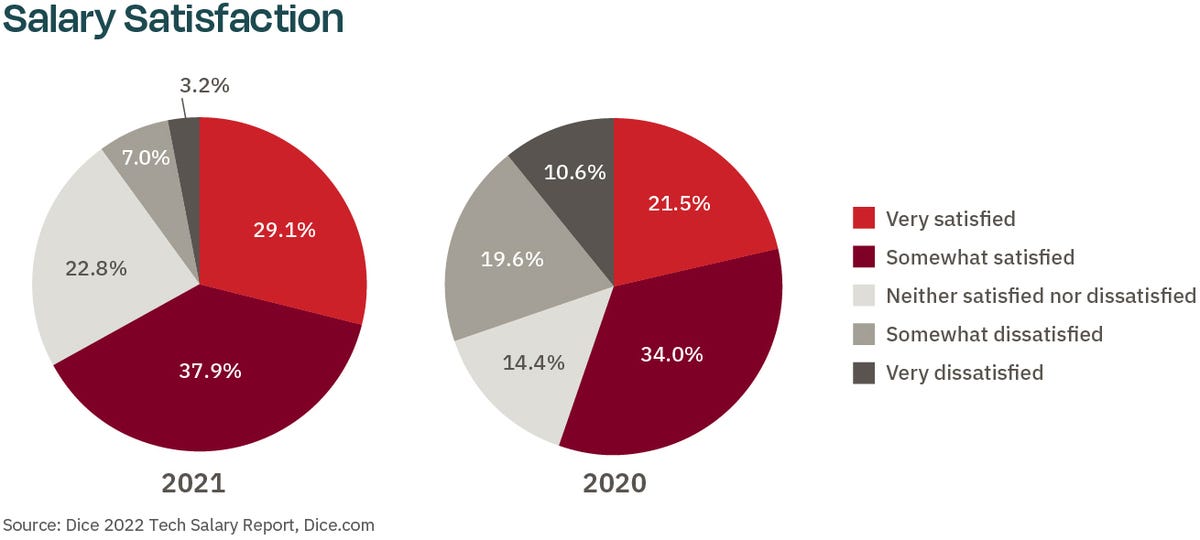
Perhaps unsurprisingly, these pay increases translate into greater satisfaction amongst tech workers. Of the more than 7,200 technologists who responded to Dice's survey, 67% reported being either 'very satisfied' or 'somewhat satisfied' with their salary – up from 55.5% in 2020. At the same time, the proportion who reported feeling very or somewhat dissatisfied with their pay dropped from nearly a third (30.2%) in 2020, to just 10.2% last year.


Image: Dice.com

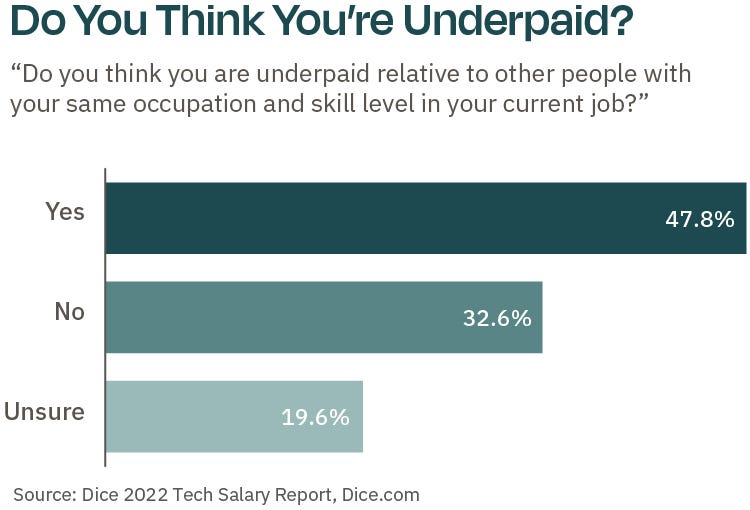
But despite rising salaries and greater satisfaction with their pay, tech workers do not feel they are being adequately compensated for their time: 47.8% of survey respondents felt they were underpaid – a marginal increase of nearly 2% compared to 2020.

SEE: Is the tech jobs boom is beginning to cool?

A few factors might be contributing to this, said Dice. For example, the low tech unemployment rate and the ever-increasing number of job vacancies may have led technologists to re-evaluate their current position. "Tech professionals are themselves or seeing their peers receive large compensation and other benefit increases as enticements to leave their current roles for another organization," Dice CEO, Art Zeile, told ZDNet.

"The close-to-historic low tech unemployment rate and the skyrocketing demand for technologists have created an environment in which technologists with varied levels of skills and experiences are being wooed by organizations that can afford to pay a premium, and that's likely driving some of the dissatisfaction in pay."


Image: Dice.com

There is also dissatisfaction among women about their salaries. Dice's 2021 Equality in Tech Report showed that some 35% of women reported dissatisfaction with their current compensation, and 49% of women reported feeling underpaid relative to their male counterparts.

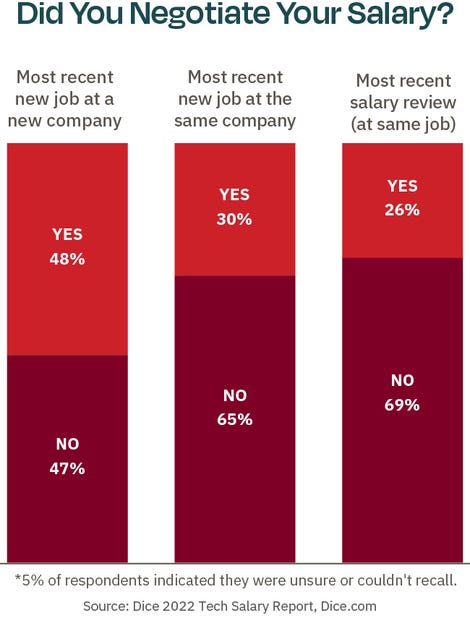
Despite technologists feeling underpaid, most are not fighting for pay rises. When asked whether they negotiated their compensation at their most recent salary review, 69% of respondents to Dice's survey replied 'No'.

This compares to 48% of tech workers who negotiated their salary for a new job at a new company. The main reason given by 10% of respondents who reported receiving a salary decrease in 2021 was because they changed employers.


Image: Dice.com

Pay isn't everything, however: alongside staple benefits, such as paid vacation days, health and dental care, and paid sick days, tech workers also increasingly want employers to offer more flexible work schedules, training and remote-working stipends, and childcare support.

Zeile said these findings were "not only a reflection of an organization's adjustment to the future of work," but also highlighted areas where organizations could be competitive in attracting and retaining talent.

"For organizations to attract talent in an ultra-competitive market, one of the most important components is to take the time to truly understand what technologists want and need in their ideal work environments and cultures, and that means starting to close the gap between the benefits that are important to employees versus what they're being offered."
China warns of air pollution risk during Beijing Winter Games

Published: 24 Jan 2022 - 

People walk near the closed loop "bubble" surrounding venues
 of the Beijing 2022 Winter Olympics on a hazy day in Beijing, China, January 24, 2022. 
REUTERS/Thomas Peter

BEIJING: Chinese authorities will take action against polluters to ensure next month's Winter Olympics will be held in a "good environment", an environment ministry spokesman said on Monday, as particularly heavy smog shrouded the capital, Beijing.

The Feb. 4-20 Games will be held in Beijing and the surrounding province of Hebei, which are both prone to heavy smog, and Liu Youbin, spokesman for the Ministry of Ecology and Environment, warned that winter weather was "very unfavourable" for efforts to keep the air clean.

"Beijing and Hebei … (can) take necessary administrative measures during the preparation and staging of the Winter Olympics to adopt control measures against enterprises and vehicles with high pollution levels," Liu told a regular briefing.

Since China won the bid for the Winter Olympics in 2015, authorities have tried to raise vehicle fuel standards, shut polluting firms and cut coal consumption in a bid to make the Games "green".

But according to environment ministry data, concentrations of hazardous airborne particles known as PM2.5, a main measure of smog, stood at 205 micrograms per cubic metre in Beijing on Monday morning.

Liu said the two regions would act if there were warnings of heavy pollution during the Games but they would also try to minimise the economic impact of any measures, and would ensure full operations at companies involved in important sectors like energy or COVID-19 control.

Last year, Beijing's average concentrations of PM2.5 fell 13% to 33 micrograms per cubic metre, meeting China's 35-microgram standard for the first time.

The number still exceeds the official World Health Organization recommendation of 5 micrograms, and concentrations are significantly higher during the winter.