Saturday, August 26, 2023


British Museum recovers some of 2,000 stolen items

  • PublishedShare

The British Museum, home to eight million items, has scrambled to address the loss of some 2,000 artefacts

About 2,000 items are thought to have been stolen from the British Museum, but some of the missing treasures have started to be recovered, chairman George Osborne has confirmed.

The ex-chancellor accepted the museum's reputation has suffered but said "it is a mess we are going to clear up".

He told the BBC "more could have been done" after theft concerns were first raised in February 2021.

A staff member the museum suspects of involvement has been sacked.

And it was announced on Friday that Hartwig Fischer, the museum's director, will step down after accepting a 2021 investigation was mishandled.

The museum, one of the UK's most prestigious cultural institutions, has been under pressure since revealing earlier this month that a number of treasures were reported "missing, stolen or damaged".

The items involved dated from the 15th Century BC to the 19th Century AD and had been kept primarily for academic and research purposes, the museum previously said.

Mr Osborne - who was appointed as chair of the museum in June 2021 - told BBC Radio 4's Today programme that "we have already started to recover some of the stolen items".

"We believe we have been the victim of thefts over a long period of time and frankly more could have been done to prevent them," he said.

Asked where the missing items were located, he said "some members of the antiquarian community are actively cooperating with us" and that recoveries so far were a "silver lining to a dark cloud".

He said he was confident that "honest people" will return items found to have been stolen, but acknowledged that "others may not".

Founded in 1753, the British Museum has amassed a collection of around eight million items, but as of 2019 only around 80,000 were on public display, with the rest held in storage.

Mr Osborne said that not all of the items are "properly catalogued and registered" and suggested "someone with knowledge of what is not registered has a big advantage in removing" them.

The museum is working closely with the police, Mr Osborne said, adding that a "forensic job" is under way to establish precisely what is missing. He said security at the museum needed to be improved.

"It has certainly been damaging to the British Museum's reputation, that is a statement of the obvious, and that is why I'm apologising on its behalf," Mr Osborne added.

A man has been interviewed by Metropolitan Police detectives over the missing items but no arrests have been made.

Senior figures at the museum have scrambled to address how they handled the discovery of missing items after it emerged concerns about potential thefts were first raised two years ago.

Asked why concerns raised in 2021 were not taken seriously, Mr Osborne said he did not believe there was a "cover-up" at the top of the museum, but said it was "possible" that "groupthink" among senior staff meant they "could not believe that there was an insider" stealing treasures.

Mr Fischer, who has held the position of director since 2016, confirmed on Friday that he would leave his role once an interim replacement had been appointed.

He was previously due to step down in 2024.

In a statement, he said: "It is evident that the British Museum did not respond as comprehensively as it should have in response to the warnings in 2021, and to the problem that has now fully emerged.

"The responsibility for that failure must ultimately rest with the director."

He also apologised for "misjudged" remarks alleging the antiques dealer who first raised concerns in 2021 had withheld information about the missing items.

Deputy director Jonathan Williams - who was involved with the 2021 investigation - will step back from his normal duties temporarily until an independent review launched by the museum concludes.

The missing-treasures scandal has prompted questions about the British Museum's wider role as an institution housing objects from around the world.

Greek archaeologist Despoina Koutsoumba told the BBC this week the Parthenon sculptures are "not safe" in London. The Greek government has long called for the artefacts, often called the Elgin Marbles, to be returned to Greece.

Tim Loughton MP, the Conservative chairman of the all party parliamentary group for the museums, has rejected claims it is no longer a trusted custodian of its vast collection.

He said calls for artefacts to be returned to their countries of origin were "opportunistic", telling BBC News culture and media editor Katie Razzall other countries should be "rallying around to help retrieve objects instead of trying to take advantage".

Mr Osborne said the British Museum plays a vital role in bringing together important collections from around the world, adding: "In an age that we are always reminded what divides us, it is a place that reminds us of what we have in common."

‘He’s an insider’: Ramaswamy’s deep ties to rightwing kingpins revealed

Republican candidate brands himself as an ‘outsider’ but has close links to prominent figures Leonard Leo and Peter Thiel


Martin Pengelly in Washington
THE GUARDIAN
Fri 25 Aug 2023

Vivek Ramaswamy has described himself as an “outsider”, accusing rivals for the Republican presidential nomination of being “bought and paid for” by donors and special interests.

But the 38-year-old Ohio-based venture capitalist, whose sharp-elbowed and angry display stood out in the first Republican debate this week, has his own close ties to influential figures from both sides of the political aisle.


Combative Vivek Ramaswamy emerges as surprise focal point of GOP debate


Prominent among such connections are Peter Thiel, the co-founder of tech giants PayPal and Palantir and a rightwing mega-donor, and Leonard Leo, the activist who has marshaled unprecedented sums in his push to stock federal courts with conservative judges.

Ramaswamy is a Yale Law School friend of JD Vance, the author of the bestselling memoir Hillbilly Elegy who enjoyed success in finance before entering politics. At Yale, Vance and Ramaswamy attended what the New Yorker called an “intimate lunch seminar for select students” that was hosted by Thiel. Last year, backed by Thiel and espousing hard-right Trumpist views, Vance won a US Senate seat in Ohio.

Thiel has since said he has stepped back from political donations. But he has backed Ramaswamy’s business career, supporting what the New Yorker called “a venture helping senior citizens access Medicare” and, last year, backing Strive Asset Management, a fund launched by Ramaswamy to attack environmental, social and governance (ESG) policies among corporate investors. Vance was also a backer.

Ramaswamy’s primary vehicle to success has been Roivant, an investment company focused on the pharmaceuticals industry founded in 2014.

The Roivant advisory board includes figures from both the Republican and Democratic establishments: Kathleen Sebelius, US health secretary under Barack Obama; Tom Daschle of South Dakota, formerly Democratic leader in the US Senate; and Olympia Snowe, formerly a Republican senator from Maine.

Ramaswamy’s links to Leo – recently the recipient of a $1.6bn donation from the industrialist Barre Seid, believed to be the biggest ever such gift, but now reportedly the subject an investigation by the attorney general of Washington DC – are many.

As reported by ProPublica and Documented, Ramaswamy has spoken at retreats staged by Teneo, a group Leo chairs and which aims to connect high-powered conservatives, to “crush liberal dominance” in American life.

Other Teneo speakers have reportedly included Ron DeSantis, the Florida governor polling ahead of Ramaswamy in the Republican primary, and the former South Carolina governor Nikki Haley, who trails Ramaswamy and clashed with him on stage in Milwaukee.

ProPublica also linked Thiel to the genesis of the Teneo group. According to a document seen by the Guardian, Ramaswamy became a Teneo member in 2021.

Elsewhere, Ramaswamy is a board member of the Philanthropy Roundtable, a group with ties to Leo, and a member of the Federalist Society, the Leo-driven group which works to stock the courts with conservatives.

Ramaswamy has also spoken to and received an award from the State Financial Officers Foundation (SFOF), a group of Republican state treasurers.

In June, in South Carolina, the Post and Courier newspaper reported that last year, before launching his presidential bid, Ramaswamy attempted “to leverage his [Republican] connections to gain access [for Strive] to lucrative contracts to manage pension funds … [with] total assets of $39.6bn”.

Similar pushes were mounted in Missouri and Indiana, the paper said. Curtis Loftis, the South Carolina state treasurer, told the Post and Courier there was “nothing improper” about such approaches.

Asked about Ramaswamy’s claims to be an outsider in light of his links to rightwing donors, activists and establishment figures, a campaign spokesperson told the Guardian: “Vivek has lived the American dream and has had tremendous success in business.

“There’s a colossal difference between someone who has friendships and business relationships with wealthy individuals and politicians who change their policies and positions to please their Super Pac donors,” they added.

In the Wisconsin debate, Ramaswamy flourished in the absence of Donald Trump, the former US president who faces 91 criminal charges but nonetheless leads Republican polling by huge margins.

Amid speculation that Ramaswamy might end up Trump’s running mate, Reed Galen, a Republican operative turned co-founder of the anti-Trump Lincoln Project, called Ramaswamy “a classic 2020s America tech bro bullshit artist … Trump for the 21st century”.

Ramaswamy’s claim to be an outsider, Galen said, was part of his “fundamental understanding … that Maga [the pro-Trump Republican base] wants him to show that the rest of these people [in the primary] are politicians. He’s willing to be the showman … the outsider. Anti-establishment. ‘If anything is there, I dislike it because it’s there.’ You know, ‘I’m going to have fun with this. I’m not going to take it seriously because you’re a bunch of hacks and goons.’”


Rightwing activist Leonard Leo under investigation in Washington DC

But in another sense, regarding Ramaswamy’s ties to the likes of Leo and Thiel, Galen said: “I think that he’s an insider.

“He walks into a room with Leonard Leo and says, ‘What do you need me to do?’ … And they’re like, ‘Here’s what we want you to do. Here’s what we need you to do.’ Right?

“Do I think [Ramaswamy] cares about [issues like restricting] abortion? No, not particularly. I don’t think he has a firmly held belief on it. But if he thinks that it will help him, and in exchange for that Leonard Leo will throw a little chicken feed of the $1.6bn that old man gave him, to help him? Sure, what the hell?

“He didn’t ever think he’d get this far. So now he’s just gonna push it as far as he can.”

Ramaswamy, Galen said, was closely tied to a world of donors and non-profits in which Leo is “certainly at the center. And this movement only moves in one direction, and it’s toward the darkness. It’s towards authoritarianism. And it’s because it finds people like Ramaswamy. And the more that all these other candidates will now attack him, they will drive him further and further into the arms of those people.”

Like hard-working farmers, corals cultivate and eat their resident algae

A new study proposes a solution to a question that perplexed Darwin: How do corals thrive in barren seascapes?


23 AUG 2023
BYMOLLY RAINS
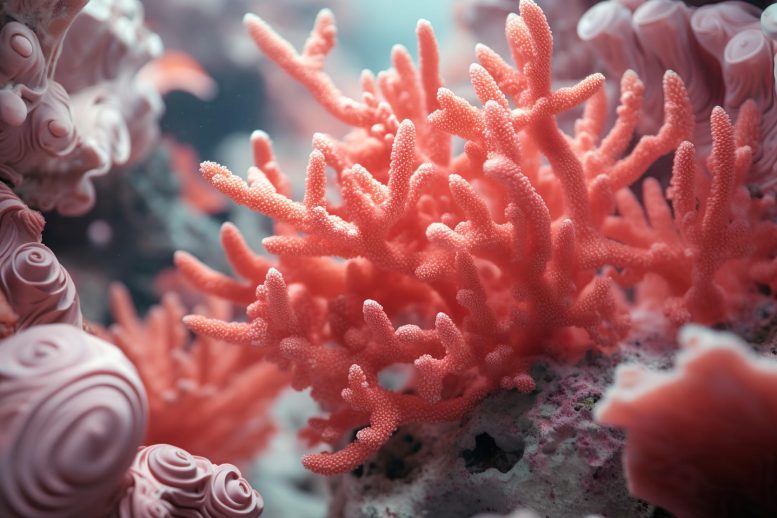
Collaboration between corals and algae allows reefs to flourish, but there is more to their partnership than previously thought.

WIEDENMANN C_D’ANGELO/UNIVERSITY OF SOUTHAMPTO

After Charles Darwin happened across “vast rings of coral-rock” while voyaging through the southern Pacific Ocean on the Beagle, he wrote that upon seeing them, “everyone must be struck with astonishment.” These encounters inspired in the naturalist a lifelong fascination with coral reefs and one persistent question: How do vibrant corals flourish in often-barren ocean landscapes?

Known as the Darwin Paradox, this mystery has continued to puzzle generations of oceanographers. A new study published today in Nature offers a solution. According to its authors, corals make up for nutrient scarcity by harvesting and feeding on their resident algae, like hungry farmers. It’s “a really, really beautiful study,” says coral biologist Mónica Medina of Pennsylvania State University, who was not involved in the work.

Researchers have long known that corals maintain a mutually beneficial relationship with the single-celled algae that call the animals’ tissue home. There, sheltered from the harsh conditions of the open ocean, the algae feed on the corals’ waste products. In return, the algae convert sunlight into energy-rich food molecules that nourish themselves and their hosts. Corals also feed on drifting zooplankton to capture other essential nutrients

But these food sources alone can’t account for the world’s vast and prolific coral reefs. “There are lots of studies that have examined [coral] nutrient transport and tried to do the math, but it never really quite made perfect sense,” says Virginia Weis, a marine physiologist at Oregon State University who was not involved in the study. In particular, the useful forms of nutrients that corals need in order to grow—including nitrogen and phosphorus—tend to be in short supply around reefs.

However, sea creatures living in the vicinity excrete plenty of inorganic nitrogen and phosphorus, which the coral’s algal residents can readily consume. Jörg Wiedenmann, head of the coral reef laboratory at the University of Southampton, wondered whether there was a connection. Could the algae somehow be passing these nutrients along to their coral hosts?

To find out, Wiedenmann and colleagues placed coral samples in tanks without any food. To half of the tanks, they added inorganic nutrients that only the coral’s resident algae could enjoy. Corals in the tanks containing no nutrients at all stopped growing and had lost about half of their algal partners after just 50 days, giving them a bleached and stunted appearance. But in the tanks where the algae had been fed, the coral grew robustly. Scientists knew algae provided corals with energy via photosynthesis, but these results suggested they were also sustaining coral growth by converting inorganic nitrogen and phosphorus into coral chow. Yet how the algae transferred those nutrients remained a mystery.

Wiedenmann wondered whether the corals were eating their algal partners. The team calculated the expected growth of the coral’s algal population given the input of nutrients, then compared its prediction with the actual number of algal cells in the tanks. They found far fewer algae than expected. What’s more, the amount of nitrogen and phosphorus contained within the unaccounted-for cells aligned with the nutrients required for the coral to grow as big as it did. Wiedenmann was convinced: The corals were preying on the algae.

Looking for evidence of this phenomenon in nature, the team observed the reef growth in the Indian Ocean’s Chagos archipelago. Here, seabirds live in high density on some islands but not others, and the birds’ droppings contain inorganic nutrients that algae can eat directly, but that coral cannot. Over a period of 3 years, the researchers found that reefs near islands with lots of birds—and, therefore, plenty of algae food—grew twice as fast as those near islands where birds were scarce. A unique form of nitrogen that is plentiful in bird droppings, but not zooplankton, also reappeared in corals around bird-dense islands. To the researchers, this was further evidence that the algae were indeed shuttling nutrients from the birds to their coral hosts.

The study nicely combines laboratory and fieldwork to crack a long-standing mystery, Medina says. It could also help scientists better understand the devastating effects of coral bleaching, she adds, in which the relationship between corals and their algal residents breaks down.


Reef-building corals farm and feed on their photosynthetic symbionts

Abstract

Coral reefs are highly diverse ecosystems that thrive in nutrient-poor waters, a phenomenon frequently referred to as the Darwin paradox1. The energy demand of coral animal hosts can often be fully met by the excess production of carbon-rich photosynthates by their algal symbionts2,3. However, the understanding of mechanisms that enable corals to acquire the vital nutrients nitrogen and phosphorus from their symbionts is incomplete4,5,6,7,8,9. Here we show, through a series of long-term experiments, that the uptake of dissolved inorganic nitrogen and phosphorus by the symbionts alone is sufficient to sustain rapid coral growth. Next, considering the nitrogen and phosphorus budgets of host and symbionts, we identify that these nutrients are gathered through symbiont ‘farming’ and are translocated to the host by digestion of excess symbiont cells. Finally, we use a large-scale natural experiment in which seabirds fertilize some reefs but not others, to show that the efficient utilization of dissolved inorganic nutrients by symbiotic corals established in our laboratory experiments has the potential to enhance coral growth in the wild at the ecosystem level. Feeding on symbionts enables coral animals to tap into an important nutrient pool and helps to explain the evolutionary and ecological success of symbiotic corals in nutrient-limited waters.
CONTINUE READING:

Reef-building corals farm and feed on their photosynthetic symbionts | Nature


Darwin’s Paradox of Coral Reefs Solved – Scientists Unravel Age-Old Mystery

Coral Reef

A research study from the University of Southampton has unveiled that corals feed on microscopic algae living within their cells, accessing a nutrient source previously thought unavailable. This discovery answers a long-standing mystery known as Darwin’s Paradox of Coral Reefs, explaining how corals flourish in nutrient-poor waters.

A new study led by the University of Southampton in the UK has uncovered why coral reefs flourish in waters that appear to be deficient in nutrients, a phenomenon that has fascinated scientists since Charles Darwin.

The research shows that corals farm and feed on their photosynthetic symbionts – microscopic algae that live inside their cells. This vegetarian diet allows the corals to tap into a large pool of nutrients that was previously considered unavailable to them. Effectively, they are eating some of their symbiont algae to get the nutrition they need to survive.

Professor Jörg Wiedenmann, Head of the Coral Reef Laboratory at the University of Southampton, who led the study comments: “The question as to why coral reefs thrive in parts of the oceans that are poor in nutrients is known as Darwin’s Paradox of Coral Reefs and has inspired the discovery of several important processes that can help to explain this phenomenon. We can now add the missing piece of the puzzle and help to solve the long-running mystery.”
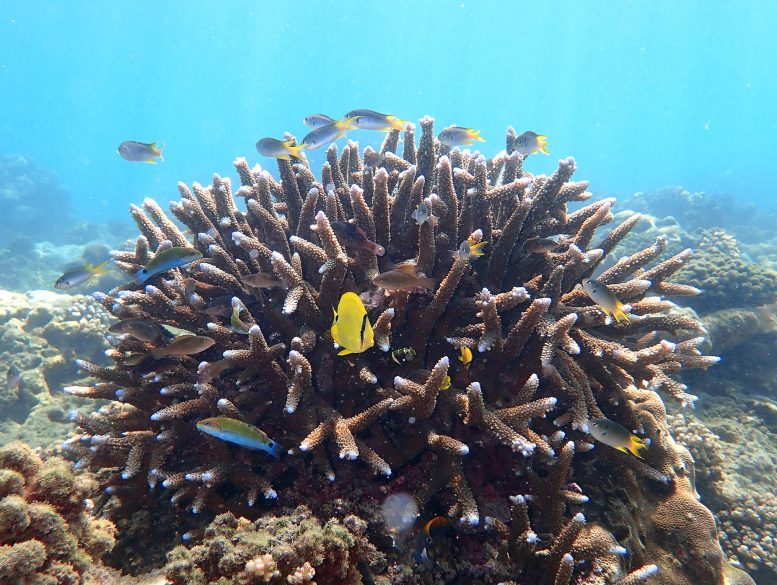
Reef Corals Provide Home and Feeding Grounds for Many Organisms

Reef corals provide home and feeding grounds for many organisms. Credit: Wiedenmann / D’Angelo / University of Southampton

He continues: “When Charles Darwin set sail on the HMS Beagle, he considered himself a geologist and during his voyage through tropical seas, quickly became interested in where and why coral reefs are formed. Darwin correctly predicted how the subsidence of the Earth’s crust and the steady upward growth of corals interact to form vast reef structures. However, the biological mechanisms behind this vigorous growth remained unstudied.”

Surviving together

Stony corals are soft-bodied creatures that may look like plants to some, but are in fact animals. These organisms are made up of many individual polyps that live together as a colony and secret limestone skeletons which form the three-dimensional framework we know as ‘reefs’.

Coral reefs are important underwater ecosystems that benefit many human communities. They provide a home and feeding ground for countless organisms, sustaining about 25 percent of global ocean biodiversity. Thereby, they deliver food and income to about half a billion people on Earth.
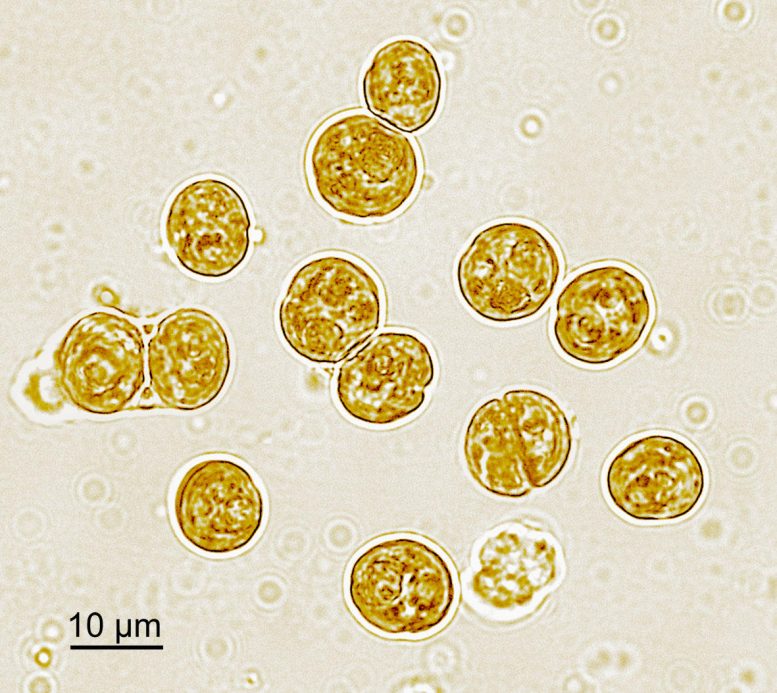
Unicellular Symbiont Algae of a Reef Coral

Unicellular symbiont algae of a reef coral showing growth by cell division. Credit: Wiedenmann / D’Angelo / University of Southampton

The coral animals are dependent on a ‘symbiosis’, a mutually beneficial relationship with microscopic algae that live inside their cells. The photosynthetic algae produce large amounts of carbon-rich compounds, such as sugars, which they transfer to the host coral for energy generation.

The symbiont algae are also very efficient in taking up dissolved inorganic nutrients from seawater, such as nitrate and phosphate. Even in nutrient-poor oceans, these compounds can be found in considerable amounts as excretion products of organisms, such as sponges, that live close by. They can also be transferred to reefs by ocean currents.

What the scientists found

In contrast to their symbionts, the coral host cannot absorb or use dissolved inorganic nutrients directly and, until now, it was unclear how these nutrients could fuel the growth of coral. However, the mechanism by which these essential growth nutrients are transferred to the coral animals has been identified by scientists from the University of Southampton, working with a team of collaborators including Lancaster University in the UK, Tel Aviv University, and the University of Jerusalem in Israel.

Their findings are published in the journal Nature.
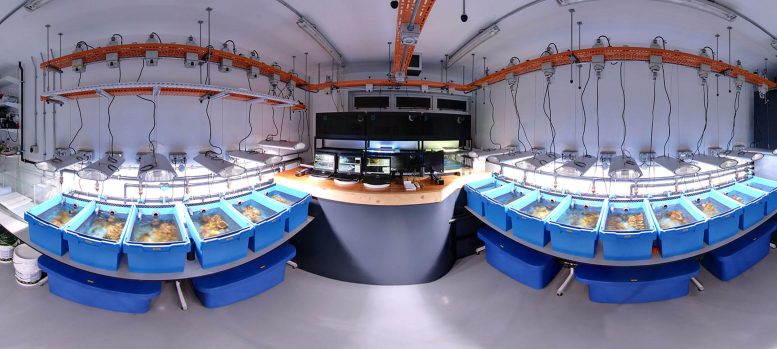
Coral Reef Laboratory at the University of Southampton

Experimental aquarium of the Coral Reef Laboratory at the University of Southampton. Credit: Wiedenmann / D’Angelo / University of Southampton

By performing a series of long-term experiments at the University of Southampton’s Coral Reef Laboratory, the scientists demonstrated that corals actually digest some of their symbiont population to access the nitrogen and phosphorus that symbionts absorb from the water. Where there are sufficient dissolved inorganic nutrients in the water, this mechanism allows corals to grow quickly, even if they do not receive any additional food. Results from fieldwork in remote coral reef atolls in the Indian Ocean support the lab findings, demonstrating that this mechanism boosts coral growth in the wild at the ecosystem level.

Dr Cecilia D’Angelo, Associate Professor of Coral Biology at Southampton and one of the lead authors, comments: “Over the many years during which we propagated symbiotic corals in our experimental aquarium system, we had observed that they grew very well even when they were not fed. It could not be explained by the current state of knowledge how nutrients were exchanged by the two partners of the symbiosis, so we figured that we were missing a big piece of the picture and started to analyze the process systematically.”
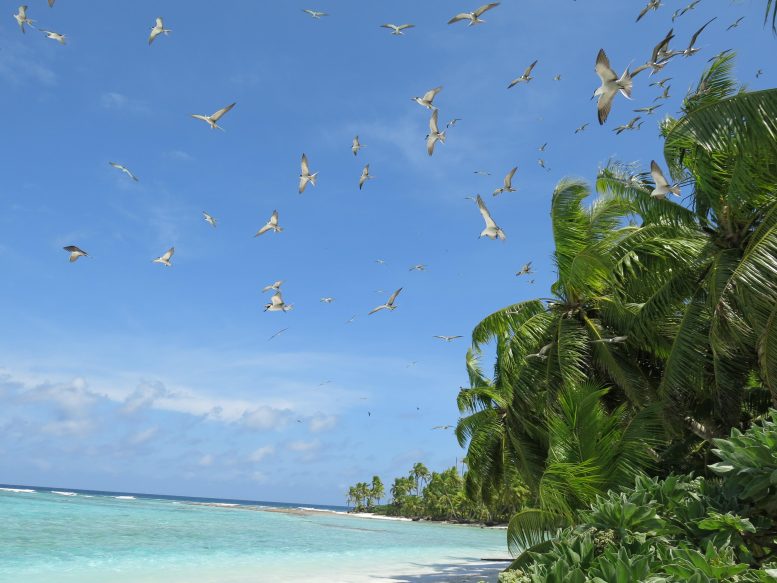
Seabirds Introduce Nutrients in Coral Reefs in the Indian Ocean

Seabirds introduce nutrients in coral reefs in the Indian Ocean. Credit: Nick Graham, Lancaster University

Dr Loreto Mardones-Velozo, a researcher in the Coral Reef Laboratory who conducted key experiments, adds: “One would expect that animals die or stop growing if they don’t eat. However, the corals looked perfectly happy and grew rapidly if we kept them in water with elevated levels of dissolved inorganic nutrients.”

The science behind the findings

The researchers used a specifically labeled chemical compound to track the movement of the essential nutrient nitrogen between the partners of the symbiosis. Nitrogen in the chemical form used in the experiments can be only integrated in their cells by the symbionts, but not the coral host.

Bastian Hambach, Manager of the Stable Isotope Mass Spectrometry Laboratory at the University of Southampton, explains: “We used isotopic labeling to ‘spike’ the nutrients supplied to the corals with nitrogen atoms that were heavier than normal. These isotopes allowed us to trace the coral’s use of the nutrients using ultrasensitive detection methods.”
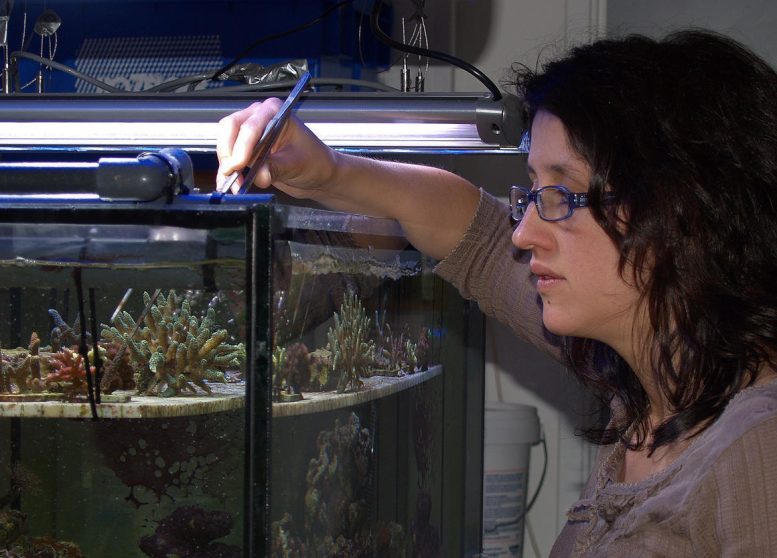
Cecilia D’Angelo Propagating Corals

Dr. Cecilia D’Angelo propagating corals in the Coral Reef Laboratory at the University of Southampton. Credit: Wiedenmann / D’Angelo / University of Southampton

Professor Paul Wilson, paleoceanographer at the University of Southampton expands: “With this technique, we could unambiguously demonstrate that the nitrogen atoms that sustained the growth of the coral tissue were derived from the dissolved inorganic nutrients that were fed to their symbionts in the experiment.”

Professor Jörg Wiedenmann of the University of Southampton adds: “We used 10 different coral species to quantify how the symbiont population grew along with their hosts. Using mathematical models of the symbiont growth, we could show that the corals digest the excess part of their symbiont population to harvest nutrients for their growth. Our data suggest that most symbiotic corals can supplement their nutrition through such a ‘vegetarian diet’.”

The scientists also analyzed corals growing around islands in the Indian Ocean, some with seabirds on them and some without, to show that corals have the potential to farm and feed on their symbionts in the wild.
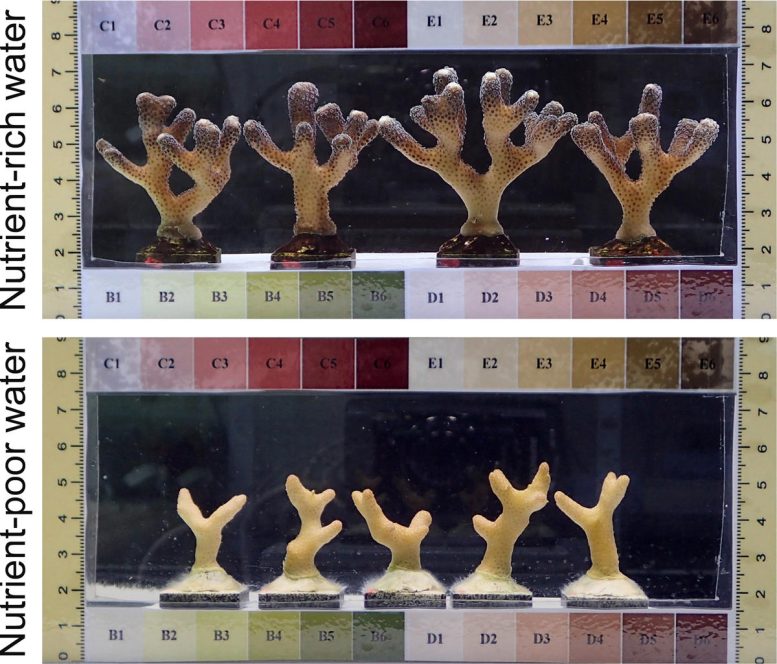
Growth of the Experimental Coral Stylophora pistillata

Growth of the experimental coral Stylophora pistillata. Credit: Mardones-Velozo / D’Angelo / Wiedenmann / University of Southampton

Professor Nick Graham, Marine Ecologist from Lancaster University, explains: “The reefs around some of these islands are supplied with substantial amounts of nutrients that come from ‘guano’, the excrements of the seabirds nesting on the islands. On other islands, the seabird colonies have been decimated by invasive rats. Accordingly, the associated reefs receive less nutrients. We measured the growth of staghorn coral colonies around islands with and without dense seabird populations and found that growth was more than twice as fast on reefs that were supplied with seabird nutrients.

“We calculate that about half of the nitrogen molecules in the tissue of the coral animals from islands with seabirds can be traced back to uptake by the symbionts and the subsequent translocation to the host.”
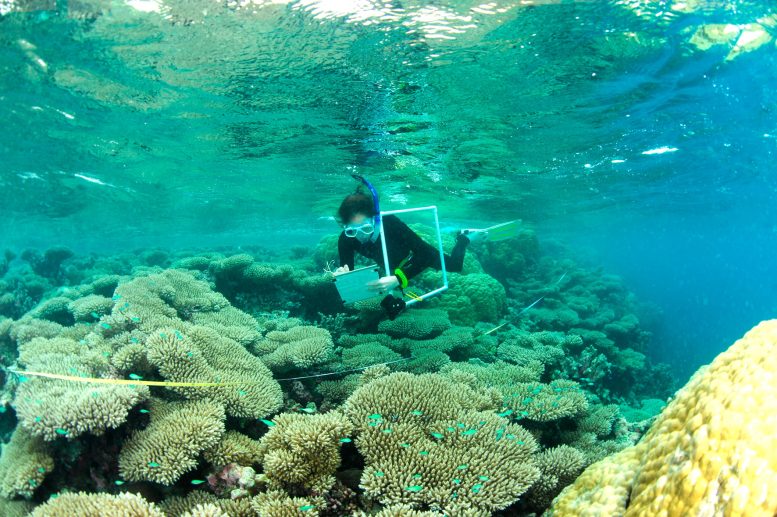
Scientist Monitoring Coral Growth on Indian Ocean Reefs

Scientist monitoring coral growth on Indian Ocean Reefs to study the effect of seabird nutrients. Credit: Nick Graham, Lancaster University

Global warming and the future

Excessive nutrient enrichment, often caused by human activities, can damage corals and represents a growing threat in many reefs. However, some coral reefs might receive less nutrients in the future as global warming may cut them off from some of their natural supply routes.

Dr D’Angelo from the University of Southampton explains: “Warming surface waters are less likely to receive nutrients from deeper water layers. The reduced water productivity can result in less nutrients for the symbionts and in turn less food for the coral animals.

The scientists’ new findings suggest that while coral animals may endure brief periods of starvation by feeding off their symbionts, some coral reefs might be at risk of starvation in response to more prolonged nutrient depletion brought on by global warming in some areas.

Reference: “Reef-building corals farm and feed on their photosynthetic symbionts” by Jörg Wiedenmann, Cecilia D’Angelo, M. Loreto Mardones, Shona Moore, Cassandra E. Benkwitt, Nicholas A. J. Graham, Bastian Hambach, Paul A. Wilson, James Vanstone, Gal Eyal, Or Ben-Zvi, Yossi Loya and Amatzia Genin, 

23 August 2023, Nature.
DOI: 10.1038/s41586-023-06442-5

Years After the Blob, the Pacific Still Doesn’t Look the Same

The 2014–2016 marine heatwave transformed the ecosystem of the northeast Pacific. Some of those changes seem here to stay.


As oceans continue to warm and heatwaves like the Blob keep coming, fish populations will struggle to bounce back. Photo by Happy Window/Shutterstock

by Ethan Freedman
August 25, 2023 | 600 words

In late 2013, a mass of warm water now known as the Blob appeared in the northeast Pacific—a massive marine heatwave that cooked coastal ecosystems from Alaska to California. Later, bolstered by an El Niño, the vast and potent heatwave wreaked havoc on marine ecosystems: thousands of seabirds died, while blooms of harmful algae poisoned marine mammals and shellfish. The suddenly warmed water also brought an influx of new animals to the northeast Pacific: ocean sunfish appeared in Alaska, while yellow-bellied sea snakes popped up in Southern California.

By 2017, the Blob had waned and many of these more tropical species had retreated. Yet not all. Some of the species that colonized new habitats during the heatwave have stuck around. And now, says Joshua Smith, a marine ecologist at the Monterey Bay Aquarium in California who documented in new research how the Blob triggered a range of subtle yet persistent shifts in the spread of marine species, “I’m starting to sort of question whether those communities will ever look the way they did.”

Historically, it’s common enough that a handful of individuals from warm-water species will make their way north during warmer years, but there wouldn’t be enough of them to sustain a long-term population, says Jenn Caselle, a marine ecologist at the University of California, Santa Barbara, and coauthor of the new paper. But because the Blob was so intense and lasted so long, sizable populations made the move into these normally cooler habitats—populations that were potentially large enough to establish more permanent footholds.

Señorita fish, for example—a bright-orange wrasse that showed up in huge numbers in central California during the heatwave—are still there, Smith says. Ocean whitefish, while historically common around Southern California’s Channel Islands, are now dominant, Caselle says, while California sheephead, a bulbous red-and-black fish, are now also much more abundant near Santa Barbara.

These changes in coastal communities, Caselle says, can have knock-on effects on how these ecosystems function. Sometimes, when one species is extirpated from a community—like a predatory fish that keeps a population of smaller fish in check or a seaweed species that provides a home for invertebrates—the ecosystem loses some kind of important function. But if that lost species is replaced by a new species that does the same thing, that new species could provide some resilience to the ecosystem, Caselle says, even if the community doesn’t look the same as it always did.

People can also adjust to new ecological realities, she says, pointing to fishers’ recently acquired fondness for the now-abundant ocean whitefish.

The Blob was one of the most intense marine heatwaves in recorded history, so it makes sense that it had a big effect on marine ecosystems. But big marine heatwaves have affected the northeast Pacific every year since 2019, including this year. Meanwhile, the current El Niño is further heating the northeast Pacific, and climate change means marine heatwaves will likely continue to be even more frequent.

As oceans continue to warm and the heatwave hits keep coming, William Cheung, a marine ecologist at the University of British Columbia who was not involved in the new research, says fish populations could be in trouble. In his own research, Cheung previously showed how warming and marine heatwaves will stress fish populations in the northeast Pacific. Usually, he says, fish populations can bounce back after a heatwave. But if heatwaves start occurring more frequently, populations will have less time to replenish themselves.

These changes are unlikely to go unnoticed. “The place where humans interact with the ocean the most is right at the coast. It’s where most of the biodiversity lives, and it’s where a lot of the productivity is,” Caselle says. “As these systems change, it can affect our everyday lives.”