Slow Motion Ethnic Cleansing in Hebron
The genocide in Gaza has burst that bubble of shadows and lies and revealed the ugly truth of the Zionist project all over Palestine. It is a cancer.
By Ken Jones

“Tell our story!” the man in the checkpoint cage yelled, in English. He and a crowd of Palestinian Muslim men were jammed together waiting to be checked out, one at a time, by an Israeli soldier in a glass booth so they could go into Hebron’s Ibrahimi Mosque to pray. Such daily and routine humiliation is the hallmark of the Israeli occupation.
I was in Hebron (Al-Khalil) for two weeks recently as part of a Community Peacemaker Team (CPT) delegation. Every day, we accompanied or heard testimony from people living there who were living under the guns of the Israeli Occupation Forces (IOF) and the aggressive hostility of the 800 settlers who claim that the city of 200,000 was given to them by their god. Every night, I kept a blog trying to capture one of the many stories we heard of the oppression.
Hebron is in the southern part of the West Bank. It hasn’t gotten the genocidal Gaza treatment that Jenin, Tulkarem, and Nur Shams are now getting. But, as someone said to me, “We are waiting our turn.” It may be that the tanks and bombs will come to Hebron too, but at the moment, what is happening there is the decades-long grind of military occupation and settler colonialism.
The stories we heard are gruesome. And everyone has one. Most men have been taken to prison and tortured. It’s common to have your home broken into in the middle of the night by soldiers who yell, beat everyone, and kidnap fathers, sons and daughters, taking them away to unknown locations, with no charges, and for an undetermined time. Entire homes are demolished regularly. Land is stolen. Movement is restricted. Surveillance is constant and pervasive. These stories don’t make the news. They have become too normalized.
The stories we heard are gruesome. And everyone has one.
Here are a couple of stories that may give a glimpse of what daily life is like in Hebron.
One day, a 20-year-old woman told us about her year in prison. She recounted the horribly dirty and crowded conditions, the scarcity and bad quality of the food, the strip searches, the beatings, the constant verbal abuse.
She said the hardest thing that she witnessed was when women from Gaza were brought in. They wore bloody clothes and their hijabs had been stripped away from them. They were given no beds, nothing to clean themselves with. They were given dirty clothes that had been deliberately contaminated with lice. When they went to the bathroom, they were taken by male soldiers.
Then she told us the story of Oct. 7, 2024, the one year “memorial” of the Gazan attack on Israelis. An officer entered women’s rooms and gave them 30 seconds to cover themselves before soldiers came in. When the soldiers came, they put zip ties on the women’s hands, blindfolded them, and took them out. They made them lie face down on muddy ground, beat them, cursed hatefully at them, and brought police dogs out to terrorize them. While this was going on, soldiers went into their cells, took all of their clothes, and set off tear gas grenades in their cells. Then they put the women back in their cells.
On another day, an older man who was living in a family home handed down through generations told us of the daily harassment he has been subjected to by settlers living next to his house. Protected by the IOF, they are taking pieces of his land every day. They have poisoned his sheep, stolen his olives, and destroyed over 250 olive trees.
His home is frequently used for family gatherings. During one of these recent gatherings, a large group of settlers burst into the house and started assaulting people. Some of them were dressed as soldiers. There were many injuries, windows were broken, and cars damaged. Then they stopped an ambulance from getting to the house.
Settlers have attacked his family in the fields and farm with stones, have brandished guns, and beaten them with sticks. They have driven jeeps right into the house, dumped bulldozers full of trash at their front door. Soldiers have tear gassed the inside of their home and flown drones overhead frequently.
The story we heard at the village of Um Al-Khair in the South Hebron Hills is emblematic of what is happening all over the West Bank. The village consists largely of descendants of refugees from the 1948 Nakba.
Immediately next to the village is a settlement of some 500 Israeli families and nearby, a military base. The teens from the settlement act as front-line vigilantes. They roam around with sticks and pepper spray making life miserable and tense for the people of the village. They have broken into homes and beaten women, damaged the village water pump, and even herded sheep right into village homes.
Whenever the villagers complain to the police about such attacks, the police say they have been told by the settlers that the teens are being attacked by the Palestinians. The police threaten to arrest the villagers if they keep making these calls.
Protected by the IOF, settlers are taking pieces of his land every day.
We were walked to a recently demolished house where a couple of young Palestinian men were sitting, looking sadly at the ruins. Three rooms and a water tank were all jumbled up in piles. One of the men told us his 60-year old mother, who owned the house, had been thrown to the ground when she yelled about her house being destroyed. There was nothing the son or mother could do about it. Their family is now crowded in with a next door neighbor. In June, Israel had demolished 10 homes in one morning in the village.
A settler organization in Israel named Regavin flies drones over newly demolished homes to report to the military any Palestinian attempt to rebuild. Still, the son and villagers are planning to rebuild the home.
Our village guide talked about the trauma of it all, especially for the kids. He said, “It is very hard for us to live in this condition. These people are not neighbors, they don’t care about us at all. They treat their dogs better than they treat us.” He worried about the mental health of his five young daughters and all of his friends living there.
We walked down to the paved road that was put in for the settlement. It was put over a dirt road that had been there since Jordan controlled this territory many years ago.
Israel now defined the paved road as the border of the village, beyond which they and their goats and sheep were not allowed to “trespass.” Simple as that, their pasture land was stolen. Soldiers also put a gate at the beginning of the road so that they can close off entry and exit into the village whenever they choose.
In June, Israel demolished 10 homes in one morning in the village.
We walked past some sapling trees, supplied by the Jewish National Fund, that settlers had just planted right next to villagers’ houses. The obvious purpose of planting the trees was to establish a claim to the land.
We saw the electric lines leading to the settlement. The villagers can’t use that electricity. They have power only from a small number of solar panels. We also saw the now repaired water pump from which they are allowed to draw from only two days a week, for a total of 6 hours. We saw the surveillance camera up on a pole overlooking the village. “They are watching us all the time,” our guide said.
We were told about the sounds of gunfire from the military firing range that was put illegally on their land. I imagined how threatening that must be, especially for the children.
All of this pressure in Um Al-Khair is one big systematic slow motion ethnic cleansing campaign, designed to push the villagers off their land. The intention is not just to demolish homes, land rights, and mental health. It’s meant to demolish hope.
But from what I could see, Palestinians will never give up hope. Every story of injustice we heard was told with a spirit of determined resilience and resistance — sumud, as it is called there.
No Palestinian we met was planning to leave or submit. Everyone appeared to be carrying on with life, with joy and humor, and with healthy relationships, despite the danger and indignities they were suffering. They refuse to live in fear. As one person said, “That’s what they want, for us to be afraid. They want us to leave. We will not fear and we will stay until this occupation is over.”
As has often happened to me when I visit places that are on the receiving side of U.S.-sponsored violence and oppression, I was struck during this visit by the strong and enviable character of the Palestinians we met. They are not defeated, their spirits are not broken. They are warm, generous, dignified. I always felt safe and cared for around them, even though I, as an American, had no right to expect such treatment. The only times I felt fear and coldness were when I was around Israeli soldiers or settlers. That’s telling.
The stories and voices of Palestinians have always been purposefully suppressed by the powers that be in the U.S. and the West. As has the truth about how Palestinians have been treated for over a hundred years. The genocide in Gaza has burst that bubble of shadows and lies and revealed the ugly truth of the Zionist project all over Palestine. It is a cancer.
Hebron is still a vibrant place, bustling with life. May its countless stories be heard, may its occupation end, may its people be free. And the same for all of Palestine.
Ken Jones is an organizer for the War Industry Resisters Network, living in Asheville, NC.
Why the Second Phase of Gaza Negotiations is Failing
Image by Planet Volumes.
The three phase ceasefire agreement between Israel and the Palestinian Resistance, while offering a fleeting glimmer of hope for ending Israel’s genocidal assault on Gaza, was never likely to succeed. Benjamin Netanyahu’s decision to break the ceasefire by blocking food and medical aid from entering Gaza—furthering war-crime starvation—was not a matter of “if” but “when.”
The ceasefire agreement was carefully designed to be implemented in three distinct phases, each to be implemented sequentially, with the oversight and verbal guarantees from the three key mediators: the United States, Qatar, and Egypt. The integrity of the agreement hinges on the mediators’ ability to ensure that all parties remain fully committed to honoring its terms. Otherwise, what credibility would the mediators’ signatures or the mediation process hold if Netanyahu could simply demand to renegotiate an agreement that took at least 8 months to finalize?
Netanyahu is leading negotiations on two conflicting fronts: one with the Resistance to exchange Israeli captives for Palestinian hostages held in Israeli dungeons, and second with the racist warmonger’s wing in his government.
In preparation to break the agreement, and to placate his warmonger ministers, Netanyahu changed the negotiating team for phase two by replacing the heads of Mossad and Shaback with his alter ego, Ron Dermer, minister of strategic affairs. Dermer who during a war cabinet meeting in mid-October 2023, told U.S. Secretary of State, Anthony Blinken, “There won’t be a humanitarian crises [sic] in Gaza if no civilians are there.”
Talks for the second phase were scheduled to start the first week of February, but Israel did not show up at the negotiation table. In a desperate bid to buy time and secure American support, Netanyahu dispatched Dermer to Washington over a week ago. His mission: to sell the idea of renegotiating the current agreement and extend the first phase.
This tactic is emblematic of Netanyahu’s broader strategy— exploiting diplomatic engagements to maintain the status quo, buying time and maximizing the number of released Israeli captives by extending phase one before finishing his genocide war and ethnic cleansing in Gaza.
The timing is no coincidence. With growing international scrutiny mounting over Israel’s genocide in Gaza and the West Bank, Netanyahu is investing in Washington’s habitual deference to Israeli demands. By stalling negotiations, Netanyahu hopes to delay difficult political reckonings required in phase two, mainly ending Israeli blockade and aggression on Gaza.
The Trump administration complied with Netanyahu’s request, pledging to dispatch its Middle East special envoy, Steve Witkoff, to renegotiate the current ceasefire agreement and floating an Israeli demand to extend phase one for additional 50 days. Trump’s decision to heed the Israeli prime minister’s request so swiftly only serves to validate Netanyahu’s view of the U.S. when he was caught on tape back in 2001 saying that “America is a thing you can move very easily.”
By acquiescing to Netanyahu’s maneuvering, Trump not only reinforced this perception but also risked undermining his own standing as a world leader. The pattern of deference to Israeli interests continues to resonate as a stark reflection of the bizarre dynamics in U.S.-Israel relations, where America’s Middle East foreign policy is exclusively franchised to Israel and its Washington Jewish lobby.
Netanyahu’s latest scheme is a reminder that as long as Washington remains willing to be “moved” at Israel’s convenience, meaningful progress toward peace will remain unattainable. Rather than acting as an impartial mediator, the U.S. continues to function as a complicit enabler, reinforcing the very power imbalances that perpetuates Israeli depravity and Palestinian adversity.
In endorsing Netanyahu’s demand to renegotiate the existing agreement rather than negotiating an end of war in phase two, the Trump administration is effectively empowering Netanyahu’s prevarications. This allows Israel to prolong Palestinians suffering while appearing to engage in negotiations. In reality, the extension serves as a tool for Netanyahu to consolidate his power amid domestic political turmoil, neutralize international pressure, and further cement Israel’s occupation and apartheid policies.
By backing Netanyahu’s decision to halt humanitarian aid to Gaza—Trump, much like his predecessor—kowtows to Netanyahu’s wishes. America’s willingness to leverage its global influence in service of Israel is a major factor in the increasingly rigid Israeli position, enabling a racist Jewish government more invested in maintaining the status quo than in seeking genuine peace. Israeli intransigence is not merely an oversight—it is a deliberate policy intended to maintain Palestinian dispossession, statelessness, and subjugation.
Israel has also violated the ceasefire agreement with Lebanon by failing to fully withdraw from Lebanese territory within the 60-day timeframe stipulated under the American and French-mediated agreement. Additionally, it has breached the decades-old ceasefire treaty with Syria launching countless of air raids and occupying the buffer zone and army positions along the border.
Israel’s willingness to violate every agreement it signs is not a failure of diplomacy—it is a direct result of enabling a war criminal who has shown time and again that his only path forward is through bloodshed. If the international community truly seeks an end to this genocide, it must stop treating Netanyahu as a legitimate partner in peace and start holding him accountable for his crimes.
By denying Palestinians their agency and as long as Washington remains beholden to an Israel-centric foreign policy—shaped by doomsday messianic Christians and the Jewish lobby—Tel Aviv will continue to perpetuate repression, sustain aggression, and ensure the failure of phase two.
The Lost ‘Arab’: Gaza and the Evolving Language of the Palestinian Struggle
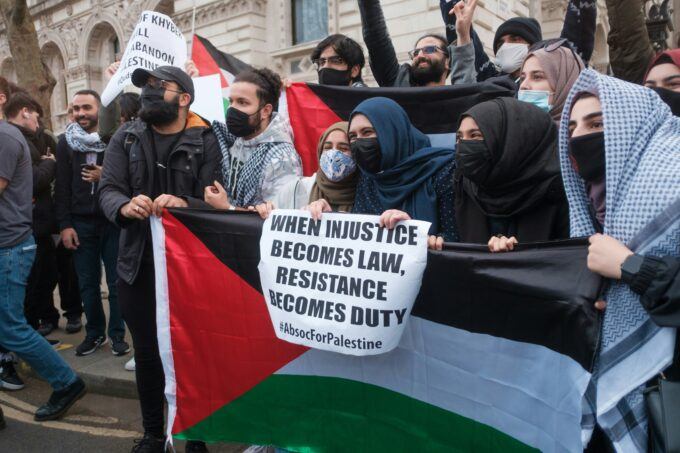
Image by Ehimetalor Akhere Unuabona.
Language matters. Aside from its immediate impact on our perception of great political events, including war, language also defines our understanding of these events throughout history, thereby shaping our relationship with the past, the present, and the future.
As Arab leaders are mobilizing to prevent any attempt to displace the Palestinian population of war-stricken Gaza – and the occupied West Bank for that matter – I couldn’t help but reflect on language: when did we stop referencing the ‘Arab-Israeli conflict,’ and substitute that with the ‘Palestinian-Israeli conflict’?
Aside from the obvious problem that military occupations should not be described as ‘conflicts’ – a neutral term that creates a moral equivalence – the removal of ‘Arabs’ from the ‘conflict’ has greatly worsened matters, not only for Palestinians, but Arabs themselves.
Before we talk about these repercussions, that of swapping words and altering phrases, it is important to dig deeper: when exactly was the term ‘Arab’ removed? And equally important, why was it added in the first place?
The League of Arab States was established in March 1945, over three years before the establishment of Israel. A main cause of that newly found Arab unity was Palestine, then under British colonial ‘mandate.’ Not only did the few independent Arab states understand the centrality of Palestine to their collective security and political identities, but they perceived Palestine as the single most critical issue for all Arab nations – independent or otherwise.
That affinity grew stronger with time, and the Arab League summits always reflected the fact that Arab peoples and governments, despite conflicts, rebellions, upheavals, and divisions, were always united in a singular value: the liberation of Palestine.
The spiritual significance of Palestine grew hand in hand with its political and strategic significance to the Arabs, thus the injection of the religious component to that relationship.
The arson attack on the Al-Aqsa Mosque in August 1969 was the main catalyst behind the establishment of the Organization of Islamic Conference (OIC) later that year. In 2011, it was renamed the Organization of Islamic Cooperation, though Palestine remained the central topic of Muslim dialogue.
Still, the ‘conflict’ remained ‘Arab,’ as Arab countries were the ones who bore the brunt of it, engaged in its wars, suffered its defeats, but also shared its moments of triumph.
The Arab military defeat in June 1967 to the Israeli army, backed by the United States and other powerful western powers, was a watershed moment. Humiliated and angry, Arab nations declared their famous “Three No’s” at the Khartoum Summit in August-September of that same year. All the ‘no’s’ centered on the idea that there will be no peace, negotiations, or recognition of Israel while Palestinians are held captive.
That strong stance, however, didn’t survive the test of time. Disunity among Arab nations rose to the surface, and such terms as Al-‘Am al-Qawmi al-‘Arabi – the Arab national security – often focused on Palestine, splintered into new conceptions surrounding the interests of nation-states.
The Camp David Accords signed between Egypt and Israel in 1979 deepened Arab divisions – and marginalized Palestine further – though, in actuality, it didn’t invent them.
It was around these times that western media, then academia, began coining new terms regarding Palestine. The ‘Arab’ was dropped, in favor of ‘Palestinian’. That simple change was earth-shattering, as Arabs, Palestinians, and people around the world began making new associations with the political discourse pertaining to Palestine. The isolation of Palestine had thus crossed that of physical sieges and military occupation, into the realm of language.
Palestinians fought hard to win their rightful and deserved position as the guardians of their own struggle. Though the Palestine Liberation Organization (PLO) was established at the behest of Egypt in the First Arab Summit in Cairo of 1964, Palestinians, under the leadership of Fatah’s Yasser Arafat, were given the helm in 1969.
Five years later, in the Arab Summit in Rabat (1974), the PLO was collectively perceived as the “sole legitimate representative of the Palestinian people,” later to be granted observer status at the United Nations.
Ideally, a truly independent Palestinian leadership needed to be embraced by a collective and unified Arab position, aiding it in the difficult, and often bloody, process of liberation. Events that followed, however, attested to a far less ideal trajectory: Arab and Palestinian divisions weakened the position of both, splintering their energies, resources, and political decisions.
But history is not destined to follow the same pattern. Though historical experiences may appear to replicate themselves, the wheel of history can be channeled to move in the right direction.
Gaza, and the great injustice resulting from the destruction of the Israeli war in the Strip, is once more being a catalyst for Arab dialogue, and, if there is enough will, unity.
Though Palestinians have demonstrated that their sumud – steadfastness – is enough to repel all stratagems aimed at their very destruction, Arab nations must reclaim their position as the first line of solidarity and support for the Palestinian people, not only for the sake of Palestine itself but also for the sake of all Arab nations.
Unity is now key to recentering the just cause of Palestine, so that language may, once more, shift, injecting the ‘Arab’ component as a critical word in a struggle for freedom that should concern all Arab and Muslim nations, and in fact, the whole world.
California Teachers Fight Palestine Censorship
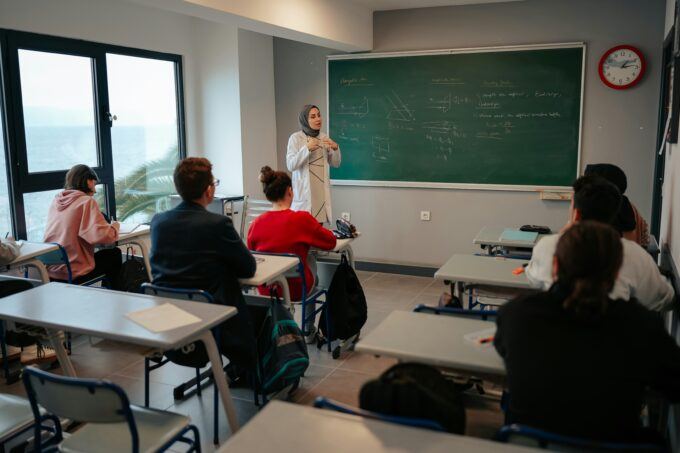
Image by Yunus Tuğ.
As the Trump administration engages in a frontal assault on the teaching of race and ethnicity at the K-12 level, a quieter but no less important battle is shaping up in deep blue California. Communities of color are mobilizing statewide to defeat AB 1468, the latest bill to emerge from the CA Legislative Jewish Caucus (LJC) in its campaign to censor Palestinian voices in ethnic studies classes, and police all ethnic studies content along with it.
Although the words “Gaza,” “Palestine” and “Israel” are nowhere to be found in the proposed legislation, the language of AB 1468 restricts the discipline to the “domestic experience” of “marginalized people” to discourage teachers from developing lessons on the impact of Israeli settler colonialism on Palestinian American and Muslim communities. AB 1468’s focus on the “domestic experience” might likewise inhibit classroom discussion of US trade policies that increase immigration at the southern border or transnational resistance to oil drilling that disproportionately harms communities of color from the global south to the Los Angeles harbor, or even discussion of state reparations for Black descendants of enslaved African peoples.
“Students fighting for ethnic studies in the late 1960s didn’t view themselves as a domestic minority, but part of a global majority,” says Christine Hong, a professor of ethnic studies at UC Santa Cruz and member of the UC Ethnic Studies Faculty Council. “During the U.S. war in Vietnam, they saw the connection between here and there, between cause and effect, and understood that marginalization and racism cannot be geographically enclosed within this country’s borders.”
The UC Ethnic Studies Faculty Council, which represents 300 ethnic studies practitioners, calls for broad public education on the possible consequences of AB 1468, suggesting it would not only censor education to whitewash history, but also increase state bureaucracy, undermine local school district authority over curriculum, and burden the state with unnecessary costs.
The Council on Islamic-American Relations (CAIR) describes the bill as “part of a broader right-wing effort to suppress discussions on race, history, and global justice” that if passed would dangerously “place curriculum decisions in the hands of politicians instead of educators.” Other opponents of the bill include Jewish Voice for Peace-Bay Area (JVP-Bay Area), Liberated Ethnic Studies Model Curriculum (LESMC), American-Arab Anti-Discrimination Committee, Arab Resource and Organizing Center (AROC), Palestine Solidarity Coalition, and CODEPINK-Central Coast.
Sponsored by Senator Rick Zbur (D-Los Angeles), Assemblywoman Dawn Addis (D-Morro Bay), and Senator Josh Becker (D-Menlo Park), the bill has a total of 31 co-sponsors–over a fourth of the state legislature. Seventeen of its co-sponsors are members of the Legislative Jewish Caucus (LJC).
The California Legislative Black Caucus has unanimously refrained from sponsoring AB 1468, and the California Faculty Association (CFA) has emphasized “when a discipline that focuses on communities of color comes under this kind of policing, the racist implications are clear.”
The bill, however, faces fierce opposition within the ranks of the 300,000 strong California Teachers Association (CTA). In 2024 CTA’s opposition to similar Zbur-Addis legislation in the Senate Appropriation Committee caused the authors to withdraw their bill. Had that prior bill become law, it would have erected steeplechase obstacles to the development of local ethnic studies lessons, e.g., a San Diego unit on Haitian Americans subjected to anti-immigrant rhetoric, or a San Francisco unit on Native Hawaiians protesting a telescope project on sacred land in Hawaii.
This new bill would require the CA Department of Education to seek input from the 18-member Instructional Quality Commission (IQC) on uniform standards for ethnic studies across non-uniform academic disciplines; conduct regional hearings on proposed standards to be adopted by 2028; monitor or “surveil” and report on instruction in ethnic studies for the next five years and require submission of local ethnic studies curriculum to the State Board of Education 60 days prior to local school district public hearings on approval. Opponents of the bill say this would constitute an unprecedented and costly infringement on local control.
AB 1468 states the intent is to establish an advisory committee of ethnic studies experts in a subsequent bill, but for now the job of developing standards and instructional materials would fall to the ICQ non-experts, including Senator Ben Allen, a member of the Legislative Jewish Caucus and a co-sponsor of AB 1468, as well as Anita Friedman, who is a former board trustee of the American Israel Public Affairs Committee (AIPAC) and leader of the Women’s International Zionist Organization (WIZO). She is also executive director of the pro-Israel Jewish Family Children’s Services (JFCS), an organization spearheading the California Teachers Collaborative on Holocaust and Genocide Education–a state-funded teacher training cadre that excludes Palestinian scholars on Israel’s genocide in Gaza and promotes the Anti-Defamation League’s conflation of antisemitism with anti-Zionism.
Both Senator Allen (then-chair of the LJC) and JFCS Friedman were also part of the IQC in 2021, recommending line item edits and participating in the unanimous vote to approve the CA Ethnic Studies Model Curriculum (CA ESMC) for state adoption.
The Jewish Public Affairs Committee (JPAC), which previously attacked the ESMC, is the power behind AB 1468. Boasting it “leads a coalition of over 35 Jewish organizations that have lobbied tirelessly for standardization of the ethnic studies … to ensure there is a comprehensive, lasting solution to the ongoing issue of antisemitism in California classrooms,” JPAC is hardly a neutral player. On its website, JPAC indicates that its purpose is to “Encourage and foster cooperation – at the State level and among citizens – between the State of Israel and the State of California” and “Combat campaigns to delegitimize and demonize Israel, including the Boycott Divestment Sanctions Movement (BDS).” Crucially, however, JPAC’s expansive definition of antisemitism includes not only discrimination against Jews and Holocaust denial, but also content critical of Israel. JPAC’s proposed ban on anti-Israel content would contradict 10th grade California social science standards that address the rise of nationalism in the Middle East and the “significance and effects of the location and establishment of Israel on world affairs.”
Senator Becker’s press release insists the bill will “protect students from inaccurate or biased information taught in their classrooms,” though Jewish Voice for Peace activists argue that “guardrails” prohibiting discussion of Israel’s occupation of Palestine or genocide in Gaza reflect a special interest bias in favor of an apartheid state. “Pro-Israel organizations are using false claims to suppress debate over the conflation of antisemitism with anti-Zionism–over the difference between bigotry against Jews and rejection of a racist nationalist Jewish state,” says Seth Morrison, an organizer with the anti-Zionist Jewish Voice for Peace, one of the fastest growing Jewish organizations in the US.
Standards confusion
In defense of the bill, Addis, a former special education teacher, argues “strong clear standards will prevent hate from taking root.” Ethnic studies as a discipline, however, has never been about “hate” but rather about providing students with the tools to not only tell their own stories, but also critically examine the society in which they live. At the current moment, such tools are more vital than ever.
The mandate for uniform teaching standards may sound reasonable at first blush, but a more studied look suggests the bill’s authors need to go back to class to learn more about ethnic studies.
After AB 101 was signed into law in 2021, the California Department of Education adopted an Ethnic Studies Model Curriculum (ESMC) with sample lesson plans, instructional resources and guiding principles that encourage students to “challenge racist, bigoted and discriminatory colonial beliefs on multiple levels” and “connect ourselves to past and contemporary social movements that struggle for social justice.” School districts were given the option to use the state curriculum and its guiding values and principles or develop their own ethnic studies curriculum tailored to address their local ethnic communities.
Under state law, ethnic studies can be taught incorporating English language arts standards in individual courses on African Americans or Chicanx/Latinx or Native Americans or Asian American/Pacific Islanders–or in a combined course on all four ethnic populations–or in an A-G course, such as English—or history, science or math, in which content is taught through the lens of marginalized communities in a class with content-specific standards.
If the bill’s sponsors intend to mandate only one set of ethnic studies standards for stand alone ethnic studies courses and for every level of math (algebra, geometry, calculus), science (biology, chemistry, physics) and social sciences (US history, government, economics), the near-impossible task of developing one-size fits all standards could stretch long past 2030, the date the law sets for ethnic studies to become a graduation requirement.
Ethnic studies scholars argue that instead of pushing for uniform standards, legislators should support rigorous criteria for ethnic studies courses to meet university entrance requirements. Currently, A-G ethnic studies, a proposed new ethnic studies requirement for entry into the University of California, is undergoing review by the UC Academic Senate. The UC’s proposed criteria include a focus on ethnic studies pedagogy, critical and intersectional analysis, struggles of Indigenous peoples and communities of color, examination of power, racial justice, and civic engagement.
Dummying down
Opponents of the bill object to its “anti-intellectual” language.
AB 1468 bill states “the goal should not be to understand abstract ideological theories, causes or pedagogies which then filter or limit the breadth of an ethnic group’s experience.”
“All academic disciplines are based on theories and pedagogies,” says Theresa Montaño, professor of Chicana/o Studies and activist with the California Faculty Association. “To deny the teaching of critical concepts, ideological theories, and pedagogies violates the principle of academic freedom and is plainly racist.”
To share the stories of marginalized communities without exploring the causes of their marginalization also suggests social science teachers should disregard the California Department of Education’s social science framework that states students will “understand and distinguish cause, effect, sequence and correlation in historical events, including the long-and-short term causal relations.”
Why ethnic studies?
In the introduction to the state ethnic studies curriculum, members of the state board of education led by President Linda Darling-Hammond highlight the positive impact of ethnic studies on student success, referencing research by Christine E. Sleeter and Miguel Zavala, co-authors of the book, Transformative Ethnic Studies in Schools: Curriculum, Pedagogy and Research (2/7/20. Teachers College Press). In summarizing the research, authors of the CA Ethnic Studies Model Curriculum write,“instruction that includes diversity experiences and a specific focus on racism and other forms of bigotry has a positive impact, such as “democracy outcomes” and higher-level thinking.”
Additional research in 2021 conducted at Stanford University, in conjunction with the San Francisco Unified School District, revealed that students assigned to an ethnic studies course in 9th grade were more likely to attend school, graduate and enroll in college.
Darlene Lee, a UCLA lecturer in ethnic studies teacher education, conducted a search of UC’s A-G requirement database. Lee found that 1,366 of the state’s 1,556 high schools have an approved A-G ethnic studies course ahead of the 2026 deadline for high schools to offer such a course.
The history of ethnic studies in California has multiple origins. It can be traced back to 1968 when high school students in East LA walked out to demand curriculum reflect the contributions of Mexican Americans to US society. That same year, historic student protests under the banner of the Third World Liberation Front (TWLF) at San Francisco State led to the lengthiest) student strike in U.S. history. Students boycotted class for half the school year until the administration met their demands, including “a curriculum that would embrace the history of all people, including ethnic minorities.” When the TWLF pressed similar demands at UC Berkeley, “the UC administration and the State of California violently opposed the TWLF to the point where Governor Ronald Reagan declared “a state of extreme emergency” at UC Berkeley, with unprecedented constant sweeps and tear-gassing … “ (MESC)
“The kids love the class.”
Lourdes Barraza is a parent of two teens enrolled in ethnic studies in the Pajaro Valley Unified School District in Santa Cruz County. “Legislators like Addis disguise their intent with words like ‘standards’ when their real agenda is to police people’s stories,” says Barraza, a strong supporter of the existing ethnic studies guiding principles enshrined in the adopted state model curriculum. Rather than impose more costs on the state with a pricey bureaucracy to shuffle papers and dummy down curriculum, Barraza wishes the sponsors of AB 1468 would demand Governor Newsom fund ethnic studies to honor the intent of AB 101. “The kids love this class,” says Barraza, adding, “It’s the one class kids never want to miss, so we are fighting for state funding.”
Barraza’s 14-year-old daughter Ixel speaks enthusiastically about her next ethnic studies class-chosen research project–the local school board and its impact on the education of her largely Latinx high school. Barraza’s 16-year-old son Maximilliano, also enrolled in an ethnic studies course, says, “My favorite project was telling a story about ourselves that highlighted how we changed and how we reflected on that pivotal experience. We could choose to present our story to the whole class or not and most students chose to present–which showed how much trust the class had built between students.”
Yes, student stories lie at the core of ethnic studies, which affirms student identities, experiences and histories, domestic and transnational. To deny those histories, to exclude academic inquiry into systems of power–white supremacy, colonialism, and imperialism—that influenced those histories is to rob students of their past, to deny them the knowledge they need to understand their present and to undermine their future ability to create a more loving society.
For this reason, communities of color call for the defeat of AB 1468, a bill they describe as “undeniably paternalistic, hostile, and racist.”
Guiding Principles for Ethnic Studies (CDE ESMC)
1. Cultivate empathy, community actualization, cultural perpetuity,20 self-worth, self-determination, and the holistic well-being of all participants, especially Native People/s and Black, Indigenous, and People of Color (BIPOC)
2. Celebrate and honor Native People/s of the land and communities of Black, Indigenous, and People of Color by providing a space to share their stories of success, community collaboration, and solidarity, along with their intellectual and cultural wealth
3. Center and place high value on the precolonial ancestral knowledge,21 narratives, and communal experiences of Native People/s and people of color and groups that are typically marginalized in society
4. Critique empire building in history and its relationship to white supremacy, racism, and other forms of power and oppression22
5. Challenge racist, bigoted, discriminatory, and imperialist/colonial beliefs and practices on multiple levels.
6. Connect ourselves to past and contemporary social movements that struggle for social justice and an equitable and democratic society, and conceptualize, imagine, and build new possibilities for a post-racist, post-systemic-racism society that promotes collective narratives of transformative resistance, critical hope, and radical healing.