Aluminum’s US comeback hinges on power, not tariffs, industry advocates say
The United States’ push to revive domestic aluminum production could stall unless smelters secure long-term access to industrial-scale electricity, according to policy advocates tracking the sector’s rapid transformation amid tariffs, reshoring efforts and rising global demand.

The global aluminum market is facing increased shortages as the closure of the Strait of Hormuz throttles supply, with spot prices for the metal spiking while exchange inventories slump. Aluminum prices climbed to a four-year high this week, driven by supply concerns and continued geopolitical instability affecting global shipping routes.
California-based environmental advocacy group Industrious Labs, dedicated to decarbonizing heavy industries, has released a new report with data that shows that since tariffs on primary aluminum were raised to 50%, imports — especially from Canada — dropped significantly.
Canada is the biggest foreign supplier of aluminum to the US, accounting for 44% of imports to its southern neighbor last year.
According to the Aluminum Import Monitor in the “unwrought” category as the proxy for primary aluminum In 2024, the US imported 2,745 kt of primary aluminum from Canada. In 2025, it was only 1,950 kt, a 29% decrease since Sec. 232 tariffs on aluminum were increased to 25% in February 2025 and then 50% in June 2025.
“Usual caveat that we believe the tariffs to have been the driving factor, but aren’t the only macroeconomic factors in play, Annie Sartor, senior campaigns director at Industrious Labs told MINING.COM.
Reshoring supply
But while the price surge and trade tensions have reignited interest in expanding US primary aluminum capacity, Sartor warned that electricity — not tariffs — remains the industry’s biggest bottleneck.
“There’s a really unpredictable commodity market right now around aluminum,” Sartor said in an interview this week.
While there are 10 primary aluminum smelters operating in Canada, there are only four operating primary aluminum smelters in the United States, down from over 30 plants in 1980. Alcoa operates smelters in Massena, New York and Warrick, Indiana, while Century Aluminum operates plants in Sebree, Kentucky and in Mt Holly, South Carolina.
Last year, Century said it will invest about $50 million to restart over 50,000 metric tons of idled production a Mt. Holly smelter in South Carolina. This year, Emirates Global Aluminium and Century entered into a joint development agreement to build the first new primary aluminum production plant in the United States since 1980 in Oklahoma, an emerging refinery hub.
But Sartor points out that building an aluminum smelter and bringing it online takes about five years.
“It would be great if you could just turn on an aluminum smelter in 30 days and start making metal. But the industry operates on much longer timelines,” she said.
Both the Biden and Trump administrations have pursued policies aimed at rebuilding US aluminum production after decades of decline.
While the Biden administration relied heavily on grants, loans and Inflation Reduction Act incentives, US president Donald Trump has instead emphasized tariffs as the preferred mechanism for protecting domestic producers.
Industrious Labs asserts that neither approach fully addresses the sector’s central challenge: access to reliable and affordable electricity.
Grid capacity
“Access to industrial-scale electricity — and increasingly industrial-scale clean electricity — is the pain point,” Sartor said.
Primary aluminum smelting is among the world’s most energy-intensive industrial processes. New facilities can require more than 500 megawatts of dedicated power supply a year, equivalent to the electricity consumption of a mid-sized city — once financing and power contracts are secured.
That challenge is becoming more acute as data centres and other large industrial users compete for grid access across North America.
“Aluminum producers are being scooped by data centers and hyperscalers,” Sartor said. “They can simply pay more for the power.”
The issue is already shaping the timeline for new projects, while US import tariffs haven’t been enough to stop the US losing another aluminum smelter.
Century Aluminum’s proposed smelter in Oklahoma — backed by a US Department of Energy grant and developed alongside Emirates Global Aluminium — remains dependent on securing a long-term electricity agreement before construction can begin.
The evolving trade relationship between Canada and the United States is also reshaping aluminum flows.
On Friday, the same day mining giant Rio Tinto (ASX: RIO) began a $1.5 billion expansion of its AP60 low-carbon aluminum smelter in Quebec, it also announced shipments of the metal to the US have now bounced back to levels from before President Trump’s tariff offensive.
Canada has historically supplied large volumes of low-carbon primary aluminum to the US market, leveraging extensive hydropower infrastructure in Quebec and British Columbia.
However, some Canadian producers are now increasingly redirecting shipments toward Europe, where demand for lower-carbon metals has strengthened under the European Union’s Carbon Border Adjustment Mechanism (CBAM).
“The aluminum industry sees itself as a North American market,” Sartor said. “Canada makes a lot of primary aluminum. The United States makes a lot of secondary or recycled aluminum. Together, when we’re working as a single market, that works great.”
The group warned that prolonged trade disruptions could permanently shift supply chains away from the United States.
“As time goes on, the stickiness of these new trade relationships starts to get stickier,” she said, noting that Canadian producers may become increasingly tied to European customers.
Despite the uncertainty, the firm believes 2026 could become a pivotal year for the North American aluminum industry, with additional smelter announcements possible if market conditions remain favorable.
“It’s an old, slow-moving industry operating in a really unpredictable market and political landscape right now,” Sartor said. “But I think this will be a big year for aluminum.”
Rio Tinto’s aluminum exports to US rebound to pre-tariff levels
One of the world’s largest aluminum producers, Rio Tinto Group, says its shipments of the lightweight metal to the US have bounced back to levels from before President Donald Trump’s tariff offensive.
The White House has hiked the levy on the metal to 50% last year, pushing Rio Tinto to sell more of its Canadian-produced aluminum in the European market. In turn, North America shipments — headed mostly to the US — fell to the mid-60% range. Flows are now back to about 80%, the producer’s aluminum chief said.
“We progressively came back to the pretariff situation — meaning the US represents the vast majority of our sales from Canada today,” Jérôme Pécresse, who heads Rio’s aluminum business, said in an interview.
Canada is the biggest foreign supplier of aluminum to the US, accounting for 44% of imports to its southern neighbor last year. Soaring US prices due to Trump’s tariffs and tight North American supplies have created a windfall for producers like Rio Tinto and Alcoa Corp. About a third of Rio Tinto’s global output of the lightweight metal is from the eastern Canadian province of Quebec, where an abundance of cheap hydroelectric power is an industry draw.
The Iran war has added further pressure on the market for the metal, with producers in Gulf states idling smelters due to damage and the inability to ship materials through the Strait of Hormuz.
“There is probably 2.5 million ton capacity in Middle East, which is offline,” Pécresse said. The crisis, he added, has led to a marginal increase in sales to Europe from Canada, Australia and New Zealand, while demonstrating “the importance for the US to have a nearby source of very competitive low carbon aluminum.”
The so-called US Midwest premium — the amount added to global price benchmarks to deliver the metal to that region — has nearly tripled since early June of last year.
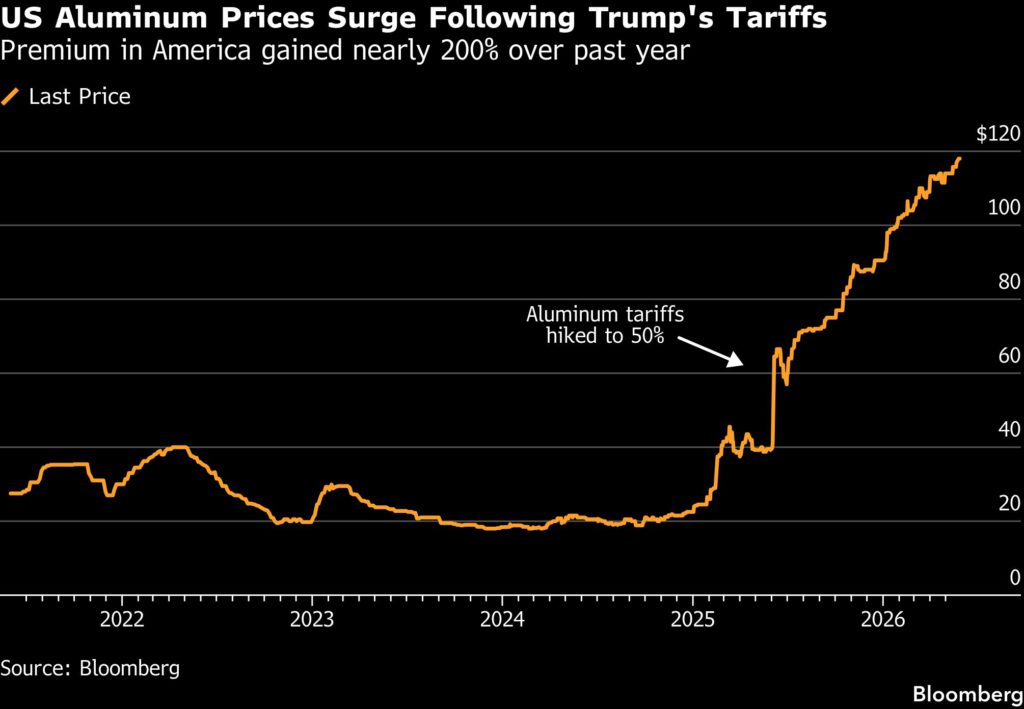
Pécresse said despite the surging premium, demand remains high.
At the same time soaring US electricity costs amid a massive data center buildout have given producers like Rio little incentive to build a new primary aluminum smelter in the US. That’s stymied President Trump’s hopes that tariffs would revive domestic metals production.
“Data centers can probably pay their electricity at two- to three-times the price you need to build a competitive smelter,” Pécresse said. “The reason we’re producing in Canada and Quebec today is because of the competitiveness of hydropower costs.”
While Rio has no plans to build US smelters, last year Emirates Global Aluminum confirmed plans to build the first new aluminum plant in the US since 1980. US producer Century Aluminum Co. joined as a partner in January for the new facility in Oklahoma, with construction expected to start by the end of the year.
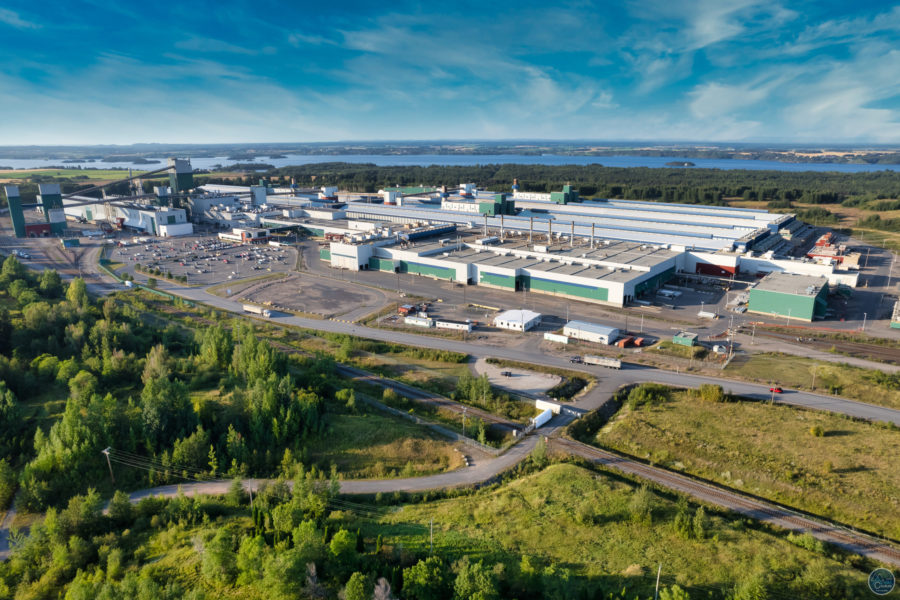
Instead, Rio is focusing its North American aluminum efforts in Canada, where the producer started operations at its AP60 smelter expansion in Quebec’s Saguenay—Lac-Saint-Jean region on Friday.
The $1.5 billion expansion will offset the loss of production associated with the idling of older smelting pot rooms nearby. The area includes an alumina refinery, four smelters and six hydroelectric power plants.
(By Jacob Lorinc and Mathieu Dion)
RIO Starts $1.5B AP60 Smelter Expansion in Quebec, Targets End-2026 Completion

Fri, May 29, 2026
Commissioning began in March, with all 96 new pots expected to be operational by the end of 2026.
The expansion will add about 160,000 metric tonnes of annual primary aluminum capacity using advanced AP60 technology.
The project supports long-term regional employment and generated over $1 billion in economic activity for Quebec during construction.
Shares of Rio Tinto (RIO) were up in morning trade after the company announced that it has started commissioning its $1.5-billion AP60 smelter expansion at Complexe Arvida in Quebec. This marks a major milestone for the deployment of its state-of-the-art, low-carbon aluminium smelting technology.
At the time of writing, RIO stocks had gained around 1%.
RIO Expansion To Boost Aluminum Capacity By 160,000 Tonnes
The commissioning process is expected to be completed by the end of 2026. Once fully operational, the expansion will add around 160,000 metric tonnes of annual primary aluminum production capacity, bringing total output using AP60 technology to about 220,000 metric tonnes per year.
The project is expected to support around 100 permanent jobs in the region. During peak construction, it created more than 1,500 jobs and generated over $1 billion in economic benefits for Quebec.
Rio Tinto said the expansion marks a new chapter in its long-standing presence in Quebec and will strengthen its ability to supply North American customers with low-carbon aluminum used in transportation, construction, electrical applications and consumer products.
RIO Expects Up To 90% Reduction In Fine Particulate Emissions
Rio Tinto said its AP60 technology is among the most efficient and low-carbon aluminum production technologies available at commercial scale. Powered by hydropower in Canada, the technology produces about one-sixth of the greenhouse gas emissions of the industry average and roughly half the emissions of the older technology used at the nearby Arvida smelter. The company also expects the AP60 expansion to reduce fine particulate matter emissions by up to 90%.
RIO Stock: What Retail Sentiment Says
Retail sentiment on Stocktwits for RIO has been “neutral” on Thursday, but message volume has been “high,” unchanged in the past 24 hours.
The RIO stock has gained over 75% in the past 12 months.
For updates and corrections, email newsroom[at]stocktwits[dot]com.
Aveek Bhowmik has no position in any of the stocks mentioned in this article. StockTwits' news team content is for informational purposes only and is not intended as investment advice. For more, see our editorial policy. This article was originally published on StockTwits.
Global aluminum price rally could draw record exports from China
The rally in the global aluminum market could spur record exports of the metal from China, where elevated prices are capping consumption.
Aluminum on the London Metal Exchange is trading at its steepest premium to Shanghai futures since March 2022, after the war in the Middle East choked supplies from a key producing region and created a deficit on the international market.
Chinese exports rose 15% in April to 598,000 tons, the highest since November 2024. They could climb further to a record of more than 680,000 tons in the coming months, said Zhu Liangmin, an analyst with researcher Beijing Aladdiny Zhongying Business Consulting Co.
Aluminum rods for power grids — exempted from a recent tightening in China’s export rebates — and alloys used in wheels, are seeing particular demand, he said.
Although prices in China have been dragged higher by the LME’s surge, as the largest producer it’s largely immune from the shortage, particularly given a slowing economy and tepid domestic demand.
Many fabricators in the production hub of Henan province are running at full capacity to meet brimming orders for products such as ultra-thin battery foil, according to a local media report. It cited an executive at Henan Mingtai Aluminum Industrial Co., who reported a jump in overseas sales in the second quarter.
LME prices have hit four-year highs in recent days, but one complicating factor is that some of those gains have been driven by fears that Chinese supply could tighten if smelters are forced to cut output to meet the government’s energy use and emissions targets.

No comments:
Post a Comment