AU
Illegal miners extract billions in Amazon gold despite Brazil crackdown, Greenpeace finds

Billions of dollars worth of gold is still being extracted illegally from Brazil’s Amazon rainforest, a study by nonprofit watchdog Greenpeace found, despite efforts by President Luiz Inacio Lula da Silva to crack down on wildcat mining.

Lula pledged upon taking office in 2023 to eliminate illegal gold mining from Indigenous lands and protected areas after years of expansion encouraged by far-right former President Jair Bolsonaro. Last year, Brazil’s Federal Police seized a record 447 kg (985 pounds) of illegally mined gold.
But as gold prices hit record highs amid intense geopolitical instability, the Greenpeace study found that miners have adapted by using permits from places with no mining activity to falsify the origin of illegally mined gold.
Greenpeace analyzed 187 forest areas with gold mining permits issued by Brazilian mining agency ANM near Indigenous lands and protected areas in the Amazon and found that 98 of them showed no signs of mining.
Still, so-called “ghost permits” from those areas were used to justify the sale of 26.8 metric tons of gold worth an estimated $3.88 billion between 2018 and March 2026.
Reuters flew over two of the permitted areas in the dataset and verified that, despite paperwork for huge output from surface mining, there was no activity to be seen. Six minutes away by air, journalists spotted a large active illegal operation in a protected area.
It was not clear where all the gold backed by so-called “ghost permits” originated, but researchers and investigators believe much of it is extracted from protected areas and Indigenous lands, such as the Kayapo people’s territory in Para state.
Kayapo chief Megaron Txucarramae expressed frustration at the government’s failure to act.
“I don’t know what else is needed to solve illegal mining on Indigenous land,” he said. “It destroys the land, pollutes the rivers, and Indigenous people, without realizing it, end up eating poisoned fish.”
ANM said in a statement that it was monitoring the permits that Greenpeace denounced for any irregularities and added that, with thousands of permits issued, the Amazon region imposes “large-scale logistical and oversight challenges.”
“As long as it is possible to launder gold using mining permits, there will be an expansion of the activity in the Amazon,” said Greenpeace Brasil spokesperson Danicley Aguiar.
(By Ricardo Brito; Editing by Manuela Andreoni and Jamie Freed)
China’s April net gold imports via Hong Kong rise 81.2% from March
China’s net gold imports via Hong Kong rose 81.2% in April from the previous month, Hong Kong Census and Statistics Department data showed on Thursday.
The world’s top gold consumer imported a net 86.715 metric tons in April, up from 47.866 tons in March, and marked its 13th straight monthly increase, the data showed.
The Hong Kong data may not provide a complete picture of Chinese purchases because gold is also imported via Shanghai and Beijing. China’s bullion buying patterns can influence global trends and markets.
China’s total gold imports via Hong Kong stood at 99.327 tons in April, up around 24.8% from March’s 79.576 tons.
Earlier this month, data from the People’s Bank of China showed the central bank loaded up on gold for an 18th straight month in April.
The country’s gold reserves have added up to 74.64 million fine troy ounces by the end of April, versus the previous month’s 74.38 million.
Spot gold prices have been under pressure since the start of the US-Israeli war with Iran in late February. The effective closure of the Strait of Hormuz has prompted a surge in Brent crude prices, fanning inflation woes and propelling rate hike expectations.
(By Anjana Anil; Editing by Alison Williams and Ronojoy Mazumdar)
Hong Kong to get edge in Asia gold-hub push with clearing system

By launching a gold-clearing system in the next couple of months, Hong Kong is set to secure first-mover advantage in a push to become Asia’s preeminent hub for bullion trading.
The clearing mechanism, expected to debut by July, is an important step in building the liquidity needed to influence pricing in the region. It would also take Hong Kong further down the road to creating a gold-trading center than longtime rival Singapore, which has announced similar plans without committing publicly to a timeline.
“If Hong Kong and Singapore are in a race to build clearing, it looks like Hong Kong authorities are very eager to win,” said Adrian Ash, head of research at BullionVault, an online platform that allows users to trade and store precious metals.
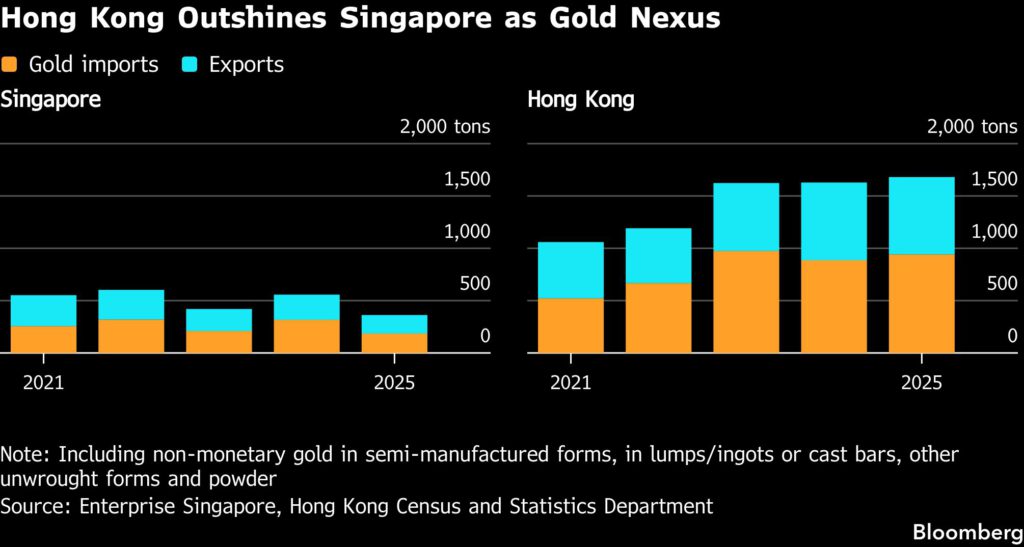
In recent months, both cities have advanced plans to capitalize on strong demand and challenge London’s long-held dominance as the global center of bullion trade. Gold’s protracted rally might have stalled since the war began in the Middle East, but many banks remain bullish about the long-term prospects for a metal coveted by investors as an alternative store of wealth.
In Hong Kong, the infrastructure is already being laid for a significant expansion of trading, refining and storage. China’s biggest express-delivery firm, SF Holding Co., plans to open a vault near the city’s airport this year, while precious metals traders are commanding bigger pay packages as established banks compete for talent with fintech and securities firms.
The timing for launching a clearing system is good, as a seasonal lull in demand over the summer will leave ample room to accumulate stockpiles of the metal, Ash said. The government-owned mechanism will also be underpinned by the large volumes of gold that move in and out of Hong Kong due to demand from China, the world’s biggest consumer.
These flows are supported by an existing lineup of refiners that includes Heraeus Ltd. and Metalor Precious Metals Hong Kong Ltd., among others. Point Gold International Ltd., a major Chinese refiner, said it was investing $150 million to expand its offices in Hong Kong and add a facility that’s scheduled to begin production this year. Singapore, by contrast, has only a single refinery that produces bullion with the industry-standard London Good Delivery accreditation.
“Hong Kong has refineries, jewelry manufacturers, factories, mining companies,” said Bernard Sin, regional director for Greater China at MKS PAMP SA, a trader and refiner that has also recently expanded its operations in the city. “It’s a gateway to North Asia: mainland China, Japan, Korea,” he said.
For a clearing system to thrive, the involvement of the world’s major bullion banks is key — and both Hong Kong and Singapore have taken significant steps in this direction. JPMorgan Chase & Co, UBS Group AG and Citigroup Inc. are supporting plans in both cities, while local banks are also participating in their respective locations. In Hong Kong, Chinese lenders have either grown their bullion desks, or are in the process of adding to them.
Interest in gold also extends beyond established banks. HGNH International Futures Co. is setting up a precious metals trading team in Hong Kong, the company said, amid similar moves from other Chinese brokerages. Digital newcomers such as Matrixdock are also looking to hire in the region.
London’s role as a gold hub is underpinned by the large stocks of bullion that it holds, much of it owned by central banks around the world. Though Hong Kong and Singapore are far behind in this regard, both are aiming to attract more of this official-sector business. In its search for client nations, China has prioritized countries participating in the Belt and Road Initiative, with Hong Kong presenting itself as an offshore option able to move gold in and out of mainland China with relative ease.
“People have been talking about China challenging London’s dominance of wholesale bullion trading for well over a decade,” Ash said. “Clearing is a vital step towards building the bullion-banking services which the No. 1 mining and consumer nation still lacks.”
Hong Kong’s large and active equity market, as well as recent efforts to strengthen two-way financial flows with the mainland, also gives the special administrative region an edge when it comes to developing a gold futures market that will be essential for any financial center aspiring to genuine price-setting power. Futures are important because they enable market participants to hedge price risk, establish real-time benchmarks and attract speculative capital — all of which create additional liquidity.
Carving a niche
While clear parallels exist in their ambitions, Hong Kong and Singapore may eventually carve out distinct niches in their efforts to develop regional influence in the gold business.
“Singapore is likely to focus on storage, whereas Hong Kong will promote trading” and refining, supported by logistics, said Doris Bao, founder of China-based consultancy Gold Harvest Management and an industry veteran.
Singapore can store at least 2,200 tons of gold in two privately operated, high-security vaults, according to data from the operators. That includes 500 tons at The Reserve and at least 1,700 tons at Le Freeport, a repository sometimes known as Asia’s Fort Knox. Hong Kong has around 150 tons of storage at its airport, which is owned by the government, although the city’s commercial vault capacity is not publicly known.
In Singapore, existing capacity is filling up fast. Demand for gold storage at Le Freeport has “risen steadily” in recent years, driven by existing logistics providers and new players, said Lincoln Ng, the company’s chief executive officer. The basement vaulting space, typically the preferred location for bullion storage due to enhanced security and higher load-bearing capacity, is near “full utilization,” he said.
In recent months, Singapore has taken custody of some of the gold moved out of Dubai as a result of the Iran war. Official data show the city-state imported record amounts from the United Arab Emirates in March and April. Singapore is also a favored location for gold owners wary of Chinese influence in Hong Kong.
“Investors increasingly view Singapore as a preferred location for wealth storage,” Ng said, adding that the Southeast Asian city-state’s popularity is underpinned by political stability, a robust financial system and strong rule of law.
(By Yihui Xie)

No comments:
Post a Comment