Tuesday, February 03, 2026


Kurdistan’s New Gas Play Just Exposed the Real Battle for Iraq

  • New long-term gas sales from the Chemchemal field signal a deeper Western effort to anchor influence in Iraq and counter Chinese, Russian, and Iranian dominance over its energy sector.

  • Expanding Kurdish gas production could help Iraq cut its reliance on Iranian gas and electricity imports.

  • This strategy makes projects like Chemchemal and Khor Mor strategic flashpoints—evidenced by recent attacks widely linked to Iran-backed actors..
The semi-autonomous Kurdistan Region of Iraq, centred in Erbil, has a significance way beyond its size, oil and gas output, and military capabilities. It is at the heart of the superpower battle for Iraq, which itself is seen by Washington, London, Beijing and Moscow, as the key to the broader Middle East. As underscored exclusively to OilPrice.com some time ago by a senior energy source who works closely with Iran’s Petroleum Ministry, China, Russia and Iran’s view is that: “By keeping the West out of energy deals in Iraq, the end of Western hegemony in the Middle East will become the decisive chapter in the West’s final demise.” On the other side of the power equation, the U.S. and its key allies want the Kurdistan Region (and the wider Iraq) to terminate all links with Chinese, Russian and Iranian companies connected to the Islamic Revolutionary Guards Corps over the long term. The U.S. and Israel also have a further strategic interest in utilising the Kurdistan Region as a base for ongoing monitoring operations against Iran. Once these basic elements are understood, then everything else that happens there makes perfect sense; and if they are not, nothing does. So, it is in this context that the recent long-term gas sales agreements from the Kurdistan Region’s Chemchemal field should be seen.

The deal itself is straightforward enough. It involves Dana Gas (headquartered in the UAE) and London-headquartered Crescent Petroleum, together with their partners in the Pearl Petroleum Consortium (Austria’s OMV, Hungary’s MOL, and Germany’s RWEST) agreeing to supply up 142 million standard cubic feet per day (mmscf/d) of gas to cement and steel producers for a period of 10 years, starting in the second half of 2027, when production from the Chemchemal field is scheduled to begin. According to company disclosures, the gas will be delivered to industrial users in Erbil and Bazian through new private-sector pipelines, including a dedicated 40-kilometre pipeline linking the Chemchemal field directly to the Bazian industrial area. This agreement follows an acceleration last year in the development by the Pearl Petroleum partners, which featured a USD160 million commitment to drill three wells, install an extended well test facility, and build associated infrastructure to support a future full-field development phase. The Chemchemal field lies just north of the Khor Mor gas field, which was the focus of its own gas expansion project in October 2025. This added 250 mmscf/d of processing capacity, increasing total capacity to 750 mmscf/d. As it stands -- and before any further output expansion at Chemchemal -- the Khor Mor gas plant supplies more than 80% of the Kurdistan Region’s electricity generation and has attracted cumulative investment exceeding USD3.5 billion.

This recent flurry of activity is going ahead despite last November’s rocket attack on the Khor Mor field, shortly after it had been announced that the output expansion programme had been completed eight months early. The attack on Khor Mor had, in turn, been the most significant since the July barrage of drone strikes on several of the Kurdistan Region’s oilfields that reduced oil production by around 150,000 barrels per day (bpd). The strike against Khor Mor caused widespread power outages, given its leading role in the provision of energy for the Sulaymaniyah region and beyond. Although there were no official claims of responsibility for the attack, senior security sources close to Iraq’s Oil Ministry highlight the likely involvement of Iran – through one of its many Iraqi conduits – as ultimately being behind it for two reasons. First, as a warning of more to come if the Kurdistan Region continues to develop its still largely latent gas potential, which would allow Iraq as a whole to more easily reduce its long-running dependence on Iran for up to 40% of its power needs through gas and electricity imports. Second, to reinforce the wedge between Iraq and the U.S. that centres on this continued relationship between Baghdad and Tehran, which looks to be reducing with a recent influx of Western firms back into the country.

The West’s response to the Khor Mor attack was a very tangible signal of intent that it still sees the Kurdistan Region as a core interest in its re-establishment of influence across Iraq and the broader Middle East, following years of Chinese and Russian advances across key areas. The U.S. bought a cargo of oil from the Kurdistan Region -- the first since the reopening of the critical Iraq-Turkey Pipeline (ITP) around two months before -- loading it onto the Seaways Brazos tanker in the Turkish port of Ceyhan and let it be known that more would follow. Not just this, but -- as evidenced in the latest Chemchemal announcement -- the U.S. and its allies will do whatever it takes to maintain a geopolitical backdrop in the Kurdistan Region to ensure that international energy firms can move ahead with their development plans as they see fit. Part of this will be a further increase in the presence of other Western firms in the KRI, which also carries with it the entitlement under international law for such developments to maintain whatever security presence on the ground that they think necessary to protect their assets and investments. In short, as a senior Washington-based legal source connected to the U.S. Treasury Department exclusively underlined to OilPrice.com after the U.S. oil tanker unloaded its Kurdistan cargo in November: “This [the recent oil shipment from Iraq to the U.S.] is just part of the whole which says, ‘we’re here again now, and this time we’re not going away’.” This idea was further reinforced with the tightening of U.S. and European sanctions on Russia that focused on specific companies -- including Rosneft.

These Western efforts also recently led to the flagship Kremlin oil firm having to reduce its stake in the Kurdistan Pipeline Company (KPC) from the 60% it acquired in 2017 to 49%. The KPC is the key operator of the feeder pipeline network within the Iraqi Kurdistan region, which connects oil fields (such as Taq Taq and Tawke) to the border metering station at Fishkhabur. At Fishkhabur, the pipeline links up with the main ITP system. It is this system that remains key to the financing of the Kurdistan Regional Government (KRG), and it was this system that was closed down in March 2023 before reopening last September. Rosneft’s wider operations in the Kurdistan Region meant Russia effectively controlled its vital oil infrastructure, as fully analysed in my latest book on the new global oil market order, through three far-reaching deals struck with the KRG in 2017. First, Russia provided the KRG with USD1.5 billion in financing through forward oil sales payable in the next three to five years. Second, it took an 80% working interest in five potentially major oil blocks in the region. And third, it established 60% ownership of the critical ITP pipeline by dint of a commitment to invest USD1.8 billion to increase its capacity to one million barrels per day. Removing Rosneft’s majority ownership of assets in the Kurdistan Region has consequently underlined the foundation of its power there.

That said, this is not pure philanthropy on the part of the West, as the Kurdistan Region has vast gas potential, in addition to that from oil. Kurdistan’s Ministry of Natural Resources (MNR) estimates that there is 25 trillion cubic feet (Tcf) of proven gas reserves and up to 198 Tcf of unproven gas resources, around 3% of the world’s total deposits. The figures look realistic, given that the US Geological Survey believes that undiscovered resources in just the Zagros fold belt of Iraq, a large part of which falls in the Kurdistan Region’s area, amounts to around 54 Tcf of gas. Discovered reserves total less than 10 Tcf of proven plus probable reserves and less than 30 Tcf of contingent resources, with the bulk of these being non-associated gas deposits located in the Region’s central and southern areas, especially those in the Bina Bawi, Khor Mor, Khurmala, Miran and Chemchemal fields. Judging from the 65% success rate of drilling activity in its oil operations, the International Energy Agency estimates a high degree of prospectivity in gas operations is likely.

By Simon Waktins for Oilprice.com

Eni and Q8 Back €500,000-Tonne Biorefinery Project in Sicily

Italy’s energy major Eni and Q8 Italy, part of Kuwait Petroleum Corporation (KPC), have formally approved a strategic joint investment to construct and operate a new biorefinery at the Priolo industrial site in Sicily. The decision follows a binding offer from Q8 and final approvals from the boards of both Eni and KPC, cementing one of the most significant biofuels investments in Southern Europe.

The project will convert the existing Versalis industrial site into a biorefinery with a nameplate capacity of 500,000 tonnes per year. The facility will produce Hydrotreated Vegetable Oil (HVO) and Sustainable Aviation Fuel (SAF-Biojet), targeting road, marine, and aviation transport markets.

According to Eni, the plant will be able to reduce greenhouse gas emissions by at least 65% compared with the fossil fuel reference mix, in line with EU decarbonization targets.

The Priolo biorefinery will leverage Eni’s proprietary Ecofining™ technology, which allows the conversion of waste feedstocks, residues, and vegetable oils into advanced biofuels that can also be used in 100% pure form. The design offers operational flexibility, enabling output to shift between HVO and SAF depending on market demand.

Engineering for the project has already been completed. Preparatory work for procurement and construction contracts is underway, demolition activities are about to begin, and the permitting process has been formally launched. Subject to regulatory approvals and final contractual arrangements, the project is expected to be completed by the end of 2028.

The investment deepens a three-decade partnership between Eni and Q8, which began with the Milazzo refinery in 1996. It also represents Q8’s second major industrial project with Eni in Sicily, underscoring Kuwait Petroleum Corporation’s continued commitment to the Italian energy market.

For Eni, the Priolo project is part of a broader strategy to repurpose legacy, loss-making chemical assets into competitive low-carbon businesses. The transformation plan was first announced in October 2024 and later formalized through an agreement signed in March 2025 at Italy’s Ministry of Enterprises and Made in Italy.

The biorefinery is also aligned with Enilive’s growth targets, which call for total biorefining capacity of 5 million tonnes per year by 2030 as Eni accelerates its pivot toward low-carbon fuels and sustainable mobility.

Europe’s biofuels sector has been gaining momentum as governments push to decarbonize transport, particularly aviation, where SAF demand is expected to grow rapidly under EU mandates. Large-scale projects like Priolo position Italy as a key hub for advanced biofuels production in the Mediterranean, with potential spillover benefits for supply chains and employment.

Eni has emphasized that the Priolo conversion will preserve jobs and industrial know-how while ensuring the long-term viability of the site. For Q8 and KPC, the project supports portfolio diversification and advances their 2050 energy transition strategy, with a focus on sustainable mobility solutions for European customers.

By Charles Kennedy for Oilprice.com

BP Shareholders Demand Proof That Fossil Fuel Pivot Will Pay

A group of institutional shareholders in BP, featuring pension funds and an activist investment outlet, has filed a resolution demanding details on how exactly the company’s return to its core business of oil and gas would boost shareholder returns.

According to a Reuters report, the group includes the Australasian Centre for Corporate Responsibility, a non-profit entity that invests in energy and mining companies with a view to making them invest more in climate change.

The demands, to be tabled at BP’s next annual shareholders’ meeting, include the publication of details about the cost-competitiveness of every project the company embarks on, reports about cost overruns and project delays, and a justification for why the return to oil and gas after a brief stint as a transition company would pay off.


In fairness, the reason BP pivoted back to oil and gas was precisely the damage that its profitability suffered as a result of its attempt to go “beyond petroleum” with its big investment plans for transition industries. Since these investments lost more money than they made, BP returned to what it does best, which is extracting, refining, and selling oil and gas products

A year ago, in a highly anticipated business strategy reset, BP announced it was increasing its investment in upstream oil and gas to $10 billion per year while slashing spending on clean energy by more than $5 billion a year.

The reason was that the reset was precisely shareholder value and the fact that BP’s stock had been underperforming the stocks of its peers ever since former CEO Bernard Looney announced the company would pivot to green energy. Interestingly, another activist investor played a role in the decision for the reset: Elliott Management has been pushing for an overhaul at the supermajor ever since it acquired a stake in it, with the focus on BP focusing more on its lucrative oil and gas business.

By Irina Slav for Oilprice.com


Private Equity’s Quiet Pivot Into Sanctioned Energy Space

  • The Carlyle–Lukoil–UAE triangle reflects a shift toward “capital without flags,” where energy assets are repositioned to navigate sanctions, fragmentation, and geopolitical risk rather.

  • Private equity and Gulf capital are exploiting dislocation, targeting optionality in midstream control, logistics, and trading flexibility.

  • The UAE is emerging as a geopolitical platform, not just a financier, quietly anchoring itself in non-Western energy flows while hedging against future exclusion.

Geopolitics are clearly again at play in the ongoing story surrounding Russia’s Lukoil international asset sale. The return of geopolitics, as clearly evident in energy markets, is putting investors on the spot; they must relearn an old lesson: oil and gas are never merely commodities, and capital is never neutral. This longstanding dynamic is clearly being played out in the quiet but strategically meaningful triangle among The Carlyle Group, Lukoil, and the United Arab Emirates, with risks stemming from sanctions, regional conflicts, and shifting alliances. When not assessing it all, the current moves appear to be a conventional story of private equity opportunism and Gulf capital recycling. Reality, however, is that it is a case study of how energy assets are being repositioned, taking into account a world of sanctions, fragmentation, and strategic hedging.

International financial giant Carlyle, not unknown for its role in geopolitics, has consistently positioned itself as one of the most geopolitically literate players in global private equity. Carlyle’s energy strategy has never been about outright ownership of national champions. Its main focus has always been about structuring exposure to cash flows, infrastructure, and optionality across jurisdictions that sit uncomfortably between politics and markets, especially in fragmented regions. At the same time, Russian giant Lukoil at present sits in a peculiar place within Russia’s energy ecosystem. As it is privately held but internationally exposed, it has historically maintained a more commercial posture than its primarily state-dominated Russian peers. Since Russia invaded Ukraine, this distinction has mattered a lot, especially when Western sanctions redrew the map of which Russian energy exposure is investable, bankable, or even discussable.

Now take into account the UAE, where Abu Dhabi and Dubai have emerged as a space for sanctioned-adjacent capital flows. The UAE is not only neutral enough to be attractive, wealthy enough to underwrite, and strategically agile enough to extract leverage, especially when able to use ambiguity. When Carlyle's management position or perspective is taken into account, the UAE is regarded not only as a source of finances but also increasingly as a geopolitical platform. For Russian companies, such as Lukoil, the UAE has become a gateway. It offers financial, logistical, and reputational access to a post-Western energy order that is still being assembled, with implications for how private equity firms like Carlyle navigate regional influence and strategic positioning.

The logic behind this is not limited to Russia. It centers on fully targeting optionality under constraint. In a world where hydrocarbons persist, Lukoil's international assets remain valuable.  To support a sale or future monetization, its monetization pathways have, however, become severely constrained, as most Western capital markets are closed or off-limits. Lukoil is also looking at a global market in which insurance, shipping, and financing have become politicized. While Asian demand continues to dominate volumes, buyers are increasing their demand for discounts. In this market setup, private equity, sovereign-aligned capital (SWFs), and hybrid jurisdictions such as the UAE are eager to act.

When addressing Carlyle’s interest in Lukoil, or the total ecosystem, it should not be regarded as a bet on the resurgence of Russia; it is clearly a wager on fragmentation. As some have already pointed out, in a segmented or partitioned energy world, real value at present is migrating from upstream production to midstream control, logistics, and trading flexibility. It is also increasingly taking into account jurisdictional arbitrage. The attractiveness of Lukoil’s assets is linked to all of this. Lukoil’s historical footprint in international projects, combined with its relative managerial autonomy, is now also supported by the company’s willingness to restructure holdings. For parties such as Carlyle or UAE financials, the Lukoil situation is a particularly interesting counterparty for capital, especially if the capital partners are seeking exposure without overt political branding.

In this constellation, the UAE's role is even more strategic. Over the last decade, Abu Dhabi’s sovereign capital has repositioned itself as a global allocator rather than a regional patron. As evidenced in recent years, as presented by ADNOCXRG, IHC, and others, energy investments are no longer focused on barrels or cubic meters, but on influence across supply chains, benchmarks, and chokepoints. By supporting, financing, or quietly partnering through structures to access the Lukoil opportunity, several objectives will be served simultaneously: the UAE will be anchored in non-Western energy flows while strengthening its ties with Russia without overt alignment. At the same time, the UAE’s position as a financial clearinghouse for politically complex assets is being pursued for years to come.

It is also involving a defensive dimension. Europe is still weaponizing its regulation (carbon pricing, sanctions, and industrial policy), while Washington conflates energy with security. To deal with these major developments and threats, Gulf actors are hedging against future exclusion. They will build leverage by facilitating capital pathways for assets that others cannot access. Abu Dhabi, in particular, recognizes that when markets tighten, it will be one of the preferred partners in the room, no longer needing to knock on the door.

For Carlyle, the total calculus in this game is much colder, or even totally icy. All private equity thrives on dislocation, which is clearly in place here. Political risks, price caps, and sanctions are instruments that depress valuations and force restructuring. The financial giant is clearly the chosen one in this constellation, as its expertise lies in engineering vehicles that separate operational cash flows from headline political risk. Carlyle is known to do this via minority stakes, structured finance, or asset carve-outs. Taking this into account, the Lukoil-linked investments should not be regarded as ideological choices but as technical exercises. Carlyle is clearly developing a strategy to extract value from mispriced assets as traditional capital has fled.

Still, for all parties considering Lukoil, the risks are non-trivial, as secondary sanctions remain a live threat. These parties also should keep in mind that regulatory scrutiny in Europe and the US is intensifying, not easing. When considering Carlyle, reputational risk could be a deal blocker in the end, but, as always, this is being dismissed by most financiers to date. Among Carlyle's capital providers, including pension funds and institutional LPs, all are currently under pressure from reputational and political risks at home. The UAE should also understand that this will not be an easy game to play. The Emirates may be at risk of overplaying neutrality. Abu Dhabi and Dubai should assess the risks that hosting excessive sanctioned-adjacent activity could make them targets of retaliation, financial de-risking, or regulatory pushback, particularly from Western partners such as the EU/UK. This will matter, perhaps increasingly, as security umbrellas from Western partners remain important.

This constellation, or balancing act, is precisely why this could be sustainable. None of these parties is fully committed. Carlyle still can exit, Lukoil can rebrand itself, while the UAE has a long list of instruments to manage. Abu Dhabi is more than able to recalibrate visibility, turning volume up or down depending on geopolitical temperature. All parties recognize that they still have options, not permanence. Maybe the current developments are the real objective.

These moves lead, at present, to the conclusion that the most likely evolution is not going to be headline-grabbing acquisitions but incremental deepening. The latter will most likely involve joint ventures in trading and logistics, as well as downstream minority stakes or non-core assets. At the same time, all lights are green when examining financial structures that monetise reserves without transferring control.

From Brussels, this is uncomfortable, as it is still debating the issue of strategic autonomy. Globally, however, capital is quietly reorganising energy power elsewhere. The Carlyle–Lukoil–UAE nexus illustrates this in reality.  Real energy geopolitics is no longer about who produces oil, but who controls pathways through which capital, barrels, and risk are laundered into acceptability.

The Lukoil-Carlyle-UAE story is not about Russia or private equity, but about the architecture of the future global energy system. Global markets will need to account for a scenario in which sanctions are permanent, alliances are fluid, and markets are segmented. Rewards will be given to those who can operate in the seams. Carlyle understands this, Lukoil needs it, and the UAE bets on the position that sitting at the crossroads is more powerful than choosing a side.

By Cyril Widdershoven for Oilprice.com


Texas Just Approved the Largest Gas Power Project in U.S. History

Texas’ environmental regulator this week issued the largest air pollution permit in the country to an enormous planned complex of gas power plants and data centers near the oilfields of the Permian Basin, according to an announcement from the project’s developers. 

Pacifico Energy, a global, investor-owned infrastructure company, called its 7.65 gigawatt GW Ranch in Pecos County “the largest power project in the United States” in a press release this week. 

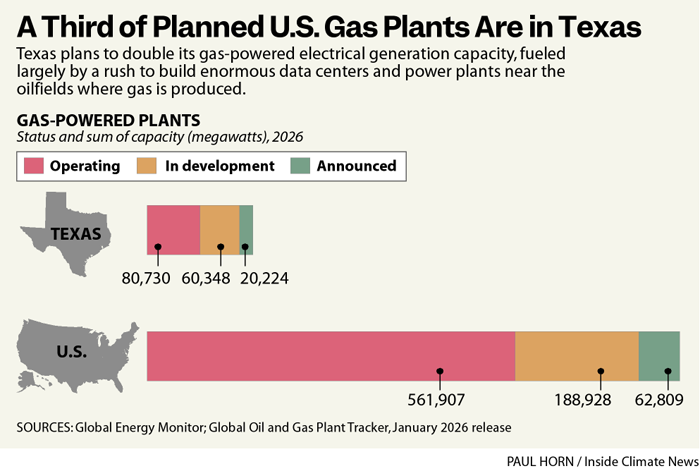
It’s among a handful of similarly colossal ventures announced during 2025 that have made Texas the global epicenter of a gas power buildout, according to data released Thursday by Global Energy Monitor (GEM).

Massive fossil fuel infrastructure is being developed, often directly at the source of gas supply, in order to feed speculative AI demand,” said Jenny Martos, project manager for GEM’s Global Oil and Gas Plant Tracker.

Developer Fermi America applied for air permits in August for 6 GW of gas power to supply data centers at its planned complex near Amarillo. In November, Chevron announced plans to build its first-ever power plant, which would produce up to 5 GW of power for artificial intelligence in West Texas.

These are enormous volumes of energy, enough to power mid-sized cities. During 2025, the pipeline of gas power projects in development in Texas grew by nearly 58 GW of generation capacity, according to the GEM report, more than the peak power demand of the state of California. 

Only China, with 50 times the population and 15 times the land, has more gas power projects in development than Texas, the GEM report said. Nearly half of all upcoming gas power projects in Texas, totalling 40 GW of capacity, are planned to directly power data centers, the report said. 

There is just an explosion of these things,” said Griffin Bird, a research analyst who tracks gas plants for the nonprofit Environmental Integrity Project in Washington, D.C. “We’re having such a tough time staying on top of new projects.”

The planned hyperscale facilities of north and west Texas, if fully built out, could be among the largest emissions sources in both the country and the world, Bird said.

Pacifico’s GW Ranch in Pecos County is authorized to release more than 12,000 tons per year of regulated air pollutants, according to permitting documents from the Texas Commission on Environmental Quality, including soot, ammonia, carbon monoxide and volatile organic compounds. 

The complex can also release up to 33 million tons per year of greenhouse gases, according to permitting documents, equal to nearly 5 percent of the total annual greenhouse gas emissions of Canada. 

Gas plants planned at Fermi America’s Project Matador would release up to 24 million tons per year of greenhouse gas.

“I’d be hard-pressed to think of a bigger emitter,” Bird said. 

Many gas power projects for data centers with up to 500 MW of capacity—enough to power more than 200,000 homes—have received permits from the Texas Commission on Environmental Quality within a month, Bird said. 

For example, Misae Gas Power applied for permits to install 206 gas generators totaling 519 MW of capacity at a data center outside San Antonio on Dec. 23. TCEQ granted the permit on Jan. 14, authorizing emissions including 133 tons per year of toxic particulate matter and 10 tons per year of cancer-causing formaldehyde.

The TCEQ did not immediately respond to a request for comment sent Wednesday evening. 

In the tiny town of Blue, about 50 miles east of Austin, the TCEQ issued a permit in October for the 1.2 GW Sandow Lakes Power Plant, which is located nearby North America’s largest Bitcoin mining facility

Neighbors in the rural community organized a group called Move the Gas Plant and formally requested a hearing from TCEQ on the air pollution permit that would authorize 460 tons per year of ammonia emissions, 153 tons of soot, 76 tons of sulfuric acid and 18 tons of other “hazardous air pollutants”—substances known or suspected to cause cancer, birth defects, reproductive issues or other serious health problems. TCEQ denied their request and issued the permits at a public meeting in October. 

“It took them literally 45 seconds to bring it up and deny our request for a hearing,” said Travis Brown, spokesperson for Move the Gas Plant and a retired state Department of Agriculture employee. “There was essentially zero discussion.”

Shortly after, Sandow began construction at the site, about four miles from the home where Brown and his wife feed deer and other wildlife in the woods of rural Lee County. 

“They’re going gung-ho out there,” he said. “They’ve cleared that site and bulldozed trees, installed housing for workers and power lines.”

Texas currently has 11 gas power plant projects under construction, according to GEM data. It has 102 projects under preconstruction—acquiring land, permits and contracts. Another 28 projects have been announced. 

If all those plants are built, it would more than double Texas’ current gas power generation capacity.

Pacifico’s GW Ranch, if operated at full 7.65 GW capacity, could consume between 1 and 2 billion cubic feet of gas per day, according to calculations by Gabriel Collins, a researcher at Rice University’s Baker Institute for Public Policy in Houston. That’s equal to between 4 and 7 percent of gas produced in 2025 from the Permian Basin, one of the world’s most prolific shale plays. 

“Even for something like the Permian, that’s a very material chunk,” said Collins, a native of Midland. 

Not every super-project announced in Texas will be built, he said. Some have slick public relations operations that oversell their technical and financial capacities, he said. 

Even those that do get built won’t come online all at once, but slowly, 100 MW at a time, over several years. They might not ever reach their full capacity.

Still, he said, the gas-powered data center projects announced in Texas and elsewhere last year involve quantities of energy that are hard to comprehend and were seldom discussed just a few years ago.

“It’s important to help people keep a sense of perspective on these,” Collins said. “Even if they built just a small fraction of what that permit says, it’d still be a tremendous facility.”

By Dylan Baddour via Inside Climate News via Zerohedge.com

India’s Russian Oil Dilemma Threatens to Shake Global Markets

The immediate suspension of crude oil imports from Russia on the part of India would present a major disruption for global oil markets, Moody’s warned today, following the announcement of a trade deal between New Delhi and Washington.

“Even though India has reduced its purchase of crude oil from Russia in recent months, it is unlikely to cease all purchases immediately which could be disruptive to India’s economic growth,” the ratings agency said in a note, as quoted by the Economic Times.

President Donald Trump broke the news of a deal with India on Monday, saying the U.S. would reduce tariffs on Indian imports in exchange for a commitment on the part of New Delhi to stop buying crude oil from Russia and boost purchases of American oil instead, along with other goods and commodities.

The deal would also grant Indian energy buyers access to Venezuelan crude and maybe even Iranian crude, as suggested by the U.S. president, providing alternatives to Russian crude, which turned the country into India’s single biggest supplier of the commodity over the past four years. Since U.S. sanctions on the two biggest Russian companies shipping crude abroad came into effect last November, however, Indian refiners have been reducing their intake and looking for alternatives.

This month, India is on track to import record-high volumes of crude oil and condensate as refiners boost non-Russian purchases further to replace barrels lost to U.S. sanctions, energy flow tracking firm Vortexa said in a report last week.

India’s crude and condensate imports will likely hit 5.2 million barrels per day (bpd) this month—a new record, as deliveries of cargoes laden with non-Russian oil surged. The jump in non-Russian crude imports is set to more than offset the decline in India’s imports of Russian crude, according to Vortexa.

By Irina Slav for Oilprice.com


U.S.-India Trade Deal Puts Oil and Russian Crude at the Core

President Donald Trump said on Monday that the United States and India have reached an agreement on a trade framework that cuts U.S. tariffs on Indian goods and commits New Delhi to expand purchases of U.S. oil and gas, pushing energy supply to the center of talks that have unfolded largely in public.

Trump’s comments outlined a deal that lowers U.S. tariffs on Indian imports to 18% and removes an additional duty tied to India’s Russian oil buying. In return, he said Prime Minister Narendra Modi agreed to sharply reduce purchases of Russian crude and shift toward U.S. supply, alongside broader commitments to buy American energy, technology, and agricultural products. Indian officials have not yet confirmed the details or timelines.

The focus on oil reflects India’s role as one of the largest buyers of Russian crude since 2022, a trade that has reshaped tanker flows and underpinned refinery margins. Washington has increasingly treated that relationship as a political issue rather than a purely commercial one, using trade pressure to push New Delhi toward alternative sourcing.


Trump also said India would be allowed to buy oil from Venezuela, presenting it as a substitute for Russian and Iranian barrels. The remark suggested potential flexibility on sanctions enforcement, though no formal policy change has been announced. Venezuela remains under U.S. sanctions, with oil exports governed by limited licenses, and it remains unclear whether any India-specific authorization has been granted or whether the comment reflected negotiating posture.

The timing is notable. India’s crude imports are running near record levels, with January volumes set to be the highest on record as refiners respond to strong domestic demand and export fuel, according to Oilprice.com. Russian grades continue to dominate incremental supply because of price, while U.S. crude has struggled to compete without discounts or logistical incentives.

Liquefied natural gas is also included in the trade framework. India remains short of natural gas and exposed to volatile spot LNG prices as it continues to seek lower-cost, long-term supply contracts. U.S. exporters see India’s growing power demand as a potential outlet, but pricing terms have yet to be agreed.

By Charles Kennedy for Oilprice.com

Russia Raises Pipeline Gas Supply to Europe via TurkStream

Russia’s natural gas exports via the TurkStream pipeline to Europe jumped by 10.3% in January from a year earlier, Reuters calculations showed on Monday, as Gazprom boosted supply via the only gas route left from Russia to the EU.

Last month, Russian gas supply via TurkStream totaled 1.73 billion cubic meters (bcm), up from 1.57 bcm in January 2025, according to the calculations made by Reuters.

On January 1, 2025, Russian pipeline gas supply to Europe crumbled again, after Ukraine refused to extend the pipeline transit deal with Russia.

Russian gas supply via pipelines to Europe has slumped since 2022, after Russia cut off many EU customers from its gas deliveries, and Nord Stream stopped supplying gas to Germany, after Russia reduced flows and after a sabotage in September 2022.

Russian pipeline gas supply via Ukraine stopped on January 1, 2025, after Ukraine refused to negotiate an extension to the transit deal.

That left only TurkStream as the conduit of Russian natural gas via pipeline to Europe.

Some European countries, including Hungary and Slovakia, continue to receive Russian gas through the TurkStream pipeline via Turkey and the Balkans.

Supplies via TurkStream have increased over the past year. 

Daily flows in January 2026 averaged 55.8 million cubic meters (mcm), up from 50.6 mcm in January 2025, per the Reuters calculations based on data from European gas transmission group Entsog. December 2025 flows averaged 56 mcm per day, so the past two months have seen consistent flows via TurkStream.

Despite higher gas flows on TurkStream, Russia’s gas sales to Europe last year plunged to a 50-year low, after crashing by 44% from 2024 in the absence of transit via Ukraine.

Moreover, the 27 EU member states last month formally adopted the regulation on phasing out Russian imports of both pipeline gas and LNG into the EU. A full ban will take effect for LNG imports from the beginning of 2027 and for pipeline gas imports from the autumn of 2027.

By Tsvetana Paraskova for Oilprice.com


Equinor Exits Vaca Muerta With $1.1 Billion Sale to Vista Energy

Equinor will sell all its assets in Argentina’s Vaca Muerta basin to Vista Energy in a cash and stock deal worth $1.1 billion, the Norwegian energy major said on Monday as it continues to high-grade its international portfolio.

The deal includes Equinor’s 30% non-operated interest in the Bandurria Sur asset and its 50% non-operated interest in the Bajo del Toro asset in the premier Argentinian shale basin that has seen oil and gas production surge over the past year.  

Equinor retains its acreage offshore Argentina as these assets are not part of the transaction with Vista Energy.  


The total consideration for the Vaca Muerta assets is around $1.1 billion. At closing, Equinor will receive an upfront cash payment of $550 million as well as shares in Vista. The consideration also includes contingent payments linked to production and oil prices over a five-year period. The transaction has an effective date of July 1, 2025.

Equinor entered Argentina in 2017 with offshore and onshore assets. The Vaca Muerta position was through a joint exploration agreement with YPF on the Bajo del Toro asset. The onshore portfolio was expanded in 2020 with the acquisition of Bandurria Sur.

Equinor’s share of the Bandurria Sur production averaged 24,400 barrels of oil equivalent per day (boepd) in the third quarter 2025, while Bajo del Toro, which is still in an early development phase, contributed 2,100 net boepd, Equinor said.  

Oil and gas production in Argentina’s Vaca Muerta is booming, thanks to fracking technology and business-friendly policies under Argentinian President Javier Milei.

Yet, Equinor has decided its assets in the basin are not core operations.

“We are realising value from two high-quality assets we have actively developed as we continue to high-grade our international portfolio,” said Philippe Mathieu, executive vice president for Exploration & Production International.

Equinor expects its international portfolio to grow production and cash flow through 2030, driven by core positions in Brazil, the U.S., and the UK.


Equinor Exits Argentina’s Vaca Muerta Shale Play

Equinor will sell all its assets in Argentina’s Vaca Muerta basin to Vista Energy in a cash and stock deal worth $1.1 billion, the Norwegian energy major said on Monday as it continues to high-grade its international portfolio.

The deal includes Equinor’s 30% non-operated interest in the Bandurria Sur asset and its 50% non-operated interest in the Bajo del Toro asset in the premier Argentinian shale basin that has seen oil and gas production surge over the past year.

Equinor retains its acreage offshore Argentina as these assets are not part of the transaction with Vista Energy.

The total consideration for the Vaca Muerta assets is around $1.1 billion. At closing, Equinor will receive an upfront cash payment of $550 million as well as shares in Vista. The consideration also includes contingent payments linked to production and oil prices over a five-year period. The transaction has an effective date July 1, 2025.

Equinor entered Argentina in 2017 with offshore and onshore assets. The Vaca Muerta position was through a joint exploration agreement with YPF on the Bajo del Toro asset. The onshore portfolio was expanded in 2020 with the acquisition of Bandurria Sur.

Equinor’s share of the Bandurria Sur production averaged 24,400 barrels of oil equivalent per day (boepd) in the third quarter 2025, while Bajo del Toro, which is still in an early development phase, contributed 2,100 net boepd, Equinor said.

Oil and gas production in Argentina’s Vaca Muerta is booming, thanks to fracking technology and business-friendly policies under Argentinian President Javier Milei.

Yet, Equinor has decided its assets in the basin are not core operations.

“We are realising value from two high-quality assets we have actively developed as we continue to high-grade our international portfolio,” said Philippe Mathieu, executive vice president for Exploration & Production International.

Equinor expects its international portfolio to grow production and cash flow through 2030, driven by core positions in Brazil, the U.S., and the UK.

By Charles Kennedy for Oilprice.com


U.S. Extends License Protecting Venezuela-Owned Citgo From Creditors

The United States has extended a Treasury license that shields Venezuela-owned refiner CITGO Petroleum Corp from creditor actions through March 20, a move that preserves the company’s legal status while debt disputes continue, Reuters reported on Monday. 

The license prevents creditors from seizing Citgo’s U.S. assets as part of ongoing litigation tied to defaults by its ultimate owner, Venezuela’s state energy company. The protection has been repeatedly renewed over successive months and years as courts and claimants press to resolve claims linked to Venezuela’s sovereign debt and defaulted bonds backed by Citgo shares.  

Citgo’s status remains central to both U.S. and Venezuelan interests as Washington adjusts its broader policy toward Caracas. The license extension comes alongside, but is separate from, recent U.S. steps to ease some sanctions on Venezuela’s oil sector, which have allowed limited crude trading and operational activity under specific authorizations. Those measures are part of a wider effort to manage Venezuela’s energy assets while legal and political disputes continue.


Despite relaxed restrictions on trading and refining Venezuelan oil, Venezuela’s hydrocarbon industry faces profound structural and investment challenges. Production has languished for years due to underinvestment, decayed infrastructure, and legal uncertainty that have deterred major international firms from large-scale commitments. Rebuilding output to pre-sanctions levels will demand significant capital over many years.  

The license extension hands the U.S. government continued control over the legal trajectory of Citgo during a period of shifting Venezuela policy. Citgo has been at the center of creditor battles since 2019, when bondholders sought to enforce claims by targeting the valuable Houston-based refiner; past extensions have bought time for negotiations and court rulings while the broader energy and legal landscape evolves.  

U.S. action on Venezuela’s oil assets comes as Caracas moves to overhaul its hydrocarbons law to attract foreign and private investment and as trading houses re-enter Brazilian-heavy crude markets previously restricted under sanctions. Those policy shifts reflect an emphasis on stabilizing Venezuelan energy output while managing complex financial and geopolitical risks.  

By Charles Kennedy for Oilprice.com