It’s possible that I shall make an ass of myself. But in that case one can always get out of it with a little dialectic. I have, of course, so worded my proposition as to be right either way (K.Marx, Letter to F.Engels on the Indian Mutiny)
Wednesday, April 01, 2026
Researchers investigate the Planetary Health Diet in pregnancy
New study among first to investigate the Planetary Health Diet in pregnancy, just published in the British Journal of Nutrition.
Prof Fionnuala McAuliffe is a Full Professor of Obstetrics and Gynaecology at UCD School of Medicine and the National Maternity Hospital (Dublin, Ireland), Director of UCD Perinatal Research Centre, and a leading Irish expert in perinatal health research.
Following The Planetary Health Diet in pregnancy can meet key nutrient requirements, suggesting that women who eat more sustainably in pregnancy may have higher intakes of several key-pregnancy-related nutrients, including folate, iron, calcium, and dietary fibre.
Due to the environmental impact of food production, there is an urgent need to rethink how and what we eat, and the researchers in this study wanted to explore whether sustainable dietary patterns are feasible in pregnancy.
The Planetary Health Diet is a mostly plant-based diet that aims to optimise human health whilst minimising the environmental impact of food production. The diet differs from that of vegan and vegetarian diets as it emphasises plant-based foods, with reduced intake of animal-based food products such as red and processed meats.
The study, conducted at UCD Perinatal Research Centre, included 678 pregnant women from two Irish cohorts who attended The National Maternity Hospital in Dublin for their pregnancy care. Women completed dietary assessments in the first trimester of pregnancy, and this data was used to calculate Planetary Health Diet Index scores.
The study found that women with higher adherence to the Planetary Health Diet in early pregnancy had daily higher intakes of key nutrients including dietary folate, iron, calcium, and fibre.
Senior author, Full Professor of Obstetrics and Gynaecology at UCD School of Medicine and the National Maternity Hospital, and leading expert in perinatal health research, Prof Fionnuala McAuliffe said: "The findings showed that adhering to a planetary health diet in pregnancy results in better intakes of many important nutrients in pregnancy and, at the same time, supports environmental sustainability."
Pregnancy is a time when nutrition needs to be carefully considered and there is a need for the population as a whole to move toward a more sustainable diet. The researchers conclude from their findings that the Planetary Health Diet in pregnancy meets most, but not all, nutrient requirements.
Although intakes were higher in the Planetary Health Diet Index scores for many nutrients, as for all pregnant women, it is still advised that additional supplements of folate, vitamin D and iodine are taken during pregnancy to meet the additional nutritional needs of Mum and baby.
The study was conducted by researchers at UCD Perinatal Research Centre, The National Maternity Hospital, Technological University Dublin and University College Dublin.
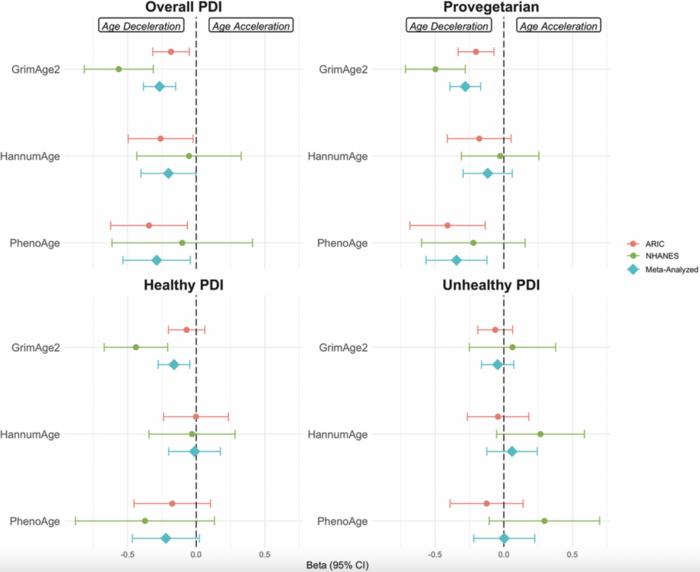
Figure 1.Associations between different types of plant-based diet indices (PDI) and epigenetic aging in the Atherosclerosis Risk in Communities Study (ARIC) and National Health and Nutrition Examination Survey (NHANES). Multivariable linear regression model was adjusted for age, sex, race (in ARIC, we used race-center), total energy intake, education, income (NHANES only), smoking status, physical activity, alcohol intake, and margarine intake (ARIC only). Estimates were meta-analyzed using fixed-effects model. In NHANES, survey-weighted linear regression was used (weighted N= 64,294,854). PDI, plant-based diet index, CI, confidence interval.
Led by first and corresponding author Hyunju Kim from the Department of Epidemiology and the Cardiovascular Health Research Unit, Department of Medicine, University of Washington, the study examined whether four plant-based diet indices — overall PDI, provegetarian diet, healthy PDI, and unhealthy PDI — were associated with DNA methylation-based measures of epigenetic aging. The authors analyzed data from the Atherosclerosis Risk in Communities (ARIC) Study (n = 2,810) and the National Health and Nutrition Examination Survey (NHANES, n = 2,056), and assessed associations with GrimAge2, HannumAge, and PhenoAge.
The researchers found that each standard deviation higher in the overall PDI, provegetarian diet, and healthy PDI was associated with decelerated GrimAge2, while higher overall PDI and provegetarian diet were also associated with decelerated PhenoAge and HannumAge. By contrast, unhealthy PDI was not significantly associated with epigenetic aging. The findings suggest that plant-rich dietary patterns, especially those emphasizing healthier plant foods, may be linked to slower biological aging in largely non-vegetarian populations.
“No significant association was observed for unhealthy PDI and any of the DNA methylation-based aging.”
The authors note that these are observational data and do not establish causality. They call for longitudinal and interventional studies to determine whether sustained adherence to healthy plant-based dietary patterns can directly influence epigenetic aging and related health outcomes over time.
Plant-based dietary patterns are associated with slower epigenetic aging
Psychotherapists aren’t prepared to treat eating disorders in boys and men
New research shows that psychotherapists don’t have the knowledge and training to treat boys and men with eating disorders and muscle dysmorphia, both of which are becoming more prevalent
Toronto, ON — A new binational study of 259 outpatient psychotherapists across Canada and the United States highlights significant gaps in clinician knowledge, confidence, and formal training related to treating eating disorders and muscle dysmorphia among boys and men, conditions that are rising sharply but remain widely misunderstood.
Led by Kyle T. Ganson, PhD, MSW, of the University of Toronto’s Factor-Inwentash Faculty of Social Work, the research is the first of its kind to examine outpatient mental health providers’ preparedness to treat this underserved group. The study found that most psychotherapists lack adequate training and report low confidence in identifying and treating these conditions, despite regularly seeing boys and men who present with eating disorder symptoms.
Overall, clinicians reported low levels of knowledge and confidence regarding both eating disorders and muscle dysmorphia in boys and men. More than one-quarter of providers said they had no knowledge of eating disorders in this population, and nearly half reported no knowledge of muscle dysmorphia, an even more concerning finding given its growing recognition in the community.
“Boys and men with eating disorders are often hiding in plain sight,” said Dr. Ganson. “Many clinicians simply haven’t been trained to recognize the unique ways these issues show up in male clients.”
Formal training was uncommon. Only a small minority of psychotherapists received any training specific to boys and men with eating disorders during their undergraduate or graduate programs, and just a quarter received such training afterward. Yet among those who received training, most reported that it improved their clinical work, suggesting that even limited educational interventions can meaningfully enhance therapists' preparedness.
Despite this, the effectiveness ratings for these trainings were modest. Providers consistently rated training on muscularity-oriented concerns, such as bulking and cutting, or excessive exercise behaviors, among the least effective components. According to Dr. Ganson, this gap has real consequences: “Clinicians are telling us they want more tools. They’re seeing boys and men in their practice but don’t feel equipped to address the muscularity-focused concerns that are often central to these cases.”
When asked about their training needs, clinicians identified several priority areas: understanding and assessing boys’ and men’s unique risk factors and symptom presentations, learning how to tailor treatment to male-specific experiences, and better addressing stigma, shame, and barriers to care. Surprisingly, fewer clinicians expressed a need for training on building rapport or fostering treatment engagement, even though boys and men are known to seek help less often and drop out of treatment more frequently.
“This is a critical moment for the field,” Dr. Ganson noted. “Our findings show that clinicians want more specialized training, and that such training is urgently needed to ensure boys and men receive competent and affirming care.”
To help meet this need, the University of Toronto’s Factor-Inwentash Faculty of Social Work offers a graduate-level Eating Disorders Assessment and Treatment course taught by Dr. Ganson. The course equips emerging social workers with gender‑responsive assessment strategies, skills for addressing muscularity‑oriented concerns (including muscle dysmorphia), and evidence‑informed psychotherapy approaches tailored to boys and men, while remaining inclusive of diverse genders and intersectional identities.
“We designed the course to close the training gap we’re seeing in the field,” said Dr. Ganson. “Students leave with practical tools, including how to assess muscularity-focused symptoms, how to adapt treatment language and strategies for boys and men, and how to address stigma and barriers, so they can deliver competent, affirming care right away.”
Contrary to persistent stereotypes, eating disorders are affecting boys and men at increasing rates. Hospitalizations and community prevalence data show sharp rises across North America and internationally. Muscle dysmorphia, a disorder marked by a preoccupation with muscularity, is also increasingly recognized among adolescent boys and young men.
These conditions often present differently in males, frequently centered on muscularity and leanness rather than thinness, yet most clinical training still reflects female-centric symptom patterns. As a result, boys and men are at heightened risk of underdiagnosis, misdiagnosis, and delayed treatment.
Because outpatient psychotherapists are often the first point of contact for individuals with eating disorders, the study authors emphasize that improving training at this level is critical.
The findings point to several opportunities to strengthen care, including:
Integrating gender-sensitive approaches into assessment and treatment
Expanding training on muscularity-oriented behaviors
Enhancing understanding of stigma and gender norms that affect help‑seeking
Tailoring psychotherapy models to male-specific body image concerns
Improving clinicians’ ability to recognize muscle dysmorphia in practice
Together, these steps can help ensure boys and men receive competent, informed, and equitable mental health care.
Quebec’s winters are notoriously long, cold and energy intensive. And even though Hydro-Québec provides abundant, relatively inexpensive electricity, waste and efficiency remain serious concerns.
A new Concordia study clarifies energy consumption patterns by looking at neighbourhood-level usage in Quebec’s major urban centres and socio-demographic data derived from Canada’s 2021 census, such as employment and income levels, car ownership, average age and household size. The researchers say this method could help utility managers, policy planners and government authorities better understand which demographics consume the most household energy and where usage is at its peak. The data could also be used in devising more effective and equitable energy strategies.
Hydro-Québec provided the researchers with hour-by-hour usage data from residential smart meters for the full four years between 2019 and 2023. The team then broke down that data for Montreal, Trois-Rivières and Quebec City according to the Forward Sortation Areas — Canada Post’s geographical subdivisions used to sort and deliver mail as efficiently as possible.
Using sophisticated models and advanced machine learning tools, the researchers determined which variables drove energy consumption the most across both long-term heating patterns and short-term daily use.
“Energy demand is not just about the building, but about the people who reside in it,” says lead author Masood Shamsaiee, a PhD student at the Next-Generation Cities Institute. “You can have two neighbourhoods with similar building profiles, but if two different types of people live in them, they are going to have two completely different consumption patterns.”
To observe long-term patterns, the researchers used a method called change-point analysis to determine when heating systems were activated as outdoor temperatures changed. They then applied a machine-learning model to measure how different socio-demographic factors influenced heating behaviours.
For short-term patterns, the team grouped daily electricity-use profiles into clusters and used another machine-learning model to determine which social characteristics best predicted each pattern. AI analyses were used so the models could reveal not just predictions, but also which factors mattered most.
The analysis revealed strong links between energy use and social characteristics. Higher-income neighbourhoods and areas with larger households tended to have higher baseline electricity use and stronger increases in consumption as heating demand rose. Lower-income neighbourhoods, however, often activated heating earlier in the season, which may reflect less efficient buildings due to poorer insulation and older windows.
Neighbourhoods with older populations tended to have higher electricity use per person, likely because residents spend more time at home and prioritize indoor comfort. Areas with a higher population of non-Canadians, newer homes, high-rise apartments, younger residents and crowded living conditions averaged lower use.
Daily routines also played a role in consumption demands. Areas with high employment levels and car-dependent lifestyles showed strong peaks in the morning and evening, when residents left for and returned from work. Neighbourhoods with higher unemployment or more walkable environments tended to have flatter electricity-use patterns throughout the day.
“I hope this study adds a human element to the different models informing policy makers,” says Shamsaiee. “This can be used as a tool to help utility companies like Hydro-Québec develop better, more detailed efficiency programs while at the same time delivering a fairer and more equitable distribution system.”
Credit: Kristin Samuelson, Northwestern University
Study suggests long-standing sensory reinstatement theory needs to be refined
In precision fMRI scans, vividness of imagination was related to activity in higher-order brain networks
Findings suggest mental imagery is closely tied to higher-level cognitive functions, as opposed to being a strictly sensory phenomenon
CHICAGO --- Imagination is one of the most powerful things our brains can do. We can relive past events while taking a walk, rehearse future conversations through inner speech or sense the heat of a fire without touching it — allowing us to learn, plan and avoid danger without direct experience.
Why imagination is often accompanied by mental imagery remains a longstanding question. When one thinks of an apple, for example, many “see” an image of an apple in their mind. When one thinks of their favorite song, many “hear” that song playing in their mind, including vocals and specific lyrics. Mental imagery has often been thought to rely mainly on reactivating the brain’s sensory regions in the absence of input — a process known as sensory reinstatement.
But a new Northwestern University study suggests that higher‑level brain systems that interpret and organize perception may also play a central role in imagination.
The scientists asked study participants to imagine different scenarios, such as a child’s birthday party or a castle on a hill, while undergoing individual‑level precision fMRI scanning. The findings suggest that imagination is not simply a copy of sensation. Instead, it appears to emerge at later stages of processing, when the brain represents information holistically as scenes, words, events or ideas rather than raw sensory input.
“When you ask someone to imagine the sound of a kid’s birthday party, they don’t just hear it — they also automatically picture the scene,” said senior author Rodrigo Braga, assistant professor of neurology at Northwestern University Feinberg School of Medicine. “It makes sense that imagination operates in this holistic, higher‑level space, given that we use it to plan, understand and speculate.”
The study will publish March 31 in Neuron.
The findings suggest mental imagery is closely tied to higher-level cognitive functions, as opposed to being a strictly sensory phenomenon.
“Our study doesn’t refute sensory reinstatement theory, but it does suggest we need to refine it,” Braga said. “It’s not just the sensory parts of the brain that are involved. When people imagine rich scenes or an internal dialogue, the strongest overlap with perception appears in later stages, where sensation has already been transformed into meaning.”
How the study worked
Eight study participants imagined different scenarios during eight separate MRI sessions, as part of a study that resulted in more than 60 hours of fMRI data. The scientists mapped each participant’s sensory and association networks and compared brain activity during imagination with activity during actual perception. They found brain activity related to imagining and perception overlapped in the higher-level association areas, not the early sensory areas.
“These association areas are particularly interesting because they are greatly expanded in the human brain compared to our close evolutionary ancestors,” Braga said. “They also allow humans to do things we are particularly advanced at, such as communicating using language. This suggests that the generation of mental imagery relies on brain networks that are particularly prominent in the human brain and suggests that these association areas likely work with earlier sensory parts of the brain to institute mental experiences.”
After exiting the scanner, participants self-reported what they had imagined in the scanner, which allowed the scientists to relate each participant's subjective reports about each imagined item with their own brain activity patterns. The participants reported that they experienced vivid visual imagery when imagining scenes and vivid sound imagery when imagining speech.
The data supported two insights into mental imagery: First, different types of imagining activated different networks, Braga said. When people thought about scenes, they were tapping into parts of a brain network called the “default network” — which works with the hippocampus (a key memory structure) to support internally generated thought such as when we think about the past or future. But when they used inner speech or thought about speech, they activated a different network called the “language network.”
Despite these differences, in both cases, imagination overlapped with perception primarily in high-level, transmodal brain regions rather than sensory-specific regions.
“The default network has sometimes been implicated as the brain’s ‘hub’ for mental imagery,” said first author Nathan Anderson, a former postdoctoral fellow at Northwestern. “Our results do show that the default network is generally engaged during imagining, but we also see different large-scale brain networks activated depending on what you are imagining.”
Activity in these association regions also tracked how vivid participants reported their imagery to be, suggesting that naturalistic imagination relies especially strongly on higher‑order interpretive systems, Braga said. The results advance our understanding of how the brain supports self-generated and sensory-independent forms of thought, Braga said.
The findings do not mean the brain’s sensory cortex is irrelevant, Braga emphasized, but they suggest a more nuanced understanding of how the brain generates mental imagery.
The study is titled, “Mental imagery and perception overlap within transmodal association networks.”