Sunday, April 19, 2026


NATO Allies Adopt Evasive Policies on US War in Iran


by  | Apr 17, 2026 

Trump administration officials are discovering that a daunting number of longstanding U.S. allies and security clients are adopting hedging policies or even openly opposing Washington’s decision to wage war against Iran.  That sobering reality has become even clearer over the past week than it was during the earlier stages of the armed conflict.  On April 12, the president called upon NATO members to join U.S. naval forces in blockading Iranian ports. The proposed move was in response to Tehran’s continuing efforts to selectively close the vital Strait of Hormuz to foreign shipping.

However, most of Washington’s alliance partners refused to join the retaliatory blockade. British prime minister Keir Starmer was especially blunt and negative. The U.K. is “not supporting” the U.S. blockade of Iranian ports, Starmer stated, insisting that the country would not get “dragged in” to the Iran war.  Starmer, along with French President Emmanuel Macron, instead proposed intensified international efforts, including a conference, to secure an effective agreement to reopen the strait.

The extensive allied refusal regarding Washington’s blockade plans reflects growing European dissatisfaction with overall U.S. policy toward Iran and, indeed, with Trump’s entire approach to world affairs. Concerned longtime proponents of close transatlantic security cooperation are expressing mounting worries that disagreements between the United States and its principal European allies about Iran policy could lead to a fatal breach in NATO.

European leaders and their publics clearly are getting restless. Serge Schmemann, the Moscow bureau chief for the New York Timesemphasizes the extent of the change.  “Mr. Trump’s war on Iran, about which NATO allies were not consulted and in which they subsequently declined to participate, has made clear that Europeans no longer defer to Mr. Trump as the de facto “‘leader of the free world.’”

At the same time, European leaders have tried to avoid directly antagonizing President Trump.  Achieving such a balance is not easy.  Trump expressed fury at NATO allies who have failed to support Washington’s intervention against Iran. Even before the latest intra-alliance spat over establishing a blockade, the president denounced such allies as “cowards.” Administration officials also are examining ways to punish uncooperative Alliance partners.  Secretary of State Marco Rubio echoed and amplified Trump’s earlier doubts about the continuing value of NATO to America’s security. “Why are we in NATO? You have to ask that question. Why do we send trillions of dollars and have all of these American forces stationed in the region, if in our time of need, we won’t be allowed to use those bases?” Rubio said during an interview with Fox News in early April.  The refusal of most NATO members to authorize U.S. airstrikes and other offensive operations against targets in Iran has especially irritated administration officials.

However, as Wall Street Journal columnists Linas Kojalaand and Vytautas Leškevičius point out, with the notable and ostentatious exception of Spain, the most significant and influential Alliance members, including Britain, France, and Italy, have all quietly assisted the U.S. war effort in other ways.  The outcome has been a bit of a muddle. “Politically, the war with Iran has widened the gap between Washington and many European governments. Operationally, it has underscored how heavily the U.S. still relies on Europe – and how cooperative most European governments are.”

European NATO leaders seem to be trying to have it both ways.  By condemning Washington’s war of aggression against Iran and the widespread economic disruption that the conflict has caused, those countries maximize their ability to win the plaudits of outraged populations and governments around the world.  Yet providing quiet backing for at least some U.S military operations and diplomatic efforts to limit Iran’s power and influence placates other countries–especially those in the Middle East – that worry about both the clerical regime’s current conduct and its long-term strategic ambitions.

It is a very delicate balancing act on several levels, and it remains to be seen if European political elites can carry it off.  Important factions within the U.S. diplomatic, intelligence, and military communities may well sympathize with at least some of the European objections to the Trump administration’s Iran policy.  However, hardliners in those same U.S. institutions are not pleased with the perceived reluctance of other NATO members to support an armed intervention that the administration regards as a high priority. Worse, Trump himself has expressed vitriolic displeasure at what he considers unreliability at best and outright betrayal at worst.  His anger is not a trivial matter.  Even a lame-duck president with low domestic public approval ratings exercises a dominant role in U.S. foreign policy. Policy differences about the Iran war have already exacerbated transatlantic tensions, and if the war does not end quickly, those tensions are almost certain to worsen dramatically.

Dr. Ted Galen Carpenter is a senior fellow at the Randolph Bourne Institute and the Libertarian Institute. He is also a contributing editor to National Security Journal and The American Conservative. He also served in various senior policy positions during a 37-year career at the Cato Institute. Dr. Carpenter is the author of 13 books and more than 1,600 articles on defense, foreign policy and civil liberties issues. His latest book is Unreliable Watchdog: The News Media and U.S. Foreign Policy (2022).


The War Powers Resolution Is Not What You’ve Been Told


by  | Apr 19, 2026 | 

Reprinted From World BEYOND War.

According to The Hill, in an article typical of U.S. media, Trump’s war on Iran is totally legal for 60 days if Congress does nothing, after which it becomes illegal, unless Congress has explicitly OK’d it. This is supposedly because of the War Powers Resolution of 1973. And The Hill is not alone in pushing this idea. Fox News agrees with The Hill. So does Time. So does USA Today. So does The Washington Post. So does Roll Call. So does Politico. So does every AI bot infecting the internet.

However, the War Powers Resolution consists of words that you can read for yourself, and here are some of them:

“The constitutional powers of the President as Commander-in-Chief to introduce United States Armed Forces into hostilities, or into situations where imminent involvement in hostilities is clearly indicated by the circumstances, are exercised only pursuant to (1) a declaration of war, (2) specific statutory authorization, or (3) a national emergency created by attack upon the United States, its territories or possessions, or its armed forces.”

  1. There has been no declaration of war by the U.S. Congress since 1941.
  2. There has been no authorization to attack Iran, nor to continue attacking Iran.
  3. There has been no attack upon the United States or its territories or possessions, and there were no attacks on its armed forces until after said armed forces had begun the war.

The same law says that a president who launches a war in any of those three situations, then has 48 hours to submit his first report explaining himself, and 60 days after that report (62 days total — plus a possible extra 30) to entirely knock it off. But none of those three situations exists. So, the president must immediately knock it off — must, in fact, have never started the war. It is simply not true that the war will become illegal after 60 days; it has been illegal since the instant it was begun. It is factually false that it must be ended after 60 days in order to comply with the law; it must be ended immediately.

If the War Powers Resolution did not exist, one could revert to the actual Constitution that the War Powers Resolution claimed to uphold and which says that the decision to declare and wage a war is up to the Congress.

If that weren’t enough, one could also find in the Constitution that spending money on anything is up to the Congress. At least one Congress Member has been pointing out lately that the Constitution says “No money shall be drawn from the Treasury, but in Consequence of Appropriations made by law.” No law has appropriated a dime for attacking Iran.

If Congress were to appropriate money for the war and/or to declare or authorize the war, there would still remain the problem that the same Constitution makes treaties to which the United States is party “the supreme law of the land” and one of those treaties is the UN Charter, which bans war except in narrow circumstances not met. Various other treaties ban war entirely.

The wars are all illegal from day 1. But don’t we still want the War Powers Resolution used to try to end them, by forcing votes on whether to end them? Sure, we do. The wars are legally allowed to continue for 0 days, but don’t we still want them stopped at 60 or 62 or 90 or 92 or whatever number of days our so-called government is willing to treat as a deadline? Sure, we do. Endless bloody massacres and fits of massive destruction are horrible, but wouldn’t they be less horrible if they could each be held to 60 days or shorter? Maybe.

Better would be to end each war immediately, right now, and to hold all the future wars to 0 days. How does one do that without a handy mechanism that corporate media outlets all pretend is real? Well, one way would be to use handy mechanisms that are real in written law. They include (redundantly) banning the use of any money for a war. They include impeaching and removing from office those waging a war. They include closing distant foreign bases, thereby making it impossible to get them attacked.

Those sound harder, perhaps, than telling a president his time is up. But you’ll have to do them anyway after you’ve told him his time is up and he’s told you to go to hell. Meanwhile all the blood of those 60 days will be on your hands — not to mention the blood of all the other wars to come.

If you let corporate media outlets and random Congress members pretend that laws say totally crazy things — such as that presidents can legally attack anyone they want if they cut it out after 2 months, what else will they decide that laws can say: no warrant is needed to spy on you? being born in the U.S. doesn’t make you a citizen? a corporation has human rights? one human right is the right to use assault rifles? bribery is free speech? a paramilitary force can kidnap people off the street? profiting from public office is acceptable?

And if all your puppet, weapons-buying, sidekick governments around the world obediently immitate the standard that their presidents can legally attack anyone they want if they cut it out after 2 months, how is that likely to work out?

David Swanson is an author, activist, journalist, and radio host. He is executive director of  WorldBeyondWar.org and campaign coordinator for RootsAction.org. Swanson’s books include War Is A Lie and When the World Outlawed War. He blogs at DavidSwanson.org  and  WarIsACrime.org. He hosts Talk Nation Radio.


Hydropower Is Making a Global Comeback

  • Hydropower remains the world’s third-largest electricity source but is often overlooked despite its vast untapped potential.

  • Its flexibility and storage capacity make it critical for balancing intermittent renewables like solar and wind.

  • Rising fossil fuel volatility is pushing governments to reconsider hydropower as a key pillar of energy diversification.

As governments look to diversify their energy mix by expanding renewable energy capacity, many are turning to solar and wind power. Meanwhile, hydropower is often overlooked by countries that do not have a tradition of hydropower production. With the ongoing conflict between the United States, Israel, and Iran, the price of fossil fuels is being pushed ever higher due to severe shortages of oil and gas. This is encouraging governments worldwide to assess their energy security and consider developing various energy sources to support greater diversification and decrease the vulnerabilities of a reliance on any one energy source. 

Hydropower has long played a major role in global energy production, with several countries around the globe relying on the power of water to provide vast amounts of clean energy. The first hydropower projects were developed in the 1800s, and hydro is now the world’s third-largest power generation source after coal and natural gas, contributing around 4,500 terawatt-hours of electricity, or 14 percent of the global total. This equates to around the same electricity production as solar and wind power combined.

China is home to around 29 percent of the world’s installed hydroelectric capacity, followed by Brazil, the United States, and Canada. However, some countries rely much more heavily on hydropower, with Norway, Paraguay, the Democratic Republic of Congo, and Albania depending on hydro for a large proportion of their electricity generation.

However, the IEA’s Executive Director, Fatih Birol, has suggested that hydropower is often overlooked, describing it as“the forgotten giant of electricity”. Birol says that it is often not included in international energy discussions, when it should be, especially with the global electricity demand set to rise at a faster pace than the overall energy demand. In 2021, the IEA published a major report on hydropower, identifying the significant potential of expanding the hydro market.

Around 60 percent of the hydro resources in emerging and developing economies are untapped. Investing in the sector could help boost energy access and power industrialisation, thereby spurring economic growth.

Unlike solar and wind power, hydropower is highly flexible, as plants are developed to rapidly adjust their generation up and down as needed, and can be stopped and restarted with relative ease. This makes them highly efficient in adapting to changes in the power demand, typically at a low cost. For this reason, hydropower could be key to clean energy diversification, filling the gap when the sun is not shining and the wind is not blowing.

Hydro resources can also be used for energy storage. Pumped-storage hydro (PSH) plants can act as giant batteries, using water instead of chemicals. At present, they are the largest form of electricity storage worldwide, with the capacity to hold 30 times more power than batteries. In addition, new technologies can make hydro plants much more efficient, meaning that investing in refurbishing and upgrading ageing plants could help boost electricity output and improve storage capacity.

There is close to 200 GW of PSH capacity worldwide, contributing around 90 percent of long-duration energy storage globally. A further 570 GW of PSH is set to be developed worldwide in the coming years. Conventional hydropower, such as the Three Gorges Dam in China, stores energy by holding water in a reservoir before releasing it to power turbines. However, PSH has the reputation as a “water battery”, as it uses excess energy, mainly from renewables, to pump water from a lower reservoir to a higher one, before allowing gravity to send the water back down pipes to boost power during low-production hours.

Despite often being overlooked, hydropower has garnered greater attention in the United States in recent months, due to President Trump’s crackdown on clean energy. A submersible hydroelectric technology is being used in the Great Lakes, one of the world’s largest freshwater bodies, which border several large North American cities, such as Chicago, Toronto, Montreal, and Detroit.

None of the five Great Lakes has substantial tides or currents to fuel hydropower, but some of the surrounding waterways do. In February, the Ocean Renewable Power Company (ORPC) announced its first urban project on the St Lawrence River in Montreal. ORPC plans to begin operating two hydroelectricity devices later this year, with 60-90 MW of resource potential in the area. The devices use carbon fibre turbines, which are turned by the flow of water. This technology has become increasingly popular in recent years, with similar projects being developed in Korea and the United Kingdom.

Despite long being used as an energy source, the potential for hydropower as part of energy diversification efforts has been greatly overlooked. As governments worldwide look for ways to strengthen their energy security and reduce reliance on volatile energy sources – such as oil and gas – hydropower could offer a major clean alternative power source, as well as provide enhanced stability through the use of hydro plants as giant batteries. 

By Felicity Bradstock for Oilprice.com


White House Wants a Nuclear Reactor Orbiting the Moon by 2028

  • The White House issued a directive on April 14 ordering NASA, the Pentagon, and the Department of Energy to develop a nuclear fission reactor capable of orbiting the moon, with a launch-ready target of 2028.

  • Nuclear power is considered the only viable energy source for a permanent lunar presence — solar, wind, and hydropower are all ruled out by the moon's environment, including 14-Earth-day-long lunar nights.

  • The U.S. launched a nuclear reactor into orbit in 1965, but space-based nuclear programs were abandoned after radioactive releases. NASA has since spent billions on space nuclear projects that went nowhere — the White House says this time is different.


The Trump administration has grand plans for “ENSURING AMERICAN SPACE SUPERIORITY.” When NASA sent humans to the moon for the first time this century earlier this month, the organization made it clear that this is just the “opening act” for a new and revitalized era of space exploration. Under the Trump administration, NASA has enormous ambitions, going as far as to plan a permanent base on the moon, which will need never-before-seen energy innovations to maintain a secure source of power. This week, the federal government laid out its plans to achieve it.

The plan is to send a nuclear reactor into space. Last year, Trump issued a plan to install a nuclear reactor on the surface of the moon, but new orders describe a brand new vision. The April 14 plan lays out a mandate for NASA, the Pentagon and the Department of Energy to develop a nuclear system capable of orbiting the moon, and to have it launch-ready as soon as 2028.

To achieve this vision, NASA will partner with various agencies to fast-track mid-power fission reactor designs and surface power variants, which will compete to achieve near-term demonstration of viable models. “The White House’s overall strategy is to conduct parallel and mutually-reinforcing NASA and Department of War (DOW) design competitions to enable near-term demonstration and use of low- to mid-power space reactors in orbit and on the lunar surface, and prepare to deploy high-power reactors in the 2030s,” Interesting Engineering reported this week.

Solving the riddle of generating power in space would be revolutionary for space exploration and expansion, and all of the political and economic power that comes along with it. “With great power competition rising, the ocean floor, Arctic, and lunar surface are becoming the front lines of global security and economic progress — but they remain energy deserts,” says Tyler Bernstein, Chief Executive Officer of a venture-backed nuclear battery startup called Zeno Power.

Nuclear is widely seen as the only feasible solution to bringing energy into space. Lunar days are extremely long, and each lunar night lasts 14 Earth days, meaning solar power is out of the question. There is no wind on the surface of the moon, so wind power is out as well. Nor is there flowing water for hydropower. Fossil fuels are not available on the moon, and bringing them into orbit would be a ludicrous waste of resources. By comparison, nuclear fission powered with high-assay, low-enriched uranium is far and away the best option.

Based on these facts, it should not be surprising that the idea of bringing nuclear power to space is a very old one that has been tried many times before. In fact, the United States launched a nuclear reactor into orbit way back in 1965, and the Soviet Union launched similar projects. However, both the United States and the USSR released radioactive materials into the atmosphere and on Earth as a part of these efforts, and this track of nuclear development was soon abandoned due to growing pushback and a wave of anti-nuclear sentiment.

Of course, nuclear fission technology has changed and advanced considerably since those ill-fated ventures. But NASA has continued to explore space-based nuclear power in the past decades, “spending billions on nuclear power projects that haven’t gone anywhere” according to a recent report from Scientific American.

But a new nuclear era is upon us. Public support for nuclear power is on the rebound, and space-age ambitions have likewise come roaring back in the Oval Office as well as the private sector. And U.S. leadership is outwardly confident that this time around, it will work. “Nuclear power in space will give us the sustained electricity, heating, and propulsion essential to a permanent robotic and eventually human presence on the moon, on Mars, and beyond,” Michael Kratsios, the director of the White House’s science and technology policy office, recently said at the Space Symposium.

By Haley Zaremba for Oilprice.com

The Overlooked War China Is Desperate to Contain

  • China hosted trilateral talks to de-escalate violence between Pakistan and Afghanistan, but continued clashes underscore fragile progress.

  • The core dispute over Taliban ties to militant groups remains unresolved and highly contentious.

  • Beijing’s role highlights both its growing regional ambitions and the limits of its diplomatic leverage.

As US President Donald Trump says the war in Iran could be over "very soon" and Pakistani mediators in Tehran prepare to meet with officials, another nearby conflict has been drawing Beijing's attention.

Since late February, fighting between Afghanistan and Pakistan has intensified, with Islamabad declaring an "open war" with its neighbor. Strikes have killed hundreds and displaced hundreds of thousands, according to the United Nations Office for the Coordination of Humanitarian Affairs in Afghanistan. The conflict has alarmed the international community and perturbed China, which is a partner to both countries and sensitive to violence along its western borders.

Against that backdrop, Beijing has stepped in to play a diplomatic role, announcing on April 8 that it hosted weeklong talks in Urumqi in western China in hopes of brokering a cease-fire. At stake is not just tempering hostilities but a broader test of China's ability to manage instability on its periphery, where it has deep economic and political ties.

While all sides have publicly backed dialogue, deep disagreements over militant groups and cross-border attacks threaten to derail any meaningful de-escalation. Delegations from all three sides were quick to tout the value of the talks. China's Foreign Ministry called them "frank and pragmatic," while the Taliban called them "useful" and said they took place "in a constructive atmosphere."

But even as the talks were underway, Afghanistan accused Pakistan of carrying out shelling across its border, raising questions about whether China can end the conflict and how much diplomatic capital it is willing to attach to the discussions as it also navigates the war in Iran.

"The Taliban and Pakistani diplomats know how to come up with word formulas that make China look good and even limited border easement measures," Michael Semple, an Afghanistan expert at Queen's University Belfast, told RFE/RL. "But agreement on the issue of Taliban support for the Tehrik-e Taliban Pakistan (TTP) is likely to prove elusive for now."

Pakistan has long alleged that Taliban-run Afghanistan harbors fighters from the TTP, a militant group that carries out cross-border attacks -- allegations the Afghan Taliban denies.

Testing Beijing's Influence

Analysts believe both Pakistan and the Taliban value China as a strategic partner.

For Islamabad, Beijing is a valuable counterweight to its archrival, India, and a needed source of foreign investment. For the Taliban, China represents a massive nearby market that could help its struggling economy while also presenting a partner to help the government gain full international recognition after the militants seized power in 2021.

But while China has leverage on paper, it's unclear how much pressure it is willing to apply.

Beijing has typically taken a back seat in international mediation, confining its efforts to situations likely to yield quick results, such as a 2023 deal between Iran and Saudi Arabia that re-established diplomatic ties between the two Middle Eastern rivals.

Amid the war in Iran, Beijing has also mostly kept its public distance, welcoming foreign delegations and looking to portray itself as an arbiter of international norms. This is in contrast to the United States, such as when Chinese leader Xi Jinping called the US blockade of Iranian ports a "return to the law of the jungle" as he hosted Sheikh Khaled bin Mohamed bin Zayed Al Nahyan, the crown prince of Abu Dhabi, on April 14.

Still, some reports, including comments from Trump himself, have suggested China has used its position as Iran's top investor and oil buyer to push toward engaging in cease-fire talks with the United States and potentially moving to wind down the fighting.

Tempering hostilities between Islamabad and Kabul will not be straightforward.

Before the Taliban's return to power in August 2021, officials from Afghanistan's ousted government similarly accused Islamabad of supporting the Taliban on Pakistani soil, which Pakistani officials denied at the time.

There have been few official statements regarding the discussions since they wrapped up in Urumqi. Pakistan has also been playing an active diplomatic role as host to US-Iran cease-fire talks.

Chinese Foreign Ministry spokeswoman Mao Ning said during a daily briefing after the talks ended that "the three parties agreed to explore a comprehensive solution to the issues in the relations between Afghanistan and Pakistan, and clarified the core and priority issues that need to be addressed."

Omar Samad, a former Afghan diplomat now based in the United States, says China-backed talks created new momentum, but there is still a large gap between rhetoric and the reality on the ground.

"The talks created a narrow opening, but openings of this kind tend to close quickly when confronted with entrenched mistrust," he told RFE/RL, adding that China and other mediators must sustain a long-term commitment to address structural issues that are "complex but not unsolvable."

From Allies To Adversaries

While the Taliban government was initially expected to maintain Pakistani support after seizing power, ties have frayed between the former allies, mainly over the TTP issue. Tensions peaked in October 2025 during a weeklong official visit by Taliban Foreign Minister Amir Khan Muttaqi to India.

On October 9, the first day of Muttaqi's visit, Islamabad launched air strikes across several Afghan provinces, including the capital, Kabul. Some reports initially indicated the Kabul attack targeted TTP leader Noor Wali Mehsud, though he later purportedly released a video to prove he was alive. In the wake of the strikes, Taliban forces launched counterattacks along the border, claiming to have killed dozens of Pakistani security personnel. Islamabad rejected those claims.

Defense ministers from both sides traveled then to Doha, the Qatari capital, on October 18 for talks mediated by Turkey, leading to a temporary cease-fire. Separate delegations later met in Istanbul that month for a follow-up meeting. That was followed by additional mediation efforts by Saudi Arabia and the United Arab Emirates, but Islamabad and Kabul failed to reach a permanent truce.

Following a renewed escalation in February, a major Pakistani strike on March 16 hit the Omid Drug Rehabilitation Center at the former NATO base, Camp Phoenix, in eastern Kabul.

Taliban officials said more than 400 people were killed, while Islamabad maintained it had struck military installations. The UN later reported a death toll of 143. Human Rights Watch condemned the incident as "an unlawful attack and a possible war crime."

"The Taliban for their part seem ideologically committed to the continuation of jihad and thus unable to distance themselves from the TTP," said Semple. "As long as the TTP campaign continues, there is every reason to expect an intensification of the conflict between the Taliban and Pakistan."

By RFE/RL

Worst U.S. Drought in Decades Puts Spring Crops at Risk


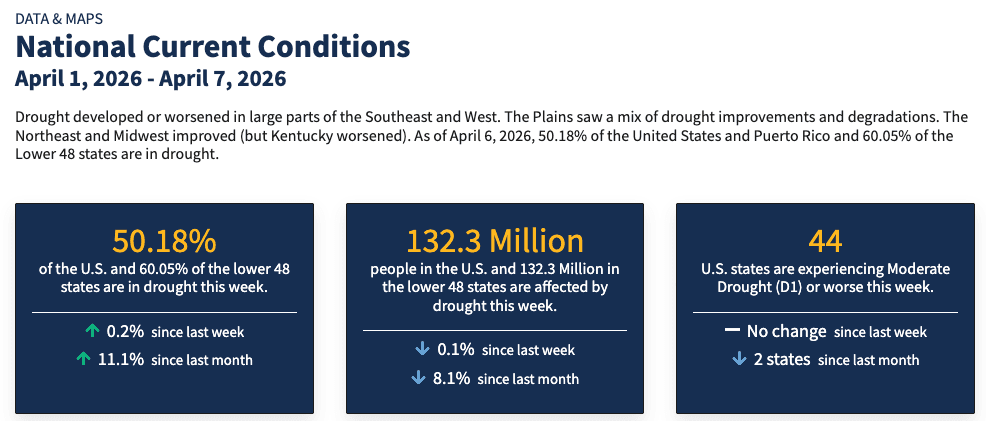
  • 60% of the Lower 48 is currently in drought as spring planting season begins, per NOAA, putting pressure on sugarcane, rice, peanuts, and wheat.

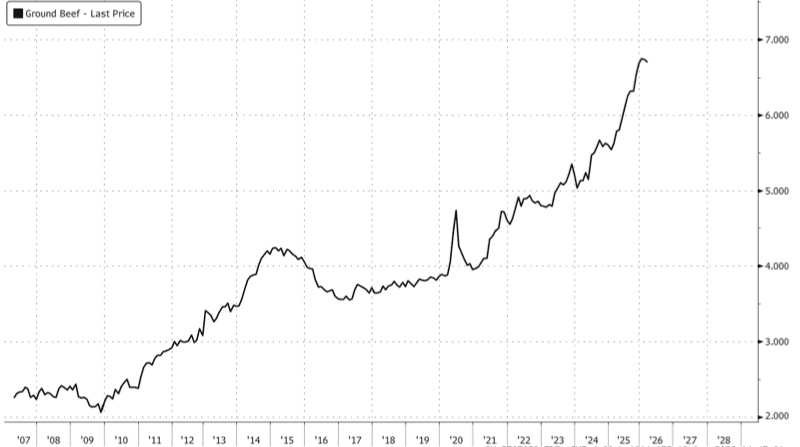
  • The U.S. cattle herd is at its lowest level since the 1950s; further drought-driven herd reductions could push beef prices to new record highs.

  • Shrinking mountain snowpack is threatening irrigation across the western U.S., with water cutbacks already imposed in Washington's Yakima Basin and along the Colorado River.

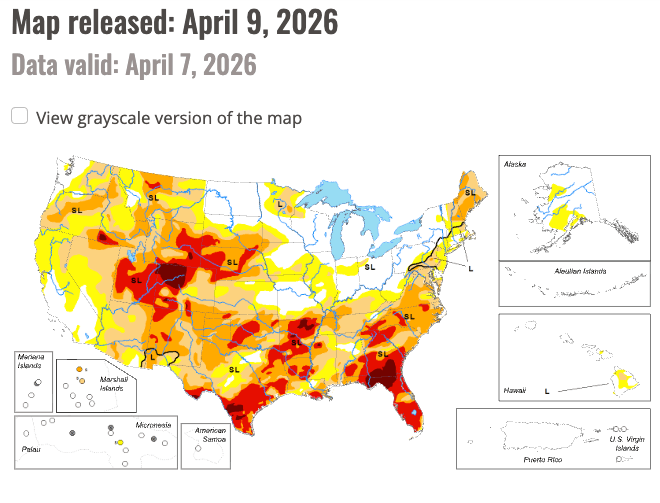
A massive drought has emerged across large swaths of the US agricultural belt, threatening crops and livestock and eventually affecting food prices, at a time when fertilizer and diesel costs are soaring. As of early April, 60% of the Lower 48 is in drought as the Northern Hemisphere growing season begins and farmers begin plantings, according to NOAA.

The southern US is already experiencing severe, extreme, and even exceptional drought conditions, putting pressure on key crops such as sugarcane, rice, and peanuts, while fruit trees have also been damaged by extreme temperatures.

Across the Great Plains, otherwise known as the nation's breadbasket, winter wheat farmers are being forced to decide whether to keep the struggling crop or cut losses and replant, with dry soil also making germination harder.

The drought also complicates matters for ranchers, as the nation's cattle herd is already at its lowest level since the 1950s. As a result, some ranches may further reduce their herds, which will only push beef prices to new record highs.

In the western US, the problem is not so much rainfall as shrinking mountain snowpack, which threatens irrigation supplies ahead of the growing season. Water-use cutbacks for agricultural purposes are already being discussed or imposed in places such as Washington's Yakima Basin and along the Colorado River.

Related:

Meteorologists Warn About Super El Nino Event

Washington, D.C. Will Feel Like June. Cue MSM Climate Doom Propaganda

X user Tony Heller noted, "The US is facing a drought possibly similar to the drought of 1610, which wiped out the Jamestown Colonists."

All bad news for food prices. Traders are piling into these agri ETFs: "Why The Fertilizer Crisis May Spark Record Inflows Into Agri ETFs."

By Zerohedge