Sunday, April 19, 2026

Successive governments have failed to learn lessons of Grenfell Tragedy

17 April, 2026 
Left Foot Forward


The conditions that facilitated the tragedy remain unchecked


We are approaching the ninth anniversary of the 2017 fire at Grenfell Towers in London which killed 72 people, including 18 children. This week, the UK parliament has passed a Bill to build a memorial to the memory of its victims. The most effective memorial would be to ensure that such avoidable tragedies never occur again. However, the conditions that facilitated the tragedy remain unchecked. The root cause of the tragedy is lust for higher profits; corporate power, performance related executive pay, failure of regulators and indifference of governments to the cry of the people.

The Grenfell tragedy provides a lens for examining systemic failures, corporate abuses, and failure of governments to hold anyone to account in not only housing but numerous other sectors too.

The Grenfell Tragedy

The Grenfell tragedy occurred in one of the wealthiest countries and cities on the planet. The 24-storey social housing block was in the Royal Borough of Kensington and Chelsea, the most affluent borough in London.

Grenfell Tower was located in the poor part of the borough, an area in the top 10% of the most deprived areas in England. Occupants of its 129 apartments had low incomes and survived on the margins of society. They frequently complained about the poor housing conditions, electrical faults and fire safety. There was no building-wide fire alarm or sprinkler system. Tenants’ complaints were ignored even though previous fires and fatalities at similar properties had raised safety concerns.

The fire was caused by an electrical fault which ignited highly combustible materials used in construction and refurbishments of the tower. A subsequent inquiry concluded that there was “systematic dishonesty” by suppliers of cladding panels and insulation products. “They engaged in deliberate and sustained strategies to manipulate the testing processes, misrepresent test data and mislead the market … Arconic deliberately concealed from the market the true extent of the danger of using Reynobond 55 PE in cassette form, particularly on high-rise buildings.”

Kingspan knowingly made false claims about its insulation’s fire performance and conducted “long-running internal discussions about what it could get away with“. Celotex used “dishonest means”.to break into the market, presenting its insulation as safe while knowing it did not meet required standards.

The Kensington and Chelsea Tenant Management Organisation responsible for managing Grenfell Tower on behalf of the Royal Borough of Kensington and Chelsea showed “persistent indifference” to tenants’ complaints about fire safety. The tragedy was the ‘culmination of decades of failure by central government and other bodies in positions of responsibility in the construction industry’, especially as little reform followed previous high-rise block fires.

The Government accepted all 58 of the inquiry’s recommendations but they have not been fully implemented. Many buildings still have the same cladding as in Grenfell.

To date, no corporation or individual has yet been charged or prosecuted over the death of 72 people. No company director has been disqualified by the Department of Business and Trade. The offending companies are not excluded from public procurement. Despite promises, no legislation has been introduced to improve corporate and director accountability. Ministers bat away calls for urgent action by claiming that the Police are looking at the issues.

Grenfell is not the only case of political indifference to corporate abuses and damaged lives.

Corporate Capture of the State

State capture, a form of political corruption, is all around us. Governments speedily prosecute carers and poor people for comparatively minor indiscretions but lack the necessary backbone for dealing with corporate crimes.

England’s water companies have over 1,200 criminal convictions. Companies reward executives for boosting profits by dumping sewage in rivers. They bypass rules on payment of bonuses. To manage public opinion, occasionally fines on companies are announced but then quietly waived or deferred. No company has had its licence to operate withdrawn. No corporate executive has been fined or prosecuted.

The Post Office scandal goes back to the 1990s. The December 2019 High Court judgment showed that it falsely secured criminal convictions of hundreds of postmasters by not revealing that its Horizon accounting system was fundamentally flawed. An independent inquiry revealed that it was assisted by Fujitsu, the supplier of the IT system, lawyers and business advisors. So far, the public purse has paid nearly £1.5bn in compensation to victims.

Horizon’s predecessor system known as Capture was used from 1992 to 1999. It too was flawed and was used to falsely secure criminal convictions of postmasters. Millions will be paid in compensation.

Despite the overwhelming evidence, no corporation or corporate executive has been fined or prosecuted. Fujitsu and others have made no contribution to compensations. Fujitsu still gets government contracts.

The third strand of the Post Office scandal is that there has been no scrutiny of the 100 or so postmaster convictions secured by the Department of Work and Pensions (DWP) for alleged frauds on payments of social security benefits. On 27 February 2025, a Minister told the House of Lords, “My noble friend Lord Sikka raised a question about the DWP convictions. I can assure him that the Minister for Transformation is looking into this, a review is being established”. On 27 January 2026, at a meeting with the relevant Minister I learnt that no review had taken place, and that the government had not even appointed a reviewer. On 23 March 2026, the government finally advertised for the post of a reviewer. The position may be filled by summer 2026 and the reviewer is expected to spend just 30 working days on the job. The review is expected to be cosmetic.

Secret commission from mis-selling of motor finance is the latest finance industry scandal. On 24 October 2024, the Court of Appeal ruled that it was unlawful for car dealers to receive a commission from a lender providing motor finance to a customer, unless it was properly disclosed to the customer and they gave informed consent to the payment. A possible compensation bill of £44bn, hitting bank profits, was mooted. Lenders appealed to the Supreme Court.

In January 2025 the Treasury, led by Chancellor Rachel Reeves, took the unprecedented step of applying to intervene and influence the Supreme Court judges on how they should interpret the law. The Treasury opposed the proposed redress and claimed the compensation would have “adverse consequences for the UK’s reputation as a place to do business and could negatively impact economic growth”. The court rejected the Chancellor’s interference. Faced with snub, the Chancellor said that she is considering emergency legislation to overrule the Supreme Court and limit customer redress. The August 2025 Supreme Court judgment severely diluted the redress available to customers.

The zeal to protect banks is not extended to victims of bank frauds. There is the long-running saga of frauds at HBOS, since 2009 owned by Lloyds Bank. Between 2002 and 2007, small business owners at the Reading branch were classified as ‘high risk’ even they had never missed a repayment of loans. They were sold unnecessary financial products and ultimately forced into liquidation, with senior managers benefiting from the forced sale of assets. Despite the evidence, the Financial Conduct Authority, the Serious Fraud Office and the Police declined to bring any prosecutions. Finally, in 2017, the Thames Valley Police and Crime Commissioner prosecuted and secured criminal convictions of HBOS managers for fraud and corruption.

Still, no regulatory agency sought to fully investigate the £1bn frauds and secure compensation for the victims. The buck was passed to Lloyds Bank for a very limited investigation by Dame Linda Dobbs. A report was promised by 2018. Nothing has been published. I have raised the matter in parliament on several occasions. The typical response from Ministers is silence, indifference, obfuscation and buck-passing.

The above is a tiny part of evidence showing callous disregard for the lives of ordinary people. In the public mind corporate crime is associated with tax dodges, illicit financial flows, dud products, profiteering, bribery and corruption, but it is more than that. It destroys lives, families and communities. The abuses are part of an enterprise culture that persuades many to believe that `bending the rules’ for personal gain is a sign of business acumen. Stealing a march on a competitor, at almost any price, to gain financial advantage is considered to be an entrepreneurial skill, especially where competitive pressures link promotion, status, profits, market shares and niches with meeting business targets. The result is that people are denied safe housing, water, work and essential services. Yet governments are obsessed with deregulation, with little regard for human rights, workers’ rights and protection of people and the environment.

The political system has done little to address the root causes of abuses. Current laws do not impose a proactive duty on companies and directors to take reasonable steps to prevent foreseeable harm arising from their commercial activities. No attempt is made to reform corporate governance, democratise corporations, reform regulation and ministerial accountability. The state itself has become a sponsor of social terror where corporate profits are prioritised over people’s lives. Unless checked, further loss of confidence in institutions of government is inevitable.


Prem Sikka is an Emeritus Professor of Accounting at the University of Essex and the University of Sheffield, a Labour member of the House of Lords, and Contributing Editor at Left Foot Forward.



Viktor Orbán’s defeat exposes ReformUK’s fragile benchmark


Yesterday
Right-Wing Watch

Left Foot Forward

Beyond Hungary, the result may point to something broader. Across Europe, parts of the populist right appear to be encountering limits and have, dare we say it, peaked.


Viktor Orbán is out. Vladimir Putin’s EU ally, who spent 16 years recasting Hungary as a model of “illiberal democracy,” has been decisively shown the door. Some 3.3 million Hungarians opted for Peter Magyar and his Tisza Party, to “dismantle the Orbán system.”

The result raises an awkward question for ultraconservative Orbán admirers in high places around the world, and none more so than Reform UK: what happens when your model collapses and with it, your supposed open highway to power?

MAGA spared no blushes

The timing, it must be said, was exquisite. JD Vance touched down in Budapest to give Orbán his blessing, only to watch voters withdraw theirs – in their droves.

And the anti-MAGA commentariat spared no blushes. “JD Vance is on a historic roll,” mocked former prosecutor and long-term Democrat Ron Filipkowski, cataloguing the vice president’s recent foreign policy blunders.

But the mockery, however deserved, risks understating the significance of what has happened in the small Central European nation, the unravelling of a political project that has spent years insisting it represents the future.

Since 2010, Viktor Orbán cultivated Hungary as a showcase for “illiberal democracy,” a “Christian nationalism” promoted as an alternative to Western liberal democracy. It was a rule focused on centralised power, hostility to independent institutions, cultural conservatism, and relentless emphasis on sovereignty and anti-immigration politics, with razor-wire fences erected at borders.

But as well as domestic governance, it was an export strategy. Through state-aligned media, think tanks, and conferences, Orbán’s Hungary was marketed across the US and Europe, including the UK, as proof that liberal democracy could be hollowed out without electoral cost.

And the model was eagerly imported wherever possible, admired and imitated by a transnational network that included figures like Donald Trump, JD Vance and Reform UK.

That model has now been not just challenged, but repudiated. The scale of Orbán’s defeat to Péter Magyar of the Tisza Party matters. So do the scenes that followed, tens of thousands on the streets of Budapest chanting “Europe! Europe! Europe!,” a direct rebuke to the insular nationalism that defined Orbán’s rule.

This was not simply a change of government. It was a collective rejection of the politics Orbán spent 16 years entrenching at home and abroad. It’s early days and of course, Magyar is a right-wing conservative, but first signs – the move towards Europe and the determination to address corruption – are promising.

Orbán and the British right

From Liz Truss being mocked for claiming “there is no longer free speech in the UK” at a right-wing conference in Hungary in 2025, overlooking Orbán’s well-known crackdown on press freedom, to Miriam Cates praising him as “one of the most important figures in the patriotic conservative movement” and, as recently as March, hosting him for an exclusive GB News interview, many right-wing UK politicians have openly admired Orbán.

This admiration has not been merely rhetorical, it has helped shape a broader political strategy. From calls for mass deportations to deep scepticism of international institutions, especially the EU, Reform-style politics has drawn heavily on Orbán’s Hungary as proof that a confrontational, anti-liberal agenda can evolve from insurgency into durable governance.

Nigel Farage and his allies have long held up Orbán as a benchmark. Farage described him as “the strongest leader in Europe” in 2018, and later as “the future of Europe” for his unapologetic defence of the nation-state against liberal consensus.

Despite Hungary having been ranked as the most corrupt country in the EU, with high levels of poverty, Reform figures have continued to express admiration for his leadership. At a 2025 political festival in Hungary, the party’s head of policy, James Orr, described Orbán’s model as a “counterexample” to what he sees as Britain’s ideological drift away from national pride and heritage.

MattGPT and the MCC

In a recent interview with Hungary Today, Reform’s defeated Gorton and Denton candidate and GB News presenter Matthew Goodwin, praised Hungary as a rare state committed to sovereignty and national identity. Goodwin, also known as ‘MattGPT’ after claims he relied on AI to write his latest book, has extensive links to institutions associated with Orbán.

As DeSmog reports, he has spoken at multiple events hosted by the Mathias Corvinus Collegium (MCC), a state-funded private college chaired by Orbán’s political director, Balázs Orbán. MCC has been described as a propaganda outfit for Orbán’s views on everything from gender to race. It has received over $1.3 billion in public funding and regularly convenes high-profile international conferences.

MCC also has a 10% stake in MOL, Hungary’s national oil company. Just days before the election, MOL announced it would pay MCC a £57 million dividend ahead of schedule, potentially giving it resources to challenge Magyar’s government. However, new reports indicate that Magyar plans to force a delay in the payout until later this year, while his government explores ways to strip MCC of its shares. He has pledged to “end the practice of political network-building with public funds” by cutting off state resources to Orbán’s affiliates.

Meanwhile in Britain, as of early 2026, MCC has been significantly bankrolling the Roger Scruton Legacy Foundation (RSLF) in London, named after the controversial right-wing British philosopher, Roger Scruton. A year before he died in 2020, Scruton was awarded the Order of Merit of Hungary by Orbán in London. The following year, the RSLF was born. In fact, Orbán’s seeming love affair with Scruton, who described Islamophobia as a “propaganda word” invented by the Muslim Brotherhood to “stop discussion of a major issue,” and referred to Hungarian Muslims as “huge tribes,” can be seen through the nine cafes named after the philosopher in Hungary.

A Good Law project report suggests that over 90% of the RSLF’s funding has come from the Russian-oil-backed MCC since 2023. Cambridge theology academic and now Reform UK’s Head of Policy James Orr is a trustee/director of the RSLF. As is Spectator editor and former Tory minister Michael Gove.

Goodwin also previously served as an MCC visiting fellow, teaching and delivering public lectures in Hungary. The Good Law Project noted in February that the role netted Goodwin between €5,000 and €10,000 a month, though Reform disputes this figure. He most recently delivered a keynote speech at an MCC event in Budapest in March 2026 titled “Reclaiming the West.”


In his first press conference following his landslide win, Peter Magyar announced the state would no longer finance institutions such as MCC. He went further, suggesting it may have been a criminal offence for Orbán to have funded MCC with public money, and that he intends to investigate.

What this might mean for ‘MattGPT’ and other figures on the right associated with the institution is far from clear, but the implications could be significant if those claims gain traction beyond Hungary. As Jolyon Maugham, executive director of the Good Law Project, put it:

“If, as Hungary’s new prime minister is suggesting, this funding is criminal, the likes of Matt Goodwin are going to be combing through our proceeds of crime legislation.”

Tim Picton, senior advocacy adviser for Spotlight on Corruption, said the case raises broader concerns about how foreign state-linked funding intersects with British politics:

“MCC has solid links to prominent political figures in the UK and is the main funder of a charity under the leadership of a member of the House of Lords. The revelations that it is now under investigation in Hungary for alleged misuse of public funds have placed the role that thinktanks play in risking foreign interference and illicit money undermining our democracy firmly back on the radar.

“The Home Office should also look carefully at whether UK groups, such as the Roger Scruton Legacy Foundation, that have benefited from funding funnelled from this Hungarian state-backed thinktank should have registered with the UK’s Foreign Influence Registration Scheme.”

The network of Orbán-linked connections within Reform doesn’t end with Roger Goodwin and James Orr. As for Farage himself, in April 2024, the Reform UK leader spoke at the National Conservatism conference in Brussels, headlined by Orbán. The event was organised by MCC’s Brussels’ arm and the Edmund Burke Foundation, where Orr serves as UK chairman. The foundation received $200,000 in 2024 from the Heritage Foundation, which authored the “Project 2025” policy blueprint for Trump’s second term, and maintains ties with the Danube Institute, another body funded by the Hungarian government.

In 2019, Tim Montgomerie, founder of Conservative Home and UnHerd, who defected from the Tories to Reform UK and remains an influential voice within the party, gave an address to the Danube Institute on the “the limits of liberalism” and the potential of its pro-natal family policies.

‘Stunning hypocrisy’

Critics have long pointed to the contradiction of Reform’s admiration of Orbán and his policies. Olivier Hoedeman of the pro-transparency group Corporate Europe Observatory argued Reform’s ties to Orbán’s pro-Kremlin government exposed “the stunning hypocrisy” of its claims to defend democracy and sovereignty.

But what will all this mean moving forward? For Hungary itself, the incoming Tisza Party government must begin the work of unwinding the system built by Viktor Orbán, of restoring institutional independence, of repairing relations with the European Union, and unlocking suspended EU funds to stabilise the economy.

Just as crucial will be whether it can reverse the outward flow of young, skilled Hungarians who left during the Orbán years and persuade them that the country offers a future worth returning to.

Beyond Hungary, the result may point to something broader. Across Europe, parts of the populist right appear to be encountering limits and have, dare we say it, peaked.

Marine Le Pen’s movement was recently stalled in local elections in France, where the far-right National Rally (RN) failed to win control of any major city.

While in the UK, Reform has stumbled in a string of by-elections, including its first electoral test at its ‘flagship’ council in Kent, where it lost to the Green Party. The contest was triggered by the jailing of one of its councillors for controlling and coercive behaviour towards his wife. Meanwhile, a recent Sunday Times poll shows support for Reform has dropped to its lowest level in over a year.

None of this amounts to collapse, but it suggests that far-right momentum is harder to sustain than to generate.

But for Reform UK, events in Hungary carry a more immediate political risk. Just as Nigel Farage’s association with Donald Trump may prove a double-edged sword with voters, so too could its long-standing admiration for Orbán, now that his model has been rejected at the ballot box, and figures within the party may face scrutiny with institutions like the MCC being potentially investigated.

That said, it would perhaps be naive in assuming Orbán’s supporters will go quietly. If anything, the tone was set before a single vote was cast.

Writing in the Telegraph ahead of the election, Tibor Fischer confidently declared: “Orban will win again and the Leftist chatterati just doesn’t get why,” dismissing critics as people who know “bugger all about Hungary or the meaning of the word authoritarian.”


The real problem, he argued, was that commentators were simply reaching for the wrong adjective. “The adjective they’re struggling to find is successful.”

That claim now reads rather differently. “Success” is a difficult label to sustain after such a resounding electoral defeat. And it’s even harder to reconcile with the 3.3 million Hungarians who turned out in record numbers to back Péter Magyar, and, in doing so, reject the very model they were told was working so well.

If Orbán’s “success story” has just been rewritten by voters, Reform UK may find it harder to convince the British electorate that it was ever the right model in the first place.

Thank you, Hungary.

Gabrielle Pickard-Whitehead is author of Right-Wing Watch
Spain approves undocumented migrant amnesty policy, breaking with Europe’s migration crackdown
Yesterday
Left Foot Forward

The aim is to bring those already embedded in Spanish society into the formal economy, ensuring they can work legally, contribute taxes, and access protections.


Spain is charting a notably different course from much of Europe’s tightening grip on migration. The government has approved an amnesty programme that could allow up to 500,000 undocumented migrants to apply for legal status, in what Prime Minister Pedro Sánchez has described as both “an act of justice and a necessity.”

Under the plan, successful applicants will receive a one-year work and residency permit. To qualify, individuals must prove they have been living in Spain for at least five months, arrived before January 1, and have no criminal record. The policy aims to bring those already embedded in Spanish society into the formal economy, ensuring they can work legally, contribute taxes, and access protections.

The move places Spain at odds with many European neighbours, which are focused on curbing arrivals and increasing deportations. Yet Sánchez argues migrants are central to Spain’s current economic strength, helping to power what is now the fastest-growing economy in Europe. With an ageing population and mounting pressure on public services, the country faces a clear demographic challenge, one that immigration may help offset.

And there is growing evidence to support this view. Goldman Sachs research shows Spain’s economy has stood out, distinguished by its higher value-added services sector, and growth momentum that is expected to last for several years.

Their economists have raised their forecasts for Spain and now expect the economy to grow 1.9% in 2026 and 1.7% in 2027, compared with previous forecasts of 1.5% and 1.6%, respectively. This increases next year’s growth forecast for the entire euro area by 0.1 percentage point to 1.2%.

Filippo Taddei, senior economist focusing on southern Europe and European policy within the Goldman Sachs European Economics team, notes how Spain’s economy is getting a boost from immigration. The country is taking in more people relative to the size of its population than Germany, France, or Italy, and the latest influx is characterised by immigrants with higher levels of education and job skills. This distinctive demographic trend “could set Spain on a better footing” than the rest of Europe.

Public reaction to the amnesty has been predictably divided. Critics have echoed familiar anti-immigration tropes, warning of “the self-wrecking of Europe.” Others have responded with support, emphasising the human and economic logic of the policy. As one observer put it, granting legal status to hundreds of thousands of people represents “a huge shift toward stability and dignity for many families.”

Whether this approach becomes a model for others, or remains an outlier, remains to be seen.


Hardt, Michael. Multitude: war and democracy in the Age of Empire /. Michael Hardt and Antonio Negri. p. cm. Sequel to: Empire. Includes index. ISBN 1-59420 ...

Empire / Michael Hardt and Antonio Negri. p. cm. Includes bibliographical ... 4.3 The Multitude against Empire. 393. Notes. 415. Index. 473. Page 11. PREFACE.


Spain Probes Europe's Worst Blackout Over Power Rule Breaches

The Spanish market and competition regulator on Friday opened probes into potential breaches of power sector rules as part of a wider investigation into last year's blackout in the country.

Spain's grid buckled on April 28, 2025, leaving the country, most of Portugal, and, for shorter periods of time, parts of France, without electricity.

Investigations and multiple reports have found over the past year that the immediate cause of the worst blackout Europe has ever seen in modern times was a surge in voltage.

On Friday, the Spanish market and competition regulator, CNMC, announced that it had found breaches of power sector regulations over extended periods of time that should be formally investigated, "although they do not in themselves constitute the cause of the incident."

As a result of ongoing investigations into the blackout and power sector behavior prior to, during, and after the outage, the CNMC has detected various indications of non-compliance with the power sector rules. Some of the non-compliant behavior was maintained for extended periods of time, "which would have affected the functioning of the electricity system and could constitute administrative infringements."

The new investigation into suspected breaching of the power sector rules does not imply that the watchdog is attributing the origin or cause of the blackout to the affected companies, "considering the fact that the incident had multiple causes," the regulator said.

The probes are expected to be completed within 9 to 18 months.

Last year, an expert panel of the European network of electricity transmission system operators, ENTSO-E, released its report on the April 2025 blackout.

The report highlighted "the exceptional and unprecedented nature of this incident - the first time a cascading series of disconnections of generation components along with voltage increases has been part of the sequence of events leading to a blackout in the Continental Europe Synchronous Area."

In short, the report said that excessive voltage was the driver behind the blackout.

By Michael Kern for Oilprice.com


Spain to formally ask EU to break Israel association agreement, Sanchez says

Spain to formally ask EU to break Israel association agreement, Sanchez says
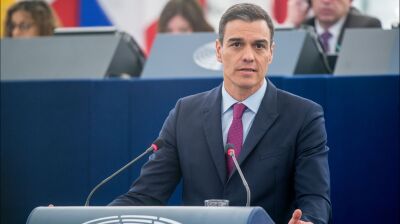
Pedro Sanchez at EU Parliament: file / bne IntelliNewsFacebook
By bnm Gulf bureau April 19, 2026

Spanish Prime Minister Pedro Sanchez said Spain will formally request the European Union suspend its association agreement with Israel at a meeting of EU foreign ministers on April 21 in Luxembourg, El Pais reported on April 19.

"A government that violates international law or the principles of the EU cannot be its partner," Sanchez said at the opening rally of the Andalusian election campaign in Gibraleon, Huelva.

Sanchez made the announcement at the first pre-campaign rally for the regional elections scheduled for May 17, attended by around 2,000 people. The prime minister is backing Socialist candidate Maria Jesus Montero, a former vice prime minister and finance minister, whose party faces a heavy defeat according to polls.

A survey by the Andalusian Studies Centre published earlier in the week gave Montero 21% of the vote and between 26 and 27 seats, below the 30 seats the party won in 2022, which was the Socialists' worst result in the region. The same poll rated Montero as the lowest-scoring leader of all candidates at 3.7 out of 10.

The Spanish government has been among the most vocal European critics of Israel's conduct in Gaza. Madrid recognised Palestine as a state in May 2024 alongside Ireland and Norway and has repeatedly called for the EU-Israel Association Agreement, which provides preferential trade access, to be reviewed on human rights grounds.

Sanchez drew on his anti-war messaging during the rally. "We are friends of the Israeli people, but we do not agree with their government," he said.

The prime minister accused Spain's opposition People's Party (PP) and far-right Vox of blocking measures on housing access, aid for working classes dealing with the impact of the war, minimum wage increases and pension revaluations. He repeated a pledge from summer 2024 to add €25bn ($28.4bn) to Spain's pension reserve fund by 2027.

Montero told the rally that if elected, no patient would wait more than 80 days for a medical test under her administration. She pledged to build 10,000 homes and facilitate access to them. The candidate said recent delays of more than a year in breast cancer screening diagnoses in Andalusia amounted to "the greatest negligence of a health system in this country."

Gibraleon is one of the towns where the Socialists retain an absolute majority in what was historically a party stronghold in southern Spain.

Spain recently reopened its embassy in Tehran as relations between the two continue to grow amid the ongoing fued with Israel and the US which backs Prime Minister Benjamin Netanyahu's campaigns in Gaza, Syria, Lebanon and Iran, IntelliNews previously reported. 


Cuba’s dilemma: Reform and overcome the crisis or collapse


La Joven Cuba graphic

First published in Spanish at La Joven Cuba. Translation by LINKS International Journal of Socialist Renewal.

There is no doubt that Cuba is facing one of the most perilous, if not the most perilous, crossroads in its history. The future of the nation as we know it, with all its virtues and flaws, its strengths and weaknesses, is at stake.

After what happened in Caracas on January 3 and the publication of United States President Donald Trump’s Executive Order on January 19, the traditional enemies of the Cuban nation hope to achieve their goals more forcibly than ever before.

Taking advantage of the current critical situation in Cuba, the US government is trying to wipe the slate clean of the past 67 years of Cuban history.

If that were to happen, we Cubans would lose all possibility of self-determination. The centuries-old emancipatory aspirations of our most eminent heroes would collapse. Cuba would never again be the nation that José Martí, Carlos Manuel de Céspedes, Ignacio Agramonte, Ana Betancourt, Mariana Grajales, Antonio Maceo, Gómez, Marta Abreu, Julio Antonio Mella, Antonio Guiteras, etc dreamed of.

Meanwhile, the country is experiencing a polycrisis resulting from the confluence of two distinct but linked phenomena. On the one hand Cuba has faced 64 years of economic warfare unleashed by the US in 1962, following the logic set out in the Mallory Memorandum of April 1960 that applying economic sanctions against the Cuban people would produce “hunger, desperation, and the overthrow of the government,” On the other hand, over the past eight years the Cuban government’s economic policies have been beset by various deficiencies and shortcomings.

Unfortunately, as in other stages of Cuba’s history, some compatriots support the hostile US policy toward our nation in the mistaken belief that our salvation and well-being lie in accepting subordination to a foreign state.

They forget all of Martí’s warnings and Cuba’s 57 years of submission to the United States. That subordination did not turn us into a prosperous country, notwithstanding the effort to promote visions of a luminous Havana that contrasted with the poverty and inequality in the rest of the country.

Other compatriots are so overwhelmed by the difficulties of recent years that they go so far as to deny the real achievements of the revolutionary project in its first stage. Their reasoning is naive: “The Americans need to come and fix this.”

Every day we hear that fateful phrase more and more often in our cities’ streets.

Finally, as often happens in other countries and contexts, other compatriots cling to a past that is not going to return. They go so far as to oppose an axiom that Fidel Castro himself defended: that we must change everything that needs to be changed.

The convergence of these three trends condemns the country to something Raúl Castro warned us about more than 15 years ago. If we do not fix our own mistakes we will plunge into an abyss. In other words, the inevitable collapse.

In his media address on February 5, President Miguel Díaz-Canel referred to some specific changes, but avoided discussing comprehensive reforms. The representative of the Cuban state used the word “change” four times, referring to issues such as the basic food basket, the import-dependent mentality, the energy matrix, and the way that the party exercises its leadership role. Similarly, the concept of “transformation” was used only five times, also for specific topics: the digital transformation of the country and the development of artificial intelligence (with the country practically without electricity), making the state apparatus more economically sustainable, municipal autonomy, encouraging Cubans living abroad to participate in the country’s development, and the energy transition.

However, at a time when more than ever the country clearly needs far-reaching economic reform and the start of a gradual political reform that makes the system of relations between citizens and the state more efficient and responsive, it is striking that the top leader of the party and the government himself has not addressed the need for reform, an extremely relevant issue in such a critical moment.

This issue has been on the national agenda ever since Fidel Castro himself launched a series of substantive changes in the 1990s by: legalising foreign currency holdings; opening the country to foreign investment; expanding self-employment; and authorising the creation of Basic Units of Agricultural Production.

On the political front, the Revolution’s leader proposed and promoted the 1992 Constitution reform. This included an electoral transformation. Previously, National Assembly of People’s Power representatives had been indirectly selected by Provincial Assembly delegates. The reform set in motion a process whereby Cuban citizens ratified the mandates of those who had been selected.

Subsequently, during his first terms as president, Raúl Castro promoted another wave of reforms, including one that had a political character and was extremely important to Cuban citizens. In 2013, breaking with years of restrictive practices, a new immigration law was adopted.

The struggle between supporters and opponents of reforms that is taking place in Cuba today has been bluntly addressed in these pages by my young colleague Rubén Padrón Garriga. In his video “The Counter-Reform” he points out that to refuse to make necessary changes “is to condemn the people to misery.”

Reforms and the current national and international context

The current national and international context is extremely serious. It demonstrates something about which there can be no confusion — the most serious contradiction that we face, as was the case in other historic stages, is the contradiction between the imperial ambitions of certain circles of power in the US and the Cuban people’s desires to have a homeland that is free and sovereign, prosperous and democratic, and just and equitable.

The Trump administration — in which Marco Rubio, a figure consumed by an innate and perverse hatred, plays a decisive role — is prepared to do anything, even military aggression, to achieve the longed-for dream of “regime change”.

For Rubio, his collaborators and a growing number of Cuban emigrants, “regime change” amounts to an unconditional surrender, not only of the government, but also of the Cuban people living on the island.

If Cuba “collapses,” as is widely believed to be inevitable, we would all be subject to US rule. It would be naive to think otherwise.

Trump himself has hinted at what could be done in Cuba and who he is most interested in supporting: “dismantling” the country to provoke a rupture in the national political process for the benefit of the Cubans who make up the majority of the diaspora in the US.

Of course, any promise from Trump is highly uncertain. Just look at the way Cubans are being treated, even those who voted for him in 2024. There are increasing arrests, deportations, and mistreatment, even of those who are already citizens.

Cubans residing in the neighbouring country to the north who supported Trump and Rubio a year ago should reflect on this before continuing to call for an invasion, a naval blockade of oil imports, or a military action of some other kind.

Trump, Rubio and a growing number of Cuban Americans are also convinced that, because of the shortcomings and errors of the Cuban government, the necessary conditions have been created to bring about the “collapse” of Cuba, its economy, and its government. President Trump’s Executive Order is clearly designed to provoke that collapse through energy strangulation. This constitutes an act of war against an entire people who pose no threat to the US.

Therefore, the challenge for Cuba and for Cubans who live here is obvious. It is impossible to remove the blockade or even to soften it. We must overcome it with effective economic policies that transcend our external dependence.

However, one must add another extremely important contradiction to the contradiction that exists between the Cuban people and the imperialist power circles within the US. That is the contradiction that exists within Cuban society between, on the one hand, those who govern the country, and on the other, the citizens who aspire to well-being and prosperity and do not view their rulers as decision-makers who are capable of making the necessary changes.

Those Cubans inside and outside Cuba who believe the issue can be resolved with a complete break and the removal from power of all those currently in government would do well to reflect on what is happening and what could happen, based on what has occurred in other countries that the US has occupied and dominated. Along with the current government there would be an attempt to erase all the positive aspects of the revolutionary process in its early years (universal access to healthcare and education, easier access to housing, etc).

They would impose a “Made in Miami” government on us, one that would only answer to the interests of the US and the Cuban-American right wing in Miami. The result would not be a “first-world capitalism” but something similar to what has happened in other countries that are subservient to Washington. We would wind up with an extractivist system whose benefits would go to foreign companies exploiting our resources, not the Cuban people. The differences between Washington, DC, and San Juan, Puerto Rico are quite striking.

And what about democracy and human rights? Trump has already shown that he does not care about them. And not just in Cuba or Venezuela. He wants to annex Canada and Greenland without consulting their citizens in the slightest.

Resolving the crisis by intensifying the path of reform

Therefore, the only path forward for us Cubans who live on the island is to do everything that we can to ensure the Cuban economy, which has been declining for several years, recovers and begins to develop so that our citizens can enjoy the decent life they so rightfully deserve. And that depends exclusively on the highest authorities in the country. Not on the provinces, not on the municipalities, and not on the average Cuban.

The demand for reforms, which is primarily economic but also political, is a natural consequence of the times that we are living in. This is especially true when we see on the National Television News that our leaders, with a few exceptions, continue to repeat the old formulas. Not only do they refuse to change, they also refuse to clearly recognise the numerous mistakes that they have made.

The statistics are compelling. The country’s GDP, volume of exports, and productivity continue to decline, while social indicators such as infant mortality and the average age of the population continue to rise due to low fertility and the growing emigration of young people of working age.

Against the backdrop of these two contradictions, Cuba is embroiled in a bitter struggle between those who, as citizens and even as rank-and-file party members, consider that it is essential to deepen the process of reforms, and those in power who are postponing changing everything that needs to be changed, hiding behind the slogan of “we are continuity.” The latter group have held sway and maintained control of power, including the mass media.

In these cases, those who defend the status quo often take advantage of the supremacy of their antiquated speech in state media, particularly television.

They reject and stigmatise anyone who thinks differently and proposes changing everything that needs changing. They defame and vilify them with the most implausible accusations. The tone of these assertions is harsh, sectarian and oppressive.

There is nothing new in these accusations. They have been seen before, such as in 2016 when, for example, a campaign was waged against so-called “centrism”.

But now there is an additional problem. It is the critical nature of the moment. These are not times for division, but for unity and growth. These are not times to plot against patriotic Cubans simply because they hold a different opinion.

The solid arguments of Cuban specialists with the highest national and international prestige on the need for reforms are being met with arguments that are difficult to sustain in serious academic debate.

As on other occasions, regarding the specific issue of reforms, the essay “Reform or Revolution” by the courageous German-Polish leader Rosa Luxemburg is being cited out of context. It is superficial to argue that this debate can be generalised beyond its specific content, as if our current situation were the same as the specific dilemma that was addressed in that text, which resulted from the internal debate within German social democracy in the last decade of the 19th century.

As is well known, that debate concerned the Erfurt Program and the best strategy for overthrowing capitalism and building socialism in Germany. In other words, the discussion centred on the best strategy for a socialist or social-democratic party to take power and on the radical nature of the path that such a party should follow once in power to overcome capitalism.

But Luxemburg’s oft-cited conclusions have nothing to do with our specific situation and debate today, namely whether the current Cuban socialist system needs reforms. The aim is to come up with proposals to change everything that needs to be changed so that Cuban socialism can achieve its intended goal: a prosperous, sustainable, just and equitable society.

It is clear that the current policies have not been successful in this regard.

A better approach to the meaning of reforms within a socialist system may be that of Atilio Borón, an academic who is well known in Cuba. In 2008, referring specifically to the Cuban and Venezuelan experiences within the concept of 21st century socialism, he stated that:

The absurdity of anathematising any reform as a heresy or a betrayal of socialism — understood as an unalterable dogma not only in terms of principles, which is correct, but also in terms of historical projects, which is wrong — is obvious, because it would mean the consecration of a suicidal immobility, the denial of the capacity for self-correction of errors and a renunciation of collective learning, conditions that are essential for the permanent improvement of socialism.

What has damaged the Cuban economy most is not the reform approved 15 years ago, as its opponents argue, but rather the failure to have applied it consistently and deliberately. There are many examples: the inexplicable delay in implementing the “re-ordering”, that is, the monetary and exchange rate unification, which was originally scheduled for 2016 but postponed until 2020, or the current surprising delay in adopting a law governing businesses, to name just two.

Cuban academics from different generations and professions have been active, subjecting the country’s reality to serious and objective analysis. They do so without resorting to slogans or subterfuges that attempt to sugarcoat the multifaceted crisis that we have been experiencing. They have been doing this in institutional spaces, such as the Economic Society of Friends of the Country, the Centre for Studies of the Cuban Economy, and the “Last Thursdays” forums organised by the Temas journal. They have been presenting their analyses publicly, in full view of the citizenry.

Acting in this way, they have been fulfilling an obligation that Julio Carranza explained more than 18 years ago:

Scientists and scientific institutions have a public service responsibility. This consists of communicating specialised information and analysis directly to society; not as a political proposal, but as well-founded interpretations that contribute to raising the cultural level and to general knowledge on different subjects.

Among the opponents of reform, an ossified view of orthodox Marxism prevails. This view predominated in the Soviet Union for more than 60 years and prevented timely reforms. As a result, by the time the proponents of reform finally managed to move in that direction, starting in 1985, it was too late. The economic stagnation resulting from the ossification and sclerosis of Marxist thought had undermined the foundations of socialism in the Soviet Union.

The paths taken by the People’s Republic of China and the Socialist Republic of Vietnam were quite different. In both countries reformist factions within their respective Communist parties succeeded in implementing transformations that opened their economies to the realities of the market. The evidence of the success of their reforms is obvious. In both countries there was no hesitation in undertaking reforms with the utmost seriousness and depth. In both countries the people now enjoy the benefits of prosperous and resilient economies.

Cuba must find the road toward its own reforms. Otherwise, all of us will run the risk of suffering an unacceptable setback that we do not deserve after so much sacrifice.

Carlos Alzugaray Treto is a former senior Cuban diplomat and professor. Now retired, he is a co-coordinator of La Joven Cuba's Advisory Board.