Saturday, May 30, 2026


US Adds Sanctions on Tankers and Iranian Oil Awaiting Trump’s Decision
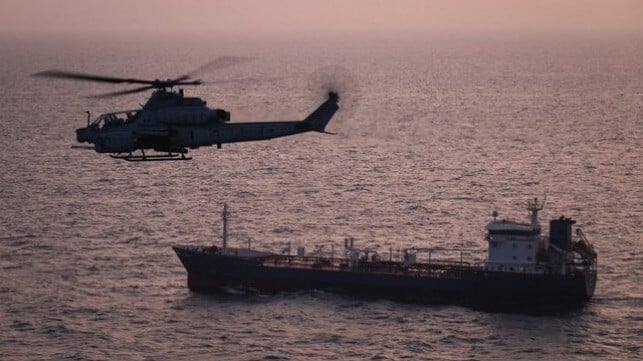
US monitoring product tanker near Iran
U.S. forces continue to press the blockade while talks are reported to be near a conclusion (CENTCOM)

Published May 29, 2026 3:15 PM by The Maritime Executive


The United States Treasury and Department of State continued with their efforts of “maximum pressure” with sanctions on Iran as the decision on the new ceasefire to end the war was reportedly near. The United States has been increasing the financial pressure through sanctions and the blockade in an effort to bring Iran to the negotiations and win favorable terms.

Donald Trump said he would be meeting with his advisers on Friday to review the status of the agreement. They said he would be making a “final determination,” although the Iranian said terms have not yet been reached.

U.S. forces continue to enforce the blockade against Iran. CENTCOM said as of May 29, a total of 115 commercial vessels have been redirected to “ensure no commerce enters or leaves Iranian ports.” TankerTrackers.com said on Wednesday that it calculated that “There are close to 60 million barrels of Iranian crude oil trapped by the U.S. Navy blockade. That is nearly $6 billion in oil revenue that currently is not reaching Tehran.”

The Department of State on Thursday reported it was increasing the sanctions to reduce the revenue that the Iranian regime receives. It said it was adding eight tankers and the companies involved in their operations, as well as three energy traders. Concurrently, Treasury reported it was sanctioning an oil sales network that facilitated the movement of tens of millions of barrels of Iranian oil. They asserted the funds were being funneled to the IRGC, Iran’s Armed Forces General Staff, and its military apparatus.

The sanctions were extended to ship managers based in Hong Kong and the United Arab Emirates, and a shipping company registered in the Marshall Islands. The tankers included both product and crude oil vessels, and they ranged from registries in Palau to the Marshall Islands, Panama, Comoros, Cameroon, and San Marino.

The NGO UANI (United Against Nuclear Iran) tracks around 200 tankers that have been sanctioned since 2020. It says that about one-in-three of the nearly 600 vessels it has tracked over the past six years involved in the Iranian oil trade.

The U.S. State Department also imposed sanctions on three traders of Iranian-origin petrochemical products. It included a trader based in Qatar, a Singapore-based company that it says was involved in the export of over $900 thousand worth of Iranian petrochemical products, and an India-based trader that it says imported approximately $54.6 million of Iranian petrochemical products. 

Iran is believed to be pushing not only for the end of the U.S. blockade but also for an end to these sanction programs. 

Trump, on social media on Friday, listed three conditions, Iran’s nuclear program, the opening of the Strait of Hormuz, and all sea mines destroyed. Reports indicate the ceasefire would be for 60 days, during which time negotiations would proceed on the enriched uranium and to finalize the terms of the agreement.


Trump Says U.S. Will End Naval Blockade of Iran
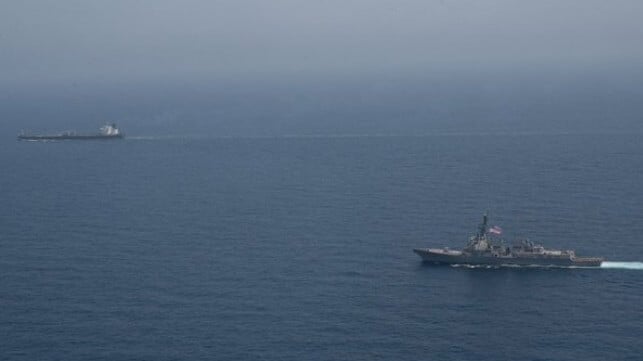
US destroyer tracking tanker
The U.S. has redirected 115 ships in the past six weeks during the blockade (CENTCOM)

Published May 29, 2026 4:14 PM by The Maritime Executive


Listing out his conditions for the ceasefire agreement on social media on Friday, Donald Trump said the U.S. would lift its naval blockade. He did not give a timeline, but said ships caught in the region may start the process of “heading home.”

Roughly a quarter of the large oil tankers trapped inside the Persian Gulf at the outbreak of the Iran war have managed to slip out, reports Bloomberg. Based on AIS signals and other data, it believes 29 of the 109 supertankers stuck in the Persian Gulf have either slipped out or gained permission from the Iranians for the transit.

However, traffic through the Strait has continued at a trickle, with even fewer vessels willing to chance a return trip back into the Persian Gulf due to the fears they could become caught. On Friday, the International Energy Agency, International Monetary Fund, World Bank Group, and World Trade Organization issued a statement warning of the lasting impact. In addition to a rapid drawdown of the world’s oil reserves, they warned that the continued disruption was having broad impacts on food and other critical supply chains.

Shortly before Trump’s statement, CENTCOM provided its daily update, reporting that a total of 115 commercial vessels have been redirected to ensure no commerce enters or leaves Iranian ports. While it no longer cites the four vessels that were disabled, it said the enforcement was ongoing. The number of vessels rose by a few each day.

“Ships caught in the Strait due to our amazing and unprecedented naval blockade, which will now be lifted, may start the process of ‘heading home!’ Say HELLO to your wives, husbands, parents, and families…” wrote Trump.

The lifting of the blockade, Trump said, was part of the efforts to fully reopen the Strait of Hormuz. He asserted that Iran had to immediately open the Strait with no tolls, for unrestricted shipping traffic in both directions. He also said the U.S. had already detonated most of the mines, but made another condition that Iran would complete the immediate removal and/or detonation of any mines that are left, while asserting, “which will not be many.”

The key conditions are that Iran will never have a nuclear weapon or bomb, and he asserted the U.S. would “unearth” the enriched uranium, which is buried deep underground in the collapsed structures bombed last year by the United States. He said only the U.S. and China have the mechanical capability to unearth the uranium. He said the International Atomic Energy Agency would also be involved, and the uranium destroyed. He made no mention of Iran’s enrichment capabilities.

No timeline was provided, but he said that he was heading into the Situation Room to meet with advisers. He said he would be making a “final determination.” Trump has not commented, but reports said he left the meeting after two hours and had not reached a decision.

Iran has yet to make a public statement on the terms or if it has agreed to the terms. Hours earlier, a military adviser to Iran’s Supreme Leader Mojtaba Khamenei warned Iran would launch attacks if the U.S. naval blockade “continues beyond a certain timeframe.

Experts agree that Iran’s exports of oil have largely been brought to a halt. TankerTrackers.com on Wednesday estimated that “There are close to 60 million barrels of Iranian crude oil trapped by the U.S. Navy blockade. That is nearly $6 billion in oil revenue that currently is not reaching Tehran.”

Iran has repeatedly said that any agreement would have to include a pullback of U.S. forces. The U.S. currently has approximately 20 warships in the region to maintain the line east of the Strait of Hormuz to enforce the blockade that Trump announced in mid-April.

 

Victims’ Families Settle on the Eve of the Dali Civil Trial

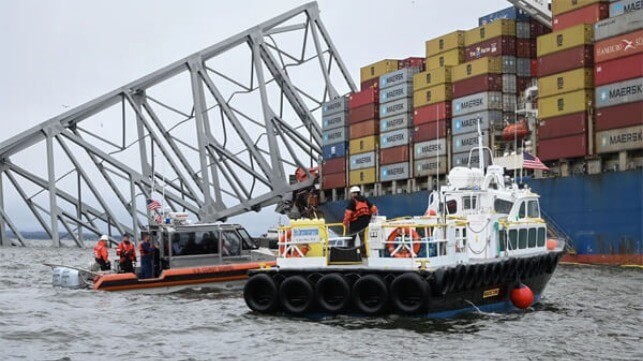
dive teams at Dali wreckage
Dive teams recovered the bodies of the six victims while one person was rescued after the bridge collapsed

Published May 29, 2026 5:44 PM by The Maritime Executive


With the civil trial due to start on Monday, June 1, additional settlements were reached with the families of those killed when the containership Dali destroyed the Baltimore roadway bridge, as well as some of the other plaintiffs. Experts have said the trial, which could run three weeks, could be one of the most consequential in U.S. maritime law.

Shortly after the allision in which the containership Dali blacked out and struck the Francis Scott Key Bridge in March 2024, the vessel’s owners, Grace Ocean, and its operators, Synergy Marine, filed with the U.S. District Court to invoke an 1850s law that would let the companies limit their liability to the value of the ship and its cargo. The law has been invoked in historic cases such as the loss of the Atlantic liner Titanic in 1912, and more recently, it was invoked with the Deepwater Horizon. Transocean, the owner of the Deepwater Horizon rig, attempted to invoke the 1851 Limitation of Liability Act to limit its payout to the value of the sunken rig. It attempted to limit the liability to around $27 million, but losing in the courts, it agreed to settle for $1.4 billion in criminal and civil fines to settle its liability.

Grace Ocean and Synergy have asked the court to decide if they can limit the liabilities to just over $40 million. In the first phase of the case, which starts next week in a bench trial, Judge James Bredar will hear the arguments on limitation. The second phase would move on to the individual claims.

Lawyers for five of the six victims of the disaster announced on Thursday, however, that they have reached a settlement and will withdraw from the case. They called it bittersweet, noting that the families still have to deal with the losses, but they could now move on. Six roadworkers died when the bridge collapsed, and a seventh was rescued from the water. One family had previously reached a settlement, and the other five reported they too have come to terms.

In addition to the victims’ families, the Baltimore Banner news outlet reports the road crew’s employer, Brawner Builders, has agreed to a settlement, as has Baltimore Gas and Electric. Earlier, the State of Maryland also reported it had settled for a record $2.25 billion.

Those still pursuing claims in the court include the one survivor. The City of Baltimore and the County also still have claims, as do many local businesses that claimed financial losses from the destruction of the bridge and the closure of the harbor.

The Baltimore Banner reports that five subpoenas were issued to compel individuals to appear in court, but it notes that the crew has invoked its right against self-incrimination. Several crewmembers have been held in Baltimore for more than two years waiting for the trial. Some crewmembers and employees of Synergy Marine also reportedly used their rights during the deposition phase. Synergy Marine has said, based on the criminal charges that were unsealed weeks ago, crewmembers and employees will not come to the United States, fearing they too could be detained or face the potential of additional criminal charges. It said it was unlikely they would testify via video, but it can use the depositions in the trial.

The trial is likely to involve mostly expert witnesses. The court has ruled that the National Transportation Safety Board report is inadmissible, but evidence collected during the investigation can be cited

The case and its outcome will be closely followed for its potential impact on future maritime liability cases. There is the potential that there could be some more settlements before the start of the trial, and still Synergy Marine and one of its technical superintendents have been indicted on criminal charges. In a separate case, the companies are pursuing claims against HD Hyundai Heavy Industries, claiming manufacturing defects in the vessel, which was built in 2015.


New Zealand Funds Upgrades for Aging Navy Ships Ahead of Fleet Renewal

HMNZS Te Kaha
New Zealand looks to add a decade to the service of its two primary warships (NZ Defence Force)

Published May 29, 2026 5:56 PM by The Maritime Executive


New Zealand is planning to extend the service life of three aging navy ships that have been the cornerstone of the country’s maritime combat capability. The government says the effort will ensure the navy continues to be well equipped even as plans for fleet renewal are being advanced.

In its 2026 budget, the government has allocated NZ$1.5 billion ($924.6 million) for defense funding, a significant portion of which will be spent on drone systems, critical ship maintenance, and work to replace an aging naval fleet. In the spending outline, the government has allocated an additional NZ$880 million ($516.8 million) for operating funding and $700 million ($411 million) of new capital funding for activities and operations, as well as priority projects with a strong focus on maritime security.

A major focus will involve undertaking critical maintenance work on the Navy’s two aging Anzac-class frigates, HMNZS Te Kaha and HMNZS Te Mana, as well as the multi-role vessel HMNZS Canterbury, in order to extend their lifespan until they are replaced. Commissioned in 1997 and 1999, respectively, Te Kaha and Te Mana have been the main combat-capable ships for the New Zealand Navy, playing vital roles in protecting the country, its exports, and maritime resources. Originally designed to have a lifespan of 30 years, the Navy has carried out technical studies that have indicated it is possible to extend the frigates’ lives until the mid-2030s.

Apart from the two frigates, New Zealand also intends to extend the service life of the 2007-built Canterbury. The 131-meter (430-foot) multi-role vessel provides sealift capabilities for the transport and deployment of equipment, vehicles, and personnel for the Navy. Built by Merwede Shipyards in the Netherlands, the vessel is also capable of transferring cargo and personnel ashore in benign conditions when port facilities are not available.


The nearly 20-year-old HMNZS Canterbury is also slated for upgrades (NZ Defence Force)


“New Zealand’s prosperity and security depend on the sea. For many years, New Zealand’s geographic distance has been seen as a shield from instability elsewhere in the world,” said Chris Penk, NZ Defense Minister. He added that recent events have served as a reminder of how quickly disruptions to international shipping routes can affect economies and supply chains across the globe. “The oceans are not a barrier to danger, but a vital national interest that must be actively secured.”

New Zealand is allocating funds to extend the life service of three navy ships at a time when it is progressing with its maritime fleet renewal program, which is part of the Defense Capability Plan.

On this, the country has begun discussions with the Royal Australian Navy and the United Kingdom’s Royal Navy, which are expected to inform the next stage for potential frigate replacement. Sometime next year, New Zealand intends to decide on whether to settle for Japanese Mogami-class frigates that were selected by Australia or the UK’s Type 31 frigates in its fleet renewal program.

The future fleet, which is expected to be built over the 2029-2039 period, will support a broad range of functions, including maritime combat, patrol and security, sealift, hydrography and diving operations, assistance to other government agencies, and support for humanitarian and disaster response.

“In the interim, we are continuing to ensure the current frigates remain operational. We know this will be a significant decision for New Zealand and we are determined to work with our partners, focus on what is in our best interests and get it right,” said Penk early this month.


First Ethanol-Methanol Bunkering Operation Completed in Rotterdam

feeder bunkering ethanol-methanol blend
The first bunkering with a pre-blended mix of ethanol-methanol took place in Rotterdam (X-Press Feeders/METHANAVE)

Published May 29, 2026 6:15 PM by The Maritime Executive


In a closely watched development that is being called a groundbreaking bunkering, the Port of Rotterdam recently hosted the first ethanol-methanol operation. It comes as there is growing interest in the maritime sector of ethanol as a possible easy addition to alternative fuels.

Singapore-based shipping company X-Press Feeders partnered with consultancy firm METHANAVE to trial the bunkering of the blended fuel on the container ship Eco Levant. The bunkering was conducted at the Port of Rotterdam, marking the first time that a bunker vessel supplied ethanol to a seagoing vessel. Maersk has also reported that it was trying ethanol on its pioneering methanol dual-fuel feeder ship Laura Maersk, and engine manufacturers WinGD and Everllence reported progress adapting engines to ethanol.

Operated by X-Press Feeders, the 148-meter (485-foot) Eco Levant was built in 2024 and sails under the flag of France. The dual-fuel vessel was designed to operate on green methanol, thus enabling her to reduce greenhouse gas (GHG) emissions by up to 65 percent. The vessel was ideal for the trial that involved delivering and bunkering a marine fuel blend consisting of 10 percent ethanol and 90 percent methanol under controlled operating conditions.

While methanol bunkering is established in the commercial shipping industry, ethanol and methanol have, in the past, been bunkered separately on the seagoing vessel. In the trial bunkering of the blended fuel on Eco Levant, both fuels were delivered separately by a single inland bunker vessel, with the batches mixed (blended) on board the receiving vessel.

The successful bunkering of the blended fuel is a critical milestone for X-Press Feeders, which is pursuing ambitious decarbonization goals targeting net-zero by 2050. Part of this strategy has been exploring and evaluating practical low-emission fuel solutions that can support greater fuel flexibility and long-term decarbonization. The fact that ethanol has the ability to reduce GHG emissions by as much as 90 percent compared with heavy fuel oil has seen the alternative fuel start to gain attention in the shipping industry.

“Maritime fuel pathways are continuing to evolve. At X-Press Feeders, we believe it’s essential to continue evaluating and advancing viable solutions that can support the long term decarbonization of our fleet,” said Shivendu Gadkar, Head of Fleet Efficiency and Performance at X-Press Feeders.

Rotterdam, Europe’s largest port, has strategically positioned itself as a hub for alternative fuels. Today, the port ranks as the world’s second-largest bunker facility, with approximately 10 million tonnes of fuel bunkered annually. Its commitment to various alternative fuels has been evident following the successful ammonia bunkering pilot that was conducted last year.

“This milestone demonstrates that Rotterdam is ready for a wide range of alternative fuels. Together with all parties in the port, we aim to enable the bunkering of all alternative, low-carbon fuels in the future, promoting greater sustainability for international shipping,” said Matthijs van Doorn, Port of Rotterdam Authority commercial director.

With the availability of ethanol and its proven ability to be an additive in fuels, stakeholders will be following the Eco Levant trial. It will further enable the industry to assess bunkering procedures, fuel handling processes, and onboard operational performance associated with blended alcohol fuels under commercial operating conditions.


Vard Secures Norway’s Highest Value Order to Build Deep-Sea Research Vessel

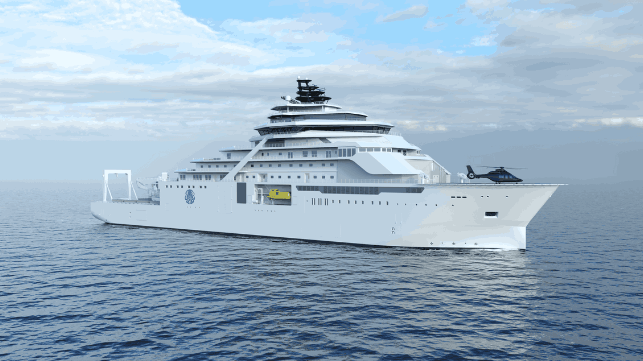
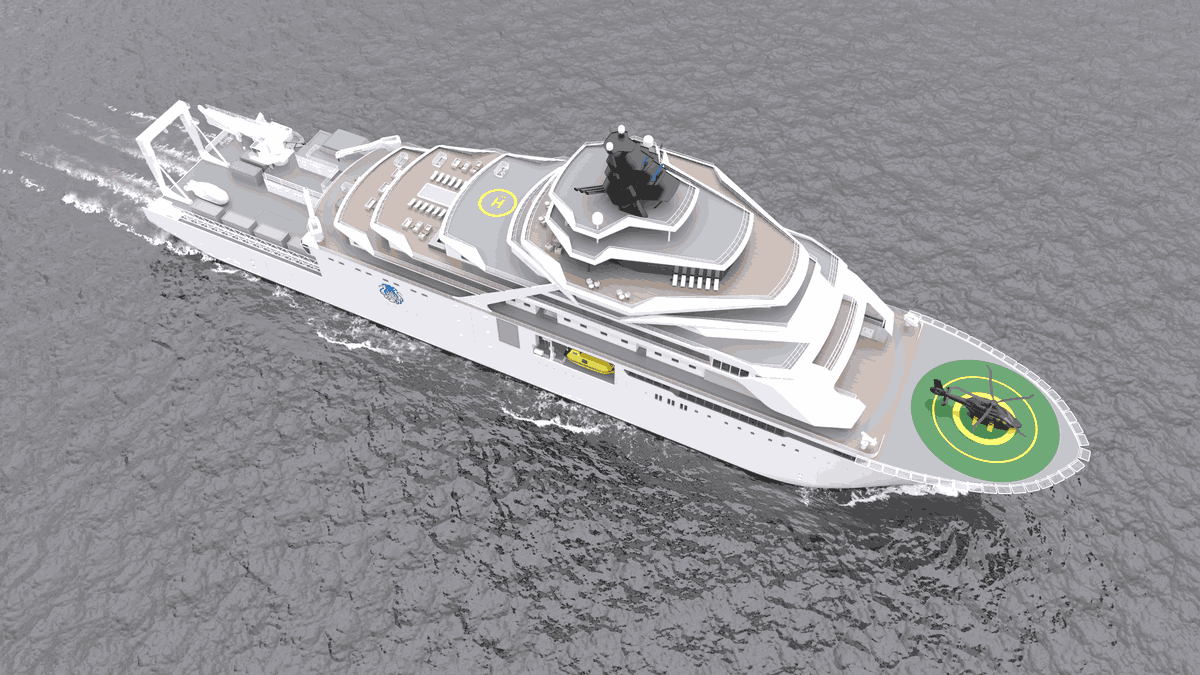
research vessel rendering
Vard reports the order for the research vessel is the highest value single-ship contract for the company and for Norwegian shipbuilders (Vard)

Published May 29, 2026 6:55 PM by The Maritime Executive


Norwegian shipbuilder Vard, a subsidiary of the Fincantieri Group, signed its highest value single ship contract and the largest order of its kind for any Norwegian shipyard. Valued at nearly €700 million (US$816 million), the contract is for the design and construction of a deep-sea research vessel for US-based research organization Inkfish.

The vessel, project-named RV11000, is based on a Vard design for specialized research vessels. Developed by Vard Design in Ã…lesund, Norway, in close collaboration with Inkfish, RV11000 will be a tailor-made platform designed for seafloor mapping, coring and sampling, submarine operations, and ROV activities at depths of up to 11,000 meters.

The ship will enable a wide range of deep-ocean missions, including the deployment and support of submersibles, ROVs and autonomous vehicles. The new research vessel will be 162 meters (531 feet) in length and is scheduled for delivery in Q1 2030. It represents a significant advancement in capability, building on the engineering and design foundations established with the RV6000 vessel, which Vard contracted in 2025 and is currently building for Inkfish. 

“The project combines scale, technological complexity, and scientific ambition, reflecting our ability to design and deliver next-generation solutions for deep-sea exploration,” said Pierroberto Folgiero, CEO and Managing Director of Fincantieri. “It also underlines the strategic importance of the underwater domain for Fincantieri, where we continue to invest and innovate, leveraging our distinctive capabilities to support increasingly complex missions, from scientific research to the monitoring and protection of critical underwater infrastructure.”


The vessel will feature one of the largest battery installations ever fitted on a ship, enabling up to 12 hours of silent operations for scientific missions, alongside a highly advanced propulsion system combining DC technology with battery hybrid solutions. The hull will be optimized for high-performance seafloor mapping, ensuring excellent station-keeping and enhanced operational efficiency, while advanced stabilizers will minimize motion and accelerations.

The unit will also be certified in accordance with the latest IACS cybersecurity requirements, ensuring a high level of resilience and protection of critical onboard systems against evolving digital threats.

Onboard facilities will include state-of-the-art laboratories, workshops, and scientific spaces, as well as high-level accommodation for up to 130 crew members and researchers, designed to ensure optimal comfort and enable the highest standards of scientific work.

Vard will manage the project, including design, hull construction, outfitting, integration, and commissioning. The hull will be built at Vard Shipyards Romania in Tulcea, while outfitting, commissioning, and delivery will be carried out at one of the group’s shipyards in Norway.


Silversea Cruise Ship Rescues Solo Sailor in North Pacific

Silver Whisper
Mark Matthes / Facebook

Published May 28, 2026 8:23 PM by The Maritime Executive


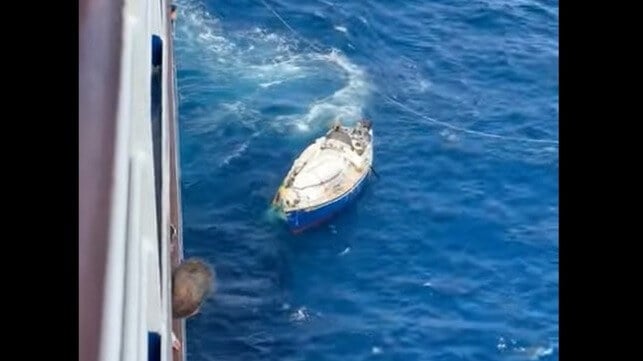
On the tail end of a Pacific voyage to Tahiti and Hawaii, the cruise ship Silver Whisper had the opportunity to save a solo sailor whose yacht had been dismasted off the Pacific coast. 

On Tuesday, the crew of the Silver Whisper got a distress call from the Canadian-flagged sailboat April Alice. The small yacht was dismasted and disabled at a position about 420 nautical miles off the coast of Oregon, and the sole crewmember had sustained a shoulder injury. The casualty was too far from shore for a U.S. Coast Guard helicopter rescue, and Silver Whisper was the vessel best placed to respond. The master diverted slightly northward to meet up with the yacht, arriving about seven hours later. 

On arrival, the crew found that the vessel in distress was in rough shape, lacking its mast and with rigging in disarray. In a typically rough North Pacific swell, the master of Silver Whisper maneuvered carefully alongside, and the crew passed a line across to the April Alice to secure the sailboat; however, the line parted, and the cruise ship's captain had to repeat the evolution. This time it was successful, and the survivor came aboard. He was provided a medical evaluation and initial treatment for his shoulder injury. 

About one hour after beginning the rescue operation, Silver Whisper got under way once more, leaving the wreck of the sailboat behind. The cruise ship returned to her home port of Vancouver on schedule on Thursday. 

Passenger Jeff Hall told the Vancouver Sun that the captain had instructed guests to return to their cabins during the rescue due to rough conditions and the need to secure the ship's stabilizers; most complied. 

"They missed one of the best parts of the cruise. We all - except for those who returned to their cabins - had a bird's-eye view of the rescue," Hall told the outlet.


Two Crew Injured as Russia Continues Attacks on Merchant Ships Near Odesa

cargo ship struck by Russian drone
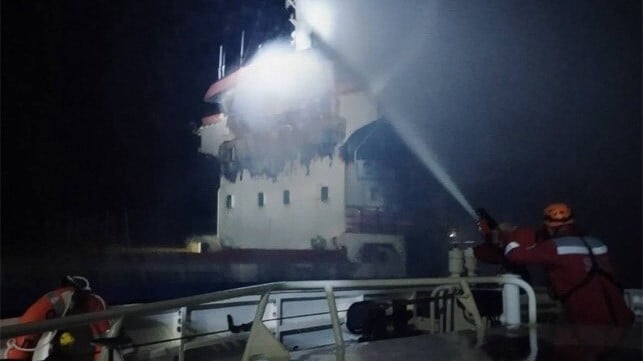
Ukraine aided in fighting the fire after the ship was struck by a Russian drone (Ukrainian Navy)

Published May 29, 2026 2:19 PM by The Maritime Executive


A small, Turkish-owned cargo ship was set on fire, and two crewmembers sustained minor injuries as Russia continues to attack merchant ships sailing near Ukraine. Turkey’s Ministry of Foreign Affairs responded, repeating its concerns regarding the risk and threats posed by the recent escalation.

The general cargo ship Ant (5,095 dwt) had sailed from the Odesa area and was heading to Turkey with an unspecified dry cargo. The ship was struck off the coast of Ukraine overnight on May 28.

The Ukrainian Navy responded and helped to evacuate two crewmembers who the Turkish authorities reported sustained minor injuries. Turkey’s Consulate General in Odesa was monitoring the care for the crew. 

The  Ukrainians aided the crew in containing the fire and putting it out. Pictures provided by the Ukrainian Navy showed the bridge and upper level of the deckhouse damaged by the fire.

Built in 2006, the vessel sails under the flag of Vanuatu and appears to have been regularly operating in the Black Sea and making port calls in Ukraine. It is also not the first time the ship has been in trouble. Three years ago, the Hellenic Coast Guard aided the ship when it was holed in a collision with another cargo ship in the eastern Aegean near Turkey.


Ukrainian officials said the Ant was being towed for repairs (Ukrainian Navy)


Vice Prime Minister Oleksiy Kuleba said the attack was one of three on merchant ships overnight. He did not provide details on the other two ships, but said the Ant was being towed for repairs.

The attacks on the ships were reported to be part of a larger wave of Russian attacks across Ukraine overnight. Ukraine’s Air Force was reporting that a total of 232 drones and one ballistic missile were fired, targeting 14 locations in Ukraine. It said that 217 of the drones were shot down, while there were reports that at least two people were killed and 25 were injured across Ukraine.

“We reiterate our warning to all parties to refrain from steps that could lead to an uncontrolled escalation of the conflict,” Turkey’s Ministry of Foreign Affairs said in its statement. It repeated calls for ensuring the safety of navigation for civilian vessels in the Black Sea.

Yesterday, Ukraine was suspected of drone attacks on three empty shadow fleet tankers that had entered the Black Sea. One of the vessels was reported damaged, while the report said at least two other drones failed to detonate while aimed at tankers anchored off the coast of Turkey.

NATO also issued a strong condemnation after a Russian drone strayed into Romania and hit the roof of an apartment building. It sparked a fire, and two people were injured. Romanian officials called it a “serious and irresponsible escalation” by Russia. Romania immediately requested a fast delivery of anti-drone systems from NATO.

How effective are Ukraine’s drone strikes at destroying Russian refinery production?

How effective are Ukraine’s drone strikes at destroying Russian refinery production?
Ukraine has been incessantly attacking Russian refineries with long-range drones, but reports on how effective these attacks are paint a mixed picture. / bne IntelliNewsFacebook
By Ben Aris in Berlin May 29, 2026

Wrangling over how effective Ukraine’s drone strikes of Russian refineries has broken out amidst conflicting reports of just how much damage is being done to Russia’s key oil infrastructure.

Since last summer, Ukraine has stepped up its campaign against Russia’s cash cow industry in an effort to cut the Kremlin off from one of its main sources of income. This year Ukraine is firing more drones at Russia than Russia fires at Ukraine for the first time ever.

As the campaign reached a crescendo last month with sustained attacks on Russia’s Baltic Sea oil terminals at Primorsk and Ust-Luga that handle a fifth of Russia’s oil traffic, Reuters reported that Russia’s oil exports were down by 40%.

However, later reports based on government figures said that while production at refineries was down by some 10-15%, exports had been largely unaffected and the damage at the two ports was largely superficial and had been repaired.

Ukraine has ramped up its drone production and is on course to make some 7mn drones this year, according to Ukrainian President Volodymyr Zelenskiy. At the same time it has introduced a new class of long-range drones that can reach deep into Russia’s interior to hit the far flung oil refineries scattered across the country. At issue is to fly the thousands of kilometres needed to reach their targets, the payload of the drones is restricted by fuel consumption concerns. Consequently, while the drones can do a lot of damage, typically causing major fires, the explosive package is not enough to destroy a refinery. As one analyst put it: “There is a big difference between hitting a refinery six times with 50kg of explosive and hitting it once with 300kg.”

Conflicting reports

On May 20 Reuters reported “Exclusive: Oil refining at a standstill in central Russia after Ukrainian drone strikes, sources say,” that key refineries at Kirishi, Moscow, Nizhny Novgorod, Ryazan, Yaroslavl, that produce some 30% of Russian petrol and a quarter of its diesel, had all gone offline.

“Virtually all major oil refineries in central Russia ‌have been forced to halt or scale back fuel output following Ukrainian drone attacks in recent days, according to official data and sources,” Reuters reported. “Moscow has already introduced a gasoline exports ban starting ​from April until the end of July.”

The combined capacity of refineries ​that have fully or partially halted operations exceeds 83mn metric ⁠tonnes per year, or around 238,000 tonnes per day. That accounts ​for around one quarter of Russia's total refining capacity, according to Reuters.

However, a follow up report by Russian Forbes reported that the impact of the attacks was a lot less damaging.

“Such losses during the peak fuel season could have been a serious blow to the country's economy, but experts interviewed by Forbes do not believe the damage is that significant. Forbes investigated why gasoline shortages occur on the exchange but not at gas stations, how long it typically takes to restore damaged refineries, and how Belarus can help,” Forbes reported.

There is no doubt that the attacks have reduced the throughput at Russian refineries and as IntelliNews reported, Russia has been forced to turn to Belarus to top up supplies to meet domestic demand. But the imports from Belarus are limited.

Russia's domestic consumption of gasoline runs at over 100,000 tonnes per day, which makes the 17,000 tonnes bought from Belarus in early May a significant share, but not a crisis. "Volumes remain small compared with Russia's daily consumption of over 100,000 tonnes," noted energy expert Sergei Vakulenko. “This is not yet a crisis of supply, but it is a signal of the strain on the system.”

On May 21, the Ministry of Energy said that the domestic motor fuel market in Russia remains stable, and the industry is prepared for seasonal demand growth.

"Currently, the domestic market is sufficiently supplied with light petroleum product reserves, the logistics infrastructure is functioning reliably, and there have been no disruptions in regional supply," the Ministry of Energy stated, without specifying reserve volumes, Forbes reports.

Following a meeting on the fuel market on May 26, Deputy Prime Minister Alexander Novak said that the government's priority remains "the reliable and uninterrupted supply of fuel to domestic consumers in the required quantities" and the need to develop additional response measures in the event of disruptions.

Domestic fuel costs have risen, but only modestly, suggesting the impact of the drone strikes is limited. From May 20 to 26, prices for AI-92 gasoline on the St. Petersburg Exchange rose by 2%, from RUB66,136 to RUB67,443 per tonne, and for AI-95, by 3%, from RUB72,833 to RUB74,954 per ton.

Rather than losing a quarter of its production, expert calculations suggest the volume of unsatisfied orders on May 26 was 41,000 tonnes for AI-92 and 34,000 tonnes for AI-95. And even those shortages could be merely market demand triggered not by physical shortages, but from traders anticipating a surge in demand.

Another factor affecting demand calculation is the possibility that the main suppliers such as Lukoil, Rosneft, and Gazpromneft have stopped selling fuel on the exchange and are instead supplying it to their own gas stations.

Another point of contention is that Reuters’ calculation uses the refineries entire production capacity as a basis for its projection, but experts interviewed by Forbes say that is an exaggeration as even if a refinery is hit, most are still continuing to work albeit at reduced levels. Some facilities can be repaired in a matter of days, while others will require more time, experts say.

"Experience shows that in previous years, there were no attacks on Russian refineries that would have caused damage requiring lengthy repairs," Stanislav Mitrakhovich, an expert at the Financial University and the National Energy Security Fund told Forbes. "I believe that even now, there's no way to disable large refining facilities for long periods, although attacks can reduce production for a short period."

The bottom line is that Russia is not yet suffering from a fuel crisis and any shortfall caused by Ukraine’s attacks can be covered by imports from Belarus for now. Russia consumes over 3mn tonnes of gasoline monthly, according to Maxim Shevyrenkov, head of the Commodity Market Analysis Center at the Institute of Energy and Finance. Belarus is capable of shipping over 200,000 tonnes of gasoline per month, and Belarusian petroleum products are imported into Russia duty-free, Shevyrenkov points out.

A similar investigation by independent Russian outlet Meduza came to similar conclusions: Ukrainian drones are being fired more frequently and penetrating deeper into Russian territory, but Russia’s refineries’ production bounces back quickly.

The main conclusions of Meduza’s investigation included:

  • The frequency and depth of UAF strikes on Russian territory have risen substantially since mid-2025 and have held at a stable level — more than 30 verified attacks per month.
  • There has been no surge in strike intensity in 2026, despite a number of high-profile attacks on Moscow, Tuapse, Perm, and other major cities.
  • Strikes on oil infrastructure represent approximately one-third of Ukraine’s long-range campaign in 2026, consistent with the second half of 2025. Ukraine’s military has likely learned in recent months to target the refinery equipment that is particularly difficult to repair.
  • The average range of UAF strikes against targets deep inside Russia has increased recently: in May, the figure doubled y/y, from 400 kilometers (249 miles) to 800 kilometers (497 miles).
  • This may indicate that Russia’s air defences are being depleted, but we don’t yet have enough data to verify.
  • The UAF’s long-range campaign was most effective in its first phase, in late summer and early fall of 2025, when Russian refineries suffered their greatest capacity losses.
  • By mid-fall of that same year, oil industry operators had adapted — judging by available data — to the more intensive strikes on their facilities, and had learned to repair damaged equipment quickly or draw on spare capacity.

Friday, May 29, 2026

EMBRACING UKRAINIAN FASCISM

RAGOZIN: Melnyk reburial signals ideological shift in Ukraine

RAGOZIN: Melnyk reburial signals ideological shift in Ukraine
Ukrainian President Volodymyr Zelenskiy attended the reburial of Andriy Melnyk, one of the leaders of the Organisation of Ukrainian Nationalists (OUN). / Volodymyr Zelenskiy via XFacebook
By Leonid Ragozin in Riga May 29, 2026

Last week, Ukrainian President Volodymyr Zelenskiy went to the National Military Memorial Cemetery to take part in the reburial of Andriy Melnyk, Adolf Hitler’s ally in World War II and one of the leaders of the Organisation of Ukrainian Nationalists (OUN). Next to Zelenskiy, stood his chief of staff Kyrylo Budanov, who has been overseeing a visible ideological shift in Ukraine since assuming office early this year. 

In a tweet published on the occasion, Budanov wrote that the reburial heralds the creation of the “Pantheon of Prominent Ukrainians”. The choice of Melnyk’s ashes as an object of national veneration sends a clear signal about the direction of that shift.

Over seven years in the presidential seat, Zelenskiy has undergone a remarkable transformation from a dove seeking rapprochement with Russia to a defiant wartime leader and the Kremlin’s sworn enemy. His attitude to Ukraine’s history has changed just as radically.

Soon after he was elected in 2019 on the promise of peace, Zelensky made a point about celebrating May 9, the Soviet Victory Day, by visiting the grave of his grandfather who fought in the Red Army.

This populist gesture was designed to appeal an overwhelming majority of Ukrainians, in both the east and west of the country, whose ancestors fought on the Soviet side in WWII and who gave their votes to the new president. A memo published by Ukraine’s ministry of foreign affairs in October 2014 cites the figure of 7mn residents of Ukraine who fought in the Soviet army during WWII versus only 240-250 thousand who collaborated with the Nazis.

As his 57th Guard Division was pushing the Germans out of Mairupol, Sloviansk and Kramatorsk, lieutenant Semyon Zelenskiy was avenging the deaths of his father (President Zelenskiy’s great-grandfather) and three brothers, all of whom perished in the Holocaust.

Meanwhile, Melnyk was attempting to set up a fascist Ukrainian puppet state in Ukraine with a constitution, authored by his friend Mykola Stsiborsky, which described future Ukraine as “authoritarian and totalitarian state”. In a letter to Hitler in 1941, Melnyk pleaded that anti-Soviet Ukrainians be “allowed to march shoulder to shoulder with the legions of Europe and with our liberator, the German Wermacht”. Meanwhile, his subordinates in Ukraine took part in Jewish pogroms in Bukovyna and assisted the Germans in killing the Jews elsewhere around the country.

Melnyk’s pleas fell on deaf ears in Berlin since Hitler saw Slavs as an inferior race subject to enslavement and extermination. He was interned by the Nazis in a camp for foreign VIPs, who were treated humanely and respectfully, and released in 1944 when Hitler felt Ukrainian fascists could help him stall the Red Army’s onslaught in western Ukraine. Failing to receive guarantees of a pro-Nazi Ukrainian state, Melnyk ended up offering his services to Western allies in the US-occupied zone.

The World Holocaust Remembrance Centre, Yad Vashem, stated that it was deeply troubled by Melnyk’s reburial in Kyiv. “Honouring the leader of a movement [OUN] that supported and collaborated with Nazi Germany during the persecution and murder of millions of Jews undermines the moral integrity essential to Holocaust remembrance,” its press release said.

OUN’s dream Ukraine

Melnyk died in 1964 and was buried in Luxembourg where his remains were lying peacefully until Zelenskiy’s administration decided to repatriate them in May this year. “Colonel Andriy Melnyk returned to a different Ukraine – not the one he had been forced to leave, but the one he had dreamed of,” Zelenskiy said at the reburial ceremony.

Today’s Ukraine is indeed much closer to Melnyk’s ideals than those Zelenskiy’s grandfather was fighting for.

Built in 1974 and topped with the 102m-tall Motherland statue, Kyiv’s WWII History Museum was designed to commemorate Soviet war heroes like Semyon Zelenskiy. In the WWII cult developed under the Ukraine-born Soviet leader Leonid Brezhnev, this was one of the three most sacred sites in the entire Soviet country.

In 2026 however, it housed an exhibition dedicated to the Russian Volunteer Corps (RVC), a military unit formed by fugitive Russian neo-Nazis who believe that today’s Ukraine is much closer to their ideals than Russian President Vladimir Putin’s authoritarian regime. They see Putin’s Russia as a continuation of the Bolshevik internationalist project, citing Putin’s tolerance to mass immigration from Central Asian countries as proof.

In its propaganda and symbols, RVC draws inspiration from Gen. Andrey Vlasov’s Russian Liberation Army which fought on Hitler’s side in WWII. Featuring prominently in the exhibition, RVC’s symbol is called Spayka, best translated as fascia. It was designed in the 1930s by the Russian emigre organisation White Cause which later joined the Russian Fascist Party. 

The exhibition was officially curated by RVC’s khorunzhy (ideological officer), Aleksey Lyovkin. Having served a sentence for racially motivated attacks on migrants in his native Tver in Russia, Lyovkin founded a band called M8L8TH (which translates as Hitler’s Hammer and contains the numerical symbol 88 that stands for Heil Hitler in skinhead jargon) before moving to Ukraine in 2015.

Although it existed in Russian imperial forces, khorunzhy is not an official rank in the Ukrainian army. It originally meant flag-bearer in the Cossack troops, but it resurfaced in the Russo-Ukrainian war as an equivalent of the Soviet politruk, a political officer. 

Officially non-existent in the Ukrainian army, khorunzhy is used as a rank in politically autonomous units that form what its members call the “Azov family” or “movement”. Born out of the original Azov battalion, this far right mega-group currently controls Ukraine’s 3rd Army Corps commanded by Andriy Biletsky, its founder and political leader. 

The 3rd Corps runs its own school of political officers which is named after Yevhen Konovalets, Melnyk’s predecessor as the OUN leader. Its political bible is Natiocracy, an ethnonationalist teaching of OUN ideologist and Melnyk’s ally, Mykola Stsiborsky.

The Azov battalion in its original forms had a significant presence of Russian neo-Nazis, like Lyovkin or the most prominent living Russian neo-Nazi leader Sergey “Malyuta” Korotkikh, who was in charge of the battalion’s intelligence. 

These Russians (though not Korotkikh) eventually formed the core of RVC, which ideologically is a part of the Azov family but operates under the auspices of Ukraine’s military intelligence, the HUR. The latter was headed by Zelenskiy’s chief of staff Budanov from 2020 to 2026.

An ideology for New Europe

Melnyk’s reburial would be hard to imagine under Zelenskiy’s previous chief of staff, Andriy Yermak, who graduated from secondary school in the Soviet times and whose father served at the USSR’s embassy in Kabul during the Soviet occupation of Afghanistan. His Russian-born mother grew up in Leningrad. Hardly famous for political restraint, he still displayed some ethical red lines when it comes to history and politics.

But Yermak took upon himself the role of chief scapegoat in a massive anti-corruption investigation that targets Zelenskiy’s immediate entourage. He has been formally charged in a multilayered corruption case which involves four mansions, one of which belongs to him and another one likely to Zelenskiy himself. 

Budanov is another story. Born in 1986, he is largely a product of post-independence Ukraine with all of its geopolitical ambivalences and mafia state realities. An ideological orphan, he was provided with a social lift when he joined unit A2245 of the HUR whose members were trained by the CIA. 

A Washington Post investigation, published in 2023, revealed that the military intelligence agency Budanov would become the head of was created under the CIA’s supervision from scratch and hermetically sealed from other Ukrainian spy agencies to avoid Russian interference. The HUR is “our baby”, the newspaper’s CIA source boasted. Since the end of WWII, the CIA’s Ukrainian operation has been defined by the influx of OUN cadres who previously worked for the Germans. 

Ideology is a swear word with the liberal-democratic paradigm which Ukraine is still ostensibly pursuing, but Zelenskiy’s chief of staff is not shy about using the word. 

“Ukraine today embodies true Europe — both geographically and, above all, ideologically,” he wrote on May 9, the day of the Soviet victory over the Nazis, also marked as Europe Day in the EU. “We are defending the security and values of the entire continent: freedom, respect and the right to one’s identity,” he continued, adding the word “identity” where centrist politicians would normally mention human rights or social justice. 

His ideology reveals itself in commemorative events like Melnyk’s reburial, which he organised. Zelenskiy named Budanov first when listing officials who helped to make it happen. It also spills into his sometimes surprising statements, like when he mused on the meaning of Rus, the Kyiv-centred medieval state which gave its name to Russia. “Rus is Ukraine. But Rus is more, much more and Ukraine is the motherland of everything, even of those who we are fighting against,” he told the audience at the Kyiv Stratcom Forum this month. “You see where is the issue: We have handed over much of our history to them, we did it voluntarily. They privatised it, although they are nobody. We are the Rus, we should rule them.”

These imperial sentiments hark back to the ideas first expressed by Azov Movement ideologists back in 2014-16. They boil down to recreating the Russian Empire, only with the capital in Kyiv rather than Moscow.

Budanov’s effort to build the pantheon of Ukrainian heroes is expected to bring more results in the coming months and years. Negotiations are underway with the US and European countries about the repatriation of prominent Ukrainians who died in exile, prominently featuring OUN leader Stepan Bandera and Simon Petlyura who led Ukrainian nationalists in the Russian civil war. 

But Zelenskiy mentioned only one figure who is going to be reburied for sure. It is Yevhen Konovalets, who headed the OUN before Bander and Melnyk and after whose name the Azov Movement’s ideological school bears.

Leonid Ragozin is a freelance journalist based in Riga. He covered Russia, Ukraine and other countries for leading global media, including the BBC, Bloomberg and Al Jazeera. Leonid co-authored “En eiropeisk tragedie”, a book about the roots of Russo-Ukranian conflict published in Norway.