Tuesday, June 02, 2026

Reflecting on Socialism Through the Lens of the Paris Commune


 June 1, 2026

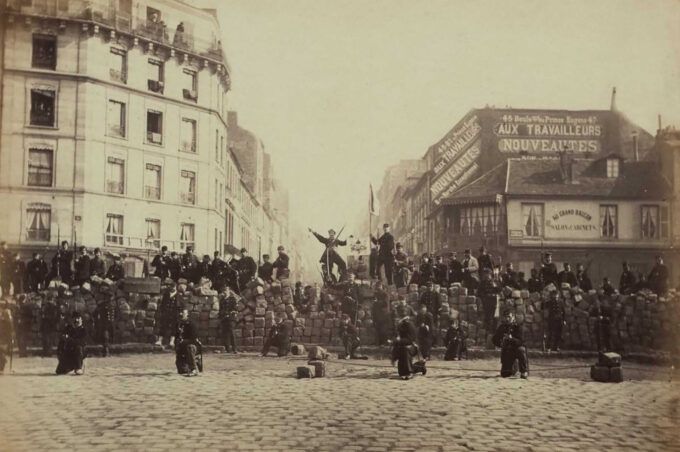
A barricade thrown up by the Communard National Guard on 18 March 1871 – Public Domain

May 28, 2026, marks the 155th anniversary of the Communards’ last stand at Père-Lachaise Cemetery and the end of the Paris Commune. A few days ago, the Tricontinental Institute published an article by our friend and comrade Vijay Prashad who seeks to draw lessons from past socialist experiences. On this occasion, he notes that “All socialist revolutions in the modern world have taken place in the poorer nations, where the peasantry predominates and where wealth has been systematically leached from their territory into distant lands.”

The Paris Commune reminds us of an important fact: here was one revolution that did not take place in a poorer country, but in one of the world’s leading capitalist nations. One need only read Émile Zola, the famous chronicler of nineteenth-century France, to remember how profoundly Second Empire society had already been transformed by capitalism. By 1871, when the Commune broke out, France was already well on the way to transitioning from competitive capitalism to imperialist capitalism, even though the latter would truly take off only after the Commune with the scramble for Africa.

In a sense, Vijay Prashad’s exclusion of the Commune from the revolutionary experiences he analyses is justified. The Commune was exceptionally short-lived (72 days!), and it lacked both a clear revolutionary programme and a revolutionary organisation. Indeed, the Commune can easily be seen as the first socialist revolution, but also as the last of the pre-modern revolutions in which craftsmen and the petty bourgeoisie indisputably played a key role alongside a working class that already represented half of Paris’ population. But this revolution was so brief that the revolutionary moment did not develop into a revolutionary experience capable of transforming society in a deep and lasting way.

Nevertheless, in New Times and Old Mistakes in a New Guise—Lenin’s text that Vijay Prashad quotes, the Russian revolutionary reflects on the construction of socialism and explicitly refers to the government of the Commune as a precursor to the Soviet government.

But is there really nothing to be learnt from the Paris Commune, apart from a legend and a few magnificent revolutionary songs, such as “The Internationale”? Admittedly, it would be a mistake to celebrate the Commune. It lasted only 72 days, and the Commune—besieged, starved, poorly armed, and divided—was ultimately crushed with a brutality that shook the whole of Europe. But it would be an even greater mistake to bury it after ceremonially paying our respects to our heroic fallen comrades. Because the Commune is the only revolutionary experiment at the heart of capitalism, we must ask ourselves, without fetishism or discouragement, what can be learnt from it. The Commune must not become a dusty museum. It must be a laboratory—a place of concrete possibilities, fatal errors, and lessons that never grow old.

I. The State is Not Neutral: A Truth That The Republic Has Written in Blood

One of the most persistent myths of French republicanism that haunts the French left is the idea of an impartial state, acting as an arbiter above the classes. The Commune shattered that myth.

In 1871, the Third Republic—Adolphe Thiers’s Republic, the one that claimed to champion ‘freedom’—reached an explicit agreement with Bismarck, the national enemy, so that Prussian troops would release tens of thousands of French soldiers in order to crush the workers of Paris. The “national defence” government, led first by Jules Favre and then by Adolphe Thiers, was in reality a class alliance against the working class.

French communists, socialists and anarchists are commemorating the Bloody Week this Sunday. What we are commemorating remains a matter of historical assessment. French bourgeois media, from Le Monde to France Culture, eagerly circulate the fanciful figures of the British historian Robert Tombs (aptly named!). In an attempt to downplay the number of casualties, he puts the death toll at between 6,000 and 7,000, hoping to show that the Bloody Week claimed fewer lives than the so-called “Reign of Terror” during France’s 1789 revolution. The message is revolutionaries are more bloodthirsty than the bourgeoisie, who hold back when it is, alas, necessary to restore order to avert an even greater bloodbath.

The Paris City Council itself circulated these figures, reducing them even further. In an article marking the 150th anniversary of the Commune, it evoked the death toll of 3,000 to 5,000 souls – even though, elsewhere, it admits 20,000 deaths — as does the French Senate. To repeat this figure of 3,000 to 4,000 deaths is not a matter of methodological error but of state amnesia. Yet the sources tell a different story. The Prefect of Police at the time estimated that 17,000 bodies had been buried at the city’s expense. Marshal Mac Mahon, the first president of the Third Republic — and thus the butcher of the Bloody Week — put forward the same figure. Camille Pelletan, a radical journalist who was not a Communard but dedicated its life to document the massacres, identified 18,000 of those shot by name.

Today, the most rigorous historical studies agree on a figure of at least 30,000 deaths in a single week. And to this horrifying number, one should add the 3,000 deaths in detention or during deportation in New Caledonia (Kanaky) and French Guiana. Less visible revealing the ferocious repression that the Communards endured, 28,000 workers were arrested, and tens of thousands were forced onto the road of exile. Camille Pelletan using the numbers of registered voters in Paris before and after the Commune, arrives at a reduction in the urban population of 150,000 people, meaning 100,000 Parisians had to flee.

In total, nearly one in four Parisian workers were shot, imprisoned or driven out. In the 11th arrondissement of Paris, a modest plaque recalling that there were so few Parisian workers remained after the Commune that workers had to be brought in from Belgium and elsewhere. Contemporary accounts report that it was impossible to find a carpenter in Paris. That construction workers were in short supply everywhere. Consequently, the years following the Commune marked the beginning of the great migration for workers from rural France to Paris.

This debate over the Bloody week’s death toll is not merely academic: it determines the nature of the bourgeois Republic. The Republic did not defend the masses’ freedoms; it played the role of executioner of its own working class. Figures are a weapon. To deny the mass slaughter is to refuse to learn the lesson: when the bourgeois state feels threatened, it does not engage in debate—it shoots. With 30,000 dead, the Bloody Week was the greatest massacre of civilians in history within such a short period of time, over such a limited area. Marx learned the lesson when he wrote that “after every revolution marking a progressive phase in the class struggle, the purely repressive character of the state power stands out in bolder and bolder relief.”

For us Marxists, the lesson is clear: the bourgeois state—whether monarchical, imperial or republican—is not an instrument to be reformed, but rather one to be dismantled. Social security institutions, public schools, hospitals: all these can be defended under capitalism, but they are not socialist strongholds. The army, the police, the central bank, the courts: this is where real power lies—and the Commune teaches us that they must be smashed. State power must be seized. Without that, the workers’ conquests are, at best, tolerated; at worst, destroyed in bloodshed.

II. The mistakes of 1871: what is killing us is indecision

If the Commune is an educational treasure, it is also because of its weaknesses. Marx never hid them.

The first mistake: failing to march on Versailles on 18 March. Thiers was isolated and defenceless, without an army. A three-hour march would have been enough. But the Communards, concerned about ‘legitimacy’, wanted to organise elections first. It was a mistake: two weeks later, Versailles had rebuilt its army.

The second mistake: failing to seize the Banque de France. This was undoubtedly the mistake with the most serious consequences. The Banque de France, the nation’s treasury, held billions in gold, banknotes and deposits. Seizing it would have deprived Versailles of its ability to pay the army, fund the repression and buy the Prussians’ complicity. But the Commune did nothing of the sort. It borrowed money from the bank — 16.9 million francs, or nearly 40% of its budget — without nationalising it. Why? Because, as Charles Beslay, the Commune’s finance delegate, put it with bewildering naivety: “We cannot be generous with other people’s money.” This sentence, uttered by an old Proudhonian haunted by respect for property, sealed the fate of the insurrection. Capital remained standing, unscathed, and financed its own arsenal against the Communards. The key stronghold of finance capital remained standing. In 1924, France’s first left-wing government was shattered by capital flight. In 2015, Syriza capitulated because it did not dare touch the Bank of Greece. The lesson spans the centuries: one does not negotiate with capital. Either you place it under revolutionary control, or it destroys you.

The third mistake: the absence of a centralised revolutionary party. The Commune was a mix of Proudhonists, Blanquists, Jacobins and anarchists. A magnificent “union of the left” ahead of its time. A superb display of impotence with deadly consequences. Without a single leadership, and lacking both military and political discipline, it allowed infiltrators from Versailles to move about freely.

The conclusion is not ‘authoritarianism for authoritarianism’s sake’, but rather: ‘A revolution without an organised party, without democratic centralism, without the ability to strike quickly and decisively, dooms itself.” The creativity of the masses is indispensable. Constant improvisation is a death sentence. Lenin and the Bolsheviks learnt this lesson by heart. With hindsight, we can (and must!) judge the Bolsheviks’ mistakes. Perhaps they were sometimes too harsh. Perhaps they were heavy-handed. But when the Bolshevik Revolution broke out, the Bloody Week was not even 50 years old. The blood was not yet dry and, for the Russian leaders and Lenin, born in 1870, it was not a distant memory; it was a childhood trauma.

The Commune teaches us not to forgive — not out of vengeance, but out of clear-sightedness. The bourgeois in Versailles did not forgive. They shot the wounded in hospitals, women and the elderly. A revolution that refuses to disarm its enemies always ends up being murdered. Not because violence is beautiful, but because the class enemy never calls a truce.

III. Living the Commune: what remains in our practice

So what should we take away from these 72 days in practical terms?

First, we must reject defeatism and fatalism. The Commune showed that a revolution at the heart of imperialism is possible. In 1871, France was a world power, not a colony. Yet the workers seized power — albeit briefly, and albeit clumsily.

Second, we must understand that the programme is not written in a quiet office, but forged in the heat of battle. The Commune did not have a pre-written ‘socialist programme’. It pioneered: the election of judges, the abolition of the standing army, the separation of church and state (34 years before it was finally voted in France), equal pay for women and men in education — a world first. It asked the trade unions to prepare for the takeover of abandoned workshops in the form of cooperatives.

This is the approach we must adopt: theorising on the basis of practice, daring to take partial measures that are oriented towards socialism, and never waiting for the ‘perfect moment’. We are right to discuss what socialism will be. That is how we will be ready. But we must not spend too much time on it. When Marx, in Critique of the Gotha Programme, defines socialism and communism, he does so in two succinct paragraphs. Socialism, “the first phase of communist society as it is when it has just emerged after prolonged birth pangs from capitalist society”, will have “inevitable defects”, and will in particular be organised around the principle of contribution, which is “therefore, a right of inequality”. Everyone receives in proportion to what they contribute. The primary goal is the abolition of the capitalist class, that is to say, the abolition of the parasitic logic whereby some receive without even contributing to labour.

It is only “in a higher phase of communist society, after the enslaving subordination of the individual to the division of labour, and therewith also the antithesis between mental and physical labour, has vanished; after labour has become not only a means of life but life’s prime want; after the productive forces have also increased with the all-around development of the individual, and all the springs of co-operative wealth flow more abundantly – only then can the narrow horizon of bourgeois right be crossed in its entirety and society inscribe on its banners: From each according to his ability, to each according to his needs!”

The concept of socialism is less important for describing a ready-made system or a set of institutions and reforms (even if this thought experiment is useful as a preparatory exercise); it is important as an inaugural moment. And this is what the Paris Commune reminds us of. What matters is the revolutionary moment of seizing state power, which makes reforms possible. Above all, the capitalist class must be disarmed because it is prepared to do anything to prevent the construction of socialism. To fail to envisage seizing state power and to transform it radically is to leave the enemy the opportunity (which they will not fail to seize) to destroy the workers’ conquests as soon as these go too far and call into question the centrality of the rate of profit. It is the difference between the reforms initiated after the inaugural revolutionary moment and far-reaching reforms under capitalist rule. Capitalists cannot endure a socialist government, even when it limits its reforms for various reasons as the Commune’s did, but they can stomach large reform that does not question their rule, because they know they can simply unravel them over time—as capitalist have resigned themselves to do with the Social security system that annoys them. This, too, is a lesson Marx draws from the Commune in The Civil War in France. We would do well to reread it frequently and make it our own, to avoid the idealist fallacy of thinking that it is by having the best, most tightly knit, most coherent project that we will win. Indeed,

The working class did not expect miracles from the Commune. They have no ready-made utopias to introduce par décret du peuple. They know that in order to work out their own emancipation, and along with it that higher form to which present society is irresistably tending by its own economical agencies, they will have to pass through long struggles, through a series of historic processes, transforming circumstances and men. They have no ideals to realize, but to set free the elements of the new society with which old collapsing bourgeois society itself is pregnant.

In conclusion

155 years after the Bloody Week, what does the Commune tell us?

It tells us:

+ That the bourgeois state kills its own children when it must;

+ That revolutionary timidity costs more than boldness;

+ That victory is impossible without a disciplined party, without taking control of the banks, without military leadership;

+ That the people invent their new forms of government as they go along.

In short, it teaches us that socialism as an inaugural moment—involving tactical thinking to hasten and prepare for the seizure of state power by raising class consciousness and strengthening class organisation—is at least as important as socialism as a project in the battle of ideas.

Le Temps des cerises (The Time of Cherries) by Jean-Baptiste Clément, that revolutionary song disguised as a love song, reminds us of the importance of the revolutionary moment:

But the time for cherries is short,
Coral pendants that you pick while dreaming.
When you are in the season of cherries,
If you are afraid of heartache
Avoid the beautiful ones.
I, who do not fear cruel sorrows,
I shall not live without suffering one day.
When you are in the season of cherries,
You’ll have love pains too.

Just as love always returns when a relationship ends, the Revolution will flare up again, and we, the revolutionaries of the twenty-first century, will make mistakes and suffer the consequences. The Commune teaches us how to avoid some of them, but let us be certain that we will make others. Without its lessons, Lenin might not have been able to dance in the snow on the 73rd day of the Bolshevik Revolution to celebrate the fact that the Soviet government had lasted longer than the Paris Commune, as some say he did.

Kevin Guillas-Cavan is the France Research Fellow at the Institute for Economic and Social Research (IRES) and part of the collective of Communistes & Matérialistes, where this essay first appeared in French.


Monday, June 01, 2026

Opinion

I've dedicated my career to soccer. I'm boycotting this World Cup.

(RNS) — A scholar specializing in soccer explains why he believes this World Cup is debasing the world's secular religion.


Fans celebrate during the announcement of the United States men's national soccer team roster, Tuesday, May 26, 2026, in New York, ahead of the FIFA World Cup soccer tournament. (AP Photo/Eduardo Munoz Alvarez)

Kirk Bowman
June 1, 2026 
RNS

(RNS) — I have devoted my career to soccer. I teach a college course on Soccer & Global Politics. I’ve conducted research in 35 countries on the social dimensions of the people’s game. I truly believe soccer is the closest thing that the secular world has to a universal religion.

This summer, eight World Cup matches will be held in Atlanta, where I live, yet I am not going to any of the games. As much as it pains me, I’ve decided to boycott the 2026 Men’s World Cup in Canada, Mexico and the United States.

I am not a fervent FIFA critic, and I am looking forward to going to Brazil for the 2027 FIFA Women’s World Cup. But I cannot in good conscience attend matches, watch matches on television or collect Panini stickers of the players this summer.


Here is why.

First, the world was promised it could come to these games — that is false.

On May 2, 2018, President Donald Trump wrote a letter to FIFA proclaiming that “all eligible athletes, officials and fans from all countries around the world would be able to enter the United States without discrimination.” FIFA President Gianni Infantino recently echoed that, saying, “America will welcome the world. Everyone who wants to come here to enjoy, to have fun and to celebrate the game will be able to do that.”

In fact, fans from Haiti and Iran are banned from entering the United States, and those from Algeria, Cape Verde, the Ivory Coast, Senegal and Tunisia have been de facto excluded by Kafkaesque, constantly changing, on-again-off-again impediments, including a $15,000-per-person bond program that was canceled too late for fans to make plans to attend the tournament.

According to a filing by U.S. Customs and Border Protection, fans from 42 countries, including the UK, France, Germany and South Korea, are subject to five-year social media searches and may be arbitrarily denied entry into the United States. Human rights organizations warn these U.S. policies could also result in risks for racial profiling and arrest.

And for those allowed in, what exactly will they be asked to celebrate?


President Donald Trump puts on his FIFA Peace Prize medal awarded to him by FIFA President Gianni Infantino, right, before the draw for the 2026 soccer World Cup at the Kennedy Center in Washington, Friday, Dec. 5, 2025. (AP Photo/Julia Demaree Nikhinson)

Early on, the Trump administration made threats to move venues from blue to red cities, and FIFA made a calculated decision to win over the president through constant adulation and sycophancy. This led to the surreal creation of the FIFA Peace Prize, which was awarded to President Trump at the FIFA 2026 World Cup group-stage draw in December 2025 at the Kennedy Center.

At the 2025 FIFA Club World Cup — the tournament FIFA uses to test facilities ahead of the World Cup itself — President Trump kept the original championship trophy, forcing the winner, Chelsea, to accept a replica. He also pilfered a medal reserved for the winning players. He awkwardly hovered over the awards ceremony, photo-bombing the champions’ photo and drawing side-eyes from Chelsea star Cole Palmer.

This scene was reminiscent of another ugly moment in the sport. In 1934, when the second FIFA World Cup was held in Italy, the phrase “Mussolini is always right” was plastered across walls throughout the country. The World Cup — known as ‘Mussolini’s World Cup’ — was a propaganda tool for glorifying Mussolini and for making Italy great again. He personally handed the championship trophy to the captain of the victorious Italians, and he delighted in the cheers and fascist salutes from the Italian players and fans.

I would like to think that if I were a soccer fan in Italy in 1934, I would have passed on that World Cup, too.


President Donald Trump holds the FIFA World Cup trophy during an announcement in the Oval Office of the White House, Friday, Aug. 22, 2025, in Washington. (AP Photo/Jacquelyn Martin)

Ugly politics is not the only issue. FIFA is committing a red-card offense by treating fans as mere spectators to be exploited, rather than as partners and participants in creating the atmosphere and spectacle that characterize soccer competitions. Soccer fans are the twelfth player, bringing the chants, the imagery and the passion. Without the fans, especially the Argentines and Moroccans, the 2022 World Cup would have felt like the Disneyland World Cup.

The bright orange Dutch flash mobs, the Japanese Samurai Blue Ultras that entertain and clean up their section after the match, the choreographed celebrations of the Brazilians and the vibrant body painting of the Senegalese are as integral to the World Cup as the players.

FIFA is manipulating and deceiving fans by releasing batches of tickets in an opaque manner to create a sense of scarcity that artificially inflates ticket prices. While FIFA does have a responsibility to generate funds for its operations from the World Cup every four years, which in part are invested in grassroots initiatives around the world to develop the game, this needs to be balanced with an awareness that the most passionate fans of South Korea, Colombia or Germany are stakeholders and irreplaceable performers in the matches that are televised around the world. The matches played in empty stadiums during the COVID pandemic confirmed that truth: Televised games without enthusiastic fans are dreary affairs.

Many of the most enthusiastic fans are working class and effectively excluded by the sky-high prices in 2026 for tickets, parking, transportation and concessions. After an outcry from fans, FIFA created a new category with around 1,000 tickets for each of the 104 matches at $60 each to be allocated to the confederations for distribution to hard-core fans. That is not nearly enough.

Soccer is the people’s game, with a universal language and shared vernacular that cuts through class distinctions and unites people in a community of fervor for the game and faith in one’s team. The Infantino-Trump partnership is debasing it and the 2026 FIFA Men’s World Cup.


Kirk Bowman at the 2024 UEFA Women’s Champions League Final at San Mamés Stadium in Bilbao, Spain. (Photo courtesy of Bowman)

And so, I am passing on the World Cup this year. I do not encourage others to make the same choice, nor do I judge those who choose to take part. I submit, however, that the spirit that makes the World Cup so special is now found in the women’s game. The tickets are affordable; Brazil will enthusiastically welcome all the teams and their fans; and the game will be used to applaud incredible players and teams, not politicians. I invite you to join me in 2027 for the beautiful game.

(Kirk Bowman is a professor in the Sam Nunn School of International Affairs at Georgia Tech. He is the author/editor of six books, including Soccer, Globalization and Innovation: The Beautiful Game in the 21st Century. The opinions expressed in this commentary do not necessarily reflect those of Religion News Service.)

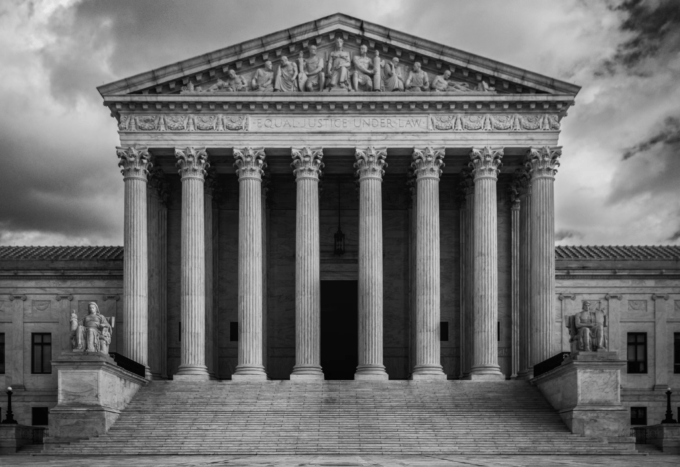
The US Supreme Court: Our Surrogate King for 223 Years

June 1, 2026

A king is a study in absolutes. His word is final, the law of the land, and he is accountable to no one, possibly excepting God.

Isn’t that a credible description of our Supreme Court? Its word is final, the law of the land, and its justices serve for life, unaccountable even to the presidents who appoint them.

Limitless in power, totally isolated, the Court can inflict great harm to the nation. It has for example eviscerated the Voting Rights Act of 1965 in two subsequent decisions, Shelby County v. Holder in 2013 and Louisiana v. Callais just this year. And now the former Confederate states are Jim-Crowing their black citizens all over again, kneecapping the impact of their votes. Discriminating against black voters in the South is once again, incontestably, the law of the land.

The Supreme Court can do such things by declaring laws or parts of laws to be unconstitutional and therefore invalid. The Court can do this because today it holds a power known as judicial review. It can tell the makers of laws—an elected Congress and an elected President—“You were wrong and we are right in saying so.”  How absolute is that?  Supreme Court justices were never elected, but they nullify laws emplaced by people who were. How anti-democratic is that?

This is not remotely what the Framers of the Constitution intended.

Article III Section 2 specifies what the Supreme Court can do. It functions all but exclusively with appellate jurisdiction. In street language that means the Court can do either of two things: it can uphold a lower court decision, or overturn it.  Nothing else. That’s it. The Court is empowered to sit in judgment of law cases. Nowhere is it empowered or even obliquely allowed to sit in judgment of the laws. The Constitution simply does not grant the Supreme Court the power of judicial review.

The Framers meant the Court to be subordinate.  In Federalist 78 Alexander Hamilton said this:

The Judiciary is beyond comparison the weakest of the three departments of powers…it can never attack with success either of the other two [branches]…”

And in Federalist 81 he was explicit:

“…there is not a syllable in the plan under consideration [i.e. the Constitution] which directly empowers the national courts to construe the laws according to the spirit of the Constitution…”

 Today’s Supreme Court invalidates laws without a speck of Constitutional authority, and it has done so for 223 years.

That takes us back to 1803 and the infamous Supreme Court case of Marbury v. Madison.

Federalist President John Adams in the last days of his term appointed 16 new lower court judges—all of Federalist persuasion. Among them was one William Marbury. Their commissions were to be delivered by the Secretary of State, as specified in the Judiciary Act of 1789, but in the scurry of a departing Administration they were not. In March Democratic-Republican Thomas Jefferson was sworn in as President. Intending to appoint judges of his own party instead Jefferson ordered his Secretary of State James Madison not to deliver the commissions.  Marbury sued for his, citing the 1789 law. John Marshall’s Supreme Court found Madison guilty but—wait for it—also saw the Judiciary Act as slightly askew of the Constitution. It was the skinniest technicality, but on that basis the Court dismissed the case.

Chief Justice Marshall said in the Court’s written decision, “It is emphatically the duty of the Judicial Department to say what the law is…a law repugnant to the Constitution is void.” So said John Marshall, but nobody else, certainly not the writers of the Constitution.

Marshall’s Supreme Court claimed judicial review simply by fiat and vaulted from the weakest branch of federal governance eventually to kinglike supremecy.

Note where our Supreme Court is today: by neutering the Voting Rights Act (and, incidentally, encouraging gerrymandering) it is up to its enrobed necks in rigging the upcoming elections, the mid-terms and the general election in 2028.

Judicial review was initially benign. It wasn’t invoked again for 57 years, and might have remained tolerable had not the Court paired it with another irresponsible decision.

In the 1886 case of Santa Clara County v. Southern Pacific Railroad the Supreme Court set a precedent with devastating consequences. It simply declared chartered corporations are persons as defined in the 14th Amendment, with rights guaranteed by the Constitution: free speech, equal protection under the law, and others. By a technical error of the Court the precedent is legally flawed, but later Courts cited it anyway. And  now corporate personhood, prima facie preposterous, is the law of the land.

Think about corporate personhood for a moment. If corporations have Constitutional rights and if they can prove in court those rights are violated by a law, they can sue to have the law overturned. They can use judicial review as a weapon.

And after Santa Clara County they did.

The 14th Amendment was meant to grant citizenship to black Americans, freed from enslavement by the Emancipation Proclamation, and to guarantee their equal treatment under the law. But now, after Santa Clara County, corporations became citizens, too.

377 cases based on the 14th Amendment were heard by the Supreme Court over the 27 years following Santa Clara County.  19 of them dealt with black Americans seeking equal protection. 288 were initiated by corporations claiming Constitutional rights—primarily to invalidate irksome laws.

As the centuries turned corporations succeeded in overturning minimum wage laws, child labor laws, laws limiting the workday, workmen’s compensation statutes, laws limiting corporate lobbying, and laws regulating utility companies. They sued for and won additional Constitutional rights, those granted by the 4th, and 5th Amendments—rights of privacy and the freedom from unreasonable search and seizure. Between 1905 and the mid-1930’s the Supreme Court found some 200 laws and regulations to be unconstitutional.

As the 20th century progressed the toxicity grew. The caustic combination of judicial review and corporate personhood would prove in time to be fatal to democracy.       In a 1976 case, Buckley v. Valeo, the Supreme Court found unconstitutional the 1910 Corrupt Practices Act. It placed parsimonious limits on how much political candidates could spend on their campaigns. No, the Court said, spending money is a form of free speech, and the Congress cannot “abridge” that right. Dollars are words? Isn’t that also prima facie preposterous? Two years later in First National Bank of Boston v. Bellotti the Court overturned the 1907 Tilman Act, prohibiting corporations from spending money on political campaigns—because corporations have free speech rights, too. In seeming contradiction a law limiting how much corporations could spend remained in place. (The law was FECA, the Federal Election Campaign Act of 1972.)

In 2010 Citizens United v. FEC removed the contradiction. If corporations could not be restrained at all from spending for political purposes, then how much they spent was immaterial. Section 441b of FECA was unconstitutional. Out with it. Corporations can spend as much as they please.

But not to worry, Justice Anthony Kennedy wrote for the majority:

…independent expenditures, including those made by corporations, do not give rise to corruption or the appearance of corruption…..The appearance of influence or access will not cause the electorate to lose faith in democracy.”   

Prima facie preposterous?

A tsunami of corporate money flooded expeditiously into the political campaigns of both parties (protected by the right of free speech) and lobbying activities as well (protected by the right of petition).

Corporations today outspend citizen interest groups in lobbying Congress and executive agencies by a factor of 86:1. In the 2024 election cycle corporations contributed 71% of the total of campaign donations, about $10.65 billion. Closely allied billionaires contributed another $2.85 billion, 19% of the total. Small individual donations came to $1.5 billion, about 10%.

By any measure, corporate citizens are the dominant influencers of federal governance today. Their financing of political campaigns renders elected officials into indentured servitude, amiably open to corporate requests. Then corporate lobbyists specify the details.

Public policy today routinely favors not the public interest, but the preferences of corporate America.

Oligarchs are commonly thought to be men and women of immense wealth with close ties to governments. We have those: Elon Musk gave $250 million to the Trump campaign in 2024. But the oligarchs dominating us today are corporate. It is not inaccurate to say our democracy was displaced by corporate oligarchy—after judicial review, after Santa Clara County, after Buckley, after Bellotti,after Citizens United. All thanks to a Supreme Court emulating royalty.

And then Donald Trump showed up, and overrode corporate oligarchy: Trump made himself a king.

The Supreme Court, the stand-in, stepped up to help. First the Court empowered Trump to ignore the rule of law: in Trump v. United States presidents became immune from prosecution for breaking laws while in office, if they do so in “official” actions. Then the Court fell into lockstep with the Republican Party, to tilt the elections of 2026 and 2028 to favor Donald Trump.

If Trump wins a third term, we will still have a king.

If he doesn’t, we’ll still have the stand-in.

This article is drawn from  a book the author is completing, The Triumph of Corporate Oligarchy: How It Defeated Democracy, Normalized Fraudulent Warfare, Devastated a Thriving Nation, and Brought Forth Donald Trump.

Richard W. Behan lives in Corvallis, Oregon. He can be reached at: richard.behan@icloud.com


LYSANDER SPOONER WOULD AGREE