Friday, June 05, 2026


KAIST study provides first large-scale empirical analysis of dual-use research and security oversight​


The Korea Advanced Institute of Science and Technology (KAIST)

KAIST Study Provides First Large-Scale Empirical Analysis of Dual-Use Research and Security Oversight​ 

image: 

<Professor Seokbeom Kwon>

view more 

Credit: KAIST


A new analysis of approximately 600,000 research papers reveals structural limits to single-country security oversight of dual-use research and identifies trade-offs that policymakers face when strengthening such oversight.

KAIST (President Kwang Hyung Lee) announced today that Professor Seokbeom Kwon of the School of Business and Technology Management has published a large-scale empirical analysis examining the structural limitations of tightening security oversight on dual-use research and its potential cost to scientific progress. The study appears in Science on June 5, 2026.

Dual-use research (DUR) refers to scientific research that has both legitimate civilian applications—such as vaccine and treatment development—and potential security-sensitive applications, such as biological weapons or bioterrorism. Examples include research on viral transmission mechanisms or pathogen behavior.

The United States has been strengthening security oversight of dual-use research. Most recently, Executive Order 14292, signed in May 2025, intensified federal oversight of biological research with potential security implications, including dangerous gain-of-function research. The U.S. government also has extended the policy definition of the dual-use research to include broader categories in addition to the gain-of-function research. However, existing policy dialogues have relied primarily on anecdotal evidence and historical case studies.

U.S. ex-ante security oversight institutions are based on National Security Decision Directive 189 (NSDD-189) and apply when the federal government is involved in research. Therefore, research conducted without federal government involvement effectively falls outside the jurisdiction of this oversight.

Professor Seokbeom Kwon developed a new analytical methodology combining the U.S. Patent and Trademark Office’s multi-stage security review process with patent-paper citation data, and analyzed approximately 600,000 research papers. The work has been recognized in academia for shifting discussions of dual-use research, which had previously relied largely on case-based analysis, toward large-scale empirical analysis.

The analysis showed that dual-use research consistently has greater scientific impact than comparable research. This means that research subject to the security oversight tends to play an important role in scientific progress and technological innovation.

In addition, the share of dual-use research directly involving the U.S. federal government decreased from about 41% in 1981 to about 22% in 2005, while the share involving foreign institutions increased from 35% to 54% over the same period. This shows that while U.S. security oversight mechanisms based on NSDD-189 have been applied to domestic research, the share of overseas dual-use research has continued to expand.

Professor Seokbeom Kwon explained, “Strengthening security oversight on dual-use research by a single country alone may impose disproportionate costs on domestic science, while having structural limits in preventing the development of equally important research conducted overseas,” adding, “To achieve both scientific progress and national security, international cooperation and balanced policy design could contribute to mitigating these structural tensions.”

This study provides data-based evidence for international policy discussions surrounding dual-use research. In particular, it is expected to serve as an important reference for future discussions on research security regulation and global cooperation systems not only in biotechnology, but also in advanced technology fields that may be connected to security concerns, such as artificial intelligence (AI) and quantum technology.

This study was published as a sole-author paper by Professor Seokbeom Kwon in Science on June 5, 2026.
 ※ Paper title: “Dual-use research under scrutiny,” DOI: 10.1126/science.aee2479

This research was supported by the National Research Foundation of Korea’s Humanities and Social Sciences Young Researcher Support Program (2025S1A5A8009362).


Inventory drawdowns mask impact of Hormuz disruption as clock runs down towards a September supply crunch

Inventory drawdowns mask impact of Hormuz disruption as clock runs down towards a September supply crunch
Global inventory releases have cushioned the blow of the Hormuz disruption so far, but they are headed towards a supply cruch in mid-September when a technical minimum is reached, says Oxford Economics. / bne IntelliNewsFacebook
By Ben Aris in Berlin June 4, 2026

Global oil markets are relying heavily on inventory drawdowns to offset a supply shock caused by the closure of the Strait of Hormuz, with OECD stockpiles potentially reaching stress levels by mid-September if current trends persist, according to Oxford Economics.

The consultancy estimates that around 14mn barrels per day (mbpd) of oil that would normally pass through the Strait of Hormuz was removed from the market in April from a total of 20mbpd pre-war, after accounting for available bypass pipeline capacity. Additional output from producers outside the Gulf and an existing market surplus reduced the effective supply loss to roughly 10mbpd, while higher prices cut demand by about 3mbpd. The remaining shortfall of approximately 5.7mbpd has been met through inventory drawdowns.

“This adjustment explains why shortages have not yet become acute,” Oxford Economics said. “The market has not had to replace the full loss of Hormuz flows, instead relying on demand destruction, additional non-Gulf supply, and inventory drawdowns to absorb the remaining gap.”

Global oil inventories are declining at a record rate as the market absorbs a major Middle East supply disruption but these mitigating factors mean there is still some wiggle room and oil prices, while elevated, have not reached the catastrophic levels predicted by some at the start of the conflict in February.

The Strait of Hormuz, located between Oman and Iran, handles roughly a fifth of global oil consumption under normal conditions. A prolonged disruption would place sustained pressure on both physical supply chains and global economic growth.

Oxford Economics argued that the key issue is not the complete exhaustion of inventories but the point at which stock levels become low enough to trigger defensive behaviour among governments, refiners and traders.

Global oil inventories stood at approximately 7,950mn barrels in April, while OECD industry and government stocks totalled 3,889mn barrels, including 2,712mn barrels held by industry.

Inventories become stressed when OECD industry stocks fall below 52 days of forward demand, equivalent to 2,308mn barrels. Based on current drawdown rates of 146mn barrels per month, OECD industry inventories would reach that threshold by mid-September, which would induce fresh panic and spiking prices.

However, that deadline might be extended to January 2027 depending on how big the effects of demand destruction are.

“The IEA reported that global oil demand fell by 3mbpd to 101.3mbpd in April. Given that prices had increased by 84%, this implies an elasticity of -0.03, in line with our earlier expectations. Crude supply from outside the Gulf increased by 1.6mbpd, implying a supply elasticity of 0.02,” Oxford Economics reports.

Over time, market participants could adjust further to higher prices, as these responses occur with a lag. Consumers can reduce fuel demand by changing behaviour or switching technologies, but decisions such as purchasing an EV take time to feed through. Producers also face lead times when drilling new wells or expanding supply, while refiners and other midstream participants need time to optimise operations, for example by prioritising transport fuels.

In addition, the rapid roll out of green energy sources is working to reduce the demand for oil and gas. Renewables have already saved Europe €100mn every day since the start of the Iran war as now half of Europe’s power is generated from renewable sources – and that capacity will continue to grow.

“This suggests that the demand and supply response could increase over time, which would reduce the pull on inventories. Indeed, a 50% increase in this adjustment would reduce the draw on inventories to 3.3mbpd (Chart 2), extending the run room to January 2028,” Oxford Economics said.

The International Energy Agency’s co-ordinated release of an all-time record 400mn barrels of oil from strategic reserves has already helped cushion the market. Oxford Economics noted that 310mn barrels remain available from the 400mn total, which should continue to support industry inventories until September.

The consultancy said emerging economies in Asia-Pacific and Africa face the greatest risk of shortages because they are less able to compete for increasingly expensive replacement supplies. By contrast, developed OECD economies are generally better positioned to secure available cargoes at prevailing prices.

Oxford Economics said pressure on Washington and Tehran to reach a ceasefire deal as the technical minimum OECD inventory levels are approached.

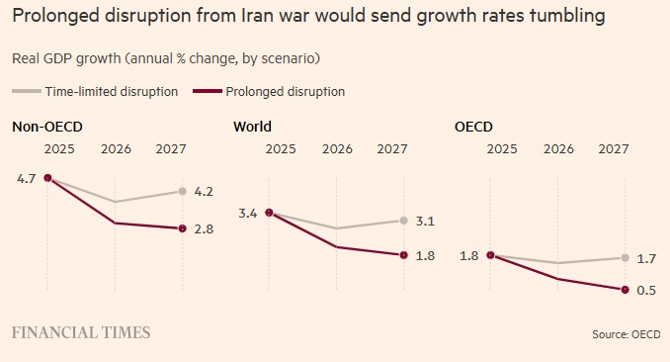
OECD itself warned on June 4 of a “dark scenario” for the global economy if the energy crisis drags on into the second half of 2027: global growth would collapse to just 2.1% this year and 1.8% next — levels last seen in the pandemic and the 2008 global financial meltdown. Energy prices would surge 50% above futures markets, triggering shortages, scarring effects on potential output, and severe hits to AI investment and semiconductor supply chains, the OECD warns. Central banks would be forced to hike interest rates by 0.5–0.75 points to fight inflation, squeezing governments’ already tight fiscal space further.

Oxford also highlighted uncertainty surrounding China’s inventory position, which is playing a major role. Between them, China and the US consume a third of global oil making them central to how the crisis plays out.

The IEA estimates that Chinese oil demand has fallen by only 0.1mbpd, far short of the fall in imports. Lower refinery runs and some switching from oil to coal in petrochemical production may explain part of the gap, but the scale of the adjustment remains difficult to reconcile.

Chinese imports fell by 3.6mbpd in April while observable inventories remained broadly unchanged, leading some analysts to suggest that the country may be drawing on underground reserves that are not visible through satellite monitoring. If those stocks prove more limited than expected, Chinese imports could rebound sharply, accelerating pressure on global supplies.

The US also remains a critical variable. US exports rose by 3.5mbpd in April, helping to ease shortages elsewhere, but any move by President Donald Trump to restrict exports in an effort to contain domestic fuel prices could tighten global markets further and hasten the depletion of inventories.


Gene swapping helped build the planet's decomposers


A new study reveals that horizontal gene transfer contributed to the repeated evolution of fungi-like, absorption-feeding life across eukaryotes.


Okinawa Institute of Science and Technology (OIST) Graduate University

Cases of horizontal gene transfer between the four osmotrophic groups 

image: 

The bar chart shows the number of horizontal gene transfer events detected between each pair of osmotrophic groups. Uncertainty remains in some cases concerning the direction of the transfer events.

view more 

Credit: Ocaña-Pallarès et al. Signatures of gene transfer in the parallel evolution of osmotrophic specialization in eukaryotes. Nat Ecol Evol (2026). https://doi.org/10.1038/s41559-026-03054-w


Decomposers are crucial for keeping Earth habitable, breaking down dead biomass and returning key nutrients, like carbon, nitrogen and phosphorus, back into the ecosystem. Most decomposers, including fungi, survive through osmotrophy — a means of feeding by absorbing dissolved nutrients rather than engulfing prey. But how this method of feeding repeatedly arose across the eukaryotic tree of life remains unclear. 

Now, researchers from the Okinawa Institute of Science and Technology (OIST) in Japan, the University of Oxford in the UK, the Barcelona Supercomputing Center, the Institute of Research in Biomedicine (IRB Barcelona), and the Universitat Oberta de Catalunya in Spain, among other institutions, have reconstructed the deep history of osmotrophic specialization in eukaryotes (organisms with complex cells). Their findings suggest that four groups of eukaryotes which have specialized in osmotrophy first arose between 720 million and 1 billion years ago and that they share a toolkit of genes involved in osmotrophic functions. Their results also indicate that horizontal gene transfer, that is, the process by which genes move from one species to another, played an important role in the evolution of these functions. 

The paper, recently published in Nature Ecology and Evolution, adds to the slow shift in how biologists think about how life evolves and how genes are inherited.  

“Horizontal gene transfer used to be framed as just a peculiarity that happens in bacteria, with eukaryotes passing genes down vertically to their offspring,” says Professor Gergely Szöllősi, who leads the Model-based Evolutionary Genomics Unit at OIST. “Instead, we show that even in eukaryotes, the branches of the tree of life can, and do, exchange genetic material, and those exchanges can allow entirely new ways of making a living to take hold.” 

Digging deep into the history of decomposers 

In this research, the team compared the genomes of species within four distantly related osmotrophic groups. Apart from Fungi, which is the most well known and studied of these groups, three other eukaryotic lineages also transitioned towards a specialised osmotrophic lifestyle: Pseudofungi, Labyrinthulea and Teretosporea.  

“Despite siting at opposite sides of the eukaryotic tree, a suite of traits have repeatedly evolved in these groups as an adaptation to an osmotrophic lifestyle, including filamentous networks and tough cell walls,” says lead author, Eduard Ocaña-Pallarès, a former post-doc in Szöllősi’s Unit, now a Ramón y Cajal research fellow at Universitat Oberta de Catalunya. “Importantly, they also share a common metabolic toolkit necessary for osmotrophy, including genes involved in nutrient uptake, ion regulation and anabolic metabolism. We wanted to know where these shared genes came from.” 

By analyzing hundreds of gene trees, the researchers identified 166 cases where horizontal gene transfer was likely to have occurred between these groups, involving genes mostly related to metabolic functions. In particular, horizontal gene transfer occurred predominantly between Fungi and Pseudofungi, and between Labyrinthulea and Teretosporea. 

“It could be that we see ‘transfer highways’ between these groups due to their shared terrestrial and aquatic ecology, respectively,” suggests Szöllősi. 

Unanswered questions 

Looking forward, the researchers pinpoint important directions for future research, including deciphering the actual function of these shared genes within each group. 

A further mystery to solve is how horizontal gene transfer happened between these lineages. “For example, was it driven by the acquisition of foreign DNA directly from the environment or through viral intermediates?” says Ocaña-Pallarès. “The main question is not anymore if horizontal gene transfer takes place in eukaryotes, but how it occurs. We still know very little about the mechanisms driving this process in eukaryotes.”  


Rice-fish farming may help curb schistosomiasis while increasing food production


University of Notre Dame
Jason Rohr 

image: 

Professor Jason Rohr in his lab at Galvin Life Science Center

view more 

Credit: Photo by Barbara Johnston/University of Notre Dame


The chronic disease schistosomiasis wreaks havoc on more than 220 million people around the world, with the vast majority of cases being in sub-Saharan Africa.

Despite decades of mass drug administration campaigns, schistosomiasis remains one of the world’s most widespread neglected tropical diseases. Rice farmers and their families are particularly at risk, as the parasitic worms that cause the disease are spread by freshwater snails found in the standing water of rice fields.

New research published in Nature Sustainability has explored how rice-fish coculturing — an intervention technique that introduces fish into the rice fields — could help reduce disease incidence and poverty along the northern Senegal River basin, a hot spot for schistosomiasis.

“One of the most exciting aspects of this research is that it suggests we don’t always have to choose between improving human health, increasing food production and protecting the environment. By restoring native fish to rice fields, we may be able to reduce disease transmission while helping farmers produce more food and generate additional income. Those kinds of win-win-win solutions are rare, but they are exactly what sustainable development requires,” said Jason Rohr, Ludmilla F., Stephen J. and Robert T. Galla College Professor of Biological Sciences at the University of Notre Dame and corresponding author of the study.

Researchers used data from more than 400 households in rural Senegal and found that the children of rice farmers had higher prevalence of the disease than children of non-farmers, indicating the increased risk of contracting the disease that rice farmers and their families face. And while there is a drug that can treat the disease, it cannot prevent reinfections, which will continuously occur and contribute to a cycle of poverty and disease.

To reduce disease transmission, the research team led by Rohr introduced African Bonytongue and Nile tilapia into rice fields, two native fish species that naturally suppress snail populations by eating snails or competing with them for resources. Through two trials, the team found that although the fish were not actively fed, both species thrived.

The researchers found that fields containing both fish species had fewer of the snails that host the parasite that causes the dominant form of schistosomiasis in the region. Fewer snails could reduce the risk of infection faced by rice farmers and their families.

But benefits of the intervention reached beyond disease transmission. The research team also found the intervention increased rice yields by more than 25 percent and improved the soil nutrients of the rice fields, all while offering a potential secondary source of income through the sale of harvested fish.

“What is most meaningful to me about this work is that we’re taking an agricultural technique used in other regions and expanding it to infectious disease transmission,” said Emily Selland, lead author of the study and graduate student in the Rohr Lab at Notre Dame. “We can tackle schistosomiasis and also support the development of these communities by designing a sustainable and multidisciplinary solution.”

Researchers believe the initial findings are encouraging, and additional work is already underway.

“The next step is determining how this approach can be scaled across schistosomiasis-endemic rice-growing regions. If these results hold, rice-fish coculturing could become a model for addressing health, food security and poverty simultaneously,” said Rohr, an affiliate of Notre Dame’s Eck Institute for Global Health and Environmental Change Initiative.

In addition to Rohr and Selland, other study coauthors include Alexandra Sack formerly from Notre Dame; Nicolas Jouanard, Amadou Guisse, Momy Seck and Louis Dossou Magblenou from Station D'innovation Aquacole; Andrea J. Lund and Giulio A. De Leo from Stanford University; David López-Carr from University of California, Santa Barbara; and Molly J. Doruska and Christopher B. Barrett from Cornell University.

The study was funded by the National Science Foundation, the Notre Dame Poverty Initiative and the Stanford Sustainability Accelerator in the Biology for Sustainability program.

Contact: Brandi Wampler, associate director of media relations, 574-631-2632, brandiwampler@nd.edu


Nutritional stress and warming seas threaten Hawaiʻi’s last false killer whales


University of Hawaii at Manoa

Aerial view of two false killer whales 

image: 

Aerial view of two false killer whales near Hawaiian Islands

view more 

Credit: Pacific Whale Foundation


A seven-year collaborative study has revealed alarming fluctuations in the health of Hawaiʻi’s endangered insular false killer whales, with some individuals losing nearly a quarter of their body weight in just a few months. Published today in Endangered Species Research, the findings provide the first quantitative evidence that nutritional stress and environmental shifts may be driving the decline of this iconic population, which now numbers fewer than 140 individuals.

The research—a partnership between the Pacific Whale Foundation (PWF), the Marine Mammal Research Program (MMRP) at UH Mānoa Hawaiʻi Institute of Marine Biology, and the Okinawa Churashima Foundation—utilized high-resolution drone photogrammetry to track 68 whales (roughly half the remaining population) between 2019 and 2025.

Rapid Declines and Climate Links 

The study documented extreme physiological shifts, including one individual that lost an estimated 28% of its body mass—approximately 500 pounds—over a 10-week period. Researchers also found that the population’s overall Body Condition Index hit a record low in 2020. This decline coincided with a severe marine heatwave and the largest single-year population drop in recent history, suggesting that rising ocean temperatures are directly impacting the whales' ability to maintain necessary energy reserves.


“This study is a critical step in understanding whether prey limitation is driving the extinction risk for these whales,” explains Jens Currie, Chief Scientist at PWF, MMRP PhD candidate, and lead author of the study. “Our findings suggest that many individuals are living on a thin metabolic margin. We are now examining how competition with fisheries for high-energy prey like ‘ahi (yellowfin tuna) and mahimahi may be forcing these whales into a state of chronic nutritional stress.”

Mapping Health Across the Archipelago 

The research highlights that health is not distributed equally across the population. Whales in "Cluster 1," known for traveling broad distances across the islands, showed significant variability in their physical condition. This suggests that the high energetic cost of moving long distances to find prey may be taking a heavier physical toll on certain social groups than others.

To ensure the highest level of accuracy, the research team validated their drone measurements against 3D scans of whales in human care at the Okinawa Churashima Foundation in Japan. This calibration provided the foundational data needed to convert aerial images into precise weight and volume estimates, confirming that the study’s measurements are accurate to within 3%.

“This level of precision allows us to pinpoint exactly when and where these whales are struggling, which is key for directing conservation efforts,” notes Lars Bejder, MMRP Director, HIMB Professor, and co-author of the study. 

“This partnership shows how research facilities throughout the Pacific ocean can play a meaningful role in global conservation,” says Nozomi Kobayashi, Chief Research Scientist at the Okinawa Churashima Foundation Research Institute. “Using precise 3D scans from animals in our care to support the recovery of endangered populations in Hawaiʻi is both powerful and inspiring.”

A Cultural and Ecological Loss

The whales found in Hawaiʻi are a distinct, island-resident population adapted to the region’s coastal ecosystems and dependent on these waters for survival. They represent one of the smallest and most endangered whale populations in the United States, where the loss of even a few animals can have consequences for the entire population.

The loss of these apex predators resonates beyond biology. “Hawaiian culture has been losing many kūpuna, elders who carry the libraries of knowledge in cultural practices,” shares Kaʻapuni, Cultural Advisor at PWF. “Losing our native population of false killer whales removes even more knowledge from our islands and our history. We cannot afford to lose any more pieces of Hawaiʻi.” 

Next Steps: A Foundation for Survival

Whales and dolphins today face multiple stressors, including climate change, entanglement in fishing gear, and pollution. Ensuring that false killer whales have enough food can help improve their resilience to these pressures. False killer whales in Hawaiʻi feed on large pelagic fish such as mahi-mahi, ono, aku, and ʻahi—species that are also favored by humans and targeted by fisheries. Understanding whether prey limitations are contributing to the population’s decline is a critical next step in their conservation.

“That is why this work is so important,” emphasizes Bejder. “These findings highlight the need to better understand the energetic requirements of these whales and how external stressors may be affecting them.”

As the population continues to decline at an average rate of 3.5% per year, this study represents a milestone: the first comprehensive effort to track the body mass and physical condition of individuals within Hawaiʻi’s endangered false killer whale population. Establishing this baseline is a critical turning point for management. Future studies built upon this foundational data will be the key to identifying shifting health trends in real-time, allowing for the robust management of pelagic fish stocks and the informed policy decisions necessary for the species’ long-term survival.

False killer whale above water 

A false killer whale suspended above the water, after launching its prey high into the air


Credit

Pacific Whale Foundation