Friday, June 05, 2026


This is how we found ‘The Heaven Sword,’ East Asia’s tallest tree after years of looking


Guest editorial by Dr Rebecca Chia-Chun Hsu, Professor Chi-Kuei Wang, and Dr Chung-Cheng Lee, authors of a new Frontiers in Forests and Global Change article describing their year-long endeavor to find Taiwan’s tallest tree


Frontiers

The Heaven Sword 

image: 

'The Heaven Sword', East Asia's tallest tree, towers above others at 84.1 meters.

view more 

Credit: Steven Pearce


Taiwan, historically known as Formosa, holds a secret deep within its rugged interior: it is one of the rare locations on our planet capable of supporting ‘giant’ trees—specimens that tower over 80 meters in height. Since 2014, our dedicated group, the ‘Taiwan tree seekers,’ has been on a mission to locate and document these sky-piercing giants. Our multidisciplinary team is a unique blend of professional tree climbers, ecologists, geologists, and remote sensing specialists.

In 2023, this persistence paid off: we located the reigning champion of the island’s forests: an 84.1-meter-tall Taiwania fir (Taiwania cryptomerioides). This massive tree currently holds the title of the tallest tree in all of East Asia. To the Indigenous Rukai people, these gargantuan firs are known by a much more poetic name, ‘The tree that hits the moon’.

The Landscape of the Island

To understand how these trees grow so large, one must look at the unique geography of Taiwan. The island covers an area of 36,000 square kilometers—roughly the same size as Switzerland. Taiwan is defined by its dramatic mountain systems. The island boasts a staggering 258 peaks that exceed 3,000 meters in elevation, with the highest point, Mt. Jade, reaching 3,952 meters.

It hosts an incredibly rich variety of plant life. It is estimated that 5,000 different species thrive here, creating a spectrum of ecosystems that range from steamy tropical rainforests at sea level to frigid alpine tundra at the highest peaks.

Approximately 60% of the island remains forested and is home to an estimated 950 million trees. While extensive industrial logging between 1912 and 1991 significantly depleted the island’s original primary forests, the incredibly steep terrain served as a natural fortress, preserving significant pockets of old-growth forest that were simply too difficult for loggers to reach.

The Search for the Hidden Giants

The formal quest began in August 2014, we, researchers from the Taiwan Forestry Research Institute (TFRI), launched our first major expedition into the Cilan conservation area. Our specific target was a legendary group of trees known as the ‘Chilan Three Sisters’. These three giant Taiwania firs had been known to locals for years, but never had been scientifically measured or thoroughly documented.

We found the tallest of these giants reached 69.3 meters with a trunk diameter of nearly three meters. International attention followed in 2017 when professional climbers from ‘The Tree Projects’ in Australia traveled to Taiwan to fully photograph the Three Sisters, sharing the majesty of Taiwan's forests with the world.

Spurred by this success, our team set sight on a more remote region near Mt. Benya, rumored to hold the largest population of Taiwania firs. This area is located near Great Ghost Lake, a site considered sacred by Indigenous peoples. The journey was grueling, requiring four days of heavy hiking just to reach the site. This expedition proved to be a turning point; we realized that identifying the tallest trees from the ground was nearly impossible. Within the dense, multi-layered canopy of an old-growth forest, your eyes can easily deceive you. While we managed to climb a 71.7-meter tree during that trip, we knew we needed a more scientific way to scan the horizon.

A High-Tech Solution: LiDAR

With 950 million trees spread across deep, inaccessible valleys, we were essentially looking for a needle in a haystack. To modernize our search, we collaborated with remote sensing experts from National Cheng Kung University to utilize LiDAR (Light Detection and Ranging). LiDAR is a sophisticated 3D scanning technique that transmits laser pulses from an aircraft toward the ground. By measuring how long it takes for the light to bounce back, the system generates a highly detailed 3D map of the landscape, revealing the height of the trees.

A community effort

Due to Taiwan’s rugged, uneven terrain, the automatic algorithm often estimates trees to be much higher than they are, for example, when the tree is right next to a steep cliff. Human eyes are much better at recognizing these geological ‘tricks’ than the automatic algorithm, so in 2020 the project became a community effort. By having hundreds of Taiwanese citizens examined the LiDAR profile images, we could filter out tens of thousands of false leads. As it turned out, 93% of trees had been mismeasured by the automatic algorithm. Without the help of citizen scientists to sort through the mountain of data and identify the most likely candidates, we would have wasted years hiking to trees that were far shorter than they appeared on the map. By the end of 2022, this collaborative effort led to the publication of the ‘Taiwan Giant Tree Map,’ which officially identified 941 individual trees that exceeded 65 meters in height.

Finding the Champion

In January 2023, during the Lunar New Year holiday, we utilized the new map to target the most promising candidate for the title of ‘tallest tree’. This expedition was an endurance test, involved a 20-kilometer river tracing and two days of steep uphill hiking.

Once the climbers reached the crown and dropped a measuring tape from the very top to the ground, the height was revealed to be 84.1 meters. This tree, christened the ‘Heaven Sword of the Da’an River,’ was officially recorded as the tallest specimen in Taiwan and East Asia.

By early 2026, our ongoing efforts have led to the discovery and climbing of ten different Taiwania trees over 70 meters tall, two of which have broken the 80-meter barrier.

A Legacy for the World

The data from the Giant Tree Map also pointed the way to the exceptional ‘temples of giants’. Near Mt. Benya, we found a single hectare of forest containing 11 trees that each exceed 65 meters. Returning to the Great Ghost Lake area ten years after our initial expedition, we were left speechless by a ‘pure forest’ of approximately 30 giant Taiwania firs growing in a dense, ancient cluster.

These trees are vital for the planet’s health. In 2024, we and 15 citizen scientists conducted a detailed study of the ‘Tao Tree’ valley, which is home to the island's third-tallest tree, to learn how much carbon dioxide the forest scrubs from the atmosphere and stores in its wood.

The results were staggering: the total carbon density of the forest (even without counting the massive root systems) was 1,384.5 Mg/ha. This makes Taiwan’s giant forests some of the most carbon-dense environments in the entire world, comparable to the most famous old-growth forests on Earth. These ‘trees that hit the moon’ are not just natural wonders; they are essential guardians of the environment


From waste-wood to load-bearing feature, a simple calculation could change the way we use misfit wood


Urging industry to make better use of wood that is wasted or burned for energy, researchers have released the first structural tests of non-straight, forked, and double-curved roundwood logs used as columns.


Aalto University

Torvinen at Pikku Finlandia 

image: 

Torvinen was involved in design and construction of the Pikku Finlandia temporary building in Helsinki.

view more 

Credit: Mikko Raskinen / Aalto University


Urging industry to make better use of wood that is wasted or burned for energy, researchers have released the first structural tests of non-straight, forked, and double-curved roundwood logs used as columns. 

In his mission to normalise the use of ‘misfit wood’, Aalto University architect and researcher Jaakko Torvinen has shown how standard, business-as-usual calculation methods can predict load-bearing capacity for organically shaped logs. It’s actually a pretty simple equation that can be used to gauge its load-bearing capacity, says Torvinen. What’s surprising is that nobody has done this earlier.

According to Torvinen, the timber and construction industries have for centuries been tied to the assumption that the best material is used for saw logs. ‘We’re so used to thinking in terms of standardised planks or beams,’ he says. ‘This explains why nobody has ever looked at a tree trunk and come up with an algorithm to gauge its strength.’

The result is a level of material wastage that Torvinen finds shocking. ‘If it’s not suitable as saw logs, it goes to pulpwood or energy wood,’ he explains. ‘But our assumption that ‘generic is best’ is old-school thinking –– and we’re wasting way too much good wood.’

Torvinen’s latest research is one step towards helping cut the millions of tonnes of imperfect wood that go to the scrap heap, instead of into use as functional, economically viable and aesthetically desirable options in construction. In presenting the first-ever load tests on organically shaped roundwood columns (curved, double-curved or forked, raw wood) from trees that would usually be deemed unfit for dressing, the study initially shows that current, typical methods can be used also for calculating their load-bearing capacity.

Combined with digital design and fabrication methods, such studies open up opportunities to utilise overlooked materials in new ways, says Torvinen. The end goal is to reduce the obstacles to mass-customisation being a realistic and financially viable option for the industry.

‘Using standard timber only is something that cash-strapped consumers are ready to abandon. So I want to clear the path to industry embracing the possibilities of misfit wood too,’ he says.

Torvinen’s high profile list of recent projects is testament to the visual appeal of using knotty, forked, or charred misfit pillars and whole-tree elements. The architect was responsible for the hauntingly beautiful outlines of Helsinki’s temporary Pikku Finlandia building and his architecturally atmospheric testament to slow-living, Puusauna, earned a prestigious 2026 Wallpaper* Design Award.

He hopes that his latest paper complements these stunning examples of misfit wood’s aesthetic potential by providing the first practical calculations to take us one step closer to recognising its viability in construction.

‘In future projects, when a designer or client wants misfit wood in a building, it won’t be laughed at as an icebreaker, but considered as a legitimate design proposal like any other,’ says Torvinen.

Jaakko Torvinen’s Puusauna is part of Aalto University’s Designs for a Cooler Planet 2026 exhibition in Helsinki from  1 Sept – 30 Oct 2026.

Preprint avail. on request


Puusauna 

Architect Jaakko Torvinen’s stunning Puusauna utilises waste wood that would otherwise be discarded. 

Credit

Photo: Päivi Tuovinen

Experiment 

The basic shape and curvature deviation (bow-imperfection) of the wood were measured with manual tools and image processing, allowing comparison between the experiment and calculations. Compressive load and wood deformation during compression were measured using draw wire sensors.

Credit

Jaakko Torvinen / Aalto University


New ‘universal vaccine’ technology could protect us from future virus outbreaks


University of Cambridge
Clinical trial volunteer receiving the vaccine 

image: 

The super antigen is compatible with most vaccine delivery systems. In this trial it was administered as DNA vaccine through a micro fluid jet. This needle-free delivery method offers an alternative to those with a fear of needle-based injections.

view more 

Credit: University of Cambridge


The first human clinical trial of a universal Sarbeco coronavirus vaccine, developed by the University of Cambridge and spin-out DIOSynVax (DVX) Ltd, has shown that the vaccine is safe and has no significant side-effects.

The trial, involving 39 healthy volunteers, tested a vaccine designed to provide protection against multiple Sarbeco coronaviruses - the large group of viruses that occur in nature including SARS-CoV-2, which caused the COVID pandemic.

The vaccine triggered immune responses in the volunteers not only to SARS-CoV-2 and SARS, but to related bat viruses that could potentially jump from animals to humans and cause future pandemics.

This trial proves the safety of an entirely new way of designing vaccines. The technology uses an AI-designed ‘super-antigen’ to provide lasting protection against a broad range of viruses - for example the Ebola group, or Sarbeco coronavirus group - even as they mutate.

Vaccines developed in this way could protect against future emerging virus threats. The technology also reduces the need for frequent reformulation, which is a fundamental limitation of current vaccines.

This is the first time that a vaccine whose active component was designed entirely by computer simulations has been tested in humans.

Participants took part in the trials at National Institute for Health and Care Research (NIHR) Clinical Research Facilities in Southampton and Cambridge. The study was sponsored by University Hospital Southampton NHS Foundation Trust (UHSFT).

The results are published in the Journal of Infection.

“We’ve converted vaccine development from being reactive to being future proof. Our vaccines will continue to provide protection against viruses even as they mutate into new strains,” said Professor Jonathan Heeney from the Lab of Viral Zoonotics, University of Cambridge’s Department of Veterinary Medicine, the scientific lead of the research.

He added: “We’ve overcome the problem of traditional vaccines, which have limited protection. It means we can escape the constant cycle of chasing the virus variants circulating in humans and updating the vaccines to try to catch up, like a dog chasing its tail.”

The antigen is the active ingredient in a vaccine – it triggers the body’s immune system to produce a protective immune response, training it to fight off future infection by a broad array of pathogens containing these specific DVX antigens.

Current vaccines, such as the seasonal flu vaccine and existing Covid-19 vaccines, use antigens from specific virus strains or variants that have already been detected in humans. But since viruses are constantly mutating, by the time these traditional vaccines are manufactured and distributed, they have limited protection and must be updated annually in an effort to keep up.

To design the antigen for a universal coronavirus vaccine, the team used all the available genetic sequence data for Sarbeco coronaviruses logged by surveillance programmes around the world. Using machine learning, they then designed a super antigen containing the antigen features common to this whole group of viruses – including ones that haven’t emerged yet.

Human clinical trials

The vaccine was given to volunteers between 18 and 50 years old at the NIHR Southampton Clinical Research Facility at UHSFT, and at the NIHR Cambridge Clinical research Facility at Addenbrookes Hospital, Cambridge.

The super antigen is compatible with most vaccine delivery systems. In this trial it was administered as DNA vaccine through a micro fluid jet. This needle-free delivery method offers an alternative to those with a fear of needle-based injections. This could make vaccination faster and easier to carry out in large numbers of people, especially in settings where conventional injections are more challenging to deliver.

A previous trial in animals - an important step before beginning human clinical trials - found that the vaccine provided a strong immune response against a range of coronaviruses. 

Further development of the vaccine is needed before it is ready for public use. A larger Phase 2 trial will next assess the vaccine’s ability to induce immune responses in a wider and more diverse population, and confirm that it generates strong, broadly protective immune responses.

The continuous pandemic threat

“Viruses like Influenza, Coronaviruses and the Ebola group are evolving continuously and by the time vaccines are rolled out, they may be poorly matched - the current “reactive” vaccine system struggles to keep pace,” said Professor Saul Faust from the University of Southampton, the trial’s chief investigator.

He added: “This new class of universal vaccines are future-proofed. They not only protect against many variants simultaneously, but potentially against related viruses that haven’t yet emerged and spilt over to humans.

“If we can develop and clinically advance this new class of vaccines before a virus outbreak begins, millions of lives could be saved, lockdowns avoided and the economy preserved.”

Professor Marian Knight, Scientific Director for NIHR Infrastructure, said: "The remarkable success of this AI-designed ‘super-antigen’ trial marks a pivotal leap forward in our ability to deliver broad, lasting viral protection.”

She added: “This milestone was only made possible through partnerships between the life sciences sector and our world-class NIHR infrastructure in Cambridge and Southampton, whose Clinical Research Facilities provided the vital expertise and environment needed to safely fast-track this innovation, and bring it one big step closer to patients.”

Coronaviruses such as SARS-CoV-2 and related Sarbeco coronaviruses continue to pose a threat to public health. A wide range of these and other viruses continue to circulate in animals that could potentially jump to humans at any time – but it’s not possible to predict which one, or when.

The research was primarily funded by Innovate UK. The DIOSynVax pipeline includes vaccine candidates for human seasonal Flu and the pandemic influenza threats, haemorrhagic fever viruses, and coronaviruses including SARS-CoV-2.

DIOSynVax - Digitally Immune Optimised Synthetic Vaccines - is a spin-out company from the University of Cambridge, established in 2017 with the support of Cambridge Enterprise, the University’s commercialisation arm. Jonathan Heeney is the Professor of Comparative Pathology at the University of Cambridge, and a Fellow at Darwin College.

Needle-free vaccine 

The vaccine was given to trial volunteers between 18 and 50 years old, in NIHR Clinical Research Facilities in Cambridge and Southampton.

Credit

University of Cambridge

ANTI TRUMP-KUSHNER LAND DEVELOPMENT

BALKAN BLOG: Albania’s ‘flamingo revolution’ raises questions over Rama’s long rule

BALKAN BLOG: Albania’s ‘flamingo revolution’ raises questions over Rama’s long rule
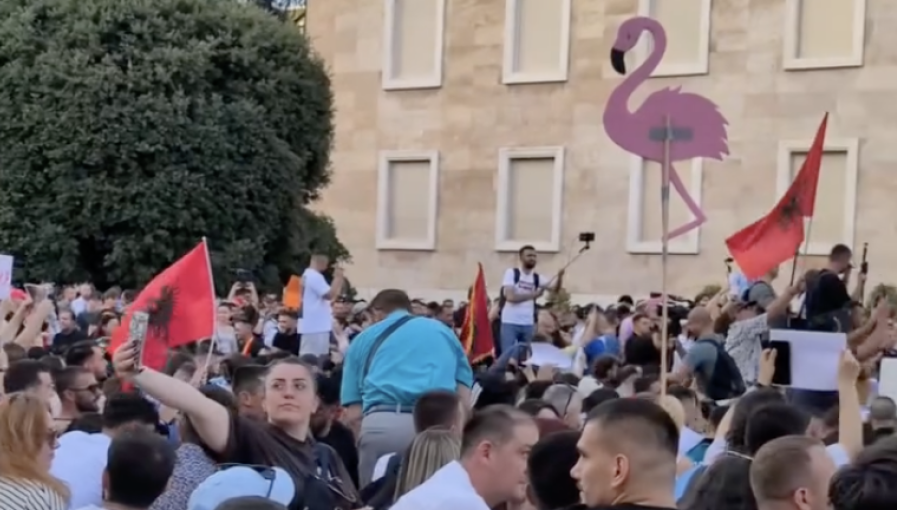
Protesters hold up a giant flamingo sign to highlight potential damage to coastal wetlands. / Lëvizja BASHKË via FacebookFacebook
By Clare Nuttall in Glasgow June 4, 2026

The ongoing protests in Albania have been dubbed the "Flamingo Revolution" as colourful flamingo cutouts are raised above crowds demonstrating against a luxury tourism development in a sensitive coastal wetland area linked to Jared Kushner, the son-in-law of US President Donald Trump.

What began as an environmental campaign against the planned development has rapidly evolved into a broader protest movement. Demonstrators are now calling not only for the project to be halted but also for Prime Minister Edi Rama to step down, prompting comparisons with the "colour revolutions" that swept parts of Eastern Europe and the former Soviet Union in the 2000s and 2010s.

The movement has spread from the coastal village of Zvërnec, near the proposed development site, to the capital Tirana. For several consecutive days, thousands of people have taken to the streets, making the protests one of the most significant public mobilisations Albania has seen in recent years.

In the latest demonstration on June 3, protesters carrying cardboard and inflatable flamingos – symbols of the lagoon's birdlife and protected ecosystem – marched through central Tirana under the banner of a "Flamingo Revolution". According to broadcaster Top-Channel, demonstrators breached police barriers and advanced toward Rama's office, prompting officers to deploy water cannons to disperse the crowd.

Organisers are seeking to broaden the movement beyond Albania. Protests are planned in cities across Europe with large Albanian diaspora communities, from Stockholm to London to Milan, in the coming days.

Support for the demonstrations has also come from outside Albania. The European Green Party, environmental organisations and a group of regional academics have publicly endorsed the protests.

An open letter signed by academics from Albania and neighbouring countries described the movement as a non-partisan mobilisation bringing together environmental activists, students, researchers and civil society groups. The letter referenced an ongoing investigation by Albania's anti-corruption prosecutors into aspects of the project.

"The protests extend beyond environmental concerns," the letter said. "For the first time in decades, citizens from diverse political and social backgrounds have united independently of both the ruling government and the traditional opposition, in response to growing frustration with lack of transparency, corruption, weakening democratic institutions, state capture, and the erosion of the rule of law."

Environmental issues have increasingly become a catalyst for political mobilisation across the Balkans in recent years.

In neighbouring Serbia, repeated protests against pollution, mining projects and urban developments have drawn tens of thousands onto the streets. Demonstrations against Rio Tinto's planned lithium mine in western Serbia became one of the country's largest protest movements in years, eventually forcing the government to suspend the project in 2022, although debate over its future has continued.

The "Don't Drown Belgrade" movement and its symbol of a giant yellow duck also drew thousands of protesters into the streets in opposition to the controversial Belgrade Waterfront project. While the protests became a significant political force, they ultimately failed to halt the development.

In Albania, the use of force against protesters in Zvërnec on May 30, combined with allegations of corruption and lack of transparency surrounding the project approval process helped transform a local environmental dispute into a broader political cause.

Albania's Special Anti-Corruption Structure (SPAK), which was established as part of judicial reforms backed by the European Union and US, has opened an investigation into aspects of the development. Protest organisers have argued that the inquiry demonstrates the need for greater scrutiny of the project and of decision-making processes surrounding it.

Whether the movement can develop into something resembling a genuine "colour revolution" remains unclear, and especially given the protests have so far lasted only days, rather than weeks or months.

While initially focused on environmental concerns, protest slogans have increasingly targeted Rama personally, with calls for his resignation becoming more prominent.

The prime minister has strongly defended the investment, portraying it as essential for Albania's economic development and tourism ambitions.

In an interview with CNN International, Rama dismissed reports of nationwide unrest and rejected claims that the development represented a takeover of protected areas by the Trump family.

"There are no protests all over Albania. There is a protest in the capital," Rama said. "There is no such thing as a 'Trump family island'. There is no such thing as the US president's family taking over protected areas with flamingos."

Rama argued that Albania was facing a coordinated disinformation campaign and said the country was "under attack" by competitors and online networks spreading false information.

The Albanian prime minister has become one of the longest-serving leaders in the region. Since first taking office in 2013, he has won four consecutive parliamentary elections, most recently in May 2025. 

His victories have been aided in part by the Socialist Party's control of state resources and strong local political networks. However, his Socialist Party has also won support through its steady progress towards EU accession, from securing candidate status in 2014 to overtaking fellow Western Balkan countries Serbia and North Macedonia to become one of the frontrunners in the process, with ambitions to join the bloc by 2030. Rama’s charismatic presence has helped raise the country’s profile on the international stage. 

Rama also made progress on fighting corruption, especially in his early years in power, though more recently the government’s reputation has been tarnished by a corruption scandal concerning former deputy prime minister Belinda Balluku, until recently a key member of Rama’s cabinet. Questions have also been raised about the use of public private partnerships (PPPs) for infrastructure projects, and major investment projects such as the UAE-backed Porto Romano. 

Meanwhile, Rama’s Socialists have benefitted from years of infighting within the opposition Democratic Party. The opposition has struggled to recover from internal divisions and leadership disputes following electoral defeats. Democratic Party leader Sali Berisha remains a polarising figure after being sanctioned by the United States over allegations of significant corruption, which he denies.

Berisha's controversial status has complicated the opposition's efforts to present itself as a credible alternative government. Many Albanians also view a return to Berisha's leadership as potentially complicating the country's path toward European Union membership.

This political landscape raises questions about whether the current protests can evolve into a sustained movement capable of challenging the government. Unlike previous colour revolutions, there is currently no obvious opposition figure around whom protesters can rally.

Berisha himself has publicly backed the development project, as reported by Top-Channel TV, meaning the traditional opposition is not aligned with the protesters' central demand. The movement is currently driven primarily by environmental activists, civil society organisations and the leftwing Lëvizja Bashkë movement, rather than Albania's mainstream opposition.

Given an anti-corruption investigation related to the project is already underway, there is a possibility it could be scrapped in the same way a similar project announced by Kushner's Affinity Partners in Serbia was previously. 

The planned development on the site of the former Chinese embassy in Belgrade, which was bombed during Nato’s 1999 air campaign, sparked protests, and there have been a series of arrests in connection to a corruption probe.

For now, it remains too early to determine how many Albanians will continue to mobilise, whether the protests can maintain momentum, and whether they can transform from a single-issue environmental campaign into a broader political movement.

The name "Flamingo Revolution" itself evokes a long tradition of colour revolutions across Eastern Europe and Eurasia.

Among the best-known examples were Georgia's Rose Revolution in 2003, which brought Mikheil Saakashvili to power; Ukraine's Orange Revolution in 2004, which overturned a disputed presidential election; Kyrgyzstan's Tulip Revolution in 2005, which led to the removal of president Askar Akayev; and North Macedonia's Colourful Revolution in 2016, where activists threw paint at government buildings during protests against alleged corruption and abuse of power.

These movements shared common themes of opposition to corruption, demands for democratic reforms and frustration with entrenched political elites. However, as IntelliNews has reported, their long-term results have been mixed. While some brought democratic openings and political change, several countries later experienced renewed political instability, corruption scandals or the return of old political patterns under new leaders.


KAIST study provides first large-scale empirical analysis of dual-use research and security oversight​


The Korea Advanced Institute of Science and Technology (KAIST)

KAIST Study Provides First Large-Scale Empirical Analysis of Dual-Use Research and Security Oversight​ 

image: 

<Professor Seokbeom Kwon>

view more 

Credit: KAIST


A new analysis of approximately 600,000 research papers reveals structural limits to single-country security oversight of dual-use research and identifies trade-offs that policymakers face when strengthening such oversight.

KAIST (President Kwang Hyung Lee) announced today that Professor Seokbeom Kwon of the School of Business and Technology Management has published a large-scale empirical analysis examining the structural limitations of tightening security oversight on dual-use research and its potential cost to scientific progress. The study appears in Science on June 5, 2026.

Dual-use research (DUR) refers to scientific research that has both legitimate civilian applications—such as vaccine and treatment development—and potential security-sensitive applications, such as biological weapons or bioterrorism. Examples include research on viral transmission mechanisms or pathogen behavior.

The United States has been strengthening security oversight of dual-use research. Most recently, Executive Order 14292, signed in May 2025, intensified federal oversight of biological research with potential security implications, including dangerous gain-of-function research. The U.S. government also has extended the policy definition of the dual-use research to include broader categories in addition to the gain-of-function research. However, existing policy dialogues have relied primarily on anecdotal evidence and historical case studies.

U.S. ex-ante security oversight institutions are based on National Security Decision Directive 189 (NSDD-189) and apply when the federal government is involved in research. Therefore, research conducted without federal government involvement effectively falls outside the jurisdiction of this oversight.

Professor Seokbeom Kwon developed a new analytical methodology combining the U.S. Patent and Trademark Office’s multi-stage security review process with patent-paper citation data, and analyzed approximately 600,000 research papers. The work has been recognized in academia for shifting discussions of dual-use research, which had previously relied largely on case-based analysis, toward large-scale empirical analysis.

The analysis showed that dual-use research consistently has greater scientific impact than comparable research. This means that research subject to the security oversight tends to play an important role in scientific progress and technological innovation.

In addition, the share of dual-use research directly involving the U.S. federal government decreased from about 41% in 1981 to about 22% in 2005, while the share involving foreign institutions increased from 35% to 54% over the same period. This shows that while U.S. security oversight mechanisms based on NSDD-189 have been applied to domestic research, the share of overseas dual-use research has continued to expand.

Professor Seokbeom Kwon explained, “Strengthening security oversight on dual-use research by a single country alone may impose disproportionate costs on domestic science, while having structural limits in preventing the development of equally important research conducted overseas,” adding, “To achieve both scientific progress and national security, international cooperation and balanced policy design could contribute to mitigating these structural tensions.”

This study provides data-based evidence for international policy discussions surrounding dual-use research. In particular, it is expected to serve as an important reference for future discussions on research security regulation and global cooperation systems not only in biotechnology, but also in advanced technology fields that may be connected to security concerns, such as artificial intelligence (AI) and quantum technology.

This study was published as a sole-author paper by Professor Seokbeom Kwon in Science on June 5, 2026.
 ※ Paper title: “Dual-use research under scrutiny,” DOI: 10.1126/science.aee2479

This research was supported by the National Research Foundation of Korea’s Humanities and Social Sciences Young Researcher Support Program (2025S1A5A8009362).