Friday, June 05, 2026

SPACE/COSMOS

Magnetic field helps binary star systems form


National Institutes of Natural Sciences
Visualization of gas flows around a binary protostar system calculated by ATERUI III 

image: 

Visualization of gas flows around a binary protostar system calculated by ATERUI III. The gas shown in red orbits around one of the two protostars. The gas shown in blue orbits around the combined binary system. The gas shown in green is being expelled from the system and is carrying away angular momentum. The present research shows that the magnetic field plays an important role in expelling gas and angular momentum.

view more 

Credit: Matsumoto, Hotokezaka, Inayoshi 2026


New simulations show that interactions with a magnetic field can work to decrease the distance between still forming binary protostars. These results can help explain the characteristics of the binary star systems observed in the Milky Way. These results can also be extrapolated to binary black holes, giving insights into how super massive black holes evolve.


Stars form from clouds of interstellar gas that collapse into dense regions known as molecular cloud cores. Multiple stars form close together simultaneously, and in some cases two stars will become gravitationally bound to each other, forming a binary star system. Observations suggest that these binary systems form early on, before the stars are even fully formed. Astronomers have struggled to explain how these still forming “protostars” can pull together into binary systems so quickly.


New simulations using multiple supercomputers including the ATERUI III supercomputer for astronomical simulations and its predecessor ATERUI II, both at the National Astronomical Observatory of Japan, have shown that interactions between an interstellar magnetic field and the gas around the protostars can remove angular momentum from the protostar pair, allowing the binary systems to form within a realistic time period. In the simulation run with zero magnetic field performed as part of this research, the protostars actually moved farther apart, indicating the importance of the magnetic field in the process.


The simulations also suggest that the same process could work on massive binary black holes in the gas-rich heart of a new galaxy formed from the merger of two smaller galaxies. This would help explain how massive black holes can move close enough to merge and form a supermassive black hole. Direct simulation of massive binary black holes over the timespans required to spiral towards each other is still computationally challenging, so rigorous investigation of the effects of magnetic fields on massive binary black holes remains a topic for future investigation.


Visualization of gas flows around a binary protostar system calculated by ATERUI III [VIDEO] 

Visualization of gas flows around a binary protostar system calculated by ATERUI III. The first half of the video shows a close-up view around the binary protostars. The second half shows a wide-field view of the system. You can see how the outflow escaping from the disk around the binary system carries angular momentum far away.

Credit

Matsumoto, Hotokezaka, Inayoshi 2026

CRIMINAL ZIONISM

Israel strikes Lebanon after truce announcement

Beirut (Lebanon) (AFP) – Israel struck south Lebanon on Thursday and threatened new attacks on Beirut despite an announcement hours earlier that Israel and Lebanon had agreed to implement a conditional ceasefire.


Issued on: 04/06/2026 - RFI

Strikes on Lebanon have persisted despite a ceasefire. © - / AFP

Israeli and Lebanese envoys held a fourth round of talks in Washington on Wednesday, agreeing to implement a ceasefire hinged on Iran-backed militant group Hezbollah halting its attacks.

But Hezbollah, which rejects the direct Israel-Lebanon talks, has not commented on the announcement, while Israel's Defence Minister Israel Katz said military operations would continue in south Lebanon.

Hezbollah drew Lebanon into the wider Middle East war to avenge the killing in US-Israeli strikes of Iran's supreme leader on February 28, and has vowed to keep fighting despite a push by the Lebanese government to disarm it.

Despite the agreement in Washington, Katz said Israeli forces retained the "freedom of action, with American backing, to strike in Beirut in response to fire on Israeli communities and territory".

The army will "at this stage, continue its fire and ground operations, remain in the security zone in Lebanon up to the Yellow Line – including in the Beaufort area – and without the return of the population, while continuing to dismantle terrorist infrastructure on the ground," he said.

An April 17 truce was meant to halt the fighting and was extended several times but has never been observed, with both sides justifying their ongoing attacks by the other's alleged violations.

Lebanon's state-run National News Agency (NNA) reported strikes along roads at several southern locations on Thursday, with a couple and their daughter wounded in an attack on their car.

Yemen edges closer to collapse after a decade of war and neglect, UN warns


'Serious mistake'

Israel's military renewed a warning to Lebanese not to go south of the Zahrani River around 45 kilometres (28 miles), after it last week declared all areas south the river "combat zones".

Earlier Thursday, the Israeli military said air raid sirens were sounded in northern Israel, with one incident involving a "suspicious aerial target" resolved, while another incident was found to be a false alarm.

Before the announcement, Hezbollah said it had launched rockets and drones early Thursday at Israeli troops who have invaded south Lebanon.

Israel's far-right National Security Minister Itamar Ben Gvir criticised the deal, calling it a "serious mistake".


Israeli and Lebanese envoys held talks in Washington © Oliver Contreras / AFP


According statement issued after the meeting, the two sides, which do not have formal diplomatic relations, also agreed to create "pilot zones" in which the Lebanese armed forces "will take exclusive control of the territory to the exclusion of all non-state actors".

More Lebanon-Israel talks are scheduled for later this month.

Senior Hezbollah official Mahmud Qomati had told AFP this week that the group would "not accept a partial ceasefire".

On Wednesday, US President Donald Trump said he wanted to separate talks on the conflict in Lebanon and those on the war with Iran.

Tehran, however, insists the conflicts are linked and its Foreign Minister Abbas Araghchi warned that any attack on Beirut would trigger a "full-scale resumption" of war.

Lebanon says Israeli attacks have killed more than 3,500 people since Hezbollah drew Lebanon into the wider Middle East war on 2 March, firing rockets at Israel in retaliation for US-Israeli strikes that killed Iran's supreme leader.


France opens torture, 'war crime' probe over Israel's treatment of Gaza flotilla activists


France's government had earlier asked prosecutors to investigate Israel's alleged violent mistreatment of activists from the Gaza-bound Global Sumud Flotilla, potentially opening a route for criminal proceedings.


Issued on: 05/06/2026
By: FRANCE 24

French activists from the Gaza-bound Global Sumud Flotilla gesture upon arrival at Charles de Gaulle Airport near Paris, on May 22, 2026. © Abdul Saboor, Reuters


Rights Group Sounds Alarm After Israel Sends Gaza’s Dr. Abu Safiya to Solitary Confinement

“The international community cannot remain silent while a respected physician is reportedly subjected to harsh conditions, denied adequate medical care, and isolated from the outside world.”


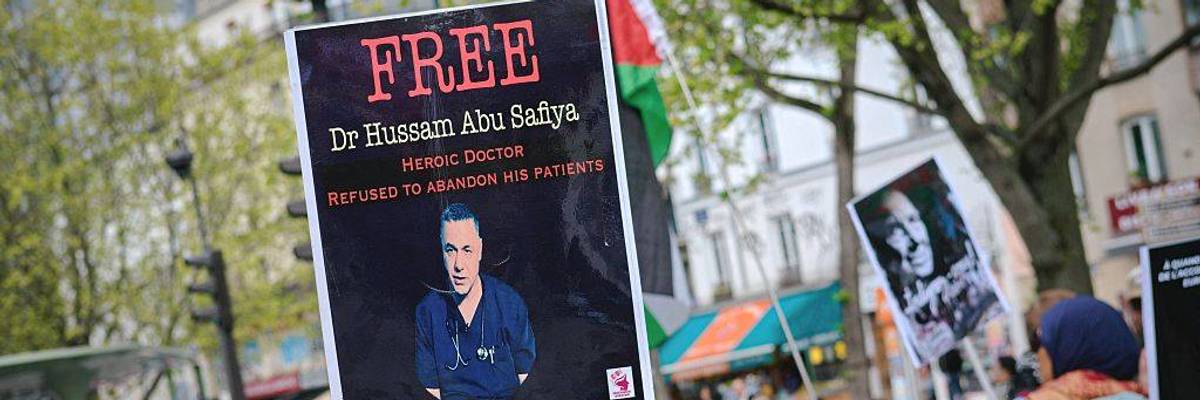
Wide view of a large crowd holding a banner reading Free Hussam Abu Safiya during a pro Palestine demonstration in Paris Ile de France France on April 18, 2026.
(Photo by Djoudi Hamani/Hans Lucas/AFP via Getty Images)

Brad Reed
Jun 05, 2026
COMMON DREAMS

A prominent human rights group on Friday sounded alarms upon learning that Dr. Hussam Abu Safiya, director of the Kamal Adwan Hospital in Gaza, has been sent to solitary confinement.

As reported by Haaretz, Physicians for Human Rights Israel (PHRI) said it learned on Thursday that Abu Safiya was moved to solitary confinement this week without any explanation.


‘We Cannot Forget the Palestinian Prisoners,’ Freed Gaza Flotilla Member Says While Returning Home


In Wake of NYT Uproar, UN Rights Office Calls for Independent Probe of Israel’s Sexual Abuse of Detainees

According to a report from The Palestine Chronicle, an attorney representing Abu Safiya claimed that his client was placed into solitary confinement in retaliation for appealing his continued detention.

Abu Safiya was first taken into custody by Israeli forces in December 2024 and has been held since then without being charged with any criminal offenses.

In a Friday statement, the Council of American-Islamic Relations said news of Abu Safiya’s solitary confinement was “deeply disturbing” and raised “even more urgent concerns about his welfare and basic human rights.”

“Congress must demand his immediate release and insist that Israel end the arbitrary detention, abuse, and mistreatment of Palestinian medical professionals and civilians,” CAIR added. “The international community cannot remain silent while a respected physician is reportedly subjected to harsh conditions, denied adequate medical care, and isolated from the outside world without any legal justification. Dr. Abu Safiya must be released immediately.”

PHRI has for months been raising concerns about Abu Safiya’s detention, long before he was transferred to solitary confinement.

While demanding the physician’s release in April, for instance, PHRI said Abu Safiya was being held “in harsh conditions, without access to medication or medical care, as his health continues to deteriorate.”

A 2025 report from Amnesty International, which has also called for Abu Safiya’s release, said that the Gaza-based physician “was detained in the course of caring for his patients and carrying out his medical duties.”

Amnesty also noted that, prior to his detention, Abu Safiya and other colleagues at the Kamal Adwan Hospital had “provided human rights and humanitarian organizations with reliable information about the health situation” in Gaza, which has been left devastated by years of Israeli attacks that have killed at least 72,000 Palestinians.

One Gaza Flotilla Boat Made It to Gaza—in Pieces


Gaza flotilla boats get their resilience from Palestinians.


A child carries part of a Global Sumud Flotilla vessel on shore in Gaza.
(Photo via Instagram)

Ann Wright
Jun 05, 2026
Common Dreams


Gaza flotilla boats have become like Palestinians. They, like Palestinians, have been attacked, beaten, partially destroyed, and thrown to the four winds by a brutal, violent Israeli government.

Some of the 2026 Gaza flotilla boats were purposefully damaged so severely by Israeli military forces that they sank, like Palestinians who are under the genocidal rubble of endless criminal Israeli bombings.


‘Yet Another Act of Piracy’: Israel Raids Humanitarian Flotilla Bound for Gaza


‘May Day! May Day! May Day!’: Israeli Forces Intercept, Open Fire on Gaza Flotilla Activists

After two brutal interceptions in international waters in April and May 2026, many resilient Gaza flotilla boats have been found floating in a variety of places around the Mediterranean, just as Palestinians as refugees are found all over the world.

Flotilla boats been found adrift off the Turkish coast, some have been found off Crete, two have been found off Lebanon, one in Egypt, and several have been found near Cyprus.


Palestinians Welcome a Flotilla Boat to Gaza


In an allegory to Palestinian history with Palestinian homes bombed into pieces from Israeli government violence, one flotilla boat, the KASR-Sadabad, found its way home to Gaza where it washed ashore at the beach Mawasi Khan Younis… in pieces, where Palestinians lovingly welcomed the boat and pulled large pieces ashore.

For the first time since 2008, an international boat, although in pieces, reached the shores of Gaza.
Judge tosses Kennedy Center lawsuit against artist who canceled over Trump’s name


David Badash 
June 05, 2026 
ALTERNET


A judge on Friday tossed out a lawsuit brought by the Kennedy Center against an artist who withdrew from a performance after the organization’s board voted to add President Donald Trump’s name to the venue, The Washington Post reports.

The artist, jazz musician Chuck Redd, pulled out over what he called “the defiant and illegal name change happening to the Kennedy Center,” according to the Post.

But, as D.C. Superior Court Judge Tanya Jones Bosier found, Kennedy Center officials had not made a legally binding agreement with Redd, and there could be no breach of contract claim as a result.

“There’s no dispute that he did not sign the 2025 agreement,” the judge said.

In a statement, Redd’s attorney, Lisa Banks, said Redd had been sued “because he publicly and rightly objected to adding Donald Trump’s name to the Kennedy Center, a living memorial to former President John F. Kennedy.”

Banks called the lawsuit “political retribution, pure and simple, by the Trump Kennedy Center,” and said that “the Court correctly saw it as such in dismissing the case with prejudice.”

According to the Post, after Redd withdrew, then-Kennedy Center president Richard Grenell said in a letter to Redd, “This is your official notice that we will seek $1 million in damages from you for this political stunt.”

In December, Redd told the Associated Press, “When I saw the name change on the Kennedy Center website and then hours later on the building, I chose to cancel our concert.”

On Thursday, the general counsel for the John F. Kennedy Center for the Performing Arts ordered Trump’s name to “immediately” be removed from the building after a federal judge found adding the president’s name to the Center was unlawful, The New York Times reported.

“The memo gave staff members detailed instructions on the materials that needed to be updated, including social media accounts, email signatures and voice mail messages,” the Times reported. “It specified that outdoor and indoor signage with the barred name must be altered by June 12.”

Late last month, a federal judge ordered that President Donald Trump could not rename the Kennedy Center, nor could he close it for what the Trump administration said were two years of renovations.

“The Kennedy Center’s organic statute makes crystal clear that the Center is to be named for President Kennedy, and it cannot bear any other formal name or public memorial based on the Board’s unilateral say-so,” the judge wrote, CNBC reported. “Congress gave the Kennedy Center its name, and only Congress can change it.”
Judge Strikes Down Trump ‘Anti-Immigrant’ Policies, Orders Restart of Asylum Processing

“This ruling reaffirms a basic principle: The federal government cannot shut down lawful immigration pathways or discriminate against people based on where they come from,” said one advocate.


People pray during an interfaith service, held adjacent to the Miami Immigration Court, on behalf of immigrants, on November 13, 2025 in Miami.
(Photo by Joe Raedle/Getty Images)


Brett Wilkins
Jun 05, 2026
COMMON DREAMS

A federal judge in Rhode Island on Friday struck down a series of President Donald Trump’s policies that he ruled were rooted in “anti-immigrant sentiments” and ordered the administration to resume processing of asylum grants and immigration benefit applications of people from 39 targeted countries.

Last November, US Citizenship and Immigration Services indefinitely suspended asylum adjudications and froze immigration applications for people affected by a travel ban implemented after a man from Afghanistan allegedly shot two National Guard troops in Washington, DC.

Trump vowed to “permanently pause migration from all Third World countries” and expedite the removal of people his administration doesn’t consider “a net asset” to the United States. The administration’s move halted the ability of people from affected nations to obtain green cards, US citizenship, and other benefits.

US District Judge John J. McConnell Jr., an appointee of former President Barack Obama, said in his ruling that the administration’s policies are rooted in “anti-immigrant sentiments that it is forbidden from letting influence its decision-making” and have placed immigrants living in the United States in “indeterminate legal limbo.”

“The challenged policies placed the lives of countless individuals on hold—solely by virtue of their countries of birth,” McConnell wrote. “Over six months later, many of those individuals remain without work, without legal status, and without any meaningful ability to plan for their futures.”

“The government effectively invites the court to shut its eyes and ignore the strong evidence of anti-immigrant animus before it,” the judge added. “Doing so would require profound naiveté on the court’s part. Unfortunately for the government, that is an invitation that this court will have to decline.”

US Department of Homeland Security (DHS) General Counsel James Percival slammed McConnell’s ruling in a social media post accusing “the Left” of “running the same gambit with so-called ‘animus’ claims since 2017.”

“It is sabotage dressed in legal clothing,” Percival added. “It goes like this: (1) the admin is racist, (2) therefore a policy I don’t like is motivated by race, (3) therefore it is invalid. They have used it on virtually every Trump-era DHS policy.”

Plaintiffs and others involved in the case welcomed McConnell’s decision.

“This ruling reaffirms a basic principle: The federal government cannot shut down lawful immigration pathways or discriminate against people based on where they come from,” Democracy Forward president and CEO Skye Perryman said in a statement.

“These unlawful policies caused enormous harm to families, workers, asylum seekers, and communities across the country who were left in limbo, unable to work, access protections, or move forward with their lives,” Perryman added. “We are pleased that the court recognized the devastating human consequences of these policies. Our communities deserve a fair process governed by law, not political targeting rooted in fear-mongering and discrimination.”


Milagro Sique, CEO at the Dorcas International Institute of Rhode Island, said: “Today is a good day. On behalf of the thousands of immigrants we serve, we are grateful to Judge McConnell for his ruling.”

“These policies were wrong, plain and simple, and caused profound fear and uncertainty for so many of our friends, neighbors, and coworkers,” Sique added. “Having the judicial process work as intended—by upholding the rule of law—gives us some reassurance that all is not lost and allows those who have been impacted to move forward with their lives in a meaningful way.”

Abbey Koenning-Rutherford, staff attorney at Muslim Advocates, said that “today’s decision is an unsparing rejection of the government’s discriminatory and unlawful actions to gut access to immigration benefits under the false pretext of national security.”

“These policies unjustly revived the discriminatory logic of the first Muslim and African bans and expanded them widely to millions of community members already inside the United States,” she continued, referring to policies enacted during Trump’s first term.

“In vacating these unlawful policies, the court makes it unmistakably clear that the Trump administration cannot hold the lives of immigrants in legal limbo based on their countries of birth, and must continue processing their applications for status and benefits as required by law,” Koenning-Rutherford added.

Congresswoman Pramila Jayapal (D-Wash.)—an immigrant from India—was among the Democratic lawmakers who applauded Friday’s ruling, writing on social media that “this is a BIG win.”

“A judge has now reaffirmed that Trump’s freeze on processing immigration applications for 39 countries is illegal and that processing must restart immediately,” she added. “Today’s ruling is not the end of the fight, but it is a major step in the right direction.”

Detention centre car drives into protest line outside NJ ICE detention center as tensions boil over

David Edwards
June 5, 2026 
RAW STORY


U.S. Immigration and Customs Enforcement (ICE) agents and federal agents secure the entrance to the Delaney Hall detention center, as demonstrators remain gathered outside, in Newark, New Jersey, U.S., May 29, 2026. REUTERS/Shannon Stapleton TPX IMAGES OF THE DAY

A tense confrontation outside Newark's Delaney Hall immigration detention facility escalated Friday when a red sedan slowly drove into a line of protesters blocking a facility exit, pushing them backward until someone hurled an object that left two large shatter marks in the vehicle's front windshield.

Video shared on X by @Patrick_Nealis showed the car sitting for several minutes as protesters blocked the exit, then creeping forward, making contact with demonstrators and forcing them back. As the car advanced, protesters could be heard shouting, "That's blood money! You will reap what you sow!" Protesters appeared to presume the driver was a facility employee, though that has not been confirmed.

The confrontation took an uglier turn as the car pressed forward. "You're f—ing Spanish!" demonstrators screamed at the driver. "You should be ashamed of yourself!"

Friday's incident is the latest in a weeks-long standoff at Delaney Hall, a privately run facility with 1,000 beds operated by GEO Group under a $1 billion ICE contract. Protests erupted on May 22 after roughly 300 detainees launched a hunger and labor strike over alleged inhumane conditions — claims federal officials deny.

The demonstrations have grown increasingly volatile. ICE agents have fired pepper balls and tear gas at crowds, and state police moved in after Democratic Gov. Mikie Sherrill declared the situation "completely unacceptable." The U.S. Press Freedom Tracker has documented at least 42 assaults on journalists covering the protests. Just Wednesday night, two more protesters were arrested after blocking vehicles at the facility entrance.

New Jersey filed suit against GEO Group, demanding that state health inspectors be granted access to the facility, with Newark threatening to expand its own separate lawsuit to push for closure.


Fed’s May Beige Book Shows Working Families Falling Behind As Trump Is ‘Choosing to Keep Prices High’

Middle-income households were “squeezing more life out of every dollar before deciding to spend it” last month, while low-income families and individuals “showed greater financial strain.”


A shopper looks at a beverage display on June 4, 2026 at a supermarket in South Burlington, Vermont. Food prices have increased nearly 30% since 2020 according to the Bureau of Labor Statistics.
(Photo by Robert Nickelsberg/Getty Images)

Julia Conley
Jun 05, 2026
COMMON DREAMS

The Beige Book, a monthly report on consumer spending, labor markets, and inflation from the Federal Reserve’s 12 districts across the country, offers an up-to-date look on how the US economy is impacting households across the US—and this week, the report for May showed a continuation of the trend that accelerated after President Donald Trump joined Israel in attacking Iran more than three months ago.

“This month’s report, the third since the escalation of the conflict in the Middle East, reveals that soaring input costs are triggering price hikes for consumers,” said the progressive think tank Groundwork Collaborative.

The report notes that regional contacts at the Federal Reserve’s districts described middle-income households as “squeezing more life out of every dollar before deciding to spend it,” while low-income families and individuals “showed greater financial strain.”

“Overall, there were reports of increased credit card usage, fewer retail visits, and stronger demand for necessities,” reads the Beige Book.

“Higher-income households remained resilient and less sensitive to price increase,” the Federal Reserve reported, indicating a “K-shaped economy”—in which wealthy Americans are represented by the top angled line and middle- and lower-income households are represented by the line angled toward the lower right.

The report comes as peace talks with Iran are stalled and the Strait of Hormuz—a key waterway for trade, particularly for the world’s oil supply, remains effectively closed following the US-Israeli invasion. Iran’s retaliatory move has sent global oil prices soaring, with gas now costing $4.22 per gallon on average.

“High prices for essentials like groceries and a tank of gas are busting household budgets and eliminating breathing room for middle- and low-income families.”

“Numerous contacts mentioned the conflict in the Middle East as a source of cost pressures and heightened business uncertainty,” reads the Beige Book. “Higher energy and fertilizer prices contributed to a moderate increase in food prices, especially for fresh produce.”

Manufacturers and retailers are also facing increased shipping costs, while auto repair rates and used-car financing rates “remained very high” in parts of the country.

The report was released days after the administration launched new strikes against Iran last weekend, and as Iran announced it was suspending peace talks with the US over Israel’s continued targeting of Lebanon.

Alex Jacquez, Groundwork’s chief of policy and advocacy, said that “Trump is choosing to keep prices high for working families.”

“High prices for essentials like groceries and a tank of gas are busting household budgets and eliminating breathing room for middle- and low-income families,” said Jacquez. “Despite his own party’s opposition, the president is forging ahead with his reckless, costly war—and leaving working Americans in the dust.”

The Beige Book also describes a “low-hire, low-fire” job market, “with workers increasingly reluctant to change jobs because of economic uncertainty.”

“Widespread economic uncertainty from continued tariffs and persistent inflation means businesses are delaying expansion, leading cautious employees to remain in their current roles—even if it means staying in worse-paying jobs,” said Groundwork.

The Federal Reserve pointed to a contact in the construction industry in Cleveland, Ohio who said employees are “nervous and stressed, as well as a human resources firm in Richmond, Virginia that reported ”that clients have explicitly slowed hiring for new roles due to uncertainty, while their existing employees seemed reluctant to leave ‘something stable’ for new opportunities.“

Jacquez said that based on the report, “Americans lucky enough to be employed full-time are losing faith in their ability to keep up with inflation as paychecks lag and the labor market stalls out.”

Jim Cramer calls out Trump official to his face for ignoring 'struggling Americans'

Jim Cramer, Image via Screengrab.

June 05, 2026
COMMON DREAMS


Longtime financial pundit Jim Cramer is worried. While President Donald Trump and his allies applaud Friday’s positive jobs report, Cramer thinks they’re not paying enough attention to the economic needs of “struggling Americans.”

While the news that job numbers have increased by 172,000 is theoretically good, Cramer posted that he is “concerned that the administration is not sensitive to the huge number of people who are struggling because of gasoline and higher rates.”

He specifically called out National Economic Council Director Kevin Hassett, who had appeared on Cramer’s CNBC show Friday morning, where the official seemed to suggest that the positive jobs report means the Fed should increase interest rates. Cramer did not like what he heard.


“Kevin, I’m a little surprised at you,” Cramer replied. “You sound like you’re part of that group which says we have to have rate hikes, and that’s a little disappointing. And I say it’s disappointing because if you’re listening to the Dollar General Call […] you’re going to hear things that are quite different from what you say, which is there’s a group of people in this country, if you listen to the people who make homes and try to sell them, a group of people in this country that are very disenfranchised.”

Hassett then tried to backpedal on his rate hike suggestion, but Cramer wasn’t having it, taking issue with the official’s assertion that “everybody’s doing well.”


“What you’re saying is that everybody’s doing well,” argued Cramer. “There’s a considerable part of the people who are not doing well in this country, and they need the help of the Fed, and I’m surprised that you’re not addressing those people — the people who make less than forty thousand dollars in this country who need help, have seen SNAP benefits decline, who have the higher gasoline prices because of the war with Iran. What about them?”

While much of their debate spotlighted interest rates, as Cramer noted, focusing on what positive economic indicators there are also ignores gas prices, which have skyrocketed due to Trump’s decision to launch war with Iran. While gas prices have come down slightly from the peak in mid-May, they’re still up by over 40 percent versus February.

What’s more, on Thursday, oil industry leaders warned Trump that prices are likely to increase significantly over the coming weeks. In the U.S., the worst of the oil cost climbs have been staved off by digging into reserves, but those stockpiles are “at dangerously low levels already” and about to run dry. Complicating matters further, even if Trump were to secure a deal to end the war and open the Hormuz Strait tomorrow, it would still take months for production to ramp back up and bring costs back down.

When Cramer pressed Hassett on these everyday issues hitting American pocketbooks, the latter could do little but resort to bluster.

“Well, obviously, we care about everybody,” Hassett claimed.

“Oh?” Cramer replied skeptically.


Top executives warn Trump that even worse price hikes are coming – and soon

Thomas Kika
June 04, 2026 
ALTERNET


At a time when voters are ready to hand Republicans a midterm revolt over the economy, Politico reported this week that top executives warned President Donald Trump that prices are about to get much worse if he does not solve the war in Iran.

Trump remains embroiled in negotiations for a lasting ceasefire and resolution to the war, which he started, with Iran's new hardline leadership refusing his demands. As that situation continues to spiral, the Strait of Hormuz remains either closed off or dangerous, depending on the day, sending global oil prices surging as a result.

According to a Thursday report from Politico, oil executives have warned Trump and his administration that, as bad as things are now, they are about to get much worse if the Strait is not reopened in a matter of weeks, citing sources close to the discussions. Without the oil that gets shipped through the body of water, global oil reserves will start to dwindle to a dangerous degree, sending prices to new heights.

"Industry executives have flagged the issue to senior White House officials and Cabinet members in recent weeks as part of the Trump administration’s ongoing dialogue with the U.S. energy industry, the people said," the report detailed. "The warnings came as recently as late last month as data from the U.S. Energy Information Administration and other sources began showing that fuel makers were increasingly relying on oil and fuel from their storage tanks to replace products no longer arriving from the Middle East."

It added later: "Some of the conversations have been general warnings while others have focused on tight inventories of specific fuel types in particular locations, such as jet fuel on the West Coast, a second person involved in the conversations said."

In response to Politico's query about the supposed warnings, the White House gave only a terse response blasting the outlet for citing anonymous sources.

“We’re at dangerously low levels already,” one of those sources, an anonymous industry executive, told Politico. “We have shared those concerns at the highest levels of government about what’s coming in mid-to-late June. … I hope they are paying attention to inventories right now. You’re hitting tank bottom.”

Exxon executive Neil Chapman recently told investors that crude barrels could reach $150-160 in two or three weeks. Another anonymous executive told Politico that the White House has already been made aware of that and warned of the crunch coming for consumers during the big holiday travel rush.

“Don’t think that an open strait is going to mean your July 4 gasoline bill isn’t going to be higher than what it is today," they said. "It’s going to be.”