Monday, June 08, 2026

South Korea To Produce First Nuclear-Powered Submarines By Mid-2030s

Launch of South Korea's 'Dosan An Chang-Ho' KSS III submarine. 

Photo Credit: Daewoo Shipbuilding & Marine Engineering (DSME)

June 8, 2026 
By Indo-Pacific Defense Forum


The Republic of Korea (ROK) will build its first nuclear-powered submarines by the mid-2030s and commission them by the end of that decade, Seoul’s Defense Ministry announced in late May 2026.

The vessels, conventionally armed and fueled by low-enriched uranium, are intended to counter North Korea’s submarine missile threats. The project will boost deterrence in the Indo-Pacific and benefit the United States and other Allies and Partners by adding an advanced asset in a critical domain.

“The nuclear-powered submarine, which will be built on the basis of a strong South Korea-U.S. alliance, is a symbol of our will to take responsibility for peace and security on the Korean Peninsula,” ROK President Lee Jae-myung said.

The U.S. approved the ROK’s pursuit of nuclear submarines after Lee and U.S. President Donald Trump met in South Korea in October 2025. The ROK Navy operates a fleet of conventional attack submarines, the newest of which have vertical launching systems capable of hosting cruise and ballistic missiles that could strike targets in North Korea. However, Seoul has said their operational range, speed and endurance are insufficient to deal with the North Korean threat, U.S. Naval Institute News reported.

“Nuclear-powered submarines are expected to play a key role in responding to North Korea’s nuclear and missile threats, based on their ability to remain submerged for an extended period with greater mobility,” ROK Defense Minister Ahn Gyu-back said.

The Defense Ministry said the submarines could shadow North Korean attack boats as soon as Pyongyang deploys them. In the event of conflict, ROK forces expect to be able to neutralize the regime’s subsurface strike capabilities before launch.

The submarine program is expected to create more than 40,000 jobs in the ROK’s shipbuilding, nuclear and defense industries, with the submarines set to be in service for 30 years.

Separately, the U.S. is working with Australia and the United Kingdom, under the AUKUS security alliance, on a project for Canberra to acquire nuclear-powered submarines that will boost deterrence and stability in the Indo-Pacific. Plans call for Australia to buy Virginia-class submarines from the U.S. and eventually deploy a new class of conventionally armed, nuclear-powered submarines, called SSN-AUKUS, jointly developed by the three nations.

A fleet of ROK nuclear-powered submarines offers similar benefits, analysts say.

“The logic mirrors Australia’s decision to acquire nuclear-powered, conventionally armed submarines under AUKUS. The United States is stronger when its close allies shoulder more responsibility at the high end of military capability,” researchers at the Rand Corp., a U.S.-based think tank, wrote in February. “A Korean nuclear-powered submarine also aligns with the broader alliance goal of balanced burden-sharing. Seoul has shown its willingness to invest in advanced military capabilities that contribute to collective deterrence and nuclear-powered submarines would be among the most consequential.”


This article was published by Indo-Pacific Defense FORUM


About Indo-Pacific Defense Forum

Indo-Pacific Defense Forum is sponsored by the United States Indo-Pacific Command (USINDOPACOM) and publishes daily online articles, daily social media updates and a quarterly magazine to provide timely updates on the Indo-Pacific security environment.

View all posts by Indo-Pacific Defense Forum →
Nuclear powers increasing deployment of warheads, SIPRI warns

The world’s nuclear-armed states are increasingly moving warheads from storage onto operational delivery systems, raising the risk of conflict despite a gradual decline in overall stockpiles, researchers warned on Monday. SIPRI said geopolitical rivalry and a new arms build-up could reverse decades of reductions in nuclear arsenals.


Issued on: 08/06/2026 - 
By: FRANCE 24

In this photo taken from video released by Russian Defence Ministry Press Service on Oct. 26, 2022, a Yars intercontinental ballistic missile is test-fired as part of Russia's nuclear drills. © AP

Researchers warned on Monday that nuclear-armed states were taking their arms out of storage and putting them on delivery systems, as the weapons of mass destruction are playing an increased role in global politics.

The Stockholm International Peace Research Institute (SIPRI) said the world's nuclear powers had an estimated total of 12,187 warheads, with about 9,745 of them in stockpiles for potential use.

That was a marginal decrease compared with the year before, as since the end of the Cold War old warheads have generally been dismantled more quickly than new ones have been deployed, resulting in a decrease in the overall number.

"The more worrying news is that even though we have lower numbers of nuclear weapons, the level of nuclear dangers and nuclear risks are rising," SIPRI director Karim Haggag told AFP.

© France 24
09:29


SIPRI also predicts that the trend of declining nuclear arms stockpiles is likely to be reversed in the coming years "as the pace of dismantlement is slowing, while the deployment of new nuclear weapons is accelerating", it said in a statement.

Haggag also listed several worrying signs, such as a breakdown in strategic arms control, such as international agreements, and competition between great powers with nuclear arms.
Out of storage

Another worrying trend is one "whereby states that have nuclear weapons are taking them out of storage and deploying them on nuclear-capable delivery systems. And so we see more deployed nuclear weapons," Haggag said.

The United States and Russia together hold around 83 per cent of the world's stockpile of nuclear arms, with more than 5,000 warheads each.

Both countries have programmes to modernise their arsenals but both have also run into challenges.


Russia announces new nuclear missile ready to launch by end of year © AFP, Reuters, France 24
00:44


The United States' nuclear modernisation programme is progressing but has faced "planning and funding challenges that are likely to further delay and significantly increase the cost of the programme", SIPRI said.

Russia's programme has also struggled with failed tests of intercontinental ballistic missiles (ICBMs), while economic sanctions and competing demands linked to the war in Ukraine also seem to have had an effect.
Geopolitical competition

China is expanding its nuclear arsenal faster than any other country.

"Intensifying geopolitical competition means a very strong incentive on the part of China to increase its reliance on nuclear weapons," Haggag said.

SIPRI estimates that China now has 620 warheads and, depending on how it decides to structure its forces, could have as many ICBMs as the United States and Russia by 2030.

But the institute noted that even if the country reaches 1,000 nuclear warheads by that time it will still only correspond to a quarter of each of the US and Russian stockpiles.

In Europe, France and the UK kept their nuclear arsenals steady at 290 and 225 respectively, but SIPRI noted that the UK's stockpile is expected to grow following a 2021 review that recommended a higher ceiling.

© France 24
01:55


France's President Emmanuel Macron likewise in March ordered an increase in the French stockpile.

SIPRI said that India is believed to have slightly expanded its nuclear arsenal to 190.

India's neighbour and arch-rival Pakistan's number remained stable at 170, but the country continued to accumulate fissile material, "suggesting that its nuclear arsenal might expand over the coming decade".

North Korea is also continuing to "fulfil its stated goal of 'exponentially' expanding its nuclear arsenal", according to SIPRI, which estimates that North Korea has about 60 nuclear warheads.

Israel – which does not acknowledge its nuclear weapons – is also believed to be modernising its arsenal, which SIPRI estimated was about 90 warheads at the start of the year.

(FRANCE 24 with AFP)


M7.8 Philippines earthquake triggers tsunami warning across Asia

M7.8 Philippines earthquake triggers tsunami warning across Asia
/ PHIVOLCSFacebook
By IntelliNews June 8, 2026

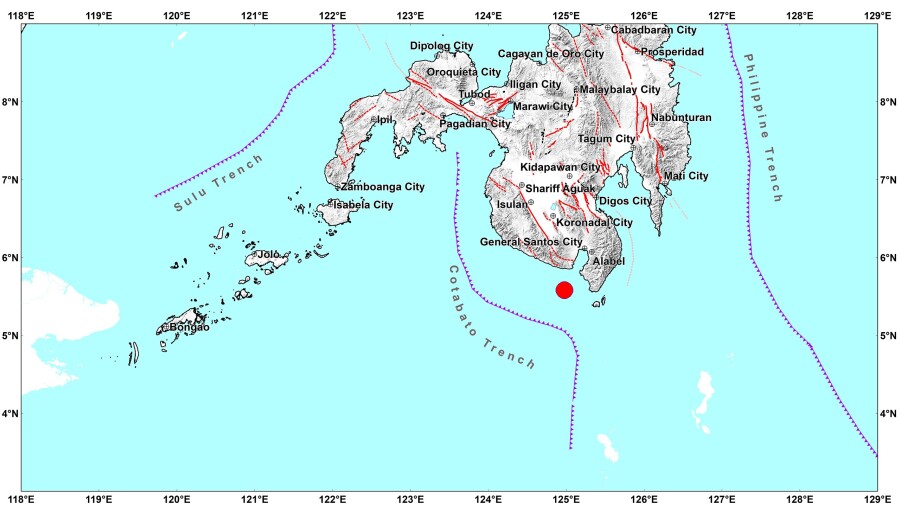
A magnitude-7.8 earthquake hit off Sarangani early on June 8, destroying buildings, disrupting utility services across parts of Mindanao, and forcing the suspension of classes and government work, Inquirer reports. The tectonic tremor struck at 7:37 am at a depth of 33 km, with its epicentre located 32 km south of Maasim.

The disaster highlights the extreme vulnerability of the southern Philippines to the Pacific Ring of Fire – where high-magnitude underwater quakes pose a dual threat of severe localized destruction and wider regional tsunami risks that can disrupt multiple Southeast Asian nations simultaneously. The timing is particularly damaging, paralysing the region on the official opening day of the school year.

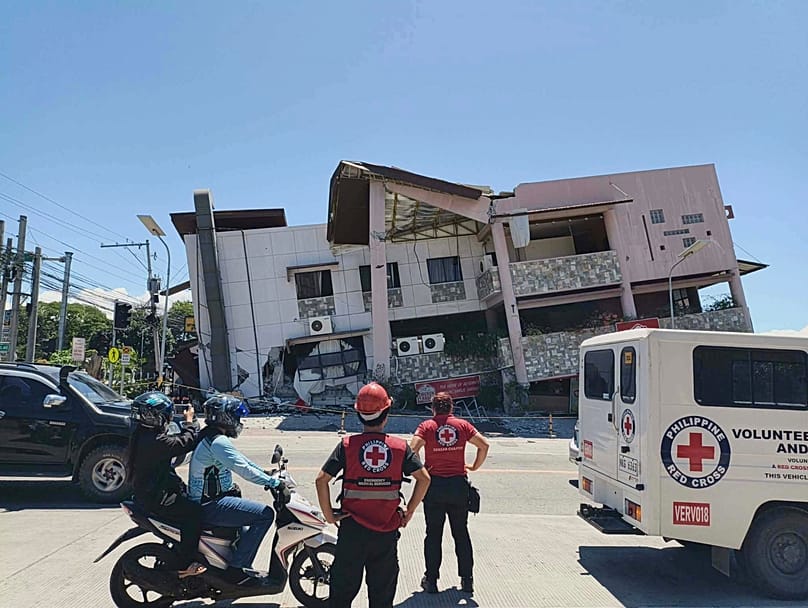
According to Aljazeera, footage on official social media channels showed a three-storey building housing a Jollibee restaurant collapsing in a cloud of debris in General Santos City. Other structures suffered smashed windows and caved-in roofs. The initial shock lasted roughly 30 seconds in Koronadal City, severing internet, electricity, and water networks. A magnitude aftershock followed shortly after at 7:49 am.

The Philippine Institute of Volcanology and Seismology (PHIVOLCS) registered the highest shaking at Instrumental Intensity VIII in Malapatan, Sarangani. General Santos City experienced Intensity VII, whilst Intensity VI hit Palimbang and Senator Ninoy Aquino. Intensity V shaking reached Davao City, Kidapawan City, Carmen, Bagumbayan, Kalamansig, President Quirino, Sibuco, and Siocon. Instrumental Intensity VII was also recorded in Koronadal City and Santa Maria.

The threat extended to regional waters. The Pacific Tsunami Warning Centre warned that coastal areas in the Philippines could face waves reaching up to 3 metres. Ocean swells of up to 1 metre were deemed possible along shorelines in Malaysia and Indonesia, prompting coastal safety alerts across the Philippines, Indonesia, and Japan.

President Ferdinand Marcos activated national crisis institutions, including the Office of Civil Defence and the National Disaster Risk Reduction and Management Council, on June 8. The premier urged immediate coastal evacuations to higher ground. Concurrently, Phivolcs instructed maritime operators to secure vessels away from the waterfront or remain in deep water offshore. No casualties have been confirmed whilst the evaluation of the disaster zone continues.

Philippines quake leaves at least 15 dead and 129 injured

Philippines quake leaves at least 15 dead and 129 injured
/ IntelliNews - SM screengrab
By IntelliNews June 8, 2026

At least 15 people have been killed and another 129 have been injured after a magnitude-7.8 earthquake hit the southern Philippines and northeast Indonesia early on June 8.

The quake hit at 7:37am local time off the coast of General Santos City on Mindanao, the Philippines' largest southern island. The Philippine Institute of Volcanology and Seismology has since said the earthquake occurred at a depth of 10km.

According to the BBC, officials from the Philippine Office of Civil Defense said 12 of the deaths were recorded in the Soccsksargen region, which includes South Cotabato, Sultan Kudarat, Sarangani and General Santos City. Rodrigo SosmeƱa, director of the local civil defence office, said at least 129 people were injured in the same region.

More than two dozen buildings, many of them commercial properties, were damaged by the earthquake. Images from General Santos City showed several collapsed structures, including a damaged supermarket and a branch of fast-food chain Jollibee.

Several countries across the region, including the Philippines, Indonesia and Japan, issued tsunami warnings following the quake, although most have since been lifted.

President Ferdinand Marcos Jr said he had directed all relevant government agencies to respond immediately, the BBC added, and urged residents in affected areas to move to higher ground.


7.8 magnitude earthquake rocks the Philippines, triggering tsunami warnings across region


By Emma De Ruiter
Published on

The strongest earthquake to hit the Philippines this year was centered at sea and caused damage in a key coastal city, knocking down power and setting off 1-metre tsunami waves along nearby coasts, officials said.

A 7.8-magnitude earthquake struck the southern Philippines on Monday, killing at least 19 people, collapsing buildings, and sparking tsunami warnings across the region.

Authorities in the Philippines and Indonesia urged residents in affected coastal regions to move to higher ground immediately, after the offshore quake hit about 24 kilometres west of Mindanao island's Sarangani province, the United States Geological Survey said.

The earthquake caused the collapse of at least one building in General Santos, a tuna-processing city of more than 700,000 people that is also a commercial hub in the south.

"As of now, there is one reported death and four injured. This is only an initial report," said Master Sergeant Robert Dagon of the General Santos City police.

"Many buildings were affected, but I cannot enumerate them now because we are busy with ongoing rescues," he added.

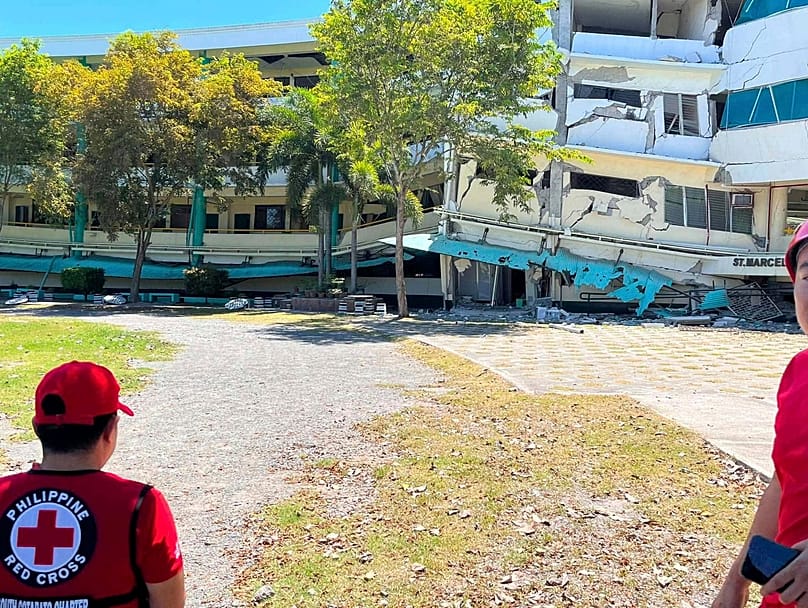
Videos posted to social media showed a shopping centre with a Jollibee fast food restaurant reduced to rubble in General Santos, while a school building that officials said was unoccupied crumpled in another city.

Philippine President Ferdinand Marcos suspended school classes in affected areas of Mindanao while calling on residents in coastal areas to evacuate immediately.

"Move to higher ground now. Do not wait," he said. "Your life is more important than anything left behind."

Tsunami warnings triggered

The powerful earthquake triggered tsunami warnings across several countries in the Pacific.

The Philippine Institute of Volcanology and Seismology monitored 1-metre waves in the provinces of Sultan Kudarat and Sarangani, and the Pacific Tsunami Warning Center (PTWC) said tsunami waves up to 3 metres were possible on some coasts of the Philippines.

The PTWC also said in a notice that tsunami waves were possible "within the next three hours" along the coasts of the Philippines, Indonesia, Palau, Taiwan and Papua New Guinea.

Rescuers inspect the damage after an earthquake in General Santos, 8 June, 2026 AP Photo

Indonesia's national disaster agency, meanwhile, instructed officials in the North Sulawesi capital, Manado, northern Gorontalo province and the Sangihe islands "to immediately direct their residents to evacuate in an orderly manner to higher ground".

Japanese authorities separately issued a tsunami advisory for swathes of its Pacific coast, projecting waves of up to one metre to hit different regions from 11:30am local time.

Malaysia’s Meteorological Department issued a tsunami warning for Sabah state on Borneo island and smaller sea changes were possible in Taiwan, Japan, Papua New Guinea and several island nations and territories in the western Pacific. An advisory for Guam was lifted about two hours after the quake and there was no threat to Hawaii, the PTWC said.

The strongest earthquake to hit the Philippines this year was was centered at sea about 13 kilometers (8 miles) southwest of General Santos and was caused by movement in the Cotabato Trench at a depth of 10 kilometers (6.2 miles), according to the Philippine Institute of Volcanology and Seismology.

Rescuers inspect the damage to Notre Dame of Dadiangas University after an earthquake in General Santos, 8 June, 2026 AP Photo


Aftershocks up to 6.5 magnitude followed, the U.S. Geological Survey said. It measured the original quake at 55 kilometers (34 miles) deep. Variations in measurements by different agencies are common in the immediate aftermath of an earthquake.

Earthquakes are a near-daily occurrence in the Philippines, which is situated on the Pacific "Ring of Fire", an arc of intense seismic activity stretching from Japan through Southeast Asia and across the Pacific basin.

Eastern Mindanao was rocked by a pair of earthquakes of 7.4 and 6.7 magnitude in October that killed at least eight people.


Scientists sound alarm on World Oceans Day as Trump axes deep-sea monitoring

The United States has removed hundreds of deep-sea instruments used to monitor the impact of climate change on marine environments, alarming scientists as the United Nations marks World Oceans Day.


Issued on: 08/06/2026 - RFI

A storm caused by the El Nino weather effect, in California, USA (illustration). 
AFP/MARK RALSTON

The development is the latest blow to environmental and climate research, which has faced repeated budget cuts implemented since US President Donald Trump began his second term in office in January 2025.

More than 900 deep-sea instruments anchored near the US Atlantic and Pacific coasts and in the Irminger Sea between Greenland and Iceland are to be removed from this month, according to a report last week in The New York Times.

The devices are part of the Ocean Observatories Initiative (OOI), a programme primarily funded by the federal government through the US National Science Foundation.

The $368 million (€319 million) deep ocean observation system began operating in 2016 and was expected to continue collecting data for 25 years, The New York Times report said.

The data has been used by researchers to study how the ocean absorbs greenhouse gases, how marine heatwaves affect fisheries and how ocean currents influence weather.

Pacific Ocean warming fuels fears of powerful 'super El Nino'

The process of removing underwater infrastructure at four of five active observation stations is expected to last 15 months and has already started at a location off the northwest US coast, Jim Edson, its lead scientist, said in a note to researchers in May, seen by French news agency AFP.

In a statement, the National Science Foundation said the programme was not being cancelled entirely and described the plans as a reduction of elements, though it was not clear what data collection capacity would be left.

It "aligns with NSF's wider strategy of a nimbler approach to prioritise support for evolving scientific priorities and emerging technologies," an NSF spokesperson said.

Dismantling the OOI would remove a major component of the Global Ocean Observing System (GOOS), a UN-coordinated framework for ocean data for weather and climate collected by several countries.
Ocean observations 'save lives'

Research published in Nature Climate Change last month showed how data losses in GOOS could degrade the ocean heat estimates that underpin things like El Nino forecasting and fisheries management.

Losing US observations would be worse than randomly losing 80 percent of all ocean data worldwide, this research found.

El Nino is a natural climate phenomenon that warms surface temperatures in the central and eastern equatorial Pacific Ocean, bringing changes to winds, pressure and rainfall patterns worldwide.

Sabrina Speich, an expert in global ocean monitoring at the Ecole Normale SupƩrieure (ENS) in Paris and co-author of the Nature Climate Change study told The Guardian newspaper that "ocean heat content is the most robust indicator of climate change we have - not just of what is happening in the ocean, but of the entire climate system."

Removing US observations alone would produce a 163 percent increase in error for annual ocean heating rates, the paper found.

As high seas treaty takes shape, Galapagos proves that protection pays off

Samantha Burgess, the strategic climate lead at the Copernicus Climate Change Service (C3S), the European Union’s Earth observation programme told The Guardian that ocean observations are "irreplaceable" because "we can’t see the deep ocean from space." They "save lives" by warning us of severe storms.

The World Meteorological Organization warned last week that there is an 80 percent chance of the El Nino phenomenon developing between June and August this year, bringing changes in winds, pressure and rainfall patterns worldwide.
'Reimagining' the oceans of the future

The topic of ocean warming is one of several addressed as part of the United Nations World Oceans Day on Monday, 8 June, under the theme 'Reimagine: Beyond the world we know, a new relationship with our ocean'.

Oceans cover 70 percent of the planet's surface and play a vital role in sustaining life, providing oxygen, feeding billions of people and hosting 80 percent of the world's biodiversity.

One of the biggest challenges is getting countries around the world to agree to a common legal framework to protect oceans.

The BBNJ Agreement - or High Seas Treaty is the first comprehensive, cross-sectoral ocean treaty in decades. Its full name is the Conservation and Sustainable Use of Marine Biological Diversity of Areas beyond National Jurisdiction.

Adopted on 19 June 2023, after more than 20 years of negotiations, it entered into force on 17 January 2026.

Despite this historic achievement, the UN says more efforts are needed to ensure the health and resilience of ocean ecosystems.

(with newswires)

Sunday, June 07, 2026

Trump officials' cell phone habits made them vulnerable to 'unhinged' spying campaign: NYT

Russia's President Vladimir Putin attends a meeting with U.S. President Donald Trump's special envoy Steve Witkoff and son-in-law Jared Kushner at the Kremlin in Moscow, Russia, January 22, 2026. 
Sputnik/Alexander Kazakov/Pool 


David McAfee
June 6, 2026 
RAW STORY

The New York Times on Saturday added significant new detail to a bombshell report first published by NBC News — and covered by Raw Story — revealing that the Pentagon has raised its counterintelligence threat assessment for Israel to "critical," its highest level.

The most striking addition: a senior U.S. official's characterization of what Israel has been doing. The aggressiveness of Israeli intelligence collection on top Trump administration officials, the official told the Times, has been "unhinged."

The Times also identified the specific American officials Israel is believed to have targeted: Steve Witkoff, Trump's chief Iran negotiator; Elbridge A. Colby, the Pentagon's top policy official; and Colby's deputy for Middle East policy, Michael P. DiMino IV.

The paper also reports American personnel in Israel found that software to intercept their communications had been installed on their phones.

That last detail underscores what officials described as a self-inflicted vulnerability. Senior Trump officials have routinely conducted national security business on personal cellphones, flown on private aircraft, and declined embassy staffing support abroad — habits that make them easy targets, according to the new report.

"The tendency of some senior Trump administration officials to fly on private aircraft, to conduct national security business on their personal phones and to reject staffing from U.S. embassies abroad made them especially vulnerable targets," a former senior official told the Times.

"Other current officials also acknowledged the use of personal cellphones by top American officials have made them easy targets for eavesdropping," the Times states.

Israel's threat designation now stands higher than any other U.S. ally and higher than some adversaries, the report notes. The Pentagon declined to comment. The White House called the account false. Israel's embassy said Israel "does not gather intelligence on American entities, let alone U.S. government officials."
ALBANIA

Foreign leader's excuse for hysteria 
PROTESTS spurred by Ivanka Trump raises eyebrows: report

Bennito L. Kelty
June 6, 2026 
RAW STORY


Protesters take part in a protest against a luxury resort plan by a company linked to U.S. President Donald Trump's son-in-law, Jared Kushner, on an environmentally sensitive part of the Adriatic coast, in Tirana, Albania, June 6, 2026. REUTERS/Florion Goga

A foreign leader's excuse for outrage caused by Ivanka Trump is raising eyebrows and doubt, according to reporting by The Daily Beast.

Albanian Prime Minister Edi Rama went to X to attack "all the endless media outlets" covering the hysteria over a luxury resort planned by Ivanka and Jared Kushner.

"Today's protest has drawn roughly 2,000 participants," Rama said. "It is the lowest turnout so far, but even at its peak, participation never exceeded 8,000 people."

However, protests have been taking place across Albania all week, the Daily Beast noted, as people decry the potential harm to the Balkan country's natural landscape.

Ivanka wants to develop a $1.4 billion resort on one of the country's uninhabited islands, Sazan, and develop hotels along a wildlife-rich coastline, the Daily Beast reported.

"How is it that what much of the world has seen over the past days appears so enormous, so dramatic, so overwhelming?" Rama asked in his post. "How could a tiny country become global news for reasons so disconnected from the reality on the ground?"


The real cage fight MAGA's going crazy for

Nick Anderson. 
Raw Story
June 4, 2026


Nick Anderson/Raw Story

Nick Anderson is a Pulitzer Prize-winning editorial cartoonist.
Chris Hayes says vulnerable GOP senator got 'sham vote' to look independent against Trump

Matthew Chapman
June 5, 2026 
RAW STORY


U.S. Senator Susan Collins (R-ME) speaks on behalf of one of U.S. President Donald Trump's judicial nominees during a Senate Judiciary Committee confirmation hearing on Capitol Hill in Washington, D.C., U.S., July 30, 2025. REUTERS/Elizabeth Frantz


Democratic Senate candidate Graham Platner has endured a brutal week of reporting on his personal history and unsavory interactions with women — issues that have left many people wringing their hands over the state of the race. However, MS NOW's Chris Hayes, who interviewed Platner earlier in the week, noted that Maine voters on the street largely seem unfazed.

Part of the reason, he suggested, is that there is genuine disgust with longtime GOP incumbent Susan Collins — despite their "reservations about his character."

"A lot of them ... really do not want to send Susan Collins back to the Senate," said Hayes. For all her posturing over the years as a dealmaker and moderate, she "is really a party line Republican" and "a rubber stamp for the Trump agenda during both terms."

"I also think Senate Republicans realize she's in trouble, right?" he continued. "I mean, this is a state that Donald Trump has lost three times. She managed to win in 2020, but she's got a real tough road ahead of her."

Because they realize she's in trouble, he continued, they organized a "sham vote" in the reconciliation bill for an amendment to formally restrict President Donald Trump's $1.776 billion "Anti-Weaponization" slush fund — and while the GOP voted it down, Collins and two other vulnerable Republicans were allowed to vote against it.

"Everyone knew that it was doomed to fail from the beginning," said Hayes, because Republicans would not let such a huge rebuke to Trump pass, even though his Justice Department is now claiming the fund won't go forward anyway. "They don't actually want to bar your money from being stolen from the government to pay off cop-beaters and seditionists. And so what they do is Collins gets to pretend to be independent when the stakes don't actually matter."

When they do, though, said Hayes, Collins reliably joins the party line — most famously being "the key vote to get Brett Kavanaugh on the Supreme Court" while falsely assuring voters he would never restrict abortion rights.


I LOVE YOU, SIR
Latest Trump retreat leaves Todd Blanche holding the bag as he faces disbarment: analyst


David McAfee
June 7, 2026
RAW STORY


Former U.S. President Trump walks alongside his attorney Todd Blanche in New York, New York, U.S., 30 May 2024. Mark Peterson/Pool via REUTERS/File Photo

President Donald Trump's decision to abandon his $1.8 billion IRS settlement didn't defuse the legal crisis surrounding it — it just shifted the target, according to a federal trial attorney who has been tracking the case.

Sabrina Haake, a 25-year federal litigator and political analyst who writes the Substack newsletter The Haake Take, argues that Trump dropped the so-called anti-weaponization fund not because of political pressure ahead of the midterms, but to avoid forcing the appointment of a third attorney general. The real threat, she writes, came from an extraordinary intervention by 35 retired federal judges.

On May 27, those judges — spanning both parties — filed a motion to reopen Trump's IRS case on suspicion of fraud against the court. Their motion accused the Department of Justice of deceiving U.S. District Judge Kathleen Williams by announcing a settlement publicly without notifying the court, then using that settlement as legal justification for transferring $1.776 billion in taxpayer money to Trump, his family, and his businesses while purporting to release all federal claims against them.

The judges called it "most egregious conduct involving a corruption of the judicial process itself," writing that the parties "used the proceedings before this Court as a legal pretext" while working to prevent the court from determining whether a legitimate case even existed. If Trump controlled both sides of the same case and personally profited from the outcome, the judges reasoned, there was no legal controversy — only theft.

At the center of it all is Attorney General Todd Blanche. Haake notes that Blanche moved to dismiss the case two days before a brief outlining the court's jurisdiction was due, and that he failed to assert basic defenses the DOJ was legally obligated to raise — defenses the department had previously asserted in a nearly identical prior case involving the same IRS contractor. His failure to mount any defense at all, the judges wrote, "only emphasizes the fraudulent nature of the settlement reached here" and "strengthens the conclusion that the litigation was collusive from the start."

Judge Williams ordered the DOJ to respond to the fraud accusations by June 14. Blanche will be editing that brief knowing that in New York, where he is licensed to practice law, committing a fraud upon the court is considered grounds for immediate suspension or permanent disbarment, according to Haake.

Stripping the larceny from the equation, Haake concludes, does nothing to resolve the underlying fraud finding. The money may be off the table. The judges' accusations are not.
'Newsflash— it's not working': MS NOW dumps more bad news in Trump's lap


Bennito L. Kelty
June 6, 2026 
RAW STORY


Reporter Jake Traylor slammed Trump's attempted 'distraction' from an ongoing affordability crisis (MSNOW/screenshot)

Trump sees his slate of D.C. vanity projects a "welcome distraction" from an ongoing affordability crisis, but MS NOW slammed the idea.

"Newsflash, it's not working," MS NOW reporter Jake Traylor said.

Traylor quoted a former White House official who said that Trump saw his reflecting pool, various fountains, and other projects as "a welcome distraction" from the ongoing war in Iran and an affordability crisis in the United States.

However, Traylor pointed to new polling that shows a meager 28 percent approval rating for the White House ballroom, a 21 percent approval rating for the triumphal arch, and 12 percent approval for putting his name on a $250 bill.

"Americans are not getting on board with this distraction," Traylor said. "Even if it is something that's working in the president's mind right now."


Military vet files federal lawsuit to stop 'deeply corrupt' White House UFC plan

David McAfee
June 7, 2026 
RAW STORY


A section of the UFC Freedom 250 stage during assembly on the South Lawn of the White House in Washington, D.C., on May 25, 2026. REUTERS/Nathan Howard


A Virginia political organizer and a military veteran filed a federal lawsuit Sunday seeking a court order to halt UFC Freedom 250, the upcoming mixed martial arts event planned for the White House South Lawn and Lincoln Memorial on June 14 — a date that is simultaneously the 250th anniversary of American independence and Donald Trump's 80th birthday.

The suit, reported by CBS News congressional correspondent Scott MacFarlane, calls the arrangement a corrupt transfer of public resources to a private business ally. "This plan is deeply corrupt," the complaint states. "The President is giving White and his company what none have enjoyed before: unfettered access to the White House and Lincoln Memorial to stage a private, for-profit sports event, with all the promotional and branding opportunities that accompany such access."

Dana White, the UFC's chief executive and a close Trump friend and ally, has publicly framed the event as a celebration of America's semiquincentennial. But the lawsuit notes that White has also admitted the event "was Trump's idea," and argues that UFC Freedom 250 is in reality "a celebration of the UFC's brand and the 80th anniversary of Donald Trump's birth" — and therefore does not qualify for the special permits that allow use of national monumental grounds.

Federal law tightly restricts private use of the South Lawn and Lincoln Memorial, both of which are national parklands administered by the National Park Service. Under the NPS's standard permitting regime, no special events of any kind, including sporting events, may be held on the South Lawn.

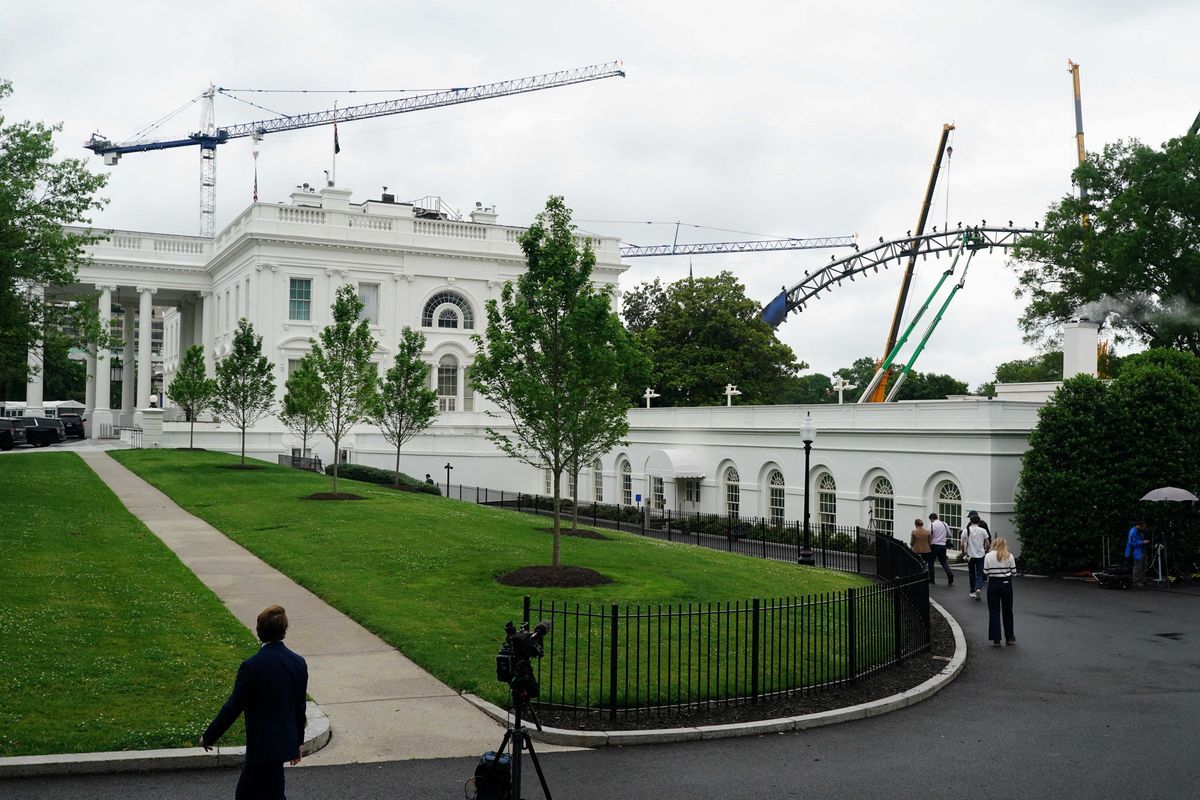
The physical footprint of the event is itself a subject of the lawsuit. The UFC has erected a 92-foot-tall, 600-ton steel structure on the South Lawn it calls "the Claw," which the suit says is "destroying much of the South Lawn in the process." Any structure on national monumental grounds, the complaint argues, must be expressly authorized by Congress and undergo a full National Environmental Policy Act review.

The commercial stakes are not being hidden. One UFC executive recently called the event "the greatest earned-marketing tool of all time." VIP packages are being sold for between $1 million and $1.5 million per head. Sponsors including Singaporean cryptocurrency exchange Crypto.com are among those with a financial interest in the event.

Trump has not indicated any intention to scale it back. In a TikTok video, he suggested the Claw might "never" be taken down, comparing it to the Eiffel Tower. "It was supposed to be taken down immediately after the World's Fair," Trump said of the Paris landmark, "and then they said, you know, we sort of like it."