Sunday, May 31, 2026

China’s economic growth leaves Japan in the dust.
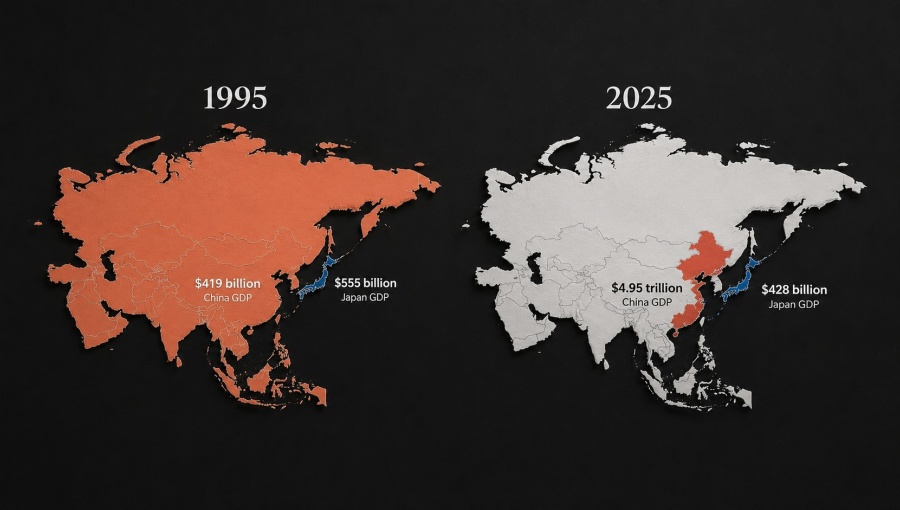
China’s economic growth leaves Japan in the dust.
Thirty years ago Japan's economy was bigger than all of Asia combined. Today it can't match China's three most prosperous regions. / bne IntelliNewsFacebook
By bne IntelliNews May 31, 2026

Thirty years ago in its heyday Japan’s economy was bigger than the whole of Asia combined. Today it is the size of just three Chinese coastal regions.

Japan has been the economic powerhouse of Asia for decades. Not any more as China’s economic growth sprints past it and is now the largest economy in the world in PPP (purchase power parity) adjusted terms. And China is not alone: the other big economies of SE Asia have been accelerating and are closing in on Japan, which has been suffering from a lost decade since its economic meltdown at the start of the 1990s.

In 1995, Japan’s nominal gross domestic product stood at roughly $5.5 trillion, accounting for around 18% of global output and making it the world’s second-largest economy.

Today, however, Japan’s economy is estimated at about $4.2 trillion -$4.4 trillion in nominal terms, having been constrained by decades of low growth, demographic decline and persistent deflationary pressures. By contrast, China’s rapid industrialisation and export-led expansion have transformed the balance of economic power in Asia.

China’s wealthiest coastal province, Guangdong, generated output of approximately CNY14 trillion ($1.9 trillion) in 2025. From the other rich regions, Jiangsu produced roughly CNY13.7 trillion ($1.9 trillion), while Shandong’s economy exceeded CNY10 trillion ($1.4 trillion). Combined, the three provinces generated more than $5 trillion of economic output, surpassing Japan’s entire economy.

The rise of the BRICS has seen all the emerging markets catch up and now overtake the more developed nations. China overtook Japan in 2010, while India has emerged as one of the fastest-growing major economies. Southeast Asian nations, including Indonesia and Vietnam, have also increased their share of global output as their economic growth also accelerates.

The trend is even more pronounced when measured using purchasing power parity (PPP), which adjusts for differences in price levels between countries. According to International Monetary Fund data, the BRICS+ (Brazil, Russia, India, China, South Africa, Egypt, Ethiopia, Iran, Indonesia and the United Arab Emirates) now accounts for a larger share of global GDP on a PPP basis than the Group of Seven advanced economies. BRICS+ economies represented more than 35% of global GDP on a PPP basis in 2025, compared with roughly 29% for the G7.

WAR IS ECOCIDE

Russia reports fuel facility fires in Saratov and Rostov after Ukrainian drone attack

Russia reports fuel facility fires in Saratov and Rostov after Ukrainian drone attack
Image from Ukrainian media. / bne IntelliNewsFacebook
By bne IntelliNews May 31, 2026

Fires broke out at fuel facilities in Russia's Saratov and Rostov regions after an overnight Ukrainian drone attack, with Russian and Ukrainian accounts differing over the extent of the damage, Russian and Ukrainian media reported on May 31.

In the Rostov region, a fuel storage facility belonging to a private company that supplies agricultural producers caught fire in the Matveyevo-Kurgan district, regional governor Yury Slyusar said, state media TASS reported.

He attributed the blaze to falling drone fragments following what he called an enemy air attack. A pharmacy, two shops, a vehicle and a gas pipe were damaged in the Matveyevo-Kurgan settlement, he added.

Ukrainian outlet UA News said Ukraine's armed forces had launched a large-scale strike on Russian energy infrastructure overnight, targeting facilities in the Saratov and Rostov regions and causing large fires.

It said a fuel facility near the Ukrainian border in Rostov had been struck directly, and that rescue workers had evacuated residents from nearby homes because of the risk of explosion and heavy smoke.

In Saratov, Ukrainian media said a series of explosions was heard during a nighttime drone alert, and that a local oil refinery owned by Rosneft, one of the oldest in Russia, had been hit.

It said footage posted by residents showed a column of black smoke and flames, with preliminary reports of damage to key processing units and no information on casualties.

Saratov regional governor Roman Busargin did not confirm a direct hit on the refinery, saying only that civilian infrastructure may have been damaged, Kyiv added. 

The accounts could not be independently verified by IntelliNews, but video footage of the events suggests that both accounts are correct in the strikes occurring. 

Kansas Fed Pres Warns Oil Price Shock Might Not Be Transitory

Federal Reserve Bank of Kansas City President Jeffrey Schmid has warned that the current global energy shock cannot simply be dismissed as transitory, given already-elevated baseline inflation. Speaking at a conference in Iceland, Schmid pointed out that inflation has stalled near 3% and remained above the Fed's 2% target for a long time, making it challenging for the central bank to "look through’’ surging oil prices. Schmid has argued that current monetary policy may not be restrictive enough, reinforcing his hawkish stance on monetary policy. Schmid has suggested that the Fed may need to consider utilizing its balance sheet as an additional tool to cool down the economy.

We're not very restrictive at this stage and I think there's some dialogue that we need to start considering what tools we have to really make it a little bit more restrictive depending on how the oil shock plays out in an environment of already high inflation," the official said. ‘‘Maybe we look at the balance sheet again as another tool to...create some restriction," he added, suggesting some sort of new drawdown in Fed holdings.

Despite high prices driven by geopolitical conflict, Schmid noted that U.S. energy firms are practicing extreme capital discipline and are reluctant to increase oil production due to price uncertainty.  However, Schmid has affirmed that whereas high energy prices are draining consumer purchasing power, the overall economy remains resilient, with steady growth and a balanced labor market.

Schmid’s warning comes hot on the heels of another hawkish stance by yet another Fed official. Dallas Federal Reserve President Lorie Logan recently warned that the world needs to cut its oil and gas consumption to keep energy prices down. Logan was one of three Fed policymakers who strongly objected to post-meeting statement language that hinted the Fed's next move would be an interest rate cut following the April 2026 Federal Open Market Committee (FOMC) meeting. Logan argued that forward guidance should accurately reflect the policy outlook, and that because inflation risks were elevated, an interest rate hike was just as likely as an interest rate cut.

By Alex Kimani for Oilprice.com


Kremlin wants “full partnership” with Afghan Taliban, military-technical deal signed

Kremlin wants “full partnership” with Afghan Taliban, military-technical deal signed
Afghanistan's TOLO News reports on the signing of the military-technical deal between Russia and the Taliban administration. / ScreenshotFacebook
By bne Eurasia desk May 31, 2026

Russia and the Taliban government in Afghanistan have signed a military-technical cooperation agreement, Russian news agencies including Interfax have reported.

The development comes two weeks after on May 14 Sergei Shoigu, secretary of Russia's Security Council, was quoted by Interfax as saying Russia – the only country in the world to formally recognise the Taliban government – was moving to establish a "full-fledged partnership" with the Islamic Emirate of Afghanistan and was encouraging other countries in the region to expand cooperation with Taliban-ruled ‌Kabul.

Shoigu reportedly said that cooperation with Taliban-ruled Afghanistan was important for the security and development of the wider region and that Moscow was building a "pragmatic dialogue" with the Taliban that ranged over areas including security, trade, culture and humanitarian support.

One matter of concern for Moscow is clearly Afghanistan’s border with the Central Asian countries of Tajikistan, Uzbekistan and Turkmenistan, with Afghanistan-based terrorist groups such as Islamic State Khorasan Province (ISKP, or ISIS-K) able to exploit porous parts of the frontier as part of terrorist operations that can extend to Russia. The Taliban, as an adversary of ISKP and other such terrorist groups, can help Russia address such difficulties. Beijing, meanwhile, is helping Tajikistan beef up its border with Afghanistan after five Chinese workers were killed last November by unidentified cross-border attackers.

The Taliban was outlawed by Russia as a terrorist movement in 2003, but the prohibition was removed in April 2025. The Islamist fundamentalists returned to power in Kabul in August 2021 after US and Nato troops exited Afghanistan.

Another likely ambition of Russia in working for a stabilised Afghanistan is to finally make the country a reliable interconnection between Central Asia and South Asia – the economic gains that could be achieved from having reliable railways, roads, energy pipelines and power lines running from landlocked Central Asia to Pakistan – a country with oceanic ports on the Arabian Sea that provide shipping options for much of the Global South – would be sizeable. As things stand, projects aiming to deliver all of these things are progressing, but only very slowly because of the instability that still prevails in much of Afghanistan. The Taliban, meanwhile, want to open up the Wakhan Corridor, which would give Afghanistan an operational border crossing with China, as reported by IntelliNews on May 19.

Russian media reported that the military-technical agreement was signed on May 27 by Shoigu and the Taliban government's Defence Minister Mohammad Yaqoob during a security forum held on the outskirts of Moscow. Yaqoob is a former military chief of the Taliban and the son of the group’s founder, Mullah Mohammad Omar.

The content of the agreement has not yet been disclosed by either party. That has led to speculation over whether the document represents a significant change in military cooperation or is simply a political posture.

Military-technical cooperation agreements can cover areas including arms sales, military training, technical maintenance, logistical support and technical assistance.

“In reality, we’re definitely not going to see a full-blown military alliance or a mutual defence coalition,” Ruslan Suleimanov, an analyst at the New Eurasian Strategies (NEST) Center, told The Insider.

"Russia's economy is under so much pressure right now that it can't afford to provide free military assistance to the Taliban government," Hamid Hakimi, a senior fellow at the Atlantic Council in Washington, was quoted as saying by Azattyk Asia.

Countries including China, Kazakhstan and Uzbekistan have established growing diplomatic, trade and economic ties with the Taliban, though they have stopped short of officially recognising its Afghan administration.

When speaking of aiming for “full-fledged” relations, Shoigu ‌was commenting during a meeting with his counterparts from the Shanghai Cooperation Organisation (SCO), a 10-member grouping that includes China, India, Iran, Pakistan and all the Central Asian states except Turkmenistan.

The SCO should revive its contact group with Afghanistan, said Shoigu.

Like Russia, Kazakhstan and Kyrgyzstan have ended their designation of the Taliban as “terrorist”.

Russia Signs Military Cooperation Deal With Afghanistan’s Taliban Government

  • Russia and the Taliban signed a military cooperation agreement, though neither side has disclosed the details or scope of the pact.

  • Experts say any cooperation is likely to focus on training, maintenance, intelligence coordination, and security issues rather than large-scale weapons transfers.

  • Both sides share concerns about Islamic State Khorasan (IS-K), which has emerged as a major security threat across Afghanistan and the broader region.

Russia and Afghanistan’s Taliban government have signed a military agreement, in a move that signals deepening cooperation between the sides, experts said.

The deal was signed on May 27 by Sergei Shoigu, secretary of Russia’s Security Council, and the Taliban’s defense minister, Mohammad Yaqub, on the sidelines of a security forum outside of Moscow, Russian media reported.

Neither side has released the text of the military cooperation agreement or offered details about its scope, making it difficult to gauge whether the deal represents a substantive shift in military cooperation or a symbolic political gesture, experts said.

Military-technical cooperation agreements can cover a wide range of activities, including arms sales, training, maintenance, logistics support, or technical assistance.

Experts said Russia’s ability and willingness to deepen defense cooperation with the Taliban is constrained by Moscow’s ongoing war in Ukraine and the crippling impact of Western sanctions on the Kremlin’s coffers.

“Russia is too economically stretched to provide free military aid to the Taliban government,” said Hameed Hakimi, nonresident senior fellow at the Atlantic Council, a Washington-based think tank.

“Meanwhile, the Taliban government does not have deep coffers to purchase such a quantity of military equipment, which would make it a consequential military trading partner in Moscow's eyes,” added Hakimi, who is also a senior research associate at ODI Global, a London-based think tank.

Any cooperation is more likely to focus on maintenance, coordination, or training rather than major arms deliveries, experts said.

Russian analyst Ruslan Suleymanov told The Insider, a Russia-focused, independent media outlet based in Latvia, that the deal is a political signal rather than a sign of imminent military support.

Expanding Ties

Russia is the only country that has formally recognized the Taliban as Afghanistan’s legitimate government. It did so in 2025, four years after the group returned to power following the withdrawal of US and NATO forces from Afghanistan in 2021.

Several countries -- including China, Kazakhstan, and Uzbekistan -- maintain diplomatic, trade, and economic ties with the Taliban without officially recognizing its government.

Russia has hosted Taliban delegations in recent years and positioned itself as a key interlocutor on Afghan security issues.

Moscow is particularly concerned about the threat posed to Russia and Central Asia, which it considers its strategic backyard, by militant groups such as Islamic State Khorasan (IS-K).

The Afghanistan-based extremist group claimed responsibility for a March 2024 assault on a packed concert venue outside Moscow that killed nearly 150 people, the deadliest attack in Russia in two decades.

Aleksandr Bortnikov, head of Russia’s Federal Security Service (FSB), warned on May 26 that IS-K remains one of the most active and dangerous terrorist organizations operating in Afghanistan.

Kabul's Search For Partners

For the Afghan Taliban, closer ties with Russia offer diplomatic and practical benefits at a time when the country remains largely isolated internationally.

Engagement with Moscow allows Kabul to signal that it is not entirely cut off from the international system and can secure partnerships with major powers outside the West.

“The symbolism of the agreement with Russia will allow the Taliban to claim external legitimacy and create a PR moment to influence public opinion domestically,” Hakimi told RFE/RL.

Ruling with an iron first, the Taliban is widely despised by Afghans. While it has brought relative stability to the war-torn country, the militant Islamist group has deprived many people of their basic rights, particularly women, and been accused of committing gross human rights abuses.

From Moscow’s perspective, the agreement fits into a broader effort to reassert influence in the region following the US-led military withdrawal from Afghanistan.

Moscow has sought to frame itself as a counterweight to Western policies. During the security forum on May 27, Shoigu reiterated Moscow’s calls on Western countries to unfreeze Afghan government assets held in foreign banks and accept what he described as responsibility for the consequences of their two-decade military presence in the country.

Earlier, on May 14, during a regional security meeting in Kyrgyzstan, Shoigu said Russia had built a “pragmatic dialogue” with the Taliban and was developing what he called a “full-fledged partnership” with Kabul, citing shared security concerns and regional stability.

By RFE/RL


WHAT DO THE TALIBAN AND PUTIN 

HAVE IN COMMON?!


Russian oil tanker arrives in Japan as Middle East supply concerns grow

Russian oil tanker arrives in Japan as Middle East supply concerns grow
Russian oil tanker arrives in Japan as Middle East supply concerns grow. / bne IntelliNewsFacebook
By bne IntelliNews May 31, 2026

A tanker carrying Russian oil has arrived at a terminal in Japan, with Japanese companies stepping up purchases amid disruption to Middle East energy supplies, Kommersant newspaper reported on May 31, citing state media.

The tanker Voyager delivered a consignment of Russian oil to a terminal operated by Japanese company ENEOS at the port of Kiire, according to ship-tracking services. Earlier in May, the same vessel had delivered oil from Sakhalin to Japanese firms Taiyo Oil and Idemitsu Kosan.

The delivery is a move that illustrates both the depth of Tokyo's long-term stake in Russia's Far East energy projects and the speed with which geopolitical calculations shift when 95 per cent of a country's oil imports are cut off at source.

Management at those companies said they had decided to buy crude from Russia to diversify their supply sources, while ENEOS said Japan's Ministry of Economy, Trade and Industry had requested additional alternative oil supplies due to the situation in the Middle East.

Japan stopped importing Russian oil after 2022, though Japanese companies occasionally buy small consignments from the Sakhalin-2 project at the authorities' request, linked to LNG supplies.

Japanese companies have begun buying Russian oil more actively due to disruptions in energy supplies from the Middle East. Japan depends on the region for more than 90% of its oil, much of which passes through the Strait of Hormuz.

Japan's Prime Minister Sanae Takaichi, speaking in Canberra on May 4 after talks with Australian Prime Minister Anthony Albanese, said the global oil supply squeeze was inflicting "enormous impact" on the Asia-Pacific region and that Japan and Australia would respond urgently to secure stable energy supplies.

Takaichi said Tokyo expected to have enough naphtha-derived chemical products to last beyond the end of the year after boosting imports from outside the Middle East.

Japan's broader response to the Hormuz crisis has included accelerated purchases from the United States and diversified naphtha imports from non-Middle Eastern suppliers.

The Voyager and Sakhalin cargoes is one element of a multi-front supply diversification, but it is the element that requires the most delicate political management, given Russia's continued war against Ukraine and Japan's formal alignment with the G7 sanctions coalition.


The magnet wars and how China still holds the keys to electric mobility

The magnet wars and how China still holds the keys to electric mobility
/ Michael Förtsch - UnsplashFacebook
By IntelliNews June 1, 2026

The global transition to electric mobility has run directly into a geopolitical choke point. While western carmakers rush to roll out new electric models, their production lines remain tethered to an extraction and refining network dominated by a single superpower, making the clean energy transition an arena of intense resource nationalism.

China still controls 90% of the global supply chain for the permanent magnets powering electric vehicles (EVs) produced by Tesla, Ford and General Motors, Autonocion reports. To help counter this, the US Department of War headed by Pete Hegseth signed a $96mn deal with Australian mining company Lynas Rare Earths to secure rare-earth oxides outside Chinese borders, the company announced from Sydney on March 16. The agreement establishes a coordinated allied price floor of $110 per kilogram for neodymium-praseodymium (NdPr) oxide to insulate non-Chinese processors from predatory state-backed pricing tactics used by Beijing.

This supply network makes up a significant geopolitical bottleneck for much of Western industrial EV and other sector strategy. The deal builds on previous efforts to establish a non-Chinese critical mineral pipeline for Western defense and automotive sectors. To this end, Washington executed a similar contract with California-based MP Materials on July 4, 2025, taking a 15% preferred equity stake via a $400mn investment, extending a $150mn loan and locking in an identical $110 per kilogram NdPr oxide price floor for 10 years.

The $110 minimum benchmark is now a Transpacific allied standard. Japan Australia Rare Earths, the procurement vehicle for Japanese industrial buyers, signed an updated contract with Lynas on March 16. The deal guarantees a minimum of 5,000 tonnes of annual NdPr oxide deliveries through 2038 at the same $110 level.

A typical motor under the hood of a 2026 Mustang Mach-E or Tesla Model Y carries one to three kilograms of neodymium-praseodymium-iron-boron permanent magnet. Preventing demagnetisation under hard acceleration requires 50 to 200 grams of heavy rare earths, specifically dysprosium and terbium. Yet no commercial-scale isolation of these materials happens inside US borders.

The Western pipeline

Physical chemical processing instead occurs at the Lynas Advanced Materials Plant in Gebeng, Malaysia, according to Autonocion. The 100-hectare facility houses three integrated processing areas: cracking and leaching, solvent extraction and product finishing. Samarium oxide production began at the plant in March, making Lynas the only commercial-scale producer of separated heavy rare earths outside China - and one much more culturally in tune with Beijing than Washington. The company reported quarterly revenue of AUD265mn ($190.4mn) for the period ending March 31, more than doubling its prior-year performance, with total rare-earth oxide production hitting 3,233 tonnes.

However, the Malaysian processing hub faces intense local and diplomatic friction. A coalition of 57 Malaysian civil society organisations sent an open letter to Prime Minister Anwar Ibrahim on April 13, opposing the deal because it directly links Malaysian soil to foreign military supply chains. The plant has generated low-level radioactive thorium-bearing residue since 2012, totalling 451,564 tonnes by 2018, according to the Malaysian Ministry of Environment, Science, Technology and Climate Change. The issue will be raised in the Malaysian Parliament in June, reported member of parliament Wong Chen.

Concurrently, Western carmakers face severe commercial pressure that pushes them toward cheaper Chinese components, Pulse Korea reports. Global trade disputes and supply chain risks drove component costs higher, forcing volume producers to review their sourcing. Hyundai Motor Group purchased KRW84 trillion ($55.4bn) worth of parts for its global production facilities last year, up 45% from 2021, while domestic plant purchases rose 31% to KRW42.8 trillion.

Chinese automotive components are routinely estimated to be over 30% cheaper than South Korean or Western equivalents due to automated manufacturing and massive economies of scale, according to Pulse Korea. To remain price-competitive, Hyundai installs battery packs from Contemporary Amperex Technology Co., Limited (CATL) in the Kona EV, while Kia uses CATL batteries in its Ray EV, Niro EV, EV5 and PV5 models.

This reliance persists despite regulatory blockades. The US Department of War designated CATL as a "Chinese military company" on January 7, 2025. This triggered Foreign Entity of Concern regulations, disqualifying any vehicle using battery components processed by enterprises with 25% or more Chinese state control from receiving federal clean energy subsidies. Consequently, CATL pivoted to asset-light technical licensing agreements, such as its intellectual property partnership with Ford in Michigan, while redirecting direct capital expenditures toward Europe and Southeast Asia, according to Fitch Ratings.

Commercial gravity VS geopolitical barriers

Where trade barriers are lower, Chinese-made vehicles dominate mass-market segments, Pulse Korea adds.

Tesla sold 25,409 units of its Model Y in South Korea between January and April, with most units manufactured at its Shanghai factory, according to data from the Korea Automobile Importers & Distributors Association. This single Chinese-built model outsold Kia’s EV5 at 10,192 units, the Hyundai Ioniq 5 at 7,625 units and even Hyundai’s bestselling Grandeur petrol sedan at 23,145 units.

The result is clear - competing effectively without Chinese suppliers is becoming impossible for traditional carmakers. Chinese automakers benefit from lower labour costs and integrated supply chains, allowing them to manufacture vehicles at costs roughly 30% to 40% below global competitors, said Kia Chief Executive Song Ho-sung, Pulse Korea reports.

The non-Chinese EV mineral map therefore remains a fragmented network of four incomplete nodes: the Mt Weld mine in Australia, the contested refinery in Malaysia, the Mountain Pass facility in California and a planned joint venture refining facility in Saudi Arabia with the Saudi Arabian Mining Company. The Pentagon's $96mn intervention moved the Malaysian node forward, but alternative supply chains are not yet operating at the scale required to break Beijing's market dominance, Nikkei Asia, indicates.


Morocco Is Emerging as a Renewable Energy Superpower

  • Morocco has expanded renewable energy capacity to roughly 5.5 GW and aims for renewables to account for 52% of its electricity mix by 2030.

  • Strong solar resources, supportive regulations, and foreign investment are driving major new solar and wind projects across the country.

  • The government is investing heavily in green hydrogen production and port infrastructure to become a leading supplier of low-carbon fuels for industry and shipping.

Morocco is rapidly becoming a renewable energy powerhouse thanks to its favourable weather conditions and proximity to Europe. The North African country has rapidly developed its solar energy sector and is now looking to become a major green hydrogen and sustainable shipping hub.

Morocco has long been heavily dependent on fossil fuel imports and continues to use coal to produce around 60 percent of its electricity. However, in recent years, it has been working to develop its renewable energy sources, with high levels of private investment in the sector supporting these efforts. The growth in the country’s green energy capacity is expected to help it tackle energy price volatility. The Moroccan government aims to achieve a 52 percent renewable energy share in the electricity mix by 2030 and 70 percent by 2050.

By the end of 2025, Morocco had an estimated 5.5 GW of operational renewable energy capacity, accounting for 45.4 percent of Morocco’s total installed capacity. This includes 2.1 GW of hydropower, 2.4 GW of wind power, and 961 MW of solar installations. In previous decades, Morocco has focused on expanding its wind power; however, with significant interest in the country’s solar sector, its solar power capacity is expected to rapidly increase in the coming years.

Morocco is highly suited to solar power installations, with one of the highest solar insolation rates in the world, at over 3,000 hours of sunshine per year. The North African country’s solar technology imports have risen by around 46 percent in the first quarter of 2026, demonstrating the growing interest in developing the sector.

The Moroccan Agency for Sustainable Energy (MASEN) has authorised approximately 66 renewable energy projects with a combined capacity of 6 GW since 2021. MASEN and the national utility ONEE are now jointly planning to add around 4.4 GW of renewable capacity by 2030, including 2.5 GW of new solar installations and 1.9 GW of new wind capacity. This will be achieved with support from private investors. Law 13-09, enacted in 2009, opened Morocco’s market to private developers, allowing them to develop renewable plants and sell electricity directly to consumers via the national grid.

Saudi Arabia's renewables developer ACWA Power has been awarded the Noor Midelt II and Noor Midelt III solar projects, each with a 400 MW capacity and a 602 MWh battery capacity. France’s EDF, Masdar, and Green of Africa were selected to construct the first stage – an 800-MW complex incorporating both PV and concentrated solar power (CSP) technologies.

In May, the Chinese Jinko Solar company announced plans to develop a 90 MW power plant project in Morocco. It will use Tiger Neo 3.0 modules that are designed for hot, extreme summer heat regions. The modules have advanced resistance to dust and sand, making them suitable for deployment in the country’s desert regions.

Morocco has attracted high levels of private investment in its solar sector, largely thanks to its proximity to Europe, as several countries aim to import clean solar power from the North African country, which is better suited to solar energy production. Several European powers are now looking to diversify their energy mixes more rapidly, as they have reduced reliance on Russian energy following Moscow’s invasion of Ukraine in 2022, and due to ongoing geopolitical issues affecting energy trade.

In addition to expanding its solar and wind power capacity, Morocco is aiming to become a global leader in green shipping. Global shipping contributes roughly 3 percent of total human-caused greenhouse gas emissions annually, a figure that is expected to rise as international trade continues to increase unless more is done to decarbonise the sector.

One of the most promising methods to reduce shipping emissions is the replacement of traditional shipping fuels with green hydrogen. Several factors make Morocco attractive to green hydrogen developers, including its advantageous geographic position, abundant renewable energy resources, and cost-effective hydrogen production potential.

In 2025, a Moroccan government committee approved green hydrogen projects valued at $32.5 billion to produce ammonia, steel, and industrial fuel. The government hopes green hydrogen – produced by splitting water through electrolysis, using renewable energy – will help it meet its domestic energy goals as well as boost exports to the European Union.

The Moroccan government’s strategic framework for developing the green hydrogen sector focuses closely on improving the country’s port infrastructure. One World Bank study analyses four key ports – Tanger Med, Mohammedia, Jorf Lasfar, and a port in the vicinity of Tan-Tan – that could all be vital to the success of Morocco’s green hydrogen ambitions. At present, Tanger Med, one of the world’s largest container ports, handles around 1.5 million tonnes of fossil-based bunker fuel every year. By shifting to green hydrogen, the port could provide a blueprint for other major ports to support more sustainable shipping practices.

By Felicity Bradstock for Oilprice.com