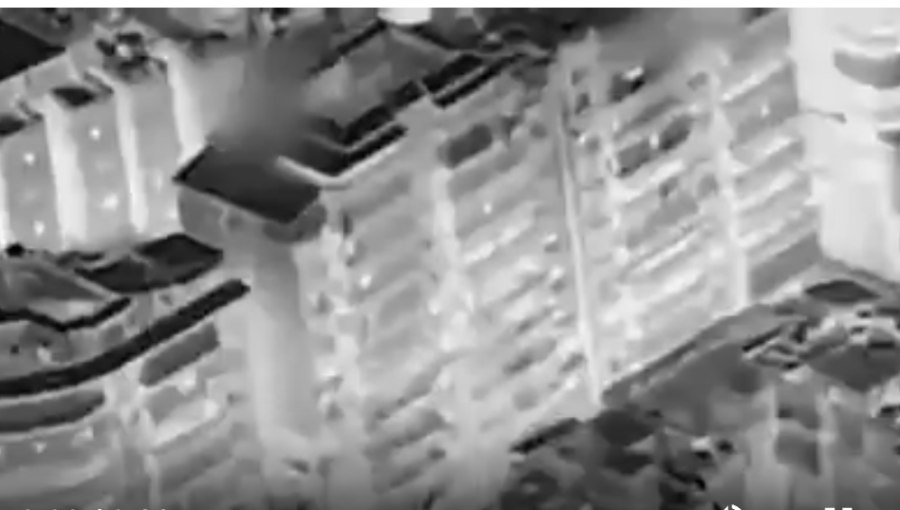
Israel is deliberately targeting residential buildings and populated areas in an attempt to depopulate southern Israel, according to reports.
This week Israel released footage of an attack on the southern Lebanese town of Yohmor showing a residential building in the middle of a built up area being totally demolished by Israeli missiles.
Israel has also been accused of dropping white phosphorus on residential areas in southern Lebanon setting towns on fire, which is illegal under international law.
Since the recent escalation of hostilities between Israel and Hezbollah on March 2, at least 217 people have been killed in Lebanon as of March 6, according to the health ministry, and hundreds of thousands have been displaced, Human Right Watch reports.
Israeli politicians have vowed to empty the south of the country up to the Litani river of its population and turn it into an Israel buffer zone protectorate.
The Litani River has long been central to Lebanon's fragile security landscape for years. Under UN Security Council Resolution 1701, which ended the 2006 war between Israel and Hezbollah, armed groups are barred from operating south of the river. Israel says Hezbollah maintains a significant presence there and has launched a major ground offensive following Hezbollah rocket attacks on Israel following the death of the former Supreme Leader Ayatollah Ali Khamenei on March 2.
Contrary to the UN Resolution, Hezbollah fighters are currently in south Lebanon and Israeli soldiers have been facing fierce resistance after crossing the border into the region. Israel has said it will seize southern Lebanon up to the Litani river to create a "buffer zone" against Hezbollah militants.
The Israeli military has issued displacement orders for the entire population of Lebanon south of the Litani River and all residents of Beirut’s southern suburbs, a Hezbollah stronghold, which also includes hundreds of thousands of people.
On March 4, Israel ordered all residents in the region to leave and said it has no intention of allowing them back in. Since then up to one million Lebanese have become internally displaced as they seek refuge to the north.
Since then, Israeli ground troops have set up new fortifications south of the river and are systematically destroying homes in emptied villages, in what some observers have called a repeat of the Israeli tactics used in Gaza, where bulldozers were used to systematically destroy houses and local infrastructure.
Defence Minister Israel Katz said on March 24 that Israel had destroyed five bridges over the river and that the military would, "control the remaining bridges and the security zone up to the Litani." He said troops would remain there as long as there is "terrorism and missiles", Reuters reported.
Commenting for the first time on Lebanon, Prime Minister Benjamin Netanyahu said on March 25 that Israel was "expanding this security strip to keep the threat of anti-tank weapons away from our towns and our territory… We are simply creating a larger buffer zone.”
Hezbollah says it is facing an "existential threat" to Lebanon and vowed to fight to prevent Israeli troops occupying the south. Hezbollah has previously used the region repeatedly to launch rocket attacks on Israel.
“The sweeping nature of the Israeli military’s displacement orders raises concerns that their primary purpose is not to protect civilians but to instead spread terror and panic, especially in the context of recent large-scale displacement of civilians in Lebanon, raising serious risks of the war crime of forced displacement,” Human Rights Watch said in a statement.
Iran targets Israeli’s Negev white phosphorus producer
Iran struck Israel’s only producer of white phosphorus chemical complex in the Negev desert, including facilities operated by Israel Chemicals Ltd (ICL) on March 26.
ICL Rotem is part of Israel’s largest chemicals company supplying industrial and defence-related supply chains. The extent of the damage and any casualties has not been independently confirmed.
The Israeli military unlawfully used artillery-fired white phosphorus munitions over homes in Lebanon on March 3, in the southern Lebanese town of Yohmor, Human Rights Watch said in a statement on March 8.
“The Israeli military’s unlawful use of white phosphorus over residential areas is extremely alarming and will have dire consequences for civilians,” said Ramzi Kaiss, Lebanon researcher at Human Rights Watch. “The incendiary effects of white phosphorus can cause death or cruel injuries that result in lifelong suffering,” the statement said.
Human Rights Watch verified and geolocated an image posted on social media the morning of March 3, showing at least two artillery-delivered white phosphorus munitions being airburst over a residential neighbourhood in the town of Yohmor in southern Lebanon.
Artillery shell bursts expelling felt wedges containing white phosphorus leave a distinctive knuckle-shaped plume, which Human Rights Watch researchers used to verify that Israel was again using the weapon over south Lebanon against civilian population centres in contravention of the rules of war.
The Iranian strike on ICL Rotem is likely to be in retribution for the Israeli attacks in Lebanon and to shut down the production of white phosphorus. The company produces specialty minerals and chemicals, including fertilisers, bromine, and phosphate-based products.
Human rights organisations, including Amnesty International and Human Rights Watch, have documented repeated cases in which Israeli forces used white phosphorus munitions in populated areas in Lebanon prior to the start of Operation Epic Fury. In statements cited by Human Rights Watch, witnesses in southern Lebanon described airbursts of white phosphorus over residential buildings.
Human Rights Watch has previously documented the Israeli military’s widespread use of white phosphorus between October 2023 and May 2024 across border villages in southern Lebanon, which put civilians at grave risk and contributed to civilian displacement.
Israeli authorities have said that their military lawfully uses white phosphorus in accordance with international law, primarily for creating smoke screens rather than as a weapon against civilians.
Human Rights Watch has urged Israel’s key allies, including the United States, the United Kingdom, and Germany, to suspend military assistance and arms sales to Israel and impose targeted sanctions on officials credibly implicated in grave crimes.
Protocol III of the Convention on Conventional Weapons is the only legally binding instrument dedicated specifically to incendiary weapons. Lebanon is party to Protocol III, while Israel is not.

No comments:
Post a Comment