Britain
Consequences of the local elections 2026
Friday 15 May 2026, by
The elections held in Cymru/Wales, England, Scotland were a mixed bag. Local elections in the United Kingdom were held on 7 May 2026 for roughly one third of the current incumbents: 5,066 English councillors for 136 English local authorities (all 32 London borough councils, 32 metropolitan boroughs, 18 unitary authorities, 6 county councils, 48 district councils) and six directly elected mayors in England. Most of these seats in England were last up for election in 2022. Some of these elections were postponed from 2025.
No local elections were held in the rest of the United Kingdom, other than two by-elections in Wales. The 2026 Scottish Parliament election, and 2026 Senedd (devolved assembly in Cymru/Wales) election were held the same day. In the Six Counties of the North of Ireland elections for the devolved Assembly and local elections will be held next year. [1]
The combined results have thrown the current UK government into turmoil. The Labour vote collapsed in Cymru “A Defeat Manufactured in Downing Street”, and continued its collapse in Scotland “Scottish Parliament elections: a balance between continuity and change”. In England the Labour Party was largely beaten by Reform UK Labour collapses, the far right grows. Labour Party members report a rarely-seen level of hostility to the Prime Minister, Keir Starmer, when canvassing the public. At least twenty per cent of Labour MPs have expressed their opinion that Starmer should go. There have been ministerial resignations including from Secretary of State for Health, Wes Streeting, with a letter attacking Starmer. Streeting is widely thought to wish to stand in a leadership election. During all this Starmer is continuing to insist that he will stay in office.
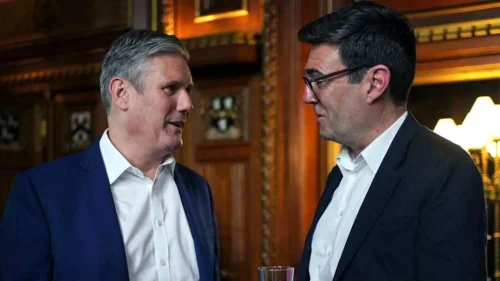
On 14 May, in a new development, the popular Mayor of Greater Manchester, Andy Burnham, announced his intention to seek the Labour candidacy for a bye-election created by a Labour MP who has announced he is resigning his seat precisely to give that chance to Burnham. Only if Burnham is back in the Westminster parliament can he provoke a leadership election.
Although the Labour National Executive Committee refused to allow Burnham to stand in a recent bye-election - resoundingly won by the Greens overturning a sizeable Labour majority - it is thought he will be allowed to stand this time. It is also a risky strategy as it is a constituency in which the far-right Reform UK made a clean sweep on 7 May and it leaves open the possibility that Labour will also lose the mayoralty. And the Greens have announced that they will fight the election, not standing aside to help Burnham win.
The following three articles look at these results from the different countries involved.
15 May 2026
Footnotes
[1] Photo: Keir Starmer and Andy Burnham.
Penelope Duggan
Penelope Duggan is a member of the bureau of the Fourth International and editor of International Viewpoint, and a member of the NPA in France. She is also a Fellow of the IIRE in Amsterdam with particular responsibility for women’s programmes.
Britain
Labour collapses, the far right grows
Friday 15 May 2026, by Simon Hannah
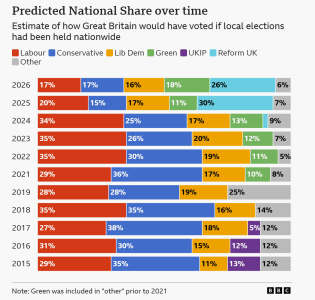
The elections across much of Britain on 7 May were a devastating blow to the ruling Labour Party who lost 1,229 councillors in England and also came third in the election for the Welsh Sennedd and lost support in the Scottish Parliamentary elections.
The Labour Party lost control of 38 English councils as well as the Welsh assembly. Wales has been a strong Labour base since the 1920s but this year they came third behind Plaid Cymru and Reform. In Scotland Labour was also beaten into joint second place behind the Scottish National Party and tying with Reform.
This was the first major test for the Labour government, elected in 2024 with a huge parliamentary majority after the Conservative government finally collapsed after years of scandals and internal crisis. Labour won a majority but had 2 million fewer votes than it got in 2019 when Jeremy Corbyn was the left leader.
Since winning power, Labour leader Keir Starmer has proven to be utterly useless; continuing the austerity agenda, attacking migrants rights, turning against transgender people and failing to tackle the housing or adult social care crisis. It has performed many U-Turns as policies have been proposed and then scrapped, including increasing inheritance tax on farmers, scrapping the winter fuel allowance for many pensioners and keeping the child benefit limit to two for each family, a policy that casts hundreds of thousands of children into poverty.
The Labour faction around Starmer are only good at one thing – purging the left. They won power by lying about the policies they would implement (which appeared relatively left wing), scrapping them all then going to war against the Labour left. Now Starmer’s future as leader looks very uncertain as many MPs blame him directly for the losses.
In power they have dealt with a huge growth of Reform, a far right party led by Nigel Farage, the leader of the Brexit movement 2015-19. Reform was only launched 3 years ago but has nearly 277,000 members. Their most popular policies are to prevent refugees arriving and to limit immigration more generally, but they also propose dismantling the welfare state and huge cuts to government spending, as well as financial deregulation to appease their main backers who are crypto-millionaires. They are also a climate change denial and anti-vax party as well as one that generally paints itself in the image of Trump.
But they now have competition to their right with Restore Britain who claim nearly 100,000 members. Restore are even more racist and reactionary, calling for mass deportations and ending asylum completely. They have started to win support in GreatYarmouth where their MP Rupert Lowe is based.
In the election in England Reform won 1,372 councillors and took control of 14 more councils. They are still the most popular party in the polls and would likely win the next general election, possibly in coalition with the remains of the Conservative Party.
The bright spot in the election was the success of the Green Party of England and Wales who have a new left- wing leader called Zack Polanski. Polanski has turned the fortunes of the Green Party around, with outspoken left policies aimed at tackling wealth inequality and the decline in living standards. The Greens membership grew from 90,000 to 250,000 within a year after he became leader, and has now largely filled the political space to the left of Labour. They won 577 councillors and took control of six local councils for the first time. Three of these were in areas where they had a history of organising, three – all in London – they subjected Labour ro surprising defeat
However ecosocialists are critical of the Greens as they are an entirely parliamentary party and as such are wedded to using the imperialist and deeply capitalist British state as the main vehicle for change. Their internal structures are very weak with local units hardly meeting and conferences being open to every member. No doubt the closer they get to power the danger of triangulation and compromise will appear, just as it did for the Labour party 100 years ago.
The failure of Your Party launched less than a year ago by Jeremy Corbyn and another former Labour MP Zarah Sultana, destroyed from within by internal faction fighting before it was even launched compounded by major undemocratic practices by Corbyn and his clique presents a serious problem for the radical left.
Despite having first past the post elections and not proportional representation in both English council elections and for the Westminster parliament – a system that has always favoured the two main political parties of Labour and Conservatives, - the UK is now increasingly a multi-party system. Pro-independence parties are running the administrations, in Wales and Scotland dominant while increasing numbers of areas in England went to the far right or the Green Party. 64 councils in the elections ended up in No Overall Control, meaning that no party got a majority.
Given the victories of the nationalist parties, there is a real possibility of the break-up of the UK in the next few years which would pose huge changes to the structure of politics and society on the British Isles.
This fragmentation of UK politics is the result of decades of neoliberalism and austerity, with declining living standards since 2008 and a general sense of decline. The Conservative party used 14 years in power to further impoverish and punish working people whilst the offensive against immigrants and refugees gathered pace. Labour was politically bereft of any meaningful ideas or radical differences from the Conservatives, with the exception of the Jeremy Corbyn years when the left briefly won control of the party. But the relentless attacks against Corbynism were deeply damaging and showed that the Labour right would never accept social democracy back into the party.
Now the hope for Labour is a soft left leader like Andy Burnham – currently mayor of Manchester. Burnham was one of the candidates defeated by Corbyn in 2015 and his re-emergence as a left leader shows how weak the Labour left actually is. His policy platform would be incredibly limited and continue to fail to tackle the main crises facing the country.
The threat of a far right government cannot be ignored or downplayed – a victory for Reform at the next election would be a strategic defeat for the working class.
12 May 2026
Simon Hannah
Simon Hannah is a member of Anti*Capitalist Resistance and author of several books on political activism in Britain.
Those were the words used by Mick Antoniw, former MS (Member of the Senedd), Counsel General in the Welsh Labour government and a senior member of the Labour Party in Cymru/Wales. He was describing the election on May 7 when Cymru underwent a change of historic proportions. [1]
The Labour Party, the party that has dominated every election in Cymru, both Westminster and Senedd, for the last 100 years, did not win either the most votes or the most seats in the Senedd elections. From a party with 29 seats out of 60 It has fallen to just 9 MSs [MS - Members of Senedd] in an expanded 96 member Senedd.
Its vote collapsed so dramatically that First Minister Eluned Morgan failed to win a seat in the Senedd. This is the first time an incumbent First Minister in any part of the UK has failed to retain their Parliamentary seat.
Labour was pushed into a poor third by Reform who won 34 seats. This is the first time Reform have won seats in the Senedd although far right parties (UKIP and the Brexit Party) have previously been represented.
Cymru will now be run by a minority Plaid Cymru government relying on agreements on specific policies with the Green Party, Labour and possibly Liberal Democrats. The Green Party has already indicated they will support Rhun ap Iorwerth, leader of Plaid Cymru for the post of First Minister. By coincidence Plaid Cymru was founded 100 years ago, the last time: Labour failed to be the largest party in Cymru.
Why did Labour collapse so spectacularly?
It has been clear for some time that Labour was in serious decline. The massive goodwill built up under former First Minister Mark Drakeford for more competent handling of the Coronavirus pandemic in 2020 – 2021 than the then Tory government in Westminster dissipated very quickly. Mark Drakeford stood down as First Minister and leader of the Welsh Labour Party in 2024 and was replaced by Vaughan Gething, the then Health Secretary.
Gething lasted barely 4 months before being forced to resign following a vote of no confidence in the Senedd followed by resignations from his cabinet by 4 ministers. Among other issues Gething was accused of lying to the Covid-19 enquiry, allegations which led to the breaking of the cooperation agreement in the Senedd with Plaid Cymru. In addition, he was accused of accepting £200,000 in donations from a recycling firm whose owner had prior convictions for breaking environmental protection legislation. In his most recent statement, Gething takes no responsibility for Labour’s disastrous performance.
Gething was eventually forced to go and was replaced by Baroness Eluned Morgan who was chosen unopposed. (Yes, the Labour Party in Britain is headed by Sir Keir Starmerr and, until a few days ago the Labour Party in Cymru was headed by a Baroness. Definitely the credentials for leading a party that claims to represent the working class.)
The entire affair left Labour surrounded by an air of sleaze and corruption, a perception that was already developing when Drakeford and Gething both accepted free tickets, flights and accommodation to watch Wales play in the 2022 football World Cup finals in Qatar.
When Keir Starmer became UK Prime Minister in 2024 Eluned Morgan expressed her belief that things would now go much better with Labour governments at both ends of the M4 (the motorway that runs from London to Carmarthenshire in west Wales). There had been considerable tension between various Tory Prime Ministers in Westminster, particularly Bosis Johnson and the Welsh government in Cardiff. Morgan’s hopes have been decisively shattered.
On a whole number of issues that politicians in Cymru consider important the UK Labour government has failed to deliver. Demands to give Cymru control over policing, justice and the Crown Estate have been rejected. Even though those powers are devolved to the Scottish Parliament.
The (now largely abandoned) HS2 railway line from London to the north of England was classed as an England and Wales project even though not a single inch of the line was within Cymru. Scotland and the 6 counties of “Northern Ireland” received compensation, Cymru got nothing. Even more bizarrely the new line between Cambridge and Oxford is also classed as an England-Wales project though neither Cambridge nor Oxford are anywhere near Cymru.
All of this is ignored by Cardiff East MP and Welsh Secretary in Keir Starmer’s cabinet who, writing in Wales Online on 11th May conceded a few mistakes made by the UK government but then argues that the party in Cymru “became distracted by causes that were miles away from the bread-and-butter issues that people care about the most”.
She cites the 20-mph speed limit and the planting of trees in Uganda, issues frequently taken up by Reform who basically deny there is any climate emergency. Uganda of course fits neatly into their racism.
Trees were planted in Uganda as part of the Welsh government’s commitment to combatting climate change: they have also been planted throughout Cymru. But Jo Stephens appears to have no idea of the threat that life on earth currently faces. The environment does not figure at all in her analysis. Despite it being the single most important issue that can only be met through an ecosocialist programme.
Stephens, who is generally regarded as being far more loyal to Starmer than to the people of Cymru, claims that people are “rightly cross about the rollout of 20 mph speed restrictions” echoing Farage and the Welsh Tories (who actually supported the 20 mph limit initially but changes their stance when they realized they could make political capital out of claiming to be the champion of “the motorist”), ignoring the reduction in deaths on the roads since the introduction of the 20 mph limit on some roads – not the “blanket” speed limit constantly lied about by the Tories and Reform. Nor does she mention the reduction in costs for the NHS because of the fall in the number of road traffic accidents. In effect she uses the issue of the 20-mph speed limit on some roads in urban areas in the same way as the UK government uses immigration – show you can out-Reform Reform. That has not exactly been a roaring success.
There are serious concerns about the state of the NHS in Cymru, problems in education and the cost-of-living crisis. According to Stephens, any time spent away from those key priorities was time wasted’. So, all the work done by the Labour government in Cymru to tackle the ecological crisis was “time wasted”.
Jo Stephens demeans the Welsh working class by claiming they are only interested in bread-and-butter issues. This is a working class that mobilized in support of the Spanish Republic, welcomed Paul Robeson with open arms, opposed apartheid in South Africa and is now opposing Israeli apartheid and supporting the Palestinian people. This is a working class that welcomed support from the lesbian and gay movement through Lesbians and Gays Support the Miners. And the women of this working class started the movement opposing the deployment of cruise missiles in their march from Cymru to Greenham Common.
Rise of Reform
Reform campaigned as if they were fighting a UK wide general election, Their main themes were get Starmer out (not an issue for the Senedd), stop the boats (again not an issue for the Senedd), “end the Nation of Sanctuary” and opposition to environmental measures, including the 20 mph speed limit which they cynically and dishonestly claim is a “blanket” measure. If this is a blanket, then it has far more holes than material since virtually the only roads affected are those in urban areas and not every local authority has applied the reduced speed limit to the same extent. Some urban roads remain at 30 mph, and others are in the process of reverting to a 30 mph limit. Others are 40, even 50mph though you would not know this from the constant denunciations of the “blanket” 20mph speed limit from Reform and the Tories.
There is no doubt that the 20 mph limit is unpopular among many motorists, but the reality is that it does save lives. Reform’s attitude is in any case hypocritical: there are towns in England run by Reform that have also introduced 20 mph zones. Reform (and the Tories) constantly complain about a “war on motorists” while totally ignoring the “war on the planet” resulting from the internal combustion engine.
In many parts of Cymru a car is a necessity for work, shopping, hospital visits, entertainment etc. Outside the major cities public transport is very infrequent and virtually non-existent after 19.00, if not earlier, Charging facilities for electric vehicles are few and far between though some authorities are now trialing gutters in the pavement to allow cables to be safely laid across the pavement making it possible for people to charge their cars at home. But the main solution is to fight for regular, accessible, preferably free public transport available at times when it is needed. Neither Reform nor the Tories have the slightest interest in that.
Reform have also been active in opposing plans for pylons to carry electricity from both onshore and offshore turbines. There is a definite case that all cables should be underground: it is not very environmentally friendly to change the environment dramatically with large number of pylons or turbines. Authorities need to discuss openly with people and work in conjunction with them to create an atmosphere in which working class people can implement the measures needed to fight climate change and other environmental threats. Since Reform are climate change deniers who support Trump’s “drill, baby, drill” threats to the planet they are only interested in the siting of pylons and turbines if they can gain support. Farage has even argued for the reopening of coal mines in Cymru and restarting the blast furnace at the steel works in Port Talbot: both of which are not only undesirable but almost certainly impossible.
“The Nation of Sanctuary” concept has been shamelessly misrepresented by Reform as allowing all refugees to come to Wales where they will automatically be provided with whatever they want. Asylum is not a devolved issue therefore any refugee coming to Cymru will have previously been vetted by the UK government. 95 percent of those accepted under the “Nation of Sanctuary” scheme are refugees from Ukraine. This has been made clear by the Ukrainian community in Caerffili who played an important role in defeating Reform in the byelection held in October 2025. Yulia Bond, a refugee from Ukraine, has continued this work on her Facebook page.
While the Left actively campaigned about Reform’s racism and its threats to the NHS it failed to challenge Reform on environmental issues. This needs to be rectified as the threat to life on earth is real and requires urgent measures to prevent extinction of much of life currently existing on the planet.
Reform put a lot of resources into the Senedd elections, with Farage visiting on numerous occasions. He even posed for photographs beside the statue of Keir Hardie in Aberdare claiming Reform were the real continuers of Hardie’s legacy. Some of Reform’s millions were used to pay for Vote Reform posters to be wrapped around local newspapers.
Reform also benefitted from the collapse of the Tory vote. The Tories did even worse than the Labour Party, winning only 7 seats. The nominal leader of Reform in Cymru is Dan Thomas who up until 2025 was a Tory councilor on Barnet Council and has a record of privatizing council services. It is still by no means certain that Dan Thomas even lives Cymru, thereby calling into question his election to the Senedd for Casnewydd Islwyn. In reality Nigel Farage is the leader: not surprising since Reform is not actually a political party but a limited company with a single owner, Nigel Farage,
Farage spent a lot of time in Cymru, especially the South Wales Valleys, the former industrial heartland of Cymru. However, Farage was nowhere to be seen when the election results were being announced. Reform had failed to win in Merthyr Tydfil despite a lot of effort and, just as he did when Reform failed to win the recent Caerffili by-election Farage disappeared from the scene. The only time Dan Thomas will be allowed to take charge will be when Farage is not satisfied with the result. In fact, even that much is not certain. The task of answering questions at weekend press conferences was given to Llyr Powell, the defeated Reform candidate in the October byelection in Caerffili.
Nevertheless, Reform did win 34 seats making them the second largest party in the Senedd. That is despite Farage referring to Cymraeg (the Welsh language) as ‘foreign’ (it has much older roots in Britain than English), one of his candidates having to withdraw because a photo emerged of him making a Nazi salute and the dissatisfaction amongst some Reform members of the number of ex-Tories who were being included as candidates.
Nor did they appear to suffer harm from the ten-year jail sentence handed out to their former leader in Cymru, Nathan Gilll, for acting in the European Parliament on behalf of Russia.
Stand Up to Racism, Cymru’n Codi (Wales Rising) and other organizations did put in a lot of work opposing Reform but clearly with limited success. We certainly cannot be complacent, hoping that after Reform prove they are incapable of running authorities then people will reject them. That is dangerous nonsense, ignoring the damage Reform will do to local services: perhaps not quite akin to the stupidity of the Communist Party of Germany who proclaimed ‘after Hitler our turn’ but dangerous nonetheless.
Green Party – Limited Success
In both England and Scotland the Green Party did very well but much less so in Cymru, though they did win their first Senedd seats in the 2 constituencies covering Cardiff.
There are 2 main reasons for their relative failure. Firstly, the campaign was very much pitched as a straight choice between Plaid Cymru. Nobody seriously believed Labour’s claims they were the only challenger to Reform and that affected the smaller parties even more.
Secondly, the D’hondt voting system used for the Senedd is probably the least democratic of proportional representation systems. People vote for a party and the party ranks their candidates in order of preference, so voters have only a limited say in who their MS is. Individuals are able to stand but they probably need to win 13-15% of the votes cast to win a seat. Each of the 16 constituencies elects 6 MSs. Given the enormous size of the constituencies, it is exceedingly difficult for individuals to win votes in places they are not well known.
Even someone as well-known as Beth Winter, former Labour MP who since the general election in 2024 has been holding community meetings in her locality alongside former Plaid Cymru leader Leannne Wood, failed to win a seat. Beth stood as an independent because of the failure of Your Party to stand candidates and was supported by most of the left in Cyrmru.
In fact, Plaid Cymru and Reform both won more seats (43 and 34 seats) than they would have done under a fully proportional system (34 and 28 seats). Labour would have won 11 rather than 9, the Conservatives 10 instead of 7, the Greens 6 instead of 2 and Lib Dems 4 instead of 1.
The outcome of the Senedd elections does not just have significant consequences for Cymru. It also has significant consequences for the United Kingdom. A Plaid Cymru led government in Caerdydd/Cardiff, an SNP government in Edinburgh and a Sinn Fein First Minister in Belfast means there will be parties opposed to the United Kingdom in office in three of its four components. (Though there is a difference in the roles of the First Minister in Belfast compared to Cardiff and Edinburgh. The post of First Minister in the Six Counties requires a Deputy First Minister from the other designation [that is Unionist]. Both posts are of equal status and one cannot take decisions without agreement from the other).
While Rhun ap Iorwerth, leader of Plaid Cymru, has been clear that he will not be pushing for a referendum on independence for Cymru during the first term of government, debates, decisions and events in Scotland and the six counties will also have an impact in Cymru.
In addition the Green Parties in Scotland and Cymru both support independence, as do many Labour voters in Cymru, and may be able to put some pressure on the SNP and Plaid Cymru governments whether or not they are a part of a formal coalition. There is a very good chance that the Green Party in Cymru will establish itself as a separate party, no longer part of the Green Party of England and Wales.
However there are also important differences between Plaid Cymru and the Green Party, in particular in relation to the M4 relief road near Casnewydd/Newport. This project was shelved by the Labour government of Mark Drakeford but arguments about it have been resurrected by Nigel Farage and Reform UK, closely followed by the Tories. While the Greens and the Labour Party remain opposed (as are the Lib Dems) Plaid Cymru is not rejecting the idea.
This could clearly impact on the ability of Plaid to cooperate with the Green Party - as well as calling into question Plaid Cymru’s commitment to The Well-being of Future Generations (Wales) Act 2015, designed to improve the social, economic, environmental and cultural well-being of Cymru for current and future generations. Increasing the amount of road traffic very definitely puts at risk the well-being of current and future generations of Cymri (the people of Cymru).
What is clear is there will be no return to the two party system that has dominated British politics since the end of the first world war. Nor is there any chance that the Labour Party will return to dominate politics in Cymru in the same way as it has for the last hundred years. Prior to Labour’s domination the Liberal Party was the dominant force in Cymru. Today they can only return 1 MS, even under a more democratic electoral system they would only manage 4. The total eclipse of the Liberal Party is a warning to the Labour Party is that unless they stop taking the working class for granted, unless they engage in discussion with the working class they will follow the Liberal Party into irrelevance.
Sadly, Your Party has failed to make much of an impression in Cymru. Your Party started in Cymru before England or Scotland, holding a meeting in Merthyr Tudful in October 2025. The meeting was organized by Beth Winter and Mark Serwotka and attended by about 300 people. Zarah Sultana attended in the afternoon while Jeremy Corbyn spoke via Zoom. Since that meeting very little has happened other than the election to the CEC, won by a hardline "The Many” supporter, Maria Donellan. A meeting to establish Your Party Cymru is scheduled for 18 - 19 July so a definite lack of urgency. Beth Winter has since pulled out of Your Party and Mark Serwotka also appears to have taken a back seat, possibly because of hostility on Facebook because of his reactionary views on trans people.
The best opportunity for building a left current that can challenge Plaid Cymru, Labour and Reform lies with Cymru’n Codi, an organization that brings together activists from a number of different parties and organizations, including Plaid Cymru and the Green Party. The name Cymru’n Codi references back to the Merthyr Rising of the 1830s, the first time the Red Flag was flown in Britain. Cymru’n Codi conducted interviews with several candidates for the Senedd: Heledd Fychan of Plaid Cymru, Tess Marshall of the Green Party and Beth Winter all of which are available on the Cymru’n Codi Substack site – only Heledd was successful in the election. Cymru’n Codi members have also been involved in drawing up a programme for People, Planet and Peace which is also available on the Substack site where it is contrasted with the manifestos of Plaid Cymru, the Green Party and Welsh Labour and points out how these manifestos all fall short of what is required to resolve the crisis of capitalism in favour of the working class and of the planet. This ecosocialist programme is kept under constant review and updated as and when necessary. I would encourage everyone to subscribe to the Substack site https://cymruncodi.substack.com/p/cymrun-codi-programme.
12 May 2026
Footnotes
[1] Graphic: By Danielmoreno4774 - Own work, CC0, https://commons.wikimedia.org/w/index.php?curid=174065061
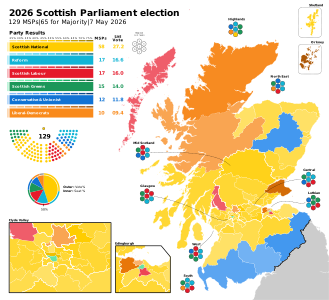
The Scottish Parliament elections on 7 May produced a balance between continuity and change. [1]
This Parliament, also known as Holyrood, was re-established in 1999 following a referendum and as part of Labour government of Tony Blair’s “devolution agenda” (designed to block moves towards independence). Scotland was an independent European state until union with the Englis state (incorporating Cymru/Wales as a “principality”) in 1707, but retained significant differences in education, a separate legal system and a separate Presbyterian church to the established Episcopalian Church of England (which the head of state/monarch and UK legislature are still tied to, despite massive decline in significance). Scotland had separate government departments for centuries and the electoral rise in the Labour Party in the early 20th century was part of a response towards “Home Rule” sentiment in Scotland. Labour abandoned Home Rule and became fully “unionist” after the 1945 war. In later years Labour’s unionism led to a transfer of working class support to the SNP that escalated in the last two decades. [2]
The independence-supporting Scottish National Party (SNP) [3] became the largest party for the fifth consecutive time since the Parliament was re-established in 1999, though it fell short of a majority. The SNP have been the largest party for 19 years and now move into their third decade of continuous leadership of the Scottish government - a remarkable outcome given the volatility of UK politics.
Despite the SNP falling back a little, the Parliament now has the largest majority supporting independence in the devolution era. This is despite the process of devolution and the electoral system being deliberately intended by the once-dominant British Labour Party to prevent independence.
While the right wing anti-immigrant party Reform UK has emerged as a significant force in Scotland for the first time, their gains in seats were entirely at the expense of the discredited rightward-moving Conservative & Unionist party [4], with the combined Reform UK and Conservative seat numbers being less than those held by the Conservatives alone in the last Parliament. Reform failed to win a constituency seat and had to rely on the regional list “top up” seats in the “two votes” electoral system.
The election was a disaster for the Labour Party [5] which had high hopes two years ago of emerging as the largest party, but they lost seats and fell to their lowest representation in the devolution era.
The big gainers were the left-wing Scottish Green Party [6], who nearly doubled their seats despite being ignominously bundled out of a joint governmental agreement with the SNP in the last parliament. The Scottish Greens won two constituency seats from the SNP for the first time in the largest cities of Glasgow and Edinburgh and won representation from all regions of Scotland. The small centre-right anti-independence Liberal Democrat party also grew but is still the smallest party in the parliament.
The SNP will continue to take the role of First Minister and nominate Government ministers as a minority, negotiating with other parties to get their legislation through. One policy of the newly re-elected government will be to demand another independence referendum from the UK Parliament at Westminster. This is very unlikely to be granted by the Starmer UK government majority, leading to a continuing “democratic deficit”. However the SNP will be strongly encouraged by the victory of Plaid Cymru [7] in Cymru/Wales to take control of government there and role of First Minister. The SNP are also working with Sinn Fein in the north of Ireland, once taboo due to Sinn Fein’s past and unionist sentiment in Scotland, but now becoming normal.
All three First Ministers and leading parties in the devolved legislatures of the UK state now support the break up and creation of separate states. The “Celtic Alliance” of the three First Ministers and parties, as it is increasingly called, will put significant pressure on the unionist forces in England. [8]
Similarities and differentiation across Britain
The separate elections took place across Britain on 7 May have provoked a crisis in the UK government of Prime Minister Keir Starmer that could see him ousted from power after only 22 months within days rather than weeks.
It is important to understand that although synchronous, the elections were to different bodies in different parts of the state in England, Scotland and Cymru/Wales, and even under totally different electoral systems and electorates. Unlike the Westminster Parliament, both Scotland and Cymru/Wales use systems for their national-devolved legislatures that are more proportional and give votes to 16/17 year olds. The electorate in Scotland includes all nationalities, the only part of the UK state where all immigrants are enfranchised.
But the common features across the UK state were a massive collapse in votes for the Labour Party compared to the UK general election in 2024, a continuing rise in support for the right wing Reform party of Nigel Farage, emerging from the Brexit Party, and a rising challenge to the Labour Party by parties setting out policies to the left of Labour or posing a radical challenge to the UK state union.
However these challenges to Labour were differentiated across different parts of the UK state - in England from the Green Party of England & Wales (GPEW) winning 5 councils and hundreds of councillors, in Scotland from the Scottish National Party (SNP) and the left wing Scottish Green Party (SGP) in Parliament, and, most dramatically, in Cymru/Wales from the left social democratic/nationalist Plaid Cymru that replaced a century of Labour domination and their 27 year uninterrupted leadership in the devolved legislature, Senedd Cymru.
There were no elections in the part of the north of Ireland occupied by the UK state, where Sinn Fein, the former political wing of the IRA, have emerged as the largest party in elections in recent year, reinforcing the fractures within the UK state on national lines. Elections will however take place for the Northern Ireland Assembly and local councils there under a more proportional system (Single Transferable Vote - STV) in May 2027 and for all the local councils in Scotland and Cymru/Wales, as well as for some councils in England. Scotland also uses the STV election system for council elections, while Cymru/Wales and England still use the less representative ’first past the post’ system for local councils.
A further fracturing and crisis of the political system into multi-party, multi-national politics in the 2027 elections and the multiple by-elections anticipated is likely to put pressure on the UK government, whoever is at the helm by then.
The results
Scottish Parliament Election results in seats (previous results in brackets from 2021)
Party Seats Vote Share Constituency / List (figures in brackets 2021 election)
SNP 58 seats (64), 38% (47%) / 27% (40%)
Labour 17 seats (22), 19% (22%) / 16% (18%)
Reform UK 17 seats (-), 16% (-) / 17% (-)
Scottish Greens 15 seats (8), 2% (1%) / 14% (8%)
Conservative 12 seats (31), 12% (22%) /12% (24%)
Liberal Democrat 10 seats (4), 11% (7%) / 9% (5%)
Unlike the UK Parliament, the Scottish Parliament is elected under an Additional Member System that resembles that used in Germany, where voters have two votes: one for a traditional ’first past the post’ constituency candidate and one for a party list top-up regional election that brings a stronger element of proportionality than the winner-takes-all Westminster system.
The SNP won the lion’s share of the constituencies taking 57 out of 73 seats, largely due to a significantly divided opposition. The SNP constituency vote however declined by 9.5% percentage points to 38.2% from the last election in 2021. Due to its domination of the constituencies, in the regional party list elections the SNP only took 1 list seat, with many SNP voters switching to other parties, particularly the Scottish Greens. But the net effect was to give the SNP a clear large lead over other parties, but short of a majority. The SNP have led a minority government on 3 of the last 4 occasions since 2007, only winning a narrow and supposedly impossible majority in a somewhat ’freak’ election result in 2011 that has yet to be replicated.
While Reform UK took 17 list seats and entered the parliament for the first time as joint largest party, this was entirely at the expense of the collapsing Tory vote. The Tories were originally a more liberal party in the Scottish Parliament, even supporting SNP budgets and advocating increased spending commitments while presenting a pro-LGBTQI image, but the process of Brexit transformed the situation and the Tories in Scotland followed their party at Westminster in moving rapidly rightwards and embracing anti-immigrant sentiment. However the Tories lost much support to the more media-savvy, more right wing populism of Nigel Farage’s Reform UK, particularly given the relentless promotion of Farage and scare-mongering against immigrants in the London-based media that Scottish unionism looks to.
The entry of the 17 members of Reform UK of a populist far right anti-migrant party into the national parliament will have a significant effect on Scottish politics. Reform UK have promoted far-right street protests against asylum seekers. Reform UK are opposed to efforts to stop climate change through development of sustainable energy. They will aim to move politics to the right. Yet, most Scots realise migration is needed to tackle an aging population and populate jobs in the economy and public services. North Sea oil and gas is nearly exhausted and due to its large land mass, Scotland is well placed to expand wind, wave and hydro sources of cleaner energy. The SNP have declared they will attempt to isolate Reform UK MSPs. Overall the combined right wing anti-immigrant parties have less seats than the previous parliament and there is a big 10 percentage points difference in electoral performance of Reform UK in Scotland than England.
The Scottish Greens were criticised from their left for standing in only six constituencies and concentrating on the list vote. The Scottish Greens are a decentralised party however, and decisions about where to stand were made in local branches. Against all the odds, the Scottish Greens took two constituencies/direct mandates, defeating two SNP ministers, and topped the list poll in five constituency areas in Glasgow and Edinburgh. Across the Glasgow region as a whole the Greens exceeded 20%, beating Labour and coming a narrow second to the SNP in what was previously regarded as Labour heartland (Labour ran Glasgow council for over 40 years from the 1970s and won all 7 Westminster seats in 2024).
The left of the left
Outside of the Greens, Labour and SNP, the left challenge completely floundered. The Scottish Socialist Party (SSP) contested the list vote in all eight regions in its own name for the first time since 2011, but its vote was minuscule (only 0.37%). The SSP was a significant force in the early days of the parliament, winning 6 seats in 2003 election and over 10% in Glasgow region. The SSP included most of the left groups to the left of Labour/SNP, but split badly over the leadership of its maverick biggest personality Tommy Sheridan, and has diminished to a small group of highly committed activists with a lost direction. Sheridan tried to reinvent his career by standing for a motley cobbled-together ’independence’ coalition arising from the ruins of the former Alba Party formed by former SNP leader Alex Salmond. Alba had turned to transphobia and the right, and has since collapsed. The Sheridan coalition also won less than 1% of the vote wherever it stood, as did the few candidacies by the George Galloway’s Workers Party and the remnants of the Militant Tendency/CWI and the Communist Party.
Despite an enthusiastic response and big conferences, the new party launched by former Labour MPs Jeremy Corbyn and Zarah Sultana has totally collapsed in Scotland and did not stand or support any candidates. Named ’Your Party Scotland’, the 300 strong conference in Dundee in February decided to form a separate but linked Scottish Party, to support Scottish independence and to contest the elections. A sizeable contingent including three councillors from the Scottish Green Party in Glasgow had joined Your Party Scotland, alongside a wide range of other left wingers who reflected the consensus by the vast majority of the radical left to support independence. But these moves to a new Scottish party were blocked by the England based clique around Corbyn supporters, despite claims to respect ’autonomy of nations’. This finally collapsed in April when it became clear candidates would not be permitted to stand and that a unitary party with the Scottish members constituting a ’branch office’, reflecting UK Labour practice, was inevitable. All the leading members of Your Party Scotland resigned, declaring it a failure, and are now engaged in a process around developing a new initiative.
The challenge ahead
In many respects the election campaign was dull. Despite their claims of being progressive, the SNP promised an element of continuity with little in the way of new thinking around tired and struggling public services. Their one radical policy - price controls over basic goods - was treated as undeliverable by the media. UK Labour threw massive spending on advertising, focussed on a presidential style campaign for their leader, Anas Sarwar, much of it funded by commercial interests and Labour supporters in England. Yet Labour failed due to the massive disillusionment among those who had voted Labour in 2024 to rid the UK government of the 14 year reign of Tories. While independence is a major cleavage in Scottish population, it’s mainly the Tories who raise it , unsuccessfully for them, as an electoral issue. Similarly with Brexit. The climate and ecological crisis was not a major feature - the main issue was the impact of the cost-of-living crisis and the failure of the UK government to tackle it.
The general feeling of voters was summed up in the old Scots language word "scunnered", meaning discontented and bored. Turnout was down ten points on the previous election to 53% - it had previously been higher than UK Westminster elections, though the electorate for Scottish Parliament elections is significantly larger due to the more inclusive electorate. The Greens tried to develop alternatives, for example by promoting an immediate policy of free bus fares to tackle both climate and poverty and having previously championed (and won) free bus travel for those under 22. But both the SNP and Greens present cautious social democratic incrementalism rather than radical change. It is Reform who are presented as the disruptors and their support mainly comes from a minority of disillusioned working class former Tory and Labour voters looking for scapegoats in the crisis.
Despite winning its largest ever Scottish Parliament majority, the movement for independence remains stalled. The Westminster UK parliament veto over a second independence referendum, established by the UK Supreme Court in 2023, remains in place. The focus on the day-to-day cost of living pressures makes it unlikely a successful mass movement for rupture will re-emerge in the short term, though the constitutional divide remains a significant cleavage, demonstrations regularly occur and polls put support for independence at 50-55%, rising to 60% if Reform UK came to power at the next Westminster election. The broader coalition against the union state is given a boost by the victory of Plaid Cymru and the liaison with Sinn Fein, though all three parties adopt constitutional gradualism and compromise with capital, relying on changing generations rather than mass mobilisation and rupture.
The SNP did put forward a radical policy in their manifesto - price controls over basic goods by the end of the year in the face of rapidly rising inflation due to war and trade. The Scottish Greens may pressure the SNP to make that policy more meaningful for a working class bearing the brunt of an economic crisis. The trade unions, increasingly disentangled from their Labour Party heritage, may support mobilisations and increase defensive actions incl.uding strikes. However, the powers of the Scottish Parliament to impose widespread price controls may be limited by the UK government using a post-Brexit Tory law over the UK internal market and their powers over fuel pricing and taxes. A confrontation over the right of the Scottish Parliament to take such measures is possible.
Whatever happens in the crisis of Labour at Westminster and the threat of a Reform victory in the UK government, there are some positives in Scotland in building a fightback.
14 May 2026
Footnotes
[1] Graphic: Par Talleyrand6 — File:2026 Scottish Parliament Election Map.svg, CC BY 4.0, https://commons.wikimedia.org/w/index.php?curid=191646626
[2] The Scottish Parliament covers a population of over 5 million and has very significant legal and constitutional role and a large annual budget of around £60 billion sterling and including some taxation measure, control over many public services like health, education, transport, aspects of social security benefits, local government, police, courts and prisons.
Importantly the UK government retains control over oil and gas industries in the North Sea and the energy infrastructure, though the Scottish government are able to use devolved planning powers to oppose fracking and the construction of new nuclear power stations, and to promote renewable options particularly wind farms. The Scottish government has deviated significantly from some UK state policies, for example abolishing university tuition fee and health prescription charges, adopting more progressive income tax measures, not breaking hospitals and schools into semi-independent “trusts”, and expanding social security benefits targeted at the poorest.
[3] The Scottish National Party, normally abbreviated to SNP, was formed in the 1930s combining a conservative layer with radical middle class support for Scottish identity. In the late 1960s and early 1970s it emerged as a significant electoral force and declared it was in the “mainstream of European social democracy” though without the formal links to the trade union bureaucracy enjoyed by Labour and most social democratic parties. It first became the largest party in the Scottish Parliament in 2007 and in 2011 won a “freak” majority of seats that resulted in the independence referendum of 2014. While losing the referendum, the SNP emerged as the strongest electoral force with a mass membership five times that of Labour, but it fell back in the UK general election of 2024 and was widely presumed to being on its way to being replaced by Labour as largest party.
[4] The Conservative party in Scotland organises under the formal title of “Scottish Conservative & Unionist Party” but is also widely known as “Tory” or “the Tories”. It was originally a separate party but merged with the Conservatives in England & Wales in the 1960s. The “Unionist” label in its title originally referred to opposition to Home Rule in Ireland and many of the party’s supporters had strong links with the unionist/loyalist block in the north of Ireland, including the sectarian protestant-supremacist Orange Order dedicated to preserving Protestantism within the UK state. The party has not won an election in Scotland since 1955, but became the second party in the Scottish Parliament in 2016. In recent years it has collapsed and many of its activists and voters have defected to the newly established and more rightwing Reform UK of Nigel Farage. However, both parties support Brexit, the UK leaving the EU, which is very unpopular in Scotland where support for EU membership runs at over 75%.
[5] The Scottish Labour Party was established by Keir Hardie in the 1880s, predating the Britain-wide Labour Party and supported “Home Rule” within the UK state - most domestic policies being controlled by national parliaments with only defence and foreign policy being coordinated at UK level. However it has now become a fully fledged unionist party and its opposition to independence and alignment with Tories in a “Better Together” campaign in 2014, led to a mass exodus of voters and members to the SNP. Its central strategy to head off independence moves from the UK state in the 1990s was to create significant “devolution” though keeping many powers at the level of the UK state. While it has some elements of a notional “autonomy” within the British Labour Party, under its current leadership of Anas Sarwar it had aligned itself with the leadership of Keir Starmer in London winning 37 out of 57 Westminster seats in the UK general election in 2024 mostly from the SNP. Following its electoral collapse in 2026 and plummeting support for Starmer across the UK, there are some marginal voices calling for it to become an independent party.
[6] The Scottish Green Party [SGP] was formed in 1990 and is entirely independent from the Green Party of England & Wales/Plaid Werydd and the Irish Green Party which operate elsewhere in the UK state. It sits on the left of Green Parties internationally and long supported Scottish independence. It has formally adopted "ecosocialism" as its ideology and increasingly uses that term to describe its politics. It is opposed to membership of the NATO alliance but supports Scottish membership of the EU when it becomes independent. It has supported the Ukraine Solidarity Campaign in Scotland and endorses Ukraine’s right to defend itself against Russia’s aggression rejecting pacifist pressures. It is strongly anti-monarchy. It entered into a governmental agreement with the SNP in the Scottish Parliament in 2022, taking two ministerial roles in the government, but its support for trans rights and opposition to an abandonment of climate targets by the SNP generated tension between the SNP and SGP and it was unceremoniously bundled out of the government by the SNP. For many Green activists the SGP was too uncritical of the SNP, and a new leadership was elected in 2025 that takes a slightly more critical tone. Other parties argue the SGP is just a satellite of the SNP. The SGP broke off relations with the Green Party in England over disputes about trans rights and recognition of devolution, but following the election of Zack Polanski as leader in England and his advocacy of Scottish and Cymru/Wales independence, there has been a convergence and closer working.
[7] Plaid Cymru “Party of Wales” was established in the 1920s and was heavily involved in the revival of Cymraeg/Welsh Language in the 1960s, though remained only a minor or fringe party confined to Cymraeg speaking areas until recently. It has long had informal relations with SNP though it does also define itself as a party of “decentralised socialism’” rather than nationalism per se.
[8] This Alliance includes the North of Ireland in which no elections were held this year. Stormont, the devolved Assembly, will be re-elected next year.
Mike Picken
Mike Picken is an activist of Ecosocialist Scotland.
.png)
.png)

No comments:
Post a Comment