Monday, January 24, 2022


German Catholic priests come out as queer, demand reform

Over 120 priests and employees with the Catholic church community in Germany came out as queer and launched a campaign demanding an end to institutional discrimination against LGBTQ people.

LGBTQ Catholics in Germany have launched an "'OutInChurch' initiative to call for support

The Roman Catholic Church in Germany on Sunday faced renewed calls for better protection of LGBTQ rights and an end to institutional discrimination against queer people.

Around 125 people, including former and current priests, teachers, church administrators and volunteers, identified themselves as gay and queer, asking the church to take into account their demands and do away with "outdated statements of church doctrine" when it comes to sexuality and gender.

The members of the church community published seven demands on social media under the "OutInChurch" initiative. These demands range from queer people saying they should be able to live without fear and have access to all kinds of activities and occupations in the church without discrimination.

They said their sexual orientation must never be considered a breach of loyalty or reason for dismissal from their occupation. They ask the church to revise its statements on sexuality based on "theological and human-scientific findings."

Besides asking for equal rights, employees also put down demands that the church takes accountability for their discrimination against people of the community throughout history, calling on the bishop to take responsibility on behalf of the church.

What has been the Vatican's stance?

The Vatican, home of the pope and the Roman Catholic Church, ruled last year that priests cannot bless same-sex unions and that such blessings weren't valid.

But the ruling also reignited a debate on the matter, and there was considerable resistance against it in some parts of Germany.

Last year, at least two bishops in Germany, including Cardinal Reinhard Marx of Munich, one of the pope's top advisers, showed some support for a kind of "pastoral" blessing for same-sex unions.

In Germany and the United States, parishes and ministers also began blessing same-sex unions in lieu of marriage, with growing calls for bishops to institutionalize gay marriage.

However, in response to formal questions from a number of dioceses on whether the practice was allowed, the Vatican's doctrinal office, the Congregation for the Doctrine of the Faith (CDF) made clear it wasn't, ruling: "negative."

Pope Francis approved the response, adding that it was "not intended to be a form of unjust discrimination, but rather a reminder of the truth of the liturgical rite" of the sacrament of marriage.

rm/fb (dpa, KNA)

India: Community health workers bear brunt of COVID efforts

Women who work in pandemic care services often work long hours for low wages. Their labor has bolstered the health care system and helped increase the rate of vaccination.


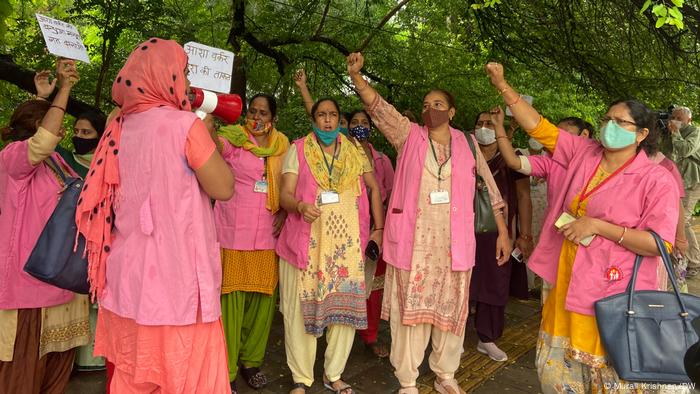
ASHA workers have initiated several protests due to low pay and long working hours


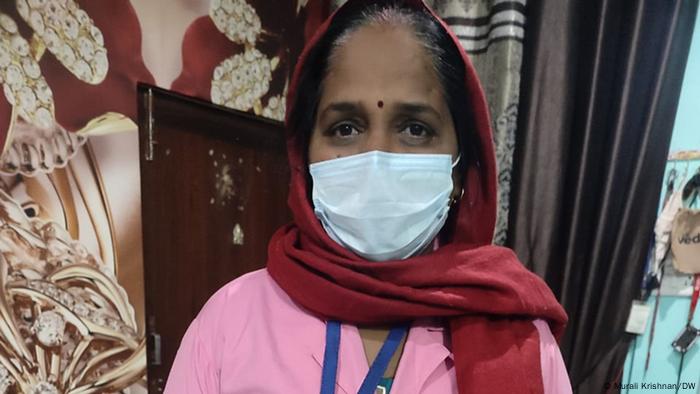
Suman Belhara, 47, an accredited social health activist (ASHA) in Delhi's congested Neb Sarai area, was offering instructions to a man who had tested positive for COVID-19.

"Please quarantine for a week and avoid contact with others. Take these tablets if the fever goes up, drink fluids, and I will come back in a couple of days to check on you," Belhara told the patient.

Belhara is one of the million-strong female social health activists who have formed the core of India's community health care in recent years. Such workers often risk theiq12r own health and safety to assist others, carrying out long working hours for low wages.

It was nearing the end of shift for Belhara, whose area covers more than 450 households. She has gone to 25 different houses in the last nine hours, conducting surveys and checking for coronavirus symptoms.

She and several other women have worked throughout the pandemic to offer health care services and information in rural communities and urban slums.


Belhara says she has worked nonstop to offer health services since the pandemic began
'We work relentlessly'

"I have no fixed hours. Sometimes, work spills over until well past nightfall. We work relentlessly," Belhara, a mother of two, told DW.

"In April, it will be two years since I started doing this work, tracing and testing people with COVID symptoms in their communities and providing the first response," Belhara said.

"When we ASHA workers started off, there was no formal or elaborate training," she added. "There was just a briefing at a local hospital, where I was given instructions on how to conduct surveys, take notes and create awareness around the virus."

Women such as Belhara have risked their own personal safety to go door to door for several months, trying to persuade people to get COVID-19 vaccines in some of India's most remote corners, as well as crowded urban slums.

"We did not have adequate health safeguards and protective gear to start off with, and this made us vulnerable to the virus. I contracted COVID in June, and it was awful. Two months later, my brother-in-law died during the second wave," she said.

Because of the duties spurred by the pandemic, ASHA workers across India have been putting in up to 14 hours a day, as well as on weekends.
Broken promises made to ASHAs

Authorities in several states had assured them earlier that they would have improved wages, but did not keep those promises. ASHA workers called a national strike in September of last year in response.

Over the past year, there have been sporadic protests in several parts of the country as ASHA workers demanded more pay and the working status of government employees.

Most workers earn 10,000-15,000 Indian rupees (€120-180, $135-200) per month, and receive performance-based incentives for health care services instead of fixed salaries.

For instance, the government pays them $4 for every institutional delivery that they facilitate in rural India, and $1.50 for the full immunization of a child younger than 1 year old.

Created in 2005 by the National Rural Health Mission to help provide health care services to people, especially women and children in far-flung areas, these front-line workers are usually tasked with carrying out prenatal and newborn care, encouraging immunization, family planning, and treating basic illnesses.

In the central state of Chhattisgarh, Rekha Sahu, 36, has often had to wade through rough waters, trek rugged terrain and walk for kilometers to reach villages in the district of Sukma.

On average, Sahu covers a 40-kilometer (25-mile) distance, partly by public buses and partly on foot. A married mother of two children, Sahu lives in Gumma village where, since 2010, she has worked with 11 others to serve about 80 families in the area.

"It was extremely difficult to convince people to take the vaccine. Though every panchayat (village council) set up vaccination centers, convincing villagers was a real task," Sahu told DW.

"Hesitancy and misconceptions are common among villagers, particularly women," she said.


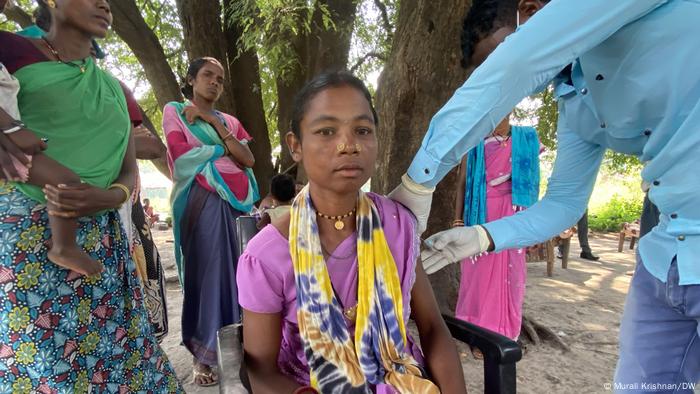
ASHA workers have been instrumental in furthering India's vaccination campaign
'Mitanins' help tackle vaccine hesitancy

In Chhattisgarh, these female health workers are referred to by their colloquial name: mitanin. Door-to-door campaigns and the work carried out by mitanins have helped ward off rumors and get villagers inoculated.

On some occasions, medical teams were chased away when they tried to approach locals, and women fled to forests.

"I was lucky, but my colleagues in other districts were abused and sometimes pelted with stones during their COVID-19 surveys last year," Sahu said.

Sahu added that some standard services that the organization provides, such as family planning, have taken a backseat during the pandemic.

This includes sharing information with mothers on the newest contraceptives and educating women on healthy timing and spacing of pregnancies.

Sahu said her personal journey as an ASHA worker began with a strong desire to have a positive impact on her community — especially for rural women in her state who have limited access to medical facilities.

UNICEF, which has provided training to many front-line workers across India, has also acknowledged the importance of ASHA workers.

"The training has ensured that the lifesaving work continues for the most vulnerable mothers, pregnant women and tribal community members, even under the most difficult circumstances," Yasumasa Kimura, UNICEF's India representative, told DW.

Edited by: Leah Carter

BELARUS

Alexievich: 'It's a shame the road to freedom is so long'

Nobel Prize winner Svetlana Alexievich speaks to DW about the heroes of her new book, reflects on the Belarusian opposition's mistakes in August 2020, and considers the final outcome of the revolution in Belarus.


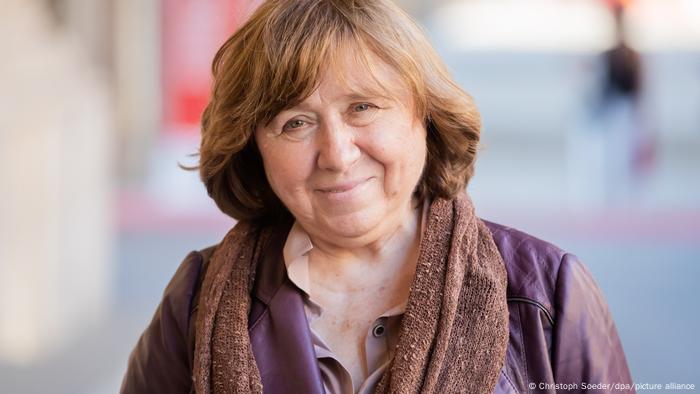
The Belarusian writer and winner of the Nobel Prize in Literature Svetlana Alexievich left Belarus over a year ago — for just a few months, she thought. It hasn't turned out like that. She now lives in Berlin, where she is working on a new book about the aftermath of the internationally disputed presidential election in Belarus in 2020.

DW: Ms. Alexievich, what did you expect of Belarus's presidential election on August 9, 2020?

Svetlana Alexievich: I was totally skeptical. But I saw it as my duty to go and vote, although it was clear that it was utterly pointless. To be honest with you, I personally did not have faith in my people. It seemed to me that people would not take to the streets and that we would carry on living as before, as if time had stood still. After three days of beatings and humiliations, after stun grenades and rubber bullets, which have the impact of a rifle bullet when they're fired from 10 meters (33 feet) away, after three days that shook the world, when women took to the streets, followed by hundreds of thousands of people, I was overwhelmed. We were all ecstatic.

What did you find most astonishing and overwhelming at the time?

Hundreds of people who were arrested were held in the prison on Okrestina Street in Minsk. You could hear them being beaten. But their parents sat outside the walls and did nothing. I believe Georgians would have taken that prison apart stone by stone. But our people simply waited for their children.
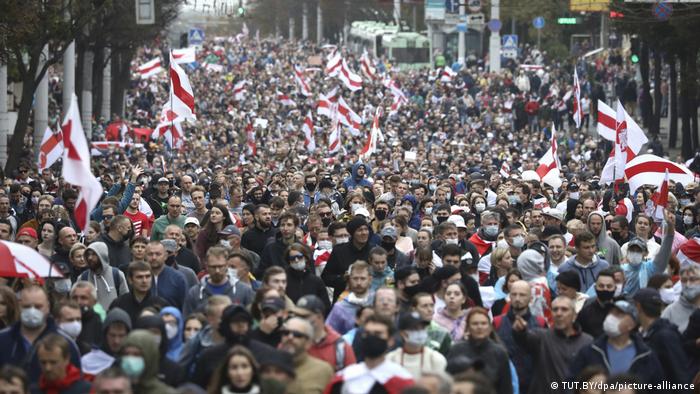

From May 2020 to March 2021, Belarusians repeatedly took to the streets to call on President Lukashenko to resign. (Photo: TUT.by/AP/dpa)

What was overwhelming was that so many young people, the ones we were always complaining about, took part in the protests. The older generation was also astonishing. These events were so much about human dignity, and I want to write a book about that. I'm collecting testaments to our dignity. It's important for all of us, especially now, when we are in the hands of the military and our civil society has been annihilated. I wouldn't describe it as a defeat, rather as a halt in the movement. Because all we went through is not going to disappear. But, as we now understand, there is still a long way to go along the road to freedom.

Are people such as Belarusian President Alexander Lukashenko capable of giving up power?

I don't believe so. Power was always what he secretly dreamed of. But what I remember is people going on marches with absolutely no thought of armed uprising. For us, it was a celebration, a celebration of discovery and excitement. Excitement about ourselves. But then, of course, we lost time. We have to admit that the protests had no leadership as such. The Coordination Council [the opposition: Ed.] didn't control what went on. We should have stayed on the streets until Lukashenko stepped down.

But I didn't want blood to be shed, and I say this again and again. Otherwise we would have come to a point where we no longer occupied the moral high ground. At the time, we prevailed through wisdom and nonviolence. This was how we got international public opinion on our side. It was impossible to crush us like in Tiananmen Square in China. If we'd acted differently, we would have given Lukashenko the right to do it. And, most importantly, the best of our young people would have died. I understand Maria Kolesnikova [opposition politician and civil liberties campaigner, currently in prison: Ed.], who was at the front, and halted thousands of people a few hundred meters from Lukashenko's residence. Like her, I didn't want any bloodshed. I'm more sympathetic to Gandhism. Gandhi, not Lenin.
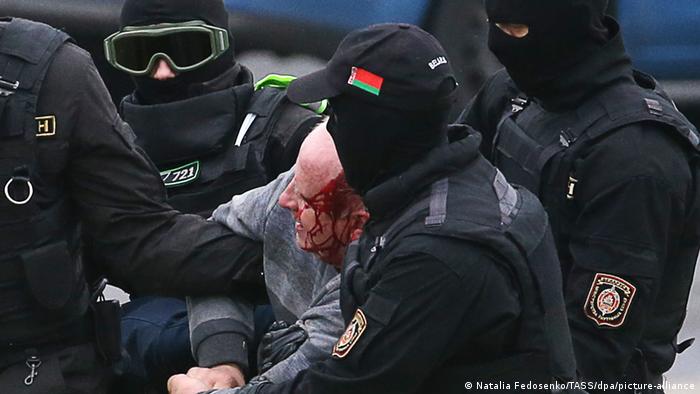

Protests intensified after the disputed election on August 9, 2020, before being brutally suppressed by the security forces

A lot of people are now saying that the Belarusian revolution is lost. Is that true?

No, I don't think so. Firstly, you have an elite there who are joining forces in a completely new kind of way. Then you have the Belarusian people, whose eyes have been opened. The people will never forget how they sat in backyards drinking tea, how they went out on the marches together. Many of the heroes of my book say this: "We lived from one Sunday to the next, and we got so much energy from it that it strengthened our backbones." We have started to become a nation.

Secondly: It's true that we can't demonstrate on the street now. Things only happen in our heads. But the people still expect changes. At some point everything will change, either as a result of sanctions, or because of Lukashenko himself, because he's his own worst enemy. I think that then it will happen very fast.

What we mustn't do now is wrap ourselves in a cocoon of powerlessness; we must prepare ourselves for a new era. We must help those who are in prison, their families and children. I have no hesitation in saying that they are children of heroes, the best among us.

Is Svetlana Alexievich before and after 2020 still the same person?

I don't think it's a case of different personalities, because my convictions haven't changed. I've simply understood that life is short, and that it's a shame the road to freedom is so long.

You know, I dream of my fellow Belarusians living like people in Germany. When I get up from my desk and go out into the street, I see them sitting in cafes, laughing. Will such nonchalance ever be the norm for us? Germans talk about life. We sit at a table, and we don't talk about what we've read, where we were, who we've fallen in love with, or who we've left; we talk about Lukashenko, about the nightmare in our country. I would never have thought that military vehicles would confront us on the streets of my hometown, and that I myself would have to live in exile.

You said that, days before you left the country, you observed minivans with tinted windows and plainclothes policemen outside your house.

In September 2020, plainclothes security forces were stationed outside my house for 10 days. Even the concierge called me and asked me not to go out: "It's not safe here, there are strange people wandering about and buses standing around." On a couple of occasions, diplomats from European countries, 18 people in all, came to me at home. Later, each of them in turn stayed a night at my house. I am very grateful to all of them for that and for everything they're doing for all of us.


Lukashenko was elected the first president of Belarus in 1994, and has ruled ever since

When I left the country, I wasn't on my own: I was escorted by diplomats. It would hardly have been possible for me to fly otherwise. I was detained for about an hour at the border. My passport was taken away. They said: "Oh, our computer has crashed. Oh, I can't get through on the phone." I asked, "What's the matter?" There was silence. But eventually they let me go.

Did it help that you are a Nobel laureate?

I was at least able to leave the country, just as a criminal proceedings were initiated against the Coordination Council. Lukashenko hates me. When I turned 70, it wasn't mentioned in a single newspaper.

You're currently living in Berlin. Do you feel at home there?

I've lived in Berlin before, in the years of my first exile, when Vasil Bykau [Belarusian writer – Ed.] and I had to leave the country. I love the spirit of Berlin and the diversity of life here. I love Germany and am grateful to it. During my first exile, I had the possibility of having an apartment in Vienna and staying there. But I want to live in Belarus. I travel around the world with interest, and I've seen a great deal, but returning home is important to me.

If the Lukashenko regime were to guarantee your safety, would you go back?

When you're a writer, you can live in your own world, and it doesn't matter where in the physical world this is. I've already heard thoughts or suggestions from diplomats along these lines, but I answered that this was impossible. How could I look people in the eye who had to leave behind young children and sick mothers in Belarus? They'll remain in exile, and I'll go home? I can't imagine it; it would be a betrayal.
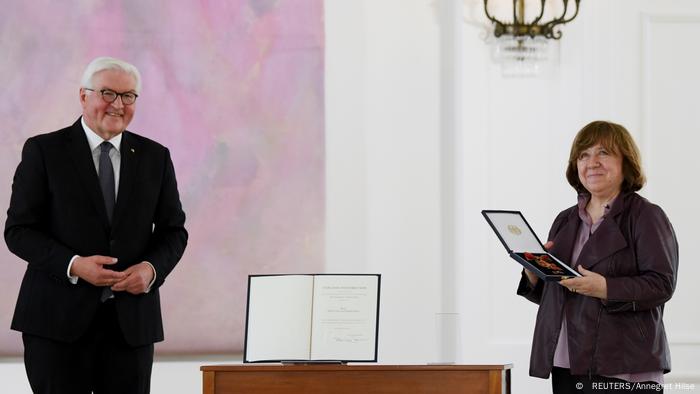

In June, President Steinmeier presented Alexievich with Germany's highest honor, the Order of Merit

You've been working on a new book for a year now. What are the questions to which you're seeking answers?

There are many. The question of war and peace is one. Were we right in seeking to avoid bloodshed? I ask everyone this. People respond differently, incidentally. I would like to write about the masked men, and the temptation of the dark; about why we're still living as if we're in the books of Aleksandr Solzhenitsyn. Why is our entire history flanked by people under arrest, with plastic bags over their heads? Why did some people hide demonstrators, while others led special forces to them?

And one more question: We will have to live with those who beat and tortured us — how can we understand them so that we don't degenerate into hatred? And so on, and on ... Where did they come from, all these wonderful people who took to the streets? How did they become the people they are? Who are their parents? It's important to me to recount as much as I can about them.

What's it like to write a book when the story is not yet complete and the end is yet to come?

I hope that the end will come while I'm writing the book.

The interviewer was Vera Nerusch.

The Belarusian writer Svetlana Alexievich was awarded the Nobel Prize for Literature in 2015. Alexievich is known for her opposition to the Lukashenko regime, but after receiving the Nobel Prize she returned from exile to live in the Belarusian capital, Minsk. During the protests in 2020, she was part of the opposition's Coordination Council, whose the members were persecuted by the Belarusian regime. In September 2020, Alexievich went into exile in Germany.

This interview was translated from Russian.                    
Burkina Faso: Why citizens are disenchanted with their president

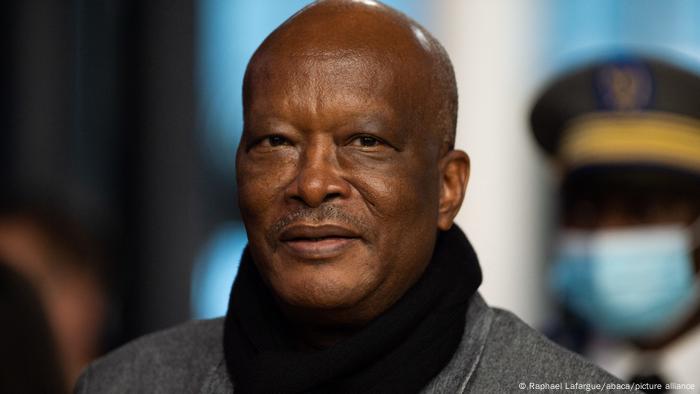
Burkina Faso's military has reportedly seized power and detained President Roch Marc Christian Kabore. The military takeover comes after months of protests over the government's failure to curb terrorist attacks.


The whereabouts of Burkina Faso's President Roch Marc Christian Kabore is unknown

The situation in Burkina Faso remains unclear amid reports that the military has seized power and President Roch Marc Christian Kabore has been detained in the capital, Ouagadougou.

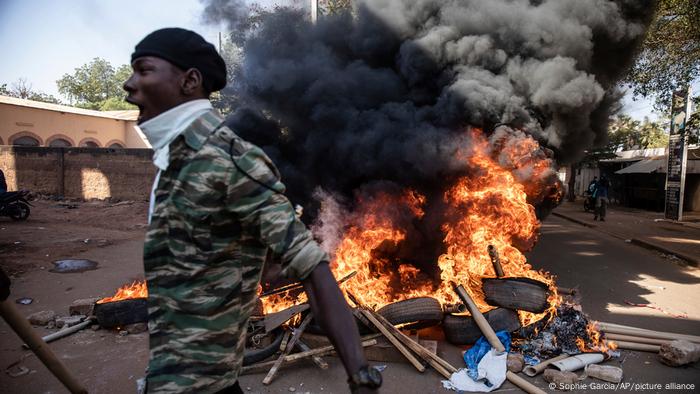
For months, the president has been under pressure from protesters who demanded he step down over the inability of his government to curb rapidly escalating insecurity and violence in the West African country.

Burkina Faso's crisis erupted with little to no warning in 2016.

Initially, the nation was spared the conflict and violence that had flared in other Sahel countries such as Mauritania, Niger and Chad following the disintegration of the Libyan state in 2011 and Mali's 2012 civil war.

But this changed in 2016 when gunmen attacked a hotel and restaurant in Burkina Faso's capital, Ouagadougou, killing at least 30 people.

It was the West African country's first large-scale terrorist attack, coming some two weeks after Kabore was inaugurated as president in 2015.

Many more attacks would follow.

Initially, strikes by groups such as Al-Qaeda in the Islamic Maghreb (AQIM) and Jama'a Nusrat ul-Islam wa al-Muslimin (JNIM) primarily targeted the military in Burkina Faso's far north in the three-border zone to Mali and Niger.

But since 2019, the number of attacks has risen sharply, with violence also spreading to "previously unaffected areas" in its northern and eastern provinces, according to the UNHCR, the United Nations Refugee Agency.

Islamist armed groups are now also increasingly targeting civilians.

At least 132 civilians were massacred in the northeastern village of Solhan in June 2021, in what was Burkina Faso's deadliest attack since the beginning of the violence.
Weak state

The roots of this violence run deep.

"The violence is a symptom of deeper, unresolved issues, namely ineffective governance, impunity for government officials who abuse civilians, a lack of job opportunities, and extreme climate shifts," wrote Nosmot Gbadamosi in a December 2021 article for Foreign Policy.

"Youth anger on those issues provides a powerful stimulus for jihadi groups that seek to recruit among the local population," she added.


Burkina Faso has seen months of anti-government protests

Other observers have long expressed similar convictions.

In a 2017 analysis of the violence in northern Burkina Faso, theInternational Crisis Group foundthat the violence has "strong local dynamics" and in its early stages was a manifestation of widespread discontent at the social order in Soum province, in the country's Sahel region.

The insecurity is generating an immense humanitarian crisis in a country that is already one of the world's poorest. Burkina Faso ranks 182 out of 189 countries on the United Nation's 2020 Human Development Index.

So far, the conflict has internally displaced nearly 1.5 million people out of a population of just 21 million.
Kabore reforms

Kabore initially came to power in 2015 after the ousting of authoritarian leader Blaise Compaore, who had ruled the country for 27 years.

There have long been rumors that Burkina Faso was spared Islamist attacks during Compaore's rule because he had colluded with the jihadists for many years.

Amid growing violence, Kabore declared a state of emergency in 2018 for 14 of the country's 45 provinces, giving security forces extra powers to search homes and arrest and detain people. It remains in place in six regions and has been prolonged several times.

Human rights groups, including Amnesty International, have reported numerous violations by security forces and self-defense groups in the provinces under the state of emergency.

This, in turn, has increased the local population's disenchantment with the federal government.

Afterwinning re-election in 2020, Kabore attempted several reforms in an attempt to defuse people's anger over the escalating violence.

Following severe criticism of his leadership following the June Solhan massacre, Kabore fired his defense and security ministers.

This was followed by the firing of his prime minister in December — a move that triggered the replacement of the entire cabinet.


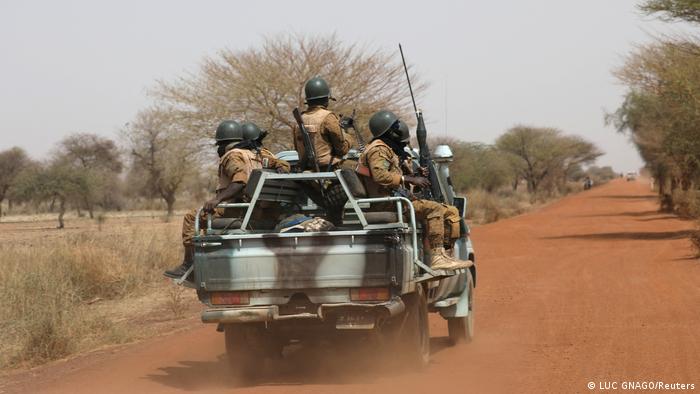
Burkina Faso's forces lack resources to fight armed groups
Under-resourced military

Burkina Faso's military is widely viewed as insufficiently equipped and poorly trained to combat the escalating violence.

In a televised address back in November 2021, President Kabore pledged to end the "dysfunction" within the military.

"We must put an end to the unacceptable dysfunction that is sapping the morale of our combat troops and hampering their capacity to fight armed terrorist groups," Kabore said.

"We must no longer hear about food issues in our army," he added, referring to reports that dozens of gendarmes killed in a strike near the northern town of Inata had gone two weeks without supplies prior to the attack and were forced to trap animals to eat.

The gendarmes had been waiting in vain for several days for a relief force when they came under attack from hundreds of fighters, according to reports by Reuters news agency.

"We must put our men in conditions that allow them to counter terrorism with all the courage and determination it takes," Kabore said in his address.
Syrian prison battle death toll tops 150, concern over fate of minors


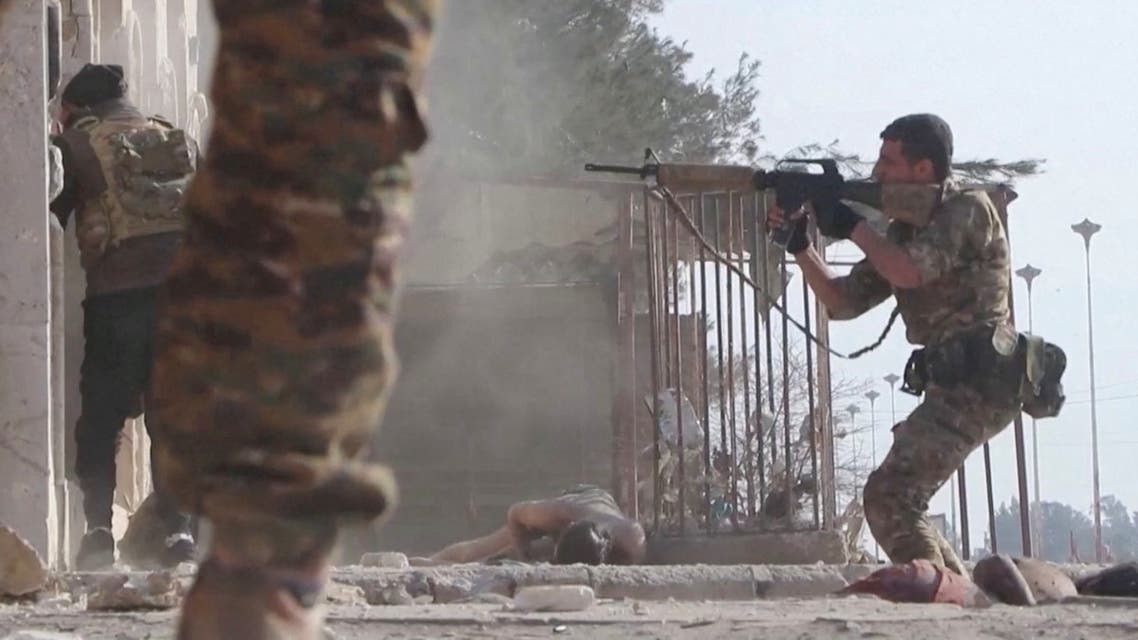
A Syrian Democratic Forces affiliate points a gun outside a prison while in clash with the Islamic State militants in Hasaka, Syria January 22, 2022. (Reuters)

AFP, Hasakeh
Published: 24 January ,2022

Kurdish forces locked down a Syrian city Monday to trap ISIS fighters who attacked a prison there five days earlier, leaving more than 150 dead in fierce battles.

The Kurdish-led Syrian Democratic Forces (SDF) charged that the ISIS militants were using hundreds of minors as “human shields” inside the Ghwayran prison in the northeastern city of Hasakeh.

The UN childrens’ agency UNICEF called for the protection of some 850 minors detained inside the jail, some as young as 12, warning that they could be “harmed or forcibly recruited” by ISIS.

More than 100 ISIS fighters late Thursday stormed Ghwayran prison using suicide truck bombs and heavy weapons, setting off days of clashes both inside the facility and in surrounding neighborhoods.

The fighting died down Sunday evening as the US-backed SDF consolidated control over areas around the jail and declared the entire city locked down for a week.

“To prevent terrorist cells from escaping... the Kurdish administration in northeast Syria announces a complete lockdown on areas inside and outside Hasakeh city for a period of seven days starting on January 24,” the administration said.

Businesses were ordered to close with the exception of essential services, such as medical centers, bakeries and fuel distribution centers.

Civilians were hunkering down Monday in their homes as Kurdish fighters backed by the US-led coalition combed the area for hideout terrorists, reported an AFP correspondent.

The SDF erected several checkpoints at the entrances to Hasakeh, with even tighter security measures imposed in neighborhoods adjacent to the jail, the correspondent revealed.

The SDF said in a statement its advances inside the prison were stymied by the use of hundreds of minors as “human shields” by IS jihadists holed up in a dormitory.

The group said the adolescents, who had been detained over suspected links to ISIS, were being kept in a “rehabilitation center” in the jail.

The Britain-based group Syrian Observatory for Human Rights said Monday that a precarious lull in fighting continued to hold, as holdout terrorists were refusing to surrender.

The group raised the death toll from the clashes to 154 killed since Thursday, including 102 terrorists, 45 Kurdish fighters and seven civilians.

In other parts of Syria’s northeast under the administration’s control, a nighttime curfew was set to go into force Monday from 6 p.m. until 6 a.m.

Peruvians donating hair to assist oil clean-up

Hundreds of Peruvians are donating their locks to assist with the cleanup efforts of an oil spill that authorities have deemed an environmental emergency.

Ladies in White opposition leader arrested in Cuba


Berta Soler was arrested ahead of a regular demonstration in support of political prisoners, her husband said (AFP/RONALDO SCHEMIDT)

Mon, January 24, 2022, 2:16 AM·2 min read

A prominent Cuban dissident was arrested along with three other women in the capital Havana on Sunday, her husband said.

Berta Soler, who leads the Ladies in White protest movement, was held ahead of a regular demonstration in support of political prisoners, former dissident Angel Moya confirmed to AFP.

Long considered the only opposition group the Cuban government allows to march regularly, the Ladies in White movement is made up of the relatives of jailed dissidents, campaigning for their release.

They march almost every Sunday, dressed in white.

"They were arrested at approximately 11 in the morning, when they were preparing to go to Santa Rita," Moya said, referring to the church where the women usually attend mass on Sunday before marching.

Along with Soler, Ladies in White members Lourdes Esquivel and Gladys Capote, as well as Barbara Ferrat, were arrested by plainclothes police, he said.

He indicated that, "prevented from going to Santa Rita," the women began a protest outside the Ladies in White headquarters in the Lawton neighborhood of Havana.

Ferrat's son, 17-year-old Jonathan Torres, was earlier arrested for participating in historic July 11 protests that flared up in about 50 Cuban cities over the summer.

A government crackdown against the unprecedented anti-government revolt left one dead, dozens injured and more than 1,000 people detained, several hundred of whom remain behind bars.

Political opposition is illegal in Cuba and dissidents, often detained for short periods of time, are considered "mercenaries" in the service of the United States.

Moya, one of 75 political prisoners of the so-called Black Spring of 2003, said that "as usual" the police did not say where the detainees were, and he did not know his wife's whereabouts.

The US embassy in Cuba condemned the arrests.

"The regime should stop harassing activists and concerned mothers. We call for their immediate release and support them and all political prisoners in #Cuba," the diplomatic mission said on its Twitter account.

cb/lp/ag/leg/axn
Pandemic causing 'nearly insurmountable' education losses globally: UNICEF


Musa Kalema, former headteacher at Cream Nursery and Primary school in Kampala, tends to chickens he keeps in one of his former classrooms following an almost two-year closure of learning institutions by the Ugandan government due to Covid-19 (AFP/Badru KATUMBA)

Mon, January 24, 2022, 2:26 PM·2 min read

School closures due to the Covid-19 pandemic have caused "nearly insurmountable" losses in education among children around the world, UNICEF said on Monday.

More than 616 million students are still being affected by full or partial school closures, the UN children's agency said.

In many countries, in addition to depriving millions of children of the chance to acquire basic skills, these disruptions have affected students' mental health, put them at greater risk of abuse and prevented many from having access to "a regular source of nutrition," UNICEF added.

"Quite simply, we are looking at a nearly insurmountable scale of loss to children's schooling," said UNICEF Chief of Education Robert Jenkins in a statement, almost two years into the pandemic.

And "just re-opening schools is not enough," he added, calling for "intensive support to recover lost education."

UNICEF reported that "learning losses to school closures have left up to 70 percent of 10-year-olds unable to read or understand a simple text, up from 53 percent pre-pandemic" in countries with low and middle income.

In Ethiopia, for example, children learned only "between 30 to 40 percent of the math they would have learned if it had been a normal school year" in primary school, the UN agency estimated.

Rich countries are far from being spared. In the United States, learning losses have been observed in several states, including Texas, California and Maryland, said UNICEF.

School dropouts are also a problem: in South Africa, between 400,000 and 500,000 students "reportedly dropped out of school altogether between March 2020 and July 2021."

Finally, in addition to rising levels of anxiety and depression among children and young people linked to the pandemic, school closures also meant more than 370 million children around the world did not get school meals, "losing what is for some children the only reliable source of food and daily nutrition."

iba/rle/sw

Why the right to education remains a challenge in Africa

Sub-Saharan Africa has the highest rate of education exclusion globally, according to the UN. Nearly 60% of youth aged 15 to 17 are not in school. Activists on the continent are now fighting to change that.


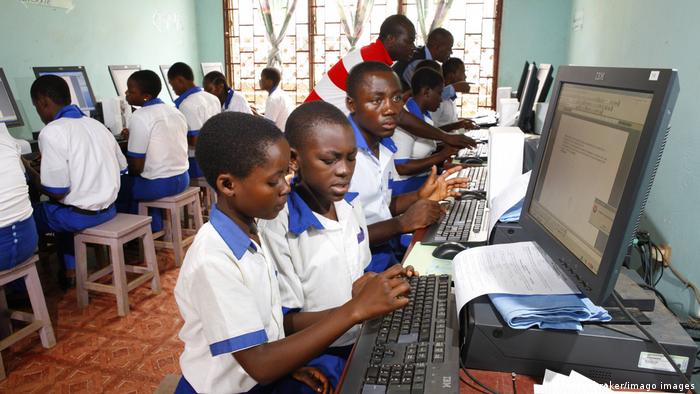
Africa has a huge gap in its education system, with some students being given IT classes, while others are barely getting by


Education is considered a universal human right, as well as an issue of public good and responsibility. However, there are still many — particularly children in developing African countries — who do not enjoy this right.

As the world marks the fourth International Day of Education under the theme "Changing Course, Transforming Education," The United Nations (UN) is calling for action.

In many African nations, those who can afford education send their children to private schools in the city. But that is not an option for many in rural areas, or for poorer families.

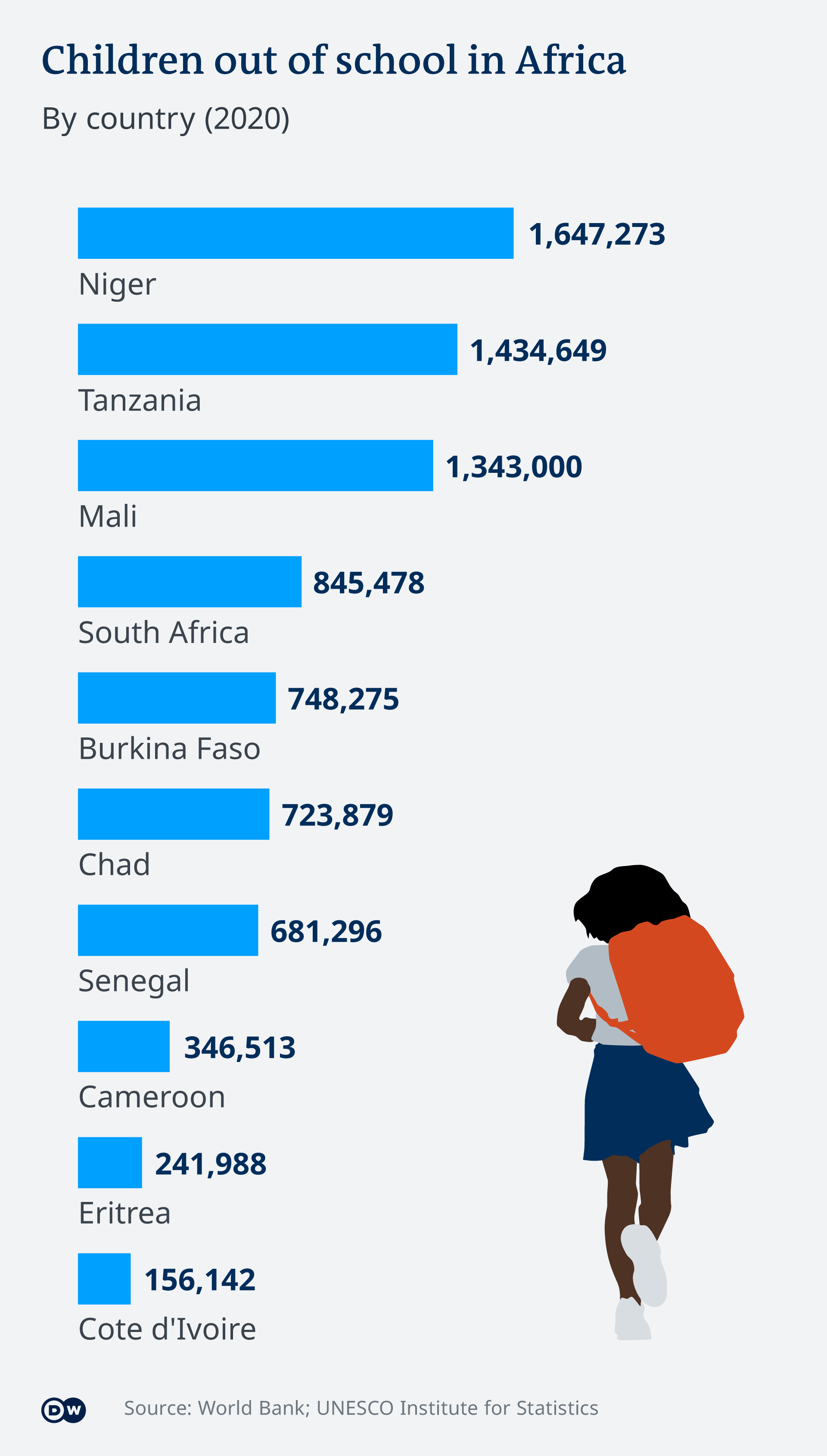
According to the United Nations Education, Scientific and Cultural Organization (UNESCO), over one-fifth of African children between the ages of 6 and 11 are not in school, while nearly 60% of youth between the ages of 15 and 17 are not enrolled.

The education of girls is of particular concern: 9 million girls on the continent between the ages of 6 and 11 will never attend school, compared to 6 million boys. By the time they reach adolescence, girls have a 36% exclusion rate compared to 32% for boys.


Many obstacles to learning

It is still common in many areas to find children on farms or playing on the streets instead of attending school.

Some countries lack proper school structures, and many are dilapidated.

"There are no toilets, desks, or even chairs in my school," Umaru Harisa, a primary school student in Nigeria, told DW. He also complained that his school is very far from his home.

"I think our teachers are dedicated, but it's very hard to learn with nothing to help us," he said.

Differing attitudes towards the value of formal education is another major problem. Skepticism of Western-style learning and the belief that girls don't need an education compounded with regional instability have created a challenging environment for learning to thrive.


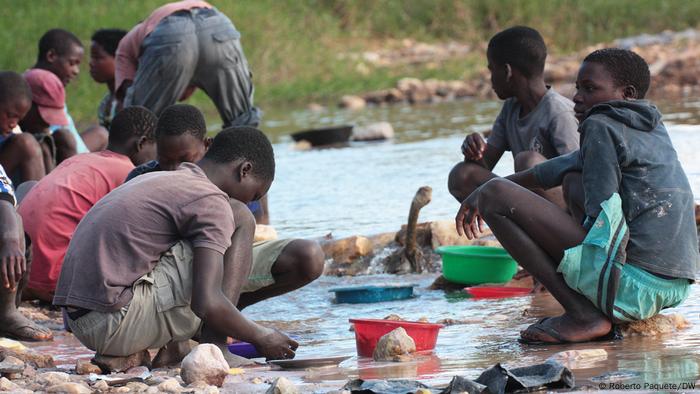
Some parents in Mozambique send their children to work in artisanal mines
Tackling worrying dropout rates

In South Africa, at least 40% of all students drop out of school before completing grade 12. Girls make up the majority of this group.

The consequences of youth prematurely dropping out of school are severe and long-lasting, with many often trapped in a vicious cycle of unemployment and poverty.

"I should have continued with my studies instead of falling pregnant," Akhona Wanda, a teen mother in South Africa told DW.

Nontathu Wanda, Akhona's mother, explained that she wants a better future for her daughter, and accessing education is crucial to achieving that goal.

"It is very important for her to finish school in order to fulfill her dreams," she told DW.
Engagement key to education

Girls like Akhona need support beyond the classroom, however most African countries lack programs to empower girls holistically.

One example of such an initiative is Isibindi Ezikoleni — which roughly translates to "Courage in Schools" — organized by the National Association of Childcare Workers in South Africa. The program focuses on tackling the root causes of disengaging from school to prevent students from dropping out.

"What I have learned in this group since grade 8 is how to be responsible and take care of myself as a girl," one student told DW.


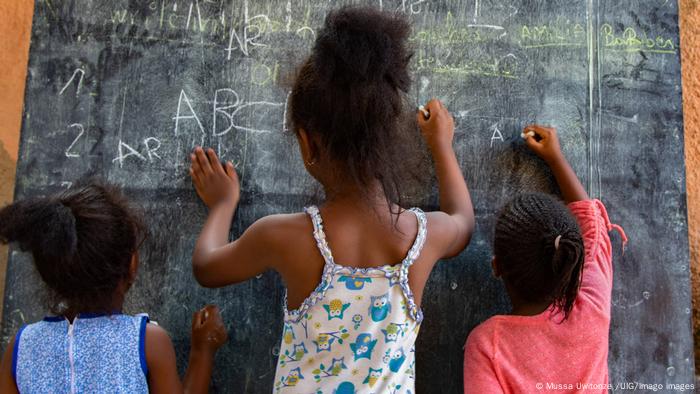
African girls face many hurdles to education, including teenage pregnancy and early marriage

South African youth worker Nomvula Piri stresses the importance of constantly engaging with children who drop out of school and encouraging them to return and continue their studies.

She has helped several pregnant schoolgirls including Akhona return to class after giving birth.

"I ensured that she got her homework and did not fall behind," Piri told DW. "She could always speak to other teachers or me. It was really important for her to continue with her schoolwork during that time.
'Out of the darkness'

In northern Nigeria's Minchika village, local authorities are also encouraging children to stay in the classroom.

Yunus Musa, the co-founder of the Give North Education campaign — which advocates basic education for all, not just a privileged few — has dedicated his life to helping rural kids access education. He believes getting African children back to school is key to society's progress, especially in developing nations.

"Only education brings my people out of the darkness," Musa told DW. "Without this education, there won't be any record of achievement."

Alhaji Ibrahim Sani, a local community leader in Nigeria, says activists like Musa are making an impact.

"We used to write letters to parents and deliver them house by house to encourage the children to go to school," he told DW. "Sometimes, the children here even take themselves to school to enroll. But still, the main thing discouraging school attendance is the distance from the school to the village."


Ex-pope Benedict admits giving 'incorrect' info to abuse inquiry

Ninth Commandment: Thou Shalt Not Bear False Witness

https://www.learnreligions.com/ninth-commandment-thou-shalt-not-bear...

2004-12-06 · Thou shalt not bear false witness against thy neighbour. ( Exodus 20:16) This commandment is somewhat unusual among those supposedly given out by to the Hebrews:


An independent report found that ex-pope Benedict XVI knowingly failed to stop four priests accused of child sex abuse in the 1980s (AFP/Andreas SOLARO)

Mon, January 24, 2022, 3:58 AM

Former pope Benedict XVI on Monday admitted providing incorrect information to a German inquiry about his presence at a 1980 meeting discussing a paedophile priest, blaming an editing "oversight".

"He is very sorry for this mistake and asks to be excused," Benedict's personal secretary Georg Ganswein said in a statement cited by the KNA news agency and republished by Vatican News.

But the statement insisted no decision was made at the meeting about reassigning the priest to pastoral duties.


An independent report last week found that Benedict XVI, who stood down in 2013, knowingly failed to stop four priests accused of child sex abuse in the 1980s.

The report by law firm Westpfahl Spilker Wastl (WSW) was commissioned by the archdiocese of Munich and Freising to examine how abuse cases were dealt with between 1945 and 2019.

Ex-pope Benedict -- whose civilian name is Joseph Ratzinger -- was the archbishop of Munich from 1977 to 1982.

In one case, a now notorious paedophile priest named Peter Hullermann was transferred to Munich from Essen in western Germany where he had been accused of abusing an 11-year-old boy.

Hullermann was reassigned to pastoral duties despite his history and continued to reoffend for many years.

The lawyers said that "to our surprise", Benedict had denied attending the meeting in 1980 at which the decision was made to admit Hullermann to the diocese, despite being quoted directly in the minutes of the meeting.

The statement from the emeritus pope said: "He would like to make it clear now that, contrary to what was stated at the hearing, he did attend the Ordinariate meeting on January 15, 1980.

"The statement to the contrary was therefore objectively incorrect," it added, while insisting this was "not done out of bad faith, but was the result of an oversight in the editing of his statement".

"Objectively correct, however, remains the statement, documented by the files, that in his meeting no decision was made about a pastoral assignment of the priest in question," it said.

"Rather, only the request to provide him with accommodation during his therapeutic treatment in Munich was granted."

The statement said further explanations would follow but the 94-year-old pope, who is said to be in shaky health, is still reading the inquiry report.

"At present, he is carefully reading the statements set down there, which fill him with shame and pain about the suffering inflicted on the victims," it said.

ar/ide/dl
Afghan women activists feel betrayed by Oslo talks


Afghan women take part in a women's rights protest in Kabul last week
 (AFP/Wakil KOHSAR)

Emma CLARK
Mon, January 24, 2022, 5:39 AM·3 min read

Afghan women protesting against the Taliban's harsh rule say they have been betrayed by Norway, the first Western nation to host the hardline Islamists since they seized power in August.

Led by the foreign minister, a Taliban delegation travelled first class on a plane specially chartered by the Norwegian government to Oslo for meetings with Western officials and members of Afghan civil society.

Women activists who have been facing intimidation by the Taliban after staging small and scattered protests are outraged by the diplomatic efforts.

"I am sorry for such a country as Norway for organising this summit, sitting with terrorists, and making deals," said Wahida Amiri, an activist who has protested regularly in Kabul since the Taliban's return.

"It saddens me a lot. Shame on the world for accepting this and opening doors to the Taliban," she told AFP.

Several women -- too afraid to step outside -– instead protested in their homes in the cities of Kabul, Bamiyan and Mazar-i-Sharif, in images posted to social media.

"Norway has invited criminals and terrorists who have no respect for women's rights and human rights," an activist from Bamiyan who asked not to be identified told AFP.

"They (the Taliban) are against women and humanity and they do not believe in freedom of speech."

Another activist in the city said women were concerned their rights would be "traded behind closed doors" in Oslo.

The Taliban have promised a softer rule than their last stint in power between 1996 and 2001 when women were banned from leaving the house without a male chaperone and forced to wear the all-covering burqa.

Many women, however, remain deeply mistrustful and afraid of the new government.

Women's rights improved slightly over the past 20 years in the patriarchal Muslim nation, but the gains were mainly limited to cities.

Last week, women activists said two of their comrades, Tamana Zaryabi Paryani and Parwana Ibrahimkhel, were seized from their homes in Kabul after taking part in a demonstration.

The Taliban have denied any involvement.

- Isolated from talks -


Some Afghans argue that engaging with the Taliban is necessary to save the country from collapse, with millions suffering from hunger.

Afghanistan's humanitarian situation has deteriorated drastically since August when the Taliban stormed back to power 20 years after being toppled.

International aid came to a halt, worsening the plight of millions of people already hungry after several severe droughts.

No country has yet recognised the new government, and Norwegian Foreign Minister Anniken Huitfeldt stressed the talks would "not represent a legitimisation or recognition of the Taliban".

During the first day of talks on Sunday -- aimed at addressing the deepening humanitarian crisis -- the Taliban met with Afghan civil society members, including women activists and journalists flown in from Kabul.

Women's rights campaigners took part in previous negotiations between the Taliban and the United States leading to a deal in Doha in 2020 that ultimately failed to stop the militants seizing control of Afghanistan.

Hoda Khamosh, a women's rights defender who was invited from Kabul to the Oslo talks, warned the West that by "remaining silent or tolerating the Taliban, you are partly responsible for these crimes".

Mahbouba Seraj, who also took part in the discussions, said she was "hopeful" and the Taliban had "acknowledged and heard us" during the talks.

But many feel isolated from the meeting, held in a high-end hilltop hotel.

"As a protester seeking the rights of women in Afghanistan, facing street fights with the Taliban in Kabul... (these women) cannot represent us in the Oslo summit," said one woman in a news clip posted to social media.

bur-ecl-fox/axn