Thursday, June 11, 2026

Trump’s Iran War Slowing Global Economic Growth to Lowest Level Since Pandemic: World Bank

“For light at the end of the tunnel, you’d have to look to the 2030s,” says the World Bank’s chief economist.


High gas prices are displayed at a filling station in Los Angeles on April 9, 2026.
(Photo by Mario Tama/Getty Images)

Brett Wilkins
Jun 11, 2026
COMMON DREAMS


The World Bank on Thursday lowered its global growth forecast for the remainder of 2026 as the illegal US-Israeli war of choice on Iran drives up energy prices, inflation, and the cost of debt.

“The global economy is facing another major shock,” the World Bank’s latest biannual Global Economic Prospects report states. “The conflict in the Middle East has triggered sharp increases in energy prices, renewed inflationary pressures, and fueled expectations of tighter monetary policy.”

“Global growth is projected to slow to 2.5% in 2026, from 2.9% in 2025—the lowest rate since the Covid-19 pandemic—amid weaker prospects for economies dependent on energy imports and those directly affected by hostilities,” the report continues. “Activity is expected to firm in 2027-28 as energy supplies recover, monetary easing resumes, and trade strengthens.”


The Iran War has resulted in the closure of the Strait of Hormuz, through which around 30% of the world’s fertilizer and 20% of its oil previously passed. In addition to increasing the risk of a global food crisis, the strait’s closure has sent fuel and fertilizer prices soaring, with US farm diesel costing nearly 50% more than it did on the war’s eve in February and various fertilizer products spiking by between one-quarter and one-half.

The war has affected the economies of countries far removed from Iran, as the World Bank reports forecasts that “growth in emerging market and developing economies (EMDEs) is expected to slow to 3.6% this year.”

“The level of per capita income across EMDEs excluding China and India, relative to advanced economies, is not expected to return to the pre-pandemic level until after 2028, implying nearly a decade of lost income convergence,” the international financial institution predicted.

World Bank Group president Ajay Banga said in a statement Thursday that “developing countries have faced a series of challenges over the last decade.”

“The impact differs by country, but the basic test is the same: Protect people and preserve stability today, without giving up on growth and jobs tomorrow,” Banga added. “In response to the current shock, we are providing liquidity where it is needed now—and we are ready with additional financing, guarantees, and private-sector solutions if pressures deepen. Our job is to help countries steady the ship, keep reforms moving, and emerge stronger on the other side.”

The bank said in April that up to $100 billion would be made available over the next 15 months for nations suffering the most acute economic shocks caused by the war.

As US President Donald Trump and Israeli Prime Minister Benjamin Netanyahu allegedly undermine efforts to end the war, the World Bank cautions that the global economic outlook “remains skewed to the downside.”

“A renewed escalation of hostilities or more prolonged disruptions to commodity flows could further raise commodity prices, intensify inflationary pressures and food insecurity, trigger financial stress, and lower growth,” the bank’s report warns.

In his foreword to the new Global Economic Prospects report, World Bank Group chief economist Indermit Gill warned that “barring a miracle, the 2020s will prove to be what their ominous opening foreshadowed: a lost decade—not just for a couple of outliers, but for dozens of developing economies.’”

“Amid one of the densest clusters of global shocks since the 1970s, nearly 1 out of every 2 developing economies has failed since 2019 to advance on the most rudimentary promise of development: narrowing the income gap with the world’s most prosperous economies,” Gill added. “For light at the end of the tunnel, you’d have to look to the 2030s.”
GOP TRANSPHOBIA


Trump-Aligned PAC Drops Six Figures in Texas on ‘AI Brainrot’ Ad Putting Talarico in a Dress

“We need to make this type of undisclosed AI political advertising illegal yesterday,” one tech journalist said.


An ad released by the conservative group Citizens for Sanity portrays James Talarico, the Democratic nominee for US Senate in Texas, wearing a dress on June 9, 2026.

(Screenshot from an ad by Citizens for Sanity via Reagan Reese/X)

Stephen Prager
Jun 09, 2026
COMMON DREAMS


Republicans are once again using artificial intelligence to attack US Senate candidate James Talarico. This time, they’re spending big to air an ad featuring the Democratic nominee for Texas in a dress singing a song about transgender children.

It follows a previous video posted by the Senate GOP’s official social media channels in March featuring an uncanny AI rendering of Talarico reading what they described as “extreme statements” he’d previously made on X (then known as Twitter) discussing his views on religion and support for the LGBTQ+ community.

Now, a Trump-aligned dark money group known as Citizens for Sanity is taking it even further. According to a report from The Daily Caller on Tuesday, the group has spent “six figures” on an ad campaign portraying the Texas state representative in a dress singing a parody of “My Favorite Things” from The Sound of Music about trans kids.


“Boys in white dresses with blue satin sashes. Girls dosed with hormones til they grow mustaches. Changing the gender of all your offspring. These are a few of my favorite things,” Talarico is shown belting out in the ad.

The ad references comments made by Talarico in 2023 in which he celebrated the trans youth who had shown up, along with other activists, at the Texas state capitol to hold a protest in opposition to Senate Bill 14, which sought to ban transition-related medical care for transgender minors, part of a wave of hundreds of pieces of legislation proposed across the US attacking LGBTQ+ individuals.

Speaking on a podcast, Talarico said: “I love—I’m just going to say this because it’s on my mind—the trans children who showed up yesterday at the state Capitol to advocate for their humanity. They shouldn’t have to, but it was an inspiration to watch.”

As Talarico became the Democratic nominee in Texas, where he’ll face off against Republican Attorney General Ken Paxton in November, official Republican channels have spliced the comments to portray Talarico as a creep.

One post in March, from the Republican National Committee Research account on X with 1.3 million views, quotes the interaction dishonestly, as follows:
HOST: “Something that you love that’s not family or friends?”
TALARICO: “Trans children.”

The ad is in line with others put out by Citizens for Sanity in 2022, when it spent a staggering $93 million attacking Democrats in swing districts. As The Guardian explained in 2024:
The group... flooded the airwaves in battleground states and swing districts with deeply offensive and often misleading ads. Some ads targeted LGBTQ+ rights and attacked “Biden and his radical allies” for supporting “the woke left’s war on girls’ sports” and the “woke war on our children”. Others pictured Latino immigrants and characterized them as criminals “draining your paychecks, wrecking your schools, ruining your hospitals [and] threatening your family”, declaring that “Joe Biden and the Democrats have erased our southern border.”

With AI deepfakes playing an increasing role in political campaigning—especially among Republicans—the group is discovering new frontiers for misinformation in this year’s election.

The 15-second spot it plans to roll out across Texas makes no indication of the fact that it was generated with AI, nor of the fact that Talarico never actually uttered any of the words in the song.

Like many other states, Texas has a law prohibiting the use of AI deepfakes to deceive voters during elections. However, it would not apply to this ad, since it is limited to state races and only applies within 30 days before the vote.

Lawmakers in the state have introduced legislation to strengthen the law by scrapping the 30-day rule and requiring disclosures on paid political content generated with AI. But despite some bipartisan support, the reforms failed to pass through the GOP-controlled Legislature.

While this new Talarico ad would be unlikely to fool most voters, others—like the one released by the Senate GOP in March—are already realistic enough to influence even savvy viewers, explained Sandra Cai, the founder of Plurall AI, an AI deepfake and fraud detection platform.

“By the time a viewer questions what they saw, the impression is already made,” she said in a social media post. “The 2026 midterms laid bare an uncomfortable truth: Disclosure labels are easy to miss and easy to ignore. The tools to produce these ads are cheap, fast, and widely available. Regulation remains a patchwork, often applying only in the final weeks before an election.”


On the left, the Talarico ad has led to familiar bewilderment that such misleading material has not been outlawed.

“We need to make this type of undisclosed AI political advertising illegal yesterday,” said the liberal tech journalist Taylor Lorenz.

And while some Talarico opponents boasted that they were “going to win the midterms by programming boomers with AI brainrot ads,” others on the right said they were also disturbed by the trend.

“James Talarico is awful,” said Frank DeVito, senior counsel at the right-wing Napa Legal Institute. “But this use of AI to generate a video of a political opponent saying or doing what he did not really say or do is not good.”


WTF?!

‘Vote for Cruelty and Corruption’: House Republicans Approve $70 Billion in New Funding for ICE and DHS

“Congressional Republicans gifting ICE with billions of extra dollars of funding while Americans are struggling to make ends meet is an outrage,” said one critic of the Trump-backed move.


High school students protest against US Customs and Immigration Enforcement outside the Minnesota State Capitol in St. Paul on January 14, 2026.
(Photo by Octavio Jones/AFP via Getty Images)


Brett Wilkins
Jun 09, 2026
COMMON DREAMS

The Republican-controlled House of Representatives on Tuesday narrowly approved nearly $70 billion in new funding for US Department of Homeland Security agencies responsible for the Trump administration’s anti-immigrant crackdown, a move denounced by Democrats and advocacy groups.

The Secure America Act—a budget reconciliation bill approved last week by the Senate, where it was introduced by Sen. Lindsey Graham (R-SC)—passed the House by a vote of 214-212. Every Republican present voted for the bill, while every Democrat in the chamber and Independent Rep. Kevin Kiley of California voted against it.

The legislation provides funding for the Department of Homeland Security (DHS), Immigration and Customs Enforcement (ICE), and Customs and Border Protection (CBP) through the end of President Donald Trump’s term. The bill now heads to Trump’s desk for his signature.

“In the final months of their House majority, House Republicans are doubling down on their failed approach: blank checks for ICE and not one cent to make things cheaper for working families,” Congressional Progressive Caucus Chair Greg Casar (D-Texas) said following Tuesday’s vote.

“The day after threatening to cut Social Security and Medicare, they are sending billions to Trump’s mass deportation machine—which still has $100 billion sitting in the bank,” he added. “The Republican Congress is a disaster for working Americans. When Democrats take back power, we must repeal this funding.”

Rep. Maxwell Frost (D-Fla.) said on X: “The House GOP just voted to give ICE and CBP $70 BILLION. Instead of investing in you and ensuring you can afford your healthcare, groceries, or rent—they chose to hand $70 BILLION to agencies operating without any guardrails while terrorizing and brutalizing our communities.”


Civil society groups also blasted House Republicans after the vote.

“Congressional Republicans gifting ICE with billions of extra dollars of funding while Americans are struggling to make ends meet is an outrage,” said Lisa Gilbert, co-president of the consumer advocacy group Public Citizen, which decried what it called “a vote for cruelty and corruption.”

“Trump’s ICE has proven that it is dangerous and out of control,” Gilbert added. “Today’s vote is... a vote against the Constitution and the safety of our communities and neighbors. Shame on congressional Republicans for ramrodding through this egregious funding.”

FWD.us President Todd Schulte said, “At a time when voters remain rightly outraged at ICE, providing hundreds of billions of dollars to ICE and CBP to terrorize communities and tear families apart while the cost of living rises and healthcare funding is slashed is both a stunning policy failure, and incredibly unpopular with voters.”

ACLU senior policy counsel Kate Voigt said in a statement that “it is unconscionable that the House would vote to write yet another blank check for ICE and Border Patrol’s campaign of chaos without any reforms. Over the past several months we’ve seen these abusive agencies kill our neighbors, harass and racially profile people, and tear thousands of families apart.”

More than 50 people have died in DHS custody since Trump returned to office, with experts asserting that many of the deaths were preventable. Detained immigrants have reported beatings and sexual abuse, medical neglect, hunger and inedible food, and denial of access to attorneys, and other mistreatment.

DHS officers have killed Americans Renee Good and Alex Pretti and Mexican national Silverio Villegas González, and have wounded numerous other people during Trump’s second term.

ICE detainees across the nation are resisting abuse in detention centers across the nation through hunger strikes and other civil disobedience, as well as via lawsuits.


Thousands of NYC Tenants to Get Millions in Back Rent Forgiven After Mamdani Targeted Their Prior Landlord

A representative from the Union of Pinnacle Tenants said the agreement to forgive back rent is “a big victory” for tenants and represents a “real direct monetary redress of people’s issues.”


New York Mayor Zohran Mamdani arrives for a press conference at Staten Island University Hospital Community Park on April 27, 2026 in New York City.
(Photo by Michael M. Santiago/Getty Images)

Brad Reed
Jun 09, 2026
COMMON DREAMS

Thousands of tenants in New York City will no longer have to pay back rent after their prior landlord was targeted by democratic socialist Mayor Zohran Mamdani earlier this year.

Gothamist reported on Tuesday that Summit Properties, which in March bought 93 properties from bankrupt owner Pinnacle Group, has agreed to forgive tenants’ back rent, which some refused to pay because of what they said were unsafe living conditions in their buildings.

Vivian Kuo, a representative from the Union of Pinnacle Tenants, said the agreement to forgive back rent is “a big victory” for tenants and represents a “real direct monetary redress of people’s issues.”

Mamdani took action against Pinnacle in January as one of his first official acts after being sworn in as mayor, noting that the landlord was responsible for “more than 5,000 housing violations and 14,000 complaints.”

In buying the buildings from Pinnacle, Summit agreed to cure half of all reported violations within 60 days and to invest at least $30 million over a five-year period to repair and improve the buildings.

According to Gothamist, Summit had already lined up its purchase of the buildings before Mamdani took office, although the mayor worked with the tenants union to extract commitments from the company to make much-needed fixes.

Jordan Barowitz, a spokesperson for Summit, told Gothamist that the company “fixed hundreds of apartments, cured thousands of violations, and exceeded our commitment.”

Mamdani has regularly put New York City landlords on notice, holding “rental ripoff” hearings where tenants have the opportunity “to tell the city exactly what your landlord’s been getting away with” and help bring about “real policy changes.”
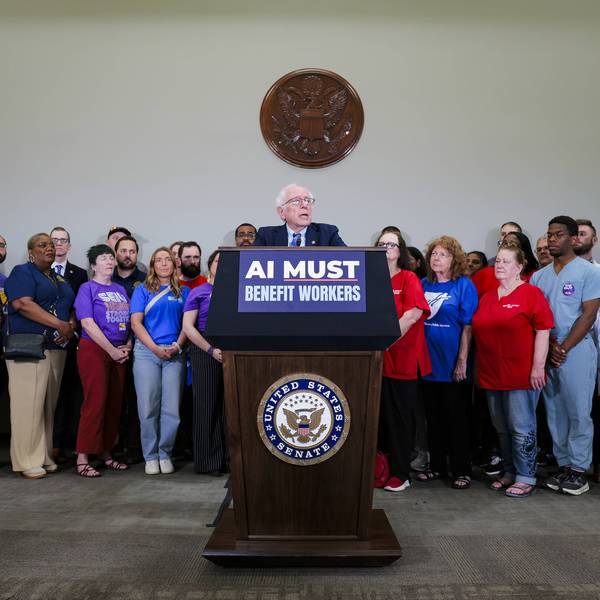
Sanders Makes Clear That He and Trump Have Different Ideas When It Comes to AI

“Do I have great confidence that Trump will do that right thing? No, I don’t.”


Senator Bernie Sanders (I-Vt.) talks to reporters following a meeting with CEO of OpenAI Sam Altman at the Dirksen Senate Office building in Washington, DC on June 3, 2026.
(Photo by Nathan Posner/Anadolu via Getty Images)

Brad Reed
Jun 09, 2026
COMMON DREAMS

With President Donald Trump seemingly open to the idea of having the federal government take a stake in major artificial intelligence firms, Sen. Bernie Sanders emphasized on Monday that he and the president have two very different visions when it comes to regulating AI.

During an interview at the National Press Club, CBS News’ Robert Costa asked Sanders (I-Vt.) to comment on Trump last week showing interest in the government partially owning Big Tech firms whose AI models could potentially disrupt American society in the coming years.
RECOMMENDED...


Sanders Sovereign Wealth Fund Plan Would Give US Public ‘Direct Ownership Stake’ in AI Giants


Big Tech GOP Donor Marc Andreessen Claims AI Better Than Human Workers: ‘Never Gets Sick... Never Files HR Complaints’

Sanders credited Trump with having sharp political instincts on the matter, theorizing that he understands the deep unease and anxiety that people feel about AI, particularly the fear that it could put millions of Americans out of work while benefiting Big Tech CEOs like Elon Musk and Mark Zuckerberg.

“So as a politician, I think that’s where he’s coming from,” Sanders said. “Do I have great confidence that Trump will do the right thing? No.”


Trump so far has only hinted at plans for a public stake in AI firms and hasn’t released any concrete plans.

In contrast, Sanders earlier this month wrote an editorial for The New York Times in which he proposed creating an AI-based sovereign wealth fund that would impose a one-time, 50% tax on OpenAI, Anthropic, and other AI behemoths, paid in the form of stock.

Sanders argued that the wealth fund was necessary to “give the public a direct role in determining the future of this technology” and “guarantee that the trillions of dollars potentially generated by AI are used to improve the lives of all of us—not simply to make the richest people in the world even richer.”

Noting that AI companies’ large language models (LLMs) were only made possible with the inputs of centuries’ worth of human knowledge and writing, Sanders said that it’s only reasonable that the public have a strong degree of control over how such technology is used.

“When a public resource generates wealth, the public should share in that wealth,” Sanders wrote. “The future of AI and the fate of humanity must not be decided behind closed doors in Silicon Valley. It must not be dictated by billionaires seeking to maximize their power and profit.”

Progressive economist Dean Baker on Tuesday pushed back on Sanders’ idea for an AI sovereign wealth fund, in particular arguing that it may be unwise for the government to create a wealth fund based on what might be a wildly overvalued asset.

“Most likely the AI sector is in a massive bubble,” cautioned Baker. “An AI sovereign wealth fund is likely to end up being a mechanism to shovel yet more money to Elon Musk, Mark Zuckerberg, and the rest of the right-wing billionaire gang. We have already given this crew enough money.”

Instead, Baker proposed handling the potential negative consequences of AI disruption through a mix of higher corporate income taxes, stricter antitrust enforcement, and shorter average work weeks.

“We have all the tools needed deal with an AI productivity boom; we just lack the political will to use them,” Baker concluded. “The sovereign wealth fund idea is a massive leap in the wrong direction.”


‘No Evidence’: Bolivia’s Paz Blames ‘Narco-Terrorists’ for Protests and Signs Law Granting Emergency Powers

US Secretary of Defense Pete Hegseth linked “narco-terrorism,” a top target of the Trump administration, to Bolivia’s ongoing protests last week.


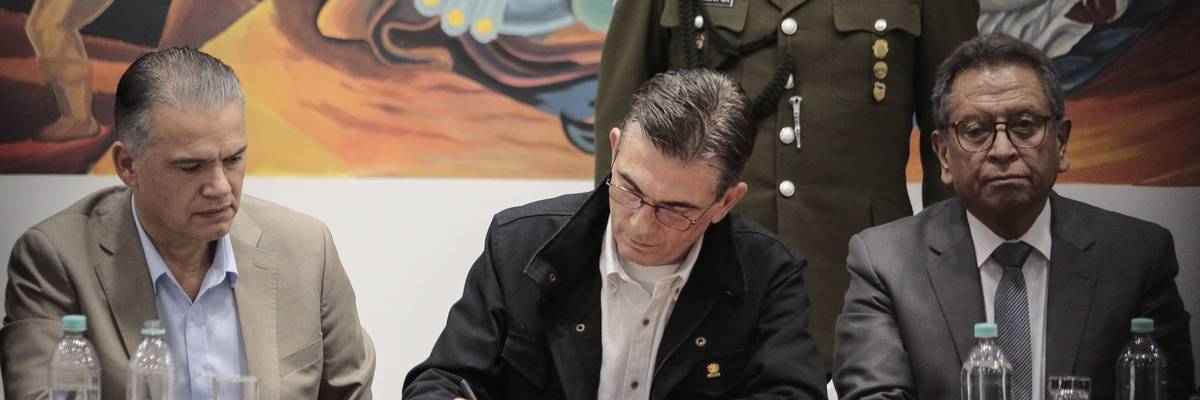
Bolivian President Rodrigo Paz signs a law that regulates states of emergency as labor unions and Indigenous groups lead protests and blockades in La Paz, Bolivia, on June 8, 2026.

(Photo by Jorge Mateo Romay Salinas/Anadolu via Getty Images)


Julia Conley
Jun 09, 2026
COMMON DREAMS


Days after the Trump administration blamed “narco-terrorists” for ongoing anti-government protests in Bolivia, US-backed President Rodrigo Paz adopted the term in a statement Monday as he signed legislation that could clear the way for his administration to impose a state of emergency—allowing the military to take action against the demonstrations and suspending constitutional rights across the South American country.

“Our security is put at risk when narco‑terrorism, and the priorities of certain actors, are not aligned with our democracy, our Constitution,” Paz said at a signing ceremony. “They put their own interests above those of Bolivian society.”
RECOMMENDED...


Bolivian Government Charges Labor Leader With Terrorism as Police Crack Down on Protests


Bolivia Lawmakers Overturn Limits on ‘Martial Law’ as Mass Uprising Demands Ouster of President


The president warned that the protest organizers’ “days are numbered.”

Local journalist Joseph Bouchard noted that Paz did not provide any evidence that the dozens of roadblocks that have been erected in Bolivia and the marches and other protests that have been held in cities including La Paz and El Alto are in any way connected to drug trafficking or “narco-terrorism.” The government of the Santa Cruz department, the largest of nine constituent departments in Bolivia, also used the term “narcoguerrillas” to describe protest organizers.


Paz signed the legislation into law weeks after the Bolivian Chamber of Senators overturned a law that imposed strict limits on how the government can declare a state of emergency in the country. The limitations included ensuring that certain rights could not be suspended under a state of exception and making the president criminally liable for exceeding the law’s parameters.

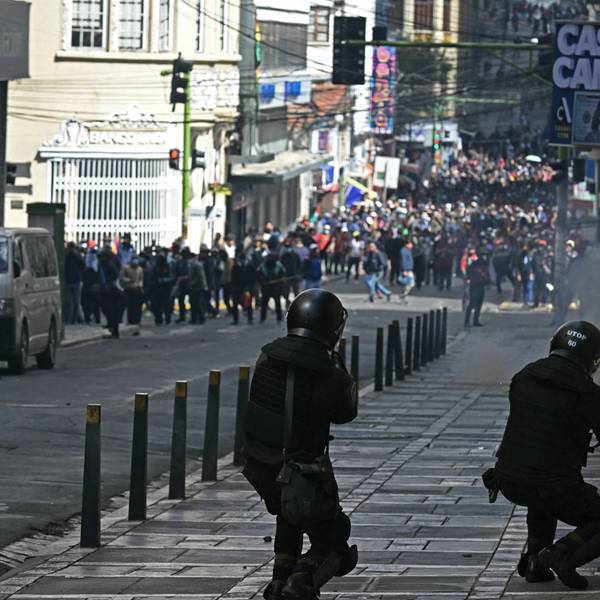
On Sunday the legislature passed a new law clearing the way for Paz to declare a state of emergency and allow the military to deploy to clear about 90 blockades and other protests.

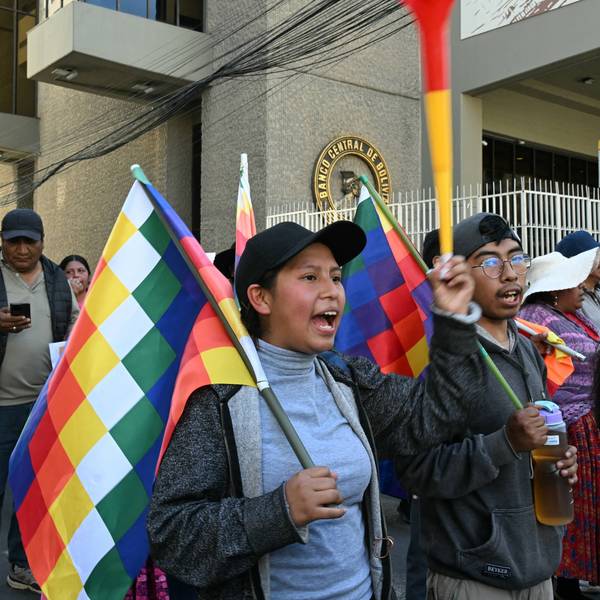
The demonstrations have included a 683-mile march in May from the northern territories to La Paz, with Indigenous representatives, teachers, mining unions, and other labor federations among those protesting low wages, privatization, and Paz’s decision to end a fuel subsidy after he became president last November. The subsidy had been crucial for working people, organizers say. Some groups are calling for Paz’s resignation.

According to The Associated Press and other outlets, the road blockades have disrupted deliveries of food, fuel, and medical supplies.

Before Paz signed the law on Monday, the country’s public prosecutor charged a leader of the main labor federation with “terrorism” for his role in leading the demonstrations.

The independent public ombudsman said over the weekend that 10 people have died as a result of the blockades, 37 people have been injured, and 365 arrests have been made from May 1-June 2. The government has said seven of the deaths resulted from a lack of medical attention, but they are still being investigated.

Last week, US Secretary of Defense Pete Hegseth said on social media that the US government and military would “reject all attempts to overthrow the legitimate government” of Paz.

“The United States is watching. Bolivia must not allow itself to fall prey to the old status quo of narco-terrorist dominance in the region,” Hegseth added.

The Trump administration has also claimed to be fighting “narco-terrorism” as it has killed more than 200 people in boat bombings in the Caribbean and eastern Pacific Ocean, and charged Venezuelan President Nicolás Maduro with drug trafficking after the US military invaded Venezuela and abducted the president in January.

In March, residents of a farming town in Ecuador described an “ambush” by Ecuadorian and American forces who had attacked the area in what the country’s right-wing president, Daniel Noboa, called an operation to take down “a training ground for drug traffickers.”

The farmers said the town was a “livestock area” with no drug trafficking activity taking place.

Bouchard noted that before signing the law regarding the declaration of a state of emergency, Paz thanked Hegseth for his “support for democracy.”

“I really don’t know how anyone could take any of this seriously,” said Bouchard, “after reading for three seconds about the Trump administration and the history of the US in Bolivia/Latin America.”

 What the Pentagon’s Snub of Mormons Was Really All About

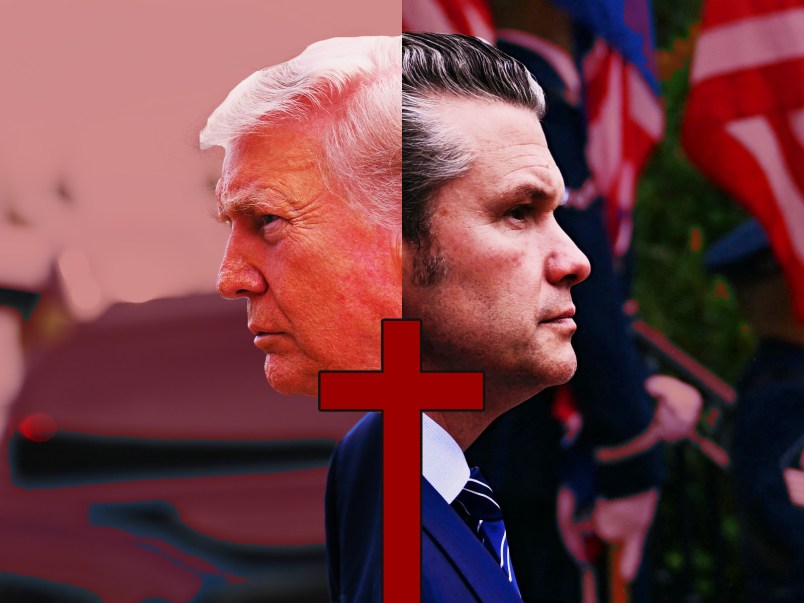
President Trump and Defense Sec Pete Hegseth. TPM illustration/Getty Images.


In Church, Merch, and State, Sarah Posner writes about the intersection of religion and politics in the United States. This column is part of TPM Cafe, TPM’s home for opinion and news analysis.

Sen. Mike Lee (R-UT), an ardent Trump loyalist, recently got a taste of what it’s like to be a disfavored religion in the Christian nationalist world of MAGA. He was triggered by the news, broken by the defense news site Military.com, that the Pentagon had eliminated 180 recognized religious faiths in order to “streamline the DoW [sic] collection of religious preferences collection [sic] for service members to enhance the delivery of targeted religious support from the Chaplaincy.” The Pentagon’s new list of what it calls Religious Affiliation Codes classified a number of religions, like Methodists and Baptists, as Christian. But Lee’s Church of Jesus Christ of Latter-Day Saints was not listed among the “Christian” faiths. He demanded — on X, of course, because United States Senators have no other means of either commanding attention or acquiring information — “why The Church of Jesus Christ of Latter-day Saints was left out of the list of Christian churches.”

Lee and other LDS lawmakers spent several days futilely seeking answers to that question. By midday Monday, Lee had lodged his complaint with management — that is, he called President Donald Trump, who “loves Latter-day Saints,” Lee assured his followers on X. The Pentagon then released a new list, which did not classify any religion as Christian. Was it a win? A win would have been for the LDS Church to have been included among the Christian faiths. Convincing the public that, yes, a religion that has the words Church of Jesus Christ in its name was actually Christian had been at the top of the senator’s to-do list this weekend. That the Pentagon chose to excise the Christian label entirely rather than apply it to Lee’s church was quite telling. But Lee declared victory anyway, writing on X that he was “grateful” to Secretary of Defense Pete Hegseth for “correcting the error.” 

It’s hard to imagine why such a new classification system was even necessary, other than being another step in Hegseth’s march to his personal brand of Christian supremacy. Hegseth reportedly insisted on whittling the list down because the number of religions practiced by members of the military had “ballooned” to over 200 religions and needed to be reduced to an apparently very arbitrary 31. The new list omits, among others, atheists and Unitarian Universalists. In announcing the revised, Lee-approved list, the Pentagon wrote on X that “the Pentagon’s job is not to adjudicate theological debates, but instead to ensure sincerely-held faith is respected and encouraged in our ranks.” 

But “adjudicating theological debates” is precisely what the Pentagon has done. Hegseth has made no secret of his religious agenda, as evidenced by his monthly prayer meetings on government property, at which his religious mentor, the Christian nationalist Doug Wilson, has preached. Wilson is not shy about his antipathy to the LDS Church. He has written that “Mormonism is not Christian” and is “a false gospel.” In April, responding to reader mail on his blog, Wilson thanked a correspondent, an Army chaplain, for the “heads up” about the “disturbing trend” of Mormon chaplains in the Corps. The reader prayed that Wilson could wield his “significant influence in certain spheres” to do something about this “heresy.”

The entire “reclassification” effort was sure to trigger complaints of both a constitutional and personal nature. But Lee, who has long shaped his political identity around his supposed expertise in the Constitution, had a deeply personal, not constitutional beef. Resolving it was also a personal matter: he expressed no concern that the list, or Hegseth’s hyper-sectarian prayer meetings, may run afoul of the First Amendment’s Establishment and Free Exercise clauses. Instead, his campaign to have his own faith properly categorized as Christian was a cry for inclusion (oh, no! not that!) in the MAGA circle. As much as Lee prides himself on his MAGA bonafides, at its religious heart MAGA is an evangelical movement, and evangelicals have long considered Mormons weird outsiders, non-Christians, and even members of a cult. In the 1990s, former President Jimmy Carter, a Southern Baptist, received blowback for questioning his brethren’s insistence that Mormons are not Christians.

Years later, Republicans contentiously chose a Mormon as their nominee for president. That nominee, Mitt Romney, had to try for the nomination twice — first in 2008, when his rival, the former Arkansas governor and Southern Baptist pastor Mike Huckabee, was forced to apologize for wondering aloud in an interview with the New York Times whether Mormons believe Jesus and Satan were brothers. (They don’t, but it’s quite a common distortion promoted by those hostile to the LDS Church.) When Romney ran again in 2012, this time successfully securing the nomination, he had to endure attacks from another Southern Baptist minister, Robert Jeffress, who later went on to be one of Trump’s first evangelical endorsers and most loyal supporters. Jeffress called Mormonism a “cult,” with anti-LDS sentiment taking center stage at the 2011 Values Voter Summit, which at the time was otherwise a typically cohesive affair of religious conservatives with shared opposition to abortion and LGBTQ people and other demonized outsiders. Later, Trump would do something Romney couldn’t pull off — win over evangelicals.

Screwworm Parasite ‘No Longer Contained in Texas’ as Trump USDA Doubles Down on Efforts to Blame Biden

“This has nothing to do with Joe Biden,” one senator said, “but Trump and DOGE definitely screwed our cattle industry.”


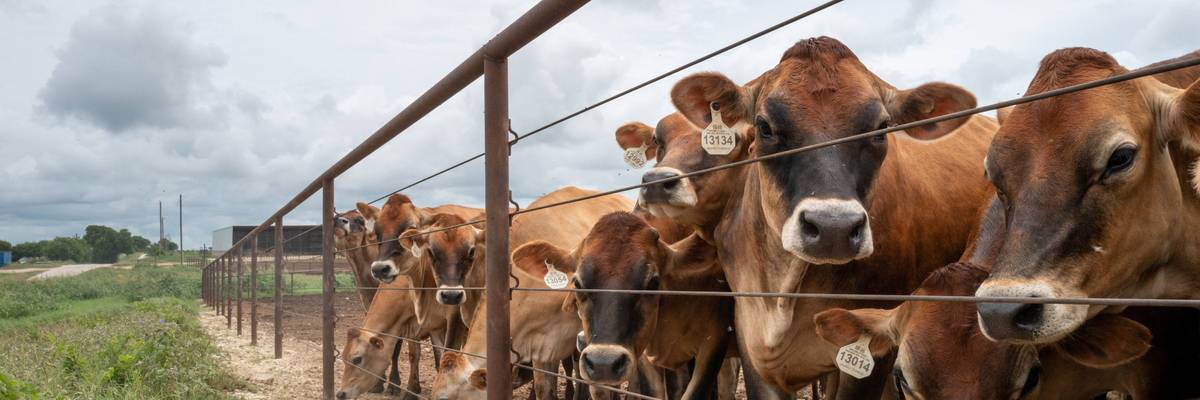
Cattle are herded in a stable on June 5, 2026 in Hamilton, Texas. US Secretary of Agriculture Brooke Rollins has confirmed the detection of the New World screwworm—a parasitic fly whose larvae feed on the living tissue of warm-blooded animals—in a cow in Zavala County, Texas.
(Photo by Brandon Bell/Getty Images)


Julia Conley
Jun 09, 2026
COMMON DREAMS

The Trump administration has emphasized in recent days that the New World screwworm infection found in a calf in Texas did not pose a threat to the United States’ larger cattle herd, which is at its lowest point in 75 years due largely to drought conditions—but the US Department of Agriculture is now acknowledging that cases of the parasite have been found outside the Texas containment zone and as far away as in New Mexico, as Republican officials attempt to blame the Biden administration for the outbreak.

While Democratic lawmakers are among those connecting the arrival of screwworm—a flesh-eating bug that feeds off the living tissue of warm-blooded animals and had been eradicated in the US in 1966—to cuts by President Donald Trump’s Department of Government Efficiency (DOGE) that specifically targeted screwworm monitoring programs, Agriculture Secretary Brooke Rollins doubled down on claims that an “open border policy” under the Biden administration was to blame.


“This does trace back to the last administration and the open border policy, and the movement of millions of people and their animals up from South America through Central America,” said Rollins with certainty on Monday.

As David Dayen explained at The American Prospect Tuesday, former President Joe Biden placed a ban on bison, horse, and cattle imports from Mexico in 2024, which Trump lifted in February 2025. At the same time, DOGE, under the leadership of Trump megadonor and tech billionaire Elon Musk, cut screwworm monitoring efforts and animal disease control and prevention efforts, slashing 1,300 employees from USDA’s Animal and Plant Health Inspection Service.

Rollins did reinstate the live import ban last May as screwworm cases were rising in Mexico and began funding prevention programs in Texas. But a $600 million facility for breeding sterile screwworm flies—a key component of successful eradication efforts—is not scheduled to be completed until late next year, and sterile flies that have been dispersed from a facility that opened in February at Moore Air Force Base in South Texas only amount to “about one one-hundredth of what it would take each week to eradicate the pest,” Dayen wrote.

He also noted that Rollins has attempted to blame Biden—who has not been in office since January 2025—despite the fact that the total average lifespan of a screwworm fly is 21 days.

“The more likely explanation is that an administration with an antipathy to government ignored government’s purpose until it was too late,” wrote Dayen.

The USDA established a 12-mile quarantine area around the affected area last week when the case was detected in South Texas, but on Monday the agency said another case had been found in Gillespie County, over 100 miles from where the initial case was reported.

A dog was also found to be infested in Lea County, New Mexico, more than 400 miles away.


The parasite is not expected to affect food safety, as it feeds on living tissue, but the outbreak raises concerns about rising beef prices, which are already high due to the low volume of cattle in the US. The high prices of fertilizer and fuel due to the war in Iran, and of equipment and repairs due to Trump’s tariff policy, have also put a strain on the cattle industry.

“The cattle producer in the US has already been under extreme financial stress,” Joe Maxwell, president of Farm Action Fund and a farmer in Missouri, told The American Prospect. “This is serious, the screwworm outbreak. But it’s even more serious because of the financial position they were already under.”

In response to Rollins’ claims, Sen. Patty Murray (D-Wash.) said Tuesday: “Let’s be clear about what happened: DOGE cut the programs and staff that tracked dangerous outbreaks like screwworm.”

“So this has nothing to do with Joe Biden,” she said, “but Trump and DOGE definitely screwed our cattle industry.”
Report Details How Climate Crisis Fuels Crop Failure Risk in Global Breadbaskets

“As globally important food-producing regions face growing risks of climate-driven disruption, the effects can ripple through livelihoods, supply chains, food assistance systems, and geopolitical relationships.”


An Indian farmer inspects his destroyed rice crop after floodwaters inundated his field in the Kapurthala district of Punjab state on September 11, 2025.
(Photo by Shammi Mehra/AFP via Getty Images)

Brett Wilkins
Jun 09, 2026
COMMON DREAMS

The climate emergency is sharply increasing the risk of crop failure in regions that produce an outsized share of the world’s staple food grains, according to a report published Tuesday that warns of “serious threats to Europe, the NATO alliance, and global stability” if cooperative resilience initiatives and other mitigation strategies aren’t pursued.

The report, “Global Breadbaskets: Food System Resilience as a Strategic Imperative,” was published by the Center for Climate and Security—part of the Council on Strategic Risks, a Washington, DC-based security policy think tank—and the Woodwell Climate Research Center, an independent nonprofit located in Falmouth, Massachusetts.

“Geopolitical fragmentation, conflict, extreme weather, and global aid cuts already strain food security. Meanwhile, climate change is increasing the likelihood of crop failures in the American, European, and Asian breadbaskets, which produce most of the staple crops underpinning global food security,” the report states.


The publication follows an April report from a pair of United Nations agencies on how extreme heat is impacting food production and food security around the planet. The new report includes a storymap that explores climate change-driven threats to wheat, rice, and maize (corn) crops in France, Germany, and India—three of the world’s “global breadbaskets.”

The analysis’ authors note that compared with 2010 threat levels, by 2040, “the risk of a given year’s crop failing is projected to grow roughly twofold for Indian wheat and German maize, roughly threefold for French wheat, roughly fourfold for French maize, and roughly sixfold for Indian rice, with sharp increases in critical producing regions.”

Climate-driven extreme heat “not only threatens crops, but also the laborers and infrastructure that translate them into food security,” the report continues. “Extreme heat is projected to reduce the suitability of 15-40% of India’s rain-fed rice-growing regions by 2050, and to reduce physical work capacity during the average growing season to as little as 40% of 2000-era levels by 2100.”

“By 2040, southwestern France will average up to 16 additional days per year above 35°C (95°F), exceeding thresholds that reduce yields, impact grain quality, and cause heat stroke,” the paper warns. “Extreme heat also threatens to damage or disable road and rail networks critical to food transportation, agricultural machinery, civil defense, and military mobilization.”

The publication also states that global breadbasket failures in Europe “could open rifts for Russian meddling, fuel instability in key partners, and elevate food production as a geopolitical lever.”

The Council on Strategic Risks operates within the transatlantic security policy community, whose work often overlaps with NATO’s interests.

“We have plenty of examples of how crop failures can contribute to political instability, from the French Revolution to the Arab Spring,” Center for Climate and Security deputy director and report lead author Tom Ellison said Tuesday in a statement. “In today’s environment, global breadbasket failures could strain NATO priorities, prompt unrest in key countries, and upend trade relationships.”

Woodwell Climate Research Center scientist and report co-author Alexandra Naegele warned that “climate change doesn’t just threaten crop yields and grain quality—it destabilizes entire food systems, from labor and livestock to food storage and transport.”

“Quantifying these climate-driven risks is an essential step toward building resilient food systems and safeguarding global food security,” she added.

The report recommends steps countries—specifically members of the European Union and NATO—can take to mitigate risks to food security, including strengthening cooperative resilience, anticipating instability and hybrid warfare, supporting strategic and vulnerable partners, coordinating trade responses, and investing in agricultural research and development.

“Amid climate change, geopolitical uncertainty, food shocks from the war in Iran, and Russian hybrid warfare, investing in a resilient food system isn’t in competition with security—it’s a key part of it,” Ellison stressed.

Monica Caparas, a scientist at the Woodwell Climate Research Center and report co-author, said, “Understanding and preparing for breadbasket failures is both a national security priority and a humanitarian imperative—one that can help protect lives, reduce instability, and strengthen food resilience before a regional shock becomes a wider crisis.”
VOLUNTEERISM FAILS

Voluntary Pledges ‘Aren’t Working,’ Report Shows as Big Banks Continue to Sow Climate Chaos

“Banks keep telling us they’re committed to climate. Then they abandon their own policies the moment political pressure mounts. Voluntary pledges have had their chance. We need binding rules—not promises.”


Wrecked vehicles remain submerged in floodwaters as volunteers work to clean up and recover belongings on July 7, 2025, after a weekend flash flood devastated homes in Leander, Texas.
(Photo by Austin American-Statesman via Getty Images)


Julia Conley
Jun 09, 2026
COMMON DREAMS

Calls for an end to oil, gas, and coal extraction grew louder in 2025 as the impact of fossil-fueled planetary heating was starkly illustrated by devastating wildfires across the Los Angeles area, deadly flash floods in Texas, a European heatwave that was blamed for the deaths of more than 24,000 people, and cyclones and floods that killed thousands.

But as climate action groups demanded that governments and financial institutions end support for fossil fuel projects and companies last year, according to a report released Monday by several organizations, the world’s largest banks only committed more financing to projects like the Mountain Valley Pipeline, a planned liquefied natural gas (LNG) “boom” in the Philippines, and fracking in the Permian Basin.

Last year, according to Banking on Climate Chaos—released by groups including the Rainforest Action Network, Sierra Club, and Oil Change International—the world’s largest financial institutions committed $906 billion in financing to fossil fuel companies, representing an 8% increase over funding the previous year.

The groups emphasized that the banks financed pollution-causing oil, gas, and coal projects even as they made “voluntary commitments” to “aligning their lending, investment, and capital markets activities with net-zero greenhouse gas emissions by 2050,” as a now-defunct United Nations-backed scheme called the Net-Zero Banking Alliance (NZBA) pledged.

More than a decade after countries agreed to the Paris climate accord and pledged to take action in a push to avert planetary heating over 1.5°C above pre-industrial temperatures, the report notes, “banks maintain and are expected to uphold climate policies independent of the NZBA.”

However, it continues, “the collapse of the NZBA—culminating in its cessation of operations in October 2025—freed banks to further unwind from climate targets and other elements of their climate strategies.”

“Notably, throughout 2025 and the first half of 2026, banks have further weakened their commitments to uphold 1.5˚C temperature rise limits, widened loopholes, and undercut sector policies for coal, oil, and gas energy or power supply primarily by removing or diluting exclusion criteria and commitments. Most policy changes in the past year were downgrades of existing policies rather than improvements,” reads the report.

“Voluntary commitments aren’t working. No major oil and gas company is doing anything even close to what is needed to hold global heating to 1.5°C, and voluntary banking sector pledges like the Net Zero Banking Alliance aren’t cutting their pipeline of cash.”

Diogo Silva, campaign lead for BankTrack and a co-author of the report, said: “Banks keep telling us they’re committed to climate. Then they abandon their own policies the moment political pressure mounts. Voluntary pledges have had their chance. We need binding rules—not promises.”

Banking on Climate Chaos highlights the banks that spent the most money investing in fossil fuel projects, with JPMorgan Chase named the leading financier of oil, coal, and gas. The Wall Street firm spent $58 billion in 2025, the same year it also “weakened” its own climate policy.

“Of the 15 North American banks in scope, 12 now have no meaningful fossil fuel commitments,” said Rainforest Action network. “JPMorgan Chase and Goldman Sachs abandoned their coal and Arctic exclusions entirely, converting them into case-by-case due diligence standards.”

JPMorgan Chase is one of three US banks listed in the top five fossil fuel backers; Bank of America financed the second-largest amount of pollution-causing projects at $47 billion, while Citigroup poured more than $45 billion into fossil fuels. Two Japanese institutions, Mitsubishi UFJ Financial Group and Mizuho Financial, were also in the top five.

With President Donald Trump taking executive action last year aimed at pressuring companies to back fossil fuel interests and “disregard social or environmental considerations,” the report notes, US banks’ share of all global fossil fuel financing increased to 32%, representing “the single largest source of fossil capital in the world.” In 2021, US banks provided 28% of fossil fuel investment.

Trump has also aggressively pushed for more coal production since taking office for his second term in January 2025, and financing for coal mining expansion surged 77% in 2025, to $84 billion. Funding for coal power also grew by 40%, with companies pouring $81 billion into coal-fired plants.

Even when asked about the report’s findings, top banks pointed to their own voluntary commitments to finance renewable energy projects and “achieve net zero financed emissions by 2050,” as a spokesperson for Citigroup said to The Guardian.

The spokesperson said the bank “supports clients in the low‑carbon transition while recognizing the real need for secure, affordable and reliable energy today. We are committed to... advancing our $1 trillion sustainable finance goal, with a focus on balancing the transition with global energy resilience”.

David Tong, global industry campaign manager for Oil Change International and a co-author of the report, warned that “every dollar of finance for oil and gas helps an industry of war profiteers squeeze out short-term profits, further trapping communities into paying higher fossil fuel energy bills, fueling war and conflict, and burning all our futures.”

“Voluntary commitments aren’t working. No major oil and gas company is doing anything even close to what is needed to hold global heating to 1.5°C, and voluntary banking sector pledges like the Net Zero Banking Alliance aren’t cutting their pipeline of cash,” he said. “Instead, banks have injected over staggering $900 billion into fossil fuel financing in 2025 alone. Governments must step in and take urgent action to hold financial institutions and fossil fuel companies accountable for their role in the climate crisis.”

Since the Paris climate agreement, the report says, banks have poured a staggering $8.7 trillion into the fossil fuel industry, with the “Dirty Dozen,” as the authors call the 12 largest fossil fuel financial backers, providing nearly 40% of all investment for coal, oil, and gas extraction.

The report makes demands of banks, calling on them to “exclude all finance for fossil fuel expansion immediately” and “require robust, 1.5°C-aligned transition plans from all existing fossil fuel clients”—but emphasizes that governments must compel financial institutions to end financing for oil, gas, and coal.

“After two consecutive years of fossil fuel finance increases by global banks—especially the increase in fossil fuel expansion finance and the continued backtracking from banks on their climate pledges—it is clear that the banking sector will not voluntarily take the necessary steps to transition out of fossil fuel finance at the pace and scale needed for the world to deliver on the Paris Agreement goals,” reads the report.

Instead, it says, governments must mandate transition planning by banks, private equity holders, insurers, and other companies; make polluters pay for climate damages; ensure public finance institutions are subject to transparent reporting and legal accountability to international standards, and rapidly wind down supply-side fossil fuel subsidies, tax exemptions, subsidies, guarantees or other public assistance for new oil, gas, and coal projects.

“A decade after Paris, just twelve banks now drive more than a third of the world’s fossil fuel financing—proof that this is no longer a problem of markets, but of a small set of decision-makers making active choices,” said Niko Lusiani, research director for Rainforest Action Network. “They are choosing to lock in an energy system that hands record profits to a few fossil firms while passing the costs onto the three of every four people on Earth who depend on imported fuel.”

“The good news is that what a handful of banks built,” said Lusiani, “governments and people worldwide have the power to change.”