Monday, January 24, 2022

3 Palestinians injured after Jewish extremists attack West Bank village near Nablus

Settlers parade through Hawara, stoning cars and storefronts, in convoy to celebrate release of Israeli imprisoned for attacking Palestinians

By AARON BOXERMAN
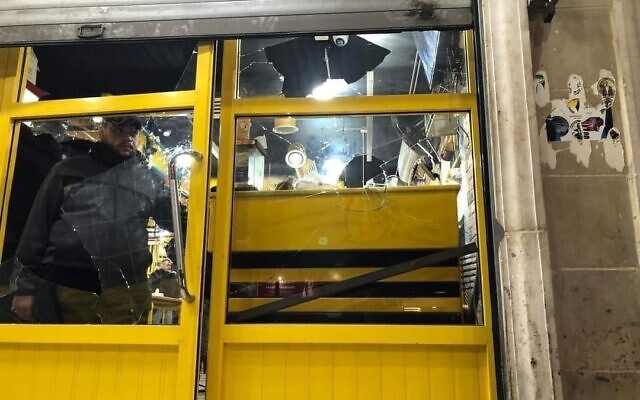
A Palestinian examines damage to a shop allegedly from Jewish extremist stone-throwing in Huwarra, near Nablus, on January 24, 2022. (courtesy)

Jewish extremists hurled stones at Palestinians while parading through a West Bank town near Nablus on Monday night, injuring three people and smashing cars throughout the village, Palestinian officials and Israeli rights groups said.

A convoy of settlers drove through Hawara, honking their horns and blasting music to celebrate the release of an Israeli imprisoned last year for throwing stones at Palestinians, according to an Israeli security official. The extremists later began throwing stones at local Palestinians.

“The friction began when a number of cars driving on Road 60 through Hawara, threw stones at businesses and parked cars and caused much damage,” the Israeli military said in a statement.

At least 20 Palestinian cars were damaged and storefronts smashed in the village, the left-wing Yesh Din rights group said. An Israeli police spokesperson said officers were investigating the incident.

Local Palestinian Authority official Ghassan Daghlas said in a phone call that a 15-year-old Palestinian from Hawara was rushed to a Nablus hospital after being struck in the head by a stone thrown by a Jewish Israeli.
Get The Times of Israel's Daily Editionby email and never miss our top stories
Newsletter email addressGET IT
By signing up, you agree to the terms

According to Hawara town mayor Mueen Dameidi, another two Palestinians, respectively aged 12 and 17, were also lightly wounded by the extremists’ stone-throwing.

Palestinian officials claimed that Israeli soldiers were present at the scene, but did nothing to prevent the attacks. When Palestinians threw back stones at their assailants, soldiers fired tear gas and stun grenades to disperse them, Dameidi said.

“The settlers broke cars. They smashed storefronts and shouted and cursed at the village residents — all in the presence of the army,” Dameidi said.
ADVERTISEMENT


A Palestinian points at a car whose windows were allegedly smashed in by a stone-throwing Jewish extremists on January 24, 2022. (courtesy)

The Israeli army declined to comment on Dameidi’s claim.

Hawara mostly lies in the West Bank’s Area C, where Israel maintains full military and civilian control. An Israeli checkpoint at the northern end of the village has frequently seen clashes between Palestinians and soldiers.

To the northeast lies Yitzhar, widely seen as one of the West Bank’s most hardline Israeli settlements. The Jewish Israeli former prisoner was reportedly being taken back to his home in the town following his release.

Israeli security officials have warned that violence by Jewish extremists in the West Bank has spiked in recent months. Shin Bet officials told The Times of Israel in late December that Jewish extremist violence had increased by 50 percent over the past year.

Following Monday night’s attack, Defense Minister Benny Gantz pledged more action on “nationalist crime.” As in previous statements, Gantz avoided specifying exactly who was carrying out the attacks.

“The recent incidents of nationalist crime in Judea and Samaria are grave and we will deal with them severely. Anyone who throws stones, sets vehicles ablaze… is a terrorist,” Gantz tweeted.

Nonetheless, the internal Israeli political debate over the phenomenon has been divisive. Right-wing Israeli politicians have denounced the characterization of the attacks as “settler violence,” charging that it is an attempt to besmirch all Jews living in the West Bank.

“There are marginal elements in every community and they should be dealt with using all means, but we must not generalize about an entire community,” Prime Minister Naftali Bennett said in mid-December.

Much of the violence is allegedly perpetrated by Jewish extremists who live in illegal outposts. Last Friday, masked figures descended from the Givat Ronen outpost — one of several outposts near Yitzhar — and viciously beat left-wing Israeli activists in the nearby Palestinian town of Burin, wounding at least six.

“If Palestinians attacked Israelis, with the Israeli army right there — would they just allow it to happen? Of course not. You’d have a dead Palestinian,” said Hawara town mayor Dameidi.

Settler riot in West Bank village causes damage, injuries

Rioting settlers hurl stones and damage storefront windows and cars in village of Huwara near Nablus as they celebrated release from custody of one of their number accused of hurling a stun grenade at a Palestinian home

Elisha Ben Kimon,Elior Levy|
Published: 01.24.22, 

At least three Palestinians, including a three-year old boy, were slightly wounded and property was damaged when dozens of settlers rioted in a West Bank village on Monday.

Police say they have launched an investigation after considerable damage was caused in Huwara near Nablus, where settlers apparently hurled stones at cars and shops, breaking windows.
  • יידוי אבנים בחווארה
    A car damaged by stones thrown by rioting settlers in West Bank village of Huwara
    The settlers who drove through the West Bank village in a convoy of cars as they rioted, were celebrating the release of one of their number from detention, after he was charged with hurling a stun grenade at a Palestinian home.
    IDF forces separated local residents from the rioters.
    יידוי אבנים בחווארה
    Storefront window damaged from stones thrown by rioting settlers in Huwara near Nablus
    The incident comes a day after cars were allegedly vandalized by settlers and two days after a group of settlers attacked Palestinian farmers and left-wing supporters using stones and sticks near an illegal outpost on the West Bank causing injuries.
    Defense Minister Benny Gantz condemned the incident and the previous violence saying he intended to act forcefully against the perpetrators.
    פעילי רבנים לזכויות אדם וקואליציית המסיק הותקפו בכפר בורין בידי מתנחלים רעולי פנים
    A car set on fire during rioting of West Bank Settlers on Saturday
    (Photo: Rabbis for Human Rights NGO )
    "Whoever hurls stones, sets cars on fire, and uses any kind of weapon is a terrorist and we will treat them as such," gantz said.
    "We are in the midst of a process to strengthen the forces on the ground [in the West Bank,] including the police and the Shin Bet and focusing our legal efforts there," he said.
    Several arrested at Washington protest against Sheikh Jarrah expulsions

    Hundreds staged a sit-in at the Israeli embassy in Washington to protest forced expulsions of Palestinians in the East Jerusalem neighbourhood


    A protest organiser leads a crowd in a series of chants in front of the
    Israeli embassy in Washington (MEE/Umar Farooq)

    By Umar A Farooq in Washington
    Published date: 24 January 2022

    Several people were arrested on Sunday after a day of largely peaceful protest outside of the Israeli embassy in Washington, where hundreds gathered to condemn the forced expulsions of Palestinians from the East Jerusalem neighbourhood of Sheikh Jarrah and other areas of occupied Palestine.

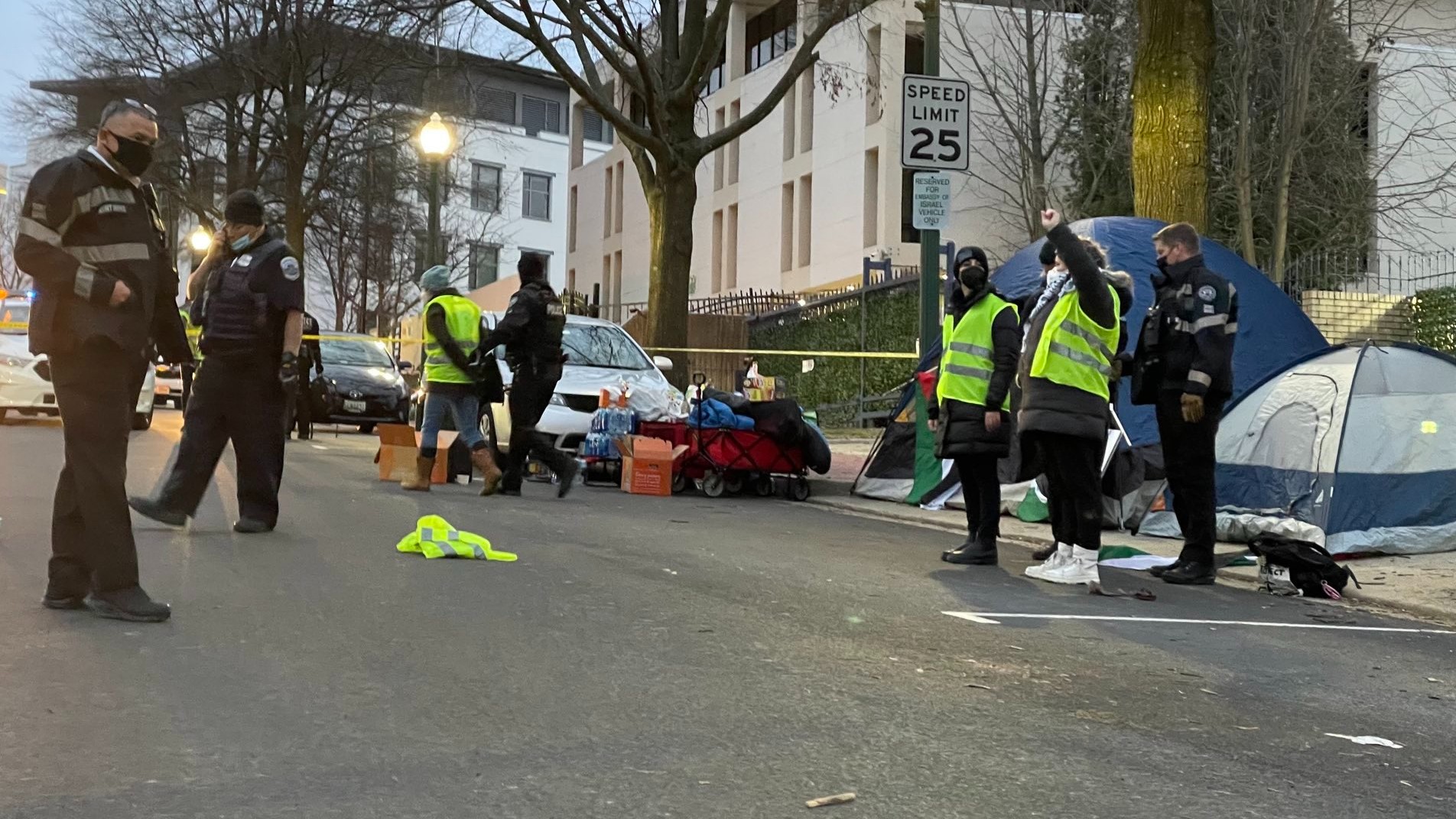
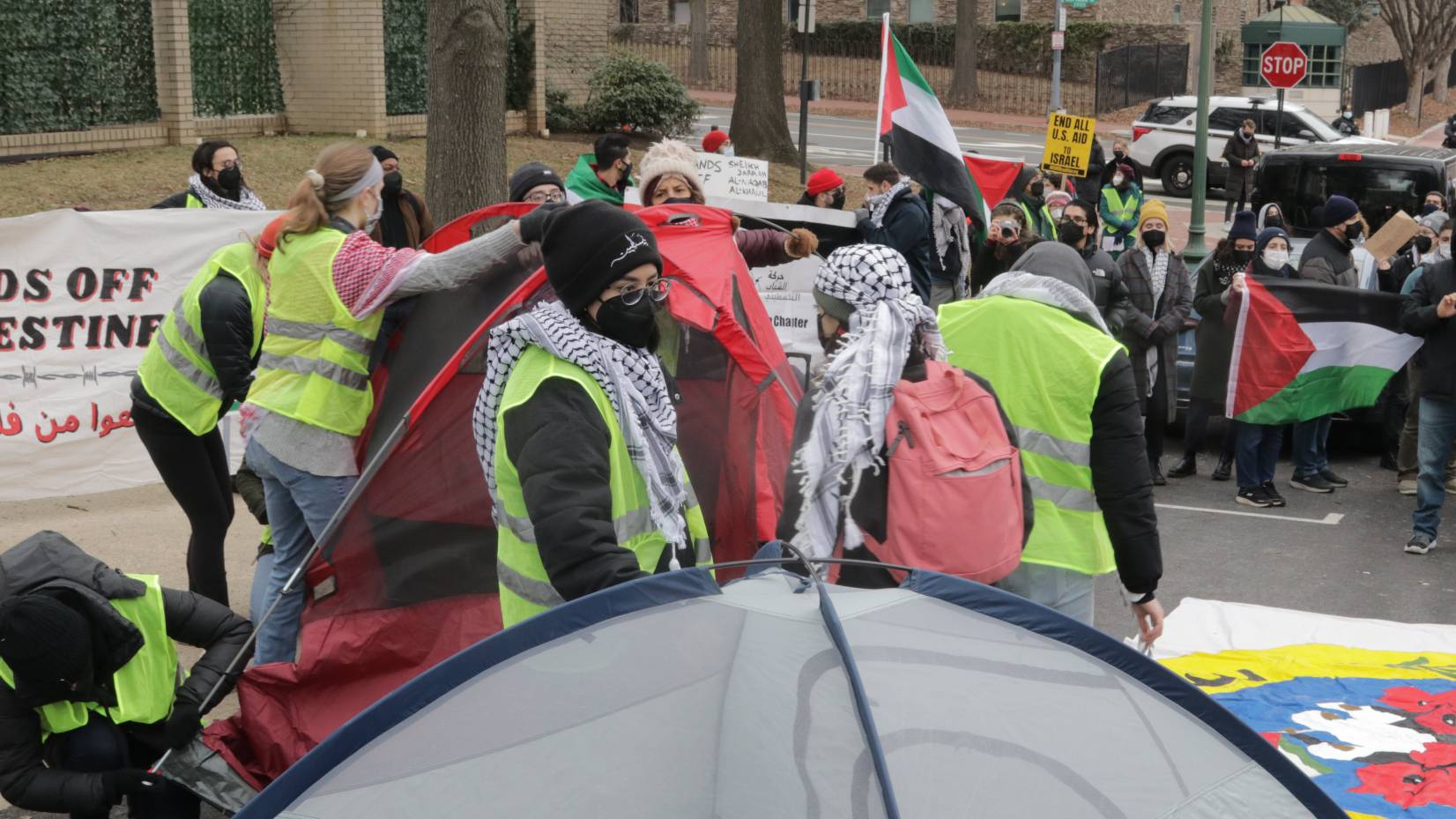
    Earlier in the day, hundreds of pro-Palestine activists gathered in front of the embassy to protest Israel's policies towards the Palestinians. After blocking off a road in front of the embassy, protesters set up three tents and laid down banners in front of the building's gate.

    Many of the demonstrators wore black and white keffiyehs, a headscarf that has come to symbolise Palestinian resistance against colonialism and the Israeli occupation, as they held up placards saying, "Hands off Sheikh Jarrah!"

    The Palestinian Youth Movement (PYM), the organisation which organised the sit-in, said seven demonstrators were arrested after the protest had largely ended and they were being held in two precincts in Washington.

    The Metropolitan Police Department of the District of Columbia referred MEE to the US Secret Service for comment, and the Secret Service did not respond by the time of publication.

    The sit-in came amid widespread condemnation over Israel's decision last week to demolish the home of the Salhiya family in Sheikh Jarrah, leaving 18 people, including children, homeless.

    Sheikh Jarrah has become a flashpoint over the past year, as the Israeli government has tried to expel multiple families from the neighbourhood in order to make way for Israeli settlers.The demolition was carried out on Wednesday by a large Israeli security operation that saw Israeli forces violently raid the home of Mahmoud Salhiya before arresting him, a number of his relatives and supporters.

    Since Israel occupied East Jerusalem in 1967 and subsequently annexed it in 1980, settlers have been trying to displace Palestinians from their homes in the area based on claims of Jewish ownership dating back to the Ottoman era.

    "We all came out here today to protest against the US complicity in the war crimes and funding of these war crimes that Israel's committing against the Palestinian people," an organiser with the PYM, who asked to remain anonymous, told Middle East Eye.

    "Israel is currently ethnically cleansing Palestinians in Sheikh Jarrah, in al-Naqab, and in al-Khalil. And we don't want our tax dollars to go towards that."
    Seven people were arrested during the sit-in in front of the Israeli embassy in Washington, on 23 January 2022 (Courtesy of Palestinian Youth Movement)

    'It's like we're back to square one'


    At present, 37 Palestinian families live in Sheikh Jarrah, six of them facing imminent eviction.

    Since 2020, Israeli courts have ordered the eviction of 13 Palestinian families in the neighbourhood. Last May, the forced evictions of multiple families ignited an international protest movement, with tens of thousands of people marching in Washington, New York, London and many other major cities across the world.

    Since then, despite the continued protests, some protesters told MEE that momentum seems to have died down.Celebrities including Bella Hadid, Mark Ruffalo, The Weeknd, Halsey, and Kehlani, all came out in solidarity with Palestinians, either directly participating in protests or sharing content on social media.

    'So we're hoping that this event and this action will revitalise the protest movement'

    - Dalia, a Palestinian protester

    "It feels like last year all over again. And it's really frustrating to feel like we're kind of back to square one," said Dalia, a protester who asked that her last name not be revealed.

    "So we're hoping that this event and this action will revitalise the protest movement."

    However, Dalia noted that since last May, the crowds attending these protests had become more diverse, showing that the cause for Palestinian rights is being supported not only by the Palestinian community in the US. More and more Americans understand the plight of Palestinians in the occupied territories.

    Polling over the past year has shown that there has been a shift when it comes to the discourse around the Israeli-Palestinian conflict, with a Gallup poll released in March 2021 finding that the majority of Democrats felt the US should be putting more pressure on the Israeli government.

    "I'm very hopeful when I see so many people from so many different backgrounds showing up and helping us because it's exhausting doing this alone," Dalia said.

    "We're constantly bombarded with information. We have to be on top of everything and it's good to know that we have a community to rely on."
    Protesters set up tents in front of the Israeli embassy in Washington (MEE/Umar Farooq)
    Puerto Rico: statue of Spanish explorer toppled before King Felipe’s visit

    Juan Ponce de León statue came down hours before king arrives on island to mark 500 years since founding of capital San Juan

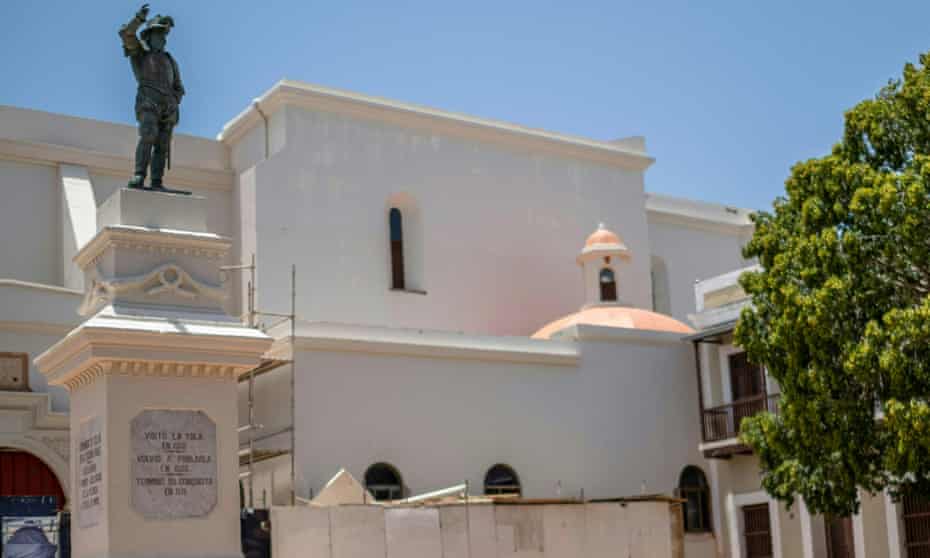
    The Juan Ponce de León statue in Old San Juan, Puerto Rico. The capital’s mayor criticized what he said was an ‘act of vandalism’.
     Photograph: Ricardo Arduengo/AFP/Getty Images

    AFP in Miami
    Mon 24 Jan 2022 

    A statue of the Spanish explorer Juan Ponce de León has been toppled in Puerto Rico’s capital, San Juan, hours before a visit to the Caribbean island by Spain’s King Felipe VI.

    The capital’s mayor, Miguel Romero, criticized the incident on Monday as an “act of vandalism” in remarks to news outlet El Nuevo Día, but sought to downplay the significance of the incident and the extent of the damage.

    “Some individuals approached the statue”, located in a square in the historic center of San Juan, and “caused damage”, according to a police report quoted by local media.

    Felipe VI was due later on Monday in Puerto Rico, a US territory, to mark the 500th anniversary of San Juan’s founding.

    The city’s origins date back to 1521, but the official celebrations were delayed due to the Covid-19 pandemic.

    Authorities indicated they were looking at security camera footage to help identify those responsible for damaging the statue.

    Local media reported that a group known as the Boriken Libertarian Forces has claimed responsibility.

    “Faced with the visit of the King of Spain, Felipe VI, to Puerto Rico and the escalation of ‘gringo’ invaders taking over our lands, we want to send a clear message: neither kings nor ‘gringo’ invaders,” the group wrote in a statement.


    Ponce de León undertook a royal mission in 1508 to explore and colonize the island, which the native Taino inhabitants called Boriken. He eventually became Puerto Rico’s first governor.

    The statue was forged in 1882 in New York, with bronze obtained from British cannons captured after a failed attack on the Spanish in Puerto Rico in 1797.
    5.5 magnitude earthquake shakes Haiti days after anniversary of 2010 disaster

    Country's geology makes it susceptible to devastating earthquakes


    Laura Gamba |24.01.2022

    BOGOTA, Colombia

    A 5.5 magnitude earthquake struck Haiti's southern peninsula on Monday, leaving at least two people dead, shaking houses and buildings and prompting schools to close.

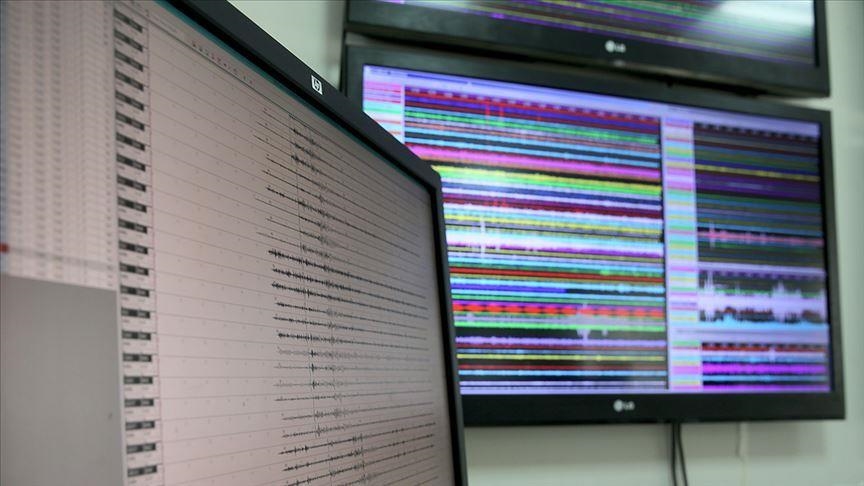
    "The earthquake occurred at 08:16 local time, with magnitude 5.5, and depth of 3.0 kilometers," the country's seismological services reported. The tremor was followed by several aftershocks.

    Haiti's Civil Protection Directorate reported that at least two people died following the earthquake. In Anse-a-Veau, a man died when a wall collapsed and the second death was caused by a landslide.

    Haiti is one of the most seismically active places in the world due to its unique geology. The country sits on a fault line between huge tectonic plates, one in North America and the other in the Caribbean.

    Monday's earthquake comes just days after the 12th anniversary of the 7.0 magnitude quake in 2010 that killed more than 220,000 people and left its capital Port-au-Prince devastated.

    In August of 2021, Haiti experienced a 7.2 magnitude earthquake that killed more than 2,000, injured at least 5,700 people and destroyed hundreds of houses leaving thousands displaced from their homes.

    In 2021, experts reported at least 1,647 earthquakes, the largest of which was the 7.2 magnitude on Aug. 14, an increase of 230% over the previous year.

    The country is still struggling with the coronavirus pandemic, a wave of gang violence and political instability following last month's assassination of President Jovenel Moise.
    Biscuit World union effort rooted in West Virginia history

    By LEAH WILLINGHAM

    1 of 4
    Former Tudor's Biscuit World employee Jennifer Patton, 38, holds up stickers displaying the logo of the United Food & Commercial Workers Local 400 union at her coworker's home in Elkview, W.Va., on Jan. 20, 2022. Patton said she was retaliated against and fired by management after she joined efforts to unionize the restaurant. Employees at the Elkview, W.Va., restaurant have already case ballots to decide whether or not they want to create a union. The votes will be read Tuesday. (AP Photo/Leah M. Willingham)


    ELKVIEW, W.Va. (AP) — While making biscuits and meatloaf at a fast-food restaurant during the coronavirus pandemic, 64-year-old Cynthia Nicholson often thinks back to her husband’s coal mining days in West Virginia.

    In that job and in his time as a pipefitter, she said, the work was grueling and sometimes dangerous — but there were standards for safety, working conditions and wages, and people felt they were treated fairly. She said that was because he belonged to unions.

    At Tudor’s Biscuit World in Elkview, a franchise of a regional chain that serves comfort food, Nicholson says workers have no such protection. With the coronavirus surging, she doesn’t feel safe.

    So, a few months ago she did the only thing that makes sense to her: She reached out to her late husband’s union friends and asked for help. On Tuesday, after months of organizing, National Labor Relations Board officials will count votes cast by some of the franchise’s roughly two dozen workers to find out if it will become the first unionized fast-food restaurant in the state

    The push for a union in this mountain town of fewer than 2,000 people echoes a larger national movement of organizing among retail and food service workers. In a business where workers have routinely been asked to stay on the job and interact with the public during the pandemic, they hope forming a union will give them more say in how they are treated.

    The effort also resonates deeply in a state with a storied history of labor activism, coming 100 years after the largest worker uprising in U.S. history erupted in West Virginia coal country.

    “We’re tired of being treated as badly as we’re being treated,” Nicholson said. “The workers are treated with no dignity, no respect, like they’re just a number.”

    The vice president of Tudor’s Biscuit World did not respond to a voicemail or text message from The Associated Press, and no one from the chain’s corporate offices responded to phone calls.

    Relatively unknown outside the region, Tudor’s Biscuit World is a staple of West Virginia: a must-stop eatery where diners can get made-from-scratch biscuits doused in gravy; country-fried steak and sandwiches including the Miner or the Mountaineer. Founded in Charleston in 1980, the chain now has more than 70 locations, mostly in West Virginia and in parts of neighboring states Ohio and Kentucky.

    In one sense, the Elkview franchise, surrounded by hills and parked next to a Dairy Queen, is far removed from the West Virginia coal mines where men and women once stood in the vanguard of the American labor movement. In another, the connection is visceral.

    Workers here feel connected to the state’s labor history in their bones, bonded by blood to men and women who saw the value of organizing for safer conditions and better pay in their own lives. Unions have been weakened considerably over the years, but many West Virginians remember a father, a husband or some other relative who once held a union job, and they witnessed the power of banding together.

    Employees in the state have often gravitated toward unionization when concerns about job safety are heightened, notes West Virginia University historian William Hal Gorby.

    “Workers across sectors are saying, ‘We are living through a moment in time where it’s making you wonder: Do you want to do this particular job because you could get sick and or die from it?’” he said. “In the early 20th century, it was the coal mine and lack of regulations and now it’s COVID.”

    A century ago, concerns over safety and quality of life drew workers to Blair Mountain, where armed miners were subdued by government officials and at least 16 men died. It was a setback for the labor movement at the time, but union membership in the state reached a peak in the decades following the battle. In the 1940s and 1950s, roughly half of West Virginia workers were employed in heavy industries such as coal, steel and glass, and the majority of those workers belonged to a union.

    By 2021, however, only 10.5% of West Virginia workers were represented by unions, according to U.S. Department of Labor statistics released last week.

    Nicholson is a retired dental assistant who lives in Elkview. She started working at Tudor’s about a year ago, earning $9 an hour as a prep cook for extra income after her husband died of cancer.

    She saw things that worried her immediately. After an employee tested positive for COVID-19, the restaurant’s employees were never informed, she said. When one of her coworkers questioned the store’s COVID policy, Nicholson said, she started getting her hours cut. Employees often had to work past their scheduled hours to cover shifts and then were reprimanded for working overtime, she said.

    Nicholson also alleges that she and other employees were shorted on their paychecks and charged hundreds of dollars for meals at work they never ate.

    “The belittling that goes on astonished me,” she said, adding that in her previous job as a dental assistant, “You weren’t allowed to act like that.”

    Nicholson reached out to one of the unions her husband had belonged to: the Plumbers & Pipefitters Local 625, based in the capital of Charleston. Union officials there connected her with the United Food & Commercial Workers Local 400, which represents 35,000 workers across six states and Washington, D.C.

    When a majority of the workers at Tudor’s Elkview franchise signed authorization cards, Nicholson said, there was a lot of excitement. They hosted rallies where people held signs saying, “We love union biscuits.”

    But soon the temperature changed. Employees started worrying that they could lose their jobs or have their hours cut. Nicholson said she was written up for small things, something that hadn’t happened before.

    Former Tudor’s head cashier Jennifer Patton, 38, said she was afraid of joining a union at first, but felt more comfortable after talking to her father-in-law, who was a union man.

    She signed on after she found out that an employee she had been riding with to another Tudor’s location had tested positive for COVID-19 and she hadn’t been told.

    Her decision had consequences: In the months that followed, she said, she was suspended multiple times even though she had never been disciplined previously and had even been promoted. Her bosses then took away her security clearance to work cashiers. Last week, she was fired.

    Patton’s son just started his first year of college. She said paying for her son’s education is important to her.

    “Me and my husband work every day, as many hours as we possibly can, and we still struggle,” she said. “Nobody deserves to be talked to and treated the way we are.”

    Tudor’s employee Susie Thompson, 67, agrees.

    “I wouldn’t be doing this job at my age unless I had to,” said Thompson, whose ex-husband belonged to a union as a strip miner. “It’s hard. Morale is so low.”

    Nicholson hopes enough workers feel the connection to the state’s past to tip the balance in favor of a collective bargaining unit now.

    “Unions protected our family members, so many workers in this state’s history,” she said. “We need that protection at Tudor’s.”
    UK
    FCA staff to vote on strike action as negotiations dry up

    CEO Rathi has dismissed staff concerns as ‘noise’

    Staff at the Financial Conduct Authority (FCA) are voting on whether or not to take industrial action in an indicative ballot call by Unite the Union, following  claims “management has refused to negotiate”.

    James Baxter-Derrington
    24 January 2022• 

    The FCA's headquarters in East London

    The union accuses management at the regulator of embarking on a programme of "severe cost-cutting", which it said is set to turn the FCA into a "bargain basement regulator".

    This programme includes cutting staff pay by 10-12% and imposing an appraisal system that "punishes strong performers", while the FCA has also recently refused to allow staff representation by an independent trade union.

    Other key concerns raised by Unite in its statement include a "botched" consultation process in order to rush through changes, staff outside London being placed on lower pay scales, and plans to cut staff pensions.

    Chief executive Nikhil Rathi was directly acknowledged in the statement over his previous dismissal of employee complaints as "noise" and claims a reduction in pay would improve staff performance, Unite said.

    Unite national officer Dominic Hook said: "Unite members will today start voting in an indicative ballot for industrial action at the FCA. The ballot will deliver a clear sense just how dire workforce morale and employee confidence is within the FCA leadership.

    "Management at the FCA are attempting to implement a program of pay cuts, which has come after two years in which the staff at the FCA have worked gruelling hours to provide financial protection against Covid for borrowers, investors, small businesses and people with mortgages.

    "Unite has made it clear that if introduced these cuts will make it even less likely that the FCA will be able to deliver this high standard of public service in the future. Experienced employees have been quitting the regulator in droves. More are expected to follow, as in a recent Unite survey 89.8% of staff described their morale as ‘low' or ‘very low'."

    He added: "You cannot regulate the British financial system on a bargain basement basis as Nikhil Rathi clearly wishes to do. Management must enter into immediate negotiations with Unite the union in order to avoid further damage and risk to the FCA."

    The update today (23 January) comes after Unite general secretary Sharon Graham wrote to the FCA in November remanding trade union recognition for its workforce, giving the regulator ten days to respond by law.

    It also follows the Treasury Select Committee's announcement of a planned investigation into workplace culture practices at the FCA last June, to which the Personal Investment Management & Financial Advice Association also gave its support.
    Boeing to pour $450 million into program for self-driving air taxi


    Wisk is one of several companies working on an electric vertical takeoff and landing air vehicle, or eVTOL. Photo courtesy Wisk/Twitter

    Jan. 24 (UPI) -- Aviation company Boeing announced on Monday that it's investing almost a half-billion more dollars into its sky taxi startup Wisk Aero, in a bid to bring the first self-flying air taxi to the market before the start of the 2030s.

    Boeing formed Wisk Aero in 2019 with its air vehicle company Kitty Hawk. Monday, the company said it will invest $450 million more in the WIsk Aero venture to develop the vehicles.

    There are a number of other similar companies and air vehicle prototypes in development, but Boeing said its focus with Wisk Aero is to introduce the first autonomous air taxi.

    "As we enter this next stage of our growth, this additional funding provides us with capital while allowing us to remain focused on our core business and our number one priority, safety," Wisk CEO Gary Gysin said in a statement.

    Wisk is one of several companies working on an electric vertical takeoff and landing air vehicle, or eVTOL.

    The Federal Aviation Administration has not yet certified any eVTOL for commercial operation, and some experts expect it will take a few years to certify that the new aircraft are safe for passengers.

    Last year, Wisk Aero announced a deal with charter company Blade to operate a fleet of 30 autonomous air taxis on its U.S. network.

    It's unknown precisely how long it will be before Wisk introduces its autonomous air vehicle, but CNBC reported that the target date is around 2028.
    Russian YouTuber's retractable lightsaber earns Guinness World Record

    Jan. 24 (UPI) -- A Russian YouTuber has been recognized by Guinness World Records as the inventor of the world's first retractable lightsaber.

    Alex Burkan, who runs the Alex Lab channel on YouTube, unveiled his Star Wars-inspired invention, which produces a plasma blade that measures more than 3 feet in length and burns at a temperature of 5,072 degrees -- hot enough to cut through steel.

    "The key component of my lightsaber is an electrolyzer. An electrolyzer is a device that can generate a huge amount of hydrogen and oxygen and compress the gas to any pressure without a mechanical compressor," Burkan told Guinness World Records.


    He said it took hundreds of experiments to get his apparatus to match the size and shape of a lightsaber hilt.

    "This is a first prototype so it has lots of limitations. It works for only 30 seconds on full power, the hydrogen torch is not as stable as it could be and you can easily see it when it moves. Sometimes the lightsaber just blows up in your hand because of hydrogen flashback," he said.

    Fellow YouTuber Hacksmith Industries, aka James Hobson, previously earned a Guinness World Record for creating the world's first retractable proto-lightsaber. Hacksmith's version of the Jedi weapon requires an external power source -- hydrogen and oxygen tanks attached to a backpack -- while Burkan's lightsaber is entirely self-contained.

    "The Hacksmith version is much more powerful, it definitely works longer than 30 seconds. Our duel would be extremely fast and furious, because I have only 30 seconds to win," Burkan said.

    Burkan said he and Hobson have a friendly rivalry.

    "Sometimes we discuss our current projects. Sometimes we threaten each other with our new inventions, but we always support each other," he said.
    Hippos can recognize familiar voices, new study finds

    By Calley Hair

    Hippopotamuses can differentiate between neighbors and strangers based only on the sound of their "wheeze honk" calls, a new study finds. Photo by Nicolas Mathevon

    Jan. 24 (UPI) -- Hippopotamuses can tell the difference between strangers and their neighbors based only on the sound of their voices, according to a study published Monday in Current Biology.

    The study indicates that the giant herbivores can identify each other by their signature, noisy "wheeze honk." When hippos hear a familiar call, they're less likely to respond with aggression than when they hear a new call for the first time.

    The results suggest that hippos, which are famously territorial, still rely on communication networks and form complex social groups.

    "We found that the vocalizations of a stranger individual induced a stronger behavioral response than those produced by individuals from either the same or a neighboring group," one of the researchers, Nicolas Mathevon, of the University of Saint-Etienne in France, said in a press release.

    "In addition to showing that hippos are able to identify conspecifics based on vocal signatures, our study highlights that hippo groups are territorial entities that behave less aggressively toward their neighbors than toward strangers."

    To study the animals, the team worked in Mozambique's Maputo Special Reserve, a 400-square-mile nature reserve that includes several lakes inhabited by groups of hippos. They recorded "wheeze honk" calls from each group. Then they would play the recording back -- to the same group, to other groups in the same lake and to groups in a distant lake.

    The hippos would respond by approaching the sound, issuing their own returning call or spraying dung. They reacted to unfamiliar calls from different lakes with more intensity, researchers found, and were more likely to mark their territory by spraying dung if they didn't recognize the vocalization as belonging to their own family or neighbors.

    Researchers on the study hope that their findings can help others learn more about hippo calls, like whether the animals can use them to determine size, sex or age. They also hope that their study will be useful in conservation efforts.

    "Before relocating a group of hippos to a new location, one precaution might be to broadcast their voices from a loudspeaker to the groups already present so that they become accustomed to them and their aggression gradually decreases," Mathevon said.

    Communication and socialization in the animal kingdom has long been a subject of fascination among researchers. In many species, communication tools are surprisingly nuanced and complex -- dogs, for example, can tell when a human switches between languages, a study published earlier this year found.
    Analysis: Crisis in Ukraine a showdown of two world views- NEITHER PROLETARIAN

    By JOHN DANISZEWSKI

    1 of 13
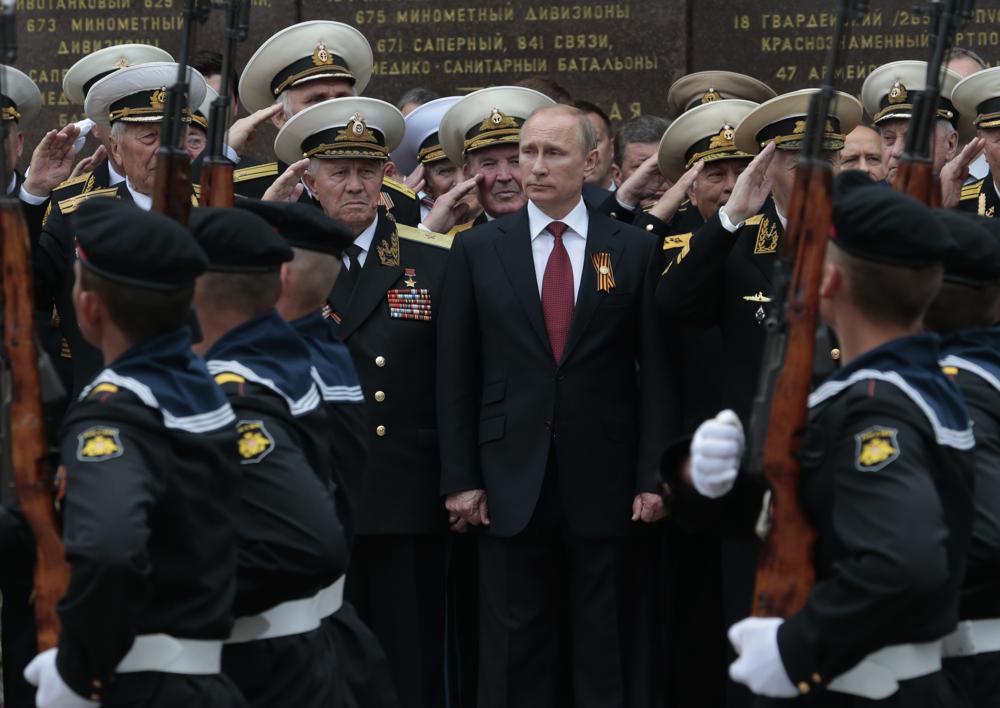
    FILE - Russian President Vladimir Putin attends a parade marking the Victory Day in Sevastopol, Crimea, on May 9, 2014. Russia's present demands are based on Putin's purported long sense of grievance and his rejection of Ukraine and Belarus as truly separate, sovereign countries but rather as part of a Russian linguistic and Orthodox motherland. (AP Photo/Ivan Sekretarev, File)


    NEW YORK (AP) — The crisis in Ukraine is hardly going away — a showdown of two world views that could upend Europe. It carries echoes of the Cold War and resurrects an idea left over from the 1945 Yalta Conference: that the West should respect a Russian sphere of influence in Central and Eastern Europe.

    Since coming to power in 2000, Russian President Vladimir Putin has worked steadily and systematically to reverse what he views as the humiliating breakup of the Soviet Union 30 years ago.

    While massing troops along Ukraine’s border and holding war games in Belarus, close to the borders of NATO members Poland and Lithuania, Putin is demanding that Ukraine be permanently barred from exercising its sovereign right to join the Western alliance, and that other NATO actions, such as stationing troops in former Soviet bloc countries, be curtailed.

    NATO has said the demands are unacceptable and that joining the alliance is a right of any country and does not threaten Russia. Putin’s critics argue that what he really fears is not NATO, but the emergence of a democratic, prospering Ukraine that could offer an alternative to Putin’s increasingly autocratic rule that Russians might find appealing.

    Russia’s present demands are based on Putin’s long sense of grievance and his rejection of Ukraine and Belarus as truly separate, sovereign countries, rather than as part of a much older Russian linguistic and Orthodox motherland that should be joined with, or at least friendly toward, Moscow.

    In a millennium-spanning treatise last summer titled, “The Historical Unity of Russians and Ukrainians,” Putin tipped his hand. He insisted that the separation of Russia, Ukraine and Belarus into separate states today is artificial, due largely to political mistakes during the Soviet period and, in the case of Ukraine, driven by a malevolent “anti-Russia project” supported by Washington since 2014.

    His Russo-centric view of the region poses a crucial test for U.S. President Joe Biden, who already is grappling with crises on multiple domestic fronts — the coronavirus pandemic, resurgence of inflation, a divided nation in which a large segment of the electorate refuses to acknowledge his presidency and a Congress that has blocked many of his social and climate goals.

    Biden has ruled out military intervention to support Ukraine, and instead has employed intense diplomacy and rallied Western allies to support what he promises will be severe and painful sanctions against Russia if it dares to invade Ukraine. But depending on how the situation plays out, he has admitted he could have trouble keeping all the allies on board.

    The Russian leader has already invaded Ukraine once, with little reaction. Russia took Crimea back from Ukraine in 2014 and has supported pro-Russian Ukrainian separatists fighting the Kyiv government in the Donbass region, a quiet war that has killed 14,000 people, more than 3,000 of them civilians.

    Putin’s strategy has been to try to recreate the power and a defined sphere of influence that Russia lost with the fall of the Berlin Wall, at least in the area of the former Soviet Union. He has bristled at what he sees as Western encroachment into the countries of the former Warsaw Pact -- which had once formed a pro-Soviet buffer between the USSR and NATO.

    Poland, Hungary and the Czech Republic were allowed to join NATO in 1999, followed in 2004 by Bulgaria, Estonia, Latvia, Lithuania, Romania and Slovakia.

    Subjected to post-World War II Soviet domination, the countries were eager to join the Western defensive alliance and the Western free-market system to secure independence and prosperity after the fall of the Iron Curtain.

    For similar reasons, both Ukraine and Georgia also want in, and have been recognized by NATO as aspiring members of the alliance. Ukrainian President Volodymyr Zelensky has asked Western leaders to take on Ukraine’s request for membership with greater urgency as a signal to Moscow that the West will defend Ukraine’s independence.

    Russia contends that NATO expansion violates commitments made to it after the Berlin Wall’s collapse in exchange for Moscow’s acceptance of the reunification of Germany. U.S. officials deny any such promises were made.

    Early in his presidency, Putin did not show adamant opposition to NATO. He suggested in a 2000 BBC interview that Russia might even be interested in joining; years later, he said he had raised that prospect with U.S. President Bill Clinton before Clinton left office in 2001.

    Now, however, Putin sees the alliance as threatening Russia’s security.

    But the newer NATO countries take the opposite view. They regard Russia, which boasts the region’s largest military and a vast nuclear arsenal, as the real threat, which is why they rushed to join NATO — afraid that a strengthened Russia might someday try to reimpose its dominance.

    A disputed election in Belarus led to months-long mass demonstrations against longtime Belarusian leader Alexander Lukashenko. Alienated from his own people and unrecognized as a legitimate president in the West, Lukashenko has been driven closer into Putin’s protective embrace.

    Similarly, after civil unrest in Kazakhstan just weeks ago, Russia sent in troops to help that former Soviet republic’s president restore order as part of a peacekeeping mission of the Russia-led Collective Security Treaty Organization alliance. The troops have since departed the country.

    Putin’s aim has been to reimpose ties with Russia’s former Soviet neighbors, while challenging and dividing the West. Rather than leading Russia in a more democratic direction, he appears to now reject the very idea of liberal democracy as a sustainable model, seeing it rather as a conceit the West uses to pursue its own aims and humiliate its foes.

    He came to power vowing to restore to Russia a sense of greatness. He seized back economic control from the oligarchs, crushed rebels in Chechnya, gradually strangled independent media and upped investment in the military. More recently, he has banned Russia’s few remaining human rights organizations.

    Beyond Russia’s borders, his secret services have overseen the assassinations of critics and meddled in foreign elections, including offering clandestine support to the election of Donald Trump in 2016, the pro-Brexit campaign in Britain and various right-wing European parties that oppose European integration.

    He told an interviewer in 2019 that “liberalism is obsolete,” implying that the dominant Western ideal of liberal democracy no longer has a place in the world. The idea that Ukrainians are independent and could be freely choosing their own alliances is to him a charade.

    “All the subterfuges associated with the anti-Russia project are clear to us. And we will never allow our historical territories and people close to us living there to be used against Russia. And to those who will undertake such an attempt, I would like to say that this way they will destroy their own country,” he wrote in his essay last summer.

    “I am confident that true sovereignty of Ukraine is possible only in partnership with Russia.”

    The challenge for Biden, NATO and the European Union is whether their collective resolve and solidarity can protect Ukraine’s vision of itself as part of the West, and whether Putin’s Russian nationalist ambitions in the region will succeed or fail.

    ___

    EDITOR’s NOTE: John Daniszewski, an Associated Press vice president and editor-at-large, covered Eastern Europe, Ukraine and Russia during the breakup of the Soviet Union and the early years of Putin’s presidency.