Tuesday, January 25, 2022

US LGBT community draws on AIDS experience to fight Covid


David Perruzza, owner of the Washington gay bar Pitchers, stands behind signs requiring proof of patrons' Covid-19 vaccination (AFP/Stefani Reynolds)


Tori OTTEN
Mon, January 24, 2022, 8:10 PM


From the start of the Covid-19 pandemic, as fear and isolation spread, Dave Perruzza had one thought -- he had seen it before.

"For me, it was thinking about the AIDS epidemic all over again, how nobody took it seriously," said Perruzza, who owns two LGBT bars in Washington, the US capital.

"We were like, 'Well, we're going to take this seriously.'"

With the Omicron variant fueling fresh restrictions around the world, some older members of the LGBT community say their shared experience of the AIDS epidemic in the 1980s put them ahead of the curve throughout the pandemic.

Perruzza has for months been requiring customers show Covid vaccination cards to enter his bars -- popular gay spot Pitchers and neighboring lesbian venue A League of Her Own, in the Adams Morgan district of the city.

He implemented his vaccine rules in July, one of the first in Washington to do so -- and months before the local government began this month to do the same.

"I think my age bracket is the last bracket that saw people that actually died of AIDS," Perruzza, 43, who lost his first boyfriend to the disease, told AFP.

"I'm not going to let history repeat itself."

The HIV/AIDS crisis in the United States raged for two decades after the first US case was discovered in 1981, and still claims lives today.

It primarily affected gay and bisexual men, Black and Latino men and trans women.

Then-president Ronald Reagan didn't declare AIDS research a federal priority until 1985, and the first treatment was developed in 1987.

By the end of 2000, at least 450,000 people had died of AIDS in the United States, according to government data.

- Same 'hysteria and lies' -

The pandemic has also brought back painful memories for Eric Sawyer, a founding member of the AIDS advocacy group ACT UP, who also lost his partner to the disease.

"The misinformation, the hysteria, the spread of just absolute lies (and) the attempts by individuals to address it being part of the problem," said Sawyer, who also worked with the UN's HIV/AIDS program.

"The stigma and discrimination that people who had Covid face... completely parallel the HIV response."

But some lessons may have been learned between the two health crises.

"The HIV epidemic taught us that education, testing and access to prevention methodologies" can be effective, said Sawyer.


HIV activists have also advocated for better distribution of supplies, as well as vaccine access for poor communities, communities of color and homeless people.

Even as these activists worked to combat Covid-19, however, the pandemic took a toll on the ongoing fight against HIV.

Studies by the Global Fund and UNAIDS found that the pandemic worldwide caused an 11 percent drop in prevention and treatment and a 22 percent drop in testing in 2020.

UNAIDS attributed the decrease to lockdowns that forced people into isolation, shuttered health services and disrupted HIV/AIDS programs.


- 'You have to care' -

"Because of our community's now-four decades of experience with HIV, we understand chemical trials, we understand antivirals," Chris Beyrer, an epidemiologist at the Johns Hopkins Bloomberg School of Public Health, told AFP. "We're not afraid of science."

"As a community, we have a lot of solidarity," he added, pointing out that many of those living with HIV are immunocompromised and need extra support.

LGBT activists rallied early in the pandemic to organize financial aid and safe housing for HIV-positive people. They also set up Covid testing at sexual health centers and Pride events.

Gay bars across the country began requiring proof of vaccination at the door, months before some US states followed suit. Almost half the states still reject any such requirements.

"LGBTQ bars are different... more like community centers," said Ed Bailey, who co-owns Washington gay bars Trade and Number 9, pointing out that gay bars have distributed HIV literature and condoms for decades.

"Our bars are sometimes the only place some of the people that patronize us are able to go and be comfortable enough to be who they are," said Bailey, 55. "That creates an entirely different level of responsibility."

"You have to care about your community."

to/bgs
China gives 'Fight Club' new ending where authorities win


China has some of the world's most restrictive censorship rules with authorities only approving a handful of foreign films for release each year (AFP/STR) (STR)

Beiyi SEOW
Mon, January 24, 2022, 9:08 PM·2 min read

The first rule of Fight Club in China? Don't mention the original ending. The second rule of Fight Club in China? Change it so the police win.

China has some of the world's most restrictive censorship rules with authorities only approving a handful of foreign films for release each year -- sometimes with major cuts.

Among the latest movies to undergo such treatment is David Fincher's 1999 cult classic "Fight Club" starring Brad Pitt and Edward Norton.


Film fans in China noticed over the weekend that a version of the movie newly available on streaming platform Tencent Video was given a makeover that transforms the anarchist, anti-capitalist message that made the film a global hit.

In the closing scenes of the original, Norton's character The Narrator, kills off his imaginary alter ego Tyler Durden -- played by Pitt -- and then watches multiple buildings explode, suggesting his character's plan to bring down modern civilisation is underway.

But the new version in China has a very different take.

The Narrator still proceeds with killing off Durden, but the exploding building scene is replaced with a black screen and a coda: "The police rapidly figured out the whole plan and arrested all criminals, successfully preventing the bomb from exploding".

It then adds that Tyler -- a figment of The Narrator's imagination -- was sent to a "lunatic asylum" for psychological treatment and was later discharged.

-'Too outrageous' -

The new ending in which the state triumphs sparked head scratching and outrage among many Chinese viewers -- many of whom would likely have seen pirated versions of the unadulterated version film.

"This is too outrageous," one viewer commented on Tencent Video.

"'Fight Club' on Tencent Video tells us that they don't just delete scenes, but add to the plot too," a user wrote on the Twitter-like Weibo platform.

It is not currently clear if government censors ordered the alternative ending or if the original movie's producers made the changes.

Tencent did not comment on the matter.

Hollywood studios often release alternative cuts in the hopes of clearing Beijing's censorship hurdles and getting lucrative access to millions of Chinese consumers.

In 2019, multiple scenes in the film "Bohemian Rhapsody" referencing iconic musician Freddie Mercury's sexuality –- a pivotal part of his biography -– were dropped in its China release.

Under President Xi Jinping, Chinese authorities have pushed to purge society of elements deemed unhealthy, including within movies, television, computer games.

They have also launched sweeping state crackdowns on tax evasion and perceived immoral behaviour in the entertainment industry, a tightening that has already targeted some of the country's biggest celebrities.

On Tuesday, the Cyberspace Administration of China announced it was launching a month-long "clean" web campaign to create a "civilised and healthy" atmosphere online over the Lunar New Year holiday.

bys/jta/lb


Covid outbreak on ship threatens Tonga aid efforts


Mango island residents fled to Tonga's capital following the volcano eruption (AFP/Eleanor GEE)


Mon, January 24, 2022,

A Covid-19 outbreak on an Australian warship threatened to disrupt Tonga eruption aid efforts Tuesday, as survivors of the deadly volcanic blast described how they fled with only the clothes on their backs.

The January 15 eruption generated huge tsunami waves and blanketed the Pacific kingdom in toxic ash when it obliterated an uninhabited island with explosive forces more powerful than a nuclear bomb.

Australia has led international relief efforts, rushing to get water and humanitarian supplies to the nation of 100,000.

But officials in Canberra said 23 Covid-19 cases had been detected among the crew of the warship HMAS Adelaide, which is steaming towards the capital Nuku'alofa laden with aid.

Tonga is one of the few places in the world that remains Covid-free and Australian Defence Minister Peter Dutton said the relief effort would not be allowed to jeopardise that status.

Dutton said the ship would remain at sea while discussions were held with Tongan authorities to decide whether the crew would attempt "contactless" delivery of the much-needed supplies.

"We're not going to put the Tongan population at risk, but at the same time we want to deliver aid as quickly as possible," he told Sky News Australia.

New Zealand, France, Japan and China have also contributed to relief efforts in the wake of an event the Tonga government has described as an "unprecedented disaster".

- 'We all ran' -

One of the worst-hit areas was Mango island, the closest inhabited land to the Hunga Tonga-Hunga Ha'apai volcano, which lies about 65 kilometres (41 miles) north of Nuku'alofa.

A local man was among three known fatalities from the disaster and Mango's entire remaining population of 62 has been relocated to the main island of Tongatapu after tsunami waves washed away their homes.

Kalisi Levani, 81, said the whole island shook and the sky turned black as she heard "explosions like shooting sounds".

"We all ran and we didn't take anything," she said.

Levani said families fled to a small hill, the island's only high ground, and she only made it over the rugged terrain with help from her son-in-law.

"I told him to put me down, because if I don't die from the tsunami, I'll die from being exhausted," she said.

Community leader Reverend Kisina Toetu'u said the islanders prayed through the night as ash rained down on them, with women and children sheltering under a woven mat as men remained exposed to the elements.

"It was only the next morning that some men, as a search party, went down to look for our missing person and saw the devastation, and that nothing was left," he said.

Asked if the community would return to Mango, Toetu’u said: "not in the near future".

"Everything is gone there, our homes, so we are here for now and then we will see what steps to take," he said.

str-ns/arb/dva
'Nightmare': Workers, students decry Japan virus entry ban

"It seems to be almost xenophobia."


1More than 370,000 people have been left in limbo by Japan's coronavirus border rules, which bar almost all new arrivals and are the strictest in the G7 (AFP/Philip FONG)

Etienne Balmer and Katie Forster
Mon, January 24, 2022,

Yanita Antoko has been waiting for over a year in Indonesia to join her husband in Japan. She has her papers and has closed her business selling homemade spice mixes, but remains shut out.

The 30-year-old is one of more than 370,000 people left in limbo by Japan's coronavirus border rules, which bar almost all new arrivals and are the strictest in the G7.

Even as other countries with tough virus restrictions like Australia reopen, Japan still bans tourists and business visitors as well as new foreign workers, students and their dependents.

"It's really, really upsetting me," said Antoko, whose Indonesian husband works as an engineer in central Japan.

"When you get married, of course you want to have children. That's the main reason we want to live together."

But there is no clarity on when that might be possible.

Prime Minister Fumio Kishida has extended the current measures, which polls show are popular with the public, until at least late February.

That leaves people like 28-year-old Santosh from Nepal in an agonising position.

He holds a business degree from Japan, speaks Japanese, and has been offered a job in the international marketing division of a Japanese company. But he has been stuck in Nepal since 2020, waiting for permission to move.

"If I cancel my plans to work in Japan, then my six years of studies there will have been for nothing," Santosh, who asked to be identified without his surname, told AFP.

"So I'm waiting and waiting."

Others like French student Leeloo Bos are facing similar difficulties in keeping their dreams alive.

The 21-year-old, whose fiance is in Japan, is attending her Japanese classes at night due to the time difference.

"It's a nightmare," she told AFP, describing language lessons that end at 4:00 am.

And while she still hopes to build a career promoting Japanese bands, she said being apart from her Japanese fiance left her "feeling empty, as though half my soul had been removed."

- 'Out of touch' -


Academics and business leaders warn Japan is losing out with its intransigent border rules.

"Expertise is declining" because companies cannot bring in foreign workers, said Michael Mroczek, president of the European Business Council in Japan.

With infections already spreading in Japan, the restrictions "appear to some extent irrational," he told AFP.

"It seems to be almost xenophobia."


Japan has recorded a relatively low 18,500 deaths during the pandemic, despite never imposing a full lockdown or pursuing a "zero-Covid" policy like neighbouring China.

A foreign ministry official defended the "stringent (border) measures" as helping explain the "significant difference between Japan and other countries" in the number of infections involving the virus's Omicron variant.

But in Japan's business world, there is frustration, with the head of the powerful Keidanren business lobby on Monday comparing the rules to Japan's self-imposed isolation from the 17th to 19th century.

The measures are "out of touch with reality," said Masakazu Tokura, urging Kishida to reconsider.

In an open letter to the prime minister last week, scholars involved in Japan-US exchange also warned the entry ban "undercuts Japan's diplomatic objectives and status as an international leader."

- Students looking elsewhere -


Davide Rossi, an Italian entrepreneur living in Japan, campaigns for the nearly 150,000 students official figures show are stuck outside the country.

"They've been in this limbo for two years but still don't have a timeline or a plan, which is the very minimum the government should give them," he told AFP.

He described frustration as those shut out watched tens of thousands of foreign athletes, officials and media enter Japan for the Olympics last year.

Students are "100 percent willing" to test and quarantine like returning citizens and residents, said Rossi.

But so far, there have been limited humanitarian exemptions, and just 87 government-sponsored students allowed into the country.

With no end in sight, many students are now looking elsewhere, including South Korea.

Hana, a first-year PhD veterinary science student from Iran, is studying remotely with a Japanese university, but she can't complete her essential lab research from afar.

She has reluctantly set herself a deadline of April to get to Japan.

After that, "I will consider another country, maybe Canada or the US," the 29-year-old said.

"If we can't enter, most of us will give up on Japan".

etb-kaf-tmo/sah/cwl/ser
Portugal's flourishing far right target Roma ahead of vote

 
ROMA AND PORTUGAL FLAGS


Socialist Prime Minister Antonio Costa has insisted there is "no problem" with the Roma who have lived in Portugal "for centuries" (AFP/PATRICIA DE MELO MOREIRA)

Thomas CABRAL
Tue, January 25, 2022, 12:04 AM·4 min read

Portugal's far-right Chega party has adopted a harsh line against the country's Roma population ahead of Sunday's snap election, accusing the community of welfare benefits abuse and crime.

And with polls suggesting the upstart faction, which has just one seat in the outgoing parliament, could emerge from the election as the third-largest party, many Roma are worried about the impact this will have on their lives.

Jose Fernandes, a restaurant owner and head of Techari, a group that represents the roughly 4,000 Roma people in Loures, a town just north of Lisbon, said the party has brought to the fore the "hidden racism" that has always existed in Portugal.

"I fear for the future... the incitement, the hatred, the retaliation against our children in schools," said the 58-year-old.

It was in Loures that Chega's leader, tough-talking former TV sports commentator Andre Ventura, first made a name for himself in 2017 by accusing the Roma of being "addicted" to welfare benefits and seeing themselves as "above the law".

At the time he was running for mayor of Loures as a candidate for the centre-right PSD, one of the two main parties that have dominated the political landscape since the 1974 revolution ended decades of right-wing dictatorship.

In 2019, he founded Chega -- or "Enough" -- which won 1.3 percent of the vote that year, securing one seat in parliament in the first such win for a far-right faction since the dictatorship.

Polls suggest the party could win around seven percent of Sunday's vote, taking more than a dozen new seats and mirroring gains by the far right elsewhere in Europe.

- 'Politically incorrect' -

The party sparked controversy the following year with a proposal to create a "specific confinement plan for Roma communities during the Covid-19 pandemic".

"The goal was to make it understood that there is a community in Portugal that has a lot of difficulty in respecting the rules of confinement," Ventura told AFP.

The community has a "chronic problem of dependence on benefits, delinquency and violence," the 39-year-old said.

Ventura said he left the PSD and founded Chega in order to spark a "politically dynamic, and sometimes politically incorrect" debate.

Maria Cardoso, a Roma housewife living in a slum in Loures and whose family of six survives on monthly benefit payments of 512 euros ($580) says she hasn't followed the election campaign.

But she has a strong opinion about Ventura.

"He is a racist, he shouldn't discriminate against the Roma," she said.

Their home, a building with bare brick walls and a corrugated iron roof covered in plastic sheets, is in one of the last slums in Loures which has gradually moved the residents into public housing.

"The Roma want to integrate but those who could give us work don't give us opportunities," said the 48-year-old who never got beyond primary school.

She was recently denied a position as a house cleaner and was once let go a day after getting a job when her employers discovered she was Roma.

- 'Scapegoat' -

The Roma population in Europe is estimated to number over 10 million and many suffer from social exclusion and extreme poverty, according to the Council of Europe, the continent's human rights watchdog.

There are 30,000 Roma in Portugal, a nation of around 10 million people, according to a 2014 study by the High Commissioner for Migration based on estimates from local authorities.

This figure only includes Roma who are "visible", meaning in camps or in social housing, said sociologist Olga Magano, one of the study's authors, adding there was "great animosity" in Portugal towards the Roma.

Prime Minister Antonio Costa, whose Socialist party is tipped to win Sunday's election while falling short of a majority, has hit back at Ventura, insisting there was "no problem with the Roma community" which has lived in Portugal "for centuries".

With migrants long coming from former colonies such as Brazil and Angola, Portugal has become accustomed to a flow of newcomers, immigration has not been such an appealing issue for the far-right as in other European nations, analysts said.

"Chega has adapted the classic xenophobic discourse of the far-right to the Portuguese context," said political scientist Alexandre Afonso of Leiden University in the Netherlands.

For Portugal's far-right, the Roma are the "most practical scapegoat", he said.

tsc/ds/hmw/bp/lc
China police response to lockdown domestic violence case sparks uproar


The response by police in China's Xi'an to a recent domestic violence case has sparked outrage on social media (AFP/Frederic J. BROWN) (Frederic J. BROWN)


Tue, January 25, 2022

A viral video of a man beating his wife in China, and police's handling of the case, has renewed a debate online in the country over how to punish domestic abusers.

Last week, a home security video that showed a man from the northwestern city of Xi'an assaulting his wife during a citywide Covid-19 lockdown spread on Chinese social media.

The police response to the incident triggered an even wider uproar, with a related hashtag racking up more than 3.6 million views.


Over the weekend, Xi'an police said the man, surnamed Wang, would be kept in custody for five days then released without criminal charge.

Under a Chinese domestic violence law passed in 2016, perpetrators can be punished with no more than 20 days of police detention. Tougher punishments can only be meted out if there are serious injuries and criminal intent is proved.

The Xi'an video showed the man repeatedly hitting his partner as a child watches from a few feet away.

It was first posted by the woman's relatives and colleagues, then later picked up by official Chinese media.

"Domestic abusers only get punished with five days' detention, and you wonder why Chinese women don't want to get married or have babies?," read one comment on Weibo.

According to police, a fight over family chores had escalated due to the wife's "extreme words and deeds". The statement added that officers had since "criticised and educated" the woman -- a move that triggered a swift online backlash.

"It's no use relying on the law for protection against domestic violence when all they do is criticise the victim," another Weibo commentator said.

The woman "sustained soft-tissue damage," the police said without giving details of her injuries.

The incident happened while Xi'an, a megacity with more than 13 million residents, was under lockdown to curb a coronavirus outbreak.

Wang's employer, a state-owned trading company in Xi'an, issued a notice Saturday saying it had fired him for violating Communist Party rules.

Domestic violence remains pervasive and under-reported in China, especially in rural communities.

There have also been concerns that a recent change to China's divorce laws -- which introduced a mandatory 30-day "cooling-off" period for couples wishing to untie the knot -- could make it harder for victims to leave abusive marriages.

About one in four married Chinese women have experienced domestic abuse, according to a 2013 survey by the All-China Women's Federation.

Last October, a Chinese man was sentenced to death for murdering his ex-wife as she live-streamed on social media in a case that shocked the nation.

prw/jta/cwl/lb
Kurds locked in tense Syria prison standoff with jihadists


US troops are seen on the ground near the prison in the Kurdish-controlled Syrian city of Hasakeh where Islamic State group fighters are holed up (AFP/Gihad DARWISH)

Tue, January 25, 2022, 2:20 AM·2 min read

US-backed Kurdish forces tightened the noose around armed jihadists hunkering down inside a Syrian prison Tuesday, with both sides facing a bloodbath or talks to end the five-day-old standoff.

Around 100 Islamic State fighters attacked Ghwayran prison in the northeastern city of Hasakeh on January 20, in their biggest military operation since their "caliphate" was defeated in 2019.

The ensuing clashes with the Kurdish forces running northeastern Syria have left more than 160 people dead, including 45 in Kurdish ranks, according to the Syrian Observatory for Human Rights.

Some of the estimated 3,500 IS prisoners inside the facility have already been bused out to other detention centres in recent hours but it was unclear how many remained holed up inside Ghwayran.

Some of the hundreds of minors detained in the prison were transferred on Monday, the Observatory said.

"If there is no deal for a swap, there will be a massacre, hundreds of people will be killed," Observatory head Rami Abdel Rahman told AFP.

The Syrian Democratic Forces, the Kurdish administration's de-facto army, have not confirmed reports that several prison guards were being held by IS fighters.

SDF forces operating with air support from the US-led coalition present in the region have deployed elite units and armoured vehicles in and around the converted school that became one of the world's largest IS prisons.

An assault has looked imminent since early Monday but the Observatory said Kurdish forces were reluctant to move in due to the presence of hostages inside.

The SDF is counting on the besieged jihadist fighters running out of ammunition and supplies, Abdel Rahman said.

He said talks were taking place for some of the Kurdish forces and prison staff trapped inside to be freed in exchange for medical treatment for wounded jihadist fighters.

The Observatory put the number of hostages held inside the prison at 27 with around 40 people whose whereabouts are unknown.

bur-aya/jmm/kir

Webb telescope reaches final destination, a million miles from Earth

(FILES) In this file photo taken on August 30, 2007 this NASA artist's rendition shows the James Webb Space Telescope (JWST)
In this file photo taken on August 30, 2007 this NASA artist's rendition shows the 
James Webb Space Telescope (JWST).

The James Webb Space Telescope has arrived at its cosmic parking spot a million miles away, bringing it a step closer to its mission to unravel the mysteries of the Universe, NASA said Monday.

At around 2:00 pm Eastern Time (1900 GMT), the observatory fired its thrusters for five minutes to reach the so-called second Lagrange point, or L2, where it will have access to nearly half the sky at any given moment.

The delicate burn added 3.6 miles per hour (1.6 meters per second) to Webb's overall speed, just enough to bring it into a "halo" orbit around L2, 1.5 million kilometers from Earth.

"Webb, welcome home!" said NASA Administrator Bill Nelson in a statement.

Webb will begin its science mission by summer, which includes using its high resolution infrared instruments to peer back in time 13.5 billion years to the first generation of galaxies that formed after the Big Bang.

At L2, it will stay in line with the Earth as it moves around the Sun, allowing Webb's sunshield to protect its sensitive equipment from heat and light.

For the giant parasol to offer effective protection, it needs the Sun, Earth and Moon to all be in the same direction, with the cold side operating at -370 degrees Fahrenheit (-225 Celsius).

The thruster firing, known as an orbital burn, was the third such maneuver since Webb was launched on an Ariane 5 rocket on December 25.

Orbital insertion burn a success, Webb arrives at L2
This mid-course correction burn inserted Webb toward its final orbit around the second
 Sun-Earth Lagrange point, or L2, nearly 1 million miles away from the Earth on
 January 24, 2022. Credit: NASA

The plan was intentional, because if Webb had gotten too much thrust from the rocket, it wouldn't be able to turn around to fly back to Earth, as that would expose its optics to the Sun, overheating and destroying them.

It was therefore decided to slightly underburn the rocket firing and use the telescope's own thrusters to make up the difference.

The burns went so well that Webb should easily be able to exceed its planned minimum life of five years, Keith Parrish Webb observatory commissioning manager told reporters on a call.

"Around 20 years, we think that's probably a good ballpark, but we're trying to refine that," he said. It's hypothetically possible, but not anticipated, that a future mission could go there and refuel it.

Webb, which is expected to cost NASA nearly $10 billion, is one of the most expensive scientific platforms ever built, comparable to the Large Hadron Collider at CERN, and its predecessor telescope, Hubble

Halo orbit

But while Hubble orbits the Earth, Webb will orbit in an area of space known as a Lagrange point, where the gravitational pull from the Sun and Earth will be balanced by the centrifugal force of the rotating system.

An object at one of these five points, first theorized by Italian French mathematician Joseph-Louis Lagrange, will remain stable and not fall into the gravity well of the Sun and Earth, requiring only a little fuel for adjustments.

Destination of James Webb telescope: Lagrange point 2
Graphic overview of Lagrange point 2, 1.5 million kms from Earth, around the James Webb 
space telescope will orbit.

Webb won't sit precisely at L2, but rather go around it in a "halo" at a distance similar to that between the Earth and Moon, completing a cycle every six months.

This will allow the telescope to remain thermally stable and to generate power from its solar panels.

Previous missions to L2 include the European Space Agency's Herschel and Planck observatories, and NASA's Wilkinson Microwave Anisotropy Probe.

Webb's position will also allow continuous communications with Earth via the Deep Space Network—three large antennas in Australia, Spain and California.

Earlier this month, NASA completed the process of unfolding Webb's massive golden mirror that will collect infrared signals from the first stars and galaxies that formed a few hundred million years after the Universe began expanding.

Visible and ultraviolet light emitted by the very first luminous objects has been stretched by the Universe's expansion, and arrives today in the form of infrared, which Webb is equipped to detect with unprecedented clarity.

Its mission also includes the study of distant planets, known as exoplanets, to determine their origin, evolution and habitability.

Next steps include aligning the telescope's optics and calibrating its scientific instruments. It is expected to transmit its first images back in June or July.

© 2022 AFP

COLLECTIVISM

Seed production and recruitment of juvenile trees affect how trees are migrating due to climate change

Seed production and recruitment affect how trees are migrating due to climate change
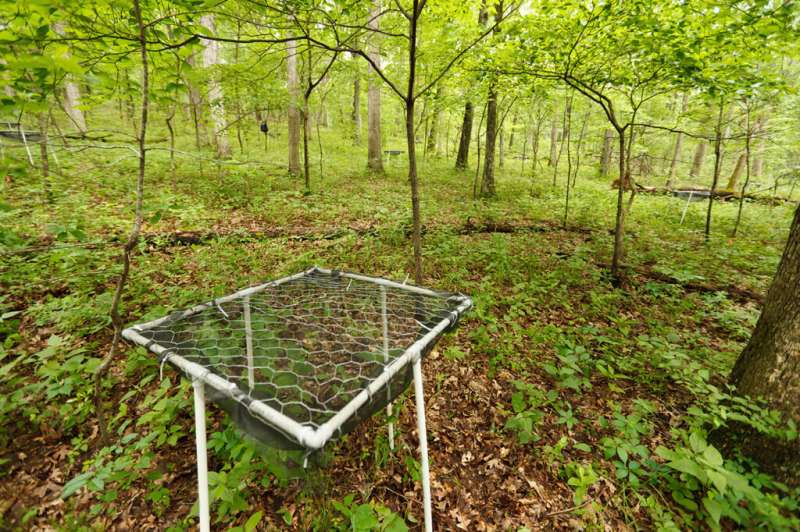
Seed trap in the oak-hickory forest at Tyson Research Center, Washington University’s
 environmental field station near Eureka, Mo. Credit: Jonathan Myers

A new study co-authored by Jonathan Myers, associate professor of biology in Arts & Sciences at Washington University in St. Louis, provides key insights into how and why tree populations migrate in response to climate change at the continental scale.

Suitable habitats for forest trees may be shifting fast with recent climate change. Across North America, most tree species in the northern part of the continent already show evidence for northward migrations due to warming temperatures. But the actual mechanics of how trees move into new areas appears to be different depending on whether the trees are found in the West or the East.

In this study led by Duke University, researchers separated out the effects of seed production—the sheer number of seeds that certain tree species create—and the establishment of juvenile trees to identify larger patterns. The results, recently published in the Proceedings of the National Academy of Sciences, provide the first continental-scale evidence for  and geographic shifts in the processes that control migration.

The researchers discovered that in the interior mountain West, high seed production and the recruitment of juvenile trees—basically, how well baby  do when they are just getting started—both contribute to migration. In the Northeast, on the other hand, migration is limited by seed production, but facilitated by high recruitment.

The study taps data from the MASTIF network, which features a massive synthesis of seed-production data from over 130 research sites across North America. It includes seven years of data from the Forest Global Earth Observatory (ForestGEO) Forest Dynamics Plot at Washington University's field station, Tyson Research Center.

"As part of a long-term study of seed production and —also known as 'seed rain'—our research team has collected, counted and identified seeds of every woody plant species in 200 seed traps distributed across the Tyson ForestGEO Plot each year since 2012," Myers said.

"Interestingly, around 30% of the 81 tree species examined in this study have been collected in our seed traps at Tyson Research Center," he said. "As one of only two research sites located in the central forests grasslands ecoregion, the Tyson ForestGEO Plot helps to bridge an important biogeographic gap in the MASTIF network."

In the new study, the southeastern United States emerges as a fecundity hotspot, but it is situated south of tree population centers where high seed production could contribute to poleward population spread. By contrast, seedling success is highest in the West and North, serving to partially offset limited  near poleward frontiers.

The evidence of fecundity and  control on tree migration can be used to inform conservation planning.

Tree fecundity and biological aging

More information: Shubhi Sharma et al, North American tree migration paced by climate in the West, lagging in the East, Proceedings of the National Academy of Sciences (2022). DOI: 10.1073/pnas.2116691118
Journal information: Proceedings of the National Academy of Sciences 
Provided by Washington University in St. Louis 

Gender disparities may be widening for physicians due to COVID-19

Women doctors published fewer studies during stay-at-home orders, study finds

Peer-Reviewed Publication

NORTHWESTERN UNIVERSITY

As people transitioned to working from home at the onset of the coronavirus pandemic, journal submissions from academics increased across the board. But a new study from Northwestern University found as men’s scholarly productivity increased, women physicians were submitting less.

The research reflects wider trends in academic publishing and is the first study to find such patterns in family medicine. The study contributes to a growing body of evidence that the pandemic caused unique career disruptions for women as they became stretched thin during remote work, causing stress, burnout and anxiety.

“The worry is that these problems will compound,” said Katherine Wright, the paper’s corresponding author and the director of research in the department of family and community medicine at Northwestern University Feinberg School of Medicine. “As men were able to submit more, they may benefit from more citations, promotions, funding and career opportunities as women fall further behind.”

The paper, “COVID-19 and Gender Differences in Family Medicine Scholarship,” will be published Jan. 24 in the journal Annals of Family Medicine.

Wright said the study was conceived in part because of observations about her own department, where she saw roles changing dramatically and many doctors attempting to play dual roles between childcare or eldercare and work. Santina Wheat, co-first author and program director of the Northwestern-McGaw family medicine residency at Erie Family Health Center in Humboldt Park, emphasized the impact of shifting schedules on her own life.

“All of a sudden we were doing telehealth at all hours of the day, and hours of the clinics shifted significantly and quickly,” Wheat said. “There was also always the sense you may need to cover for someone else, which impacted your ability to think about the academic side — or mentor others to do the same.”

To conduct the study, the team performed a bibliometric analysis of journal submissions to see how submission rates changed during the pandemic. With access to the last five years of submission data from the Annals of Family Medicine, the top-ranked primary care journal, the scientists reviewed submission data before and during the pandemic. They examined submission volume by gender in addition to distribution of author’s gender by submission type (such as original research versus special reports, which impact tenure differently).

The paper found the Annals of Family Medicine received 41.5% of its submissions from women during the early months of the pandemic — the period analyzed by scientists — marking a widening gender gap in the field.

The paper warns the gap is “troubling” and may result in long-term repercussions for women in the medical field because of how tenure decisions are made. Wright’s hope is that adding this research to the growing body of data will catalyze change in these fields.

“Publications are still the hallmark of tenure and promotion decisions, so we want to make sure women aren’t at risk of falling further behind,” Wright said. “Our hope is this data might be used by promotion and tenure committees to reevaluate promotion criteria.”

For example, Wright said, women tend to be more involved in creating curriculum and service, so weighting activities like these more equally with publications could help balance the scales. She added that there’s both a childcare and eldercare crisis in the country, and that parents and caretakers need strengthened support to thrive in their roles. Wright said without intervention, these impacts will reverberate beyond the pandemic.

Beyond advocacy, the team hopes to look at other metrics of diversity in the data and see if other populations have been impacted disproportionately by the pandemic. They’re also currently analyzing the gender composition of peer reviewers, the gatekeepers of the work accepted by scientific journals.

Deborah Smith Clements, chair of the department of family and community medicine, the Nancy Warren Furey Professor of Community Medicine and a professor of medical education, also is a co-author, along with Deborah Edburg, a professor and physician at Rush University.