Saturday, June 11, 2022

Does Erdogan have a green light from Russia to move into Syria?

The US and Iran oppose the planned Turkish operation, as Erdogan digs in further on

 Finland and Sweden’s NATO bids, and warns Greece on the Aegean Islands.
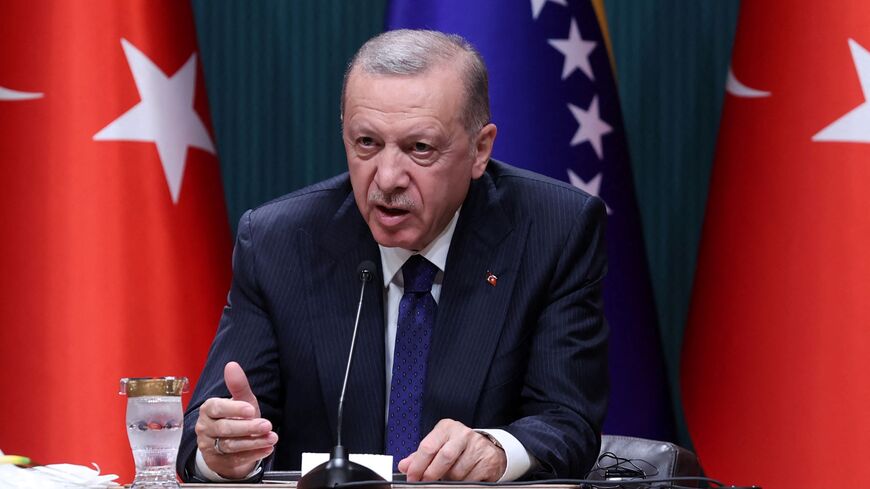

Turkey's President Recep Tayyip Erdogan attends a press conference after his meeting with Venezuelan President Nicolas Maduro in Ankara on June 8, 2022.
- ADEM ALTAN/AFP via Getty Images

Week in Review
@AlMonitor
June 10, 2022


In shift, Russia ‘understands’ Turkey’s concerns in Syria …

Perhaps Turkish President Recep Tayyip Erdogan is channeling Winston Churchill, who once said "never let a good crisis go to waste."

For Erdogan, that good crisis is the Ukraine war, a time for a star turn on the world stage as mediator, as well as for settling accounts with Syrian Kurdish "terrorists" and redefining Turkey's role within NATO.

In Syria, Erdogan is giving no sign that he is reconsidering his plan for another military operation to carve out a 30-km "security line."

On June 9 he said, "We hope that none of our true allies or friends will object to these legitimate security concerns of our country, or particularly go for terrorist organizations."

By terrorist organizations, Erdogan means Syrian Kurdish groups — the Democratic Union Party (PYD), People’s Protection Units (YPG), and the US-aligned Syrian Democratic Forces (SDF) — which he considers as linked to the Kurdistan Workers Party (PKK), a US- and Turkish-designated terrorist group.

Turkey is also in the midst of an economic freefall, as Mustafa Sonmez reports, and burdened by over 3.6 million Syrian refugees, whom Erdogan would like to return to the envisioned "secure" zone.

Khaled Al-Khateb reports from Aleppo that Turkish-backed Free Syrian Army (FSA) factions in northern Syria are preparing for a seemingly imminent Turkish offensive by conducting their own military drills.

Russia, given its international isolation over the Ukraine war, hopes to stay at least somewhat in Turkey’s ally or friend camp, despite many points of friction, including Turkish drone sales to Ukraine.

So perhaps it was no surprise that Russian Foreign Minister Sergey Lavrov said after meeting with his Turkish counterpart Mevlut Cavusoglu in Ankara, "We understand fully the concerns of our friends over the threats created on their borders by outside forces that are fueling separatist sentiment."

The reference to the "outside forces" is a dig at the US military presence in Syria (900 troops) and American support for the SDF — a remark likely appreciated in Ankara.

Lavrov’s "understanding" seemed a shift from just last week when Russia’s Ministry of Foreign Affairs spokeswoman Maria Zakharova said, "We hope that Ankara will refrain from actions that could lead to a dangerous deterioration of the already difficult situation in Syria." Such a move "would be a direct violation of Syria’s sovereignty and territorial integrity,” she said, and would “cause a further escalation of tensions."

… while US is ‘unstinting’ to get Turkey to back off

As for the US, Turkey is "well aware" of the Biden administration’s opposition to a move.

“We are completely unstinting in our efforts with the Turkish government to back them off on this ill-considered venture,” US Assistant Secretary of State Barbara Leaf told the Senate Foreign Relations Committee on June 8.

The State Department has expressed to Turkey its "deep concern" about the impact of a new military incursion on civilians, US counterterrorist operations, and efforts to promote political stability in Syria. The US has called on Turkey to respect ceasefire lines and Ankara’s October 2019 commitment to halt military operations.

The question is whether, in private, these statements of concern are proffered with some type of carrot and stick to give Erdogan pause. The Turkish president doesn’t seem to bend to "concern."

Iran, Turkey face off

Opposition to another military operation is also coming from the east.

"Turkey and Iran appear headed for a face-off in Syria," writes Fehim Tastekin, "with Tehran explicitly opposing Ankara’s plan for a fresh military operation against Kurdish-held areas, wary of risks to its own posture in the region."

Iran has sent "militia reinforcements to two Shiite settlements northwest of Aleppo, not far from a key area in Ankara’s crosshairs, while trying to talk Turkey out from making the move — apparently with little success thus far," Tastekin adds.

Despite differing and sometimes conflicting interests, Turkey, Russia and Iran have hung together as partners in the ‘Astana’ diplomatic forum for dealing with Syria. But the strains are beginning to show.

"Tehran feels pushed aside as a guarantor of the trilateral Astana process on Syria," writes Tastekin. "The hardening climate might undermine the whole process as the three sides prepare to hold an 18th round of talks later this month."

Erdogan calls out ‘terrorists’ in Sweden’s parliament

Meanwhile, Erdogan is not yet showing any hints of compromise in his opposition to the NATO membership bids of Sweden and Finland.

Speaking at a press conference in Ankara on June 8 with Venezuelan President Nicolas Maduro, Erdogan said PKK/YPG/PYD terrorists run "rampant in Sweden … even in their parliaments there are terrorists."

The Swedish parliamentarian he is referring to is Amineh Kakabaveh, a former Kurdish guerrilla whose swing vote has allowed the government to pass the budget and survive a no-confidence vote this past week.

Kakabaveh is an independent who conditioned her support for the government of Prime Minister Magdalena Andersson on Andersson’s Social Democrats recognizing the Kurdish-led autonomous administration in northeast Syria.

The Kurdish connection to Sweden is deep and complex, and difficult to unwind.

"Nesrin Abdullah, commander of the YPG’s all-female arm, is a frequent visitor to Stockholm where she enjoys hero status and is received by top officials," Amberin Zaman reported from Sweden. "They include the foreign minister, Ann Linde, a long-time campaigner for minority rights. Photos showing Abdullah, Linde and Kakabaveh together in the Swedish parliament in May drove Ankara mad, leading Turkish Foreign Minister Mevlut Cavusoglu to blast her at a NATO gathering last month for her 'so-called feminist policies.'"

"Turkey says no such visits can be repeated," Zaman adds. "All support for the YPG, which enjoys the protection of US forces in Syria, needs to end. The activities of PKK-leaning groups inside Sweden must be banned. Ankara also wants Sweden to extradite individuals, mainly Kurds and associates of Fethullah Gulen, the Sunni preacher accused of orchestrating the failed attempt to violently overthrow Erdogan in 2016."

"As long as these terrorists remain in their parliaments and as long as terrorist organizations continue to hold demonstrations with the pictures of terrorist leaders in the streets of Stockholm … we cannot tell them ‘Go ahead, please, join NATO,’" said Erdogan on June 8.

"The same goes for Finland, too. Finland, as well, is engaged in many similar activities unfortunately," he added.

Erdogan: ‘This nation is determined’

Erdogan’s NATO issues extend beyond Sweden and Finland.

He has amped up the rhetoric on Greece, and those NATO countries which provide Athens weapons, in another sign of the deepening schism between the two countries over the Aegean islands.

Behave yourself," Erdogan warned Athens. "Turkey, if need be, will not hesitate to exercise its rights emanating from international agreements concerning the militarization of islands, let alone giving up on its rights in the Aegean."

"I’m not joking, I’m speaking seriously. This nation is determined," he added.

Given Turkey’s economic crisis, Erdogan may be open to the "highest bidder," says Hadley Gamble of CNBC, on the latest ‘On the Middle East’ podcast.

It may end up being a "question of weapons," adds Gamble, referring to pending US sales of F-16’s to Turkey, which the Biden administration has said is separate from the discussions over Sweden and Finland joining NATO.




CRIMINAL CAPITALI$M

New Evidence on the Role of Subnational Diplomacy in China’s Pursuit of U.S. Technology

By Ryan Scoville
Friday, June 10, 2022

Chinese flag radiowood, https://flic.kr/p/7asMfM
 CC BY-NC 2.0, https://creativecommons.org/licenses/by-nc/2.0/

In a recent interview, FBI Director Christopher Wray explained that the People’s Republic of China has stolen more U.S. corporate data than all other nations combined and is seeking to acquire American trade secrets and intellectual property “on a scale that is unprecedented in history.” China reportedly relies on a combination of industrial espionage, academic contacts, investment, and cyber theft in pursuit of this acquisition. Senior U.S. officials have observed that China also relies on subnational relations with U.S. state governments, but the nature and extent of those relations have generally been unclear. In this post, I will help to address that lack of clarity by presenting new evidence that China has entered into a substantial collection of written agreements with U.S. states for the purpose of promoting technology transfer in a number of strategically sensitive fields of innovation, including information technology, nanotechnology, aerospace, biotechnology, and semiconductors. Most of these agreements appear to have been adopted not only without federal notice, consultation, or approval, but also at China’s initiative and without public disclosure. The evidence thus suggests that subnational diplomacy has played an inconspicuous but material role in Beijing’s effort to acquire cutting-edge American technology. To address this and other problems that can arise from state engagement in foreign relations, Congress should enact legislation to ensure federal monitoring and public disclosure of future agreements.

Background

Before getting into the details of the evidence, a bit of background on how it emerged: In 2019, the Trump administration filed a lawsuit to challenge the constitutionality of a 2017 agreement on carbon dioxide emissions between California and the Canadian province of Québec. The lawsuit failed in the district court but not before revealing a marked lack of transparency about the nature and extent of U.S. state agreements with foreign governments. States typically do not publish these arrangements, so neither the litigants nor amici had a clear sense of whether California’s was typical or aberrational. Duncan Hollis conducted an important study on state practice in this area in 2009, but a decade passed, no one followed up, and there was reason to believe that conditions had changed, so I decided to use state public-records laws to investigate. In 2020, my research assistant and I filed more than 650 public-records requests—one with every major executive department and administrative agency in each of the 50 states—in an effort to obtain copies of all commitments in force at that time.


The New Evidence

The results were surprising in a variety of ways, and two of the biggest surprises involved China.

The first was that, although U.S. states have traditionally entered into the largest number of agreements with Canada and its provinces, states disclosed more operative commitments with China than with any other country. It appears, moreover, that this shift occurred sometime in roughly the past decade. Hollis’s 2009 study found that states had concluded 70 agreements with Canada, followed by 61 with China or Taiwan and 41 with Israel. In contrast, the new evidence shows that, out of a total of more than 600 agreements in force between U.S. states and foreign governments in 2020, 115 are with mainland China alone, followed by 94 with Canada and 59 with Mexico. The agreements with China include 24 different U.S. states as parties and focus on economic relations more than any other issue. Many may still be in effect.


The second surprise was that, although the agreements with China often seem innocuous or beneficial to state and national interests, well over a dozen expressly promote cooperation, collaboration or even “technology transfer” in strategic sectors. For instance, Alabama, California, Maryland, and Pennsylvania have signed memoranda of understanding that call on them to foster cooperation between U.S. and Chinese firms in the field of information technology. A 2016 agreement between New York and China provides that the parties will “support cooperation” in nanotechnology. A 2015 memorandum of understanding between Washington and China states that the parties “will support companies to cooperate” in the aerospace industry. Iowa, Maryland, Massachusetts, Ohio, and Texas have each pledged to promote cooperation with China in biotechnology. Idaho—home to Micron Technology, one of the largest manufacturers of semiconductors in the U.S.—has an arrangement with China’s Ministry of Commerce to “facilitate trade and investment activities” in the semiconductor industry. And many other commitments call for economic cooperation in general terms. Implementation may very well complicate federal efforts to protect U.S. technological leadership by encouraging private transactions that flout U.S. export controls, expand China’s influence over American companies, and burden federal oversight by the Committee on Foreign Investment in the United States.

Certain features of the agreements and their adoption make these risks especially concerning. First, it appears that China took the lead in much of the drafting. Several documents use the same formatting, language, and organization, even though they involve different states as parties. Others use syntax that is atypical for a native English speaker. These patterns seem to indicate that the Chinese government has been handing predrafted documents to their state counterparts and simply asking for signatures. If that is indeed the case, there is reason to question whether states are getting as much out of the agreements as China, and whether they are resisting any language that disserves U.S. national interests.

Second, most of the agreements have been in effect for a decade or more. Idaho’s arrangement on semiconductors, for example, was signed in 2006. This longevity has created ample opportunities for implementation.

Third, state governments generally have not been transparent about the agreements. As far as I can tell, only three are referenced in official state sources, only one is available online, and states have not reported them to Congress or the executive branch. In my 2021 interview with Reta Jo Lewis, former State Department special representative for global intergovernmental affairs, she explained that the State Department is not responsible for monitoring subnational engagement in foreign relations and that states typically enter agreements with foreign governments without consulting or notifying federal authorities. I have not seen any evidence to the contrary in these cases.

Finally, China’s engagement with U.S. states is likely to persist. In a recent article in The Diplomat, Flora Yan reported that, under the Biden administration, China-U.S. subnational exchanges “have largely continued, with signs indicating expansion.” For Beijing and states alike, the incentives for such expansion seem obvious: enhanced trade and investment between the world’s two largest economies, along with a potential way around U.S. federal gridlock and hostility. These incentives may very well spur states to enter additional agreements of concern in the future.

To be sure, it is not clear whether anything has or will come from the agreements. All appear to be nonbinding, so states may simply disregard them. At the same time, it is hard to imagine that states would enter commitments with a foreign sovereign in the absence of any intention to comply. There is anecdotal evidence, moreover, that even nonbinding subnational arrangements have generated economic benefits in the context of Sino-U.S. relations. This suggests that states have acted to fulfill their agreements in at least some cases.

A Proposal for Reform

The circumstances create a strong case for transparency going forward. As I explain in a new article detailing my research, Congress should respond by enacting legislation that is loosely analogous to the Case-Zablocki Act. This legislation would require states to timely transmit to the State Department the text of all commitments with foreign governments, including China’s. It would also require the department to publish the results on a public website. Such legislation has precedent in foreign countries such as Australia (see also the resulting online database) and in reporting mandates that Congress has imposed on states in various other contexts.

The benefits of the resulting transparency seem clear. It would help to deter states from violating the Constitution’s Compact Clause, which generally requires them to obtain congressional consent to enter into any binding “Agreement or Compact” with a foreign power. It would help to deter states from infringing the Article I Treaty Clause, which prohibits them from entering into any “Treaty.” It would promote the accountability of state officials by facilitating public knowledge of any commitments that disserve state or national interests. It seems unlikely to discourage agreements that advance those interests. And it would likely create only limited financial and administrative costs.

Recent congressional interest in subnational diplomacy suggests that there may be a realistic chance for reform. In the 116th Congress, Rep. Ted Lieu and Sen. Chris Murphy each introduced the City and State Diplomacy Act, part of which would have required the State Department to “maintain[] a public database of subnational engagements.” In the 117th Congress, Lieu and Murphy introduced newer bills that omitted the original provision for a public database but proposed to task the State Department with “tracking subnational engagements.” Although not enacted into law, this language also appeared in a version of the National Defense Authorization Act for Fiscal Year 2022 (NDAA) that passed the House of Representatives in September 2021, so the notion of federal monitoring clearly enjoys substantial support.

To address the risks posed by state agreements with foreign governments, and with China in particular, Congress should revive the City and State Diplomacy Act, with a few key revisions. First, drafters should expand the bill’s definition of “subnational engagements.” All of the recent versions defined this term as “formal meetings or events between elected officials of State or municipal governments and their foreign counterparts.” Agreements, however, are not “meetings or events” under the ordinary meanings of those terms, so this definition would exclude all agreements from federal oversight, even while requiring the State Department to monitor attendant events such as signing ceremonies. It is hard to see the logic in that choice, given the general importance of written agreements for structuring and managing foreign relations. In addition, it is common for agreements to be signed not by a state’s “elected officials” but rather by appointees. The recent definition would thus exempt many agreements from federal monitoring even if they somehow qualify as “meetings or events.” To correct these problems, the next iteration of the City and State Diplomacy Act should redefine “subnational engagements” explicitly to include all written commitments.

Second, Congress should not task the State Department merely with “tracking” subnational engagements, as proposed in the most recent version of the bill. While better than nothing, tracking per se does not ensure the disclosure of any engagements to the public or even to Congress, which holds primary authority to grant or withhold consent to state agreements and compacts with foreign powers under the Compact Clause. A separate provision of the bill recommended annual briefings to Congress regarding the department’s “work” on subnational diplomacy, but that language also seems insufficient, as it leaves open the possibility of briefings that detail State Department activity but omit information about the subnational engagements themselves. To address this issue, legislators should revive the original proposal for a public database, thereby promoting access to agreement texts for Congress and voters alike.

Finally, Congress should add language to facilitate the database’s creation and maintenance. The recent bills contained no requirement for states to notify the State Department of their engagements, much less a deadline for notification. Nor did the bills contain any provision to enforce or even encourage state cooperation with federal efforts to create the database. These omissions created a risk of belated and incomplete collection on the part of database managers. To fix them, legislators should require states to provide copies of the texts of their agreements to the State Department and impose a deadline for doing so. The Case-Zablocki Act, for example, requires the transmittal of the text of an international agreement to which the U.S. is a party no later than 60 days after entry into force. If concerned about state compliance, Congress might also consider enforcement options, such as a provision indicating that no commitment shall carry any force or effect prior to transmittal, or a provision that expressly conditions the availability of pertinent federal funding on state compliance.

Conclusion

As a general matter, it is neither surprising nor troubling that U.S. states enter into agreements with foreign governments. It is striking, however, that they typically do so without notifying the public or even the federal government. And it is concerning that a significant number of the agreements affirmatively encourage the transfer of strategically important technologies to America’s chief geopolitical rival, despite U.S. federal efforts to protect American technological leadership. These conditions call for transparency and federal monitoring under a revived and revised City and State Diplomacy Act.

BUDDHISTVA LIKE HINDUTVA

Buddhist dedication ceremony to take place at Tamil temple site despite court order

A dedication ceremony for a new Buddha statue is set to take place tomorrow with the assistance of the Sri Lankan army in Kurunthurmalai, Mullaitivu, in a further attempt to seize the site of an ancient Tamil temple.

The ceremony, where a Buddha statue carved in Kabok stone be consecrated, is expected to attract a large number of Sinhalese from the South, including senior Sri Lankan army officers, police officers and Buddhist monks.

The Athi Aiyanar temple, a native place of worship of Tamils located in the Thannimurippu area, has been targeted by intense landgrab efforts by Sinhala Buddhist monks over recent years. Their efforts have been met with fierce resistance from locals which in 2018 led to a court order decreeing that no changes could be made to the site. The court also stated that the archaeology department had abused its power in allowing Buddhist monks to survey the area.

In January 2021, Vidura Wickramanayaka, Sri Lanka's state minister for 'national heritage', accompanied by army soldiers and archaeology department officers, led an event at Kurunthurmalai,  in which a new Buddha statue was placed and consecrated at the site of the Athi Aiyanar temple despite the court order banning them to do so. Since then, the Sri Lankan army and the archeology department have intimidated and banned local Tamils from entering the area.

Tamil National Alliance (TNA) spokesperson M A Sumanthiran and former Northern Provincial Councillor T Ravikaran have filed an interim injunction has been filed to stop any excavation work. However, the inunction has still not been granted. 

In a recent report, People for Equality and Relief in Lanka (PEARL) highlight that since the end of the armed conflict in 2009, Sri Lanka's Director General of Archaeology "has ordered excavations and instructed district authorities to put up Buddhist structures on pre-existing Tamil worship sites and private Tamil lands, regardless of any opposition to it." 

The advocacy organisation also notes how the state have justified Buddhisisation across the North-East by destroying and appropriating Tamil and Muslim places of worship to erect Buddhist shrines which in turn has provided "space and authority for Buddhist monks to influence the agenda" of the Sri Lankan government. 

ICC publishes protocols for ethical engagement in the Arctic

The Inuit Circumpolar Council's protocols were developed in response to negative experiences with outside researchers and other visitors.


Alaska’s Dalee Sambo Dorough (left) is seen in a 2018 file photo after being elected chair of the Inuit Circumpolar Council at the group’s quadrennial meeting in Utqiagvik. Here she’s pictured with outgoing ICC chair Okalik Eegeesiak, of Canada. (Yereth Rosen / ArcticToday file photo)

As more scientists, policymakers, industrial developers and mariners head north into the warming and melting Arctic, some of the region’s Indigenous people have developed standards for how the visitors should operate respectfully and collaboratively.

The Inuit Circumpolar Council, representing Inuit people from Greenland to Chukotka in the Russian Far East, last week released a set of protocols intended to ensure that Indigenous people have more say in what happens in their homeland.

The ICC’s Circumpolar Inuit Protocols on Equitable and Ethical Engagement, was developed over three years, said Carolina Behe, a science and Indigenous knowledge advisor with the organization’s Alaska affiliate. But the motivation for the protocols began much earlier, she said.

Over many years, Inuit residents have chafed at “the heavy, heavy top-down” approach to scientific research and other activities, Behe said. There have been persistent complaints, for example, about researchers coming to the Arctic, doing their projects, leaving and then never communicating with the residents in any follow-up, she said.

“Over and over, the point came up about lack of engagement,” she said.

The protocols are intended to protect Inuit rights, including intellectual rights, as activity in the Arctic intensifies, said ICC officials from Alaska.

“We persist with the call for all others to recognize our status, rights, and role in relation to every issue of concern to us,” Dalee Sambo Dorough, the organization’s international chair and a professor at the University of Alaska Anchorage, said in a statement.

“As the first inhabitants and stewards of the Arctic, we have the right and responsibility to protect our environment and culture,” James Stotts, president of ICC Alaska, said in the statement. “Our knowledge must be relied upon to inform decision-making in all matters.”

The protocols are divided into eight categories. They include guidance for building partnerships, sharing data, co-producing knowledge, practicing good governance and distributing funding.

In the category of communication, for example, there are specific pieces of advice, such as: “Listen more than you speak.” The communications category also lists the Arctic’s Inuit as the experts on local safety whose guidance should be followed. In the category of funding, there is a call to prioritize local hiring and to adequately and fairly pay local people.

“Inuit need to be compensated for our knowledge, expertise, time, and labor. Agree upon appropriate compensation before work begins,” the document says.

In the scientific community, there is increasing attention to collaboration with the Indigenous people of Alaska and the Arctic.

The National Science Foundation’s Navigating the New Arctic initiative is one program that is putting a recently strengthened emphasis on community engagement and co-production of knowledge. The program funds and manages numerous research projects, with a series of Arctic operating principles intended to be applicable to each project.

The ICC’s newly released protocols, however, go beyond such specific research projects and beyond the category of scientific research entirely, Behe said. They are applicable to local people’s relationships with industries, with government agencies and with international organizations like the Arctic Council and United Nations, she said.

This story was first published by Alaska Beacon and is republished here under a Creative Commons license. You can read the original here.

Finland plans to build barriers on its border with Russia

The move is meant to prepare against hybrid threats from Russia.

By Reuters
-June 10, 2022

A general view of the border town of Imatra, Finland on March 24, 2022.
 (Essi Lehto / Reuters File Photo)


Road signs are seen at the Imatra border crossing with Russia, amid Russia's invasion of Ukraine, in Imatra, Finland on March 23, 2022. (Essi Lehto / Reuters File Photo)


HELSINKI — Finland’s government plans to amend border legislation to allow the building of barriers on its eastern frontier with Russia, it said on Thursday, in a move to strengthen preparedness against hybrid threats amid Russia’s invasion of Ukraine.

Finland, which is currently applying for membership in the Western military alliance NATO, has a history of wars with Russia, although currently the forest-covered border zone between the two countries is marked merely with signs and plastic lines for most of its 1,300-kilometer (810-mile) length.

The Finnish government has rushed to strengthen border security as it fears Russia could attempt to put pressure on Finland by sending asylum seekers to its borders — as the European Union accused Belarus of doing at the end of last year when hundreds of migrants from the Middle East, Afghanistan and Africa got stuck on the Polish border.

The government’s amendments to the law include a proposal to enable concentrating the reception of asylum applications only at specific points of entry.

Under existing EU rules, migrants have the right to ask for asylum at any given entry point to an EU member country.

The amendments would also allow the building of barriers such as fences, as well as new roads to facilitate border patrolling on the Finnish side.

“Later on, the government will decide on border barriers to the critical zones on the eastern border, on the basis of the Finnish Border Guard’s assessment,” minister of internal affairs Krista Mikkonen said in a statement.

Reporting by Anne Kauranen.
Trans deputy’s gender-confirmation surgery must be covered by county plan, GA judge says

Charlotte Observer (NC)

A Georgia federal district court judge has ruled in favor of a transgender sheriff’s deputy who sued the county after she was told that her health insurance plan would not cover gender-confirmation surgery.

In a June 2 ruling, Judge Marc Treadwell found that Houston County, Georgia, had violated the Equal Protection Clause of the U.S. Constitution by denying Houston County Sheriff’s Deputy Anna Lange coverage for gender-affirming care under her county health plan, according to a lawsuit filed on Lange’s behalf in 2019.

Lange, who was assigned male at birth, began her gender transition in 2017, according to the lawsuit.

She has worked for the Houston County Sheriff’s Department for the past 16 years, according to the Transgender Legal Defense & Education Fund, which represented Lange in the lawsuit. In 2018, she requested permission from Sheriff Cullen Talton to wear the women’s uniform and to present as a woman at work.

The sheriff ultimately granted Lange’s request, despite saying he didn’t “believe in sex changes” and he told her that she would need a “tough skin” to deal with her coworkers.

The Houston County Sheriff’s Office declined a request for comment from McClatchy News.

Lange’s doctors later concluded she would need gender-confirmation surgery in order to treat her gender dysphoria, according to court documents. Gender dysphoria is a condition of distress experienced by people whose gender identity conflicts with the gender they were assigned at birth, according to the Mayo Clinic.

On Nov. 30, 2018, the county’s personnel director denied Lange’s request for pre-authorization for the surgery. Lange appealed the decision but was denied again in 2019, court documents show.

In the judge’s decision, Treadwell wrote that by excluding coverage for gender-affirming care in its health insurance policy, Houston County was unconstitutionally discriminating against transgender people, who are protected under Title VII — a section of the Civil Rights Act.

“Sex discrimination under Title VII includes discrimination based on sexual orientation and discrimination based on gender stereotyping because ‘it is impossible to discriminate against a person for being homosexual or transgender without discriminating against that individual based on sex,’” Treadwell wrote.

Lange said in a statement published by the Transgender Legal Defense & Education Fund that she was relieved by the judge’s decision.

“I can confidently move forward with my life knowing that gender affirming care is protected under federal law,” her statement says. “This decision is not only a personal victory, but a tremendous step forward for all transgender Southerners who are seeking insurance coverage for medically necessary care.”

One in four people who responded to the 2015 U.S. Transgender Survey reported experiencing a problem with their insurance related to being transgender, including being denied coverage for care for a gender transition. More than half of those who sought coverage for a gender-affirming surgery were denied. (2015 was the latest year the survey was conducted.)

Transgender Legal Defense & Education Fund legal director David Brown said in a statement that the Georgia ruling will have an impact on the lives of transgender people throughout the southern U.S.

“The Court’s decision makes clear that depriving transgender people of healthcare is not only immoral but also illegal,” the statement says. “An employer cannot refuse health coverage to a transgender employee who needs access to medically necessary, life-saving care.”

How many Americans are trans or nonbinary? Poll shows big difference between age groups

Professor who refused to use student’s pronouns wins $400K lawsuit with Ohio college

Your US passport can soon come with third gender option. What to know about the change

©2022 The Charlotte Observer. Visit charlotteobserver.com. Distributed by Tribune Content Agency, LLC.

LGBTQ RIGHTS ARE HUMAN RIGHTS WHICH TRUMP RELIGIOUS RITES


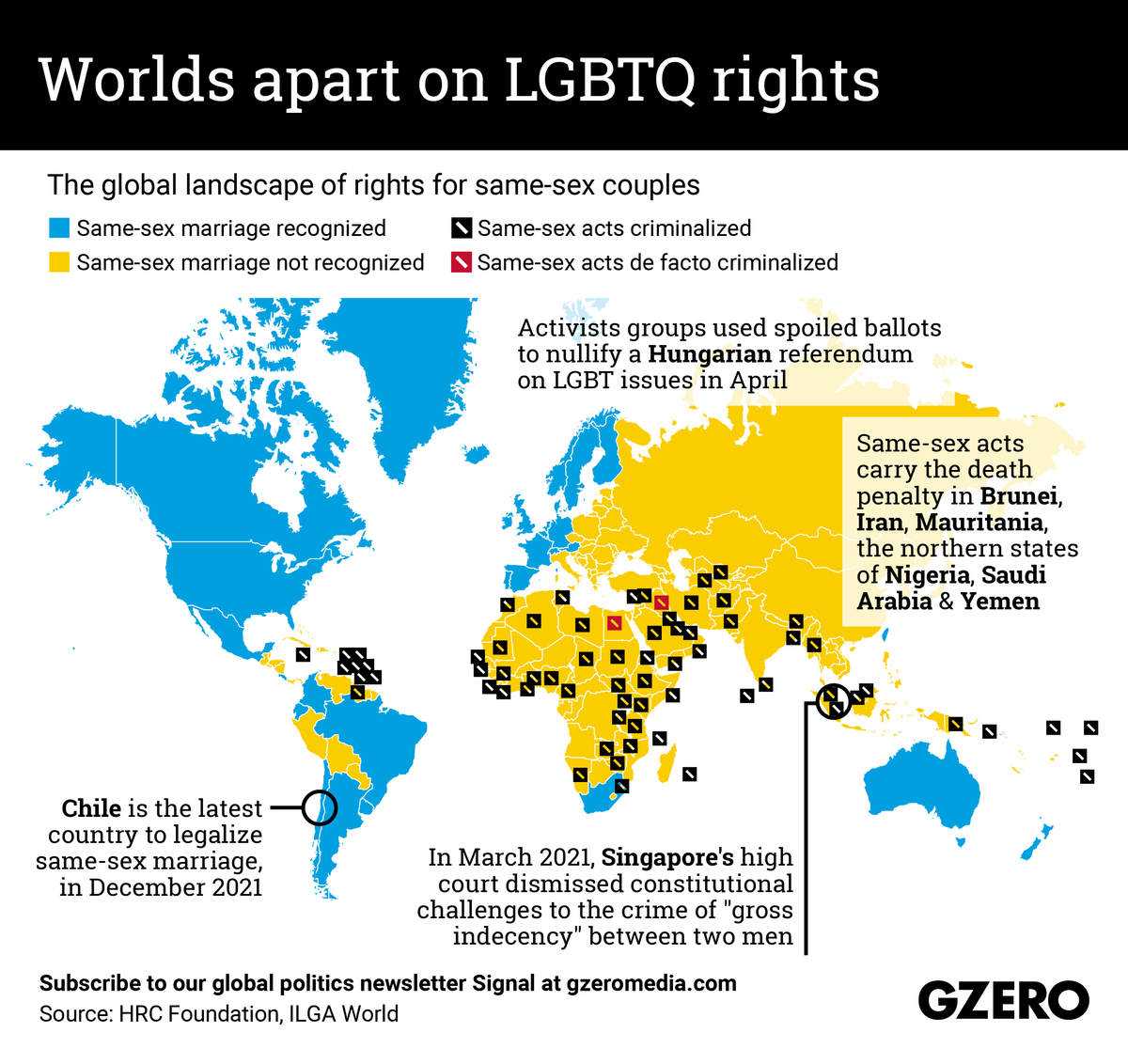
LGBTQ Pride Month is currently being celebrated throughout the United States. Since the Stonewall riots in New York City in 1969, progress towards equal protections for LGBTQ people has been hard-won throughout the country, culminating in the legalization of same-sex marriage in 2015. Significant progress for LGBTQ communities seeking equal protection under the law has been made in much of Western Europe and the Americas but still lags in most of Africa and Asia, where same-sex sexual acts are deemed illegal in many states. Here's a look at the legal environment for LGBTQ people around the globe.
White supremacists riling up thousands of followers on social media
10 Jun, 2022

A white man who gunned down shoppers at a Buffalo, New York supermarket shared his anti semitic rants on Gab, on a site that attracts extremists. Photo / AP

AP

The social media posts are of a distinct type. They hint darkly that the CIA or the FBI are behind mass shootings. They traffic in racist, sexist and homophobic tropes. They revel in the prospect of a "white boy summer".

White nationalists and supremacists, on accounts often run by young men, are building thriving, macho communities across social media platforms like Instagram, Telegram and TikTok, evading detection with coded hashtags and innuendo.

Their snarky memes and trendy videos are riling up thousands of followers on divisive issues including abortion, guns, immigration and LGBTQ rights. The Department of Homeland Security warned this week such skewed framing of the subjects could drive extremists to violently attack public places across the US in the coming months.

These type of threats and racist ideology have become so commonplace on social media it's nearly impossible for law enforcement to separate internet ramblings from dangerous, potentially violent people, Michael German, who infiltrated white supremacy groups as an FBI agent, told the Senate Judiciary Committee on Tuesday (local time).

"It seems intuitive that effective social media monitoring might provide clues to help law enforcement prevent attacks," German said. "After all, the white supremacist attackers in Buffalo, Pittsburgh and El Paso all gained access to materials online and expressed their hateful, violent intentions on social media."

But, he continued, "so many false alarms drown out threats".

The DHS and the FBI are also working with state and local agencies to raise awareness about the increased threat around the US in the coming months.

The heightened concern comes just weeks after a white 18-year-old entered a supermarket in Buffalo, New York, with the goal of killing as many Black patrons as possible. He gunned down 10.

That shooter claims to have been introduced to neo-Nazi websites and a livestream of the 2019 Christchurch, New Zealand, mosque shootings on the anonymous, online messaging board 4Chan. In 2018, the white man who gunned down 11 at a Pittsburgh synagogue shared his antisemitic rants on Gab, a site that attracts extremists. The year before, a 21-year-old white man who killed 23 people at a Walmart in the largely Hispanic city of El Paso, Texas, shared his anti-immigrant hate on the messaging board 8Chan.

References to hate-filled ideologies are more elusive across mainstream platforms like Twitter, Instagram, TikTok and Telegram. To avoid detection from artificial intelligence-powered moderation, users don't use obvious terms like "white genocide" or "white power" in conversation.


A white 18-year-old entered a Buffalo, New York supermarket with the goal of killing as many Black patrons as possible and gunned down 10. Photo / AP

They signal their beliefs in other ways: a Christian cross emoji in their profile or words like "anglo" or "pilled," a term embraced by far-right chatrooms, in usernames. Most recently, some of these accounts have borrowed the pop song "White Boy Summer" to cheer on the leaked Supreme Court draft opinion on Roe v. Wade, according to an analysis by Zignal Labs, a social media intelligence firm.

Facebook and Instagram owner Meta banned praise and support for white nationalist and separatist movements in 2019 on company platforms, but the social media shift to subtlety makes it difficult to moderate the posts. Meta says it has more than 350 experts, with backgrounds from national security to radicalisation research, dedicated to ridding the site of such hateful speech.


"We know these groups are determined to find new ways to try to evade our policies, and that's why we invest in people and technology and work with outside experts to constantly update and improve our enforcement efforts," David Tessler, the head of dangerous organisations and individuals policy for Meta, said in a statement.

A closer look reveals hundreds of posts steeped in sexist, antisemitic, racist and homophobic content.

In one Instagram post identified by The Associated Press, an account called White Primacy appeared to post a photo of a billboard that describes a common way Jewish people were exterminated during the Holocaust.

"We're just 75 years since the gas chambers. So no, a billboard calling out bigotry against Jews isn't an overreaction," the pictured billboard said.

The caption of the post, however, denied gas chambers were used at all. The post's comments were even worse: "If what they said really happened, we'd be in such a better place," one user commented. "We're going to finish what they started someday," another wrote.

The account, which had more than 4000 followers, was immediately removed, after the AP asked Meta about it. Meta has banned posts that deny the Holocaust on its platform since 2020.

US extremists are mimicking the social media strategy used by the Islamic State group, which turned to subtle language and images across Telegram, Facebook and YouTube a decade ago to evade the industry-wide crackdown of the terrorist group's online presence, said Mia Bloom, a communications professor at Georgia State University.

"They're trying to recruit," said Bloom, who has researched social media use for both Islamic State terrorists and far-right extremists. "We're starting to see some of the same patterns with ISIS and the far-right. The coded speech, the ways to evade AI. The groups were appealing to a younger and younger crowd."

For example, on Instagram, one of the most popular apps for teens and young adults, white supremacists amplify each other's content daily and point their followers to new accounts

In recent weeks, a cluster of those accounts has turned its sights on Pride Month, with some calling for gay marriage to be "re-criminalised" and others using the #Pride or rainbow flag emoji to post homophobic memes.

Law enforcement agencies are already monitoring an active threat from a young Arizona man who says on his Telegram accounts he is "leading the war" against retail giant Target for its Pride Month merchandise and children's clothing line and has promised to "hunt LGBT supporters" at the stores. In videos posted to his Telegram and YouTube accounts, sometimes filmed at Target stores, he encourages others to go to the stores as well.

Target said in a statement it is working with local and national law enforcement agencies who are investigating the videos.

As society becomes more accepting of LGBTQ rights, the issue may be especially triggering for young men who have held traditional beliefs around relationships and marriage, Bloom said.

"That might explain the vulnerability to radical belief systems: A lot of the beliefs that they grew up with, that they held rather firmly, are being shaken," she said. "That's where it becomes an opportunity for these groups: They're lashing out and they're picking on things that are very different."

Read More


Joint Statement on Canada-Mexico-United States Cooperation

From: Global Affairs Canada
MEDIA NOTE
OFFICE OF THE SPOKESPERSON
JUNE 10, 2022


Canada, Mexico, and the United States share a close relationship based on shared values and priorities. We acknowledge that working together as North America we can bring new ideas and energy to the hemisphere, and we commit to reinvigorating how we address together the issues of our time. As three likeminded countries, we affirm our strong commitment to democratic principles and intend to cooperate closely to stand up for multilateralism and the rules-based international order, support the rule of law, promote inclusive growth, invest in the development of communities, protect and promote human rights, advance gender equality, and reinforce democracy at home and inspire democratic development around the world. We worked together towards ending the COVID-19 pandemic and continue to create the conditions for equitable growth and strengthening North American competitiveness. On the occasion of today’s North American Foreign Ministers’ Meeting in Los Angeles, our three countries commit to further enhancing our deep partnership and to continue working together in support of peace and prosperity around the globe.

We reaffirm our support for Ukraine’s independence, sovereignty, and territorial integrity, and condemn Russia’s unprovoked invasion of its sovereign and democratic neighbor in violation of international law. Canada, Mexico, and the United States have repeatedly condemned civilian deaths resulting from Russia’s illegal invasion of Ukraine and stated the importance of upholding international law, including the UN Charter. We also emphasize the urgent need to allow and facilitate rapid and unimpeded passage of humanitarian relief for civilians in need. These are principles that sustain our rules-based order. We affirm the need to ensure accountability in relevant national and international courts for crimes committed, without exceptions, and support the work of the Prosecutor of the International Criminal Court and the Independent International Commission of Inquiry on Ukraine established by the Human Rights Council. We are united in our continued support for the people of Ukraine. We also express our commitment to work together in support of those suffering around the world from the global impacts of this invasion, particularly vulnerable populations now experiencing greater food and economic insecurity.

Our coordinated responses to Russian aggression against Ukraine, including calls to establish a diplomatic path forward, demonstrate the importance of North American solidarity. We call on the Russian Federation to withdraw immediately all its military forces and equipment from within the internationally recognized borders of Ukraine and return to a path of dialogue and diplomacy. Canada,

Mexico, and the United States – as close hemispheric partners and friends – are committed to further strengthening our relations, which is key to our collective security and prosperity.

We reaffirm our commitment to addressing the root causes of irregular migration and poverty and to investing in the region – prioritizing cooperation for development to create economic opportunity for all. In particular, the three governments are united in efforts towards investing in initiatives that directly benefit the most marginalized communities. We support multilateral efforts to develop value chains and physical infrastructure in the Americas that will generate employment and equitable growth. We acknowledge that addressing irregular migration in the region requires a coordinated approach, and we support the Regional Conference on Migration, the Comprehensive Regional Protection and Solutions Framework and the vision of the Global Compact on Migration.

We celebrate the tradition of our region in welcoming refugees and migrants, and we recognize the positive contributions of refugees and migrants to the socio-economic development of their host communities. We applaud the sustained efforts of States in our hemisphere in ensuring safe, orderly, and regular migration by hosting refugees, providing regular migration pathways, promoting local economic and social integration, facilitating voluntary return, and supporting the reintegration of returnees. We remain committed to collectively leveraging the benefits of migration while addressing its challenges in countries and communities of origin, transit, destination, and return.

We are committed to continuing our cooperation to support and strengthen Haiti’s democratic process, including through our collective efforts to promote an inclusive, Haitian-led political path forward. We are also committed to working closely with the United Nations and other regional partners to promote peaceful, fair, and sustainable growth throughout the hemisphere.

We reaffirm our commitment to protect human rights, particularly for members of vulnerable and historically marginalized communities, like the LGBTQI+ and two spirit community, and afro-descendant communities, as well as the rights of Indigenous peoples. We also stress the importance of individual freedom of expression and media freedom, and together advocate for addressing impunity and inequality.

We collectively commit to taking bold, swift, and coordinated action to address the climate crisis. Climate change threatens our economies and our communities, especially those who are vulnerable and underserved. As we work to address the climate crisis, we recognize the tremendous opportunity to build back better, to create well-paying and reliable jobs in ever-growing markets, and to position North America as a global leader in clean energy solutions.

As partner countries in championing development in the Americas, we reaffirm our commitment to advancing feminist approaches, eliminating structural and indirect barriers for women, girls and marginalized people, and to integrate gender perspectives in our shared priorities. We continue to advocate for feminist approaches for a more effective, fair, relevant and accountable United Nations in support of the Sustainable Development Goals.

We recognize the integral place of Indigenous peoples in North America, and their contributions to the diversity and richness of our culture and society. We acknowledge that cultural diversity and linguistic plurality are part of the heritage of humanity, so we place great value in the historical and cultural legacy of indigenous communities in the region.

By recognizing the historical legacy towards indigenous communities, our vision aims to achieve real progress towards reconciliation and a renewed relationship based on respect, truth, cooperation, partnership, and in recognition of the rights of Indigenous peoples. We reiterate our unwavering commitment to ensure that Indigenous rights, interests, and aspirations are recognized in decision-making. We intend to work together, in partnership with Indigenous peoples from our three countries, to attain our goals of safety, security, well-being, socio-economic development, and empowerment for all Indigenous peoples. We also recognize that ending violence against Indigenous women and girls requires a holistic, multidimensional, and multi-sectoral approach.

During our meeting today, we also discussed planning for the next North American Leaders’ Summit in Mexico in December.

We look forward to our increased cooperation in the years to come.

China’s CPEC damaging environment in Pakistan’s Gilgit-Baltistan

Gilgit Baltistan [PoK], June 11 (ANI): Although Pakistan termed the China-Pakistan Economic Corridor, CPEC as a game-changer for the country’s ailing economy but the fact of the matter is that Chinese mega projects are showing an adverse impact on Gilgit-Baltistan’s environment leading to uncontrollable pollution and irreversible depletion of aquatic ecosystems.

Under the banner of CPEC, Pakistan and China are initiating work on mega-dams, oil and gas pipelines, and uranium and heavy metal extraction in Gilgit-Baltistan. Gilgit-Baltistan is also providing over half of its drinking and irrigation water to Pakistan and Chinese mega projects but these projects are showing an adverse impact on the local climate leading to uncontrollable pollution and irreversible depletion of aquatic ecosystems, Global Order reported.

Recently, Pakistan’s Hasanabad had witnessed a glacial lake burst which washed away houses and razed a major bridge on the Karakoram Highway and the biggest reason behind this is climate change.

Looking at climate change, the World Bank warned that one-third of these glaciers will disappear by the end of this century causing famine of great magnitude in Pakistan. Melting ice sheets would also release viruses locked away for thousands of years causing an unprecedented rise in occurrences of rare diseases.

Meanwhile, the United Nations claimed that climate disasters could kill over 300,000 people in Pakistan in the next three decades and the alarming numbers would reach manifolds if we include the anticipated deaths from novel pandemics.

According to the publication, deforestation is the major cause of landslides in Gilgit-Baltistan. Plantation could reverse the climatic issue and even former Pakistan Prime Minister Imran Khan said that the ten billion tree tsunami” is a good initiative but no such development took place. Even the forest land was given to Chinese hydroelectric projects in Khyber Pakhtunkhwa (KPK).

Pakistan Army instead of protecting the locals’ interests, snatched their indigenous lands and imposed Chinese interests on them.

Despite repeated warnings from locals, the military has confiscated hundreds of thousands of acres of private land in places like Diamer, Shigar, Ghizer, Gilgit and Hunza and awarded them to the Chinese companies. In one instance, the army bulldozed and flattened homes in Makpondas to grant private land to a Chinese company to build a CPEC-related economic zone, according to the publication.

Experts claim that by 2030, China will be able to produce twelve gigawatts of electricity for Pakistan from the ongoing hydro-projects in Gilgit-Baltistan. One of those projects is Diamer-Bhasha, the largest roller compact concrete dam in the world. However, the Diamer dam is being built in a geologically volatile territory where earthquakes are a daily phenomenon.

Looking at such situations, locals have raised their voices against the construction of CPEC but the government doesn’t listen to a single sound of it. The Pakistani Army is filing the case against those people who raise their voices against land theft and environmental destruction. The locals argued that the establishment is committing real treason and terrorism by sacrificing the well-being of locals for China.

Like elsewhere, the Chinese model of extraction and development is a toxic ‘friendship’ for Gilgit-Baltistan as its fragile ecology is ravaged. (ANI)

This report is auto-generated from ANI news service. ThePrint holds no responsibility for its content.


Source: The Print