Saturday, June 11, 2022

Bolivian ex-president Jeanine Áñez jailed as leader of ‘coup’

Court finds rightwinger defied constitution during chaotic exit of Evo Morales, from whom she took over presidency
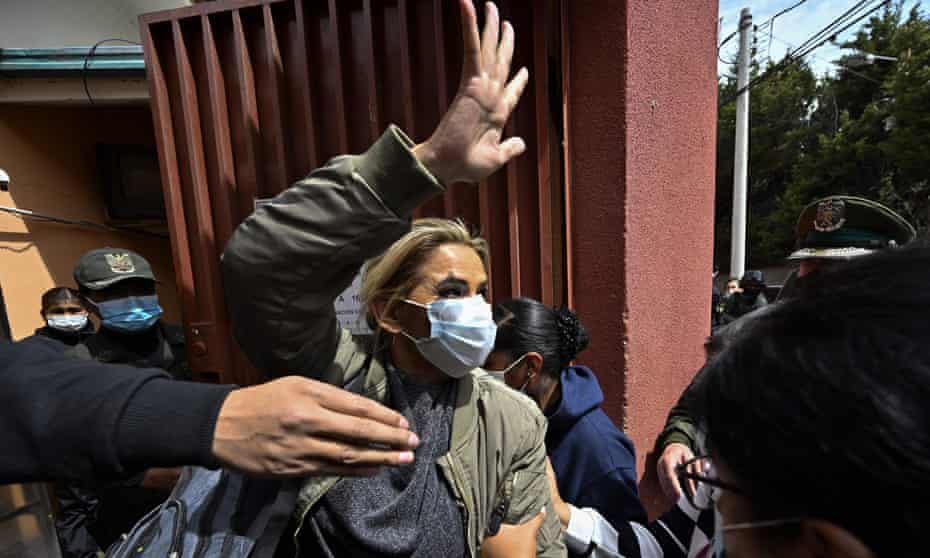
Jeanine Áñez waves as she is taken to prison in March during her trial in La Paz. A Bolivian court has sentenced the former president to 10 years’ jail, concluding she orchestrated a coup against her predecessor. Photograph: Aizar Raldes/AFP/Getty Images


Reuters in La Paz
Sat 11 Jun 2022 

A Bolivian court has found former president Jeanine Áñez guilty of orchestrating a coup that brought her to power during a 2019 political crisis.

She was sentenced to 10 years in prison.

Áñez, 54, was convicted on Friday of making “decisions contrary to the constitution” and of “dereliction of duty”.


The prosecution said Áñez, then a rightwing senator, violated norms that guarantee the constitutional and democratic order after Bolivia’s 2019 presidential elections.

Bolivia has been split over whether a coup occurred when then-president Evo Morales resigned in 2019, with Áñez ascending to the presidency amid a leadership vacuum. Morales’ departure followed mass protests over a disputed election in which he claimed to win a controversial fourth consecutive term in office.


Accidental president or coup-plotter? Trial lays bare Bolivia’s polarisation

Áñez maintains she is innocent. The contentious case has further exposed the fault lines in a deeply divided country while also fuelling concerns about its judicial process.

“We are concerned about how this case has been pursued and we call on superior courts to examine how the proceedings were conducted,” said Cesar Munoz, a senior researcher for the Americas at Human Rights Watch.

Áñez was not allowed to attend the trial in person, instead following the hearing and participating from prison. She has been detained since her arrest in March 2021 on initial charges of terrorism, sedition and conspiracy.

Members and supporters of Morales’ Movement to Socialism (MAS) party, which returned to power in 2020, say Áñez played a key role in what it says was a coup against Morales, Bolivia’s first indigenous president, who oversaw a dramatic reduction in poverty as president from 2005 to 2019.

As president, Áñez drew criticisms of political score-settling when her administration prosecuted former MAS officials.

Áñez’s supporters say her trial was illegitimate and political. In the trial, Áñez said she was the product of circumstance and that her ascension to the top office helped calm a tense nation and lay the groundwork for elections in October 2020.

“I didn’t lift a finger to become president, but I did what I had to do,” Áñez said in her final statement to the judge. “I assumed the presidency out of obligation, according to what is established in the constitution.”
The California District Attorney who prosecuted women after stillbirths has been ousted from office
Abortion-rights supporters chant their objections at the Kentucky Capitol on Wednesday, April 13, 2022, in Frankfort, Ky., Kentucky is one of at least four states with abortion-related ballot measures in 2022. AP Photo/Bruce Schreiner, File

Keith Fagundes, District Attorney in California's Kings County, lost his June 9 primary election.

Fagundes charged Adora Perez and Chelsea Becker with murder, claiming they caused their stillbirths.

Fagundes' challenger campaigned against the charges, which were also criticized by California's AG.

Keith Fagundes, the California District Attorney who pursued murder charges against two women he claimed caused their stillbirths by using drugs while pregnant, was ousted from his position during the state's primary election on June 9.

Fagundes lost his seat as Kings County DA to challenger Sarah Hacker by at least 15% of the vote, ABC30 reported.

The cases of Chelsea Becker and Adora Perez, who both experienced stillbirths after struggling with drug addiction during their pregnancies, were central issues to the election. Despite California law specifically excluding pregnant people from being charged with the murder of their own fetus, Fagundes claimed the women's drug use caused their stillbirths and charged them both.

Perez, who pled guilty to manslaughter to avoid a longer sentence, had her 11-year sentence overturned after serving four years in jail. Becker, who could not afford bail while awaiting trial, spent 16 months in jail before her charges were dismissed.

"Those two cases, they're a symptom of the disease," Hacker, the Hanford lawyer who beat Fagundes in the primary election, told The San Francisco Chronicle. "And the disease that has infected our criminal justice system here in Kings County is preferential treatment."

Hacker wasn't the only legal mind with concerns about Fagundes' choice to charge the women. California's Attorney General, Rob Bonta, issued a statement in January clarifying the state law and condemning the charges against them.

"The loss of a pregnancy at any stage is a physically and emotionally traumatic experience that should not be exacerbated by the threat of being charged with murder," Bonta said in the statement. "The charges against Ms. Becker and Ms. Perez were not consistent with the law, and this misuse of section 187 should not be repeated. With reproductive rights under attack in this country, it is important that we make it clear: Here in California, we do not criminalize the loss of a pregnancy."

Fagundes agreed to an interview with Insider prior to the primary election. He stopped responding to requests for comment after election results became available.

US Military Spending Is Undebatable Because It’s Indefensible

Spain, Thailand, Germany, Japan, Netherlands – The word has gone out that every government can buy a lot more weapons with either no debate at all or with all debate shut down by a single word: Russia. Do a web search for “weapons buying” and you’ll find story after story about U.S. residents solving their personal problems the way their government does. But search for the secret code words “defense spending” and the headlines look like a united global community of nations each doing its important bit to enrich the merchants of death.

Weapons companies don’t mind. Their stocks are soaring. US weapons exports exceed those of the next five leading weapons-dealing countries. The top seven countries account for 84% of weapons exports. Second place in international weapons dealing, held by Russia for the previous seven years, was taken over in 2021 by France. The only overlap between significant weapons dealing and where wars are present is in Ukraine and Russia – two countries impacted by a war widely recognized as outside the norm and meriting serious media coverage of the victims. In most years no nations with wars present are weapons dealers. Some nations get wars, others profit from wars.

In many cases, when nations increase their military spending, it’s understood as fulfilling a commitment to the US government. The Prime Minister of Japan, for example, has promised Joe Biden that Japan will spend a lot more. Other times, its a commitment to NATO that’s discussed by weapons-buying governments. In US minds, President Trump was anti-NATO and President Biden pro-NATO. But both advanced the identical demand of NATO members: buy more weapons. And both had success, although neither has come anywhere close to boosting NATO in the way that Russia has.

But getting other countries even to double their military spending is pocket change. The big bucks always come from the US government itself, which spends more than the next 10 countries combined, 8 of those 10 being US weapons customers pressured by the US to spend more. According to most US media outlets . . . nothing is happening. Other countries are boosting their so-called “defense spending,” but nothing whatsoever is happening in the United States, although there was that little $40 billion gift of “aid” to Ukraine recently.

But in weapons-company-advertisement-space outlet Politico, another big boost in US military spending is coming soon, and the question of whether to increase or decrease the military budget has already been pre-decided: “Democrats will be forced to either back Biden’s blueprint or – as they did last year – ladle on billions more in military spending.” Biden’s blueprint is for yet another big increase, at least in dollar figures. The favorite topic of the “news” generated by weapons-funded stink tanks and former Pentagon employees and military media is inflation.

So, let’s take a look at US military spending over the years (available data goes back to 1949), adjusted for inflation and using 2020 dollars for every year. In those terms, the high point was reached when Barack Obama was in the White House. But the budgets of recent years far exceed any other point in the past, including the Reagan years, including the Vietnam years, and including the Korea years. Returning to the pre-Endless War on Terror spending level would mean about a $300 billion cut rather than the usual $30 billion increase. Returning to the level of that golden day of conservative righteousness, 1950, would mean a reduction of about $600 billion.

The reasons to reduce military spending include: the higher than ever risk of nuclear apocalypse, the immense environmental damage done by weaponry, the horrific human damage done by weaponry, the economic drain, the desperate need for global cooperation and spending on environment and health and welfare, and the promises of the 2020 Democratic Party platform.

The reasons to increase military spending include: lots of election campaigns are funded by weapons dealers.

So, of course, there’s no debate. A debate that cannot be had must simply be declared over before it begins. Media outlets universally agree. The White House agrees. The whole of Congress agrees. Not a single caucus or Congress Member is organizing to vote No on military spending unless it’s reduced. Even peace groups agree. They almost universally call military spending “defense,” despite not being paid a dime to do so, and they’re putting out joint statements opposing increases but refusing to even mention the possibility of decreases. After all, that’s been placed outside the acceptable range of opinion.

David Swanson is an author, activist, journalist, and radio host. He is executive director of WorldBeyondWar.org and campaign coordinator for RootsAction.org. Swanson’s books include War Is A Lie and When the World Outlawed War. He blogs at DavidSwanson.org and WarIsACrime.org. He hosts Talk Nation Radio. This originally appeared at WorldBeyondWar.org.


SEE LA REVUE GAUCHE - Left Comment: Search results for PERMANENT ARMS ECONOMY 

BEING DOWN, UNDER
Nearly 70% of veterinarians have lost a colleague or peer to suicide, study finds

Australian research shows six in 10 have sought professional help for their mental health


Expert puts Australian vets’ worsening mental health down to increasing client demands, changes in attitudes towards veterinary care, increasing costs and dealing with people who can’t afford them. Photograph: zoranm/Getty Images

Australian Associated Press
Sat 11 Jun 2022 

New research shows nearly 70% of veterinarians have lost a colleague or peer to suicide and about six in 10 have sought professional help for their mental health.

For those with decades of experience, including former Australian Veterinary Association national president Dr Warwick Vale, the figures come as no surprise.


Like many, he’s struggled with mental illness and had close colleagues take their own lives.

“[A lot] don’t have [my] same sort of optimism and haven’t probably had the same luck or good fortune to have the benefits realised for themselves in their career,” Vale told AAP.
Advertisement


“That’s not right - it’s a tragedy. It’s an issue we’ve got to solve and I think the problem is probably getting worse.”

The research, led by Dr Nadine Hamilton with the backing of petfood maker Royal Canin, reflects long-running issues in the sector.


ER for animals: inside Australia's Currumbin Wildlife hospital – a photo essay

Another larger study by the veterinary association showed about 67% of vets have experienced a mental health condition at some point.

Vale puts vets’ worsening mental health down to increasing client demands, changes in attitudes towards veterinary care, increasing costs and dealing with people who can’t afford them.

“It’s quite demotivating for vets to have to cut corners on treatment or euthanise animals because of a lack of resources to treat the animal,” he said.

Vale said the profession has a lot of “housekeeping” to do when it comes to better supporting workers and ensuring the industry’s viability.

He said some work 12-hour days without lunch breaks, earn $50,000 a year and deal with abuse from clients.

“We’re trying to fix people after they’re broken, when really we should be concentrating on preventing them from breaking,” he said.

Melbourne vet Dr Morgan Baum was lucky enough to find a supportive workplace that mitigates the hardships faced by other new graduates.

However, she and Vale agreed there’s a big disconnect between vets and the community.


Mental health issues more common among young Australians, national survey suggests


Hamilton’s research found nearly eight in 10 Australian pet owners do not know the incidence of suicide among vets is four times the national average.

About four in 10 believe vets’ salaries are more than $100,000, when entry-level vets with up to three years’ experience earn an average of $87,810.

“People are truly treating their pets as their children and if they want the best care … it’s important vets are of sound mind and happy, and enjoying what they’re doing to provide that care,” Baum said.

She said vets were constantly in a flux of highs and lows; moving from one euthanasia appointment to an appointment with a family’s new puppy or kitten.

“When you go home with your family and friends, you’re just too drained to talk to anyone.”

Vale said unlike medical services for humans, animal services received little government support, with no tax incentives for pet care and few resources for training.

He pointed to one vet practice in Western Australia that has had to suspend its weekend emergency service.

“Without a community contribution and the community recognising that we’ll be poorer and worse off without a veterinary service … then we’re going to see closure, especially in country and regional areas,” Vale said.

In Australia, the crisis support service Lifeline is 13 11 14. In the UK and Ireland, Samaritans can be contacted on 116 123, or email jo@samaritans.org or jo@samaritans.ie. In the US, the National Suicide Prevention Lifeline is at 800-273-8255 or chat for support. You can also text HOME to 741741 to connect with a crisis text line counselor. Other international helplines can be found at befrienders.org

UK

Middle men profited from government buying PPE, says Labour MP

Social Affairs Editor and Presenter10 Jun 2022

We spoke to Labour MP Meg Hillier, chair of the Public Accounts Committee, and began by asking whether the Department of Health’s response that no apology was necessary for procuring too much PPE rather than too little was something that most people would agree with.

RCN: Nurses’ lives might have been saved without PPE wastage


Louise McEvoy
10 Jun 2022

The lives of nursing staff might have been saved if ‘money had been used more wisely’ and ‘decent-quality PPE bought,’ the chair of the RCN has said, on learning the government plans to burn up to £4bn worth of unused PPE.

The Department of Health and Social Care (DHSC) spent more than £12bn on PPE in 2020-21, a report published by the Public Accounts Committee today (June 10) says, but ‘due to the speed of which the procurement took place and the volumes of PPE ordered, equipment was purchased that did not always meet requirements and much higher prices than normal were paid’.

The spending watchdog says £4bn was lost because equipment, such as masks and gowns, did not meet NHS standards, was defective or not needed.

‘The Department has no clear disposal strategy for this excess PPE, but told us that it plans to burn significant volumes and will aim to generate power from this,’ the report says.

The RCN has criticised ‘the shameful waste of public money spent and the environmental impact of disposing of the unusable PPE.’

Pat Cullen, RCN general secretary and chief executive, said members will find this ‘galling,’ adding that ‘it’s a painful reminder of the worst of the pandemic – inadequate or wasteful PPE’.

‘Sending billions of pounds up in smoke when NHS and care services are struggling will be hard for them to comprehend,’ she said.

‘If this money had been used more wisely and decent-quality PPE bought in the first place, then the lives of nursing staff might have been saved.’

The RCN said nursing staff led the UK’s response to the Covid-19 pandemic and were faced with ‘incredibly challenging working conditions on the frontline.’

Ms Cullen said the ‘waste and lack of planning’ is ‘an insult to those who made the ultimate sacrifice.’

The DHSC has told the BBC the committee’s claims are ‘misleading.’ A spokesman said: ‘We make no apology for procuring too much PPE rather than too little, and only 3% of the PPE we procured was unusable in any context.’

The DHSC has also argued that it was better to purchase PPE despite the ‘globally inflated market,’ rather than risk running out of equipment.

The report also refers to a ‘haphazard purchasing strategy’ having resulted in ‘problems with a large number of the PPE contracts it entered into.’

It says: ‘It is currently engaged in commercial negotiations, legal review or mediation in respect of 24% of the PPE contracts awarded.

‘This includes issues with contracts for products that were not fit for purpose, and one contract for 3.5bn gloves where there are allegations of modern slavery against the manufacturer.’

According to the Public Accounts Committee, the accounts show the DHSC spent £1.3bn without HM Treasury approval, and also needed to seek the Treasury’s retrospective approval in many other cases during its response to the pandemic.

The DHSC had a ‘track record for failing to comply with the requirements of managing public money’ before the pandemic, the committee said, which has ‘now been exacerbated further as a result of the Covid-19 response.’

It concluded: ‘The Department must learn from its experience of responding to the Covid-19 pandemic and quickly develop clear post-pandemic plans to transition back to business as usual.

‘This should include implementing a robust procurement and inventory management processes and controls to ensure proper financial management and having a clear coordinated strategy for dealing with the significant volumes of excess PPE in the most cost effective and environmentally-friendly way.’

Ms Cullen added: ‘It will be critical, if we are to truly learn the lessons, for the forthcoming C-19 public inquiry to pin down causes and to say clearly where mistakes were made so they are never repeated.’

During the pandemic, nurses felt under pressure to work without adequate PPE and the RCN hit back at ‘unacceptable’ guidance to reuse PPE due to shortages.

UK
‘Hard to comprehend:’ Fury as government plan to BURN £4bn of unusable PPE

“Sending billions of pounds up in smoke when NHS and care services are struggling will be hard for them to comprehend."


by Joe Mellor
2022-06-10 11:20
in News


Government plans to burn £4 billion of unusable personal protective equipment (PPE) to generate power have been criticised by MPs as potentially costly – both financially and to the environment.

It comes as a firm linked to Tory peer Michelle Mone was awarded £200m of taxpayers’ money in contracts via the VIP fast lane.

Angela Rayner tweeted: “MedPro is now under National Crime Agency investigation but Ministers won’t come clean about these contracts. What have they got to hide?”


The Public Accounts Committee (PAC) said the Department of Health and Social Care (DHSC) lost 75% of the £12 billion it spent on PPE in the first year of the coronavirus pandemic to inflated prices and faulty kit.

This included £4 billion worth which could not be used because it did not meet NHS standards.

MPs also raised concerns about “inappropriate”, unauthorised payoffs made by health bodies to staff, warning that more of these are likely to happen amid the large-scale restructuring of the NHS.


During the pandemic, three clinical commissioning groups (CCGs) paid special severance payments without the required approval from the Treasury, the committee said.

PAC chairwoman Dame Meg Hillier said the DHSC has done little to “put its house in order” after wasting “huge amounts” of public money.

The Labour MP said: “The story of PPE purchasing is perhaps the most shameful episode in the UK Government response to the pandemic.

“At the start of the pandemic health service and social care staff were left to risk their own and their families’ lives due to the lack of basic PPE.

“In a desperate bid to catch up, the Government splurged huge amounts of money, paying obscenely inflated prices and payments to middlemen in a chaotic rush, during which they chucked out even the most cursory due diligence.

“This has left us with massive public contracts now under investigation by the National Crime Agency or in dispute because of allegations of modern slavery in the supply chain.

Galling

“Add to that a series of inappropriate, unauthorised severance payoffs made by clinical commissioning groups in the first year of the pandemic and the impression given falls even further from what we expect.

“The DHSC singularly failed to manage this crisis, despite years of clear and known risk of a pandemic, and the challenges facing it now are vast, from getting the NHS back on its feet to preparing for the next major crisis.

“There are, frankly, too few signs that it is putting its house in order or knows how to.”

The PAC has urged the DHSC to clarify its plan to dispose of unusable and excess PPE, including predicted costs to the Treasury and to the environment.

Chief executive of the Royal College of Nursing (RCN), Pat Cullen, said the burning of PPE is a “galling” reminder that the DHSC’s approach to procurement may also have cost nurses’ lives.

She said: “Our members will find this galling.

“It is a painful reminder of the worst of the pandemic – inadequate or wasteful PPE.

“Sending billions of pounds up in smoke when NHS and care services are struggling will be hard for them to comprehend.

“If this money had been used more wisely and decent quality PPE bought in the first place, then nurses’ lives might have been saved.

“It will be critical, if we are to truly learn the lessons, for the forthcoming public inquiry to pin down causes and to say clearly where mistakes were made so they are never repeated.”
BURMA/MYANMAR
Nearly 600 properties seized by junta over alleged ties to armed resistance

The owners are accused of connections to the shadow government and the deposed NLD party.

By RFA Burmese Service
2022.06.08
Junta authorities seize the home of an NLD lawmaker in the Magway
 region city of Pakokku, Nov. 11, 2021.

Myanmar’s junta has confiscated nearly 600 homes and other buildings owned by people it claims are members or supporters of the armed resistance, according to a report by independent research group the Institute for Strategy and Policy (ISP Myanmar).

The report found that, between the military’s Feb. 1, 2021, coup and May 20 this year, authorities seized 586 properties, mostly from people who have alleged ties to the shadow National Unity Government (NUG), Pyidaungsu Hluttaw Committee of Representatives (CRPH), and anti-junta People’s Defense Force (PDF) paramilitary group — all of which the regime considers “terrorist organizations.”

Several other confiscated properties belonged to people the military regime said had a role in bombings of junta targets, anti-coup protests, and the nationwide anti-junta Civil Disobedience Movement (CDM).

Among the seizures were the homes of NUG acting President Duwa Lashi La and Prime Minister Mahn Winn Khaing Thann, the report said. The largest number of properties, 159, were confiscated from owners in embattled Sagaing region, where the military has faced some of the strongest resistance to date.

Myint Htwe, a former lawmaker for the deposed National League for Democracy (NLD) party representing Ye-U township in the Sagaing Regional Parliament, called the military’s seizures “arbitrary” and illegal.

“These confiscations are entirely arbitrary, according to the law,” the former MP, whose home was among those confiscated, told RFA’s Burmese Service.

“The junta is a terrorist organization that has violated all the ethics of how soldiers should act and how civilians should be treated. I know they will never abide by the laws, and I don’t expect anything different.”

According to ISP Myanmar’s findings, 373 properties, or nearly two-thirds of those seized, belonged to civilians. Another 147 properties belonged to lawmakers, while 66 were owned by the NLD or its members.

Kyaw Htet Aung, senior researcher at ISP Myanmar, said the confiscations had taken an emotional, social and economic toll on the victims.

“Especially, the family members and victims of home confiscations have had their lives disrupted and ruined,” he said.

“When someone loses their home, they can live with relatives or shelter at a camp for internally displaced people,” he added. “But often it becomes difficult to maintain one’s regular social, economic, educational and medical activities after a home is lost. Owning a home is central part of one’s life.”

Attempts by RFA to contact junta deputy information minister, Maj. Gen. Zaw Min Tun, for comment on the confiscations went unanswered Wednesday.

A photo shows the exterior of the home of Moe Ma Kha, a former NLD lawmaker for the Bago Regional Parliament, which was sealed off by junta authorities in Taungoo city on Feb. 12, 2022. Credit: Citizen journalist


Targeting the NLD

NLD Central Committee member Kyaw Htwe said the junta is illegally targeting members of his party.

“The military regime is jealous of the NLD party for achieving landslide victories in every free and fair election. They know they cannot achieve a monopoly on power while the NLD is around, and that’s why they are targeting the party,” he said.

“They destroyed the party headquarters, sealed party member’s homes, and arrested the party members. They even arrest and intimidate the family members of NLD members and supporters. They are taking away the rights of the people.”

The junta says voter fraud led to the NLD’s landslide victory in the country’s November 2020 election but has yet to provide evidence for its claims. It has instead violently suppressed nationwide protests calling for a return to civilian rule, killing 1,909 people and arresting 14,046 in the 16 months since, according to the Bangkok-based Assistance Association for Political Prisoners.

Most detainees from the NLD were charged for alleged crimes that carry heavy sentences, including rebellion, corruption, unlawful association and incitement.

The NLD said in January that more than three-quarters of its members arrested by the junta remained in detention more than 11 months after the military seized power. Since the Feb. 1 coup, junta security forces have arrested hundreds of NLD members, including leader Aung San Suu Kyi and former President Win Myint.

Political Analyst Than Soe Naing said the junta is using every means at its disposal to crush the resistance movement and drive away its supporters.

“They intend to make NLD supporters and proponents of the NUG suffer and become homeless,” he said.

“There are no laws or constitutional provisions that support such actions. The junta is now using unprecedented and inhumane tactics to suppress the resistance and its supporters.”

Translated by Ye Kaung Myint Maung. Written in English by Joshua Lipes.


Guards deny female inmates drinking water after protest in Myanmar’s Insein Prison

The women said a fellow prisoner’s miscarriage was the result of guard negligence.
By RFA Burmese
2022.06.10

Guards deny female inmates drinking water after protest in Myanmar’s Insein PrisonA guard stands outside of Insein Prison in Yangon, in a file photo.

Authorities in Myanmar’s notorious Insein Prison have cut off the drinking water supply to the cells of female political prisoners who protested poor living conditions in the facility after a fellow inmate who was denied medical treatment suffered a miscarriage, sources said Friday.

Sources who visited the prison on the outskirts of Myanmar’s commercial capital Yangon told RFA Burmese that dozens of prisoners have been forced to drink from the toilet after the taps were turned off more than two weeks ago, leaving them with no other source of water.

“The authorities cut off the drinking water since the protest,” said one recent visitor, who spoke to RFA on condition of anonymity.

“They put 60-70 female prisoners in one prison hall. I was told that all of them are now forced to drink water from the toilet.”

The source said that some of the prisoners have contracted cholera and other diseases after drinking the unclean water.

Last month, a 24-year-old political prisoner at Insein named Cherry Bo Kyi Naing, who is serving a three-year prison sentence for “unlawful association,” suffered an early-term miscarriage after authorities delayed sending her to the hospital for treatment.

On May 23, the female political prisoners held a protest, claiming that Cherry Bo Kyi Naing’s miscarriage was avoidable and the result of negligence by the guards. Two days later, prison authorities shut down the protest and relocated all the female political prisoners to the single prison hall, before shutting off the water supply.

When asked by RFA for comment on the situation at Insein, Prison Department spokesperson Khin Shwe denied reports that the women had been cut off access to drinking water.

“In Insein prison, we provide adequate water supplies for both drinking and hygiene,” he said.

“We don’t give such punishments for incidents that occur in the prison. We have no such thing.”

Attempts by RFA to reach the International Committee of the Red Cross in Bangkok, Thailand, went unanswered Friday. The Bangkok-based Assistance Association for Political Prisoners (AAPP) told RFA it is still making inquiries into the protest at Insein and the response by authorities and was unable to comment.

Kaythi Aye, a former political prisoner in Myanmar who now lives in Norway, told RFA that female prisoners require better hygiene conditions than their male counterparts, and access to clean water is crucial.

“Prisoners are in serious trouble when they don’t have access to clean water, especially during the monsoon season, when mosquitos proliferate and people suffer skin conditions,” she said.

“Wet conditions cause disease to spread further. It’s inhumane to cut off clean water for the female prisoners.”

According to the AAPP, security forces have arrested more than 11,000 civilians in Myanmar since the military seized power in a Feb. 1, 2021 coup. There are nearly 1,200 female prisoners across the country, around 200 of which are held in Insein Prison.

Dutch government angers farmers with new emission goals

PATHETIQUE
 
Jun 10, 2022 

THE HAGUE, Netherlands (AP) — The Dutch government unveiled goals Friday to drastically reduce emissions of nitrogen oxides to protect the environment, a plan that would lead to major upheavals in the Netherlands’ multibillion dollar agriculture industry and has already angered some farmers.

Calling it an “unavoidable transition,” the government mandated reductions in emissions of up to 70 percent in many places close to protected nature areas and as high as 95 percent in other places.

The ruling coalition earmarked an extra 24.3 billion euros ($25.6 billion) to finance changes that will likely make many farmers drastically reduce their number of livestock or to get rid of them altogether.

Farming is a key sector in the Dutch economy, with exports worth nearly 105 billion euros last year. But it comes at a cost of producing of polluting gases, despite farmers taking steps to reduce emissions.

Prime Minister Mark Rutte conceded that the plan would hit many farmers hard.

“Of course, it has enormous consequences. I understand that, and it is simply terrible,” Rutte said. “And especially if they are businesses handed down in the family who want to proudly continue.”

Provincial governments across the Netherlands now have a year to draw up concrete plans to achieve the reductions outlined in the goals released Friday.

LTO, an organization that represents 35,000 farmers, called the targets “unrealistic.”

A group representing angry farmers already has called for a demonstration in The Hague later this month to protest Friday’s proposals. Past protests by the agriculture sector have seen hundreds of tractors clogging roads around the country and gathering on a park in The Hague.

Some farmers did not wait and drove their tractors in protests Friday night, including a group who parked in the street where the government minister responsible for the nitrogen policy lives, local media reported. National broadcaster NOS reported that the minister, Christianne van der Wal, left her house to speak to the farmers.

The government has been forced to act in part because European Union emissions guidelines are being breached around the country and that has led to courts blocking building and infrastructure projects in recent years because they would exacerbate the problem.
For Palestinians skateboarding is ‘so much more than a sport… it’s the only space where they can be free’


Sadie Whitelocks - Yesterday 

At a rare skate park in Nablus, young Palestinian board riders face a series of obstacles before they are even able to drop in to try their latest tricks.

“I’ll get stopped at a checkpoint and encounter some sort of stop-and-frisk… He’s not shooting me, but he’s making me feel demeaned. I’ll then go to the skate park and think, ‘Screw that border police officer who wants to make me feel minimal’,” says Maen Hammad, a 30-year-old human rights campaigner and documentary maker chronicling the rise of skate culture in the West Bank.

Mr Hammad, second son of Palestinian refugees who moved to the US aged two, returned to the country of his birth in 2014 in search of a sense of identity. Taking his beloved skateboard with him, he found a rising local scene which he eventually documented in his short film, Kickflips Over Occupation.

It captures children learning to skate in dusty concrete streets against graffiti-covered walls, scrawled with statements such as “What would Anne Frank do?”. Clips show young people practising outside shopping centres much like in American suburbs, or whizzing past mosques. Young skaters speak of how they love the sport, while others practice after dark in streets festooned with lights.

Yet seven years on from its release, skate parks remain scarce and skate shops are virtually non-existent. Mr Hammad said for many, skateboarding is a rare respite from the oppression that permeates the lives of Palestinian youth.

“It would be wrong to assume it’s only blood and grenades and arrests,” he says. “It’s who you can love or how you get to school. That’s why skateboarding is so much more than a sport or a hobby. In a lot of circumstances, it’s the only space where they can live a normal life and just be free from context for a bit.”

Mr Hammad is putting these dynamics under the spotlight through Landing, an ongoing photography project that is showcasing the “purposeful escape” provided by skateboarding amidst Israel’s military occupation.

While some of the photographs were taken by Mr Hammad, the rest were shot by the core group of Palestinian skaters using disposable cameras.

“I’ve always felt weird speaking on behalf of Palestinian skaters because who am I to do so, you know? I grew up in America and have an American passport, which brings with it a lot of privilege,” he admits. “I always knew that part of my relationship with skating in Palestine is shared, while there are also parts that I don’t share, but I think are even cooler. I wanted to make sure that this wasn’t another case of someone from the diaspora returning to assume the narrative of Palestinians.”

He chose to take a collaborative approach, with the disposable cameras aiming to allow young skaters to take photos of the world around them, providing “a glimpse into being young and Palestinian”.

“There are photos of them hanging out, doing homework, walking around, falling in love,” he says. “Sure, when looked at in isolation, they might seem meaningless. But when put into context? It’s radical to be doing even the most mundane things in a world that has effectively dehumanised their existence.”

In a place where the median age is under 21, Mr Hammad says the Israeli occupation means many young people are conditioned to feel hopeless. But the slowly growing skateboarding community is challenging this everyday reality in its own nonviolent way, he says.

“Skateboarding as a sport is very disobedient in essence. I mean, when you think of your prototypical skater, you think of a tenacious, strong-willed rebel trying to raise hell, right? Well, skateboarding in Palestine is sending that message,” he says

“It’s sending a message to the occupier and the world – it’s a refusal of the status quo. It is showing that no amount of soldiers, no amount of checkpoints, no wall, no army can keep us quiet and in place.”

Mr Hammad lives in Ramallah, just 10km north of Jerusalem in the central West Bank but refers to the city as a bubble. He says many young people demonstrate a lack of political aspiration as there has not been a Palestinian election for more than 16 years.

“It’s the same human rights crisis that Palestinians have faced for over 73 years. And why I highlight that it’s worse is because the population is still so young and there’s no real space to assume anything but hopelessness.”

While Mr Hammad is hopeful about his project, he’s wary of making any bold claims.

“I’m not saying that skateboarding is going to free Palestine, but I do think that it’s one of many important tools that allow young people to have control over how they sustain a sense of community.”

His fellow skaters have also helped his own understanding of the nuances of his birthplace. “It’s messy to assume that a Palestinian is just somebody who is wearing a keffiyeh and has a rock in his hand,” he says.

But with so many restrictions on movement, it’s perhaps not surprising that his favourite aspect of skateboarding is simply the occupation of space.

“It’s a cool way to not be a victim of physical space – whether that means being stuck in traffic or behind the separation wall – but actually engage with it.”