Saturday, June 11, 2022

CRIMINAL CRYPTO CAPITALI$M
USSEC Has Proof That Terra Funneled $80 Million To Various Crypto Wallets Before Collapse


By Nica Osorio @techcentrik
06/10/22 

VIDEO 01:03 Celebrities Under Fire After Crypto Market Collapses

KEY POINTS

Terraform Labs is currently being investigated by various authorities

The USSEC is also looking into the design structure of Terra

LUNA 2.0, the native token of the new Terra blockchain was trading down 0.51 percent at $3.10


The US Securities and Exchange Commission (USSEC) reportedly has proof that Terraform Labs funneled around $80 million in funds to multiple cryptocurrency wallets in the months leading to the collapse of Terra's algorithmic stablecoin UST and its native token LUNA.

Terraform Labs may have moved on from LUNA and UST, but authorities are hell-bent on trying to get to the bottom of the collapse that dragged the entire cryptocurrency down for weeks, letting them trade in a bearish market.

While authorities in South Korea, where two TFL offices were previously situated, are currently investigating the collapse, the USSEC is conducting its own investigation on CEO and founder Do Kwon and several Terra employees for potential irregularities leading to the downfall of the once-glorious cryptocurrency.

Apparently, the USSEC conducted a video survey with some of the key designers of TFL to look into the design structure of Terra, a local news agency reported. During the investigation, the team stumbled upon a situation where 100 billion won or around $80 million of the company's funds were being funneled monthly to different crypto wallets for "operating expense."

As a part of SKALE network's mainnet launch series, our CEO, Do Kwon joined Jack O'Holleran CEO of SKALE Labs and Simon Seojoon Kim CEO and managing partner from Hashed talked about bringing crypto mainstream in this panel talk. 
Photo: YouTube Screenshot/Terra Offiicial YouTube Channel

These transactions happened in the months leading to the collapse of Terra. Reports claimed that the USSEC saw it as a red flag that screamed potential money laundering activity -- something several insiders previously claimed Do Kwon maneuvered.

The USSEC secured statements from TFL employees stating that "the funds flowed into dozens of cryptocurrency wallets." One of the key informants claimed Kwon had not received any official payment from the company, triggering more suspicions.

"This corroborates the information provided by my sources (that indicated Do Kwon had silently been cashing out hundreds of millions into foreign bank accounts & bitcoin wallets)," FatManTerra, the mouthpiece of some of the TFL whistleblowers, tweeted. The Twitter user has accused Kwon of lots of allegations but has yet to provide any piece of evidence implicating the Terraform Labs founder.

LUNA 2.0, the native token of the new Terra blockchain was trading down 0.51 percent at $3.10 with a 24-hour volume of $624,790,408 as of 4:22 a.m. ET on Friday based on the latest data from CoinMarketCap.
Brazil, U.S. To Cooperate Against Illegal Timber Exports From The Amazon

By Lisandra Paraguassu
06/10/22

The governments of Brazil and the United States are in talks to jointly combat exports of illegal timber from the Amazon rainforest, as well as other unlawful environmental activities.

The talks were held on the sidelines of a meeting Thursday at the Summit of the Americas between U.S. Special Presidential Envoy for Climate John Kerry and Brazil's Justice and Public Security Minister Anderson Torres and Environment Minister Joaquim Leite.

The details of the cooperation deal have not yet been defined, Torres told Reuters on Friday, but a possible agreement around collaboration would involve support from the United States, especially in the area of intelligence.

Torres said the partnership could also entail resources for setting up bases in the Amazon, adding that a technical meeting to define its model should be scheduled in the coming weeks.

"I think that if we begin to work more closely together, this collaboration will involve intelligence and information exchange, the investigation of these timber routes," Torres said.

The meeting with Kerry dealt with various issues of Brazilian environmental policy, but centered on policies for combating organized crime in the Amazon, which includes the extraction and illegal sale of wood, but also mining and other crimes.

Brazil has faced international criticism for its handling of illegal deforestation in the Amazon and other environmental issues. Brazil's Amazon deforestation in 2021 surged to the highest level in 15 years, according to official government statistics.

 Yemen flag peace

The Precarious Yemen Truce – OpEd

By 

The two-month truce between the Yemeni government and the Houthis, brokered by the UN, ended on June 2 but has been extended for a further two months. The two sides are still far apart, but the truce period certainly witnessed a marked reduction in civilian deaths and casualties – down by more than 50 per cent according to published data.  It has also seen a degree of tentative co-operation between the two sides.  But the situation remains shaky, and the two sides continually trade accusations about breaches committed by one side or the other.

The truce deal included a halt to offensive military operations, permitting fuel imports into Houthi-controlled ports and some flights from Sanaa airport which has been closed to commercial flights since 2015. The Yemeni government controls Yemen’s airspace and seas.

Misunderstandings mark the relationship between the two sides. On May 6 the Saudi-led alliance announced a humanitarian gesture in support of the truce.  In coordination with the International Committee of the Red Cross, it said it was in the process of freeing more than 100 Houthi prisoners and transporting them back to Yemen.  In the event 126 prisoners were repatriated, of which 108 were flown from Saudi Arabia to the southern city of Aden, where Yemen’s Saudi-backed government is based.  The Houthis refused to accept them.  The head of the Houthis’ prisoner affairs committee said the list of detainees included people “unknown to us and who are not among our prisoners”.

They said that only five of the detainees were “prisoners of war”, four were fishermen “who had been kidnapped in the Red Sea” and nine of the detainees were foreigners from Africa.  The Houthi movement said it welcomed the freeing of any Yemenis, but called for coordination with its authorities – adding that, for its part, the group had freed 400 prisoners of war so far in 2022.

On May 10 Hans Grundberg, UN special envoy for Yemen, hastened to the country intent on shoring up the truce.  He had issues to resolve with both sides. He needed to persuade the Houthis to resume flights from Sanaa airport and to lift their siege of Taiz in south-western Yemen. He had also to take into account the Houthis’ accusation that the government had been impeding fuel shipments to the port of Hodeidah. 

Grundberg made progress.  The government had been insisting that all passengers on flights from Sanaa carry government-issued passports.  By May 12 Grundberg had persuaded the Saudi coalition to allow Houthi-issued passport holders to travel outside Yemen, removing the major obstacle to the resumption of commercial flights from Sanaa under the truce deal.  

Meanwhile, in the face of a potential environmental disaster, the two sides in Yemen’s civil conflict did at least agree on one issue.

The FSO (floating, storage and offloading vessel) Safer was constructed in 1976 as an oil tanker and converted to an FSO facility a decade later. It is among the largest oil tankers in the world and is currently holding more than a million barrels of oil.   Anchored off Yemen’s Red Sea coast for more than 30 years, it has been out of use since 2015 and is now beyond repair and at imminent risk of spilling its contents into the Red Sea.  The consequences would be disastrous. Fishing communities on the Red Sea coast would be devasted, and the nearby ports of Hodeidah and Saleef, the lifelines allowing food, fuel and humanitarian supplies to enter Yemen, would close. 

On May 11 the UN and the Netherlands co-sponsored a pledging conference in the Hague, in an effort to raise the $144 million required to prevent the Safer from splitting, breaking apart or exploding.  The plan is to install a replacement vessel within 18 months, and meanwhile to transfer the oil from the decaying tanker to a safe temporary vessel in a four-month emergency operation. 

In a video message to the conference, UN Secretary-General Antonio Guterres stressed the need for urgent action. “Today’s event is a critical step towards preventing a catastrophe that would affect Yemen, the region and the world,” he said. “There isn’t a moment to lose.” 

Some $40 million was immediately pledged by 10 donor countries plus the EU, and is now available to allow a start to be made. The UN-coordinated plan is supported by both the Yemeni government coalition and the Houthis.  

The official coordinating the UN Development Program in Yemen, Auke Lootsma, emphasized the urgent need for the rest of the funding: “If we do not receive sufficient funding urgently, the weather window to transfer the oil will close.  By October, high winds and volatile currents make the operation more dangerous and increase the risk of the ship breaking up.” 

This common danger has already generated a degree of agreement between the disputing sides in Yemen, and might well induce more. So the UN is trying to arrange for the truce to be extended beyond June 2, to allow for negotiations aimed at ending the seven-year war. 

The war can be brought to a close only through an understanding between Saudi Arabia and the Houthis, but all parties will need to be realistic about the limits of the Houthis’ capacity for compromise, particularly when it comes to their relationship with Iran.  What Yemen really needs are elections, an inclusive government, and a new structure for the state. UN Resolution 2216 aims to establish democracy in a federally united Yemen. The Houthis must be given the opportunity to choose. Do they wish to remain an outlawed militia permanently, or would they prefer to become a legitimate political party, able to contest parliamentary and presidential elections and participate in government? The price would be serious engagement in negotiations aimed at a peaceful transition to a political solution for a united Yemen.


Neville Teller's latest book is ""Trump and the Holy Land: 2016-2020". He has written about the Middle East for more than 30 years, has published five books on the subject, and blogs at "A Mid-East Journal". Born in London and a graduate of Oxford University, he is also a long-time dramatist, writer and abridger for BBC radio and for the UK audiobook industry. He was made an MBE in the Queen's Birthday Honours, 2006 "for services to broadcasting and to drama."

San Francisco hosts largest display of AIDS Memorial Quilt

It's been 35 years since the first panels of the AIDS Memorial Quilt were stitched together, sparking a national movement for action and remembrance for an epidemic that has claimed over 36 million lives around the world. (June 10)


 LOOKS LIKE MARRIOT BRAND

Russia's rebranded McDonald's shares new logo following company's exit amid Ukraine invasion

IMAGE: HANDOUT VIA REUTERS
Russia's Rebranded McDonald's Shares New Logo Following Company's Exit Amid 
Ukraine Invasion

The Russian fast food chain that was up until very recently McDonald’s has unveiled its new logo as it prepares to open some of its re-branded restaurants on Sunday.

As reported by Reuters, the rebranded chain, which has yet to announce its name, is set to open its first 15 restaurants in the Moscow area on Sunday, followed by another 200 locations in other parts of the country later this month.

The new logo features a green background with a red circle and two yellow slashes that reference a burger and fries.

The new logo also somewhat looks like the shape of an “M.”

The news arrives nearly a month after McDonald’s announced it would exit the Russian market following the country’s invasion of Ukraine.

Days later, the fast food chain sold its 850 Russian locations to existing licensee Alexander Govor.

“The agreement remains subject to certain conditions, including regulatory approval, with closing expected to occur in the coming weeks,” McDonald’s said in a press release.

“The sale and purchase agreement provides for employees to be retained for at least two years, on equivalent terms. The buyer has also agreed to fund the salaries of corporate employees who work in 45 regions of the country until closing, as well as fund existing liabilities to suppliers, landlords and utilities.”

As for a new name for the fast food brand formerly known as McDonald’s, the Guardian reports the new chain was rumoured to be named “My Burger,” but Russian state-owned news source RIA Novosti later confirmed that it was just a placeholder.


World Must ‘Speed Up’ Efforts To End AIDS Pandemic By 2030

To end AIDS, beat COVID-19 and “stop the pandemics of the future”, the world needs to ensure global access to lifesaving health technologies, the UN Chef de Cabinet has told a meeting of the General Assembly to review progress.

The AIDS pandemic continues to be responsible for more than 13,000 deaths every week.

Yet, one year after adopting a political declaration on HIV and AIDS: Ending Inequalities and Getting on Track to End AIDS by 2030, data from UNAIDS shows that HIV infections and AIDS-related deaths are not currently declining fast enough to end the pandemic in eight years, as Member States have pledged to do.

Member States have highlighted the need to “work together to speed up progress on implementation,” said the UN agency.

Tackling inequalities

In advance of the meeting, Secretary-General António Guterres released a report on implementing the HIV/AIDS political declaration entitled Tackling inequalities to end the AIDS pandemic.

The report sets out how inequalities and insufficient investment “leave the world dangerously underprepared to confront the pandemics of today and tomorrow.”

It also highlights solutions, including HIV prevention and societal enablers; community-led responses; equitable access to medicines, vaccines, and health technologies; sustainable financing for AIDS and pandemic response; and the need to strengthen global partnerships.

Getting on the path

Representing the UN chief, Chef de Cabinet, Courtenay Rattray, outlined three immediate steps to reverse current trends and get back on track.

“First, we need to tackle intersecting inequalities, discrimination and the marginalization of entire communities, which are often exacerbated by punitive laws, policies and practices,” he said, calling for policy reforms to reduce the HIV risks for marginalized communities – including sex workers, people who inject drugs, prisoners, transgender people and gay men.

The Chef de Cabinet pointed out how stigmatization obstructs public health while “social solidarity protects everyone”.

Invest in global health

The second step was to share health technologies, including antiretrovirals, and make them available to people in all countries throughout the world.

Thirdly, more resources must be committed: “Investments in AIDS are investments in global health security. They save lives – and money,” he said.

Investments in AIDS are investments in global health security -- UN chief

Meeting the targets

General Assembly President Abdulla Shahid noted that equal access to healthcare is “an essential human right to guarantee public health, for all.”

“Striving to achieve the 2025 AIDS targets is an opportunity to work together to increase investments towards public health systems and pandemic responses, and to draw on the hard-learnt lessons from the HIV/AIDS crisis for our recovery from COVID-19, and vice versa”, he said.

According to the political declaration, released last June, if the international community reaches the targets, 3.6 million new HIV-infections and 1.7 million AIDS-related deaths will be prevented by 2030.

It calls on countries to provide 95 per cent of all at-risk people with access to preventative care, and for countries to ensure that 95 per cent of HIV-positive citizens are aware of their HIV status.

The 95 per cent of those who know their status, should also have access to HIV treatment, according to the declaration.

Prioritizing collective action

Statements on behalf of the Africa Group in the General Assembly, the Caribbean Community and Central American Integration System, and European Union, all emphasized the urgency of stepping up collective action and rooting out inequality, to ensure a successful HIV response.

And the Africa Group and others spoke about addressing discriminatory laws that keep people from accessing healthcare and social services.

Haiti ranked 173 out of 180 in environment management

BY JUHAKENSON BLAISEJUN. 10, 2022

Haiti is the eighth worst country in environmental management in the Environmental Performance Index (EPI)'s 2022 standings. 
Photo by Georges H. Rouzier for The Haitian Times

PORT-AU-PRINCE — After receiving a score of 26.1 out of 100, Haiti finished in 173rd place in the 2022 Environmental Performance Index (EPI) standings of 180 countries.

“The 2022 ranking tells us what we already know, our environmental situation is critical, catastrophic,” Edgar Previlon, the executive director of Network for Youth Education, Environment and Health (REJES), told The Haitian Times.

“Unfortunately, no sustainable or structural actions can be considered in this context of weak, illegitimate central governance, marked by this revolting insecurity and the accelerated deterioration of living conditions,” he added.

Meanwhile Haiti’s neighbor, the Dominican Republic, holds the 89th spot in the EPI ranking. Denmark topped the list with a score of 77.9 while India finished last, accumulating 18.9 points.

Researchers from Yale and Columbia University started the EPI ranking in January 2006. It ranks countries based on climate change performance, environmental health and ecosystem vitality.

EPI’s latest ranking came out at a time when the Haitian government has chosen June to be environment month to raise awareness among citizens about environmental protection. The ranking was also released days after Haiti’s Civil Protection disaster response agency announced that 19 tropical storms, including four hurricanes, might hit Haiti this hurricane season.

Authorities urged residents to stay informed of bad weather and remain vigilant.

Haiti is the fifth most exposed country to natural disasters in the world, according to the United Nations Office for Disaster Risk Reduction (UNDRR). Residents have not been well-prepared for hurricanes in years past and ended up sustaining much loss of life, limb or property from storms that caused significantly less devastation in neighboring countries

In August 2020, Storm Laura passed through Haiti, killing at least 20 people and damaging or destroying about 465 homes from flooding.

“It’s time to recognize the need for an environmental emergency,” Previlon said. “The state and civil organizations should work on implementing a solid plan to find the appropriate resources to manage Haiti’s environment well.”
Death Sentence For Ukraine Foreign Fighters Is A War Crime: UN Rights Office

Saturday, 11 June 2022
Press Release: UN News

The UN human rights office, OHCHR, on Friday condemned the death sentence handed down to three foreign fighters in Ukraine by a court in the self-proclaimed Donetsk People’s Republic. “Such trials against prisoners of war amount to a war crime,” said OHCHR spokesperson Ravina Shamdasani.

The three men - Britons Aiden Aslin and Shaun Pinner, and Moroccan Saaudun Brahim – were captured while fighting for Ukraine, reportedly defending the southern port city of Mariupol.

Bitter fighting between Ukrainian and Russian forces since the Russian invasion on 24 February flattened the city, where UN rights chief Michelle Bachelet has previously condemned attacks against civilians and civilian infrastructure, that have likely caused thousands of deaths.

OHCHR is concerned about the so-called Supreme Court of the self-proclaimed Donetsk People’s Republic sentencing three servicemen to death,” said Ms. Shamdasani. “According to the chief command of Ukraine, all the men were part of the Ukrainian armed forces and if that is the case, they should not be considered as mercenaries.”

Answering a question at the regular briefing in New York on Thursday about the death sentences handed down, the UN Spokesperson Stéphane Dujarric, said the the Organization always has "and we always will", opposed the death penalty under any circumstances. "And we would call on the combatants who have been detained, to be afforded international protection, and to be treated according to the Geneva Conventions", he added.

Longstanding concerns

The UN rights office spokesperson also highlighted longstanding concerns about fair trial violations in Ukraine’s breakaway eastern regions bordering Russia. “Since 2015, we have observed that the so-called judiciary within these self-contained republics has not complied with essential fair trial guarantees, such as public hearings, independence, impartiality of the courts and the right not to be compelled to testify.”
Speaking in Geneva, Ms. Shamdasani added that “such trials against prisoners of war amount to a war crime. In the case of the use of the death penalty, fair trial guarantees are of course all the more important.”

Pro-Russian rebels have sentenced to death two British fighters and a Moroccan who were captured while fighting for Ukraine. 


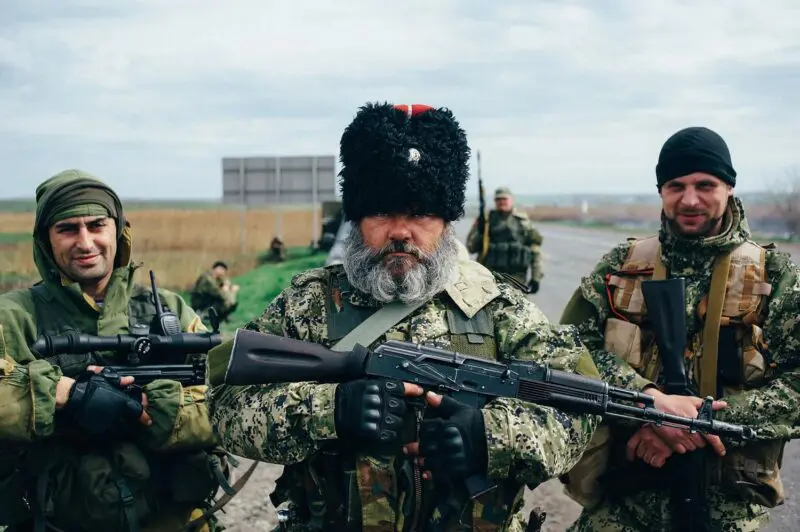
Alexander Mozhaev, a pro-Russian separatist whose photograph has appeared in numerous publications
 in recent days and who says he is not employed by the Russian state, stands with fellow separatists 
in the town of Slavyansk on April 20 Maxim Dondyuk

The death sentences on Thursday came from separatist authorities in the Donetsk region, which is part of the Donbass, as Moscow concentrates its firepower on the strategic industrial hub of Sievierodonetsk.

Rebels ordered the death penalty for Aiden Aslin, Shaun Pinner and Saaudun Brahim after they were accused of acting as mercenaries for Kiev, Russian media reported.

Britain said it was “deeply concerned” by the sentences. A spokesperson for Prime Minister Boris Johnson stressed that “Under the Geneva Convention, prisoners of war are entitled to combatant immunity.”

The two Britons surrendered in April in Mariupol, the southern port city that was captured by Russian troops after a weeks-long siege. They later appeared on Russian TV calling on Johnson to negotiate their release.

Brahim surrendered in March in the eastern town of Volnovakha.

During a trial that lasted three days, the men pleaded guilty to committing “actions aimed at seizing power and overthrowing the constitutional order of the Donetsk People’s Republic”, Russian news agency Interfax said.

‘Fate of Donbass’

Western countries have provided weapons and aid for Ukraine since the February 24 attack, while a number of people from abroad have come to fight against Russian forces.

The fiercest fighting is now focused on Sievierodonetsk in the Luhansk region, where Ukrainian officials say their outgunned forces are still holding out amid street battles despite the city being mostly under Russian control.

The regional governor of Luhansk, also part of the Donbass, said Western artillery would quickly help secure a Ukrainian victory for the bombarded city.

“As soon as we have long-range artillery to be able to conduct duels with Russian artillery, our special forces can clean up the city in two to three days,” governor Sergiy Gaiday said.

In his evening address to the Ukrainian people on Wednesday, Zelenskyy said the battle for Sievierodonetsk was “probably one of the most difficult throughout this war.

“In many ways, the fate of our Donbass is being decided there.”

The city of Lysychansk, which is separated from Sievierodonetsk by a river, is still in Ukrainian hands but under fierce Russian bombardment.


Tree Rings Shed Light on a Stradivarius Mystery

Analyses of 17th-century stringed instruments suggest that a young Antonio Stradivari might have apprenticed with a particular craftsman.


The “Hellier” violin, made by Antonio Stradivari in 1679.Credit...Henry Nicholls/Reuters

By Katherine Kornei
June 8, 2022

Sign up for Science Times Get stories that capture the wonders of nature, the cosmos and the human body. Get it sent to your inbox.


History is revealed in tree rings. They have been used to determine the ages of historical buildings as well as when Vikings first arrived in the Americas. Now, tree rings have shed light on a longstanding mystery in the rarefied world of multimillion-dollar musical instruments.

By analyzing the wood of two 17th-century stringed instruments, a team of researchers has uncovered evidence of how Antonio Stradivari might have honed his craft, developing the skills used in the creation of the rare, namesake Stradivarius violins.

Mauro Bernabei, a dendrochronologist at the Italian National Research Council in San Michele all’Adige, and his colleagues published their results last month in the journal Dendrochronologia, and their findings are consistent with the young Stradivari apprenticing with Nicola Amati, a master luthier roughly 40 years his senior. Such a link between the two acclaimed craftsmen has long been hypothesized.

In the 17th and early 18th centuries, Stradivari created stringed instruments renowned for their craftsmanship and superior sound. “Stradivari is generally regarded as the best violin maker who ever lived,” said Kevin Kelly, a violin maker in Boston who has handled dozens of Stradivarius instruments.

Only about 600 of Stradivari’s masterpieces survive today, all prized by collectors and performers alike. A Stradivarius violin currently on the auction block — the first such sale in decades — is predicted to fetch up to $20 million.

An 18th-century depiction of Antonio Stradivari, the Italian crafter of instruments.
Credit...World History Archive/Alamy

Stradivari likely learned his craft by apprenticing with an older mentor, as was customary at the time. That could have been Amati, who, by the mid-17th century, was well established and also living in Cremona, a city in what is now Italy.

“Some people assume that because Stradivari was Cremonese and he was such a great violin maker, he must have apprenticed with Amati,” said Mr. Kelly, who was not involved in the new study.

But evidence of a link between Stradivari and Amati has remained stubbornly tenuous: One violin made by Stradivari bears a label reading “Antonius Stradiuarius Cremonensis Alumnus Nicolaij Amati, Faciebat Anno 1666.” That wording implies that Stradivari was a pupil of Amati, said Mr. Kelly, but it was the only label like it that has surfaced.

With the goal of shedding light on this musical mystery, Dr. Bernabei and his team visited the Museum of the Conservatory of San Pietro a Majella in Naples and analyzed the wood of a small harp made by Stradivari in 1681. Using a digital camera, the researchers precisely measured the widths of 157 tree rings visible on the instrument’s spruce soundboard.

A small harp by Stradivari from 1681.Credit...DeAgostini/Getty Images

The pattern created by plotting the width of tree rings, one after the other, is like a fingerprint. This is because the amount that a trees grows each year depends on the weather, water conditions and a slew of other factors, Dr. Bernabei said. “Plants record very accurately what happens in their surroundings.”

The researchers compared their measurements from the Stradivari harp with other tree ring sequences measured from stringed instruments. Out of more than 600 records, one stood out for being astonishingly similar: a spruce soundboard from a cello made by Nicola Amati in 1679. “All the maximum and minimum values are coincident,” Dr. Bernabei said. “It’s like somebody split a trunk in two different parts.”

The same wood was indeed used to make the Stradivari harp and the Amati cello, Dr. Bernabei and his colleagues suggest. This was consistent with the two craftsmen sharing a workshop, with the elder Amati possibly mentoring the younger Stradivari, the team concluded.

Perhaps that is true, said Mr. Kelly, but it is not the only possibility. Instead, Mr. Amati and Stradivari might simply have purchased wood from the same person, he said. After all, luthiers in 17th-and 18th-century Cremona belonged to a small community, said Mr. Kelly. “They basically all lived on the same street.”

Stradivarius used by Einstein’s teacher sells for $15.3 million

Instrument belonged to virtuoso Toscha Seidel, who played it in ‘Wizard of Oz’; he and Einstein participated in 1933 concert to support fleeing German Jewish scientists

By AFP
Today

Albert Einstein. (AP Photo)

NEW YORK — A rare Stradivarius violin that belonged to a Russian-American virtuoso and was used in the “Wizard of Oz” soundtrack sold at auction in New York Thursday for $15.3 million, just below the record for such an instrument, according to auction house Tarisio.

The violin, made in 1714 by master craftsman Antonio Stradivari, belonged to virtuoso Toscha Seidel, who not only used it on the score for the 1939 Hollywood classic, but also no doubt while teaching his famous student Albert Einstein.

“This violin has sat side by side with the great mathematician scientist as they played quartets in Albert’s home in Princeton, New Jersey,” said Jason Price, founder of Tarisio, which specializes in stringed instruments.

Seidel, who immigrated to the United States in the 1930s, and Einstein, who fled the Nazi regime in Europe, participated in a New York concert in 1933 in support of fleeing German Jewish scientists.

Of the thousands of instruments made by Stradivari, there are still around 600 known today.

“Of those, many are in museums, many are in foundations and are in situations where they won’t be sold,” Price said.

“There’s a select few which are known as the Golden Period examples, which is approximately between 1710 and 1720,” he said.

“And these, for the most part, are those which are most desired and most highly valued.”

The violin had previously belonged to the Munetsugu collection in Japan. Tarisio did not reveal who the buyer was.

The record for a Stradivarius at auction was set in 2011, when a violin baptized “Lady Blunt,” said to have belonged to Lady Anne Blunt, granddaughter of the poet Lord Byron, was sold for $15.9 in London.

In 2014, another Stradivarius whose auction price was set at a minimum of $45 million did not sell.


CRIMINAL CAPITALI$M
Reforms Are Imposed on U.N. Agency That Made Questionable Investments

After a New York Times report revealed unusual investments putting tens of millions of dollars at risk, the board of the U.N.’s Office for Project Services demanded major changes.

Grete Faremo, left, and Vitaly Vanshelboim, center, at a 2016 event with Dominica’s ambassador to the United Nations. Ms. Faremo resigned in May as the top official at the U.N.’s Office for Project Services; Mr. Vanshelboim, who was her deputy, is on administrative leave.
Credit...Eugene Gologursky/Getty Images


By Farnaz Fassihi and David Fahrenthold
June 10, 2022

After a series of puzzling financial decisions that put tens of millions of dollars at risk, the executive board of a little-heralded United Nations agency took the rare step on Friday of voting to swiftly enforce a series of reforms.

The actions by the board of the Office for Project Services, or UNOPS, followed a report by The New York Times that revealed a series of questionable investments at the agency, totaling about $61 million, of which more than one-third may have been lost.

Friday’s moves by the board of the agency, which supplies logistical services to other U.N. agencies, imposed strict limitations on all financial reserves at UNOPS and suspended work at its investment unit. Its auditing and ethics watchdog functions will also be overhauled and its current business model re-evaluated, among other actions.

Additionally, a 10-member team will investigate the institutional failures at UNOPS that led to the questionable investments and will recommend further reforms.

U.N. officials said the speed and scope of the actions taken by the board were rare for the United Nations, where bureaucracy often hampers fast action.

“For months, the U.S. has pushed for greater transparency and accountability regarding financial mismanagement at UNOPS,” said Chris Lu, the U.S. representative for U.N. management and reform. “We are pleased that the UNOPS executive board has taken swift and decisive action.”

The incident has damaged the credibility of the United Nations and weakened the trust of donor countries at a time when the organization is seeking major funding infusions for an array of global crises.

The United States, which sits on the agency’s executive board, has paused its funding to UNOPS, said Mr. Lu, adding that the United States would press for “appropriate law enforcement action against any and all wrongdoers.”

Finland has also suspended all its funding to UNOPS and is reviewing its donations to other U.N. agencies.

The agency’s leader at the time, Grete Faremo of Norway, resigned hours after The Times published its investigation into UNOPS’s fraught investments. She stepped down at the request of António Guterres, the secretary general of the U.N., according to a U.N. official.

U.N. agencies hire UNOPS to build roads, deliver supplies and perform other logistical tasks.

Its financial troubles began when it accumulated millions of dollars of surplus funds, and officials at the agency lent $58 million to a single group of companies, all connected to a British businessman whom members of the agency’s investment unit had met at a party in 2015.

An additional $3 million was given as a grant to the same British businessman’s college-aged daughter for advocacy on protecting oceans.

Dragan Micic, who represented UNOPS at the board meeting, said the agency hoped to “move toward more transparency and rebuild the trust of our board members and partners.”

Ms. Faremo’s deputy, Vitaly Vanshelboim, was placed on leave while an investigation was completed by the U.N.’s internal oversight office. The report is now finished and is with Mr. Guterres’s office, which could take further disciplinary action.

“The next steps include possible administrative sanctions or referral to the relevant judicial authorities in the case of potential criminal wrongdoing,” said Stéphane Dujarric, a spokesman for Mr. Guterres.

The loans were intended to finance renewable-energy and housing projects in the developing world. But U.N. auditors later said that the companies defaulted on more than $22 million. Auditors said one of the companies admitted it had used most of its U.N. loan — intended to finance energy projects — to pay off pre-existing debts.

Attorneys for the businessman, David Kendrick, released statements last month saying that neither Mr. Kendrick not his daughter had done anything wrong and that the projects UNOPS had invested in had been slowed by government decisions and the Covid-19 pandemic. Mr. Kendrick, according to the statement, still expected them to succeed.

UNOPS

A Pot of U.N. Money. Risk-Taking Officials. A Sea of Questions.
May 7, 2022


Farnaz Fassihi is a reporter for The New York Times based in New York. Previously she was a senior writer and war correspondent for the Wall Street Journal for 17 years based in the Middle East. @farnazfassihi