Friday, July 15, 2022

Biden brings Palestinians aid but no new peace plan

Yesterday 9:11 PM

JERUSALEM (Reuters) - U.S. President Joe Biden will not come with a plan to restart the stalled Israel-Palestinian peace process when he visits the West Bank on Friday, at the end of the first leg of his Middle East trip, a senior administration official said.


© Reuters/EVELYN HOCKSTEIN
U.S. President Biden visits Jerusalem

Biden will restate his backing for a two-state solution to the decades-long conflict and will unveil a fresh package of economic and technical assistance for the Palestinians, but there are no expectations of any major political breakthrough.

"[There] are practical realities on the ground that we are very mindful of so we have not come in with a top-down plan but we have always said that if the parties are ready to talk, and we think they should, we will be there, right beside them," the official said.


© Reuters/EVELYN HOCKSTEIN
U.S. President Biden visits Jerusalem

Biden is expected to meet Palestinian President Mahmoud Abbas in Bethlehem before leaving for Saudi Arabia on the second stage of his trip.

Even before his visit, Palestinian leaders had accused Biden's administration of prioritizing Israel's integration into a regional security arrangement with Arab countries above their concerns, including self-determination and continued Israeli settlement building in the occupied West Bank.


© Reuters/RANEEN SAWAFTA
Palestinians take part in a protest against the visit of U.S. President Joe Biden to West Bank

On Thursday, as Biden and Israeli Prime Minister Yair Lapid announced deepening security ties in their so-called "Jerusalem Declaration," there were protests in the West Bank and Gaza against his visit.

Biden administration officials have rejected Palestinian charges of inaction, pointing to a reversal of the funding cuts and diplomatic freeze imposed by former President Donald Trump.

"There was really no connection whatsoever, no discussions with the Palestinians, funding had been entirely severed, there was really no prospect of any political discussions of any kind," the official said.

He said the move to deepen Israel's regional integration "is not ... an end run around that fundamental issue."


© Reuters/RANEEN SAWAFTA
Palestinians take part in a protest against the visit of U.S. President Joe Biden to West Bank

With little prospect of political progress, the focus is likely to be on the new funding and technical assistance measures Biden will unveil.

As well as a multi-year contribution of up to $100 million for hospitals in East Jerusalem, he will announce measures to upgrade telecoms networks in the West Bank and Gaza to high speed 4G standards by the end of 2023 and other measures to ease travel between the West Bank and neighbouring Jordan.

In addition, there will be a separate $201 million funding package provided through the UN relief agency UNRWA to help Palestinian refugees.

A two-state solution with an independent Palestinian state sitting alongside the existing state of Israel has long been the favoured solution for the international community. But it has appeared an increasingly distant prospect, with hardening attitudes and waning support on both sides.

On Thursday, both Biden and Lapid voiced support for the two-state model. But with Israel heading for elections in November and little backing for stopping the expansion of Israeli settlements on West Bank land that Palestinians want for a future state, immediate prospects for agreement appear remote.


© Reuters/RANEEN SAWAFTA
Palestinians take part in a protest against the visit of U.S. President Joe Biden to West Bank

(Reporting by James Mackenzie; Editing by Daniel Wallis)


Biden heads to West Bank, with little to offer Palestinians

By AAMER MADHANI, JOSEPH KRAUSS and CHRIS MEGERIAN
1 of 6
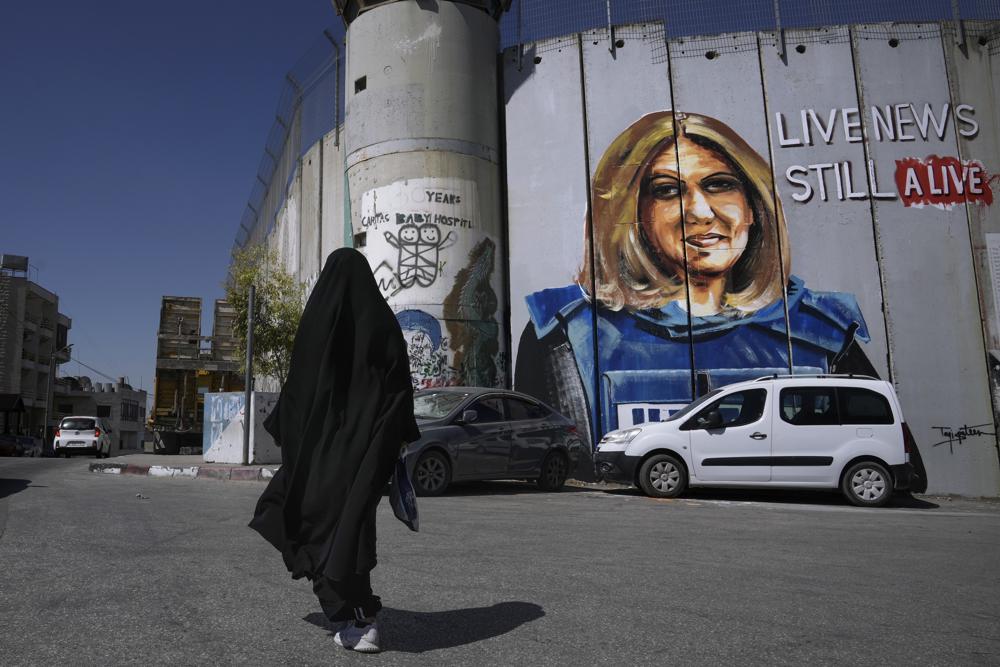
A mural by Palestinian artist Taqi Spateen depicts slain Palestinian-American journalist Shireen Abu Akleh on part of Israel's controversial separation barrier, in the West Bank city of Bethlehem, July 6, 2022. On Thursday, July 14, 2022, Lina Abu Akleh, the niece of the slain Al Jazeera journalist, is criticizing President Joe Biden for not meeting with her family as it presses the U.S. to hold Israel accountable for her death. (AP Photo/ Mahmoud Illean, File)


JERUSALEM (AP) — When President Joe Biden heads to the occupied West Bank on Friday for talks with Palestinian leaders, he will have little to offer beyond U.S. money aimed at buying calm.

He’s expected to announce $316 million in financial assistance — about a third of which will require congressional approval — and a commitment from Israel to modernize wireless access for Palestinians.

But although Biden will reiterate his support for an independent Palestinian state, there’s no clear path to one. The last round of serious peace talks broke down more than a decade ago, leaving millions of Palestinians living under Israeli military rule.

Israel’s outgoing government has taken steps to improve economic conditions in the occupied West Bank and Gaza. But Yair Lapid, the caretaker prime minister, does not have a mandate to hold peace negotiations, and Nov. 1 elections could bring to power a right-wing government that is opposed to Palestinian statehood.

Meanwhile, the 86-year-old President Mahmoud Abbas, whose Palestinian Authority administers parts of the occupied West Bank and cooperates with Israel on security, is more representative of the status quo than Palestinian aspirations.

His Fatah party lost an election, and control of Gaza, to the Islamic militant group Hamas more than 15 years ago. He called off the first national elections since then last year — blaming Israel — when Fatah appeared to be heading for another crushing defeat. Polls over the past year have consistently found that nearly 80% of Palestinians want him to resign.

Biden acknowledged this week that while he supports a two-state solution, it won’t happen “in the near-term.” The U.S. also appears to have accepted defeat in its more modest push to reopen a Jerusalem consulate serving the Palestinians that was closed when President Donald Trump recognized the contested city as Israel’s capital.

Palestinian leaders also fear being further undermined by the Abraham Accords, a diplomatic vehicle for Arab nations to normalize relations with Israel despite the continuing occupation. Biden, who heads next to Saudi Arabia to attend a summit of Arab leaders, hopes to broaden that process, which began under Trump.

Hours before Biden was set to become the first U.S. leader to fly directly from Israel to the kingdom, Saudi Arabia’s General Authority of Civil Aviation announced early Friday “the decision to open the Kingdom’s airspace for all air carriers that meet the requirements of the Authority for overflying.”

It signaled the end of its longstanding ban on Israeli flights overflying its territory — an incremental step toward the normalization of relations between Saudi Arabia and Israel that builds on the strong, but informal ties the erstwhile foes have developed in recent years over their shared concerns about Iran’s growing influence in the region.

“President Biden welcomes and commends the historic decision by the leadership of Saudi Arabia to open Saudi airspace to all civilian carriers without discrimination, a decision that includes flights to and from Israel,” said U.S. National Security Adviser Jake Sullivan in a statement early Friday.

There’s been hardly any mention of the Palestinians over the past two days, as Biden has showered Israel with praise, holding it up as a democracy that shares American values. At a press conference with Biden, Lapid evoked the U.S. civil rights movement to portray Israel as a bastion of freedom.

It all reeked of hypocrisy to Palestinians, who have endured 55 years of military occupation with no end in sight.

“The idea of shared values actually makes me sick to my stomach,” said Diana Buttu, a Palestinian lawyer and political analyst. “I don’t think Israeli values are anything that people should be striving towards.”

Both Biden and Lapid said they supported an eventual two-state solution in order to ensure that Israel remains a Jewish-majority state. But Biden is expected to announce little beyond financial assistance, including $201 million for the United Nations agency for Palestinian refugees.

Biden proposed $100 million, subject to congressional approval, for hospitals in east Jerusalem that serve Palestinians. Another $15 million is for humanitarian assistance, plus $7.2 million for programs to promote cooperation between Israelis and Palestinians.

His approach, often referred to as “economic peace,” has limitations.

“You can’t buy a solution to the Israeli-Palestinian conflict,” said Aaron David Miller, a senior fellow at the Carnegie Endowment for International Peace and former U.S. State Department official. “It doesn’t work, because that’s not what drives this conflict.”

That sentiment was on display in the West Bank on Thursday, where dozens of Palestinians gathered to protest Biden. More protests were expected Friday.

“Mr. Biden is trying to marginalize the Palestinian issue,” said Mustafa Barghouti, a veteran Palestinian activist. “If he does not allow Palestinians to have their rights, then he is helping Israel kill and end the very last possibility of peace.”

At this point, the Palestinian goal of an independent state in east Jerusalem, the West Bank and Gaza — territories Israel seized in the 1967 Mideast war — appears more distant than ever.

Israel is expanding settlements in annexed east Jerusalem and the West Bank, which are now home to some 700,000 Jewish settlers. The Palestinian view the settlements — many of which resemble sprawling suburbs — as the main obstacle to peace, because they carve up the land on which a Palestinian state would be established. Most of the world considers them illegal.

Military rule in the West Bank has sown widespread despair, contributing to a recent wave of violence. A 15-year blockade of Gaza, which Israel says is needed to contain Hamas, has helped fuel four devastating wars. Jerusalem, home to famed holy sites and the emotional heart of the conflict, is as volatile as ever.

Israel has its own grievances — including Palestinian Authority payments to the families of prisoners and slain attackers, which Israel says incentivize violence. The PA defends the payments as a form of welfare for those it sees as victims of the conflict.

It’s unclear if eliminating the “martyrs’ fund” would advance the goal of statehood. Israel is dominated by nationalist and religious parties that are opposed to a Palestinian state and view the West Bank as the biblical and historical heartland of the Jewish people.

Well-known human rights groups have concluded that Israel’s seemingly permanent control over millions of Palestinians amounts to apartheid. One of those groups, Israel’s own B’Tselem, hung banners in the West Bank ahead of Biden’s visit.

Israel rejects that label as an attack on its very existence, even though two former Israeli prime ministers warned years ago that their country would be seen that way if it did not reach a two-state agreement with the Palestinians. The U.S. also rejects the apartheid allegations.

Biden will also likely see banners calling for justice for Palestinian-American journalist Shireen Abu Akleh, who was killed during an Israeli military raid in the West Bank in May. Israel says she might have been struck by Palestinian gunfire, while investigations by The Associated Press and other media outlets support Palestinian witnesses who say she was shot by Israeli forces.

The U.S. says she was likely killed by Israeli troops but that it appeared to be unintentional, without saying how it reached those conclusions. That angered many Palestinians, including Abu Akleh’s family, who accused the U.S. of trying to help Israel evade responsibility for her death.

___

Krauss reported from Ottawa, Ontario. Megerian reported from Washington. AP writer Zeke Miller in Washington contributed.


BETHLEHEM: US President Joe Biden said during a trip to the occupied West Bank on Friday that Palestinians need to see a path towards statehood, even if hopes for a peace process with Israel remain bleak.... Read more on: https://www.omanobserver.om/article/1122209/world/region/biden-says-palestinians-need-to-see-political-horizon

Thursday, July 14, 2022

FIREWALL ALBERTA
What the spectre of Alberta separatism means for Canada

In October, members of Alberta’s governing United Conservative Party (UCP) will elect a new leader who will then become Alberta’s next premier.


Lisa Young, Professor of Political Science, University of Calgary, University of Calgary \and Jared Wesley, Professor, Political Science, University of Alberta - 

© THE CANADIAN PRESS/Jason Franson
Edmonton demonstrators gather to protest against COVID-19 measures and support the 'freedom convoy' in February 2022. Research suggests Alberta separatist sentiments have as much to do with antipathy about the federal government and Justin Trudeau as actually leaving Confederation.

A defining issue in this leadership race is Alberta’s place in Canadian Confederation, with several contenders openly discussing “sovereignty,” “autonomy” and even “independence.”

Are Albertans really so keen to sever ties with the rest of Canada? Should Canadians pay much attention to the separatist movement in Alberta? To answer these questions, we looked at data from the recent Viewpoint Alberta survey.


© Author provided
An infographic that shows the key findings of the Viewpoint Alberta survey.


Separatism and the economy

Support for separation remains a minority view in the province, with one in five believing Alberta “should separate from Canada and form an independent country.”

This is a small base from which to build a province-wide following. Yet separatists make up one-third of UCP voters — a sizeable constituency for would-be leaders to court.


© THE CANADIAN PRESS/Jeff McIntoshBrian Jean is among those vying to replace outgoing Premier Jason Kenney. His campaign slogan is ‘Autonomy for Albertans.’

What motivates these Albertans to take such a drastic position?

Unlike sovereigntists in Québec motivated by a desire to protect their culture, we find Alberta separatists are preoccupied with fiscal and economic issues.

According to our research, Alberta’s separatist movement is also grounded more in party politics than it is in nationalism.

Separatists place themselves further to the right than other Albertans. They are more likely to support conservative political parties both federally and provincially. And they strongly dislike the federal government and Justin Trudeau.
How committed are Alberta separatists?

In our analysis, we found two clues that suggest support for separatism is less a heartfelt desire to form a new country and more a tactical expression of grievances.

The first is that most Albertans – including the separatists themselves – think separation is unlikely. Barely one in 10 separatists think Alberta independence is “very likely” or “will happen.”

The second clue is that the majority of the separatists (62 per cent) retain a sense of attachment to Canada. Separatists are simply angrier and more pessimistic about the country’s future.


Related video: 'Free Alberta Strategy' seeks to declare Alberta a sovereign jurisdiction

They haven’t turned their backs entirely on Canada; they feel it’s headed in the wrong direction and in need of radical reform. 
THEY WANT IT TO BE AMERICAN, REPUBLICAN AMERICA


© THE CANADIAN PRESS/Jeff McIntoshPremier Jason Kenney serves pancakes at his last Stampede breakfast in Calgary on July 11. Kenney’s resignation set the stage for a United Conservative Party leadership race and several contenders are already discussing Alberta sovereignty.
Pessimism and mistrust

Most separatists’ worldviews are grounded in a sense of status loss and mistrust for institutions that has fuelled populist movements elsewhere in the world.


They are more likely to feel like they are falling behind others in society, and they have very little confidence in governments and elites. These suspicions drew most separatists into supporting the so-called freedom convoy that occupied Ottawa for weeks in February 2022.


Read more: What the truck? The 'freedom convoy' protesters are heading back to Ottawa

Separatists stood out in their belief that the most recent federal election was unfair. This may be because their favoured party lost despite winning more votes, or a belief in conspiracy theories spread by right-wing news outlets.

Whatever the reason, this low level of trust — combined with a deep sense of pessimism about the future — has sparked movements like Brexit and Trumpism in other parts of the world.

Separatism in Alberta


While support for separation is a minority view in Alberta, it’s not a fringe position. An overwhelming majority of separatists support the UCP provincially and make up a substantial part of its base of support.

EXCEPT THEY HAVE BEEN IN POWER IN ALBERTA FOR 44 YEARS AS THE PROGRESSIVE CONSERVATIVES, AND AS RIGHT WING BIBLE BELT SOCIAL CREDIT FOR 75 YEARS BEFORE THAT 


Danielle Smith, Wildrose leader in this 2014 photo, is now a leadership contender to replace Jason Kenney.

Such a large voting bloc is enticing to leadership contenders. Veiled promises to restore Alberta’s “sovereignty” or secure greater “autonomy” can help sell party memberships. They may even lead to victory in the UCP race, creating pressure for the winner to deliver on promises that are politically and constitutionally impossible.

But our research tells us that flirting with separatism is likely to fall flat — if not backfire entirely — during a provincial election.

The broader Alberta electorate is federalist. The majority do not support measures that would further divide the province from Canada.


Eighty per cent of Albertans reject separation, and solid majorities also oppose abandoning the Canada Pension Plan, the RCMP and federal income tax collection. Most opposed the “freedom convoy” and what it stood for, and the majority have confidence in most political institutions.


Candidates running for the UCP leadership have a choice. They can pay lip service to populist and sovereigntist positions to gain internal party support. Or they can resist that temptation with an eye to winning the next provincial election, preserving national unity and strengthening democratic institutions in the process.

Implications for Canada


Canadians outside Alberta should keep a careful eye on this dynamic. Even though they lack the profile of Québec sovereigntists, Alberta separatists are positioned to exert significant political influence on intergovernmental relations in the years to come.

How much influence depends on the commitments made by the eventual winner of the UCP leadership race, and the response from the rest of Canada to their push for a fairer deal in Confederation.

If the next premier is unable to deliver on their promises by securing meaningful concessions from the rest of Canada, separatists would be further alienated from the democratic process. Their disappointment might lead to further civil unrest like what we saw from the “freedom convoy,” adding fuel to the politics of resentment.

This article is republished from The Conversation, a nonprofit news site dedicated to sharing ideas from academic experts.

Read more:
Protests in Ottawa are a recurring disaster, affecting neighbourhoods and residents
Alberta budget means Albertans are trapped on a relentless fiscal rollercoaster ride

Jared Wesley receives funding from the Social Sciences and Humanities Research Council, the Kule Institute for Advanced Study, and the Killam Trust.

Lisa Young does not work for, consult, own shares in or receive funding from any company or organisation that would benefit from this article, and has disclosed no relevant affiliations beyond their academic appointment.

SEE 


Federal suspension lifted, but Muslim charity presses ahead with case in top court


OTTAWA — A Muslim international relief charity is telling the Supreme Court of Canada the federal government should not be allowed to "shoot first and hold a hearing later" when it comes to levying administrative penalties.


Ottawa-based Human Concern International can resume issuing tax receipts to donors now that a government-imposed suspension has expired.

But HCI is asking the top court to review the Federal Court of Appeal's March dismissal of its request for a freeze of the suspension while a challenge of the penalty played out.

The Canada Revenue Agency levied the one-year suspension in July 2021 following an audit by the revenue agency's charities directorate that flagged concerns about six initiatives.

Although the suspension has now ended, HCI is still pursuing the legal matter of a right to a freeze on the basis it has significant repercussions for the charitable sector as a whole.

In its application seeking a hearing in the Supreme Court, HCI says the rule of law in Canada will be "significantly diminished" if the court does not step in.

The charity argues federal agencies will be empowered to impose penalties before an airing of the issues — and prior to a determination of guilt.

"Justice will be denied to innocent parties, as government agencies will be free to extract punishments from citizens, even where the punishment cannot be reversed in the event bureaucratic error is identified at trial."

Any other charities going through a revenue agency audit "will live in this fear of suspension," HCI executive director Mahmuda Khan said in an interview. "And they'll also feel like, OK, we have nowhere to go, or there's no way to hold CRA accountable. And that's not the position we want to have for charities in Canada."

The revenue agency accused HCI of improperly issuing donation receipts totalling more than US$307,000 on behalf of organizations administering the six projects in question — a practice known as third-party receipting.

The initiatives included three education and health projects in India, education and skills development of orphans in Bangladesh, orphan support in Somalia and an education project in Kenya.


HCI, the oldest Muslim global relief charity in Canada, says charities often work with individuals and groups connected to the communities where the projects are taking place.

The charity insists it has always been committed to maintaining direction and control of its overseas projects and to ensuring that all such projects conducted through third-party intermediaries constitute HCI's own charitable activities.

HCI objected to the suspension through the revenue agency's internal administrative appeal process. That appeal is ongoing, Khan said.

At the same time, it applied to the federal Tax Court to delay application of the suspension until the revenue agency had considered the objection.

In August 2021, a Tax Court judge declined to grant a stay of the suspension.

In its March decision, a three-member panel of the Federal Court of Appeal upheld the judge's ruling, saying HCI had not raised any error warranting intervention.

The Court of Appeal also said there was no merit to HCI's argument that the Tax Court should have applied principles of natural justice to ensure the charity was not deprived of its right to a hearing on the merits of the matter before the suspension was imposed.

In its application to the Supreme Court, HCI says it lost an estimated $4 million in donations as a result of the suspension.

The charity has also incurred "significant legal fees," Khan said.

HCI says while the revenue agency plays an important public function in regulating the special status of charities, that public interest can still be served by imposition of a suspension once internal appeals at the agency have been exhausted.

Federal lawyers have yet to file arguments in response. The Supreme Court is expected to decide in coming weeks whether to hear the case.

The federal revenue agency confirmed to The Canadian Press that HCI's receipting privileges are now restored.

In a statement Thursday marking the end of the one-year suspension, HCI said tax receipts will be issued for all eligible donations going forward.

"HCI is grateful that many of our donors stood by us during these challenging times while the CRA one-year suspension was in effect. The support for our humanitarian programs despite our inability to issue tax receipts is evidence of HCI's 40-year achievement in continuing our bond with our donors and beneficiaries," the statement said.

"HCI worked tirelessly to minimize the impact of the suspension on our beneficiaries, including supporting tens of thousands of orphans, empowering vulnerable women, providing water aid, rebuilding Gaza, or responding to emergencies in Afghanistan and Yemen."

This report by The Canadian Press was first published July 14, 2022.

Jim Bronskill, The Canadian Press

SEXY SCIENCE

NASA's James Webb Space Telescope imaged Jupiter's rings and moons, in white-hot infrared

Jupiter and its moon Europa (left), are seen through the James Webb Space Telescope's NIRCam instrument.NASA, ESA, CSA, and B. Holler and J. Stansberry (STScI)

NASA has cast its most powerful infrared eye on Jupiter with a new set of images from the James Webb Space Telescope (JWST).

The new observatory, orbiting the sun about 1 million miles from Earth, proved it can peer more than 13 billion light-years across the universe this week, when NASA released its first full-color images. They show countless galaxies, stars, and clouds of dust in the distant universe.

JWST can image closer, more familiar objects, too. On Thursday, NASA released a series of new JWST images showing Jupiter in stunning detail. Alongside the gas giant are its moons Europa, Thebe, and Metis. Scientists think Europa has a saltwater ocean, deep below its thick ice crust, which could harbor alien life.

Even Jupiter's thin rings are visible in some of the new images. The rings are made of dust particles hurled into space when micrometeoroids crash into nearby moons. Nobody knew they existed until the Voyager spacecraft passed Jupiter in 1979, looked back, and saw the rings silhouetted against the sun.

side by side images of jupiter and its moon in different infrared wavelengths one orange showing jupiters bands one bright yellow
Jupiter and its moons seen through the James Webb Space Telescope's NIRCam instrument short-wavelength filter (left) and long-wavelength filter (right).NASA, ESA, CSA, and B. Holler and J. Stansberry (STScI)

Europa's shadow appears just to the left of Jupiter's famous Great Red Spot, an anticyclone large enough to swallow Earth. The storm is white in this picture, because of how scientists processed the infrared data the telescope beamed back.

"I couldn't believe that we saw everything so clearly, and how bright they were," Stefanie Milam, a planetary scientist on NASA's JWST team, said in a blog post revealing the images. "It's really exciting to think of the capability and opportunity that we have for observing these kinds of objects in our solar system."

side by side images show jupiter in two types of infrared light with large moon europa and thin planetary rings
Jupiter and its moons and rings, as captured by JWST in short infrared wavelengths (left) and long infrared wavelengths (right).NASA, ESA, CSA, and B. Holler and J. Stansberry (STScI)

JWST captured the new images using its Near Infrared Camera (NIRCam) filter. The images that clearly show the bands of Jupiter's atmosphere were captured using a filter for short wavelengths of light. Others, like the above image showing Jupiter as a ball of bright white light, went through a filter for long wavelengths.

To make sure the telescope can find and track stars in the background of bright objects like Jupiter, NASA focused the telescope on a distant star as Jupiter moved past. That resulted in the below animation of Jupiter and Europa zipping by.

gif shows jupiter and its moon europa passing through the frame
Jupiter and its moon Europa are seen in this animation made from three images taken through the NIRCam instrument short-wavelength filter.NASA, ESA, CSA, and B. Holler and J. Stansberry (STScI)

"Combined with the deep field images released the other day, these images of Jupiter demonstrate the full grasp of what Webb can observe, from the faintest, most distant observable galaxies to planets in our own cosmic backyard that you can see with the naked eye from your actual backyard," Bryan Holler, a scientist at the Space Telescope Science Institute in Baltimore, who helped plan these observations, said in a statement.

jupiter bright white infrared ball with a thin ring around it and a bright moon next to it
Jupiter and some of its moons are seen through NIRCam’s 3.23 micron filter.NASA, ESA, CSA, and B. Holler and J. Stansberry (STScI)

This is just the beginning of JWST casting its eye across our solar system. NASA plans for the telescope to study all the outer planets — from Mars outward — along with many of their moons. That includes Europa. In the coming years, JWST might be able to analyze light from water plumes shooting out of Europa's underground ocean, through its ice crust, and into space. That data could tell scientists about the composition of that ocean.

"I think that's just one of the coolest things that we'll be able to do with this telescope in the solar system," Milam said.


CRIMINAL CAPITALI$M & ECOCIDE
Officials suggest pipeline company hid problems after spill

Thu, July 14, 2022 


BILLINGS, Mont. (AP) — U.S. prosecutors suspect a Wyoming company of potentially concealing problems with a pipeline that broke in 2015 and spilled more than 50,000 gallons (240,000 liters) of crude into Montana’s Yellowstone River, fouling a small city’s drinking water supply, court filings show.

The government is suing Bridger Pipeline for violations of environmental laws in the 2015 spill, which came after the line buried beneath the Yellowstone became exposed and broke when ice scoured the river bottom near Glendive, Montana. Prosecutors are pursuing similar claims against a related company over a 2016 spill in North Dakota that released more than 600,000 gallons (2.7 million liters) of crude.

The accidents came a few years after an Exxon-Mobil oil pipeline broke beneath the Yellowstone during flooding. The spills helped put a national focus on the nation's aging pipeline network, which has continued to suffer high profile accidents including recent spills in Louisiana and California.

A survey of Bridger's pipeline on the company's behalf in 2011 included a note that the pipe was buried only 1.5 feet (0.5 meters) beneath the ever-shifting river bottom. That would have put it at heightened risk of breaking.

But after the spill, prosecutors alleged, company representatives referenced a second survey when they told federal regulators that the pipeline had been buried at least 7.9 feet (2.4 meters), giving it “adequate cover” to protect against spills.

“This raises questions – which Bridger has yet to answer – about whether Bridger concealed material facts about the condition of the crossing before the Yellowstone spill,” assistant U.S. Attorney Mark Elmer wrote in court documents.

Attorneys for Bridger rejected the allegations about conflicting surveys as “conspiracy theories."

Pipeline company spokesperson Bill Salvin said the government misunderstood the surveys.

“There was adequate depth of cover across the entire crossing,” Salvin said. “We think the government is trying to find something that’s just not there.”

Federal prosecutors last month filed a lawsuit with similar claims against a sister company, Belle Fourche Pipeline, over the 2016 North Dakota spill that contaminated the Little Missouri River and a tributary.

Both pipeline businesses are part of Casper, Wyoming-based True Companies, which operates 1,800 miles (2,900 kilometers) of line in Montana, North Dakota and Wyoming.

Prosecutors allege the spills violated the Clean Water Act and are subject to penalties of up to $6.6 million in the Montana case and up to $89.5 million in the North Dakota case.

Attorneys for Belle Fourche, in their initial response to the federal lawsuit, on Thursday denied any violations of pollution laws. A more detailed response is expected at a later date.

The legal challenges over the spills come as Bridger seeks to build a new pipeline from western North Dakota to southeastern Montana. North Dakota Public Service Commission in May approved part of the line.

Bridger last year reached a $2 million settlement with the federal government and Montana over damages from the Yellowstone River spill. The company was previously fined $1 million in the case by the Montana Department of Environmental Quality.

___

Follow Brown on twitter: @MatthewBrownAP

Matthew Brown, The Associated Press
RACIST ISLAMAPHOBIC STATE
Ottawa closes special Afghan immigration program to new applicants

Thu, July 14, 2022

Afghans hoping for evacuation wait inside a crowded holding area at Kabul's airport in August 2021. (David Lavery - image credit)

Less than halfway to its goal of bringing 40,000 Afghans to Canada, the federal government is no longer taking new referrals for the special immigration program meant to prioritize former employees of the Armed Forces or Canadian government and their families.

CBC News has learned the government is processing the last of the 18,000 applications filled out by Afghans hoping to come here through the program. Advocates for refugees say the decision to wind down the program abandons Afghans desperate to come to this country.

The program was set up nearly a year ago, a few weeks before Kabul fell to the Taliban in August, 2021 and before the government of Prime Minister Justin Trudeau promised to bring 40,000 Afghans to safety here.

Immigration, Refugees and Citizenship Canada's online referral portal for the program is still up but a spokesperson for Immigration Minister Sean Fraser confirmed in a media statement that all spots in the program have been taken up.

"IRCC has applications for more than 15,000 Afghans and their family members in various stages of processing," the spokesperson wrote. "Global Affairs Canada (GAC) and National Defence have shared referrals with IRCC for the remaining spots."

The Toronto Star first reported the program appeared to be about to close in mid-June, prompting a coalition of aid organizations to issue a joint statement condemning the move.

"From the government side, there hasn't been a lot of clarity on precisely what the criteria are," said Lauryn Oates, the executive director of Canadian Women 4 Women in Afghanistan, one of the groups behind the joint statement.

'They are trapped and ... in danger'

Oates said 17 people from her organization have asked the Canadian government to state whether they qualify for the program. She said they all started the process last year but have not received invitations to apply yet.

"They have tried everything else. They have knocked on the doors of other governments, other embassies, all kinds of other programs," she said. "They are trapped and they are in danger."

Oates is calling on the government to extend the program for another year and to expand the number of spots open to Afghan immigrants.

"And parallel to that, we'll be trying everything possible to get our people out of the country and to safety," she said.

CBC News spoke to one Afghan who works with a Canadian non-governmental organization and is splitting his time between Pakistan and Kabul while he tries to stay one step ahead of the Taliban. He's among those waiting to learn if he qualifies for the Canadian program.


Sean Kilpatrick/The Canadian Press

"I was left behind from Canada. I haven't heard back from them," he said. The CBC is not disclosing his name because both his office and his neighbourhood have been searched by the Taliban.

He said he was "shocked" by the former Afghan government's sudden collapse last August. He said that when the news came in, he went to find his wife and children and take them into hiding.

Other programs open, minister's office says

Fraser's office said other avenues remain for Afghans who wish to come to Canada, such as a humanitarian program and another to help families of former military interpreters who are already here.

"I think it is deceptive for the government to make that suggestion to people," said NDP immigration critic Jenny Kwan. "That is just a rejection. And telling people to go to other streams is a dead end for them.

"What the government needs to do is to come forward and open up that program to ensure that those who are eligible, those who served Canada, who are part of the Canadian military and their family members, are brought to safety."

Roughly 16,540 Afghans have arrived in Canada since August of last year.

In its statement to the CBC, Fraser's office also said it has received "hundreds of thousands of communications from those expressing interest in coming to Canada since the fall of Kabul.

"Regrettably, this is a far larger number than we can bring to Canada."
Documents show politics drove Alberta's decision to lift COVID restrictions, critics argue

Thu, July 14, 2022 

Dr. Deena Hinshaw, Alberta's chief medical officer of health, prepared a PowerPoint presentation that was given to cabinet ahead of its Feb. 8 decision to ease public health measures, which included eliminating masking in schools. (Jason Franson/The Canadian Press - image credit)

Two key documents — shielded from the public until now — are providing some insight into how the Alberta government came to ease COVID-19 public health measures earlier this year.

A Court of Queen's Bench justice in Edmonton recently rejected the government's cabinet confidentiality claim and ordered a PowerPoint presentation and cabinet committee minutes be disclosed. It stemmed from a case challenging the decision to remove the province's school mask mandate and block school boards from bringing in their own.

Lawyers for the Alberta Federation of Labour (AFL) and the parents of five immunocompromised children argue Albertans have the right to know what led up to the decision to lift the mandate.


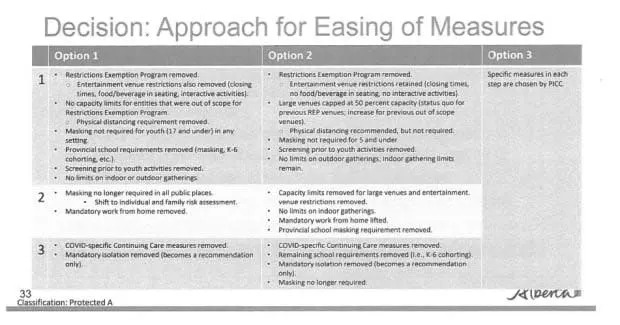
The first of the highly anticipated documents is a Feb. 8 PowerPoint presentation prepared by Alberta's chief medical officer of health, Dr. Deena Hinshaw, which was presented by Health Minister Jason Copping, according to the province.

It offers three possible options for lifting restrictions, seemingly crafted within the parameters of earlier guidance from the Priorities Implementation Cabinet Committee (PICC).

"Per previous PICC direction, three-step approaches to easing are proposed, with a focus on removing the restrictions exemption program and easing youth masking requirements," the PowerPoint presentation said.

The first option proposed significant easing in Step 1, including eliminating school masking right away.

The second option suggested more moderate easing initially with school masking lifted in Step 2.

The third option left the approach open to the cabinet committee.

"The options presented to cabinet very much skewed in favour of lifting restrictions," said Lorian Hardcastle, who teaches health law and policy at the University of Calgary.

CBC

"Interestingly, embedded in what I would expect to be a scientific discussion were considerations around political concerns and economic concerns. And very notably to me is that one of the "pros" listed in this presentation was to have Alberta be a leader in reopening, and that has nothing to do with science. That's politics."


In its discussion about timing, the document noted certain unspecified metrics would need to be achieved before moving to next steps and that "Alberta will be a leader in entering the endemic space, balancing the risks and benefits to easing before other Canadian jurisdictions."


Cabinet committee minutes


The provincial government was also ordered to hand over cabinet committee meeting minutes from Feb. 8, the day it announced its plans to lift public health measures.

The minutes — which include the decision reached but no documentation of any discussion — show the second, more moderate option was chosen.

But the framework for easing restrictions that was actually put in place differs from the second option presented to cabinet and it appears the plan was modified.

The province lifted masking in schools two weeks after moving into Step 1 and before moving into Step 2. It also lifted the overarching provincial mask mandate earlier than the scenario laid out.

According to Hardcastle, with no record of the cabinet discussion, it's impossible to know exactly what led to the changes.

"We don't have a lot of information on how or why that decision was reached, and I think that's unfortunate from an accountability perspective," she said.


Colin Hall/CBC

While the PowerPoint laid out a plan for removing public health measures, it also noted Alberta was not yet in the endemic phase.

Any easing of measures, it said, "should be predicated on declining rates of new COVID-19 hospitalizations over a sustained period of time."

The PowerPoint noted the COVID positivity rate at the time had been stable for a few weeks, and while hospitalizations seemed to be at a "plateau," they were "still high and straining the system."

It also warned that once COVID infrastructure is "ramped down," it would be difficult to re-establish quickly and that an uptick in cases would be expected as restrictions eased.

"If the situation worsens and the continued transition to endemic is not possible due to the level of strain on the acute-care system, the reinstatement of public health measures may be recommended," the PowerPoint reads.

The AFL, which is one of the applicants in the case, calls the revelations in the documents "unsettling."

"They had their eyes clearly focused on politics and their own narrow political interest, rather than the broader public interest where their focus should have been," said AFL president Gil McGowan.

"I find it really troubling that the government was making a decision that was going to affect the health and safety of so many people, including our kids, just so they could say that they're first. That's not something that should be on their mind. What they should be focused on is the public interest and public safety, not bragging rights."

Alberta government defends decision

The Alberta government said the documents filed in court show what they've argued all along.

"We moved forward with a plan to safely lift public health measures, in line with other provinces and other countries, based on the best available evidence, and advice from Alberta Health and the chief medical officer of health," Steve Buick, press secretary for Health Minister Copping, said in a statement emailed to CBC News.

"We stand by our decision to lift public health measures, including ending mandatory masking in schools. It was the right choice for kids, and it did not pose undue risk to our communities."

Buick said the documents show the provincial government did not cast aside advice contained in the PowerPoint presentation.

Suggestions that we ignored or overrode recommendations are simply false. - Steve Buick, press secretary for the health minister

"The minister of health provided cabinet with three options, presented uniformly without a recommended option. Cabinet chose from those options. Suggestions that we ignored or overrode recommendations are simply false," said Buick, adding the provincial government is determined to avoid disruption of schools in the future as much as possible.

What these documents highlight, one expert argues, is the delineation between public health and political decision-makers.

"It wouldn't be unusual for there to be fairly strict general guidelines announced by the decision-maker and then for the public service to work within those guidelines to give options on exact details of the implementation," said Dr. Michael Curry, a clinical associate professor in the department of emergency medicine at the University of British Columbia who teaches about legal and ethical issues.

"So I think what Albertans can glean is that there was a discussion between cabinet which put some limits on the options that would be brought forth by the public health office, and the public health office brought forward a number of expert recommendations to the cabinet. But the exact implementation seems to have been a decision that was made by the cabinet."

Behind the COVID curtain: formerly confidential Alberta government documents made public

The Provincial Court of Alberta released documents on Wednesday that provide the public a glimpse behind the curtain on how the UCP government decided when to begin removing Alberta's COVID-19 restrictions in February.


Dr. Deena Hinshaw, Alberta's chief medical officer of health, updates media on the COVID-19 situation in Edmonton, Friday, March 20, 2020.

Meaghan Archer - Yesterday 

The documents — which were previously marked confidential — were ordered by provincial court to be turned over by one of the authors, along with the health department and chief medical officer of health Dr. Deena Hinshaw, after the parents of five immunocompromised kids and the Alberta Federation of Labour sued the UCP government over the decision to lift the mask mandate in February.

Premier Jason Kenney announced on Feb. 8 that the province would be lifting the vaccine passport system, and only five days later, end the school mask mandate.

The decision was made shortly after the UCP COVID cabinet committee met and weighed options presented by Health Minister Jason Copping on how to move forward as Alberta transitioned out of the pandemic phase of COVID-19 and into the transition phase

The third and final phase is the endemic phase.

Read more:
Challenge on lifting mask mandate in Alberta schools denied by court

The document states that Alberta would be leading the way into the endemic phase with a “gradual removal of public health measures” to decrease risk.

However, the document warns that “lifting restrictions should begin only once pressures on the health-care system have sufficiently eased and are likely to continue easing.”

“From my perspective, it clearly shows that their eyes were focused clearly on politics, especially their narrow self-interest and politics, and not where it should have been, which is on public safety, especially for our kids,” said Gil McGowan, president of the Alberta Federation of Labour.

As requested by the provincial government, Hinshaw provided recommendations for going forward with lifting all restrictions, which included ramping up the capacity of the health-care system as it was going to become overwhelmed, and warning of additional waves as a result of increased exposure.


“She was right about all of her warnings and they just ignored them. And now we're paying the price,” McGowan said.

Read more
Disclosing Hinshaw’s COVID-19 restriction discussions won’t affect cabinet confidentiality: expert

Overall, she gave three options on removing restrictions, the first being removing the majority of restrictions, including removing masks in schools in Step 1.

The second option kept more restrictions in place and the school mask mandate not being lifted until Step 2.

The third option left all decisions up to the cabinet.

“The big, big takeaway for me was just how focused this was on reopening being a key driving concern of our pandemic policy,” said Lorian Hardcastle, associate professor of law at the University of Calgary's Cumming School of Medicine.

“There's a lot of criticism out there that the government's approach at times favoured politics over what made sense from a public health perspective. And I think we see elements of that in this presentation.”

The government denies ignoring or overriding any of Dr. Hinshaw’s recommendations.

Read more:
COVID-19: Edmonton, Calgary school boards weigh in on Kenney dropping mask mandate for kids

“The minister of health provided cabinet with three options, presented uniformly without a recommended option. Cabinet chose from those options,” Steve Buick, press secretary to the minister of health, wrote in a statement on Wednesday.

“We stand by our decision to lift public health measures, including ending mandatory masking in schools. It was the right choice for kids and it did not pose undue risk to our communities."

“I think that the government's concern is that if we start to erode away at cabinet confidence, there will be very little that they can discuss that voters in the public won't ultimately get access to,” said Hardcastle.

The biggest lesson, according to McGowan, is that “we really desperately want to make sure that we don't make the same mistake in the fall that was made in the spring.”

— With files from Tom Vernon, Global News

Video: Alberta drops mask mandate for kids, education minister says boards can’t enforce their own
Kenyan farmers swap tobacco for beans

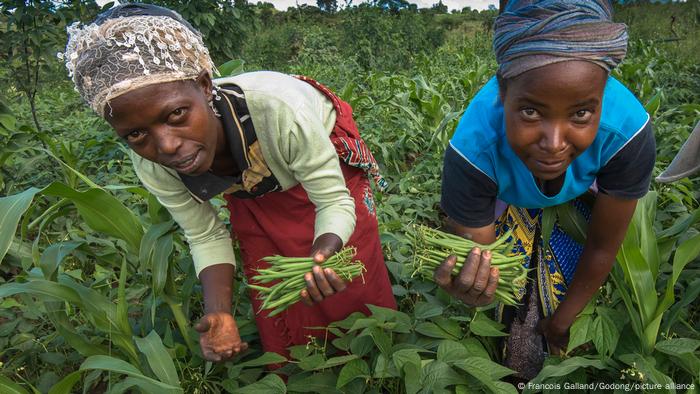
Over 100 Kenyan tobacco farmers took part in a government-backed project to plant sustainable crops instead of the usual tobacco plants. Their first harvest so far already yielded 135 tons of high-iron beans.


Farmers have sold 135 tons of beans to under the World Food Program's regional buying scheme

Some 100 Kenyan farmers were part of a pilot project to help farmers transition from tobacco to alternative food crop farming. The World Health Organization (WHO), the World Food Program (WFP) and the United Nations' Food and Agriculture Organization (FAO) funded the project and helped retrain the farmers.

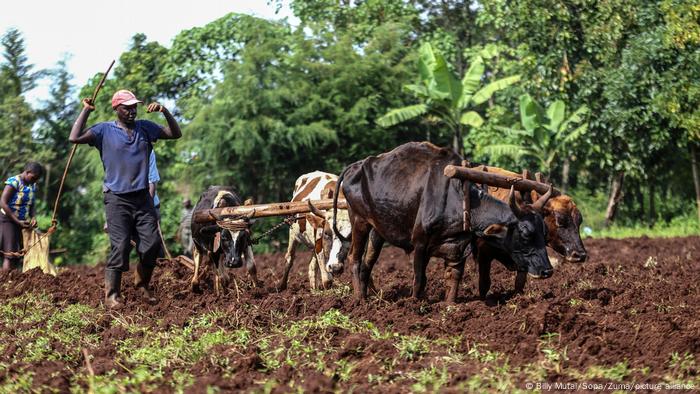
They were given the opportunity to transform their fields from tobacco leaves to a myriad of crops — including corn and sweet potato.

DW's Thelma Mwadzaya, who visited the farms, says she saw sprawling vineyards alongside neatly done homesteads. She attributed it to a sign that "the farmers are living under better living conditions."

"The project in Migori for the tobacco farmers is a major shift towards attaining a healthy nation and the Ministry of Health fully supports such ventures," says Kenya's Health Cabinet Secretary Mutahi Kagwe.


Farmers' health is a major concern for the Kenyan government and the UN agencies
Health hazards and school dropouts

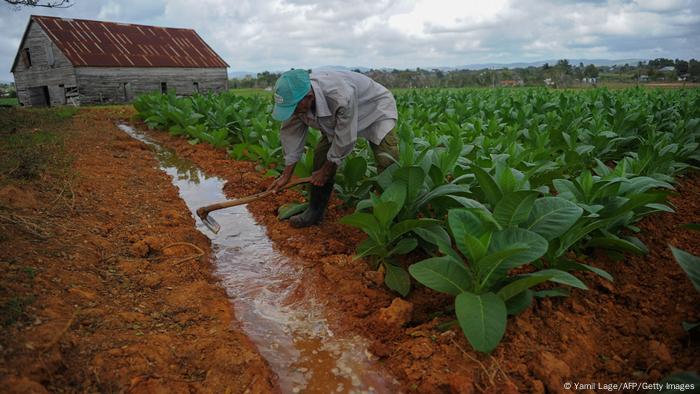
Farming tobacco plants contributed less than 1% to Kenya's economic development. The farmers were further exposed to serious health risks, such as cardiovascular and respiratory diseases, over 20 different types or subtypes of cancer, and many other debilitating health conditions, according to the WHO.

During handwashing of tobacco leaves without protective gloves, farmers expose their skin to the highly-addictive nicotine substance.

The WHO also reports that more than 6,000 Kenyans die of tobacco-related diseases every year. The global annual death toll of 8 million deaths occurs mostly in low and middle-income countries, which are "often the main targets of intensive tobacco industry interference and marketing," according to the global public health institution.

Most of the farmers say they were happy to move away from such health hazards and towards less labor intensive and environmentally friendly farming.

"My teeth have fallen and left me in bad shape," said Patrice Chitang'ita Kisunte, a farmer from Sakuri in Kenya's southwestern Migori county.

"I advised [other farmers] to stop tobacco farming and plant other things like maize, beans and potatoes."

The health of the farmers was one of the major concerns for the Kenyan government and the three United Nations agencies. Another was mass school dropouts among farmers' children.

"When tobacco was being grown actively, there was a lot of school drop outs," says Rose Ghati, a resident and farmer in Kuria.

"They used to leave school because they know that tobacco is there and they can make money off it."

WHERE DO YOUR WINTER ROSES COME FROM?
Bright colors
The homes near Kenya's Lake Naivasha are as colorful as the millions of flowers grown there each year. Known as the "flower bed of Africa," the area north of the country's capital Nairobi, exports cut roses, carnations and other blooms around the world. The industry is central to the country's economy. But it has a dark side too.


Markets for the goods

The UN agencies launched the Tobacco Free Farms project in Migori County with the government of Kenya to mitigate these issues. The collaboration is the first of its kind in the world.

According to the WHO, the project has seen farmers' health improve, increased school attendance amongst children previously working on the farms, and crops which are considered better for the environment replacing tobacco.

"Right now, my kids have time for homework, but during tobacco farming, they did not," said long-time tobacco grower Alice Achieng Obare, one of hundreds of farmers in Migori county who have moved away from tobacco.


Kenya used to be a major export of tobacco leaves

"WFP has provided a ready market for high iron beans, promoted good agricultural practices, nutrition sensitization, and post-harvest loss training," says Simon Cammelbeeck, the managing director of the Farm to Market Alliance, another partner in the project.

Growing beans has the added advantage that they are full of iron, which is said to help counter numerous heath and development problems among children and pregnant women.

"The process used in that project is for the entire value chain, from production of what we call alternative food source to putting food on the table," says Husna Mubarak, a project officer with FAO.

"Most importantly there's technical support, on how to till the land, plant the seeds, and most importantly provide capacity to ensure that you are able to add value to it, package it and be able to market it out."


Watch video04:47
Kenyan farmers embrace organic farming


Knowledge transfer

Kenya had ratified the legally binding WHO Framework Convention on Tobacco Control in 2004 and became the first country in the world to pilot the alternative tobacco project.

"We are encouraging the farmers to farm other cash crops," Elizabeth Robi, assistant chief of the Sakuri area in Kuria East, told DW.

"Most farmers have shifted to coffee. This is because that tobacco was affecting even the person who is not farming through inhaling that smoke. So their health has improved."

The government and the three UN agencies plan to take the knowledge from the pilot project to farmers along the former tobacco belt in Kuria West.

Thelma Mwadzaya in Kenya contributed to this article.

Edited by Keith Walker

THE KANGA: EAST AFRICA'S CULTURAL JEWEL
A rich fashion trend history
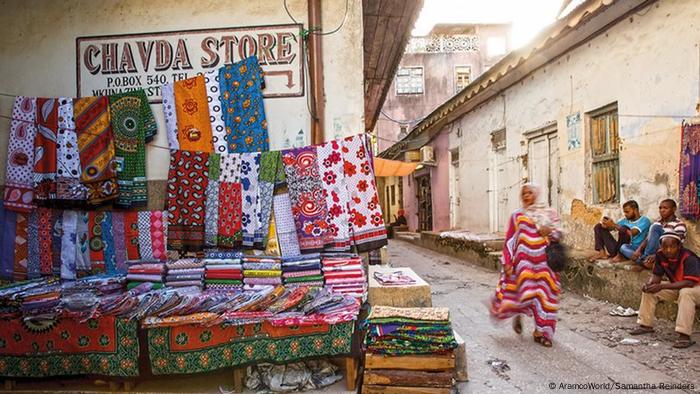
The origin of the kanga can be traced back to coastal East Africa in the mid-19th Century. It is believed that some stylish women in Zanzibar had the idea of buying printed kerchiefs in lengths of six. This was later modified into pairs. They were sewn together into single designs called 'Leso' after the square kerchiefs that had originally been brought to Africa by Portuguese traders.
12345678


DW RECOMMENDS

Good teamwork: How radio stations in Kenya are implementing gender equality


Africa still too reliant on commodities exports, UN says

Nearly 60% of African countries remain dependent on exports of commodities despite decadeslong efforts to diversify. A shift to technology and financial services could help them withstand economic shocks, the UN says.


The United Nations has called for African countries to diversify their economies away from commodities

African countries must break their reliance on commodities exports for economic growth and diversify towards higher-value services, the United Nations warned Thursday.

The call comes as the price of many key commodities — which skyrocketed over the past year to the benefit of many African export-led economies — have begun to cool off.

In its Economic Development in Africa Report 2022, the United Nations Conference on Trade and Development (UNCTAD) urged governments across the continent to boost investments in technology and financial services, among other sectors.

UNCTAD noted that 45 of the continent's 54 countries still remain dependent on agricultural, mining and extractive exports, despite decadeslong efforts to diversify their economies.

'Highly volatile revenues' from commodities

The report said the heavy reliance on commodity exports like oil, gas, minerals, food and agricultural raw materials resulted in ″highly volatile revenues″ for low-income nations due to the ″price boom and bust nature of the market.″

The paper described the so-called ″resource curse,″ where commodities-rich countries tend to have low growth and development outcomes due to the price instability of their exports.

UNCTAD said this vulnerability is ″often amplified″ by geopolitical factors and events like the COVID-19 pandemic and the 2008-9 global financial crisis.

While several African countries have taken steps to boost their services sectors, the UN body noted that they have been mainly focused on transport and tourism, which now makes up to two-thirds of service exports across the continent.

Information technology (IT) and financial services account for just 20% of Africa's services exports, it said.

By moving economic sectors up the value chain, African nations could better weather economic shocks like climate change, future health emergencies, and the food crisis exacerbated by the Ukraine conflict, UNCTAD said.

Africa needs more high-tech investment

″Our latest report focuses on the services sector … particularly enterprises that are high-skilled and high- knowledge, such as fintech, health care technology, logistics technology as well as agriculture and energy [technology],″ Paul Akiwomi, UNCTAD's director for the Division for Africa, Least Developed Countries and Special Programs, told DW.

Akiwomi said investments in new economic areas would also bring benefits to support countries' existing commodity sectors, for example, through new technologies.

"We believe that this can alter the development trajectory of many countries, moving them away from being solely commodity-based to more diverse economies," he added.

He gave the example of Mauritius, which was an agricultural economy with sugar cane as its major export. Over the past 20 years, the Indian Ocean island has diversified its economy and more recently has moved into financial services and fintech, winning substantial investments from India and the United States.


UNCTAD is pushing African nations to create the environment for high-tech startups to thrive

″Now SMEs [small and medium-sized enterprises] account for 40% of GDP and 56% of jobs. So this is a massive shift in the diversification of the economy,″ Akiwomi told DW.

He also noted how Nigeria and Kenya have become major hubs for fintech and health tech startups respectively.

Economic diversification would also help to boost the new middle class in Africa as it would create more high-skilled jobs in operations, finance, engineering and marketing, among others, the UN spokesman said.

However, UNCTAD's report said it was vital that African governments provide adequate regulatory frameworks and financial mechanisms, and called for more innovative financial instruments for local SMEs to secure access to financing.

″The financing of SMEs that are innovative and technology-driven is still a very difficult area in Africa,″ Akiwomi told DW, adding that ″the culture of lending money for an idea is still not there.″

Citing data from the International Finance Corporation, UNCTAD's report noted that Africa's 50 million SMEs have an unmet financing need of $416 billion (€415 billion) every year.

African free trade zone will help growth

The paper described how the African Continental Free Trade Area (AfCFTA), which took effect in 2019 and which aims to create a single market for the continent's 1.4 billion people, will help new sectors thrive by boosting inter-Africa trade.

"AfCFTA allows for scale," Akiwomi said. "Each country will be moving at a different pace and level based on their comparative advantages."

"You have shorter distances between countries, you get access to intermediaries, lower trade costs, access to other services. All of these benefits would allow African countries to transform their economies," he told DW.


A startup in Benin has come up with the Xover COVID infections tracking app

Commodities boom helps but hurts too

Rising commodities prices as a result of supply chain delays in the wake of the COVID-19 pandemic have been a blessing and a curse to many African countries.

While nations have achieved much higher prices for their exports, African consumers and businesses have not escaped the much higher costs of oil, gas, food and fertilizers.

While some financial analysts have declared a new commodity supercycle — a longer era of higher prices for raw materials — prices have already started to moderate in recent months.

The price of copper has since fallen to an 18-month low and oil prices are more than 20% off their recent highs, further boosting the argument for new, more reliable engines of growth.

Edited by: Hardy Graupner
CRIMINAL CAPITALI$M
Amazon offers concessions to end antitrust probe, says EU

Amazon has offered to "refrain" from using the data of competitors after the EU accused the US retail and tech giant of collecting the information to benefit itself at the expense of its rivals.


Amazon aims to end a pair of antitrust investigations with a series of concessions to the EU

Seeking to resolve two European Union antitrust probes, Amazon has offered to stop using data related to its competitors to boost its own retail business, EU regulators said on Thursday.

The EU's competition authority has accused the online giant of using the data to benefit its own retail business, to the detriment of rivals that also sell on its platform.
Amazon to treat sellers equally

With the threat of a multi-billion dollar fine hanging over the online retailer for its data collection practices, an EU statement said Amazon "commits to refrain from using non-public data relating to, or derived from, the activities of independent sellers on its marketplace."

More specifically, Amazon has offered to treat sellers equally when ranking their offers for the "buy box" on its platform, which generates a large portion of its sales.

Amazon will also insert a second buy box for a rival product if it differs considerably in price and delivery from the product in the first box.

Accusations of breaching 'EU antitrust rules by distorting competition'

In November 2020, the bloc's executive branch, the European Commission, released a statement saying it had informed Amazon of its "preliminary view" that it had "breached EU antitrust rules by distorting competition in online retail markets."

The European Commission accused Amazon of "systematically relying on non-public business data of independent sellers who sell on its marketplace, to the benefit of Amazon's own retail business, which directly competes with those third-party sellers."
Under the microscope

Last week Britain's competition watchdog — the Competition and Markets Authority (CMA) — launched an investigation into whether Amazon has been abusing its dominance in the marketplace to undermine rivals.

Thursday's concessional move from Amazon is not the first time it has decided to try to stave off EU sanctions. In 2017, it scrapped some clauses in its distribution deals with European e-book publishers, leading regulators to call off their probe.

In 2019, Amazon restructured its terms of service for third-party merchants and persuaded the German antitrust agency to end its seven-month investigation.

jsi/sms (Reuters, AP, AFP)