It’s possible that I shall make an ass of myself. But in that case one can always get out of it with a little dialectic. I have, of course, so worded my proposition as to be right either way (K.Marx, Letter to F.Engels on the Indian Mutiny)
Saturday, May 30, 2026
EDF and Mistral Partner to Bring Sovereign AI to Nuclear Power
EDF and Mistral AI will collaborate on AI tools designed for EDF’s nuclear operations, including conversational agents that can search technical knowledge from France’s nuclear fleet and construction sites. The tools will support field teams, maintenance operations, engineering work and EPR2 construction activities, while EDF retains ownership of its data.
The agreement underscores France’s push to pair nuclear expansion with domestic AI capabilities and tighter control over strategic industrial data. EDF is preparing its EPR2 reactor program as part of France’s broader nuclear revival, while Mistral has emerged as a flagship European AI company focused on alternatives to U.S. and Chinese platforms. The companies said the systems will be hosted on trusted infrastructure, including sovereign cloud or EDF data centers, reflecting growing concern over data sovereignty in critical energy infrastructure.
The AI tools will not be used in nuclear plant control systems, a key distinction given the safety and regulatory sensitivities around nuclear operations.
Russia and Kazakhstan sign nuclear power plant agreement
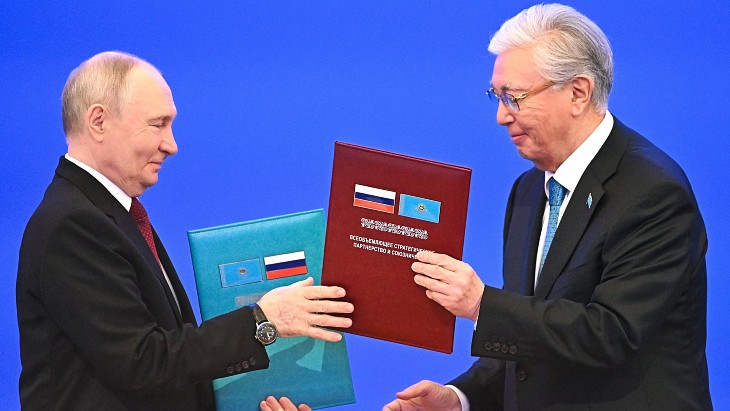
An intergovernmental agreement setting out the key principles - and export loan financing - for Kazakhstan's first nuclear power plant project has been signed during Russian President Vladimir Putin's state visit to the country.
A number of bilateral agreements have been signed during the presidential visit (Image: Kremlin.ru)
Following talks between the two presidents, a list of agreements signed by the two countries was published, including one "on the basic principles and conditions of cooperation on the project to build a nuclear power plant on the territory of the Republic of Kazakhstan".
Another agreement was "on the provision to the Government of the Republic of Kazakhstan of a state export loan to finance the construction of a nuclear power plant on the territory of the Republic of Kazakhstan".
A third nuclear-related agreement was on an action plan "in the field of interdepartmental cooperation in the field of nuclear and radiation safety regulation for 2026-2030".
Russia's state nuclear corporation Rosatom said the intergovernmental agreement "defines the key parameters of the nuclear power plant construction project. Specifically, it concerns the construction of two Russian-designed power units with VVER-1200 reactors based on best Russian practices. The document covers key areas of cooperation during the NPP's operational life, including maintenance and fuel supply".
Rosatom Director General Alexey Likhachev and Almasadam Satkaliyev, Chairman of Kazakhstan's Atomic Energy Agency, signed the agreements in the presence of the presidents.
Further details of the financing was not included in the official announcements, although the official news agency Kazinform said that preliminary estimates put the cost of the two units at about USD14.4 billion with another USD2 billion earmarked for physical security systems and social infrastructure. It quoted Satkaliyev as saying the export loan had "very favourable terms for Kazakhstan". It also reported that the construction start was targeted for 2027, and the aim was for operation of the first unit in 2034.
In their comments after their talks and the signing of the agreements, Kazakhstan's President Kassym-Jomart Tokayev said: "There's every reason to single out energy as a very successful area of cooperation. In my view, the agreement signed today on the construction of the Balkhash Nuclear Power Plant is of exceptional significance.
"I express my gratitude to the President of the Russian Federation for his personal and decisive support in launching this large-scale project, which will become a driving force for scientific, educational, and technological collaboration and will ensure the development of new related energy sectors and industry as a whole."
President Putin called it "a flagship project in the field of peaceful nuclear energy" and said "the commissioning of the plant will make a significant contribution to the energy supply of the Kazakh economy, helping to provide businesses and households with affordable and clean energy".
He added: "I would like to point out that, as we agreed with the President of Kazakhstan, we are not simply talking about the creation of a nuclear power plant or construction; we are talking about the creation of an entire industry, including education, personnel training, and so on."
Background
Kazakhstan is the world's leading producer of uranium. Although it does not currently use nuclear energy, it is not without nuclear experience: it has three operating research reactors, and a Russian-designed BN-350 sodium-cooled fast reactor operated near Aktau for 26 years, until 1999.
Kazakhstan has been preparing for a possible nuclear power programme to reduce its reliance on fossil fuels, diversify its energy mix and reduce CO2 emissions for some time. Kazakhstan Nuclear Power Plant (KNPP), a subsidiary of Kazakhstan's Samruk-Kazyna National Welfare Fund JSC, was set up in 2014. In a referendum in 2024 more than 70% of the 7.8 million people who voted answered 'yes' to the question: "Do you agree with the construction of a nuclear power plant in Kazakhstan?"
Floating nuclear power plants 'realistic' for Greece
The report by the Deon Policy Institute think-tank identified no fundamental barriers to the implementation of floating nuclear power plants in Greece, although policy, regulatory, financial and social acceptance issues still need to be overcome.
(Image: Deon Policy Institute)
The study derives its policy insights from a research programme conducted by CORE POWER, Athlos Energy - a Greek nuclear company founded in 2024 - and the American Bureau of Shipping. The research, stemming from a two-day workshop held in Athens last October, focused on discussions to assess the political, economic, social, technological, legal and environmental factors that would shape the potential deployment of floating nuclear power plants - or FNPPs - in a European country such as Greece. This is also known as a PESTLE framework.
Greece has historically not deployed nuclear power, but in March this year, Prime Minister Kyriakos Mitsotakis announced at the 2nd Nuclear Energy Summit in Paris that it would examine the potential role of small modular reactors in its energy mix and establish a dedicated ministerial committee to submit proposals to the government, Deon said.
"Given Greece's long maritime heritage, developed port infrastructure and reinvigorated shipbuilding industry, the potential for deploying FNPPs warrants consideration. FNPPs are also compatible with Greece’s geography and energy markets, given the large number of inhabited islands, the increasing need for desalination and the country’s climate goals," it added.
Policy, legal and regulatory frameworks in Greece do not yet substantively address nuclear energy or FNPP deployment, reflecting a broader gap in European energy and maritime policy discussions, the study finds. But no fundamental barriers to implementation were identified, "suggesting that the challenge is not one of feasibility, but of framework development".
The study notes a need for clearer assessment and regulatory pathways, including coordination across maritime, nuclear and energy authorities, and - while FNPPs are perceived positively - social acceptance of nuclear energy remains low in Greece compared with other countries, implying a need for further education and engagement with both the broader public and key stakeholders.
The combined PESTLE analysis shows that FNPPs should not be seen as a standalone energy project, but a complex strategic choice with public-policy impact, the report notes. The strongest arguments in favour of deploying FNPPs in Greece are primarily environmental and political, as they are directly linked to strengthening the country’s energy autonomy, it concludes, although "critical questions remain open" on financing and economic viability of the technology within the Greek context.
Similarly, while technical obstacles exist, these are mainly due to Greece's limited domestic nuclear experience. The "most decisive barriers are institutional and temporal. This can be attributed to the lack of enduring political commitment, incomplete regulatory and institutional preparation, and insufficient engagement with society".
The report calls for "systematic, coordinated action and credible communication, through which Greece can leverage international experience, gradually develop its own nuclear programme, and implement it through maritime applications that demonstrate higher levels of social and political acceptance", it says, adding that "FNPPs can represent a realistic option for Greece only as the result of a gradual, institutionally organised, and socially prepared strategy".
"This PESTLE study shows that Floating Nuclear Power Plants are not a distant or purely theoretical option for Greece," George Laskaris, President of Deon Policy Institute, said. "No fundamental technical or institutional barriers were identified; the real challenge is building the policy, regulatory, financial and social foundations needed for responsible assessment. For Greece, FNPPs sit at the intersection of energy security, decarbonisation, maritime capability and industrial policy."
In June last year, Russia's Rosatom was selected as the leader of an international consortium to build Kazakhstan's first planned nuclear power plant - to be called the Balkhash plant - in the village of Ulken, in Zhambyl district, on the shore of Lake Balkhash. China National Nuclear Corporation is lined up to build a second one, at a site also in the Zhambyl district, adjacent to the site selected for the first plant, as well as a third plant, Kazinform News Agency reported last July.
The government has set a target for nuclear to produce a 5% share of the national generation mix by 2035.
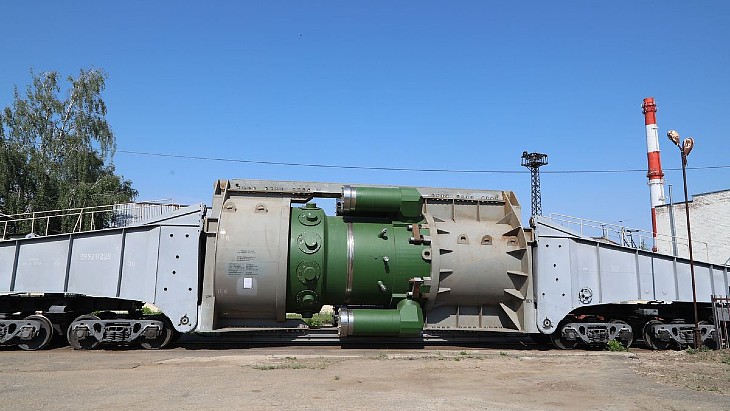
First RITM-200 reactor unit manufactured for floating nuclear plant
The RITM-200C reactor will be one of two which will together be installed on the first of Russia's planned fleet of floating nuclear power units.
(Image: Rosatom)
The 58 MWe capacity reactor unit has been manufactured by Rosatom's Machine-Building division at the ZiO-Podolsk plant near Moscow.
Serial production of the floating power units (FPU-106) is under way to power a copper mining industrial cluster in the Chukotka Autonomous Okrug. This will be the first such project to provide carbon-free energy for industrial production, with four floating power units earmarked for it.
Alexey Likhachev, Director General of Rosatom, said: "Rosatom continues to expand its range of floating power units, and the completion of the first reactor for the lead floating nuclear power unit is a significant milestone. Today, Russia is the only country with an operating floating nuclear power plant, and we intend to maintain our leadership in the development of small-scale technologies, offering innovative and low-carbon energy solutions to our partners in Russia and abroad."
The RITM-200C is a modification of the RITM-200 reactors in operation on the latest series of nuclear-powered icebreakers. In total, Rosatom's Machine-Building division is in various stages of producing 14 RITM-200-based reactor units for icebreakers and floating power units.
Russia's first floating nuclear power plant, the Akademik Lomonosov, has been operating in Chukotka since 2020. During this time, it has generated more than 1.2 billion kWh of electricity and avoided more than 400,000 tonnes of greenhouse gases, Rosatom said.
The state nuclear corporation says that the RITM-200 reactors have proved their effectiveness in Arctic conditions. It says that, in floating power units, they will be able to effectively address current or potential energy shortages in remote, offshore areas. As well as producing floating power units for domestic use, Russia also sees considerable export potential.
According to past presentations, the FPU-106 units would provide 106 MWe, the refuelling interval would be every 5 to 7 years, and there would be a service life of about 40 years. A version of a floating power unit targeting international markets would be 100 MWe with a refuelling interval of 10 years and a service life of 60 years.
'Largest ever shipment' for a single nuclear plant
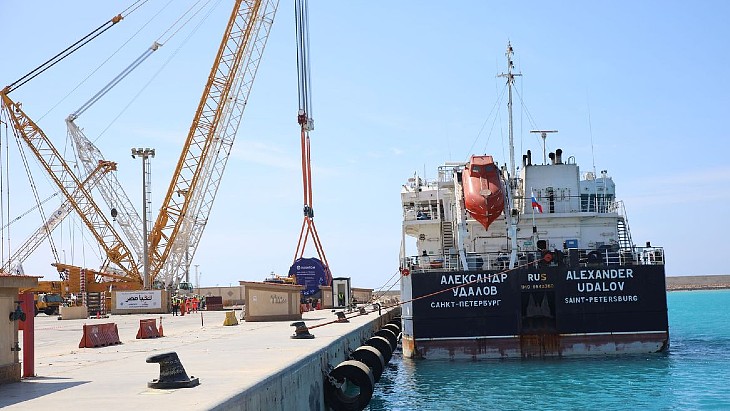
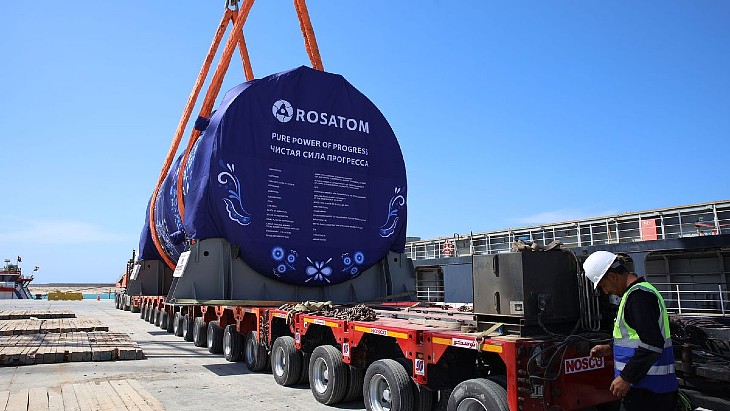
A reactor pressure vessel, four steam generators and a pressuriser, have been shipped together from Volgodonsk in Russia to Egypt's El Dabaa Nuclear Power plant.
(Image: Rosatom)
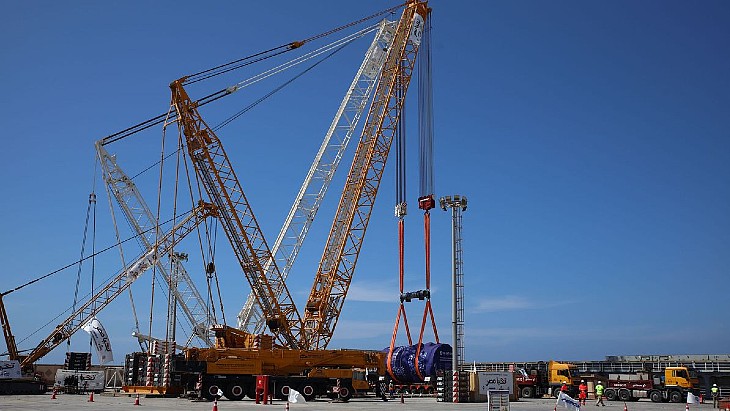
In addition to the 330-tonne reactor vessel for El Dabaa’s second unit, the other equipment - including the pressuriser for unit 1 - pushed the total cargo weight up to about 2,000 tonnes.
The items were manufactured at the Atomash plant in Volgodonsk in Russia's Rostock Region and delivered on the Alexander Udalov, a vessel designed for both river and maritime transport. This enabled the equipment to be delivered directly from the plant's pier to the specially constructed port at the El Dabaa NPP construction site.
Lifting the equipment is a high-precision operation (Image: Rosatom)
The cylindrical steel reactor pressure vessel, with an initial service life of 60 years, with the possible extension to 80 years, houses the reactor core and ensures a hermetic seal and withstands high pressures and temperatures, ensuring the safety and reliability of the power unit.
It had a special 500-square-metre cover for its journey, comprimising two layers, a special canvas one to protect it from moisture during transport and a second, decorative, outer layer.
(Image: Rosatom)
According to Russia's state nuclear corporation Rosatom, "this shipment was the largest ever for a single nuclear power plant".
Alexey Likhachev, Rosatom Director General, said: "The equipment shipped to the El Dabaa NPP is essential for the transition to start-up operations for the first power unit and for the peak construction of the second power unit."
Minister of Electricity and Renewable Energy Mahmoud Esmat attended the unloading of the cargo at El Dabaa’s port. According to Egypt's Nuclear Power Plant Authority, he said the project was central to the national energy strategy, praised the strategic relations between Egypt and Russia, and added that the El Dabaa plant project was being implemented according to the timetable, including an increase in training programmes to prepare for future operation of the plant.
Background
El Dabaa will be Egypt's first nuclear power plant, and the first in Africa since South Africa's Koeberg was built nearly 40 years ago. The Rosatom-led project, about 320 kilometres north-west of Cairo, will comprise four VVER-1200 units, like those already in operation at the Leningrad and Novovoronezh nuclear power plants in Russia, and the Ostrovets plant in Belarus.
Under the 2017 contracts, Rosatom will not only build the plant, but will also supply Russian nuclear fuel for its entire life cycle, including building a storage facility and supplying containers for storing used nuclear fuel. It will also assist Egyptian partners in training personnel and plant maintenance for the first 10 years of its operation. Rosatom said last month that it is aiming for a future service life of 100 years for nuclear power plants.
The four units are being built almost concurrently, with first concrete at unit 1 in July 2022, followed in turn by the others, concluding with first concrete at unit 4 in January 2024. The reactor pressure vessel was delivered in October 2025 and installed in El Dabaa's first unit the following month, following a ceremony which included speeches from the Egyptian and Russian presidents.
Egypt's aim is for 9% of electricity to be generated by nuclear by 2030, which would be achieved by the commercial operation of the first two units by that time, directly displacing oil and gas.
Energoatom gets operating licence for centralised fuel storage facility
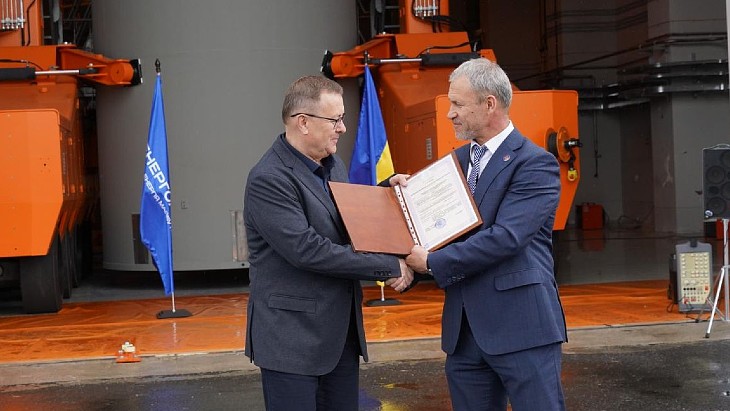
The official licence for the operation of the Centralised Spent Nuclear Fuel Storage Facility has been handed over by the State Nuclear Regulatory Inspectorate of Ukraine to Energoatom.
(Image: Energoatom)
The Centralised Spent Nuclear Fuel Storage Facility, located in the Chernobyl Exclusion Zone, is a dry storage site for used nuclear fuel assemblies from the country's VVER-1000 and VVER-440 reactors. It is designed to have a total storage capacity of 16,530 used fuel assemblies, including 12,010 VVER-1000 assemblies and 4520 VVER-440 assemblies. Contracts were signed for its construction with USA-based Holtec International in 2005, though construction only began in 2017.
It started receiving used nuclear fuel from the country's nuclear power plants at the end of 2023 and it has been operating under a commissioning licence. The decision to issue a licence followed examination of the detail of the application and an inspection carried out from 20 April to 1 May.
Head of the State Nuclear Regulatory Inspectorate of Ukraine (SNRIU) Oleg Korikov said: "Issuing a licence for the 'nuclear facility operation' life cycle stage of the … facility means the completion of the process of creating our own system for safe management of used nuclear fuel in Ukraine. It is important that the operation of the Central Spent Nuclear Fuel Storage Facility will ensure compliance with nuclear and radiation safety requirements, as well as IAEA standards. According to them, the reactor holding pools of each reactor facility must have free volume for complete unloading of the core at any time during operation. I congratulate you on this event and wish you trouble-free operation."
Pavlo Kovtonyuk, Acting Chairman of Energoatom, said: "Obtaining a licence to operate the Central Spent Fuel Storage Facility confirms the ability of the Ukrainian nuclear industry to implement large-scale and technologically complex projects in accordance with the highest global safety standards. The operation of the storage facility over the next 100 years strengthens the energy sustainability of Ukrainian nuclear generation, guarantees reliable management of spent nuclear fuel, and provides the state with a significant economic effect."
Energoatom says that the new facility will save USD200 million a year which it previously had to pay for the used fuel to be transported and stored in Russia. It will also avoid the risk of having to interrupt operation of plants because of a lack of capacity to safely store used fuel.
Nineteen years on, companies team up for US new-build project
Fulcrum Point Holdings and Blue Castle Holdings have formed a joint venture to take Blue Castle's project to build a nuclear power plant at Green River in Utah through the next stages of site development, licensing, and eventual reactor deployment, using Holtec International's SMR-300 small modular reactor technology.
A rendering of a Holtec SMR-300 using air-cooled condenser technology (Image: Holtec International)
Fulcrum Point is an affiliate of Utah nuclear services company Hi Tech Solutions. Last year, Hi Tech Solutions signed a strategic cooperation agreement with Holtec International and the State of Utah covering collaboration to support the deployment of Holtec's SMR-300 in Utah and the broader Mountain West region.
The Green River site has previously undergone extensive technical and environmental analysis, including meteorological and seismic data collection, core boring, geophysical surveys, groundwater monitoring, ecological studies, and bathymetry work, Blue Castle said, and the project also benefits from existing water rights, access to the road and rail networks, and multi-market transmission opportunities.
The project to build the nuclear power plant at Green River was first proposed by Transition Power Development in 2007 - project activities and management were consolidated by Transition Power Development into Blue Castle Holdings in 2009. By 2011, Blue Castle Holdings had already begun pre‐application activities with the US Nuclear Regulatory Commission (NRC) on an Early Site Permit (ESP) for the site, located about five miles west-northwest of Green River in Emery County. In 2014, Blue Castle Holdings signed a memorandum of understanding with Westinghouse to pursue the development of a two-unit AP1000 plant at the site: at that time, it said it anticipated submitting an ESP application in 2016.
Fulcrum Point and Blue Castle said they will now work together to move the project from its current stage through the federal licensing process and towards reactor deployment, with SMR technology and equipment to be provided by Holtec International.
"Blue Castle's focus from the beginning has been to create exactly this kind of opportunity with a company like Fulcrum Point," the company's CEO, Aaron Tilton, said. "Over the past 19 years, Blue Castle has laid the groundwork to de-risk a site for the deployment of nuclear power, creating significant value for future energy development that can serve energy demand across Utah and the surrounding region, as well as potential on-site, behind-the-meter opportunities for advanced technology applications. We appreciate the collaborative effort with Emery County and the City of Green River to create high-value jobs and meaningful economic impact in rural Utah."
Utah initiatives
In 2024, Utah Governor Spencer Cox launched an initiative, Operation Gigawatt, to double Utah's power production over the next 10 years. In November last year, Cox unveiled a project in partnership with Hi Tech Solutions and Holtec International to site a manufacturing hub in Brigham City to produce parts for SMR-300 and other advanced nuclear technologies, as well as a workforce training centre, as part of a longer-term plan to deploy a fleet of SMR reactors in Utah and then across the Mountain West region.
Holtec's SMR-300 is a pressurised water reactor producing about 300 MW of electrical power or 1050 MW of thermal power for process applications. The company is planning to deploy two SMR-300 reactors at the Palisades Nuclear Generating Station site in Michigan, demonstrating viability for additional orders both domestically and abroad. The reactor is designed to be able to operate using air-cooled condensers, and this flexibility is an attractive feature in arid environments like Utah, where water resources are scarce.
"With Holtec's restart of Palisades Nuclear plant in Michigan ongoing, and the first Holtec SMR-300s, Pioneer 1 and 2, in the NRC licensing process and early site preparation, the work by our partners to acquire sites for next-of-kind deployment in Utah is paramount to our Mountain West expansion strategy as part of Operation Gigawatt," Holtec International President Rick Springman said. "Supply chain development follows reactor deployments, making the advancement of this project crucial to downstream supply chain investments in the state across the nuclear ecosystem."
The project is part of a broader portfolio of energy development projects being advanced by Fulcrum Point, which was formed by Hi Tech Solutions founder Chris Hayter, to develop nuclear power projects across the Mountain West.
"Fulcrum Point is stepping into this project as a true development partner to help move the Blue Castle Project from years of groundwork into the next phase of execution," Hayter said. "Blue Castle has done important work to position this site for success, and we now bring the technical, operational, and project development capabilities needed to help advance it through licensing, deployment planning, and eventual construction. This project has the potential to strengthen Utah's energy future, support rural economic growth, and deliver reliable power for decades to come."
Decommissioning milestone reached at Trawsfynydd
Nuclear Restoration Services has announced the completion of a 20-year project to remove all the remaining intermediate-level radioactive waste from the shut-down Trawsfynydd nuclear power plant in Gwynedd, North Wales, UK.
(Image: NDA)
The 392 MWe Trawsfynydd Magnox nuclear power plant - the only inland nuclear power station in the UK - began operation in 1965 and was retired in 1991, with defueling completed by 1997. Since generation stopped, the site has focused on safely managing the legacy left behind, with much of the effort centred on reducing risk and preparing the site for long term decommissioning. In July 2020, the Nuclear Decommissioning Authority (NDA) announced its intention to pursue a rolling programme of decommissioning aimed at accelerating Magnox reactor sites decommissioning with Trawsfynydd identified as the 'lead and learn' site.
NDA subsidiary Nuclear Restoration Services (NRS) has now announced the completion of the Higher Activity Waste (HAW) programme. This work, which took 20 years to complete, focused on the safe management and storage of radioactive waste left behind from operations. The programme focused on the highest waste that remained on site, categorised as intermediate-level waste - a mid-range category of radioactive waste which is more active than everyday low-level waste, but not as hazardous as high-level waste.
It involved retrieving legacy material, processing it safely and placing it into secure long-term storage on site. In total, almost 2,300 individual waste packages were completed, representing a significant delivery achievement and the removal of the site's hazards.
The final waste package has now been transferred into storage, bringing the long‑running campaign to a close. Along the way, teams developed practical and innovative ways of working to safely retrieve the waste. This included using a robotic arm to remove material from deep storage areas and specialist vacuum equipment to collect fine dust and small fragments.
NRS said learning from this work was shared with other sites across the country, helping to improve efficiency, reduce costs and support delivery across the wider decommissioning programme.
"This is not just the end of a major programme, it is the end of an era," said NRS CEO Rob Fletcher. "Completing this work safely and successfully has allowed Trawsfynydd to move into its next phase of delivery, reducing the height of the reactors by almost half. This will create the most noticeable change to the landscape in decades."
NRS Trawsfynydd Site Director Tom Williams added: "Bringing the HAW programme to a close is a remarkable achievement for everyone at Trawsfynydd. Its completion represents a key delivery milestone in our decommissioning mission; one we can look back on with pride whilst also looking forward with excitement to the start of our new major projects."
In October last year, infrastructure solutions company Costain was awarded a GBP70 million (USD94 million) contract to reduce the height of the two reactor buildings at Trawsfynydd from about 54 metres to 25 metres. That project is expected to take up to four years to be completed.
Construction starts for Shin Hanul 4
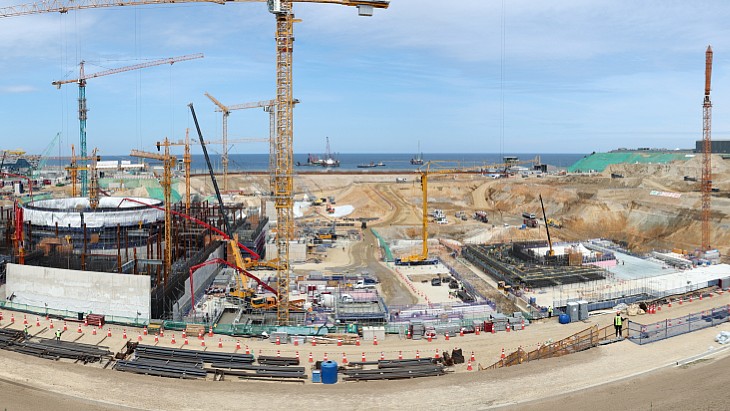
First concrete has been poured for the reactor building of South Korea's Shin Hanul nuclear power plant's unit 4, marking the official start of construction.
Construction work is under way on both Shin Hanul 3 and 4 (Image: KHNP)
Korea Hydro & Nuclear Power said the initial pouring of concrete for the foundation began on 29 May. Construction permits for Shin Hanul units 3 and 4 - APR1400 units - were issued in September 2024, with first concrete poured for unit 3 in May 2025.
Kim Hoe-cheon, KHNP President, said: "Shin Hanul Units 3 and 4 are a solid foundation that will support Korea’s energy future, just like the concrete being constructed now. Let us build world-class nuclear power plants with safety as our top priority, with a sense of mission to contribute to achieving the national carbon neutrality goal."
KHNP said that Shin Hanul 4 is targeted for completion in 2033, with unit 3 scehduled for operation a year earlier. Once both units are completed it says they are expected to supply 46% of the annual power requirements of the Gyeongbuk region.
Background
In November 2014, KHNP signed an agreement with Ulchin County to build Shin Hanul 3 and 4. The company applied for a construction licence for the units in January 2016. Site preparation for the two units was originally scheduled to begin in May 2017, with commercial operation of unit 3 scheduled for December 2022, with unit 4 following a year later.
However, KHNP announced in May 2017 that it had instructed Kepco Engineering & Construction - which signed a design contract in March 2016 - to suspend work for the planned units as a result of the then new President Moon Jae-in's policy of phasing out nuclear power. Work towards licensing the new units continued.
President Yoon Seok-yeol - who assumed power in May 2022 - reversed the former president's policy of phasing out nuclear power. Preparatory groundwork began for the construction of the two APR1400s following the approval by the South Korean government of the project's implementation plan in June 2023. This effectively approved 20 licensing and permitting procedures under the jurisdiction of 11 ministries required for the construction of nuclear power plants.
In March 2023, KHNP and Doosan Enerbility signed a KRW2.9 trillion (USD2.2 billion) contract for the supply of the main equipment for Shin Hanul 3 and 4. Under the contract - which will run for 10 years - Doosan Enerbility will supply the nuclear reactors, steam generators and turbine generators for the two APR1400 units.
South Korea has four operational APR1400 units - Saeul units 1 and 2 (formerly Shin Kori 3 and 4) and Shin Hanul units 1 and 2. Two further APR1400s are under construction as Saeul units 3 and 4. Four APR1400 units have also been built at the Barakah nuclear power plant in the UAE, which are all now in commercial operation.
_68931.jpg)
_87383.jpg)
_93956.jpg)

No comments:
Post a Comment