Thursday, January 05, 2023

After hurricanes, Florida neighborhoods see steady housing demand, wealthier residents

A new peer-reviewed study finds that, between 2000 and 2016, communities hit by hurricanes see no long-term change in housing demand—but that wealthier residents move in in the years immediately following a storm

Peer-Reviewed Publication

RESOURCES FOR THE FUTURE (RFF)

A new peer-reviewed study, which analyzes Florida housing markets battered by hurricanes, finds that affected areas tend to gentrify slightly in the years following a storm: the average income of new buyers increases while long-term demand stays stable.

The authors of the paper—who are based at Resources for the Future (RFF), the University of California San Diego, and the US Government Accountability Office—use data from county tax assessments, the National Oceanic and Atmospheric Administration (NOAA), and Zillow to gauge conditions of the housing markets and population turnover in Florida from 2000 to 2016.

The finding that housing demand didn’t decrease—and, perhaps counterintuitively, attracted wealthier inhabitants—was particularly surprising to the authors, especially given Florida’s reckoning with hurricane adaptation and resilience measures in the face of climate change.

“Hurricanes are projected to get stronger,” coauthor and RFF Fellow Yanjun (Penny) Liao said. “Our findings show that the idea that people will naturally retreat from hazardous areas may not necessarily hold up. In Florida, at least, it appears that market forces are not encouraging people to move to safer places.”

The authors find that hurricanes cause a temporary increase in home prices, likely due to the sudden decrease in housing supply from storm losses. However, they find that prices subside to baseline levels after an average of three years, which is approximately how long it takes for areas to build up housing stock to pre-storm levels. But during those pivotal three years when housing prices are higher than normal, the authors note several important tendencies:

  • In the three years following a hurricane, the average income of new buyers increases proportionally to the rise in home prices. By the time prices stabilize, more than a quarter of all homes are occupied by households with a higher income than before the hurricane arrived.
  • Home prices in hurricane-ravaged areas are 5 percent higher on average than unaffected ones during the three years following a hurricane. After three years, prices return to—but do not drop below—pre-storm levels.
  • There is no significant change to the socio-demographic characteristics of neighborhoods after a hurricane other than income.
  • Hurricanes do not fundamentally change the long-run demand for housing in affected areas.

One hypothesis for the gentrification phenomena is that wealthier households may move into communities at a higher rate following a storm because they have a greater ability to both absorb the temporary price increase and any insurance cost increases.

"In some ways, this indicates a market flaw given the current state of the climate,” said coauthor Joshua Graff Zivin of the University of California San Diego. “Policies may be needed to ensure that these communities have strong adaptation and mitigation measures in place to deal with future storms.”

The findings in this study are something that the National Flood Insurance Program (NFIP) and federal disaster assistance programs could find useful. Gentrification in Florida could lead to higher post-hurricane insurance claims from the NFIP, which could place a heavier burden on federal taxpayers, who back the program. In addition, federal spending in disaster assistance could also increase as a result.

The authors note that future research should examine the equity implications of post-hurricane housing markets, particularly in the context of fluctuating housing prices and options available to lower income buyers and renters in the years following a hurricane.

For more, read the Journal of Environmental Economics and Management article, “How Hurricanes Sweep Up Housing Markets: Evidence from Florida,” by Joshua Graff Zivin of the University of California San Diego, Yanjun (Penny) Liao of Resources for the Future, and Yann PanassiĆ© of the US Government Accountability Office.

Researchers detect fluoride in water with new simple color change test

Test is first to use artificial cell sensors to detect environmental contaminant

Peer-Reviewed Publication

NORTHWESTERN UNIVERSITY

Cell-free biosensors 

IMAGE: DIAGRAM OF CELL-FREE BIOSENSOR view more 

CREDIT: LUCKS/KAMAT; NORTHWESTERN UNIVERSITY

Environmental contaminants like fluoride, lead and pesticides exist all around and even within us. While researchers have simple ways to measure concentrations of such contaminants inside lab environments, levels are much more difficult to test in the field. That’s because they require costly specialized equipment.

Recent efforts in synthetic biology have leveraged cellular biosensors to both detect and report environmental contaminants in a cost-effective and field-deployable manner. Even as progress is being made, scientists have struggled to answer the question of how to protect sensor components from substances that naturally exist in extracted samples.

A cross-disciplinary team of synthetic biologists at Northwestern University is developing a sensor platform that will be able to detect a range of environmental and biological targets in real-world samples. Using an established riboswitch to build a biosensor for fluoride, the team found they could both protect the sensor and operate similarly to the way cells do by encapsulating the sensor inside a fatty membrane.

In a new paper published today (Jan. 4) in the journal Science Advances, researchers demonstrated that by modifying the makeup and penetrability of the lipid bilayer membrane, they could further tune and control the performance of their sensor.

“So much data is being generated, and a lot of it is being driven by health apps like smart watches,” said Julius Lucks, a co-corresponding author and professor of chemical and biological engineering at Northwestern’s McCormick School of Engineering. “We can sense our heartbeat, our temperature, but if you think about it, we really have no way to sense chemical things. We’re living in an information age, but the information we have is so miniscule — chemical sensing opens enormous dimensions of information that you can tap into.”

Lucks is also the associate chair of the chemical and biological engineering department. His lab has advanced the field’s understanding of molecular systems that respond to environmental changes by studying RNA and its role in cells; how RNA is used by cells to sense changes in their environment; and how these concepts can be used within cell-free systems to monitor the environment for health and sustainability.  

Cell-free synthetic biology, in which engineered biomolecular systems are used to activate biological machinery rather than living cells, is compelling because it is efficient, versatile and low-cost. Lucks designed a riboswitch sensor using bacterial cell extracts to power gene expression reactions (including fluorescent RNA or protein that lights up in response to contaminants) that produce visual outputs cheaply and within minutes.

Neha Kamat, an assistant professor of biomedical engineering within McCormick and a co-corresponding author, originally met Lucks at their faculty orientation and was interested in his desire to expand access to information. Kamat, whose expertise is in engineered membranes and membrane assembly, wondered if she could make Lucks’s test tube system better using a vesicle, a membrane with two layers.  

“They’re using RNA and its associated machinery to sense molecules in real water samples and generate meaningful outputs,” Kamat said. “My lab works a lot with the lipids commonly used to encapsulate mRNA for drug delivery, with the goal of using these compartments to build more cell-like structures. We had the idea that we could protect Julius’s switches and allow them to work in samples that might be kind of dirty with other contaminants, like a cell can.”

Other researchers have tried to place a sensor inside a membrane, but the switch stopped working properly and produced a much smaller signal because it’s difficult to fit everything within the small container and then scale it up. To overcome this, the team modified the genetic output in the sensor to amplify and color it, so it’s visible by eye and “you don’t need a fancy detector to do it,” said Lucks.

Encapsulation and protection are important to the sensor to make it function in native environments, like a wastewater channel with lots of other contaminants to erode the switch. This would be an example of “distributed sensing,” which could aid in fields from agriculture to human health.

The group came together more officially when they received Northwestern’s Chemistry of Life Processes Institute’s (CLP) Cornew Innovation Award by pitching their “potentially disruptive” idea to the CLP’s advisory board. The team earned seed funding to get their idea off the ground.

Lucks calls this project a “jumping off point” from which they will be able to embed sensors into more materials, including “smart” materials that can change properties, as in biology.

“As synthetic biologists, one of our major themes is identifying challenges and looking to nature,” Lucks said. “What is it doing already? Can we build off that and make it do more to meet our needs?”

Fluoride became an obvious choice because there’s a natural RNA molecule that senses it, allowing the team to design a simpler mechanism. But in the future, Kamat and Lucks have high ambitions about where use of the sensors can expand.

For example, the sensors could flow through the human body to detect small molecules and biomarkers before the sensor is retrieved through urine or another passive method. It could also detect levels of nitrate in soil and aid in monitoring run-off. Beyond that, Lucks and Kamat are excited to see uses within materials science such as soft robotics, thinking about how to build something akin to a butterfly that smells through its feet.

The paper, “Robust and tunable performance of a cell-free biosensor encapsulated in lipid vesicles,” was supported by the CLP, the National Science Foundation (grant numbers 1844219, 1844336 and 2145050) and the U.S. Department of Defense National Science and Engineering Graduate Fellowship. Margrethe A. Boyd and Walter Thavarajah (of Northwestern) were also co-authors on the study.

Disclaimer: AAAS and EurekA

Climate warming reduces organic carbon burial beneath oceans

Painstaking study of 50-plus years of seafloor sediment cores has surprise payoff

Peer-Reviewed Publication

RICE UNIVERSITY

JOIDES Resolution 

IMAGE: THE JOIDES RESOLUTION IS A SCIENTIFIC RESEARCH VESSEL OPERATED BY TEXAS A&M UNIVERSITY FOR THE INTERNATIONAL OCEAN DISCOVERY PROGRAM THAT DRILLS INTO THE OCEAN FLOOR TO COLLECT AND STUDY CORE SAMPLES. view more 

CREDIT: COURTESY OF THE INTERNATIONAL OCEAN DISCOVERY PROGRAM

HOUSTON – (Jan. 4, 2023) – An international team of scientists painstakingly gathered data from more than 50 years of seagoing scientific drilling missions to conduct a first-of-its-kind study of organic carbon that falls to the bottom of the ocean and gets drawn deep inside the planet.

Their study, published this week in Nature, suggests climate warming could reduce organic carbon burial and increase the amount of carbon that’s returned to the atmosphere, because warmer ocean temperatures could increase the metabolic rates of bacteria.

Researchers from Rice University, Texas A&M University, the University of Leeds and the University of Bremen analyzed data from drilled cores of muddy seafloor sediments that were gathered during 81 of the more than 1,500 shipboard expeditions mounted by the International Ocean Discovery Program (IODP) and its predecessors. Their study provides the most detailed accounting to date of organic carbon burial over the past 30 million years, and it suggests scientists have much to learn about the dynamics of Earth’s long-term carbon cycle.

“What we’re finding is that burial of organic carbon is very active,” said study co-author Mark Torres of Rice. “It changes a lot, and it responds to the Earth's climatic system much more than scientists previously thought.”

The paper’s corresponding author, Texas A&M oceanographer Yige Zhang, said, “If our new records turn out to be right, then they’re going to change a lot of our understanding about the organic carbon cycle. As we warm up the ocean, it will make it harder for organic carbon to find its way to be buried in the marine sediment system.”

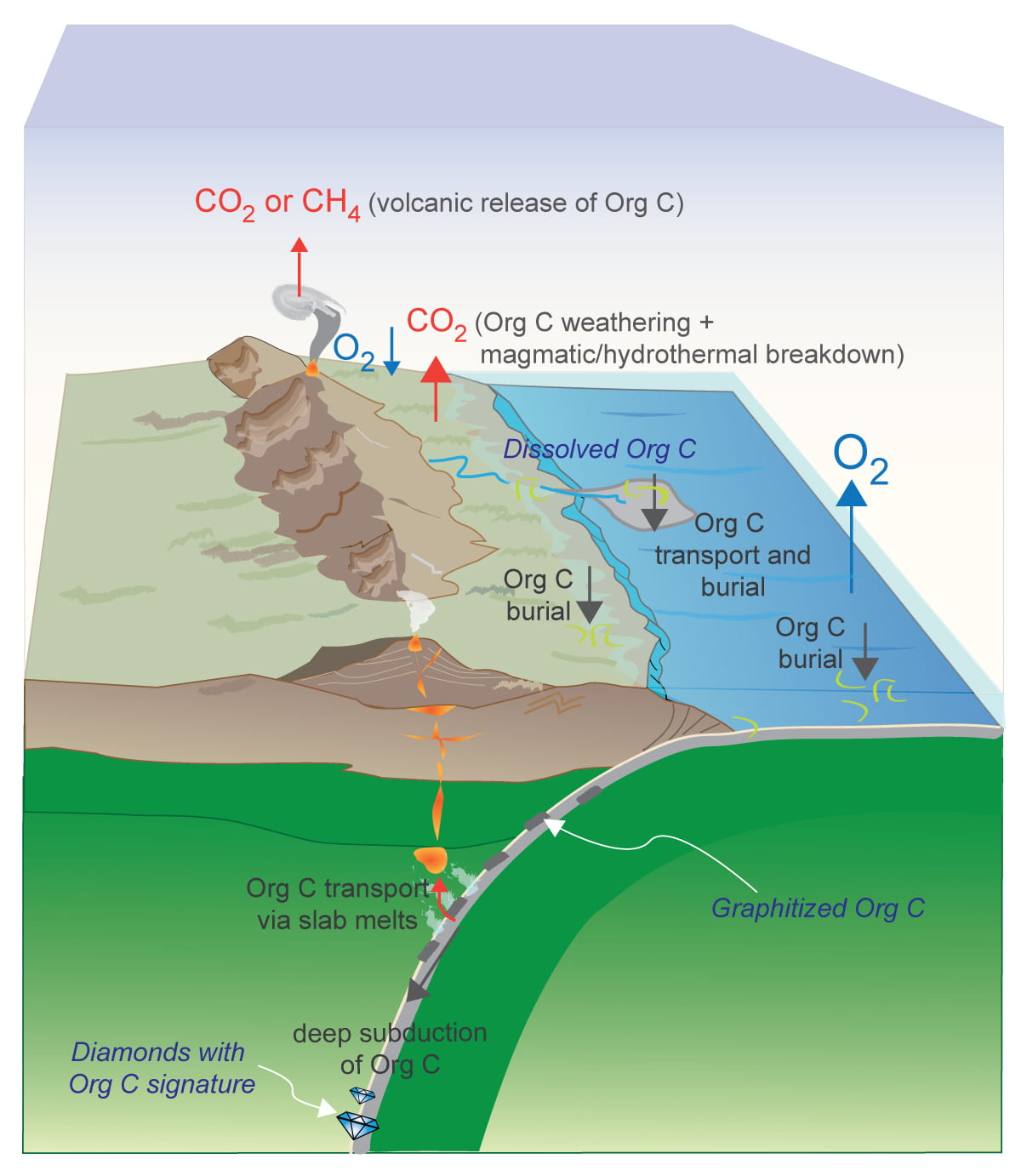
Carbon is the main component of life, and carbon constantly cycles between Earth’s atmosphere and biosphere as plants and animals grow and decompose. Carbon can also cycle through the Earth on a journey that takes millions of years. It begins at tectonic subduction zones where the relatively thin tectonic plates atop oceans are dragged down below thicker plates that sit atop continents. Downward diving oceanic crust heats up as it sinks, and most of its carbon returns to the atmosphere as carbon dioxide (CO2) from volcanoes.

Scientists have long studied the amount of carbon that gets buried in ocean sediments. Drilled cores from the ocean floor contain layers of sediments laid down over tens of millions of years. Using radiometric dating and other methods, researchers can determine when specific sediments were laid down. Scientists can also learn a lot about past conditions on Earth by studying minerals and microscopic skeletons of organisms trapped in sediments.

“There are two isotopes of carbon — carbon-12 and carbon-13,” said Torres, an assistant professor in Rice’s Department of Earth, Environmental and Planetary Sciences. “The difference is just one neutron. So carbon-13 is just a bit heavier.

“But life is lazy, and if something’s heavier — even that tiny bit — it’s harder to move,” Torres said. “So life prefers the lighter isotope, carbon-12. And if you grow a plant and give it CO2, it will actually preferentially take up the lighter isotope. That means the ratio of carbon-13 to -12 in the plant is going to be lower — contain less 13 — than in the CO2 you fed the plant.”

For decades scientists have used isotopic ratios to study the relative amounts of inorganic and organic carbon that was undergoing burial at specific points in Earth’s history. Based on those studies and computational models, Torres said scientists have largely believed the amount of carbon undergoing burial had changed very little over the past 30 million years.

Zhang said, “We had this idea of using the actual data and calculating their organic carbon burial rates to come up with the global carbon burial. We wanted to see if this ‘bottom-up’ method agreed with the traditional method of isotopic calculations, which is more ‘top down.’”

The job of compiling data from IODP expeditions fell to study first author, Ziye Li of Bremen, who was then a visiting student in Zhang’s lab at A&M.

Zhang said the study findings were shocking.

“Our new results are very different — they’re the opposite of what the isotope calculations are suggesting,” he said.

Zhang said this is particularly the case during a period called the mid-Miocene, about 15 million years ago. Conventional scientific wisdom held that a large amount of organic carbon was buried around this interval, exemplified by the organic-rich “Monterey Formation” in California. The team’s findings suggest instead that the smallest amount of organic carbon was buried during this interval over the last 23 million years or so.

He described the team’s paper as the beginning of a potentially impactful new way to analyze data that may aid in understanding and addressing climate change.

“It’s people’s curiosity, but I also want to make it more informative about what’s going to happen in the future,” Zhang said. “We’re doing several things quite creatively to really use paleo data to inform us about the present and future.”

The research was supported by the American Chemical Society’s Petroleum Research Fund (59797-DNI2). On behalf of the National Science Foundation, Texas A&M has served as the science operator of the IODP drill ship JOIDES Resolution for the past 36 years as part of the largest federal research grant currently managed by the university.

-30-


A schematic depiction of the burial and deep subduction of organic carbon.

CREDIT

R. Dasgupta/Rice University

Peer-reviewed paper:

“Neogene burial of organic carbon in the global ocean” | Nature | DOI: 10.1038/s41586-022-05413-6

Ziye Li, Yi Ge Zhang, Mark Torres and Benjamin J. W. Mills

https://www.nature.com/articles/s41586-022-05413-6

High-resolution IMAGES are available for download at:

https://news-network.rice.edu/news/files/2023/01/0104_CARBON-jr-lg.jpg
CAPTION: The JOIDES Resolution is a scientific research vessel operated by Texas A&M University for the International Ocean Discovery Program that drills into the ocean floor to collect and study core samples. (Photo courtesy of the International Ocean Discovery Program)

https://news-network.rice.edu/news/files/2023/01/0104_CARBON-mt-lg.jpg
CAPTION: Mark Torres (Photo by Tommy LaVergne/Rice University)

https://news-network.rice.edu/news/files/2023/01/0104_CARBON-RDfig-lg.jpg
CAPTION: A schematic depiction of the burial and deep subduction of organic carbon. (Image courtesy of R. Dasgupta/Rice University)

Related stories:

Mark Torres wins Geochemical Society's Clarke Award – Feb. 12, 2021
https://news.rice.edu/news/2021/mark-torres-wins-geochemical-societys-clarke-award

Glaciers may have helped warm Earth – July 31, 2017
https://news2.rice.edu/2017/07/31/glaciers-may-have-helped-warm-earth/

Links:

Texas A&M University research feature – Jan. 4, 2023
https://artsci.tamu.edu/news/2023/01/texas-aandm-oceanographers-research-points-to-new-method-of-understanding-global-organic-carbon-cycle.html

This release can be found online at news.rice.edu.

Follow Rice News and Media Relations via Twitter @RiceUNews.

Located on a 300-acre forested campus in Houston, Rice University is consistently ranked among the nation’s top 20 universities by U.S. News & World Report. Rice has highly respected schools of Architecture, Business, Continuing Studies, Engineering, Humanities, Music, Natural Sciences and Social Sciences and is home to the Baker Institute for Public Policy. With 4,240 undergraduates and 3,972 graduate students, Rice’s undergraduate student-to-faculty ratio is just under 6-to-1. Its residential college system builds close-knit communities and lifelong friendships, just one reason why Rice is ranked No. 1 for lots of race/class interaction and No. 1 for quality of life by the Princeton Review. Rice is also rated as a best value among private universities by Kiplinger’s Personal Finance.

Climate change could cause “disaster” in the world’s oceans, say UC Irvine scientists

Deep overturning circulation collapses with strong warming

Peer-Reviewed Publication

UNIVERSITY OF CALIFORNIA - IRVINE

Irvine, Calif., Jan. 4, 2023 — Climate-driven heating of seawater is causing a slowdown of deep circulation patterns in the Atlantic and Southern oceans, according to University of California, Irvine Earth system scientists, and if this process continues, the ocean’s ability to remove carbon dioxide from the atmosphere will be severely limited, further exacerbating global warming.

In a recent study published in Nature Climate Change, these researchers analyzed projections from three dozen climate models and found that the Atlantic Meridional Overturning Circulation and the Southern Meridional Overturning Circulation will slow by as much as 42 percent by 2100. The simulations suggest that under worst-case warming, the SMOC could cease entirely by 2300.

"Analysis of the projections from 36 Earth system models over a range of climate scenarios shows that unchecked global warming could lead to a shutdown of the ocean deep circulation,” said co-author J. Keith Moore, UCI professor of Earth system science. “This would be a climate disaster similar in magnitude to complete melting of the ice sheets on land.”

The importance of overturning circulation

In the Atlantic, as warm water flows northwards on the surface, it cools and evaporates, making it saltier and denser. This heavier water sinks into the deep ocean and proceeds to the south where it eventually rises back up, carrying from the depths the nutrients that are the food foundation of marine ecosystems.

In addition, globe-spanning ocean circulation creates a powerful factory for the processing of atmospheric carbon dioxide. The basic physical and chemical interaction of seawater and air – what Moore and his colleagues call a “solubility pump” – draws CO2 into the ocean. While the ocean circulation sends some carbon back to the sky, the net amount is sequestered in the ocean’s depths.

Additionally, a “biological pump” occurs as phytoplankton use CO2 during photosynthesis and in forming carbonate shells. When the plankton and larger animals die, they sink, slowly decomposing and releasing the carbon and nutrients at depth. Some comes back up with circulation and upwelling, but a portion remains banked beneath the waves.

“A disruption in circulation would reduce ocean uptake of carbon dioxide from the atmosphere, intensifying and extending the hot climate conditions,” Moore said. “Over time the nutrients that support marine ecosystems would increasingly become trapped in the deep ocean, leading to declining global-ocean biological productivity.”

Humans depend on the solubility pump and the biological pump to help remove some of the CO2 emitting into the air through fossil fuel burning, land use practices and other activities, according to Moore.

“Our analysis also shows that reducing greenhouse gas emissions now can prevent this complete shutdown of the deep circulation in the future,” he said.

Joining Moore on this project, which was funded by the U.S. Department of Energy, were lead author Yi Liu, UCI Ph.D. student in Earth system science; Francois Primeau, professor and chair of UCI’s Department of Earth System Science; and Wei-Lei Wang, professor of ocean and Earth sciences at Xiamen University in China. The study depended substantially on simulations developed by the Coupled Model Intercomparison Project phase 6 (CMIP6) project used to inform the IPCC climate assessments.

About the University of California, Irvine: Founded in 1965, UCI is a member of the prestigious Association of American Universities and is ranked among the nation’s top 10 public universities by U.S. News & World Report. The campus has produced five Nobel laureates and is known for its academic achievement, premier research, innovation and anteater mascot. Led by Chancellor Howard Gillman, UCI has more than 36,000 students and offers 224 degree programs. It’s located in one of the world’s safest and most economically vibrant communities and is Orange County’s second-largest employer, contributing $7 billion annually to the local economy and $8 billion statewide. For more on UCI, visit www.uci.edu.

Media access: Radio programs/stations may, for a fee, use an on-campus ISDN line to interview UCI faculty and experts, subject to availability and university approval. For more UCI news, visit news.uci.edu. Additional resources for journalists may be found at communications.uci.edu/for-journalists.

Cyclone researchers: Warming climate means more and stronger Atlantic tropical storms

Peer-Reviewed Publication

IOWA STATE UNIVERSITY

Cyclone studies 

IMAGE: IOWA STATE UNIVERSITY'S CHRISTINA PATRICOLA AND COLLABORATORS HAVE RECENTLY PUBLISHED STUDIES OF TROPICAL CYCLONES AND THE HURRICANES THEY CAN PRODUCE. view more 

CREDIT: PHOTO BY CHRISTOPHER GANNON/IOWA STATE UNIVERSITY.

AMES, Iowa – A warming climate will increase the number of tropical cyclones and their intensity in the North Atlantic, potentially creating more and stronger hurricanes, according to simulations using a high-resolution, global climate model.


“Unfortunately, it’s not great news for people living in coastal regions,” said Christina Patricola, an Iowa State University assistant professor of geological and atmospheric sciences, an affiliate of the U.S. Department of Energy’s Lawrence Berkeley National Laboratory in California and a study leader. “Atlantic hurricane seasons will become even more active in the future, and hurricanes will be even more intense.”


The research team ran climate simulations using the Department of Energy’s Energy Exascale Earth System Model and found that tropical cyclone frequency could increase 66% during active North Atlantic hurricane seasons by the end of this century. (Those seasons are typically characterized by La NiƱa conditions – unusually cool surface water in the eastern tropical Pacific Ocean – and the positive phase of the Atlantic Meridional Mode – warmer surface temperatures in the northern tropical Atlantic Ocean).


The projected numbers of tropical cyclones could increase by 34% during inactive North Atlantic hurricane seasons. (Inactive seasons generally occur during El NiƱo conditions with warmer surface temperatures in the eastern tropical Pacific Ocean and the negative phase of the Atlantic Meridional Mode with cooler surface temperatures in the northern tropical Atlantic Ocean.)


In addition, the simulations project an increase in storm intensity during the active and inactive storm seasons.


The scientific journal Geophysical Research Letters recently published the findings. Ana C.T. Sena, an Iowa State postdoctoral research associate, is first author. (See sidebar.)


“Altogether, the co-occurring increase in (tropical cyclone) number and strength may lead to increased risk to the continental North Atlantic in the future climate,” the researchers wrote.


Patricola added: “Anything that can be done to curb greenhouse gas emissions could be helpful to reduce this risk.”


Cyclone studies in Cyclone Country

Iowa State is home to the Cyclones and storm sirens are part of the hype at most athletic contests. Talk of the Cyclones is all over campus. But North Atlantic tropical cyclones? What are they?


“Tropical cyclone is a more generic term than hurricane,” Patricola said. “Hurricanes are relatively strong tropical cyclones.”


Exactly, says the National Oceanic and Atmospheric Administration. Tropical cyclone is a general reference to a low-pressure system that forms over tropical waters with thunderstorms near the center of its closed, cyclonic winds. When those rotating winds exceed 39 mph, the system becomes a named tropical storm. At 74-plus mph, it becomes a hurricane in the Atlantic and East Pacific oceans, a typhoon in the northern West Pacific.


Patricola grew up in the Northeast and can still tell stories about 1991’s Hurricane Bob.


“That was a big one for us in Massachusetts,” she said. “For me, it was very exciting. It really caught my interest.”


She was a Weather Channel fanatic through a lot of hurricanes in the mid-1990s. And that led to studies of geological and atmospheric sciences at Cornell University in New York, followed by atmospheric science and climate research at Texas A&M University and Lawrence Berkeley National Laboratory. Patricola joined the Iowa State faculty in August 2020.


Patricola’s research interests include climate dynamics, climate variability and change, extreme weather events, atmosphere-ocean interactions, high-resolution climate modeling, land-atmosphere interactions, paleoclimates. And, tropical cyclones.


Why are tropical cyclone numbers so consistent?

Patricola and another set of collaborators have just published a second research paper about tropical cyclones. This one is also in Geophysical Research Letters, with Derrick Danso, an Iowa State postdoctoral research associate, as first author. The paper examines a possible explanation for the relatively constant number of tropical cyclones observed globally from year to year. (See sidebar.)


Could it be that African Easterly Waves, low pressure systems over the Sahel region of North Africa that take moist tropical winds and raise them up into thunderclouds, are a key to that steady production of storms?


Using regional model simulations, the researchers were able to filter out the African Easterly Waves and see what happened. As it turned out, the simulations didn’t change the seasonal number of Atlantic tropical cyclones. But, tropical cyclones were stronger, peak formation of the storms shifted from September to August, and the formation region shifted from the coast of North Africa to the Gulf of Mexico.


So African Easterly Waves many not help researchers predict the number of Atlantic tropical cyclones every year, but they do appear to impact important storm characteristics, including intensity and possibly where they make landfall.


Both papers call for more study.


“We are,” Patricola said, “chipping away at the problem of predicting the number of tropical cyclones.”


– 30 –


Read the papers

“Future Changes in Active and Inactive Atlantic Hurricane Seasons in the Energy Exascale Earth System Model,” Geophysical Research Letters, Volume 49, Issue 21, November 2022

  • Ana C.T. Sena, Iowa State University postdoctoral research associate in geological and atmospheric sciences
  • Christina Patricola, Iowa State assistant professor of geological and atmospheric sciences; U.S. Department of Energy’s Lawrence Berkeley National Laboratory affiliate
  • Burlen Loring, Lawrence Berkeley National Laboratory computer systems engineer


“Influence of African Easterly Wave Suppression on Atlantic Tropical Cyclone Activity in a Convection-Permitting Model,” Geophysical Research Letters, Volume 49, Issue 22, November 2022

  • Derrick Danso, Iowa State postdoctoral research associate in geological and atmospheric sciences
  • Christina Patricola, Iowa State assistant professor of geological and atmospheric sciences; Lawrence Berkeley National Laboratory affiliate
  • Emily Bercos-Hickey, Lawrence Berkeley National Laboratory postdoctoral research fellow


An Early Career Research Program grant to Patricola from the U.S. Department of Energy’s Office of Science, Office of Biological and Environmental Research, and Earth and Environmental Systems Modeling Program provided support for both studies.

Illinois Tech assistant professor awarded funding to stop spread of ‘forever chemicals’ into waterways

David Lampert’s project aimed at finding solutions to halting movement of PFAS in water resources receives phase II funding in EPA competition

Grant and Award Announcement

ILLINOIS INSTITUTE OF TECHNOLOGY

David Lampert 

IMAGE: ASSISTANT PROFESSOR DAVID LAMPERT view more 

CREDIT: DAVID LAMPERT

CHICAGO—January 4, 2023—Illinois Institute of Technology (Illinois Tech) Assistant Professor David Lampert was recently awarded funding by the U.S. Environmental Protection Agency’s People, Prosperity, and the Planet (P3) Student Design Competition for a project to stop the spread of “forever chemicals” into waterways. Lampert’s project—one of just three nationwide selected for phase II funding—focuses on preventing the movement of perfluoroalkyl and polyfluoroalkyl substances (PFAS) and is aimed at finding solutions that can be implemented on a large scale.

PFAS are a class of chemicals that have been used in a wide range of commercial products, including non-stick pans and shampoo, since the 1960s. Some types of PFAS have been linked to negative health impacts, including cancer, and are referred to as “forever chemicals” because they do not break down in nature. The use of some types of PFAS have decreased, but many still show up in products.

“If you take a blood sample of basically anyone and measure it, you can find a detectable level of these PFAS compounds,” said Lampert. 

Lampert is leading a team of students in a project that will test various materials for their ability to capture PFAS as it moves. The team will also include students with business, social science, and entrepreneurial expertise as the project progresses.

Phase I funding from the EPA’s P3 project allowed Lampert and his team to conduct a pilot study, which involved designing a laboratory experiment to track  the movement of PFAS through soil and groundwater over time and examine the ability of various materials to contain the pollution and protect surface water resources.

For phase II, Lampert plans to add water columns and worms to the soil system to see how water flow and animal burrowing impact the movement of PFAS. He will also test the soil for additional types of PFAS and study how worms bioaccumulate the compounds, which is important for understanding how PFAS spread to humans through bioaccumulation in fish. These findings will help Lampert identify and test potential intervention strategies for stopping the movement of PFAS.

“There’s a complicated hydrological-environmental modeling question there to try to understand this whole process of how the PFAS gets from a contaminated area to the receptors and people who might be exposed to it,” said Lampert. “Our goal is to find a solution that can be implemented on larger scales.”

Lampert’s team also plans to conduct a field test at an existing PFAS-heavy site. The ultimate goal of the project is to develop and demonstrate effective methods for preventing the movement of PFAS into water resources, improving water quality and protecting human health.

“I’m trying to understand what processes are happening in our water systems and trying to figure out how we can do better from an ecology point of view, a human health point of view, and sustainability point of view,” Lampert said.

Disclaimer: This content was developed under Assistance Agreement No. SU840180 and SV840421 awarded by the U.S. Environmental Protection Agency to David Lampert. It has not been formally reviewed by EPA. The views expressed in this document are solely those of the authors and do not necessarily reflect those of the Agency. EPA does not endorse any products or commercial services mentioned in this publication.

David Lampert, “Sorbent-Amended Caps for PFAS-Contaminated Sediments,” Environmental Protection Agency; Awards Number SU840180 and SV84042