Thursday, January 05, 2023

UKRAINE
The true war of attrition begins 
Meduza sums up what happened on the battlefield in 2022 — and what it portends for the year ahead

January 4, 2023
Source: Meduza


Ukrainian artillery firing back at Russian positions in the Kharkiv region. December 24, 2022
Evgeniy Maloletka / AP / Scanpix / LETA

Late in 2022, the war in Ukraine reached a new turning point. Russia conducted its “first wave” of mobilization and partially eliminated the personnel deficit that contributed to its numerous military defeats in the fall. Now, the Russian army might face a shortage of a different resource: artillery ammunition. Meanwhile, Ukraine is experiencing a shell shortage of its own. Overcoming the deficiency won’t be easy: the West, which is assisting Ukraine with supplies, has largely exhausted its own stockpiles. It’s against this backdrop that Russia and Ukraine are fighting a protracted artillery battle around the cities of Soledar and Bakhmut, which is rapidly eating away at the ammunition both sides have left. It’s increasing looking like the true “war of attrition” — as many began referring to the war in Ukraine almost as soon as its hot stage began — will take place in 2023. The outcome of this stage will hinge primarily on which side is better able to adapt to its worsening ammunition shortage.

In this article, our editors attempt to assess the military situation in Ukraine based on the available data. Meduza opposes the war and demands the immediate withdrawal of Russian troops from Ukraine.

What states were the Russian and Ukrainian armies in at the start of the full-scale war?

The Russian army

In February, Russia’s command planned to mount a quick victory by launching a decisive operative and advancing its troops at a record pace. In the first days of the full-scale invasion, the Russian army captured a significant amount of Ukrainian territory, taking advantage of the fact that the Ukrainian military hadn’t yet had time to deploy and wasn’t ready to mount a full defense anywhere outside the Donbas.

Just a few weeks later, however, as Ukrainian units arrived at the fronts that had by then formed, the Russian army suffered a major defeat: it completely withdrew from Ukraine’s north (with the exception of the Kharkiv area, which was significant for its subsequent offensive in the Donbas) and retreated south — to 50 kilometers outside of Kherson (to prevent the city and surrounding bridges from falling into the reach of Ukrainian artillery). It became clear that Russia’s troops weren’t prepared to attack the positions of a fully deployed and well-motivated opponent.

In the next stage of the war, the Russian command hoped to conduct a wide-scale offensive in eastern Ukraine. The Russian Armed Forces planned to exhaust the Ukrainian army’s reserves, sapping its supply of armored vehicles and personnel. At the same time, the Russian military's own problems had become clear by the spring:

  • Its units badly lacked personnel: this affected both its troops’ ability to conduct combat operations and its supply chain, which also suffered from labor shortages. Vladimir Putin was unwilling to use mobilization to fix this shortcoming at the time (though there were rumors about a mobilization drive as early as May).
  • The practice of using battalion tactical groups (BTGs) consisting of soldiers at constant readiness (every brigade or division was instructed to designate these soldiers in advance) turned out to be unsuitable for a full-scale war; these groups were created for fast-paced operations against relatively weak opponents. BTGs have also been used to support hybrid operations, but in those cases, local partners have usually done the “dirty work” (such as in Syria or in earlier stages of the war in the Donbas). Neither of these scenarios apply to the current situation in Ukraine.
  • The Russian Aerospace Forces tried and failed to gain dominance in Ukrainian airspace. Russian aviation didn’t have a proven system for overcoming anti-air defenses like NATO does. Because Ukraine’s air defense systems are still operating, the Russian Aerospace Forces were unable to use the method that had worked for them in Syria: dropping conventional unguided bombs from medium altitudes after using computer systems to aim them. At the same time, Russia had few high-precision guided weapons.
  • As a result, aviation played a decisive role neither over the front line nor behind it. The latter is especially significant: the Russian military is still incapable of stopping the flow of Ukrainian reinforcements to the most difficult parts of the front.
  • The Russian army’s logistics system also proved ill-suited for intensive fighting. The Russian military depends on railroads, and can therefore only attack from the vicinity of railway stations. It can receive supplies in the Donbas and in the eastern part of the Kharkiv region, but the railroad in the annexed part of the Zaporizhzhia region is only connected by rail to Crimea, which itself can only receive supplies through the Kerch Bridge. The railroad from Donetsk to Melitopol, meanwhile, has been impossible for Russia to restore; it’s too close to the front line.
  • Russia’s logistical problems have determined where it can and can’t launch large-scale offensives. Its only options are parts of Donetsk, western parts of the Luhansk region, and eastern parts of the Kharkiv region.

It was these factors that determined the course of Russia’s summer campaign. Because of its manpower shortage, the Russian military was forced to abandon its plan of surrounding all of Ukraine’s positions in the Donbas. Instead, it had to choose a less ambitious course of action: conducting an offensive on Lysychansk and Sievierodonetsk from Izyum in the Kharkiv region. The goal was to reach Ukraine’s main base in the region, in Kramatorsk and Slovyansk.

At the same time, without full aviation support, Russian troops were relying entirely on their superior artillery and ammunition supplies, which seemed inexhaustible. During the battle for Sievierodonetsk and Lysychansk, according to Ukrainian generals, the Russian army (across the entire front) fired 40,000–60,000 shells a day, while Ukraine launched no more than 6,000 shells daily.

Sievierodonetsk and Lysychansk were ultimately captured in early July, at the same time that Russian forces (primarily PMC Wagner) reached the outskirts of Bakhmut. There, however, the offensive wore thin, and Russia’s units were transferred from Sievierodonetsk and Izyum to Kherson, where Ukraine was expected to launch a counteroffensive.

The Ukrainian army

In early December, the British Royal United Services Institute (RUSI) released a report whose authors included high-ranking Ukrainian military officers. It summarized the Ukrainian side’s view of the war’s initial stage.

  • For the first few weeks after Russia launched its invasion, Ukraine was unable to deploy troops in the areas of Russia’s major assaults. It was finally able to complete its deployment in late March, which allowed Ukrainian forces to stop Russia’s offensives around Kyiv and Mykolaiv. Ukrainian artillery, which wasn’t yet suffering from an ammunition shortage at that point, played an important role.
  • Mobilized Ukrainians began joining territorial defense brigades as well as new battalions and brigades in the Ukrainian Armed Forces. Over time, the units of mobilized soldiers became more combat capable.
  • Ukraine’s military command managed to save some of its air defense systems (though most of its air defenses were destroyed by Russia’s first offensive) and aviation (Russia’s Aerospace Forces were unable to stop Ukraine from sending its aircraft to alternate airfields).
  • After the Russian army’s retreat from northern Ukraine, the West agreed to significantly ramp up both the quantity and quality of its weapon supplies to the Ukrainian military. In late spring, Ukraine started receiving heavy weaponry, including howitzers. This was especially significant, as ammunition for the Soviet-made weapons the military was using before had started to run out — both because it consumed ammo at a high rate and because it had lost multiple large storage facilities to Russia.
  • In July, when the Ukrainian army was retreating from Sievierodonetsk, it received its first shipment of HIMARS multiple rocket launcher systems. This immediately changed the situation on the front, exacerbating Russia’s already-serious logistics problems. By late summer, large Russian weapons storage facilities were blowing up practically every day. It’s likely that Russia lost a significant portion of its shells to Ukrainian HIMARS strikes. By the end of July, Russian artillery activity had decreased markedly.

After that, the Ukrainian Armed Forces took advantage of the numerical advantage it had gained as a result of the country’s mobilization (and of the Kremlin’s refusal — at the point — to conduct its own mobilization). This took the form of two major attacks:

  • The first was launched in late August, in the Kharkiv region, and didn’t lead to quick success. From the beginning, Ukrainian troops faced combat-ready Russian reserve troops that had been transferred from the Donbas, and suffered significant losses without gaining much territory in most areas. Nonetheless, by the end of the fall, Russia had left Kherson. Supporting a large group of forces capable of resisting sustained Ukrainian attacks while its crossing points over the Dnipro River were bombed everyday turned out to be an impossible task.
  • Ukraine’s second attack was launched in early September in the southeastern part of the Kharkiv region. It caused the immediate collapse of Russia’s defenses and the destruction of Russia’s bridgehead on the Seversky Donets River, from which Russia had been attacking Slovyansk and Kramatorsk. Russian troops abandoned hundreds of armored vehicles in the course of their retreat. A week after the start of the offensive near Kupyansk, Ukrainian forces blocked the supply routes for all of Russia’s forces in the northern Donbas. As a result, the Russian army abandoned its defense line along the left bank of the Seversky Donets, as well as a large railway station and the city of Lyman.

The success of this offensive is directly linked to the Russian army’s logistics problems. After the fierce battle for Sievierodonetsk and Lysychansk, Russia was suffering from a severe manpower shortage. The Russian command was ultimately only able to devote combat-capable troops to one area that was under threat: its bridgehead on the right bank of the Dnipro (where it sent troops from Izyum, among others). In the area around the Balakliya and Kharkiv regions, the Ukrainian military encountered only small and ineffective Russian units.


Please, read this message from Meduza’s team:

Dear readers! For eight years, Meduza has delivered reliable information about Russia and the rest of the world. Our reporting is vital for millions of people in Russia, Ukraine, and beyond. Access to trusted news sources is even more important in times of war. Help Meduza publish the news that Russia’s censors want to silence. Please, support our work.


To plug its holes in the front, the Kremlin declared mobilization in Russia immediately after it lost Lyman. The units of mobilized soldiers that arrived near Lyman and Kupyansk were ultimately able to stop the Ukrainian military from advancing further into the Luhansk region.

The battle for Bakhmut continues to rage on. Why are both sides so determined to control the city?

Russia’s offensive on Bakhmut began all the way back in July — immediately after it captured Lysychansk. The fighting scaled down fairly quickly; most of Russia’s forces that had fought in the battle for Sievierodonetsk and Lysychansk left the Donbas in August (many soldiers were transferred to Kherson, while others went on leave). Many Ukrainian troops, too, were transferred out of the area for various reasons.

PMC Wagner (whose numbers were then relatively small) spent several months working to capture favorable positions on the flank of a small Ukrainian group defending Bakhmut. In late July, the Wagner Group captured the Vuhlehirska Power Station, which was just 20 kilometers (12 miles) south of the city. In August, forces from the self-proclaimed “Donetsk People’s Republic” joined the mercenaries to take control of the Knauf plant in Soledar, eight kilometers (five miles) from northeastern Bakhmut. After gradually gaining ground throughout the two months that followed, they found themselves quite close to Bakhmut in the southeast and northeast.

But while Russia’s proxy forces had been making slow progress towards the city, the situation on the front had fundamentally changed. The Russian grouping that was supposed to advance from Izyum to meet Wagner’s forces had disappeared from the map; an immediate assault on Bakhmut no longer made sense. Russia could no longer surround Ukraine’s forces in Kramatorsk and Slovyansk or even capture significant territory in the Donbas: the Ukrainian Armed Forces had already set up a new defense line beyond Bakhmut that Russia’s troops would have to break through, suffering more losses and expending ammunition.

At the same time, however, the Wagner Group itself had grown significantly larger over the fall by recruiting prisoners and acquired its own heavy artillery (along with the experienced artillery gunners of the self-proclaimed “Donetsk People’s Republic”), aviation, and air defense systems. Airborne units were also sent from Kherson to provide assistance.

Ultimately, as the mercenary group’s assault intensified, Ukraine’s command was forced to choose between surrendering Bakhmut or sending massive reinforcements to the area. It chose the second option. In December, units of more than 10 Ukrainian brigades took part in combat from Soledar and Bakhmut to the outskirts of Horlivka.

This isn’t the first time both sides have involved major forces in a battle of little to no strategic importance — the same thing happened in Sievierodonetsk. In June, the Ukrainian military sent substantial reserves to defend the city but was unable to hold its positions — and suffered huge losses. Nonetheless, Ukraine’s resistance exhausted the Russian army and forced it to expend a huge amount of artillery shells.

It’s likely that both sides consider the summer battle to have been a success:

  • The Russian army formally occupied a significant portion of the Donbas and tied down Ukraine’s forces;
  • The Ukrainian army forced the Russian army to spend a large amount of resources.

Many Western military experts, including Michael Kofman and Rob Lee, agree: in their view, even though Russia won the battle for Sievierodonetsk and Lysychansk, it was probably even more damaging to the Russian army than the defeats in Balakliya, Izyum, Kupyansk, and Lyman. Russia’s irrational expenditure of resources this summer was the key to the success of Ukraine’s subsequent offensive, according to Kofman and Lee.

Now, however, both sides are experiencing growing ammunition shortages that will be difficult to overcome. While the West supplied Ukraine with more than 100,000 shells after its defeat at Sievierodonetsk this summer, it’s unlikely to give support on such a large scale again. But the Russian side is in a similar boat: while its shell stocks seemed practically endless in the summer, now it’s experiencing a deficit even around Bakhmut.

The war is exhausting ammunition stockpiles in Russia, Ukraine, and the West. How do they replan to replenish them?

In late December, a video appeared online in which two men claiming to be PMC Wagner fighters berated Russian Army General Staff Chief Valery Gerasimov for his failure to supply the troops carrying out the assault on Bakhmut with enough ammunition. Wagner Group founder Evgeny Prigozhin later confirmed that the clip was made by his mercenaries — and with his approval. According to Prigozhin, the ammunition shortage is preventing Russian forces from completing the operation successfully.

Western military and intelligence officials have also spoken about this issue: according to some estimatesRussia will start facing critical ammunition problems in January. Ukrainian officers, too, have noted that Russia’s artillery around Bakhmut seems to be firing less than it did in the summer.

In other words, Russia is now feeling the consequences of its intensive shelling against Ukrainian forces this summer. On one hand, the Russian military is unable to use the reserves that remain from the Soviet period (they’re expired). On the other hand, it can’t manufacture ammunition fast enough to keep shelling at the rate it did during the battle for Sievierodonetsk (even if the Ukrainian estimates that Russia used 40,000–60,000 shells a day are exaggerated). Experts estimate that between 2014 and 2021, Russia produced about 3.5 million 152-mm shells. That’s likely the same amount it consumed in the first six months of the war. The situation with multiple launch rocket system munitions is comparable. As a result, even increasing production by dozens of percentage points wouldn’t be enough to solve the problem.

At the same time, Western media has begun reporting that the Pentagon wants the Ukrainian military to adjust its approach in the war. Rather than expending large amounts of ammunition, Washington reportedly wants Ukrainians to learn to fight “more like Americans” — that is, to maneuver more effectively.

The West’s desire to change the way Ukrainians fight is almost certainly a response to NATO’s own shell shortage. Unlike countries whose armies were built on the legacy of the Soviet one, NATO countries stopped viewing artillery as the “God of war” decades ago — and, as a result, they have neither the stockpiles necessary for firing thousands of weapons for months on end nor the manufacturing capacity necessary to produce millions of shells per year. The West’s plans for increasing production are clearly insufficient to provide Kyiv with ammunition on the scale it needs.

But making Ukrainian troops “fight like Americans” won’t work either, Michael Kofman has warned. That’s because the U.S. relies not just on maneuvers and interactions between different branches of its armed forces, but also — and more heavily — on its overwhelming firepower. And that firepower lies not in artillery but in aviation — something the Ukrainians don’t currently have on the necessary scale.

The U.S. is taking practical steps to make Ukraine’s Air Force more effective in its current state. Its last military aid package to Ukraine, for example, included kits for converting unguided aerial munitions into guided ones. These should increase the accuracy of Ukraine’s bombs, though they won’t solve the country’s main problem, which is a shortage of planes. Even before the full-scale war, the Ukrainian Air Force was an order of magnitude inferior to Russia’s in size, and it’s suffered significant losses since February. But NATO has made it clear that, at least for now, providing Ukraine with Western-made planes is off the table: Washington believes the risk of unnecessary escalation is too high.

The next stage of the Hot Cold War


January 05, 2023 

After a year of big surprises, led by Russia’s invasion of Ukraine, the global spike in inflation rates, and the collapse of cryptocurrency ventures, what kind of year will 2023 prove to be? This kind of short-run question is hard to answer, because repercussions of events spread so quickly and unpredictably across our globalized world. But the last 12 months highlighted one major trend that will shape what happens next, in 2023 and beyond: the decline of Russia.

Russian aggression is nothing new. Moscow has been invading other countries since the mid-1990s and has occupied parts of Ukrainian territory since 2014. But the brutality of Russia’s attacks since late February far exceeds what is acceptable to most countries. The most recent phase, destroying civilian energy infrastructure, is widely seen as amounting to a war crime. It is unlikely to change the course of the war, which Russia is losing.

In the bigger picture, Russia has again entered a period of secular decline, during which it will have limited access to Western investment, technology, or consumer goods. Russia’s empires have collapsed before, in 1917-18 and again when the Soviet Union imploded in 1989-91. In both cases, the collapse took a while to get going, and then proved quite complete. Of course, historically Russia has also been able to reassert control, using its own resources during the Civil War of 1917-22 and getting a lot of help from Western companies during the 1990s.

This time, too, we should expect a long struggle for power within Russia, implying serious existential risks for the world, including who ends up controlling Russian nuclear weapons. But the more direct economic impact will be reflected in the world energy market.

Demand for Russian fossil fuels is way down. Before its 2022 invasion of Ukraine, Russia produced about 10.8 million barrels of oil per day, of which around eight million were exported (either as crude or refined products). The sharp decline in Russian economic activity means that more oil is available for export, but the European Union, the United States, and their allies are now buying crude from other suppliers – and the same will be true for refined products from February 2023. The International Energy Agency predicts that Russian oil exports will fall to around six million barrels per day over 2023-24. Over the medium term, India might buy 1-2 million barrels and China could sop up the rest – assuming both countries want to become more dependent on a malevolent and unreliable partner.

Purchases by India, China, and a few others can still result in a lot of free cash flow and tax revenue for Russia. Whoever leads Russia will put much of these proceeds into building and buying weapons – including missiles with which it can hit a wide range of countries from long distance. NATO member countries are, one hopes, protected to some extent by the threat of retaliation, but Russia can be expected to engage in sabotage and other deniable attacks on Western energy infrastructure (and similar vulnerable strategic targets). Russia is on its way to becoming the best-financed pariah state ever.

During the Cold War, the Soviet Union was careful not to attack Western Europe and the US too directly (and vice versa). Instead, both sides used proxy wars and other forms of pressure. This time, however, we should expect much more direct confrontation. The Russian elite have boxed themselves into a corner, with a bizarre set of beliefs – right-wing nationalism on steroids – and long-range weapons. Giving ground – literally or metaphorically – to these extremists, will only embolden them to take more.

The need to limit over time how much cash Russia can spend on aggression is why the price cap on Russian oil exports is so important. The evidence so far is that this is working as intended, enabling India and China to buy Russian oil at a big discount compared to world prices.

But further measures are needed, including accelerated investments in renewable energy to reduce world demand for oil. If we continue to depend on Russia and its allies in the OPEC+ cartel, the ability and temptation to disrupt our economies will be immense. There is now a pressing national security dimension to the energy transition.

High inflation in the 1970s had multiple causes, beginning with tight economies in the 1960s (and the Vietnam War). But the problems were exacerbated by two oil price shocks, in 1973 and 1979. OPEC+ members understand that they have the power to do this again, at a time of their choosing – or the next time Russia asks for a favor.

Oil demand and supply are quite unresponsive to oil prices in the short run, but historically quite responsive over 5-10 years. In 2023 and beyond, the West needs to focus more intently on reducing demand for fossil fuels, particularly oil, and increasing the supply of alternative energy sources (outside the control of Russia and OPEC).

Copyright: Project Syndicate
-- Contact us at english@hkej.com


SIMON JOHNSON
Simon Johnson, a former chief economist of the IMF, is a professor at MIT Sloan, a senior fellow at the Peterson Institute for International Economics, and co-founder of a leading economics blog, The Baseline Scenario. 

Iran frees actress Alidoosti, jailed over anti-government unrest

The 75th Cannes Film Festival - News conference for the film "Leila's Brothers" in competition - Cannes, France on May 26, 2022. Cast member Taraneh Alidoosti reacts.
Reuters file

DUBAI — Iran has released top Iranian actress Taraneh Alidoosti on bail, state media reported on Wednesday (Jan 4), weeks after she was detained for criticising a crackdown on anti-government protests that have rocked the Islamic Republic for months.

Best-known for her role in "The Salesman", which won an Academy Award in 2017, the pro-reform artist Alidoosti had supported the protests, including by posting her picture on Instagram in November without the compulsory hijab head covering, and holding up a sign which read "Woman, Life, Freedom" in Kurdish, a popular slogan in the mass protests.

The semi-official ILNA news agency, citing her lawyer, said "Alidoosti, who was arrested on Dec 17, was released today on bail", without giving further details.

Her picture, taken in front of Tehran's notorious Evin prison, was widely shared on social media.

The protests, sparked by the death of a young Kurdish woman while in the custody of the morality police, have posed one of the biggest legitimacy challenges to the Shi'ite Muslim-ruled Islamic Republic since the 1979 revolution.

Since Amini's death, protesters from all walks of life have taken to the streets, calling for the downfall of the country's clerical rulers, with women taking off and burning their headscarves in fury across the country.

Dozens of female Iranian actresses and artists have posted pictures of themselves without the compulsory hijab, in solidarity with the demonstrations in which women have played a leading role.

Facing their worst legitimacy crisis in the past four decades, Iran's clerical rulers have accused a coalition of “anarchists, terrorists and foreign foes" of orchestrating the protests.

The Islamic Republic has so far executed two people involved in mass protests. The Norway-based Iran Human Rights group has said that at least 100 detained protesters face possible death sentences.

ALSO READ: Iranian chess player was warned not to return to Iran after competing without hijab: Source

Source: Reuters

Anti-Boluarte protests resume in Peru

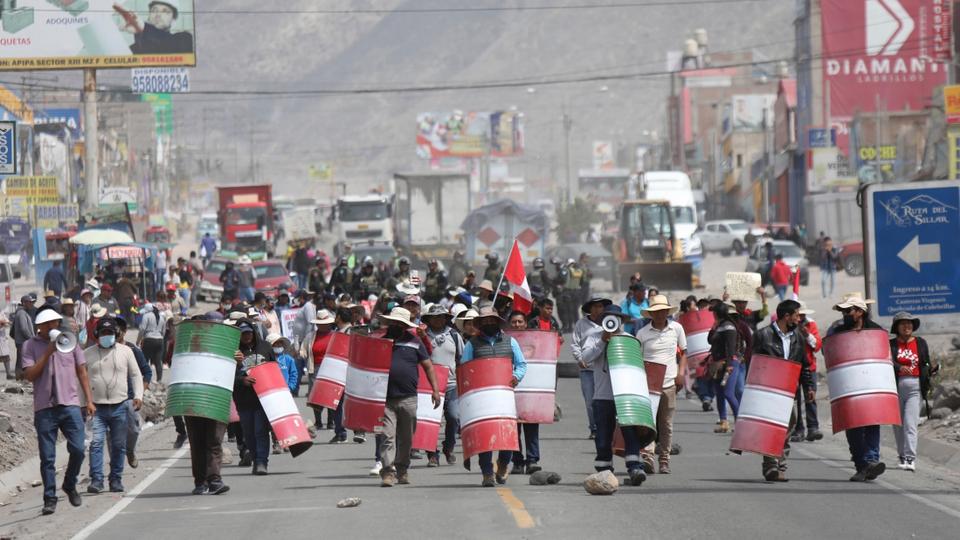
Protesters barricade main routes in southern regions of Puno, Cusco, Apurimac and Arequipa, as well as Junin in the centre, demanding resignation of President Dina Boluarte, who took over from her ousted predecessor Pedro Castillo.

Demonstrators march with makeshift shields during a protest against President Dina Boluarte's government and Congress, in Arequipa. (AP)

After a fortnight-long break, Peruvians have taken to the streets again, blocking roads countrywide to demand the resignation of President Dina Boluarte, who took over from her ousted predecessor in December.

Protesters on Wednesday used stones and burning tires to barricade main routes in the southern regions of Puno, Cusco, Apurimac and Arequipa, as well as Junin in the centre, chanting for Boluarte to leave.

The demonstrations died down over the holiday period, but by Wednesday, the protesters had remobilised.

"There are 10 blockades, mainly around Puno," government spokesperson Alberto Otarola told reporters in Lima, where a crisis centre was erected.

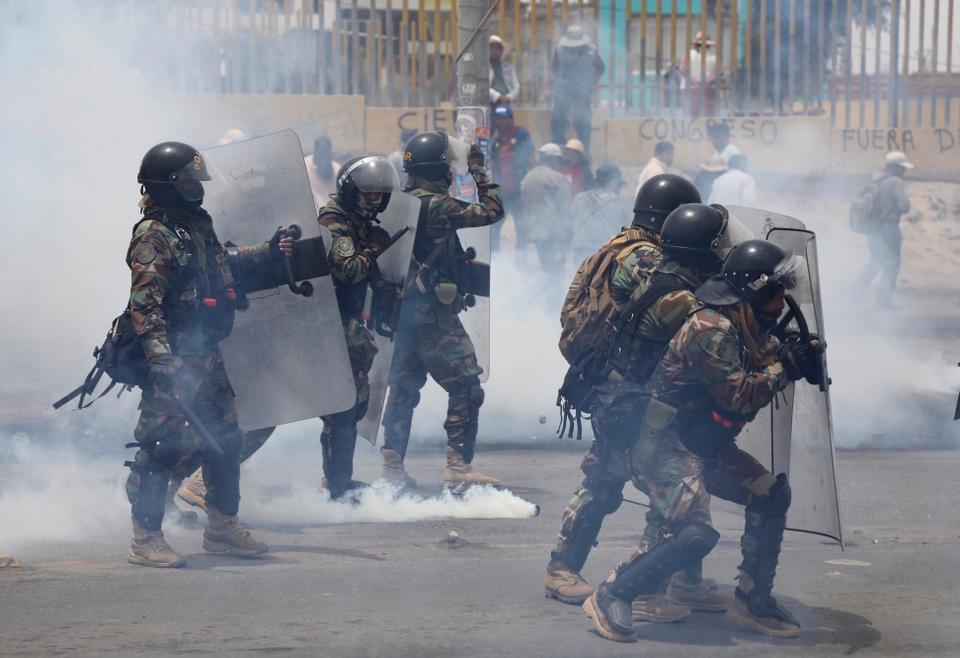
In Arequipa, police sought to break up hundreds of protesters using tear gas.

Dozens also gathered in the capital, Lima.

"The airports are functioning normally," said Otarola.

READ MORE: Ousted Peru leader Castillo calls his detention 'political revenge'

Nationwide state of emergency

Boluarte took over on December 7 as the South American country's first woman president following the impeachment and arrest of Pedro Castillo after he tried to dissolve Congress and rule by decree.

Castillo, a leftist former rural school teacher and union leader, faced vehement opposition from Congress during his 18 months in office, and had been the subject of numerous criminal investigations into allegations of widespread graft.

His ouster sparked nationwide protests, with Peru's rights ombudsman reporting 22 people killed in clashes and more than 600 injured.

Boluarte's government declared a 30-day nationwide state of emergency, while she attempted to calm the uproar by seeking to bring forward elections.

READ MORE: Peru court orders 18-month detention for ousted president Castillo

Riot police face off with demonstrators protesting against President Dina Boluarte's government and Congress, in Arequipa. (AP)

'This will continue'

As a precaution, train services between the town of Cusco and the Inca citadel of Machu Picchu were suspended indefinitely on Tuesday, and some 2,000 tourists were escorted from the heritage site.

In the first wave of protests, thousands of tourists found themselves stranded at Machu Picchu and Cusco for days due to road, railway and airport blockades.

TV footage showed police and the army guarding the headquarters of public institutions in some areas where protests have been announced, including Ayacucho, a region with the highest number of victims in the recent demonstrations.

From Lima, Boluarte called for an end to the protests she blamed for "delays, pain, economic losses" and appealed instead for "peace, calm, unity to promote development of the homeland."

Protest leader Milan Knezvich, in the mountainous Apurimac region, vowed the struggle will continue.

"No one will want to talk to her. As long as Mrs Dina Boluarte does not resign, this will continue," he told Exitosa radio.

The new government has agreed to bring forward elections set for 2026 to April next year, but many want voting to happen even sooner.

On Tuesday, marches were held in various parts of Peru against the planned restart of the anti-Boluarte protests.

READ MORE: Peru Congress to reconsider early election amid protests
West opposes rest of world in UN votes for fairer economic system, equality, sustainable development

The West opposed the rest of the planet in United Nations General Assembly votes that called for a new international economic order based on sovereign equality, sustainable development, and biological diversity.


By Ben Norton
Published2022-12-22


Most countries on Earth voted at the United Nations General Assembly to support a call for a new international economic order that is based on sovereign equality and cooperation, that rejects unilateral sanctions and advocates for debt relief for the Global South.

The only countries that opposed this widely popular proposal were the West and its allies.

The United States and its proxies were also the lone votes against common-sensical resolutions promoting sustainable development, biological diversity, and basic civil rights for Palestinians. Almost the entire world supported these proposals.


Washington showed itself to be a rogue state on the international stage, voting against practically every resolution, even on uncontroversial issues where the rest of the planet is in agreement.

Most of these resolutions were commonplace, are introduced every year, and have been voted on many times before, with similar results: the West vs. the rest.

In 1974, formerly colonized nations in the Global South proposed a plan to dismantle the remaining economic structures of colonialism.

They called it the New International Economic Order (NIEO), and said that it should be “based on the principles of equity, sovereign equality, interdependence, common interest, cooperation and solidarity among all States.”

The NIEO has been consistently voted on at the United Nations in the five decades since. And the West has persistently opposed it.

On December 14, 2022, 123 countries voted in favor of the NIEO – 64% of the UN’s 193 member states. (The number would have been even higher, but several nations that have been illegally sanctioned by the US, such as Venezuela and Zimbabwe, had their UN voting rights temporarily suspended because they have been unable to pay their membership fees in dollars.)

Just 50 nations voted against it, with one abstention, from NATO member Türkiye.


The 50 countries opposed to the call for a fairer, more equitable economic system consisted of the United States, members of the European Union, Britain, Israel, Canada, Australia, South Korea, and Japan.

This grouping has been referred to as the “Collective West.”

The West is not a geographic construct; it is a political one. This is why Australia, which was created as a British settler colony, is located in the eastern hemisphere but is politically and culturally part of the West.

The same is true for apartheid Israel, which like Australia was created as a British settler-colonial project and has since become a US proxy with a key geostrategic location in West Asia.

Similarly, the two East Asian nations that are part of this Western bloc are military occupied by the United States, which has stationed tens of thousands of troops in Japan since the mid-1940s and in South Korea since the early 1950s.

Reflecting on the December 14 vote, Chinese journalist Chen Weihua observed, “It’s US and EU against the rest of the world. Basically 900 million against the more than 7 billion from Asia, Africa to Latin America.”

The UN General Assembly (UNGA) resolution “reaffirms the need to continue working towards a new international economic order based on the principles of equity, sovereign equality, interdependence, common interest, cooperation and solidarity among all States.”

It also “reiterates that States are strongly urged to refrain from promulgating and applying any unilateral economic, financial or trade measures not in accordance with international law and the Charter of the United Nations that impede the full achievement of economic and social development, particularly in developing countries.”

The resolution calls for “mutually supporting world trade, monetary and financial systems” and “coordination of macroeconomic policies among countries to avoid negative spillover effects, especially in developing countries”

It similarly urges debt relief for the Global South, stating that it “expresses concern over the increasing debt vulnerabilities of developing countries, the net negative capital flows from developing countries, the fluctuation of exchange rates and the tightening of global financial conditions, and in this regard stresses the need to explore the means and instruments needed to achieve debt sustainability and the measures necessary to reduce the indebtedness of developing countries.”

The December 14 vote took place in the 53rd plenary meeting of the 77th session of the UNGA, featuring reports from the body’s Second Committee, which focuses on economic and financial affairs.
Rogue state: USA votes against entire world at UN

The votes were very similar on related UNGA resolutions. They illustrated how the United States and its proxies act as rogue regimes, violating the will of the international community.

A proposal on “international trade and development” had almost the exact same vote, with 122 in favor, 48 against, and one abstention (once again, Türkiye).

In this resolution, “the Assembly urged the international community to adopt urgent and effective measures to eliminate the use of unilateral economic, financial or trade measures that are not authorized by relevant organs of the United Nations, and that are inconsistent with the principles of international law or the Charter of the United Nations or that contravene the basic principles of the multilateral trading system and that affect, in particular, but not exclusively, developing countries.”


A related resolution emphasized the “role of the United Nations in promoting development in the context of globalization and interdependence.”

In this vote, European countries abstained. The only votes against the resolution came from the United States and Israel.

In the measure, “the Assembly noted with concern that the mobilization of sufficient financing remains a major challenge in the implementation of the 2030 Agenda and that progress has not been shared evenly within and among countries, leading to further deepening of existing inequalities.”


Even on other resolutions that were completely straightforward and common-sensical, the US voted against the entire world.

The UNGA adopted a resolution calling to implement the Convention on Biological Diversity and reaffirming its contribution to sustainable development.

166 countries supported the resolution, while just three nations opposed it (the US, Israel, and Japan), with one abstention (South Korea).

All 193 UN member states except for one, the USA, have ratified the Convention on Biological Diversity. Washington stands alone as the only capital on Earth that refuses to join the planet-saving agreement.


The United States also opposed most of the world in a UN vote to recognized the “permanent sovereignty of the Palestinian people in the Occupied Palestinian Territory, including East Jerusalem, and of the Arab population in the occupied Syrian Golan over their natural resources.”

This resolution passed with 159 countries in favor and 10 abstentions (Australia, Cameroon, Côte d’Ivoire, Guatemala, Papua New Guinea, Rwanda, Solomon Islands, South Sudan, Togo, and Tuvalu).

A mere eight member states voted against recognizing these basic political and civil rights for Palestinians, including the US, Israel, Canada, Chad, and small island nations that typically vote as US proxies at the UN, including the Marshall Islands, Micronesia, and Palau (all former US colonies that have “free association” agreements with Washington and use the dollar as their currency), and Nauru (which uses the Australian dollar).


This pattern was yet again visible in a resolution titled “Oil Slick on Lebanese Shores,” in which the UN lightly criticized Israel for illegally bombing Lebanon’s Jiyeh Power Station in 2006, unleashing a massive oil spill that still causes problems today.

In addition to severely damaging the environment, the UN noted that this Israeli attack cost Lebanon at least $856.4 million.

The language of the resolution was very mild, expressing “its deep concern about the adverse implications of the destruction by the Israeli Air Force of the oil storage tanks in the direct vicinity of the Lebanese Jiyeh electric power plant for the achievement of sustainable development in Lebanon.”

160 member states voted in favor of the resolution, including European countries.

It was opposed only by the US, Israel, Canada, Australia, and Washington’s proxies in the Marshall Islands, Micronesia, Nauru, and Palau.


These votes on December 14 were by no means the only time the United States has exposed to the world its status as an unaccountable rogue regime.
In recent UN votes condemning the six-decade US blockade on Cuba and calling on Israel to get rid of its nuclear weapons, Washington and Tel Aviv spat in the face of the rest of the world.


British empire killed 165 million Indians in 40 years: How colonialism inspired fascism

A scholarly study found that British colonialism caused approximately 165 million deaths in India from 1880 to 1920, while stealing trillions of dollars of wealth. The global capitalist system was founded on European imperial genocides, which inspired Adolf Hitler and led to fascism.

ByBen Norton
Published2022-12-12


British colonialism caused at least 100 million deaths in India in roughly 40 years, according to an academic study.

And during nearly 200 years of colonialism, the British empire stole at least $45 trillion in wealth from India, a prominent economist has calculated.

The genocidal crimes committed by European empires outside of their borders inspired Adolf Hitler and Benito Mussolini, leading to the rise of fascist regimes that carried out similar genocidal crimes within their borders.


Economic anthropologist Jason Hickel and his co-author Dylan Sullivan published an article in the respected academic journal World Development titled “Capitalism and extreme poverty: A global analysis of real wages, human height, and mortality since the long 16th century.”

In the report, the scholars estimated that India suffered 165 million excess deaths due to British colonialism between 1880 and 1920.

“This figure is larger than the combined number of deaths from both World Wars, including the Nazi holocaust,” they noted.

They added, “Indian life expectancy did not reach the level of early modern England (35.8 years) until 1950, after decolonization.”


Hickel and Sullivan summarized their research in an article in Al Jazeera, titled “How British colonialism killed 100 million Indians in 40 years.”


They explained:

According to research by the economic historian Robert C Allen, extreme poverty in India increased under British rule, from 23 percent in 1810 to more than 50 percent in the mid-20th century. Real wages declined during the British colonial period, reaching a nadir in the 19th century, while famines became more frequent and more deadly. Far from benefitting the Indian people, colonialism was a human tragedy with few parallels in recorded history.

Experts agree that the period from 1880 to 1920 – the height of Britain’s imperial power – was particularly devastating for India. Comprehensive population censuses carried out by the colonial regime beginning in the 1880s reveal that the death rate increased considerably during this period, from 37.2 deaths per 1,000 people in the 1880s to 44.2 in the 1910s. Life expectancy declined from 26.7 years to 21.9 years.

In a recent paper in the journal World Development, we used census data to estimate the number of people killed by British imperial policies during these four brutal decades. Robust data on mortality rates in India only exists from the 1880s. If we use this as the baseline for “normal” mortality, we find that some 50 million excess deaths occurred under the aegis of British colonialism during the period from 1891 to 1920.

Fifty million deaths is a staggering figure, and yet this is a conservative estimate. Data on real wages indicates that by 1880, living standards in colonial India had already declined dramatically from their previous levels. Allen and other scholars argue that prior to colonialism, Indian living standards may have been “on a par with the developing parts of Western Europe.” We do not know for sure what India’s pre-colonial mortality rate was, but if we assume it was similar to that of England in the 16th and 17th centuries (27.18 deaths per 1,000 people), we find that 165 million excess deaths occurred in India during the period from 1881 to 1920.

While the precise number of deaths is sensitive to the assumptions we make about baseline mortality, it is clear that somewhere in the vicinity of 100 million people died prematurely at the height of British colonialism. This is among the largest policy-induced mortality crises in human history. It is larger than the combined number of deaths that occurred during all famines in the Soviet Union, Maoist China, North Korea, Pol Pot’s Cambodia, and Mengistu’s Ethiopia.


This staggering figure does not include the tens of millions more Indians who died in human-made famines that were caused by the British empire.

In the notorious Bengal famine in 1943, an estimated 3 million Indians starved to death, while the British government exported food and banned grain imports.

Academic studies by scientists found that the 1943 Bengal famine was not a result of natural causes; it was the product of the policies of British Prime Minister Winston Churchill.


Churchill himself was a notorious racist who stated, “I hate Indians. They are a beastly people with a beastly religion.”

In the early 1930s, Churchill also admired Nazi leader Adolf Hitler and the Italian dictator who founded fascism, Benito Mussolini.

Churchill’s own scholarly supporters admitted that he “expressed admiration for Mussolini” and, “if forced to choose between Italian fascism and Italian communism, Churchill unhesitatingly would choose the former.”
Indian politician Shashi Tharoor, who served as an under-secretary general of the United Nations, has exhaustively documented the crimes of the British empire, particularly under Churchill.

Churchill has as much blood on his hands as Hitler does,” Tharoor stressed. He pointed to “the decisions that he [Churchill] personally signed off during the Bengal famine, when 4.3 million people died because of the decisions he took or endorsed.”

Award-winning Indian economist Utsa Patnaik has estimated that the British empire drained $45 trillion of wealth from the Indian subcontinent.


In a 2018 interview with the Indian news website Mint, she explained:


Between 1765 and 1938, the drain amounted to £9.2 trillion (equal to $45 trillion), taking India’s export surplus earnings as the measure, and compounding it at a 5% rate of interest. Indians were never credited with their own gold and forex earnings. Instead, the local producers here were ‘paid’ the rupee equivalent out of the budget—something you’d never find in any independent country. The ‘drain’ varied between 26-36% of the central government budget. It would obviously have made an enormous difference if India’s huge international earnings had been retained within the country. India would have been far more developed, with much better health and social welfare indicators. There was virtually no increase in per capita income between 1900 and 1946, even though India registered the second largest export surplus earnings in the world for three decades before 1929.

Since all the earnings were taken by Britain, such stagnation is not surprising. Ordinary people died like flies owing to under-nutrition and disease. It is shocking that Indian expectation of life at birth was just 22 years in 1911. The most telling index, however, is food grain availability. Because the purchasing power of ordinary Indians was being squeezed by high taxes, the per capita annual consumption of food grains went down from 200kg in 1900 to 157kg on the eve of World War II, and further plummeted to 137kg by 1946. No country in the world today, not even the least developed, is anywhere near the position India was in 1946.

Patnaik emphasized:

The modern capitalist world would not exist without colonialism and the drain. During Britain’s industrial transition, 1780 to 1820, the drain from Asia and the West Indies combined was about 6 percent of Britain’s GDP, nearly the same as its own savings rate. After the mid-19th century, Britain was running current account deficits with Continental Europe and North America, and at the same time, it was investing massively in these regions, which meant running capital account deficits too. The two deficits summed to large and rising balance of payments (BoP) deficits with these regions.

How was it possible for Britain to export so much capital—which went into building railways, roads and factories in the U.S. and continental Europe? Its BoP deficits with these regions were being settled by appropriating the financial gold and forex earned by the colonies, especially India. Every unusual expense like war was also put on the Indian budget, and whatever India was not able to meet through its annual exchange earnings was shown as its indebtedness, on which interest accumulated.
US now world’s top LNG exporter, as Europe boycotts cheaper Russian gas

The USA has rapidly become the world’s biggest exporter of liquefied natural gas (LNG), tied with Qatar. Europe replaced Asia as the top market for US LNG in 2022, boycotting cheaper Russian energy over the proxy war in Ukraine.

By  Ben Norton


The United States has rapidly become the world’s biggest exporter of liquefied natural gas (LNG), tied with Qatar.

A significant reason for this meteoric increase is because Europe replaced Asia as the top market for US LNG in 2022, as Brussels pledged to boycott Russian energy over the proxy war in Ukraine.

Among the principal importers of US LNG are France, Spain, Britain, the Netherlands, and Italy.

Europe is now paying significantly more for expensive US LNG than it had previously for Russian pipeline gas.

As of 2022, Europe had the highest energy prices on the planet. This was a key factor in fueling an inflation crisis that spread worldwide, and hit Europe especially hard.

Bloomberg reported that the “US tied Qatar as the world’s top exporter of liquefied natural gas” in 2022, calling it “a milestone for the meteoric rise of America as a major supplier of the fuel.”

The outlet added that the United States, “which only began exporting LNG from the lower-48 states in 2016 and has seemingly overnight become a dominant force in the industry.”

A graph from the Energy Information Administration (EIA) illustrates the monumental shift in US LNG exports in just six years.


S&P Global reported in September 2022 that European imports of LNG made up the “lion’s share” of US exports in the first six months of 2022.

Global imports of US LNG nearly doubled from $10.8 billion in the first half of 2021 to $21.2 billion in same period in 2022.

“Many U.S. LNG export cargoes departed for Europe in the first half of 2022 as the war in Ukraine prompted a scramble for LNG supplies,” S&P Global wrote, adding that “LNG market experts have warned that shipments of LNG cannot quickly replace curtailed pipeline imports from Russia and that the region’s need for significant LNG volumes will remain strong.”

The market intelligence unit stressed that Europe has the highest gas prices on Earth. Its benchmark energy price hit a historic high of roughly €320 per megawatt hour in August.

S&P Global followed up with another report in November, stating that the “European energy crisis has put US natural gas in high demand and in a position of acute geopolitical relevance.”

The financial information firm used the same language, that the “lion’s share headed to Europe following Russia’s invasion of Ukraine in February” and the escalation of the NATO-Russia proxy war.

The industry monitor LNGPrime reported that France, Spain, the Netherlands, Japan, and Italy bought nearly half (46.4%) of total US LNG exports in May 2022.

Reuters noted in December 2022 that US LNG prices had approximately doubled in the previous year. It added that US LNG exports to Europe increased by a staggering 137% in the first 11 months of 2022, compared to 2021.

The news wire added that “the United States will remain the primary supplier of LNG to Europe for at least 2023. This will likely generate even greater revenue for U.S exporters after a record 2022, which totaled $35 billion through September, compared to $8.3 billion over the same period in 2021.”

This massive spike in energy prices is causing economic chaos in Europe. Politico published an article in November 2022 titled “Why cheap US gas costs a fortune in Europe.”

It pointed out that US LNG is almost four times more expensive in Europe. And it is not just North American corporations that are profiting from this substantial markup, but also European importers and resellers.

Even France’s right-wing President Emmanuel Macron, a former investment banker, complained to French industrial executes, “In today’s geopolitical context, among countries that support Ukraine there are two categories being created in the gas market: those who are paying dearly and those who are selling at very high prices… The United States is a producer of cheap gas that they are selling us at a high price… I don’t think that’s friendly.”

Politico added, “Macron’s dig conveniently ignored that the largest European holder of long-term U.S. gas contracts is none other than France’s own TotalEnergies.”

In 2018, the CEO of Austrian fossil fuel company OMV estimated that Russian pipeline gas was 50% cheaper than US LNG. The corporate executive, Rainer Seele, said, “I think it is about 50% difference between LNG and Russian gas.”

The fuel of the future


January 04, 2023 

Green hydrogen is all the rage these days. During November’s United Nations Climate Change Conference (COP27) in Egypt, German Chancellor Olaf Scholz announced that Germany will invest more than €4 billion ($4.3 billion) in developing a market for it. In the United States, President Joe Biden’s administration has made “clean” hydrogen a centerpiece of its Inflation Reduction Act, which provides subsidies for renewable energies. China, too, is so invested in electrolysis that some observers already fear that it will take over the market the same way it did with photovoltaic panels. And even corporations like the Australian mining giant Fortescue are betting on it becoming a multibillion-dollar industry.

When a technology is hyped to such an extent, many environmental activists tend to become nervous. Is “clean hydrogen” merely a way to greenwash so-called “blue” and “pink” hydrogen, generated from natural gas and nuclear energy, respectively? Is it an attempt to produce a magic techno-fix that vindicates absurd excesses like space tourism and hypersonic flight, when the world’s middle and upper classes should be shrinking their energy and resource consumption? Or is this the next stage of extractivism, appropriating low-income populations’ land and water under the guise of fighting climate change?

The short answer to all these questions is yes. But that is neither inevitable nor the whole story. Yes, the green hydrogen dream could well develop into a nightmare if we do not get it right. Still, it is an indispensable building block of the global economy’s transition from climate-destroying fossil fuels to sustainable models based on 100% renewable energies. It may be difficult to accept this ambiguity, but the urgent need to avert a climate catastrophe requires no less.

Given hydrogen’s many potential applications, some leading experts estimate that it could power 20-30% of global energy consumption by mid-century. But that does not necessarily make it the most efficient choice. Electric batteries, for example, require far fewer renewable kilowatt hours per kilometer traveled to power cars and trucks than hydrogen fuel cells or e-fuels do. Similarly, using heat pumps is more efficient than converting gas boilers to hydrogen. Organic alternatives to nitrogen fertilizer should also be given much more consideration.

But there are several critical sectors with few economically viable zero-carbon alternatives to green hydrogen and its derivatives, including long-distance shipping and aviation, chemicals, and steelmaking. Notwithstanding the hype, many industries will clearly need vast amounts of clean hydrogen to achieve net-zero emissions by 2050. To illustrate the scale of the challenge, Bloomberg New Energy Finance founder Michael Liebreich recently estimated that just replacing today’s “dirty” hydrogen – produced from fossil fuels – would require 143% of the wind and solar energy the world currently has.

Several countries in the Global South have been blessed with world-class solar and wind potential, enabling them to produce green hydrogen at very low cost. Some, like Namibia, have built their industrial development strategy around this competitive advantage. But how could international trade in green hydrogen and its derivatives become a pathway to prosperity? And how can developing countries avoid the green extractivism trap and ensure that trade is fair and sustainable?

A series of consultations and studies in Chile, Argentina, Brazil, Colombia, South Africa, Morocco, and Tunisia have explored these questions at length. A new report by the Heinrich Böll Foundation and Bread for the World synthesizes their findings and highlights the need to do no harm. To prevent the green hydrogen dream from becoming a nightmare, we must develop the sector with territorial planning, and clear standards and policies, as well as uphold local communities’ right to prior informed consent. To deliver on the promise of post-fossil development and foster sustainable economies, governments must devise ambitious and realistic industrial strategies. And these strategies must be embedded in a systemic approach to sustainable development and the energy transition. Moreover, we need to consider how hydrogen is used – not just who can pay for it.

None of this will happen by itself. Achieving a sustainable future is a political choice that requires leadership and cooperation. Several countries could help make fair and sustainable trade in green hydrogen a reality. Namibia, Chile, Colombia, and now (under President Luiz Inácio Lula da Silva) Brazil, for example, have the right political conditions for balancing green-hydrogen production with strong environmental and social standards. Over time, Argentina and South Africa could join this list and become producer countries.

As a prospective major importer and consumer of green hydrogen, Germany would need to form partnerships with producing countries, based on strong environmental and social standards. And given its progressive government, it can be expected to engage with its long-term partners not just as resource providers, but as fellow travelers on the journey toward sustainable, inclusive prosperity.

To that end, Germany and other energy importers must also support exporting countries in their efforts to localize value creation. In this way, the emerging international trade in green hydrogen could become a harbinger of a new, equitable trading relationship between the Global North and South. That is a future worth fighting for, and renewable energy holds the key.

Copyright: Project Syndicate
-- Contact us at english@hkej.com

Head of International Politics at the Heinrich Böll Foundation