Thursday, June 01, 2023

Erdoğan’s Electoral Victory Imperils Democratic Forces in Turkey

The far right’s ascendance will affect both domestic and foreign policy in Turkey.
PublishedMay 30, 2023
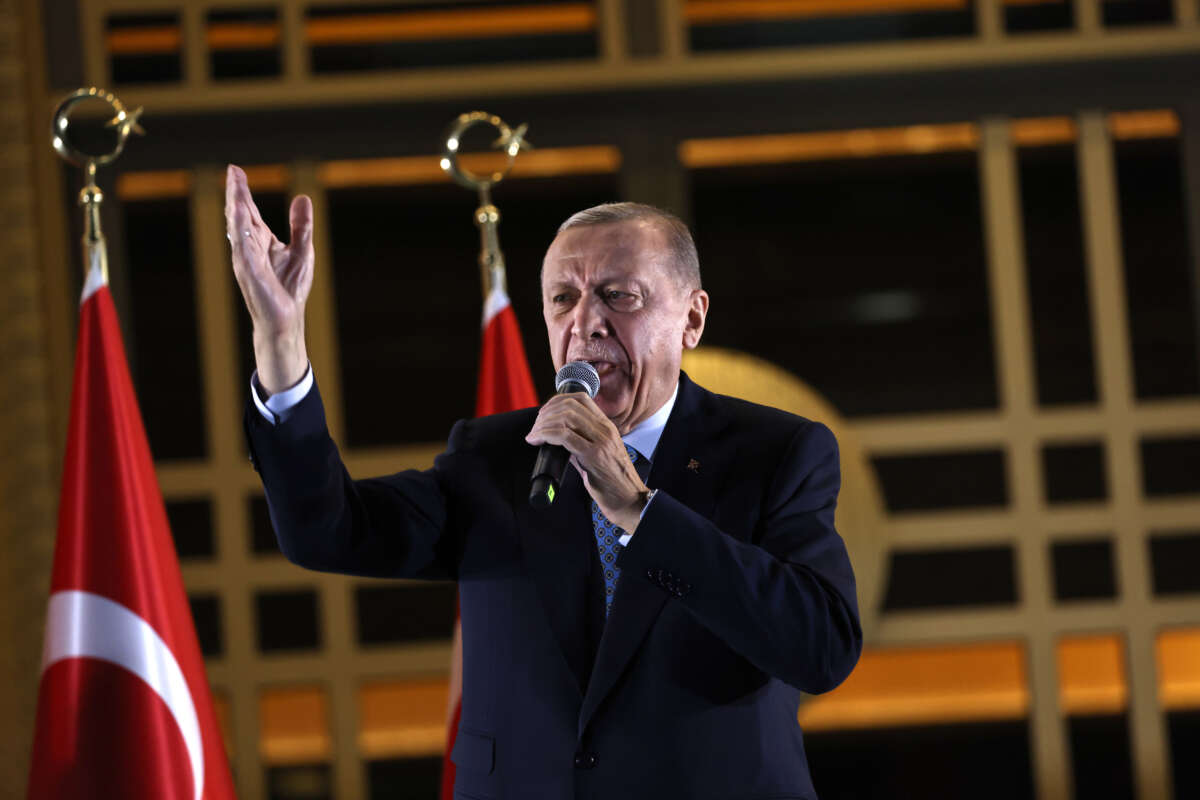
President Recep Tayyip Erdoğan speaks at the presidential palace after winning reelection in a runoff on May 28, 2023, in Ankara, Turkey.
CHRIS MCGRATH / GETTY IMAGES

On May 28, Turkish citizens went to the polls for a second round of voting in the presidential election. On the ballot, Recep Tayyip Erdoğan and his Justice and Development Party (AKP) were challenged by a six-party opposition alliance purporting to stand for an alternative politics embracing all Turks regardless of political views, religious affiliation, ethnic background, gender identity and sexual orientation. After an inconclusive first round saw Erdoğan receive just under the crucial 50 percent of the vote, Turkey’s president mustered 52.14 percent of votes in the second round on Sunday, beating his challenger, Kemal Kılıçdaroğlu, who won 47.86 percent.
The AKP’s Majoritarian Authoritarianism

The AKP’s politics can be described as antagonistic, plebiscitary, majoritarian and authoritarian. The majoritarian authoritarianism of the AKP manifested itself in its track record of censorship and interfering in elections. In 2022, with its coalition partner, the Nationalist Action Party (MHP), it introduced reforms that undermined the impartiality of the country’s supreme election authority (YSK) and reduced the possibility of appeals against irregularities during the voting or counting process being investigated and upheld. In October 2022, the so-called “censorship law” was passed to criminalise “misinformation” (effectively criticism of the government), rein in Twitter accounts critical of Erdoğan and establish tight control over online news in an information landscape where all major media are already controlled by the AKP.

Moreover, during the past 15 years, the AKP adopted a presidential leadership model with a substantially weakened parliament. Often ignoring the diversity of interests and voices within the parliamentary system, Erdoğan instead appealed to a mythical “national will of the people” to discredit and contest supreme court decisions that would uphold the rights of individuals, especially those within Turkey’s marginalized communities.

This aversion toward the expression of diversity has characterized the AKP’s crackdown on dissent. Consider the 2013 Gezi park protests, in which a localized protest near Istanbul’s Taksim Square against government plans to develop a mass shopping mall on space occupied by an urban park, and its violent suppression by the police, transmuted into a wave of mass protests throughout Turkey expressing widespread disquiet over Erdoğan’s increasingly authoritarian governance style; or the mass purges of suspected dissidents in the public sector and civil society after the 2016 coup d’état. Don’t forget when members of Academics for Peace criticized the government’s violent suppression of the Kurdish movement in southeastern Turkey were vilified and criminalized, leading to a crackdown on civil society later that year.

This emphasis on the unity of “the people” also proved to be an obstacle in the relatively brief period of negotiations with the Kurdistan Workers’ Party (PKK) that started in 2013, only to be abandoned in 2015. The end of this process ended the dialogue with the PKK. It also led to a protracted campaign to ban the leftist, pro-Kurdish Peoples’ Democratic Party (HDP) whose vision of a diverse Turkish society, relative electoral success and competition with the AKP for the Kurdish vote has challenged Erdoğan’s own narrative and strategy. A court case against HDP is ongoing with the party, which faces closure, and its politicians face a five-year ban

An alternative, more pluralistic, vision has been discernible in “democratic enclaves,” especially at the level of local government authorities controlled by the opposition, such as the Istanbul Metropolitan Municipality (İBB) under Istanbul Mayor Ekrem İmamoğlu. In these, communication strategies designed to reach the diverse communities sharing the urban space have been complemented with experimentation with more sustained, inclusive decision-making processes enabling urban citizens to express their views and inform policies such as the creation of women’s refuges, rendering recreation facilities accessible to all, co-designing neighbourhoods and creating neighbourhood forums.

More recently, in the run-up to the first round of the presidential elections, the main challenger and leader of the Republican People’s Party (CHP), Kemal Kılıçdaroğlu, attempted to project a more tolerant vision of Turkey, and a democratic commitment untypical of his party’s customary repressive and authoritarian leanings and distrust towards minorities.

In his addresses, he reflected on his Alevi identity and the diversity of Turkish society, and expressed his solidarity toward Turkey’s Kurdish citizens, urging voters not to succumb to the scapegoating of their Kurdish compatriots by the AKP. Kılıçdaroğlu’s Kurdish opening, although welcomed by the pro-Kurdish HDP that urged its supporters to vote for him, was not enthusiastically accepted by everybody in his opposition coalition, the Nation Alliance. A motley group of parties with ultranationalist, statist and Islamist standpoints, tentatively united in their determination to end Erdoğan’s rule, the Nation Alliance lacks a coherent, positive vision beyond rolling back Erdoğan’s reforms, apart from an agreement on some vague policy directions.

Kılıçdaroğlu’s CHP is itself divided, historically guided by a vision of a unitary Turkey in which Kurdish activism is deemed a threat. Party supporters were more inclined to opt for backing charismatic İmamoğlu, whose appreciation of Turkey’s diversity is complemented by a more personalistic leadership and populist style at a time when the republic’s institutions are in dire need of reinvigoration and relevance.

Meral Akşener, the leader of İYİ (the second largest coalition party), also favoring İmamoğlu’s personalistic style, hesitated to endorse Kılıçdaroğlu’s candidacy and expressed her reservations regarding an opening to the country’s Kurdish population. İYİ, an offshoot of ultranationalist MHP, represents for some a more socially acceptable version of the atavistic nationalism of its parent party and has been implicated in xenophobic, anti-minority intimidation. These unresolved issues have not deterred opposition supporters from casting their votes for Kılıçdaroğlu.

Yet, the fuzzy policy directions — and talk of return to a status quo ante whose contours the parties have not been able to agree on — have deterred ambivalent voters of pious and even conservative Kurdish backgrounds who feel that the CHP’s historical militant secularism, combined with the ultranationalism of İYİ, threaten the opportunities that Erdoğan’s rule afforded them through welfare and employment networks. These voters also benefited from legislation that allowed covered women to access public universities and employment in state agencies, and the expansion of the country’s health and welfare infrastructure.

It is this dimension of Turkey’s polarization –– the fear among those who had felt excluded from the benefits of the economic development and the politics of the pre-Erdoğan era, and who worry that they will be once more “left behind” — that has impacted on the outcome of the presidential election. Kılıçdaroğlu’s attempt to attract the nationalist vote in the second round by adopting a more uncompromising stance on the issue of the repatriation of Syrian and other refugees exposed him to criticism by Erdoğan, who reminded his supporters of the secularist nationalism of the CHP and its endorsement of military meddling in politics.
The Election Aftermath

The election outcome is unlikely to resolve the pressing challenges that Turkey is facing. The society remains bitterly divided, with the opposing sides not trusting each other. The campaigns of both coalitions primarily addressed their most faithful members. Attempts of both contenders to reach out to “the other side,” meanwhile, have not been sustained and did not reassure the intended recipients. The opposition coalition has already experienced aftershocks. Akşener has already expressed misgivings about Kılıçdaroğlu’s leadership and politics. Other voices have expressed criticism of Kılıçdaroğlu’s political style and lack of charisma and of his “imposition” as Erdoğan’s challenger. In 2024, municipal elections will occur in which the important metropolitan municipalities of Istanbul and Ankara will be bitterly fought over. Perhaps the opposition’s need to defend them from an AKP challenge and retain them might delay a split in its ranks although the centrifugal forces are already testing its coherence.

The woes of the opposition aside, it needs to be noted that the winner of this election has been the nationalist far right. Candidates had to adjust their campaign messages to woo nationalists both within their coalitions and among those voters that supported the third candidate, Sinan Oğan, or abstained in the first round. The far right’s ascendance will affect both domestic and foreign policy.

Erdoğan cannot afford to remain on bad terms with the U.S. as the success of his regional policies, including the isolation and weakening of the Autonomous Administration of North and East Syria (Rojava), depends on navigating between the U.S. and Russia and utilizing each of them as a counterweight against the other. His military needs technological upgrades (F-16 upgrades and purchases as an interim option to build up Turkey’s air capability) and wants to be included in the F-35 program from which it was kept out as Turkey bought the Russian-manufactured S-400 missile air defense system in 2019. U.S. President Biden has shown he is willing to cooperate with a “more reliable” Erdoğan with him agreeing to Sweden’s NATO accession for example.

Yet, Turkey’s relations with its former Western allies are going to be transactional. It would thus be wrong to assume that Turkey will relinquish its relative autonomy vis-a-vis the U.S., as nationalists have been pushing for greater distancing from the U.S. and the EU in favor of a more Eurasianist orientation, and as Turkey’s foreign policy depends on tactical alliances or convergences with other actors — mainly Russia.

Nationalism is also sure to inform Erdoğan’s approach to Turkey’s Kurdish population. The AKP has always been ambivalent toward the Kurdish issue as it has been enjoying the support of a large segment of the country’s conservative Kurdish population — with Erdoğan having received more than 40 percent of the vote in the southeast of the country in the presidential elections of 2014 and 2018.

The Peace Process that the AKP government embarked on between 2013 and 2015 depended on a militarily neutralised PKK and a politically weak HDP, especially after the latter’s 2015 strong election performance in the region. The emergence of Rojava and Turkey’s treatment of the Kurdish self-determination experiment there as a PKK-orchestrated existential threat led to the termination of dialogue and the securitization of the Kurdish issue.

Although Erdoğan has not shied from making appeals to his “Kurdish brothers,” and although he has embraced the Kurdish Islamist conservative HUDAPAR (Free Cause Party), any relaxation of the security measures in Kurdish populated areas will presuppose the banning and effective neutralization of the HDP and the isolation of the PKK, which is also a central goal of Erdoğan’s main nationalist ally MHP. The current impasse in the southeast of the country will thus not reach a solution anytime soon.

Turkish presence in Syria will also not easily end, as Turkey has invested considerable resources and effectively replicated the administration and infrastructure of Turkish provinces in the 9,000 square kilometers it has been occupying just as it did in the non-internationally recognised Turkish Republic of Northern Cyprus after its 1974 invasion.

Any withdrawal in the longer term is likely to follow some degree of demographic engineering with the (re)settlement of Syrian Arab Sunni refugees in Kurdish or Kurdish-settled areas, and will be conditional on some sort of Turkish “guarantee” of demographic and political arrangements amenable to Turkish state interests.

On the domestic front, Erdoğan’s election campaign heralded the start of a series of culture wars with regards to the rights of women, the LGBTIQ+ communities, and ethnic and religious minorities, whose position will continue to be undermined, especially as the production of crises may play a central role in a strategy of distractions and disorientation of the public.

But the continued ability of Erdoğan’s administration to govern Turkey and to pursue a successful foreign policy effectively depends on the economy. The policy of negative real interest rates that Erdoğan followed against the established consensus among economists, the lack of independence of the Central Bank has already reached its limits.

Short of resorting to a policy of austerity, Erdoğan is likely to seek investments and temporary support from the Gulf monarchies, deferred debt repayment from Russia and bet on increased tourism revenues but, in the longer term, he will need to address the country’s low-quality growth, propped by the construction sector, credit expansion and government spending.

Although much of the international community — weary with the war in Ukraine, with Russian aggression and with increasing Chinese influence — appears to be ready to embrace a resilient Erdoğan, governments and international civil society groups need to urgently develop strategies to support the forces and communities that have created and protected Turkey’s democratic enclaves. Moreover, they should extend their hand to refugees and to the democratic forces within the country’s Kurdish movement that are increasingly under attack, persecuted, silenced and disciplined.


Truthout is widely read among people with lower ­incomes and among young people who are mired in debt. Our site is read at public libraries, among people without internet access of their own. People print out our articles and send them to family members in prison — we receive letters from behind bars regularly thanking us for our coverage. Our stories are emailed and shared around communities, sparking grassroots mobilization.

We’re committed to keeping all Truthout articles free and available to the public. But in order to do that, we need those who can afford to contribute to our work to do so.

We’ll never require you to give, but we can ask you from the bottom of our hearts: Will you donate what you can, so we can continue providing journalism in the service of justice and truth?


SPYROS A. SOFOS  is a political sociologist and a visiting senior fellow at the Middle East Centre of the London School of Economics. He is the author of Turkish Politics and ‘The People’: Mass Mobilisation and Populism (Edinburgh University Press 2022). He has also coauthored Islam in Europe: Public Spaces and Civic Networks (Palgrave 2013) and Tormented by History: Nationalism in Greece and Turkey (Oxford University Press 2008). Spyros is also the lead editor of #RethinkingPopulism.
Bush Files to Strike Expanded Work Requirements for SNAP Out of Debt Limit Bill

“Work requirements are ineffective at best, and deadly at worst,” Rep. Cori Bush said.


By Sharon Zhang , TRUTHOUTPublishedMay 31, 2023

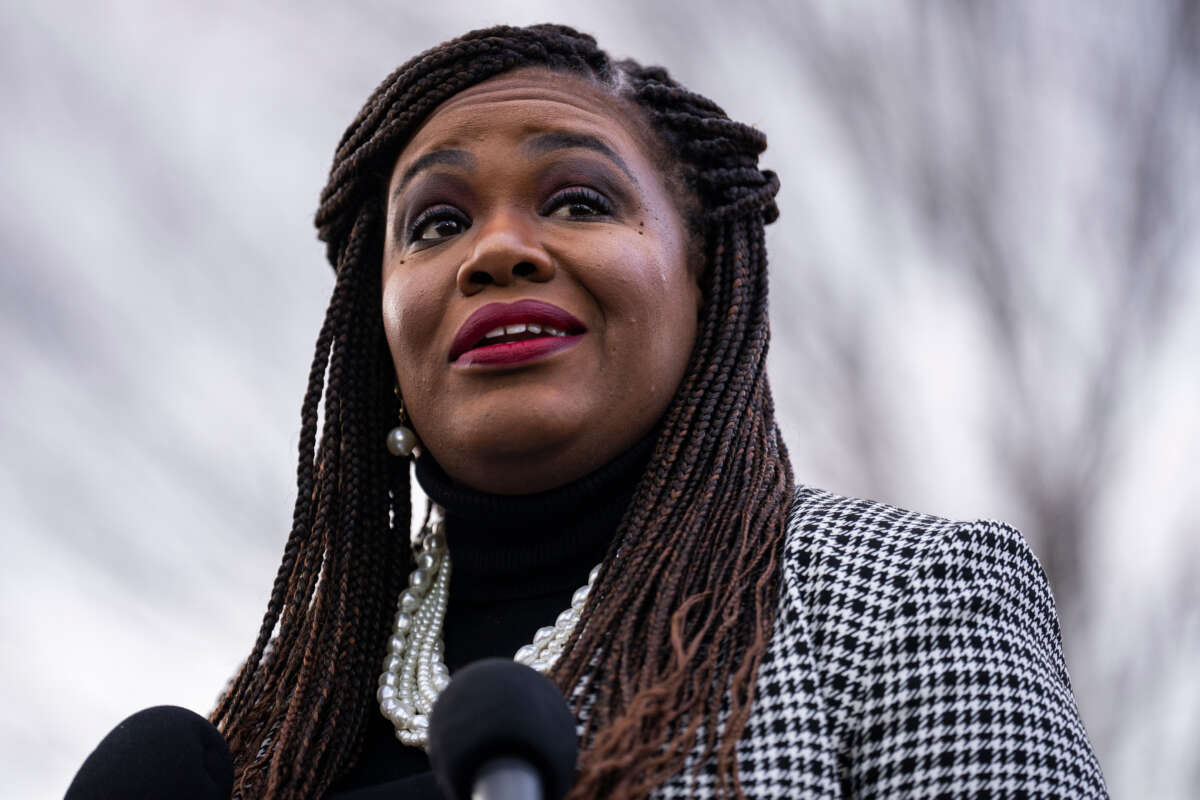
Rep. Cori Bush speaks during a news conference outside the U.S. Capitol on January 26, 2023.
TOM WILLIAMS / CQ-ROLL CALL, INC VIA GETTY IMAGES

Ahead of Wednesday’s House vote on the debt ceiling deal, progressive lawmakers have introduced a pair of amendments to remove provisions that would hurt the nation’s most economically vulnerable populations.

On Tuesday, Rep. Ayanna Pressley (D-Massachusetts) filed an amendment to the legislation that would strike a provision buried in the bill that would restart student loan payments at the end of this summer and prohibit the Biden administration from further extending the pause.

“The student loan payment pause has been an essential lifeline for workers and families struggling to make ends meet,” Pressley said in a statement on the amendment. “Republicans continue to play games with our economy, with disregard for our most vulnerable families.”

Pressley’s proposal is popular among the public. According to polling released by the Student Borrower Protection Center and Data for Progress on Tuesday, 61 percent of voters say that the payment pause should be extended if the Supreme Court strikes down Biden’s cancellation plan, which it appears poised to do.

“The pause on student loan payments remains one of the most durably popular pieces of economic policy because the American people recognize what Washington has long struggled to understand: the student loan system is broken and the burden of student debt creates a barrier to economic opportunity for all of us,” said Student Borrower Protection Center executive director Mike Pierce in a statement. “The debt limit deal raises the stakes even higher for millions of working people with student debt.”

RELATED STORY

Debt Limit Deal Prohibits Biden From Extending Student Loan Payment Pause Again
The bill would implement a sweeping change for student debt at a time of great uncertainty for borrowers.
By Sharon Zhang , TRUTHOUTMay 30, 2023


Also on Tuesday, Representatives Cori Bush (D-Missouri) and Barbara Lee (D-California) introduced an amendment to the debt limit bill that would remove an expansion to work requirements for Supplemental Nutrition Assistance Program (SNAP), or food stamps.

Republicans have proposed extending the age range in which people have to prove that they’re working in order to receive SNAP benefits — which are already notoriously hard to receive — from 49 years to 54 years old. The proposal has been harshly criticized by progressives and anti-hunger advocates, who say that such a proposal could leave thousands of people to experience food insecurity just because Republicans didn’t think they deserved to eat.

“Republicans’ insistence that the federal government rip food from vulnerable people’s mouths in order to solve their manufactured crisis is despicable and frankly outrageous,” said Bush and Lee in a joint statement about their amendment. “Work requirements are ineffective at best, and deadly at worst. Allowing people to starve and children to go hungry is not a solution to any problem — it’s racist, classist, and inhumane.”

The amendment has been cosponsored by Representatives Jamaal Bowman (D-New York), Gwen Moore (D-Wisconsin) and Rashida Tlaib (D-Michigan).

The debt ceiling deal struck between House Speaker Kevin McCarthy (R-California) and President Joe Biden furthers Republicans’ objective of weakening SNAP and reducing the number of recipients through more work requirements, though the GOP says their goal is to reduce government spending.

A Congressional Budget Office (CBO) report out Tuesday night found that, contrary to Republicans’ supposed fiscal responsibility, the SNAP changes would actually end up costing $2.1 billion more within the next ten years, while an estimated 78,000 more people would be eligible for SNAP benefits, due to new exclusions to work requirements like for veterans and people experiencing homelessness. (Bush and Lee’s amendments are targeted at getting rid of the age hike and would keep the new exclusions.)

But CBO’s findings may be overly simplistic, progressives and experts have said. The finding is “HIGHLY theoretical,” wrote The American Prospect executive editor David Dayen on Twitter on Wednesday. “There’s no funding to identify eligible people without benefits or to help them apply or find the necessary documentation. I obviously haven’t seen the model but it seems like wishful thinking to me.”

Dayen further pointed out that it is highly unlikely that SNAP would be able to inform all unhoused people, for instance, that they were newly eligible for the program, and that it could distribute and process all the paperwork necessary to prove their eligibility.Lawmakers have also expressed skepticism over the CBO finding. Rep. Jim McGovern (D-Massachusetts) told Politico that kicking hundreds of thousands of people aged 50 to 54 off of SNAP couldn’t be balanced out with the new work requirement exclusions. “This is a food benefit. So moving the deck chairs around and saying, you get food, but you don’t — that’s not a very convincing argument to me,” McGovern said.
THIRD WORLD U$A
Sanders Report Uncovers Looming Child Care Cliff If Congress Lets Funding Expire

One in 5 child care centers will soon have to decrease the number of children they serve if Congress fails to act.
PublishedMay 31, 2023
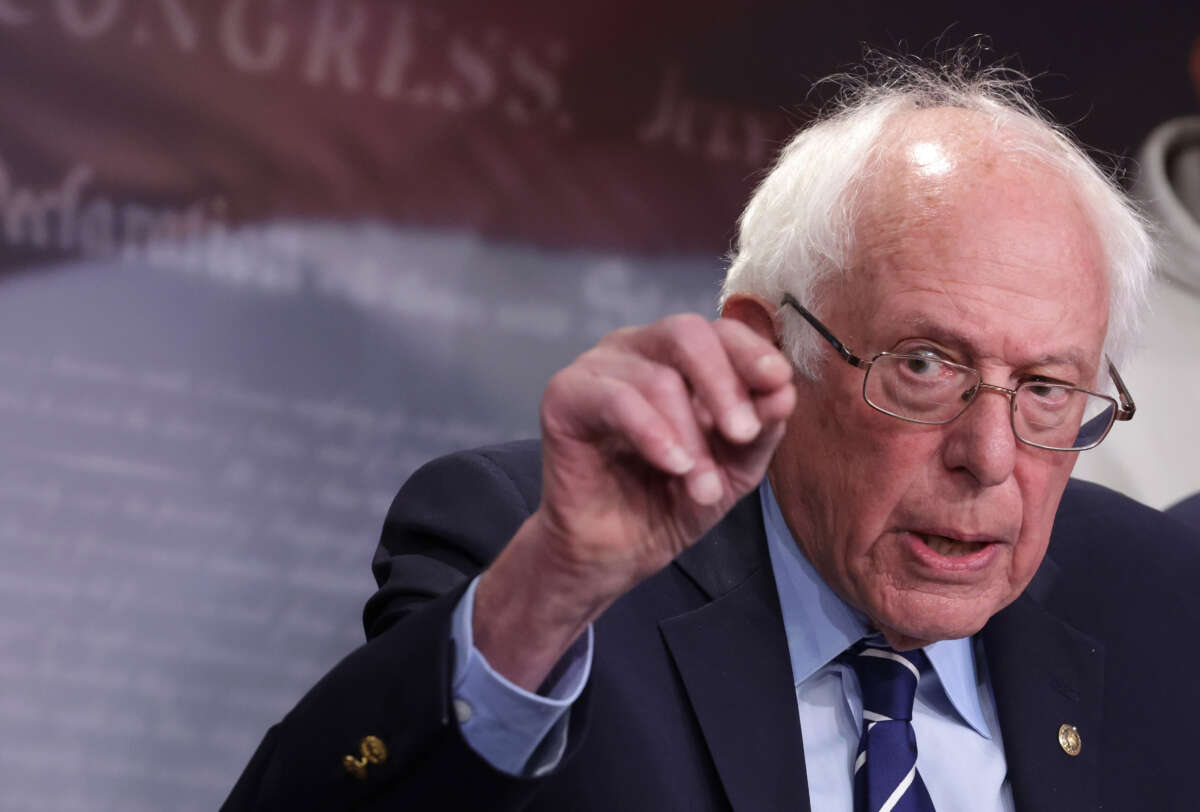
Sen. Bernie Sanders speaks during a news conference at the U.S. Capitol on May 18, 2023, in Washington, D.C.
ALEX WONG / GETTY IMAGES

Sen. Bernie Sanders (I-Vermont) released a report on Tuesday finding that the U.S. is quickly hurtling toward a child care cliff that will plunge the country even deeper into its child care crisis come September unless Congress acts.

The report, released by Health, Education, Labor and Pensions (HELP) Committee chair Sanders and member Sen. Patty Murray (D-Washington), finds that both families and child care workers will face trouble if the child care funding passed in the COVID-19 economic stimulus bills is allowed to expire this fall.

According to data from the Department of Health and Human Services (HHS), those grants have helped more than 220,000 child care providers and served nearly 10 million children across the country. This funding was a saving grace for the child care industry at a time when the industry was already in deep crisis — with sky-high prices and a vast labor shortage, which are still at play despite the increased funding of about $37.5 billion provided by various stimulus packages.

These problems will worsen when the extra aid runs out on September 30, the report finds. According to a National Association for the Education of Young Children survey of over 12,000 early child care educators conducted last November and cited by the report, 19 percent of family child care providers say they will have to cut the amount of children they can serve when the funding expires. Forty-three percent of child care center directors said they would have to raise tuition.

Meanwhile, these centers would be forced to lose or cut wages for staff, the survey found. Over one-fourth of child care providers said they would have to cut wages or salary increases, and over one-fifth of center directors said they’d have to lay off staff altogether.

RELATED STORY

Poll Finds 4 in 5 Voters Support Capping Child Care Costs for All Families in US
Polling finds that 90 percent of voters who are parents are concerned about child care costs.
By Sharon Zhang , TRUTHOUTMay 12, 2023


In an industry that has already lost 100,000 workers through the course of the pandemic, in large part due to low pay, forcing wages to stay stagnant or become even lower would be disastrous for the labor force. Bureau of Labor Statistics data shows that child care workers make a median wage of just $13.22 an hour, or $27,490 a year — not even enough for a worker to afford their own service, with child care costing about $16,000 a year on average across the country as of 2021.

On the other hand, the report cites findings from HHS that the stimulus funding has helped families of at least 700,000 children access lower health care costs. Ohio used the funding to implement provisions like free child care for eligible families, while Montana capped copayments to $10 a month for certain families. In West Virginia, administrators were able to expand child care subsidies for “essential” workers during the pandemic. And, in North Carolina and Michigan, the funding paved the way for an increase in child care subsidies for lower-income families.

Congress must authorize permanent investments in child care to begin to heal a system “that is hanging on by a thread,” the report read.

Sanders pointed out that the cost of child care is “outrageously high” in a HELP hearing on the subject on Wednesday, citing surveys that have found that roughly 40 percent of parents report being unable to afford child care and going into debt in order to obtain it.

“In other words, you want to have a child in America and you’re working class? Well, we’re going to make you pay for that. You’re going to go deeply in debt. Thank you for having a child. Not exactly what I think we should be doing as a nation,” the senator said.

“If Congress does nothing, this funding will expire on September 30th of this year, making a very bad situation worse. We cannot allow that to happen. We need to renew that vital funding,” he said.

But, Sanders added, “That is not all we need to do. We need a vision — for all those with the family values — we need a vision for the future which understands that every family in America has the right to high quality, affordable child care, that child care workers deserve decent pay for the important work they do, and we must expand the number of child care programs available so anybody in America can get the quality child care they need.”

Wednesday, May 31, 2023

74 Percent of US Voters Support Raising Federal Minimum Wage to $20 an Hour

The federal minimum wage hasn’t been raised in 14 years, a record-long stretch.
PublishedMay 30, 2023 
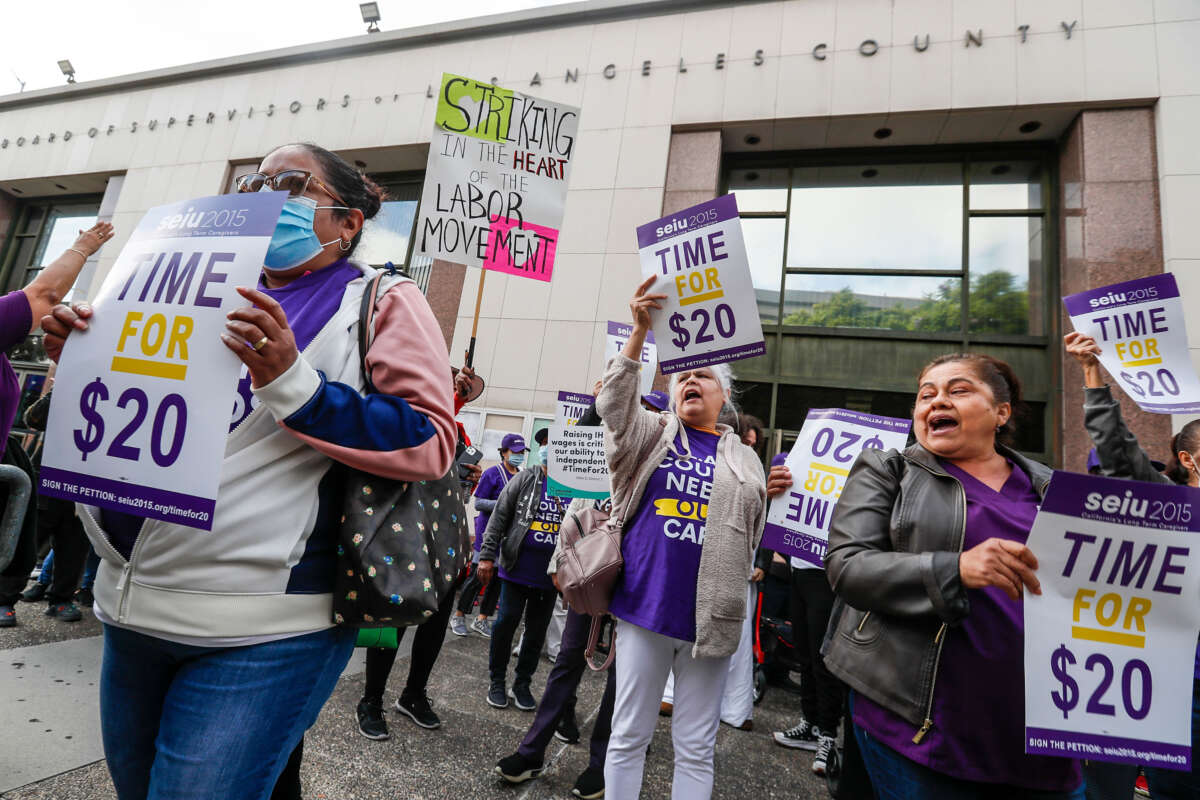
Workers who assist people with disabilities in their homes through the In-Home Supportive Services program urge the Los Angeles County Board of Supervisors to increase their pay on November 1, 2022, in Los Angeles, California.
ROBERT GAUTHIER / LOS ANGELES TIMES VIA GETTY IMAGES

Amid the longest period in Congressional history without any raising of the federal minimum wage, new polling finds that the vast majority of voters not only support raising the minimum wage, but also nearly tripling it.

According to polling by Data for Progress released last week, 74 percent of voters support raising the federal minimum wage to $20 an hour — almost three times the current level of $7.25 an hour. A majority of 50 percent of respondents said they “strongly support” the proposal, while 24 percent said they “somewhat” support it.

This support includes majorities of voters across the political spectrum. Support is strongest among Democrats, with 89 percent saying that they favor raising the minimum wage to $20 an hour. But independents and Republicans back the idea as well, with 74 percent and 60 percent support from both groups, respectively.

The polling comes amid a 14-year stretch since the last time the federal minimum wage was raised, with its real value reaching its lowest point in 67 years. The minimum wage is not a living wage – the wage required to afford basic needs like shelter – nearly anywhere in the U.S.

According to the Massachusetts Institute of Technology living wage calculator, in a typical family of four with two adults and two children, both adults would need to work 98 hours a week in order to survive on a $7.25 wage. In fact, research in 2021 found that even a $15 minimum wage — more than double the current minimum wage — isn’t a living wage in any state in the U.S. MIT’s living wage calculator estimated that, in 2021, the living wage for a family of four was $24.16 an hour, or about $100,500 a year.

RELATED STORY

ECONOMY & LABOR
In Louisiana, Rock-Bottom Minimum Wage Is Becoming a Liability for Republicans
Republicans stubbornly defend $7.25 an hour in a state where more than one in four children live in poverty.
By Mike Ludwig
May 17, 2023

A $20 an hour wage is a nonstarter in Congress. Thirty states and many municipalities have raised their minimum wage above $7.25, with four states with a minimum wage of $15 an hour.

Progressive and Democratic lawmakers have tried to raise the federal minimum wage to $15 an hour, but have been thwarted by the GOP and conservatives in their own party.

Sen. Bernie Sanders (I-Vermont) is embarking on a tour of several Southern states this week in order to promote his bill that would raise the federal minimum wage to $17 an hour, which he says should be the new benchmark after over a decade of labor activists’ Fight for $15 campaign.

The Data for Progress polling found significant support for Sanders’s proposal as well. A slightly higher proportion of voters support raising the federal minimum to $17 an hour, with 76 percent support overall and 94 percent support from Democrats.

The survey further found that voters overwhelmingly recognize that workers must be paid more than $20 an hour in order to have a “decent quality of life” — as in, being able to afford basic necessities like food and rent without struggling. Sixty-three percent of respondents said that workers must earn more than $20 an hour to have a decent quality of life. When asked to estimate a benchmark at which that quality of life could be achieved, voters responded with an average answer of $26.20.

Even if the federal minimum wage were raised, a large swath of workers like tipped workers, whose federal minimum wage is $2.13, and gig workers, would be exempt from it. In some places, voters and lawmakers have passed legislation to end the tipped wage or set a minimum wage for gig workers like Uber drivers, but the initiatives have little chance of being considered by Congress.

Truthout is widely read among people with lower ­incomes and among young people who are mired in debt. Our site is read at public libraries, among people without internet access of their own. People print out our articles and send them to family members in prison — we receive letters from behind bars regularly thanking us for our coverage. Our stories are emailed and shared around communities, sparking grassroots mobilization.

We’re committed to keeping all Truthout articles free and available to the public. But in order to do that, we need those who can afford to contribute to our work to do so.

We’ll never require you to give, but we can ask you from the bottom of our hearts: Will you donate what you can, so we can continue providing journalism in the service of justice and truth?

This article is licensed under Creative Commons (CC BY-NC-ND 4.0), and you are free to share and republish under the terms of the license.


SHARON ZHANG is a news writer at Truthout covering politics, climate and labor. Before coming to Truthout, Sharon had written stories for Pacific Standard, The New Republic, and more. She has a master’s degree in environmental studies. She can be found on Twitter: @zhang_sharon.
Trump Makes Xenophobic Campaign Pledge to End Birthright Citizenship


Over a century of legal precedent and a constitutional amendment would bar Trump from taking such an egregious action.
Published  May 31, 202
3
Former President Donald Trump is seen arriving at Trump Tower on May 28, 2023, in New York City.
JAMES DEVANEY / GC IMAGES

On Tuesday, former President Donald Trump announced on his campaign site that, if he’s elected in 2024, on his first day back in the White House he’d issue an executive order ending birthright citizenship — an action that would be unconstitutional and likely face an immediate challenge in the courts.

“As part of my plan to secure the border, on Day One of my new term in office, I will sign an executive order making clear to federal agencies that under the correct interpretation of the law, going forward, the future children of illegal aliens will not receive automatic U.S. citizenship,” Trump said in a statement, wrongly asserting that current law was being interpreted incorrectly.

In addition to claiming without evidence that his executive action would “secure the border,” Trump’s campaign website also stated that the order would stop so-called birth tourism — a practice that is so rare it is often labeled as a myth.

The announcement by Trump came during the same week as an important legal anniversary directly related to the topic of birthright citizenship. It was this week 125 years ago, in the court case United States v. Wong Kim Ark, that the Supreme Court first recognized that the 14th Amendment established the legal right of people born in the country to be citizens.

The idea that Trump could change that precedent through an executive order (or anything short of a constitutional amendment) borders on the absurd. The amendment’s first sentence says:

RELATED STORY

He’s openly helping the Saudi regime “sportswash” its human rights record while taking unknown millions from it.
By Heather Digby Parton , SALON
May 26, 2023

All persons born or naturalized in the United States, and subject to the jurisdiction thereof, are citizens of the United States and of the state wherein they reside.

Legal experts have suggested that, rather than being a serious promise to alter law, Trump’s call to end birthright citizenship is simply a dog whistle to appeal to xenophobic and bigoted far right members of his base of support.

“I think it’s pretty clear that, for political purposes, he thinks that this kind of announcement will appeal to his base,” said Stephen Yale-Loehr, an immigration law professor at Cornell University, speaking to CBS News on the matter. “It shows that he has anti-immigration credentials. And most of his voters don’t know or don’t care about whether such an executive order would be legal.”

Trump set off a firestorm of anger when he made a similar promise weeks before the 2018 midterms, stating in an interview with Axios that he’d soon make an executive order ending birthright citizenship, and that it’d be easy for him to do so in a purportedly legal way.

“It was always told to me that you needed a constitutional amendment. Guess what? You don’t,” Trump said incorrectly.

If Trump’s theory was true, it would render any section or amendment of the Constitution pointless, as presidents in the future could nullify it by decree.

Ultimately, Trump didn’t follow through on his pledge.

Fifteen professors from prestigious law schools throughout the U.S. blasted the former president in 2018 for suggesting he could ignore the rule of law and legal precedent, noting that there was “no serious scholarly debate about whether a president can, through executive action, contradict the Supreme Court’s long-standing and consistent interpretation of the Citizenship Clause of the 14th Amendment.”

Civil and immigration rights groups also condemned Trump’s bigotry. Mijente, a Latinx rights organization, described his calls for ending birthright citizenship as a “barely-veiled assault on the rights of immigrants and other communities of color” that sought to rile up his base of voters before the 2018 midterms.

“[Trump] is using us for his political purposes right now — as scapegoats, as punching bags, as bogeymen and bogeywomen, as a collection of old stereotypes to be exploited for the benefit of sowing division and hate,” the group said.

Truthout is widely read among people with lower ­incomes and among young people who are mired in debt. Our site is read at public libraries, among people without internet access of their own. People print out our articles and send them to family members in prison — we receive letters from behind bars regularly thanking us for our coverage. Our stories are emailed and shared around communities, sparking grassroots mobilization.

We’re committed to keeping all Truthout articles free and available to the public. But in order to do that, we need those who can afford to contribute to our work to do so.

We’ll never require you to give, but we can ask you from the bottom of our hearts: Will you donate what you can, so we can continue providing journalism in the service of justice and truth?

This article is licensed under Creative Commons (CC BY-NC-ND 4.0), and you are free to share and republish under the terms of the license.


CHRIS WALKER  is a news writer at Truthout, and is based out of Madison, Wisconsin. Focusing on both national and local topics since the early 2000s, he has produced thousands of articles analyzing the issues of the day and their impact on the American people. He can be found on Twitter: @thatchriswalker
Who does the U.S. owe $31.4 trillion?


Janet Nguyen
May 26, 2023

The debt limit is the amount of money the Treasury can borrow to meet its obligations. The deadline for Congress to lift the limit, lest the U.S. default, is quickly approaching. 
Chip Somodevilla/Getty Images

This is just one of the stories from our “I’ve Always Wondered” series, where we tackle all of your questions about the world of business, no matter how big or small. Ever wondered if recycling is worth it? Or how store brands stack up against name brands? Check out more from the series here.

Listener David Friedli from Murray, Nebraska, asks:

The debt limit: Who do we owe money to? Do other countries owe us money? Has anyone ever defaulted on their debt to us? Why is it that the United States’ budget and debt limit are on different timelines … wouldn’t it make great sense to have them both tied to the same deadline, perhaps forcing Congress and the executive branch to see them as one issue, not two separate discussions?

Treasury Secretary Janet Yellen has announced June 5 as the new deadline for when the U.S. could default on its debt, which she and many other experts say could lead to catastrophic economic consequences.


Debt Held by the Public
Intragovernmental Holdings

So far, the White House and Congress have failed to reach a deal to raise the government’s borrowing limit due to demands for steep spending cuts from Republican officials. Earlier this year, the U.S. hit the $31.4 trillion debt ceiling, which is the amount it’s allowed to borrow to pay existing obligations, like Social Security, Medicare benefits and military salaries. A default could mean a delay in these payments, higher borrowing costs throughout the economy, greater volatility in the stock market and a range of unpredictable effects.

But late Friday, President Joe Biden said a deal to increase the debt limit was close. Since 1960, that limit has been upped or extended about 80 times, and the nation has never defaulted. “There’s a negotiation going on,” Biden said. “I’m hopeful we’ll know by tonight whether we’re going to be able to have a deal.”

First, the debt held by the public stands at more than $24.64 trillion. This represents debt securities, like Treasury bonds and notes, bought by banks, insurance companies, state and local governments, foreign governments and private investors.

The remaining debt, which totals about $6.83 trillion, can be classified as intragovernmental holdings. This is basically debt the government owes itself. “For example, some federal trust funds invest in Treasury securities, thereby lending money to [the] Treasury,” according to the U.S. Government Accountability Office. The Social Security Administration, the Department of Defense and the United States Postal Service all have investment holdings in federal debt.

Japan
$1.1T
China (mainland)
$859.4B
United Kingdom
$668.3B
Belgium
$331.1B
Luxembourg
$318.2B
Switzerland
$290.5B
Cayman Islands
$285.3B
Canada
$254.1B
Ireland
$253.4B
Taiwan
$234.6B


In total, other territories hold about $7.4 trillion in U.S. debt. Japan owns the most at $1.1 trillion, followed by China, with $859 billion, and the United Kingdom at $668 billion.

In isolation, this $7.4 trillion amount is a lot, said Scott Morris, a senior fellow at the Center for Global Development. “But the way an economist would look at this is to say, ‘Well, how does that compare to the size of our economy?’” he said.

And when you do that, the amount of debt we owe other countries is not “particularly problematic,” Morris said.

The United States supported China’s entrance into the World Trade Organization at the turn of the millennium, which led to an export boom of Chinese goods into the U.S. China ended up parking much of its sales in U.S. Treasurys, CNN reported, because of their perceived safety as an investment. By 2008, China had overtaken Japan as the largest foreign holder of U.S. debt.

But over the past decade, Japan reclaimed its top spot. Like China, Japan also sells lots of goods to the U.S. and then invests much of the proceeds in U.S. Treasurys, explained Insider.

Has anyone defaulted on their debts to us?

Anna Gelpern, a professor at Georgetown University Law Center, said over email that many countries have owed us money and paid it late. She pointed to Britain, which took more than 60 years to pay off a $4.3 billion U.S. loan to refinance the battered country at the end of World War II. The final payment was made six years after it was supposed to come in.

In the 1930s, the country also defaulted on debt to the U.S. that it had accrued during World War I. This had lasting consequences, according to author David James Gill, with London being frozen out of U.S. securities and money markets.

But when a country is struggling to repay the money it’s borrowed, the debt might be rescheduled or even forgiven, Morris noted.

“When it comes to one government owing money to another government, you may never see a moment that is called ‘default,’” he said.

The United States has forgiven debt owed by other countries, like it did with Iraq in 2004, shortly after President George W. Bush invaded the country. In late 2000, President Bill Clinton signed a law that would "forgive or alleviate" $435 million worth of debt for the world's poorest countries.

Why don't we address the debt limit when passing the budget?

The president is supposed to submit a budget to Congress by the first Monday in February every year. Naturally, this includes estimates of the government’s income and spending. Congress is then tasked with agreeing on a joint budget resolution by April 15. But if it fails to do so by May 15, a House committee can begin the appropriations process.

If appropriations aren’t done by the start of October, then federal agencies without an appropriation can be funded through continuing resolutions, according to the Tax Policy Center.

But even though a budget has been approved, the Treasury’s ability to borrow the money to fund government operations can bump up against the debt ceiling. In the early 20th century, Congress enabled the Treasury to issue bonds without congressional approval — up to a certain amount — to provide greater flexibility. Thus, the birth of the debt ceiling.

But what was supposed to give the Treasury flexibility has become a tool for what people call political gamesmanship. To solve this issue, the Bipartisan Policy Center has proposed an approach that would link the debt limit to the annual budgeting process.

The BPC says that if Congress adopts a budget resolution by April 15, legislation to suspend the debt limit should be sent to the president. If Congress doesn’t, then the president should be able to ask Congress for a debt limit suspension that would last till the end of the fiscal year.

A bipartisan bill known as the Responsible Budgeting Act, which ties these goals together, was introduced in Congress in 2021 and endorsed by the BPC. Under the bill, a concurrent budget resolution should meet “a certain fiscal threshold” by reducing the ratio of debt to gross domestic product by at least 5 percentage points in the 10th year.

“These recurring debt limit episodes showcase that there really is no time on the congressional calendar that lawmakers have set aside to really debate about our future fiscal path,” said Rachel Snyderman, director of economic policy at BPC.

Attempts to align the debt limit and budget-making have been difficult because it would require reform to the budget process itself, Snyderman said. She added that it’s already tough enough for Congress to pass 12 appropriation bills each year for discretionary funding.

But there are some lawmakers and groups, including the Center on Budget and Policy Priorities, who say the United States should abolish the debt limit entirely so we don’t run into this issue.

"Using the debt ceiling as a bargaining chip is always irresponsible, but it’s especially dangerous given recent turmoil in the banking industry and interest-rate increases by the [Federal Reserve] to address inflation," the CBPP wrote on its website.
Tech layoffs ravage the teams that fight online misinformation and hate speech

CNBC
UPDATED SAT, MAY 27 2023
Hayden Field@HAYDENFIELD
Jonathan Vanian@JONATHANVANIAN

KEY POINTS
Meta, Amazon, Alphabet and Twitter have all drastically reduced the size of their teams focused on internet trust and safety as well as ethics as the companies focus on cost cuts.

As part of Meta’s mass layoffs, the company ended a fact-checking project that had taken half a year to build, according to people familiar with the matter.

“Abuse actors are usually ahead of the game; it’s cat and mouse,” said Arjun Narayan, who previously served as a trust and safety lead at Google and ByteDance.


Mark Zuckerberg, chief executive officer of Meta Platforms Inc., left, arrives at federal court in San Jose, California, US, on Tuesday, Dec. 20, 2022.
David Paul Morris | Bloomberg | Getty Images

Toward the end of 2022, engineers on Meta’s team combating misinformation were ready to debut a key fact-checking tool that had taken half a year to build. The company needed all the reputational help it could get after a string of crises had badly damaged the credibility of Facebook and Instagram and given regulators additional ammunition to bear down on the platforms.

The new product would let third-party fact-checkers like The Associated Press and Reuters, as well as credible experts, add comments at the top of questionable articles on Facebook as a way to verify their trustworthiness.

But CEO Mark Zuckerberg’s commitment to make 2023 the “year of efficiency” spelled the end of the ambitious effort, according to three people familiar with the matter who asked not to be named due to confidentiality agreements.

Over multiple rounds of layoffs, Meta announced plans to eliminate roughly 21,000 jobs, a mass downsizing that had an outsized effect on the company’s trust and safety work. The fact-checking tool, which had initial buy-in from executives and was still in a testing phase early this year, was completely dissolved, the sources said.

A Meta spokesperson did not respond to questions related to job cuts in specific areas and said in an emailed statement that “we remain focused on advancing our industry-leading integrity efforts and continue to invest in teams and technologies to protect our community.”

Across the tech industry, as companies tighten their belts and impose hefty layoffs to address macroeconomic pressures and slowing revenue growth, wide swaths of people tasked with protecting the internet’s most-populous playgrounds are being shown the exits. The cuts come at a time of increased cyberbullying, which has been linked to higher rates of adolescent self-harm, and as the spread of misinformation and violent content collides with the exploding use of artificial intelligence.

In their most recent earnings calls, tech executives highlighted their commitment to “do more with less,” boosting productivity with fewer resources. Meta, Alphabet, Amazon and Microsoft have all cut thousands of jobs after staffing up rapidly before and during the Covid pandemic. Microsoft CEO Satya Nadella recently said his company would suspend salary increases for full-time employees.

The slashing of teams tasked with trust and safety and AI ethics is a sign of how far companies are willing to go to meet Wall Street demands for efficiency, even with the 2024 U.S. election season — and the online chaos that’s expected to ensue — just months away from kickoff. AI ethics and trust and safety are different departments within tech companies but are aligned on goals related to limiting real-life harm that can stem from use of their companies’ products and services.

“Abuse actors are usually ahead of the game; it’s cat and mouse,” said Arjun Narayan, who previously served as a trust and safety lead at Google and TikTok parent ByteDance, and is now head of trust and safety at news aggregator app Smart News. “You’re always playing catch-up.”

For now, tech companies seem to view both trust and safety and AI ethics as cost centers.

Twitter effectively disbanded its ethical AI team in November and laid off all but one of its members, along with 15% of its trust and safety department, according to reports. In February, Google cut about one-third of a unit that aims to protect society from misinformation, radicalization, toxicity and censorship. Meta reportedly ended the contracts of about 200 content moderators in early January. It also laid off at least 16 members of Instagram’s well-being group and more than 100 positions related to trust, integrity and responsibility, according to documents filed with the U.S. Department of Labor.

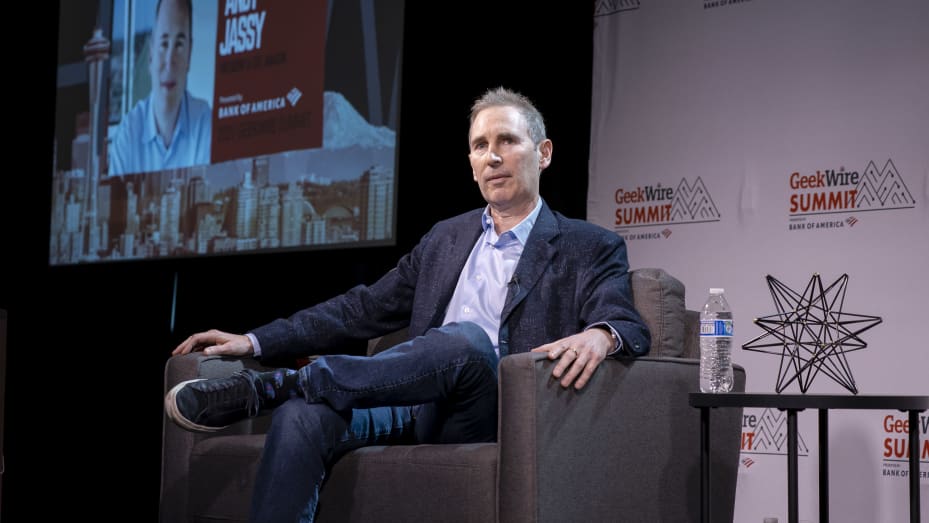
Andy Jassy, chief executive officer of Amazon.Com Inc., during the GeekWire Summit in Seattle, Washington, U.S., on Tuesday, Oct. 5, 2021.
David Ryder | Bloomberg | Getty Images

In March, Amazon downsized its responsible AI team and Microsoft laid off its entire ethics and society team – the second of two layoff rounds that reportedly took the team from 30 members to zero. Amazon didn’t respond to a request for comment, and Microsoft pointed to a blog post regarding its job cuts.

At Amazon’s game streaming unit Twitch, staffers learned of their fate in March from an ill-timed internal post from Amazon CEO Andy Jassy.

Jassy’s announcement that 9,000 jobs would be cut companywide included 400 employees at Twitch. Of those, about 50 were part of the team responsible for monitoring abusive, illegal or harmful behavior, according to people familiar with the matter who spoke on the condition of anonymity because the details were private.

The trust and safety team, or T&S as it’s known internally, was losing about 15% of its staff just as content moderation was seemingly more important than ever.

In an email to employees, Twitch CEO Dan Clancy didn’t call out the T&S department specifically, but he confirmed the broader cuts among his staffers, who had just learned about the layoffs from Jassy’s post on a message board.

“I’m disappointed to share the news this way before we’re able to communicate directly to those who will be impacted,” Clancy wrote in the email, which was viewed by CNBC.

‘Hard to win back consumer trust’

A current member of Twitch’s T&S team said the remaining employees in the unit are feeling “whiplash” and worry about a potential second round of layoffs. The person said the cuts caused a big hit to institutional knowledge, adding that there was a significant reduction in Twitch’s law enforcement response team, which deals with physical threats, violence, terrorism groups and self-harm.

A Twitch spokesperson did not provide a comment for this story, instead directing CNBC to a blog post from March announcing the layoffs. The post didn’t include any mention of trust and safety or content moderation.

Narayan of Smart News said that with a lack of investment in safety at the major platforms, companies lose their ability to scale in a way that keeps pace with malicious activity. As more problematic content spreads, there’s an “erosion of trust,” he said.

“In the long run, it’s really hard to win back consumer trust,” Narayan added.

While layoffs at Meta and Amazon followed demands from investors and a dramatic slump in ad revenue and share prices, Twitter’s cuts resulted from a change in ownership.

Almost immediately after Elon Musk closed his $44 billion purchase of Twitter in October, he began eliminating thousands of jobs. That included all but one member of the company’s 17-person AI ethics team, according to Rumman Chowdhury, who served as director of Twitter’s machine learning ethics, transparency and accountability team. The last remaining person ended up quitting.

The team members learned of their status when their laptops were turned off remotely, Chowdhury said. Hours later, they received email notifications.

“I had just recently gotten head count to build out my AI red team, so these would be the people who would adversarially hack our models from an ethical perspective and try to do that work,” Chowdhury told CNBC. She added, “It really just felt like the rug was pulled as my team was getting into our stride.”

Part of that stride involved working on “algorithmic amplification monitoring,” Chowdhury said, or tracking elections and political parties to see if “content was being amplified in a way that it shouldn’t.”

Chowdhury referenced an initiative in July 2021, when Twitter’s AI ethics team led what was billed as the industry’s first-ever algorithmic bias bounty competition. The company invited outsiders to audit the platform for bias, and made the results public.

Chowdhury said she worries that now Musk “is actively seeking to undo all the work we have done.”

“There is no internal accountability,” she said. “We served two of the product teams to make sure that what’s happening behind the scenes was serving the people on the platform equitably.”

Twitter did not provide a comment for this story.


WATCH NOW
VIDEO04:02
Ad giant IPG advises brands to pause Twitter advertising after Musk takeover


Advertisers are pulling back in places where they see increased reputational risk.

According to Sensor Tower, six of the top 10 categories of U.S. advertisers on Twitter spent much less in the first quarter of this year compared with a year earlier, with that group collectively slashing its spending by 53%. The site has recently come under fire for allowing the spread of violent images and videos.

The rapid rise in popularity of chatbots is only complicating matters. The types of AI models created by OpenAI, the company behind ChatGPT, and others make it easier to populate fake accounts with content. Researchers from the Allen Institute for AI, Princeton University and Georgia Tech ran tests in ChatGPT’s application programming interface (API), and found up to a sixfold increase in toxicity, depending on which type of functional identity, such as a customer service agent or virtual assistant, a company assigned to the chatbot.

Regulators are paying close attention to AI’s growing influence and the simultaneous downsizing of groups dedicated to AI ethics and trust and safety. Michael Atleson, an attorney at the Federal Trade Commission’s division of advertising practices, called out the paradox in a blog post earlier this month.

“Given these many concerns about the use of new AI tools, it’s perhaps not the best time for firms building or deploying them to remove or fire personnel devoted to ethics and responsibility for AI and engineering,” Atleson wrote. “If the FTC comes calling and you want to convince us that you adequately assessed risks and mitigated harms, these reductions might not be a good look.”
 
Meta as a bellwether


For years, as the tech industry was enjoying an extended bull market and the top internet platforms were flush with cash, Meta was viewed by many experts as a leader in prioritizing ethics and safety.

The company spent years hiring trust and safety workers, including many with academic backgrounds in the social sciences, to help avoid a repeat of the 2016 presidential election cycle, when disinformation campaigns, often operated by foreign actors, ran rampant on Facebook. The embarrassment culminated in the 2018 Cambridge Analytica scandal, which exposed how a third party was illicitly using personal data from Facebook.

But following a brutal 2022 for Meta’s ad business — and its stock price — Zuckerberg went into cutting mode, winning plaudits along the way from investors who had complained of the company’s bloat.

Beyond the fact-checking project, the layoffs hit researchers, engineers, user design experts and others who worked on issues pertaining to societal concerns. The company’s dedicated team focused on combating misinformation suffered numerous losses, four former Meta employees said.

Prior to Meta’s first round of layoffs in November, the company had already taken steps to consolidate members of its integrity team into a single unit. In September, Meta merged its central integrity team, which handles social matters, with its business integrity group tasked with addressing ads and business-related issues like spam and fake accounts, ex-employees said.

In the ensuing months, as broader cuts swept across the company, former trust and safety employees described working under the fear of looming layoffs and for managers who sometimes failed to see how their work affected Meta’s bottom line.

For example, things like improving spam filters that required fewer resources could get clearance over long-term safety projects that would entail policy changes, such as initiatives involving misinformation. Employees felt incentivized to take on more manageable tasks because they could show their results in their six-month performance reviews, ex-staffers said.

Ravi Iyer, a former Meta project manager who left the company before the layoffs, said that the cuts across content moderation are less bothersome than the fact that many of the people he knows who lost their jobs were performing critical roles on design and policy changes.

“I don’t think we should reflexively think that having fewer trust and safety workers means platforms will necessarily be worse,” said Iyer, who’s now the managing director of the Psychology of Technology Institute at University of Southern California’s Neely Center. “However, many of the people I’ve seen laid off are amongst the most thoughtful in rethinking the fundamental designs of these platforms, and if platforms are not going to invest in reconsidering design choices that have been proven to be harmful — then yes, we should all be worried.”

A Meta spokesperson previously downplayed the significance of the job cuts in the misinformation unit, tweeting that the “team has been integrated into the broader content integrity team, which is substantially larger and focused on integrity work across the company.”

Still, sources familiar with the matter said that following the layoffs, the company has fewer people working on misinformation issues.

WATCH NOW
VIDEO04:09
Meta Q1 earnings were a ‘tour de force’, says Wedgewood’s David Rolfe


For those who’ve gained expertise in AI ethics, trust and safety and related content moderation, the employment picture looks grim.

Newly unemployed workers in those fields from across the social media landscape told CNBC that there aren’t many job openings in their area of specialization as companies continue to trim costs. One former Meta employee said that after interviewing for trust and safety roles at Microsoft and Google, those positions were suddenly axed.

An ex-Meta staffer said the company’s retreat from trust and safety is likely to filter down to smaller peers and startups that appear to be “following Meta in terms of their layoff strategy.”

Chowdhury, Twitter’s former AI ethics lead, said these types of jobs are a natural place for cuts because “they’re not seen as driving profit in product.”

“My perspective is that it’s completely the wrong framing,” she said. “But it’s hard to demonstrate value when your value is that you’re not being sued or someone is not being harmed. We don’t have a shiny widget or a fancy model at the end of what we do; what we have is a community that’s safe and protected. That is a long-term financial benefit, but in the quarter over quarter, it’s really hard to measure what that means.”

At Twitch, the T&S team included people who knew where to look to spot dangerous activity, according to a former employee in the group. That’s particularly important in gaming, which is “its own unique beast,” the person said.

Now, there are fewer people checking in on the “dark, scary places” where offenders hide and abusive activity gets groomed, the ex-employee added.

More importantly, nobody knows how bad it can get.
USE A SKULL AND CROSSBONES
Canada to require warning labels on individual cigarettes

Agence France-Presse
May 31, 2023

A woman smoking a cigarette [Shutterstock]

The messaging, to be phased in starting August 1, will include lines such as "Poison in every puff," "Tobacco smoke harms children" and "Cigarettes cause cancer."

Addictions Minister Carolyn Bennett said tobacco use continues to kill 48,000 Canadians each year. The new labelling rule is a world first, she said, although Britain has flirted with a similar regulation.

"This bold step will make health warning messages virtually unavoidable and, together with updated graphic images displayed on the package, will provide a real and startling reminder of the health consequences of smoking," Bennett said.

The Canadian government noted that some young people, who are particularly susceptible to the risk of tobacco dependence, start smoking after being given a single cigarette rather than a pack labeled with health warnings.

In 2000, Canada became the first country to order graphic warnings on packs of cigarettes -- including grisly pictorials of diseased hearts and lungs -- to raise awareness of the health hazards associated with tobacco use.

Smoking has been trending down over the past two decades.

Ottawa aims to further reduce the number of smokers in the country to five percent of the population, or about 2 million people, by 2035 -- from about 13 percent currently.

According to government data, almost half of the country's health care costs are linked to substance use.

© 2023 AFP

E-cigarettes won’t help you quit smoking regular cigarettes, study suggests

E-cigarettes won’t help you quit smoking regular cigarettes, study suggestsVuse e-cigarette packages are seen displayed at Cigar N Vape on Oct. 13, 2021 in the Park Slope neighborhood of the Brooklyn borough in New York City. - Michael M. Santiago/Getty Images North America/TNS