Wednesday, October 18, 2023

SELF CENSORING BOOK FAIRS U$A

For children's books on LGBTQ, race, Scholastic had a solution. Librarians weren't happy

Zachary Schermele, USA TODAY
Updated Wed, October 18, 2023 at 2:04 PM MDT·4 min read

Scholastic, the world’s largest publisher and distributor of children’s books, is separating some books with LGBTQ themes and discussions of race in a special book fair collection, which elementary schools can opt into – or out of.

It’s not going over well.

The collection – called “Share Every Story, Celebrate Every Voice” – was originally curated, the company said, to protect teachers and librarians in the dozens of states and districts that have passed laws or policies prohibiting specific types of books from being in schools.

“These laws create an almost impossible dilemma: back away from these titles or risk making teachers, librarians, and volunteers vulnerable to being fired, sued, or prosecuted,” the publisher wrote in a public statement Friday.

"We don’t pretend this solution is perfect – but the other option would be to not offer these books at all – which is not something we’d consider," the statement said.

Scholastic pulls controversial book: "A birthday cake for George Washington" yanked over portrayal of slavery

But the effort has dismayed some authors and librarians. One middle school librarian in Louisiana told the School Library Journal she is canceling her book fair this year over the controversy. Some bestselling authors urged schools in recent days to look elsewhere for book fairs.

“So @Scholastic has a No Diversity Option and Librarians have to Opt In to get diverse books now,” wrote Jacqueline Woodson, the award-winning author of the novel “Brown Girl Dreaming,” in a social media post Friday. “Other Options for Book Fairs?”
'Easing the way for book banning extremists'

The controversy demonstrates yet another seemingly rote custom in American society becoming a casualty of culture-war politics. For decades, Scholastic's popular book fairs have been a fall staple of many libraries, especially in public elementary schools, where children near the start of every school year eagerly await the arrival of new books.

In a statement Tuesday, the free speech and literary organization PEN America called on Scholastic to reject any role in accommodating “nefarious laws and local pressures,” or risk being an “accessory to government censorship.”

“What we understand was conceived as a practical adaptation to keep book fairs going in a fraught legal and political climate is clearly at risk of being twisted to accomplish censorious ends,” the group said.

A petition circulating online from Red Wine and Blue, a political group of liberal mothers that is something of an anti-Moms for Liberty, says Scholastic has "eased the way for book banning extremists."

What's behind the surge in book bans? A low-tech website tied to Moms for Liberty
'Diverse' titles in every book fair

Scholastic stressed it provides diverse titles to every book fair. It blamed much of the reproval on misconceptions.

“The biggest misconception is that Scholastic Book Fairs is putting all diverse titles into one optional case,” the company said. “This is not true, in any school, in any location we serve.”

According to a list provided to USA TODAY by Scholastic, some of the roughly 60 titles in the collection include “All Are Welcome,” a children’s book by Alexandra Penfold, which features same-sex and interracial parents. Another is “Justice Ketanji,” by author Denise Lewis Patrick, who charts the path of Ketanji Brown Jackson to becoming the first Black woman to serve on the Supreme Court.

Another on the Scholastic list is "Alma and How She Got Her Name" by Juana Martinez-Neal. It's a picture book that has won a Caldecott Medal.

"The little girl, Alma, as well as all of her family are rendered in pencil with the color of their skin being the paper itself, to encourage all children to more easily see themselves in them," Martinez-Neal told USA TODAY in her first comments about challenges to her book.

"Until today, I made no comments. I needed to understand the reasoning behind the banning. I have yet to find out the reasons. I tried so hard to make a book for all young readers, I can only ask why?" Martinez-Neal said. "What is it about the story of a little girl’s name and her family that they want to keep from children? More so, who is deciding to exclude this book?"

Book fair hosts in every state have included the new collection in their fairs, Scholastic spokesperson Anne Sparkman said in an email to USA TODAY. When local laws or policies create content restrictions, many fairs make the collection available during a special time when parents can come, too, she said.

The American Library Association released preliminary data in September showing public libraries have seen a record surge in book banning efforts this year. The organization compiled nearly 2,000 challenges to unique books between January 1 and Aug. 31 of this year. That number is up 20% from the same period last year, ALA said.

"Book fairs are a celebration of reading and a moment that students look forward to each year − their faces light up every time they crack open the pages of a new book," said Brandon Wolf, national press secretary for the Human Rights Campaign. "All students − no matter their background, sexual orientation, or gender identity − deserve that joy, to feel safe and welcomed in schools, and to see their lives reflected in the stories they read."

Zachary Schermele is a breaking news and education reporter for USA TODAY. You can reach him by email at zschermele@usatoday.com. Follow him on X at @ZachSchermele.

This article originally appeared on USA TODAY: Scholastic siloed children's books on LGBTQ and race, librarians say

Scholastic to separate books on race, gender and sexuality for book fairs

Adrian Horton
Wed, October 18, 2023 

Photograph: Amy Sussman/WireImage

The children’s book publisher Scholastic said it will separate titles in its elementary school book fairs by race, gender and sexuality, allowing school districts to include or exclude the list.

The decision is a response to dozens of state laws restricting how the topics are discussed in schools, which Scholastic has opposed. Districts can now opt out of the new list, called the Share Every Story, Celebrate Every Voice catalog, or choose specific titles from it.

Related: ‘Criminal liability for librarians’: the fight against US rightwing book bans

The new catalog of 64 titles includes biographies of the supreme court justice Ketanji Brown Jackson and the civil rights icon John Lewis; the memoir I Am Ruby Bridges, on the experience of desegregating schools; the picture book Change Sings by the poet Amanda Gorman; The Storyteller, a middle grade novel about a Cherokee boy; and the disability-positive titles You Are Enough and You Are Loved.

In a statement last week, Scholastic said it created the separate catalog to continue offering diverse books in a hostile legislative environment that could threaten school districts, teachers or librarians. “There is now enacted or pending legislation in more than 30 US states prohibiting certain kinds of books from being in schools – mostly LGBTQIA+ titles and books that engage with the presence of racism in our country,” it said. “Because Scholastic Book Fairs are invited into schools, where books can be purchased by kids on their own, these laws create an almost impossible dilemma: back away from these titles or risk making teachers, librarians and volunteers vulnerable to being fired, sued or prosecuted.

“We cannot make a decision for our school partners around what risks they are willing to take, based on the state and local laws that apply to their district,” the statement added, “so these topics and this collection have been part of many planning calls that happen in advance of shipping a fair.

“We don’t pretend this solution is perfect – but the other option would be to not offer these books at all – which is not something we’d consider.”

Alongside PEN America, Scholastic has signed an open letter condemning book bans on the state and local level. But the Share Every Story catalog demonstrates the difficulty of continuing to do business in states in which restrictions on diverse titles could put schools and teachers in jeopardy.

Florida, for example, recently passed a law that would allow educators to be fired, and school districts to be sued or fined, for teaching banned material on race, gender or sexuality. Some school districts in the state are now requiring parents to fill out permission slips for their children to attend book fairs.

In a Tuesday statement, PEN America called Scholastic a “valued partner”, but said it disagreed with the publisher’s decision to create the Share Every Story catalog. “We call on Scholastic to explore other solutions so they can reject any role in accommodating these nefarious laws,” the organization said.

“To be clear, it is essential to lay blame on the legislators and activists who are putting Scholastic and other publishers in an impossible bind when it comes to the distribution of a diverse range of books,” the PEN statement continued, noting the “climate of fear” at work in schools and libraries.

But “sequestering books on these topics risks depriving students and families of books that speak to them. It will deny the opportunity for all students to encounter diverse stories that increase empathy, understanding, and reflect the range of human experiences and identities which are essential underpinnings of a pluralistic, democratic society.”

Scholastic hosts about 120,000 book fairs annually, according to the publisher, which began the practice in 1981. The fairs, which generate about $200m in profits shared with schools, reaches about 35 million children annually in all 50 states and internationally.


Why Everyone Is So Mad at … the Scholastic Book Fair?

Rebecca Onion
SLATE
Tue, October 17, 2023 

Yung Wing School, P.S. 124, in New York City. Michael Loccisano/Getty Images

The Scholastic Book Fair, the still-trucking darling of the nostalgic internet, is in trouble. For weeks, librarians have been reporting an odd experience: When they went to order books for this fall’s book fairs, they were given the option to “opt in” to offer books with LGBTQ+ themes and “diverse” storylines. On Reddit almost a month ago, many librarians corroborated a poster’s firsthand report of this phenomenon unfolding at their school. In a series of TikToks from late September, a librarian told the story of being asked to opt in and saying yes. She followed up with a video of an unboxing of all the books that came in that opt-in collection: Lincoln Peirce’s graphic novel Big Nate: Payback Time!, an installment in a series that has previously been dinged for being too “sexual” (“That would sell like hotcakes,” the librarian remarked); Picture Day, by Sarah Sax, another graphic novel in which a middle-school girl asks another girl on a date; Chris “Ludacris” Bridges’ picture book Daddy and Me and the Rhyme to Be; a John Lewis bio; and a Ketanji Brown Jackson bio, because what’s more controversial than that?

After news of the checkbox spread, Scholastic finally issued a press release in response on Friday. The company called the idea that the fairs “put all diverse titles into one optional case” a “misconception.” Instead, Scholastic said, in order to protect “teachers, librarians, and volunteers” who work in states with laws about critical race theory and discussion of LGBTQ+ issues in schools from being “fired, sued, or prosecuted,” it had created an “additional collection”—called “Share Every Story, Celebrate Every Voice”—while maintaining that there are still “diverse titles throughout every book fair, for every age level.”

Though the statement is mealy-mouthed, Scholastic is not inventing a threat here. A teacher in Georgia was fired over the summer after a parent complained about her reading to her fifth-grade class Scott Stuart’s My Shadow Is Purple, a book about gender identity that the teacher says she purchased at the school’s book fair. (The teacher is appealing the termination to the state’s board of education.) Last year, one Texas school canceled its Scholastic book fairs, alleging that two students had purchased “adult” books inappropriate for their age at the fairs in the spring. These cases weren’t mentioned in the press release, but they seem to offer a good example of this kind of risk.

Scholastic, a brand name that doesn’t quite rival Disney but comes close in its particular realm, is a great target for right-wing culture warriors: a beloved purveyor of American children’s content that has long been perceived as a giant of the monoculture. The right-wing publisher Brave Books (“Pro-God, Pro-America children’s books”) ran an anti-Scholastic campaign earlier this year, promoting its own right-wing “book fair” by targeting Scholastic directly. If you put your email address into its website, Brave will send you a PDF with images from specific Scholastic books alongside some pronoun-specifying social media bios and personal photos of Scholastic authors. It mentions that Scholastic’s “largest shareholders include BlackRock and Vanguard” (boogeymen of the populist right) and calls the fair’s books “sick.”

“We all remember the Scholastic Book Fairs of our childhood, with the colorful book displays and the wish-list flyers,” Brave’s anti-Scholastic PDF says. “Scholastic’s iconic Book Fairs have been the primary mode of getting these books into children’s hands.” But the company, Brave warns darkly, is not the same as you remember, and “has had a dramatic shift in its mission and principles.”

On this, people on either side of the political spectrum may now agree. Anti–book banners online thought Friday’s Scholastic press release was far from sufficient, calling the company’s position “craven,” “disgusting,” and “gutless.” “I understand if a librarian needs to separate out certain books because displaying them will put them in danger,” wrote graphic novelist and Scholastic author Molly Knox Ostertag, in a much more understanding response than most. “But I fundamentally don’t think that is a call the publisher should be making for them.”

Scholastic’s down-the-middle response had such a harsh reception in part because its internet audience is made up of bookish people for whom loving the Scholastic Book Fair is a marker of identity and tribe. YouTube is full of Scholastic Book Fair nostalgia videos made by happy nerds who seem to get good viewership simply by remembering how it was. Back in 2017, Vox ran an explainer on the “nostalgic joys of the Scholastic book fair,” citing a since-deleted tweet: “Marry someone who makes you feel the way you felt during scholastic book fair week in grade school.”

Many of these people, I might gently suggest, have no memory of what a toy store the book fair actually can be. I took a photo of my kindergartner’s book fair “wish list” last spring because it was so amazing. In careful handwriting, the aide who accompanied my 5-year-old around the fair preview filled out the list of “titles” she earmarked for purchase: “1. Mini backpack. 2. Bear highlighter pen. 3. Rainbow bookmark. 4. Jelly fish pen.” The litany of tchotchkes continued onto the back for 20 entries, containing not one single book. (She ended up with a book with a mermaid necklace embedded on the cover.) In other words, the Scholastic Book Fair may be iconic, but for many reasons, it was already far from perfect.

Before Scholastic consolidated the national school book-fair market in the 1990s, there were other choices. Will the politics of the book-banning era provoke an undoing of its chokehold on the category? After author Jacqueline Woodson tweeted about Scholastic’s press release, asking for “other options for book fairs,” many replies mentioned collaborations with local indie bookstores, as well as a startup called Literati. (Literati touts its fairs’ lack of trinkets as a selling point.) But while profits from Scholastic’s book fairs fell, for obvious reasons, during the height of the COVID-19 pandemic, the company says, the business has now recovered. In September, Scholastic CEO Peter Warwick described the spending at Scholastic book fairs as now “very strong.”

On Monday morning, Scholastic’s official account on X posted a meme-ified viral tweet from 2017. Back then, @emsenesac wrote: “U ever smell the air and it smells like the fourth grade scholastic book fair on a chilly Tuesday in October of 2007”? The replies were not positive. “Cowards!” tweeted one. “Go hug a book burner,” added another. The dreaded “opt-in” box may not be the death of the Scholastic Book Fair this time, but it’s clear the company has so far only found a solution that will make no one happy.

Column: Angry over antisemitism, billionaires are seeking to cancel free speech on campus

Michael Hiltzik
Wed, October 18, 2023 

Palestinian supporters demonstrate during a protest at Columbia University in New York on Oct. 12. (Yuki Iwamura/Associted Press)

The announcement by billionaire Leslie Wexner, the former boss of the Limited and Victoria's Secret, that his foundation is cutting its ties with Harvard University over that institution's inadequate response to the Oct. 7 Hamas terror attack in Israel raises a couple of questions.

One is how he would have had the university respond to the attack? The other is why did Harvard continue to accept donations from Wexner, given the billionaire's long relationship with sex trafficker Jeffrey Epstein?

We'll probe the later issue in a moment. But the first question is pertinent to what is emerging as a sort of billionaires' cancel campaign against the Ivy League universities and other institutions that have enjoyed their patronage for about as long as America has had billionaires.

We unequivocally — and emphatically — condemn antisemitism as antithetical to our institutional values. As a university, we also fiercely support the free exchange of ideas as central to our educational mission.

University of Pennsylvania President M. Elizabeth Magill and fellow administrators

This campaign has been prompted by the Hamas attack and the universities' ostensibly incomplete and insufficient position statements about it. The universities are accused of countenancing antisemitic statements by students and faculty in the aftermath of the attack and fostering antisemitic teachings and sentiments on campus even prior to the attack.

In addition to Wexner's announcement, we've had these other manifestations of the billionaire donors' discontent:

—The billionaire Huntsman family, led by Jon Huntsman Jr., a former U.S. ambassador to China, said that it would henceforth "close its checkbook" to the University of Pennsylvania, the beneficiary of tens of millions of dollars of donations from three generations of Huntsmans.

"Moral relativism" has made Penn "almost unrecognizable," Huntsman told Penn President M. Elizabeth Magill in a letter that cited its "silence in the face of reprehensible and historic Hamas evil against the people of Israel."

—Ronald Lauder, heir to the Estée Lauder fortune and president of the World Jewish Congress, also threatened to cut off donations to Penn, of which he is an alumnus, due to in part to its hosting last month of a festival of Palestinian writers that included some who were said to have expressed manifestly antisemitic views.

—Hedge fund billionaire Bill Ackman called on Harvard to disclose the names of members of student organizations that issued a statement asserting that the "apartheid regime" of Israel is "the only one to blame" for the attack. The goal, Ackman tweeted, is to ensure that neither he nor any other CEOs "inadvertently hire any of their members."

Read more: Column: With a $300-million donation to Harvard, a hedge fund billionaire shows why we need a wealth tax

Let's make clear here that one cannot describe the Hamas attack as anything other than an indefensibly heinous and monstrous act that exceeds the capacity of words to describe and human intellect to comprehend. "Even in the present state of the world, the murder, wounding, and kidnapping of so many defenseless civilians is shocking in its depravity," wrote Fintan O'Toole of the New York Review of Books.

Looking ahead to the almost inevitable consequences of the attack for the residents of Gaza, O'Toole wrote: "Hamas’s knowing provocation of Israel’s wrath against a Gazan population it cannot then defend shows that it cares as little for its own civilians as it does for the enemy’s."

It's not for us to question the sincerity of the billionaires' objections to the universities' responses to the Hamas attack in particular and to antisemitism more generally.

It would be churlish and inappropriate to doubt the genuineness of their thoughts, statements and emotions, arising as they do when the fog of war in the Mideast and while the shock and inconsolable grief provoked by the Hamas attack makes any sober contemplation of the long history of Israeli-Arab relations impossible.

When the time will come for that to happen, if ever, can't be predicted just now. Past efforts have foundered for many reasons, including the regular outbursts of religious and political violence that have roiled the region.

When I visited Israel in 2000 to report on its burgeoning high-tech industry, the business and political leaders I met spoke with unalloyed optimism, in the wake of the Oslo accords, of the prospects for economic growth that would lift the entire region.

Factories straddled the border with Jordan and Palestinian workers moved almost entirely unmolested to and from jobs in Israeli plants. One entrepreneur I met had received approval from Israel and the Palestinian Authority to build an international industrial park — in Gaza. My sources spoke of the trend toward economic cooperation as irreversible.

Weeks after I returned home, the second intifada erupted in Jerusalem, the West Bank and Gaza. Terrorist attacks took the lives of more than 1,000 Israeli civilians, and the same people I had met in Israel infused with so much cheer and hope messaged me to say that "a line had been crossed" by Palestinians that could never be erased. The dream of international prosperity evaporated.

For all that, even at this unsettled moment we can try to place the billionaires' campaign in context.

Read more: Column: Wall Street Journal tells us to weep for the plight of the very, very rich

We can begin by examining the extraordinary influence on even our richest academic institutions of the donors' outrageous wealth. There is an undeniably performative element in their philanthropy, rewarded with their names on buildings and schools — the Leslie H. Wexner Building at Harvard, the Lauder Institute of Management and International Studies at Penn, for example.

There's the tendency for recipient institutions to whitewash the donors' histories. When the billionaire David H. Koch died in 2019, the Massachusetts Institute of Technology treated his shade to a celebration of his generosity to the university in the fields of cancer research, child care and even basketball. Of his role in suppressing the facts of climate change, fighting access to medical coverage for low-income Americans and undermining the expansion of renewable energy, MIT was completely, utterly silent.

Earlier this year, Harvard's president marked an enormous $300-million donation from hedge fund billionaire Kenneth C. Griffin by treating it as an entirely selfless act of philanthropy. Of Griffin's contribution of $54 million to a fight against an Illinois ballot measure that would have raised the state’s top tax rate on incomes higher than $750,000 to about 8% from 5% — which could have cost Griffin about $50 million a year — not a word. (The measure was defeated.)

Wexner may also have enjoyed a certain amount of solicitude from Harvard associated with his relationship with Epstein. That relationship was close, appeared to have helped Epstein amass a large personal fortune, but was murky in its details and character. (Wexner has denied knowing anything about Epstein's sex trafficking.) But the relationship went unmentioned in Harvard's internal 2020 investigation of its own relationship with Epstein.

The investigation reported that the university had received $9.1 million in gifts from Epstein from 1998 to 2008, ending when Epstein was convicted in Florida for sex crimes in 2008. When the investigation was published, some $201,000 in Epstein gifts remained unspent. The university donated the money to nonprofits supporting the victims of sex trafficking and sexual abuse.

It's also worthwhile to take a closer look at the billionaires' specific complaints.

The statement that Ackman and his fellow Harvard alumni found objectionable — and in many respects, appropriately — was not an official statement of the Harvard administration, but came from a coalition of 27 individual student groups, almost all of them purporting to represent students identifying as members of ethnic groups marginalized or politically targeted in America or worldwide, such as Palestinians, Muslims, Arab women, South Asians and Pakistanis. (Some members of those groups have said since the statement's publication that they didn't know about it in advance and didn't agree with its content.)

Read more: Column: Meta and Twitter show the drawbacks of giving self-satisfied billionaires too much power

Harvard President Claudine Gay issued a statement Oct. 10 disavowing the students' statement — “While our students have the right to speak for themselves, no student group — not even 30 student groups — speaks for Harvard University or its leadership,” she said, adding, "Let there be no doubt that I condemn the terrorist atrocities perpetrated by Hamas. Such inhumanity is abhorrent, whatever one’s individual views of the origins of longstanding conflicts in the region.”

It's appropriate to note here that Harvard, along with other elite universities, has not always held antisemitism at arm's length. Starting around 1910, the universities became concerned that too many Jews were attaining admission — 20% to 30% at Harvard by some reckonings. The universities created admission standards that discriminated subtly against Jews and that in many respects persisted into the 1970s and beyond.

Former New York City Council President Andrew Stein wrote Tuesday (in an op-ed co-written by Harvard law professor emeritus Alan Dershowitz) that when he matriculated at Harvard the institution "discriminated against Jews in the selection of deans and presidents" and "welcomed recruitment on campus by corporations and law firms that openly discriminated against Jews."

Among the particulars at Penn that agitated Huntsman and Lauder was the Palestine Writes Literary Festival held in September and featuring the participation of 120 Palestinian writers. The event was designed, according to its organizers, as a counterweight to "the pervasive exclusion from or tokenization of Palestinian voices in mainstream literary institutions."

It this an appropriate event to be hosted by a major university? Certainly. Was it foreseeable that some of the participants might hold antisemitic views? Indubitably.

Should the university have vetted every participant and all their contributions? That would be plainly impossible, if the event were to be held at all. In any case, Magill and her fellow university administrators issued a statement noting that the institution had not organized the festival and acknowledging concerns that some speakers "have a documented and troubling history of engaging in antisemitism by speaking and acting in ways that denigrate Jewish people."

They also said, "We unequivocally — and emphatically — condemn antisemitism as antithetical to our institutional values. As a university, we also fiercely support the free exchange of ideas as central to our educational mission. This includes the expression of views that are controversial and even those that are incompatible with our institutional values."

The unanswered question in this environment and in the aftermath of the Hamas attack is what role our universities can and must play. It's understandable that alumni, faculty and students demand that these institutions condemn this event through their administrators.

We look up to our academic institutions as repositories of humane values and social norms, which makes their silence appear to be tantamount to complicity in terrorism and murder. But they also function as a public square in which political and social issues must be examined through outreach, insight and objectivity.

Statements condemning the Hamas attack and antisemitism generally, issued in the heat of an atrocity and under the pressure of threats from their richest benefactors, can't avoid looking like pro-forma responses, vacant at their core. One can only hope that when the passage of time allows us to contemplate the reality of Israeli-Palestinian relations, their history, consequences and future from a distance, our universities will have the courage to stand in the forefront of the effort.

Get the latest from Michael Hiltzik
Commentary on economics and more from a Pulitzer Prize winner.

This story originally appeared in Los Angeles Times.

Pro-Palestinian demonstrators swarm on Capitol Hill, demand Gaza ceasefire as police arrest protesters

Sarah Rumpf-Whitten
Updated Wed, October 18, 2023

Pro-Palestinian demonstrators swarmed the Cannon Rotunda on Capitol Hill in Washington, D.C., on Wednesday, with hundreds of protesters demanding a ceasefire between Israel and Hamas.

Footage from inside the Cannon Office Building showed a large group chanting "Ceasefire Now!" and calling for Congress to demand the fighting stop in Israel. The protesters were spotted wearing black T-shirts reading, "Jews Say Ceasefire Now!"


Protesters were seen inside the U.S. Capitol building on Wednesday afternoon.

The group Jewish Voice for Peace said in a post on X, formerly Twitter, that "over 350" demonstrators," including two dozen rabbis, were inside the large rotunda while thousands of others protested outside.

PRESIDENT BIDEN VITIS ISRAEL AS IDF BLAMES GAZA HOSPITAL BLAST ON HAMAS

U.S. Capitol Police (USCP) said demonstrations are not allowed inside congressional buildings and worked to clear the crowd. In an X post, USCP warned the protesters to stop demonstrating and "when they did not comply we began arresting them."

U.S. Capitol Police said that they arrested 300 demonstrators who stormed a rotunda on Wednesday afternoon.

USCP told Fox News that approximately 300 demonstrators were arrested in the protest on Capitol Hill, including at least three who were charged with assault on a police officer during the demonstrations.

READ ON THE FOX NEWS APP

USCP also confirmed to Fox News that demonstrators inside the Cannon Rotunda will be charged with illegally protesting inside a House office building.

At 6 p.m., authorities said that the rotunda is clear of illegal protesters and that USCP is processing the arrests.

Capitol Police say demonstrators inside the Cannon Rotunda will be charged with illegally protesting inside a House Office Building.

U.S. Capitol Police say that demonstrations are not allowed inside congressional buildings and are working to clear the crowd.

USCP also said more protesters are walking in the roadway around the House side of the Capitol Complex, and they have begun temporary rolling road closures for safety.

"A large group of protesters are walking in the roadway around the House side of the Capitol Complex," USCP wrote in an X post. "For safety reasons, we have temporary rolling road closures in effect."


The large group of pro-Palestinian demonstrators were arrested.

Massive march on the Cannon House Office Building in solidarity with Palestinians.

More than 30 protesters were arrested in front of the White House on Monday and over the weekend, thousands of pro-Palestinian activists took to the streets of the nation's capital to advocate for a cease-fire between Israel and the Iranian-backed Hamas militant group.

Fox News' Elizabeth Elkind and Chad Pergram contributed to this report.

Original article source: Pro-Palestinian demonstrators swarm on Capitol Hill, demand Gaza ceasefire as police arrest protesters


Pro-Palestinian protests in U.S. Capitol end in arrests

Suzanne Bates
DESERET NEWS
Wed, October 18, 2023 

Demonstrators, calling for a cease-fire in the ongoing war between Israel and Hamas, protest inside the Cannon House Office Building at the Capitol in Washington on Wednesday, Oct. 18, 2023. | Amanda Andrade-Rhoades, Associated Press

More than 300 pro-Palestinian protesters were in the U.S. Capitol Wednesday, leading to several arrests by Capitol police officers.

A large group of demonstrators, who say they were with the groups Jewish Voice for Peace, and IfNotNow, gathered in the rotunda in the Cannon House Office Building where they staged a sit-in, according to multiple reports. Hundreds of other protesters gathered outside. They chanted “Cease-fire now.”

The Anti-Defamation League calls Jewish Voice for Peace a “radical anti-Israel activist group that advocates for a complete economic, cultural and academic boycott of the state of Israel.”

The House and Senate Sergeant-at-Arms sent a memo to congressional offices advising lawmakers to take underground tunnels and to remain inside during the protests, while bike-rack barriers were put up around the Cannon Building, according to the Washington Examiner.

Capitol police officers arrested several of the protesters Wednesday evening, including three who were arrested for assaulting an officer, according to a U.S. Capitol Police social media post. By 4 p.m. MDT, the Rotunda was cleared, they reported.


U.S. Capitol Police officers detain demonstrators protesting inside the Cannon House Office Building on Capitol Hill in Washington, Wednesday, Oct. 18, 2023. | Jose Luis Magana, Associated Press

While some, including Rep. Marjorie Taylor-Greene called the demonstrators “insurrectionists,” most lawmakers seemed generally unruffled by the protests.

Utah Sen. Mike Lee’s communications director Billy Gribbin told the Deseret News the senator was busy with his usual work Wednesday.

“Sen. Lee stands with the victims of terrorism in Israel,” Gribbin said. “He spent the day crafting new legislation with his colleagues, celebrating the 30th anniversary of the Religious Freedom Restoration Act with a speech at the Heritage Foundation, and working for the people of Utah.”


Thousands protest in Federal Plaza and at Israeli Consulate in support of Palestinians as conflict escalates

Caroline Kubzansky, Chicago Tribune
Wed, October 18, 2023 

Terrence Antonio James/Chicago Tribune/TNS

Thousands of people demonstrated Wednesday in Chicago’s Federal Plaza and in front of the Israeli Consulate in support of Palestinians who are dying in the intensifying clash in the Middle East.

Wednesday’s gathering was the third protest in a week organized by Chicago Coalition for Justice in Palestine in support of the Palestinian cause. The demonstrations have drawn thousands to the Loop to condemn mounting fatalities in the war between Israel and Hamas, a terrorist group, and call for Palestinian sovereignty.

On Tuesday, the Gaza Health Ministry said more than 500 died at a Gaza City hospital in a strike that Israel blamed on Hamas misfiring a rocket while Hamas attributed the blast to the Israelis.

Before the blast, about 2,800 Palestinians had been reported killed by Israeli strikes in Gaza. An additional 1,200 people are believed to be buried under the rubble, alive or dead, health authorities said. An Oct. 7 attack by Hamas left about 1,400 Israelis dead and almost 200 taken hostage.

One million people have been displaced in about 10 days, according to the United Nations.

Tammy Abughnaim, 32, stood near Alexander Calder’s Flamingo sculpture in her work scrubs. Abughnaim, a doctor, attended the rally to condemn Tuesday’s deaths at the hospital. Her sign read “hospitals are not targets.”

“Life is sacred, and as a physician I spend all of my time trying to save lives,” she said. “There has to be a limit to what you’re able to condone.”

Abughnaim said she had been planning to travel to Gaza to assist with medical training through the nonprofit MedGlobal before violence broke out. “We had to scrap that trip,” she said. “So this is intensely personal to me right now.”

Another woman who asked to only be identified by her first name, Raya, attended the rally with her mother and a collection of signs. One of them read “stop murdering children.”

“You have dead children, orphaned children and parents without children anymore (in Gaza),” she said, her voice catching. “I’m here for the children.”

Raya, 30 and her mother Rena, 60, said they have family in Gaza. “Every time we call them they say so far, we are still alive,” Rena said.

Lynn Pollack, 71, and Lynne Kavin, 56, stood together with a sign that said “Jews say stop genocide of Palestinians.” Both organize with the activist organization Jewish Voice for Peace, which identifies itself as anti-Zionist and has called for a cease-fire in the Middle East.

Pollack and Kavin said they felt it was important to attend the rally because of the “huge role” American Jews have in the conflict.

“It’s American Jews who are enabling this to go on,” Pollack said. “We have to show the world that Israel doesn’t represent every Jew; the Israeli government doesn’t speak for us.”

The pair had attended the two previous protests by Chicago Coalition for Justice in Palestine, and they plan to continue attending “until it stops,” Pollack said.

Rally organizers and guest speakers took turns at the microphone to call for an end to U.S. military aid to the Israeli government and mourn the dead before the crowd set off toward the Israeli consulate.

The crowd spanned three blocks and marched north on Dearborn before turning onto Madison, eventually reaching the Israeli Consulate at 500 W. Madison St.

As the crowd screamed in front of the Accenture Tower, three men and four women paused at Madison and Canal streets to pray. Droves of Palestinian flags fluttered behind the prayer groups as diners in a nearby restaurant looked on.

As night fell and the protest continued in front of the consulate, other groups took turns praying on the sidewalk. Their chants mingled with the beating drums, clapping and demonstrators’ shouts of “from the river, to the sea, Palestine will be free.”
Number Of Journalist Casualties In Israel-Hamas War Rises To 17

Shruti Rajkumar
Wed, October 18, 2023 


The number of journalists killed while covering the Israel-Hamas war has risen to at least 17 as of early Wednesday morning, marking a jump from the death toll reported last week.

On Oct. 7, Hamas, a militant group located in Gaza, launched a massive attack on Israel, prompting Israel to retaliate by launching strikes at the blockaded Gaza Strip and declaring war.

The ongoing Israeli-Hamas war has become the deadliest of the five Gaza wars on both sides, with more than 1,400 Israelis and 2,000 Palestinians dead. Hundreds of thousands were displaced, thousands were injured and dozens are being held captive.

The casualties have included journalists who were on the scene covering the war and shedding light on the horrific events that have unfolded, which has become especially important amid the spread of misinformation online.

Less than a week into the war, at least 10 journalists had been killed on Thursday. Now, at least 17 journalists — 13 Palestinian, three Israeli, one Lebanese — have died, according to the Committee to Protect Journalists (CPJ).

On Oct. 13, Beirut-based videographer for Reuters Issam Abdallah was killed in a shelling attack near the Lebanon border while filming cross-border fires between Israel and Lebanon. Witnesses at the scene said the shell that killed Abdallah was from Israel. According to the Guardian, Israeli authorities have said that they are investigating what happened.

“I urge all parties in this conflict to respect and work with all media to ensure the safety of journalists reporting in the region,” Reuters Editor-in-Chief Alessandra Gallon said in a statement on Monday. “[Abdallah] was an experienced, talented and passionate journalist who was much loved by his colleagues here at Reuters. He was just doing his job when he was killed.”

That same day, an Israeli airstrike killed Husam Mubarak, a journalist for the Hamas-affiliated Al Aqsa Radio, in the Gaza Strip. Salam Mema, a freelance journalist, was confirmed dead after her body was pulled from the rubble of her home in the Jabalia Camp, struck by an Israeli airstrike three days prior. Mema was also the head of the Women Journalists Committee at the Palestinian Media Assembly, an organization dedicated to advancing the work of Palestinian journalists.

On Oct. 17, two journalists were killed by Israeli airstrikes in Gaza. Those journalists were Mohammad Balousha, a journalist and the administrative and financial manager of the media channel “Palestine Today” office in Gaza and Al-Aqsa TV journalist Issam Bhar.

According to CPJ, as of Wednesday, eight journalists were reported injured, and three were reported missing or detaine


BUSINESS AS USUAL

Israel troops kill two Palestinian teens

in West Bank amid Gaza anger

By Ali Sawafta

RAMALLAH, West Bank (Reuters) -Israeli forces shot dead two Palestinian teenagers near Ramallah in the West Bank on Wednesday during widespread protests against Israel's bombing of the Gaza Strip, Palestinian officials said.

The deaths brought the toll of Palestinians killed in the latest flare-up of Israeli-Palestinian violence to at least 64 in the West Bank, a sharp uptick in fatal clashes with the army and settlers.

Israel is preparing a ground assault in the Gaza Strip in response to a deadly attack by Palestinian militant group Hamas that killed at least 1,400 Israelis, mostly civilians, on Oct. 7.

Israeli forces have carried out their fiercest bombardment of Gaza in response, killing more than 3,000 Palestinians and imposing a total siege on the blockaded enclave that Hamas controls, fuelling anger among Palestinians in the West Bank.

A statement from the Palestinian Authority's health ministry said Israeli forces shot a 15-year-old and a 17-year-old in the village of Shuqba west of Ramallah. It did not elaborate.

Residents told Reuters the two boys were trying to set fire to tyres in protest against Israel when they were shot. Israel's defence forces, asked for comment, said they were looking into the incident.

Israel's bombardment of Gaza has inflamed tensions in the West Bank, the other Palestinian territory under Israeli occupation. Earlier, hundreds of Palestinians marched in West Bank cities, a day after a deadly hospital explosion in Gaza for which Israel and Palestinian militants have traded blame.

Waving Palestinian flags and chanting for Hamas, a rare show of support for the militant group that has a relatively small presence in the West Bank, some young Palestinians said they were ready to resort to violence to oppose Israel's assault.

"With our blood and spirit, we sacrifice ourselves for you, Gaza!" a crowd in Ramallah chanted, later shouting "we want the Qassam Brigades", a reference to Hamas's military wing.

Hamas said separately that one of its members in the West Bank was killed trying to throw an explosive device at Israeli security forces near the northern city of Nablus on Wednesday.

'COME AND SHOOT GUNS'

Salah, a 20-year-old at the Ramallah protest who identified himself only by his first name, said he hoped more people would rally to the Palestinian cause.

"Everyone must come and defend Gaza. Whoever has stones should come and throw them, whoever has guns should come and shoot them," he said.

Hamas said on Wednesday that an explosion at the Al-Ahli al-Arabi hospital in Gaza killed hundreds of people and blamed Israeli strikes. Israel says a failed rocket launch by militants in Gaza was the cause of the blast and accuses Hamas of inflating the death toll.

The West Bank is home to the Palestinian Authority (PA) which is dominated by Hamas rivals Fatah and 87-year-old Palestinian President Mahmoud Abbas.

Palestinian security forces in Ramallah fired tear gas and stun grenades to disperse protesters throwing rocks and chanting against Abbas on Tuesday after the Gaza hospital attack.

The outbreak of West Bank protests also highlights long-simmering Palestinian anger against Abbas, whose forces have long faced criticism for coordinating with Israel on security in the territory.

The West Bank borders Jerusalem which houses sites sacred to Muslims, Christians and Jews and is a flashpoint for internecine violence. Hamas announced its Oct. 7 attack in part as revenge for Israeli attacks on Muslim worshippers at the Al-Aqsa mosque in Jerusalem's old city.

(Reporting by Ali Sawafta, additional reporting by Henriette Chacar in Jerusalem, writing by Yomna Ehab, John Davison; Editing by Alex Richardson, Christina Fincher and Philippa Fletcher)


Opinion
 We are a Palestinian and an Israeli in Los Angeles. We find comfort and hope in mourning together

Rana Shalhoub and Hila Keren
Tue, October 17, 2023 

A man wearing a yarmulke holds a small Israeli flag over his head as thousands of pro-Palestinian supporters rally in front of the Israeli Consulate in Los Angeles, on Saturday. (Jay L. Clendenin / Los Angeles Times)


We are two American women living in Los Angeles, spending our days working at one of the city’s oldest law schools. One of us, Rana, is Palestinian. The other, Hila, is Israeli. We are both profoundly worried about our beloved family members in the Middle East — Jewish and Arab — who are neighbors and are all currently suffering greatly as rockets keep falling and more violence looms.

Our hearts are broken by the brutal Hamas terror attack last weekend and by the prospect of additional deaths and misery in our respective communities. We want to say loud and clear that we condemn the cruel murder of kids, youths, parents and grandparents by Hamas. At the same time, we support the rights of Palestinians to live in peace and with dignity, just as every human being deserves.

In addition to the tragedy of terrorism and warfare, in the last few days we have also encountered painful misunderstandings and simplistic views of the dreadful conflict in the Middle East. Rana was blamed for spreading antisemitic ideology by classmates who failed to distinguish her genuine concern for Palestinian lives from endorsing atrocities she abhors. When she tried to educate her peers about the plight of innocent civilians on both sides and convince them that antisemitic and anti-Arab rhetoric similarly impede peace, she was unfairly accused of being an antisemite herself.

Hila, on the other hand, faced some progressive academics who seemed to doubt, ignore or downplay the suffering of Israelis and somehow portrayed the atrocities executed by Hamas as a justified form of Palestinian resistance.

Additionally, each of us was exposed to calls for the destruction of Gaza, as if there were no children — Palestinians and kidnapped Israelis — on the other side of the border from Israel. We both refuse to imagine what that apocalypse would mean for the people we love and the entire region.

Right after the bloody Oct. 7 weekend, Hila read in an Israeli news outlet that the warning sirens and Hamas rockets had just reached Jerusalem. Remembering that Rana has relatives in the area, she immediately texted her. It was early morning, but Rana quickly texted back with good news and care: “Thank you for checking in … they are safe and hopefully it stays like that. I’m hoping your family and friends are safe …”

Read more: Opinion: My whole family is in Gaza and they have nowhere to run. Will it be at their graves that we meet again?

A few hours later, we saw each other for the first time since it all started. We hugged. It was a long hug. One of those in which you hold the other, feeling their body and heart against yours. And then came the tears. We cried about the children who came to this world for such a brief time only to be killed by hate. We wept because we were so afraid of what was to come. We are still scared.

We also experienced a brisk sense of relief. Without words, we somehow knew the other understands exactly how it feels to have your roots in this corner of the world. So we just held each other a second longer, mourning the losses.

Our hug, the words that followed it and the comfort we found in each other would not have been possible had we assumed, like many others, that all Palestinians are ready to kill Jewish Israelis or at least cheer when they die. Nor would any of that have happened if we presumed that all Jewish people are eager to harm Palestinians or seek their elimination. Those assumptions are awful and wrong. They lead to innocent people trapped by a ceaseless conflict paying with their lives.

Read more: Opinion: Invading Gaza, but to what end? Netanyahu's incompetent government has no answers

Of course, our close connection does not mean we agree on all aspects of this catastrophic situation. But we feel grateful that our true care for each other has at least allowed us to unite around two things. One relates to the present: the value of mourning together all loss of innocent human life. The other relates to the future: the belief that humanity on both sides is key to breaking the vicious circle created by hate.

Do we know how to bring more peace to the area in which our families live? Not at all. Like most, we are still devastated and terrified and have no clue. But, at this horrific moment, our relationship has taught us we can start by not selectively grieving those with whom we share religion or national origin while having no sorrow when those on the other side are killed.

Fortunate to be away from the war, we found a space for our mutual belief in human lives. We then learned that just before the latest hideous events, our Israeli and Palestinian sisters had the courage and vision to hold a joint gathering in Jerusalem to demonstrate and affirm their commitment to a nonviolent resolution. Had we been there, we would have probably joined, and we want to encourage others to search together for more ways to embrace and protect the fragile wish for better days.

In fact, even as the recent tragedy has pushed some to take extreme positions and make regrettable statements, many organizations remained united and committed to working together to prevent escalation and continue their tireless search for common ground. For example, the Alliance for Middle East Peace, a coalition of over 170 organizations and tens of thousands of Palestinians and Israelis, stated: “ALLMEP stands in solidarity with our members across the region: the brave Israelis and Palestinians who refuse to be enemies, and who are working to shape a reality where events such as those witnessed over the past few days become unimaginable. Our members are speaking loudly and clearly about the values that unite our community: Opposition to this horrific violence, and a commitment to Israeli/Palestinian partnership on the path to ending it, and achieving peace and equality.”

So even at this dark time, we dare to hope that we are not alone and many people still believe in collective humanity and, instead of alienating one another, will work to help bring some light. If we are wrong, those fueled by hate have already won.

Rana Shalhoub is a third-year law student, a teaching assistant and a board member of the International Law Society at Southwestern Law School, Los Angeles. Hila Keren is the associate dean for research and a professor of law at Southwestern Law School, Los Angeles.

This story originally appeared in Los Angeles Times.


Opinion


I'm a Palestinian. I condemn Hamas and advocate for Israeli and Palestinian human rights.

Nahed Artoul Zehr
The Tennessean
Tue, October 17, 2023 

I’m a Christian Palestinian who was born in Israel. I emigrated to the United States with my family when I was 6 and I have loved America ever since. My husband, Joel, and I moved to Nashville almost 12 years ago – our three children are “native” Nashvillians. This is home.

As a Palestinian, a Christian, a mother, and a human being, I condemn the atrocities committed by Hamas in Israel. My heart bleeds for every Israeli person affected by these events, and I feel the fear and pain of my Jewish friends as if it were my own.

I vehemently decry any action whose intended outcome is the loss of civilian life. The direct targeting of civilians, whether done by military or insurgency forces, is not only a war crime but a crime against humanity. As a person of faith I would say it is a crime against God.

I wish my condemnation and pain stopped there. I wish I could write a period at the end of those sentences and feel that my sense of justice has been satisfied. Like everyone else, I, too, want to be on the right side of history.

The fact of the matter is, this conflict is not binary. There is no “side” to stand with because the dignity and humanity of 9 million Israelis (20% of whom are ethnically Palestinian) and 5 million Palestinians living in the Palestinian Territories under military occupation is at stake.

There is no “side.” This is, plainly put, a human struggle.
The conflict in the Middle East has reached another tipping point

The history of this struggle is complex and the multiple parties involved often take great liberties with historical facts. I will not provide that history here except to say that this is a modern conflict.


The widely disseminated myth that this struggle goes back to biblical times is uninformed at best and manipulative at worst. The notion that this is a pitting of Islam versus Judaism suffers from the same shaky ground.

This is a struggle for land, for survival, and for self-determination. It’s a struggle for a place to call home – a place to raise one’s children and to give them roots steeped in history and tradition, and to give them opportunities for a life well lived. This is what’s at stake for Israelis and Palestinians.

Readers react to Israel-Hamas war: On Israel war, readers question generalizations of Muslims and congressional bombast

As Israelis begin the process of recovering from Hamas’s attack, it is imperative to remember that the stakes are higher than they’ve ever been. How they choose to respond will have a cataclysmic – no, an existential – effect both for their humanity as well as that of the Palestinians. The conflict has reached another tipping point.

Israeli forces declared the state of Israel in 1948, expelling masses of Palestinians from their homes and forcing them into refugee camps and exile. Since the Six Day War of 1967, Palestinians have been living under Israeli military occupation in the West Bank and the Gaza Strip. Effectively, both areas have become open air prisons, with the Israeli government controlling the borders, as well as access to water, electricity, and medical supplies. Palestinians in the Occupied Territories are routinely subject to the brutality of Israel’s military, whose indiscriminate use of force and immoral tactics have been documented repeatedly by third party observers and human rights organizations.
There is too much at stake for Palestinians and Israelis alike

And now, the Gaza Strip, home to over 2 million people living in an area that’s approximately one-fourth the size of Davidson County, is being bombed indiscriminately – with many simply unable to leave because they are poor and destitute and do not have anywhere else to go. They are stateless – strangers in their own land. This, too, is a crime against God.

A better Middle East is possible: Palestinian state supporters should all condemn Hamas terrorist attack against Israel

We cannot succumb to the temptation of intellectual apathy – reducing the complexity of this struggle and its accompanying humanitarian crisis to a post on our social media feeds.

How can we choose the humanity of one group of people over another because we want to take a "stand?"

There is too much at stake – for the Palestinians and the Israelis – and for all of us. This is not the time to abandon our moral compass and fall prey to the trap of tribal mentality, where we become quick to prioritize retaliation to satisfy and ease our fear and pain.

This will occur at the expense of doing the immense work of building trust and easing tensions, of addressing the root causes - which is the only type of work that will give both Israelis and Palestinians a real future.


This is an opportunity to halt the cycle of violence – not continue it into perpetuity. If we lose our ability to see the dignity of Israelis and Palestinians as equally worthy of our concern and our support - if we do not take a “stand” for their collective humanity - we will all be lost.

Dr. Nahed Artoul Zehr holds a Ph.D. in religious studies from Florida State University, was a professor at Western Kentucky University, executive director at Faith and Culture Center - Nashville, and is the founder of True Contributors, LLC. She lives in Nashville with her husband, Joel, their daughters Nurah and Nadeen, and their son, Saleem.

This article originally appeared on Nashville Tennessean: Israel at war: Protect human rights of Palestinians and Israelis alike

Our Jewish and Palestinian friends are hurting. We need to give them grace. | Opinion

Linda Blackford
Tue, October 17, 2023 

I have a text group with some of my dearest friends; we first met in sixth grade. Last week, a week after the Hamas attacks on Israel, one of them sent this text:

“Hello, my dearest, oldest friends. You know how when someone in your family dies and you’re walking around feeling utterly devastated and everyone else seems to think it’s just a normal day? That is in great part how I’ve felt this week.

“By the way, I am very well aware that it is an extremely complicated situation, and I have requisitely complicated feelings about it, but it can be very lonely being Jewish in the world.”

This gentle rebuke was a good wake-up call to me, full of my own busyness and worries.

The still-unfolding situation in Israel and Gaza may seem far away to many of us, but our Jewish and Palestinian friends are hurting right now, watching tragedy upon tragedy unfold.

We need to give them all compassion and grace.

On Tuesday, hundreds of Palestinians — many of them children — were killed by airstrikes hitting a hospital where many had sought shelter. Israel and Hamas blame each other for the blast. At a rally that night at Lexington’s courthouse, Summer Shalash held her own son, Dean, and blinked away tears.

She is hurting.

She had taken her children to the West Bank city of Ramallah this summer, where she and her husband still have many relatives. Gaza is less than two hours away.


“It’s crazy. You see your kids and then you see all those kids,” she said. “How do you explain it? Why are these kids dying? Why are they getting killed for no reason?”

Sheila Jelen is also hurting.

One of her oldest friends’ sons, Hersh Goldberg Polin, was taken hostage by Hamas after the group attacked an Israeli music festival. He tried to hide in a bomb shelter as Hamas fighters threw grenades and sprayed bullets into it. A witness who survived by playing dead said his arm below the elbow was blown off, but because he is an army medic, he had fashioned a tourniquet for it.

His mother, Rachel Goldberg, wrote about him and the shared pain of mothers in the New York TImes.

“And I would say this, then, as mother to other mothers,” she wrote. “If you see Hersh, please help him. I think about it a lot. I really think I would help your son, if he was in front of me, injured, near me.”

Jelen is director of the University of Kentucky Jewish Studies program, and says, too often, the situation between Israelis and Palestinians is narrowed down to black and white.

“I really believe there’s only one way out of this, to remember we live in a world full of humans,” she said. “It’s a very sensitive hot button issue ... Israelis have lost a lot of people, and Palestinians have lost a lot of people.”

Heba Suleiman is hurting.

She is thinking about friends marooned in Gaza without running water or electricity, and friends in other Palestinian towns that have been shut down.

“We sit and watch and we can’t do anything about it,” she said. “What’s going to happen to the people of Gaza if you don’t give them water?”

Danit Schachman feels relieved that she is back in Lexington, but also a little guilty at all the people she left behind.

She’s a 17-year-old high school student from Lexington who was doing a semester at a school outside Tel Aviv. Her program was on a field trip in Jerusalem when the sirens went off, and she and her classmates spent the day going in and out of the bomb shelter.


She and her parents lived through the terror of sirens, of uncertainty, of fear. She was evacuated to Europe and then home again.

“I feel pretty guilty for leaving Israel because I have family and friends who were not able to leave,” Danit said. “It’s just that it’s hard to wrap my head around that I’m home. It’s really hard to swallow what’s going on in Israel. It’s horrible and I never thought I would experience anything like this.”


Ashraf Shalash is also feeling some guilt because he can no longer watch the news.

“My heart is broken because I’m seeing all these innocent children dying,” he said. “I can’t do anything. I don’t feel like working, I don’t feel like doing anything.”

This hideous scenario is decades in the making, hugely complicated and hard to understand, especially for many of us who are unconnected to these kinds of homelands by religion or ancestry. It would be easy to ignore. But right now, all we need to do is show we care.

Rabbi David Wirtschafter is in pain.

He has been trying to comfort his congregation at Temple Adath Israel in Lexington while checking on friends and family in Israel.

“I think you can call on your friends of any faith who you know or fear to be impacted by this war, and let them know you’re thinking about them and worried about their loved ones, and you’re praying for peace and consolation at this terrible time,” he said.

“It is my hope that when the time is ripe there can be an interfaith gathering expressing sorrow at the terrible loss of life and offering prayers for peace.”

If you want to know more about the situation in Israel and Gaza, here are some introductory books recommended by UK professor Jelen.

▪ “Righteous Victims” by Benny Morris

▪ “The Lemon Tree: An Arab, A Jew, and the Heart of the Middle East” by Sandy Tolan

▪ “The Israeli Palestinian Conflict: What Everyone Needs to Know” by Dov Waxman

▪ Side by Side: Parallel Histories of Israel-Palestine (edited volume)

▪ PBS Special: War in the Holy Land.

Why is it so hard for Palestinians to enter the U.S. as refugees?
Julia Ainsley
Tue, October 17, 2023 

Amid the Gaza conflict, Republicans in Congress and on the presidential campaign trail are advocating for a ban on any Palestinian refugees’ coming to the U.S. — but already very few Palestinians are admitted, and the Biden administration has no plans to change the status quo.

Out of more than 60,000 total refugees resettled in the U.S. in fiscal year 2023, 56 Palestinians were admitted. In the past 10 years, fewer than 600 Palestinians in all have come to the U.S. as refugees, according to the State Department.

The numbers are so low in large part because Palestinians cannot follow the same pathway into the U.S. as other nationalities. The 1951 Refugee Convention that established the United Nations High Commissioner for Refugees and defined the criteria for refugees around the world explicitly left out Palestinians living in Lebanon, Jordan, Syria, the West Bank, East Jerusalem and Gaza. The U.S. uses the refugee agency to identify potential refugees.


The U.N. has since established the United Nations Relief and Works Agency for Palestine Refugees in the Near East, but it provides only aid, not resettlement, according to its website.

Palestinians who do find their way to the U.S. as refugees may be coming from other parts of the world while they retain their Palestinian citizenship, or they may have been referred as refugees to the U.N. refugee agency by nongovernmental organizations, according to the Lutheran Immigration and Refugee Service, which provides support to refugees entering the U.S.

A spokesperson for the Lutheran Immigration and Refugee Service told NBC News neither it nor other traditional refugee advocacy organizations have called for raising the number of Palestinians admitted to the U.S. because of the international rules complicating their resettlement.

Florida Gov. Ron DeSantis, a Republican presidential candidate, accused one of his opponents, former U.N. Ambassador Nikki Haley, of trying to “import” Palestinians into the U.S.

Speaking Tuesday on SiriusXM’s “The Megyn Kelly Show,” DeSantis renewed his calls to block Palestinian refugees.

“The average person in Gaza that’s been taught to hate Jews, you know, their view is they don’t necessarily want their own state. What they seek is the destruction of the Jewish state. And that is not limited to Hamas. That is a widespread, deeply embedded belief amongst Palestinian Arabs in the Gaza Strip,” DeSantis said.

In Congress, Republican Reps. Tom Tiffany of Wisconsin and Andy Ogles of Tennessee introduced the Guaranteeing Aggressors Zero Admission Act, or the GAZA Act, which would prevent the Biden administration from issuing visas to people with Palestinian Authority passports.

Spokespeople for the Department of Homeland Security said the agency has no plans to change the refugee admission process for people from Gaza or to create special programs to speed processing for Israelis who may want to come to the U.S.

Former President Donald Trump also said this week that he would extend his travel ban to Gaza if he is re-elected.

Trump claimed on Truth Social last week that members of Hamas, the terrorist organization in Gaza responsible for carrying out the attacks on Israel, were “pouring” over the southern U.S. border.

A DHS official said the idea that members of Hamas are “pouring” across the border or that the numbers have increased recently is false. The exact number of recent border crossers who are associated with Hamas remains classified.

This article was originally published on NBCNews.com
Humanitarian crisis in Gaza an 'unprecedented catastrophe,' UN says

JULIA JACOBO
Wed, October 18, 2023 

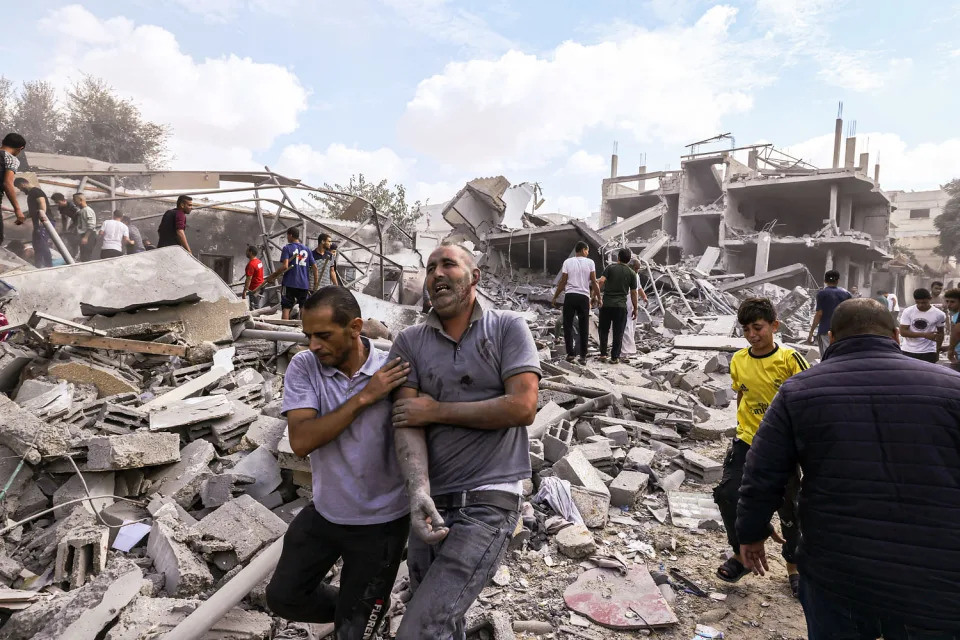
An "unprecedented catastrophe" is unfolding for civilians in Gaza, according to the United Nations, which is pleading for Islamic leaders to allow humanitarian efforts into the territory to help those trapped there.

The United Nations Relief and Works Agency for Palestine Refugees in the Near East (UNRWA) released a statement Wednesday urging the Council of Foreign Ministers of the Organization of Islamic Cooperation "to firmly and unconditionally support the humanitarian efforts to safeguard civilians in Gaza."

MORE: 'Specter of death' hangs over Gaza as aid groups wait for access, UN official says

UNRWA Commissioner-General Philippe Lazzarini evoked the "harrowing images" from the Al-Ahli Hospital in Gaza, where nearly 500 people were killed in a blast on Tuesday night, to highlight the plight of the civilians who remain in Gaza. Another air strike struck an UNRWA school sheltering 4,000 displaced people on Tuesday, killing at least six people, Lazzarini said.

"An unprecedented catastrophe is unfolding before our eyes," Lazzarini said. "Gaza is being strangled and the world seems to have lost its humanity."


A humanitarian crisis began in Gaza almost as soon as the retaliatory air strikes from Israel began last week, following the Oct. 7 attack on Israel by the Gaza-based terrorist organization Hamas, experts told ABC News. The territory is "highly dependent" on imports, and with the crossings into Israel and Egypt currently sealed, supplies are running out fast.

Just one week after the latest fighting between Israel and Hamas began, one million people inside Gaza were forced to flee their homes, according to Lazzarini.

MORE: Rafah crossing: Why are people, aid stuck at Egypt-Gaza border?

Fourteen frontline humanitarian workers from the UNRWA are among the dead in Gaza, Lazzarini noted, adding that since the fighting began, not one shipment of aid has been allowed into Gaza.


A surgical team and 60 tons of humanitarian aid and medical items have been mobilized to the Rafah border crossing from Egypt, into southern Gaza, the International Committee of the Red Cross announced on Tuesday. But the aid was not granted passage on Monday, when the crossing was supposed to be opened.

Images show tractor-trailers filled with supplies and other goods idling on roads leading to Gaza.

MORE: Humanitarian crisis for food insecurity, lack of water supply about to begin in Gaza, experts say

Potable water, stocks of food, and other supplies such as hygiene materials and medicine are in short supply in Gaza, Lazzarini said, adding that people are being forced to drink unclean water.

"We are on the brink of a major health and sanitation crisis," Lazzarini said.


A mother named Rana, who is trapped in Gaza with her family, told ABC News that she and her children go to sleep every night in fear that they will never wake up again.

At night, Gaza becomes a "ghost city" in near darkness, with sirens and bomb blasts the only sounds to break the silence, she said.

"We sleep in one room," said Rana, who did not want to provide her last name or location due to safety concerns. "We keep praying."

MORE: Israel-Gaza live updates: DOD says Islamic Jihad responsible for hospital blast

During remarks from Israel on Wednesday morning, President Joe Biden said that Israel agreed to allow humanitarian assistance to move from Egypt to Gaza. The passage will be subject to inspections and the aid will go to civilians, not Hamas, Biden said.


As of Wednesday evening, it was unclear when the crossings between Gaza and Egypt will open for humanitarian passage.

Humanitarian crisis in Gaza an 'unprecedented catastrophe,' UN says originally appeared on abcnews.go.com