Thursday, October 19, 2023


New insights into the genetics of the common octopus: Genome at the chromosome level decoded

New insights into the genetics of the common octopus: genome at the chromosome level decoded
Octopus vulgaris. Credit: Antonio, Valerio Cirillo (BEOM SZN), 2023

Octopuses are fascinating animals—and serve as important model organisms in neuroscience, cognition research and developmental biology.

To gain a deeper understanding of their biology and evolutionary history, validated data on the composition of their  is needed, which has been lacking until now. Scientists from the University of Vienna together with an international research team have now been able to close this gap and, in a study, determined impressive figures: 2.8 billion base pairs—organized in 30 chromosomes.

What sounds so simple is the result of complex, computer-assisted genome analyses and comparisons with the genomes of other cephalopod species. The research has just been published in G3: Genes / Genomes / Genetics.

Octopuses, together with squid and cuttlefish, belong to a group of coleoid cephalopods consisting of several hundreds of species that are characterized by highly diversified lifestyles, body structure and adaptations to their environment. The study of these animals looks back on a long tradition, especially since the neuronal plasticity of the octopus brain—meaning the brain's ability to change and adapt as you learn and experience new things—provides evidence for the existence of functionally analogous structures to the brains of mammals.

This is making them a comparative model group for neurophysiological studies. Also, their ability to regenerate parts of their bodies as well as the rapid changes of their body patterns, which are important for camouflage and communication, make  a popular research subject for studying how these innovative traits arose—and how they have changed—during evolution.

Closing a gap

In the  there has been a rising need for detailed knowledge on cephalopod genomes to understand the evolution of their unique traits and their biology. An important contribution to this aim is encoding the common octopus' genome at chromosome level—an information that has not been available until now.

This has now been remedied by a research team from the University of Vienna, which—together with colleagues from the KU Leuven (Belgium), the Centro Nacional de Análisis Genómico (CNAG; Spain) and the Stazione Zoologica Anton Dohrn (Italy)—"supplied" the missing data and carried out extensive, molecular biological and computer-assisted studies of the octopus genome.

"With our current technologies used in genomics research, we were able to create a kind of 'genome map' for the octopus, showing how genetic information is arranged at the chromosome level," explains study first author Dalila Destanović, a scientist at the Simakov Laboratory in the Department of Neuroscience and Developmental Biology at the University of Vienna.

This reference genome, which is highly resolved at the chromosome level, will allow the  to better understand the characteristics and biology of these fascinating animals on the one hand, and also to trace the evolutionary history of Octopus vulgaris on the other. Research teams can now further investigate or understand the evolutionary trajectory of coleiid cephalopods and more distantly related mollusks such as clams or snails.

2.8 billion base pairs—30 chromosomes

In fact, the researchers were able to identify 30 chromosomes in the Octopus vulgaris genome, in which 99.34% of 2.8 billion base pairs are arranged. This means that scientists now have a high-quality reference sequence that will serve as a basis for further studies on the function of genes and thus for a better understanding of biological properties of the common octopus.

The chromosomal structure of the Octopus vulgaris genome will also provide insight into the dynamic evolutionary history of these organisms by estimating chromosome rearrangement rates. Already, by comparing the Octopus vulgaris genome with the genomes of four other octopus species, the researchers have been able to show that all chromosomes exhibit numerous structural changes that have occurred during evolution by breaking off pieces of chromosomes, rearranging them and reconnecting them at the same chromosome.

"Even among closely related species, we observed numerous structural changes of the chromosomes. This finding poses questions on genome dynamics throughout their evolutionary history and opens the door to investigate how this relates to their unique traits", explains Dalila Destanović.

The dynamic  of the  genome spans a period of 44 million years—and many exciting research questions are still open. The results of the current study will amount to answering some of these questions by bridging traditional Octopus vulgaris research in neurobiology, behavior and development to molecular genetic insights in these areas.

More information: Darrin Schultz, A chromosome-level reference genome for the common octopus, Octopus vulgaris (Cuvier, 1797), G3: Genes / Genomes / Genetics (2023). DOI: 10.1093/g3journal/jkad220


Tech breathes new life into endangered Native American languages

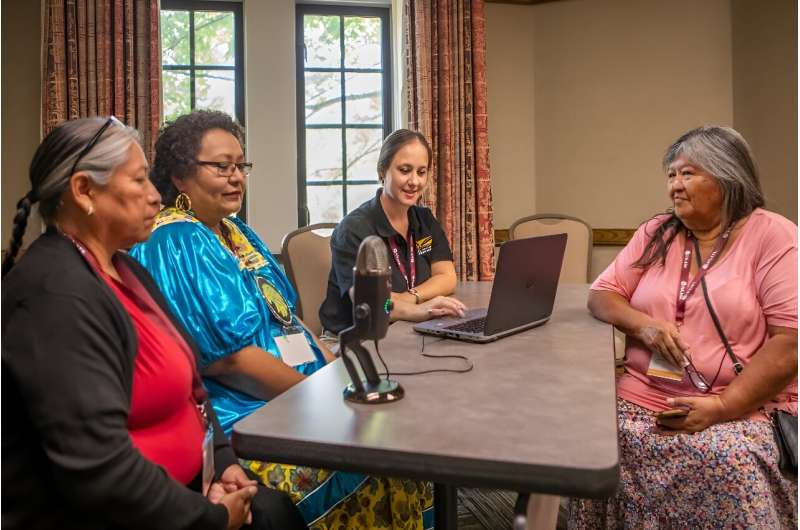
Ashleigh Surma (second right) assists Elva Case (left), Linda Lupe (second left) and Joycelene Johnson (right) in recording Indigenous languages in Bloomington, Indiana, on October 13, 2023
Ashleigh Surma (second right) assists Elva Case (left), Linda Lupe (second left) and 
Joycelene Johnson (right) in recording Indigenous languages in Bloomington, Indiana, on
 October 13, 2023.

Linguistics experts are turning to cutting-edge technologies to revitalize threatened Native American languages—and rejuvenate generations of Indigenous tradition—through new approaches such as children's books and smartphone apps.

In one such endeavor, three Native American women rack their brains as they gather around a computer, trying to remember—and record—dozens of Apache  words related to everyday activities such as cooking and eating.

They are creating an online English-Apache dictionary, just one of several projects working to preserve endangered Indigenous languages in the United States.

The women are working with Rapid Word Collection (RWC) software, which uses an algorithm to search Apache text and audio databases for so-called forgotten words.

The words are then defined, translated into English, and their pronunciation recorded, so the dictionary's users will know how to say them properly.

Teacher Joycelene Johnson and two of her colleagues validate the definition of the word Apache word "kapas," which means potato in English.

"The applications in the  are good for (a) non-speaker—at least they'll have a museum of it where they can go to for reference," said Johnson, a 68-year-old who teaches Apache vocabulary and grammar.

According to her, the bilingual school on her reservation has about a thousand students—but only one, an eleventh-grader, is fluent in Apache.

Johnson spoke at just one of several workshops at the International Conference on Indigenous Language Documentation, Education and Revitalization (ICILDER) last weekend at the University of Indiana.

Representatives from around 40 Indigenous groups from around the world gathered in the college town of Bloomington just days after the United States—which counts about 6.8 million Native American residents, or about two percent of the population—marked Indigenous People's Day.

Using the Rapid Word Collection (RCW) software, Indigenous communities can now create dictionaries of their languages in a fraction of the time
Using the Rapid Word Collection (RCW) software, Indigenous communities can now create dictionaries of their languages in a fraction of the time.

4,500 languages at risk

Linguists, teachers, students, researchers and Indigenous leaders spent the weekend brainstorming how exactly to rescue these vulnerable languages from the brink.

Of the more than 6,000 Indigenous languages recognized globally, nearly half of them are at risk of disappearing, with about 1,500 facing immediate extinction, according to a 2021 study from UNESCO.

The RWC was developed by The Language Conservancy (TLC), an NGO dedicated to protecting around 50 Indigenous languages around the world, in order to churn out such dictionaries at super-speed.

TLC, which has a $3 million budget, regularly teams up linguists with Native American language teachers to work on these dictionaries.

The software has "increased the efficiency in the workflow," said Wilhelm Meya, the CEO of TLC and one of the ICILDER organizers—now, an Indigenous community can build a dictionary from scratch within a year, instead of 20.

"That allows us to serve languages quickly and build that infrastructure that they need to be able to survive moving forward," the 51-year old Austrian-American anthropologist explained.

'Crisis level'

That speed is vital, because time is of the essence: in the United States and Canada, the last generation of native speakers are dying.

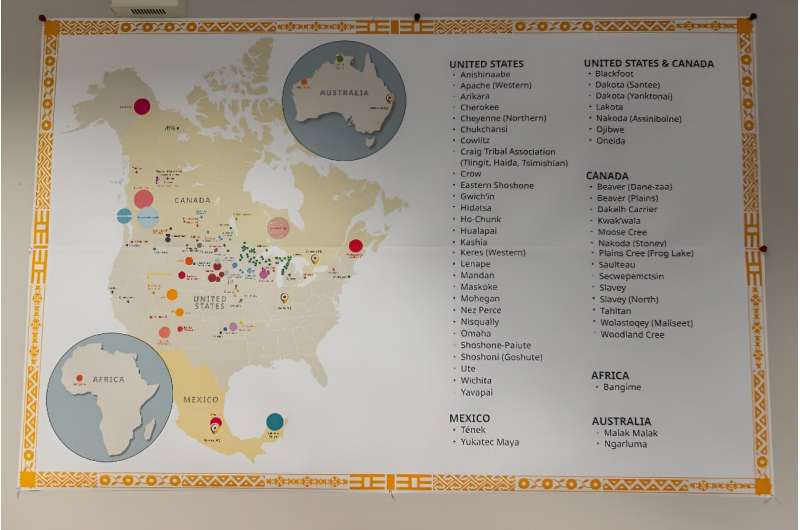
A map showing the regions of North America where language conservation efforts are conducted is displayed at the conference in Bloomington
A map showing the regions of North America where language conservation efforts are conducted is displayed at the conference in Bloomington.

According to TLC, 143 out of 219 languages are in danger of extinction in the United States, while 75 of 94 are at similar risk in Canada.

Those are still just a small fraction of the 400 to 500 Indigenous languages that were spoken in the two countries before the arrival of Europeans and their decimation of native populations some 500 years ago.

"The situation is really at a crisis level," Meya said.

With the average age of Indigenous language speakers around 75, he added, there are only a few years left to document these languages before they disappear forever.

"Once it's gone, it's gone. You really can't bring it back very easily," said Meya, whose organization distributes their learning materials for free throughout the United States and on Native American reservations.

"When the language goes, so does the culture," he said.

Jacob Chavez, a 26-year-old Cherokee language learner who called himself a "really big supporter" of the language technology, said he appreciates how it allows communities to "record things a lot quicker and hold onto things for a lot longer than we could before."

'Identity'

Paula Hawkins, who teaches the Tahltan language—which is spoken in parts of British Columbia—said she is "really excited" to see an online dictionary, just as her parents helped create the first Tahltan print dictionary in the 1980s.

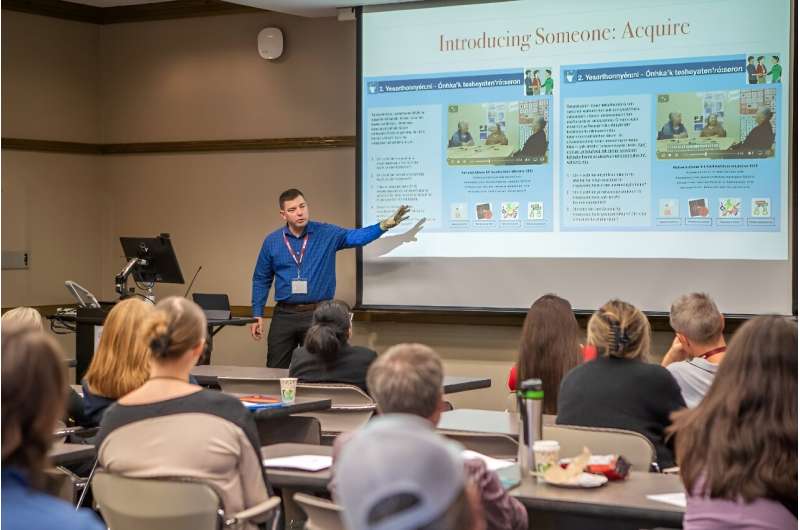
Attendees listen during the ICILDER 2023 Conference (International Conference on Indigenous Language Documentation, Education, and Revitalization) in Bloomington, Indiana, on October 13, 2023
Attendees listen during the ICILDER 2023 Conference (International Conference on Indigenous Language Documentation, Education, and Revitalization) in Bloomington, Indiana, on October 13, 2023.

But her colleague, 51-year-old Danielle North King, from the Chemehuevi, or Nuwuvi nation, fears that such projects impose a "Western way of writing" onto "an Indigenous way of speaking"—the vast majority of human languages are solely oral, with no writing systems.

Indeed, Lakota Indigenous leaders denounced TLC last year, after the organization tried to copywrite teaching material that included recordings from the nation's elders.

"We don't own the copyright or the IP () for any of the languages we work with," Meya clarified, adding that his goal is to protect Indigenous culture.

"If we were at a hospital and I was a white doctor and I had an Indigenous patient, would I not be allowed to work on him or serve him because I'm not Indigenous?" Meya asked.

"Race can really become a hindrance to this type of work," Meya explained, when dealing with such a sensitive subject.

Language is "so fundamental to identity and to nationhood and sovereignty."

© 2023 AFP


What killed Lolita? Necropsy findings released for the Seaquarium's beloved orca

orca
Credit: Pixabay/CC0 Public Domain

The Seaquarium's beloved performing killer whale, Lolita, appears to have died of old age and multiple chronic illnesses, according to the executive summary of her necropsy released Tuesday afternoon to the Miami Herald.

Lolita, also known as Tokitae or Toki, died Aug. 18 at the age of 57. Her carcass was swiftly packed in ice and driven to the University of Georgia, where a necropsy was completed on Aug. 19.

In initial reports, the Seaquarium cited  as the cause of death. That finding appears to be backed up by the documents released by the Seaquarium on Tuesday.

"The results of the analysis performed indicate that the death was due to the progression of multiple chronic conditions some of which derived from age," the Seaquarium wrote in a .

Dr. Judy St Leger, a veterinarian with 20 years of experience working with marine mammals, conducted the necropsy. She found Lolita suffered from "acute and chronic bronchointerstitial pneumonia and renal degeneration, and a chronic condition of the heart implying the degeneration of the cardiac valves."

Just a few days prior to her death, Lolita was declared to be in excellent health by the veterinarian overseeing her care and by the CEO of The Dolphin Company.

"A week ago, the vets were here. You know, she was doing great. And the staff is completely devastated. Because this just came completely out of the blue," said Pritam Singh, a Keys developer and founder of Friends for Lolita. "But we had no idea that this was going to happen and so we're as surprised as anybody else."

After the necropsy, Lolita's cremated remains were spread across her home waters in a traditional ceremony conducted by Lummi Nation leaders. Known by her indigenous name of Sk'aliCh'elh-tenaut, the orca was considered a member of the Lummi tribe.

Lolita was being trained for a possible cross-country move to her native waters in the Pacific Northwest. The plan, developed by the nonprofit Friends of Lolita in conjunction with the Whale Sanctuary Project, was to transport the aging orca to a sea pen in Puget Sound, where she was captured from the L pod in 1970. NFL owner Jim Irsay pledged to help fund the $15–20 million relocation, but acknowledged that many obstacles had to be overcome, such as obtaining various state and federal permits.

A group of Lolita's former trainers and vets, called Truth4Toki, opposed what they called "a risky fundraising publicity stunt" that Lolita would not survive given her age, medical issues and half century in captivity. They advocated a short move to Orlando's SeaWorld, where she could live in a larger tank and be cared for by orca experts.

Some of the orca's health problems arose after her diet was reduced from 160 pounds of fish per day to 120 pounds two years ago, ex-trainers and vets said. They feared she was chronically dehydrated, putting stress on her kidneys. Seaquarium said her  was cut to be in tune with the reduced amount of exercise she was getting.

2023 Miami Herald. Distributed by Tribune Content Agency, LLC.


Physicists create new form of antenna for radio waves

Physicists create new form of antenna for radio waves
Passive Rydberg-atomic transducer. Credit: University of Otago

University of Otago physicists have used a small glass bulb containing an atomic vapor to demonstrate a new form of antenna for radio waves. The bulb was "wired up" with laser beams and could therefore be placed far from any receiver electronics.

Dr. Susi Otto, from the Dodd-Walls Center for Photonic and Quantum Technologies, led the field testing of the portable atomic radio  sensor. A paper on the creation was published in Applied Physics Letters.

Such sensors, that are enabled by atoms in a so-called Rydberg state, can provide superior performance over current antenna technologies as they are highly sensitive, have broad tunability, and small physical size, making them attractive for use in defense and communications.

For example, they could simplify communications for soldiers on the battlefield as they cover the full spectrum of radio frequencies, rather than needing multiple antennas to cover different frequency bands, and are super sensitive and accurate to detect a wide range of critical signals. The ability to eliminate the need for multiple sensors also makes them useful in satellite technology.

Importantly, compared to more traditional sensors, Rydberg sensors can function without any , which can scatter the radio frequency field of interest and the atomic sensor is accessed via , replacing the need for electric cables.

The Otago group's new design is portable and can be taken outside the laboratory. In a first out-of-lab demonstration, the sensor was able to efficiently measure fields in a distance of 30m using a free-space laser link. This adds important flexibility to Rydberg-atom based sensing technologies.

They envision these developments will make quantum sensors more robust and cost-effective, enabling them to move out of labs and into the real world.

More information: J. Susanne Otto et al, Distant RF field sensing with a passive Rydberg-atomic transducer, Applied Physics Letters (2023). DOI: 10.1063/5.0169993


Amazon will start testing drones that will drop prescriptions on your doorstep, literally
Credit: Amazon via AP

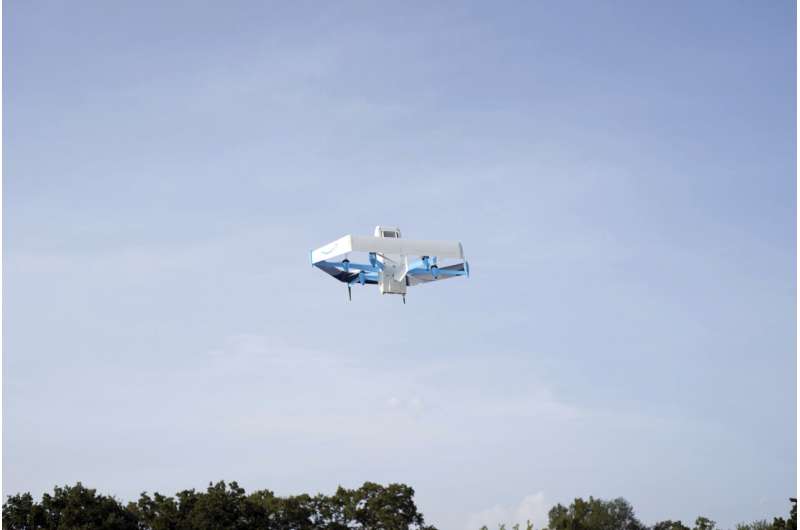
Amazon will soon make prescription drugs fall from the sky when the e-commerce giant becomes the latest company to test drone deliveries for medications.

The company said Wednesday that customers in College Station, Texas, can now get prescriptions delivered by a drone within an hour of placing their order.

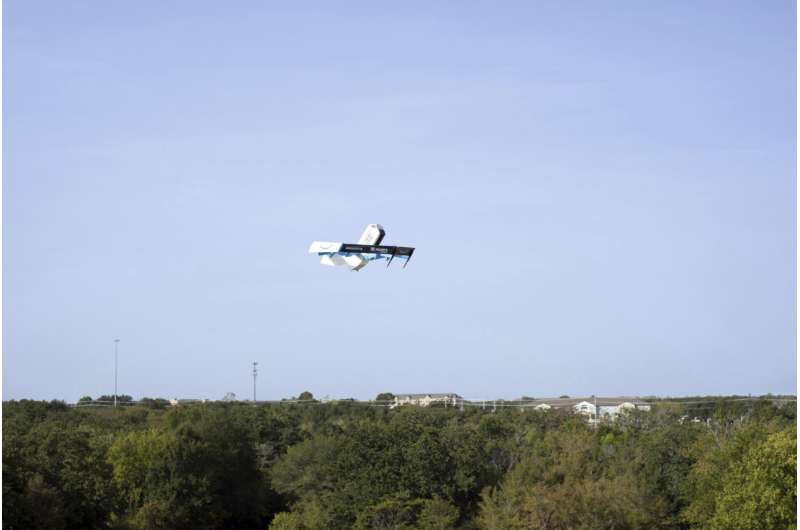
The drone, programed to fly from a delivery center with a secure pharmacy, will travel to the customer's address, descend to a height of about four meters—or 13 feet—and drop a padded package.

Amazon says customers will be able to choose from more than 500 medications, a list that includes common treatments for conditions like the flu or pneumonia, but not controlled substances.

The company's Prime Air division began testing drone deliveries of common household items last December in College Station and Lockeford, California. Amazon spokesperson Jessica Bardoulas said the company has made thousands of deliveries since launching the service, and is expanding it to include prescriptions based in part on customer requests.

Later on Wednesday, Amazon announced it will also launch drone delivery at a third U.S. location and cities in Italy and the United Kingdom by the end of next year. The company said it will disclose the exact locations in the coming months.

Amazon Prime already delivers some medications from the company's pharmacy inside of two days. But pharmacy Vice President John Love said that doesn't help someone with an acute illness like the flu.

"What we're trying to do is figure out how can we bend the curve on speed," he said.

Amazon Pharmacy Chief Medical Officer Dr. Vin Gupta says the U.S. health care system generally struggles with diagnosing and treating patients quickly for acute illnesses, something that was apparent throughout the COVID-19 pandemic.

Narrowing the window between diagnosis and treating makes many treatments more effective, he said.

Amazon will start testing drones that will drop prescriptions on your doorstep, literally
This photo provided by Amazon shows a drone delivering presciption drugs in College Station, Texas. Amazon will soon make prescription drugs fall from the sky when the e-commerce giant becomes the latest company to test drone deliveries for medications. The company said Wednesday, Oct. 18, 2023 that customers in College Station, Texas, can now get prescriptions delivered by a drone within an hour of placing their order. Credit: Amazon via AP

Amazon is not the first company to explore prescription deliveries by drone. The drugstore chain CVS Health worked with UPS to test deliveries in 2019 in North Carolina but that program has ended, a CVS spokesman said.

Intermountain Health started providing drone deliveries of prescriptions in 2021 in the Salt Lake City area and has been expanding the program, according to Daniel Duersch, supply chain director for the health care system. Intermountain is partnering with the logistics company Zipline to use drones that drop packages by parachute.

Companies seeking to use drones for commercial purposes have faced hurdles from regulators who want to make sure things are operating safely. Amazon founder Jeff Bezos had predicted a decade ago that drones would be making deliveries by 2018. Even now, the e-commerce giant is only using the technology in a small number of markets.

Lisa Ellman, the executive director of the Commercial Drone Alliance, an industry group that counts Amazon as one of its members, said to date, regulatory approvals have been limited to specific geographic areas and "in terms of their scope and usefulness to companies."

That said, she noted regulators have also been issuing more approvals. Last month, the FAA gave the OK for Zipline and UPS to fly longer-range drones.

Walmart has also been working to expand its own drone deliveries.

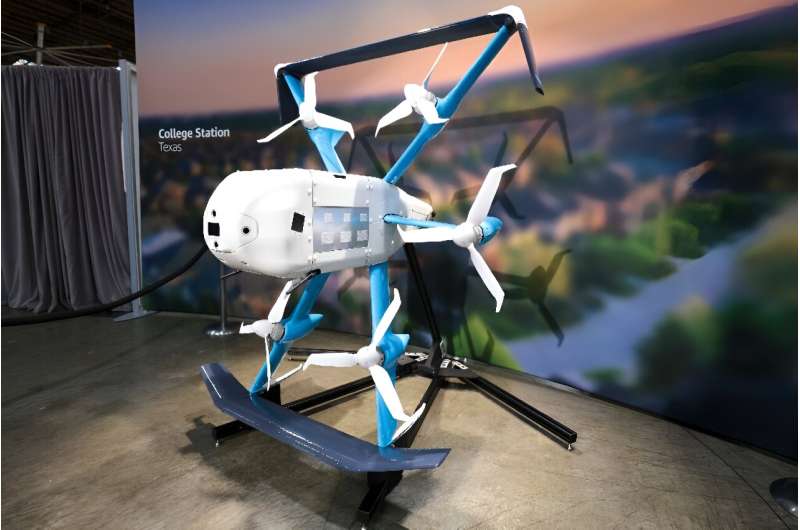
Also on Wednesday, Amazon unveiled a new drone called MK30 that, by the end of next year, will replace the drones it currently uses to delivery packages. The company says the new drone flies further, is smaller and quieter, and also has enhanced delivery capabilities.

Amazon has said its drones will fly as high as 120 meters, or nearly 400 feet, before slowly descending when they reach the customer's home. The drone will check to make sure the delivery zone is clear of pets, children or any other obstructions before dropping the package on a delivery marker.

Amazon has been growing its presence in health care for a few years now.

Aside from adding a pharmacy, it also spent nearly $4 billion to buy primary care provider One Medical. In August, the company added video telemedicine visits in all 50 states.

© 2023 The Associated Press. All rights reserved. This material may not be published, broadcast, rewritten or redistributed without permission.


Amazon to expand drone delivery into Britain and Italy

Amazon delivery drones are currently used in two US states, with a third to be added in the near future
Amazon delivery drones are currently used in two US states, with a third to be added in the near future.

Amazon on Wednesday said it hopes to expand drone delivery into Britain and Italy by late next year, as it unveiled new warehouse robots and tech in its race to get shoppers what they want quickly.

The Seattle-based e-commerce colossus said it will expand  of certain purchases to a third US state as well as to the two European countries by the end of 2024.

Amazon delivery drones are already at work in California and Texas, and a new MK30 model will be able to operate in more  than those currently in use, Amazon Prime Air vice president David Carbon said during a marketing event.

"Our customers have always wanted things faster and I think this is a way we can get to it at scale," said Prime AI director of engineering Jason Patrao, adding that the drone program, while currently small, "is going to be something that I think we will all get used to."

Amazon has also installed a new robotics system called Sequoia in one of its Texas logistics centers, the company said.

The system features automated vehicles, gantry cranes, mechanical arms, computer vision technologies and ergonomic workstations for employees, a presentation showed.

Amazon already uses 750,000 robots in its warehouses, but the idea is to make the various machines more interoperable, according to executives.

"It becomes magical when you blend multiple robotics systems with our amazing people," said Amazon Robotics chief technologist Tye Brady.

Sequoia can identify and put away stock in warehouses "up to 75 percent faster" than was previously possible, the company said in a statement.

And order processing time can be reduced by 25 percent in best-case scenarios.

"This means we can list items on sale on Amazon.com more quickly, benefitting both sellers and customers," Amazon said.

Traditional brick-and-mortar stores still account for about 80 percent of retail business, but sales are likely to shift more online the more such immediate gratification through fast delivery becomes available, analysts said.

"The better they get at delivery, the more it continues to grow the e-commerce market overall and Amazon's place within that market," said Insider Intelligence analyst Andrew Lipsman.

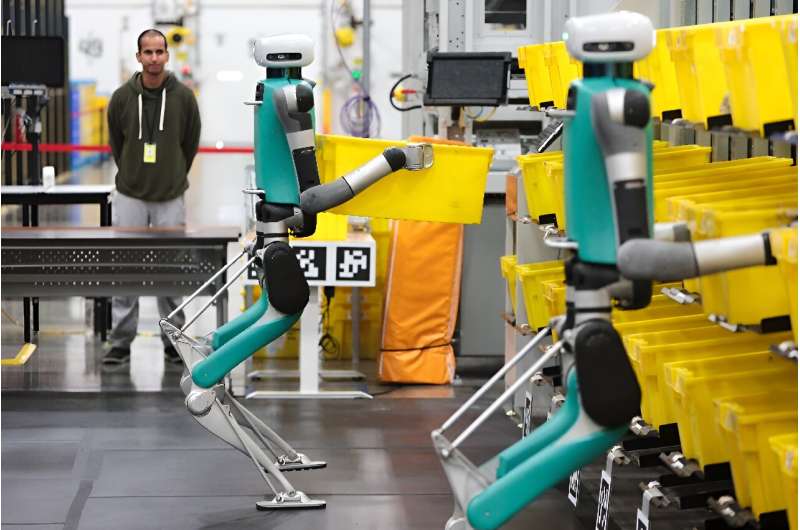
Amazon also wants to add robots to perform manual labor tasks at its warehouses
Amazon also wants to add robots to perform manual labor tasks at its warehouses.

The popular online shopping platform became a lifeline for many during the pandemic, but since this year it has been facing a new kind of competition from Chinese e-commerce apps.

Fashion retailer Shein and especially Temu, which offers , homeware and electronics, have won over many consumers with their low prices.

"Given how aggressively Temu is trying to compete with Amazon and the money they seem to be willing to spend on logistics and getting cheap goods to people, I'm sure Amazon has some level of concern," Lipsman said.

Jobs versus robots

Without specifying whether jobs would be lost through the use of robots, Amazon emphasized the gains in terms of safety, sparing workers from repetitive tasks and even creating jobs.

"Over the past ten years, we have installed hundreds of thousands of robotic systems while creating hundreds of thousands of jobs," the group stressed.

"We think that the repetitive, the mundane work that people do, we do see that shifting more to robotics," said Scott Dresser, vice president for Amazon robotics.

"There's also an opportunity to make things safer, when people (are) bending and lifting heavy objects, when people are walking miles in the fulfillment center," he said.

Amazon, the second-largest employer in the US, just behind Walmart, will also be testing android-like machines from Agility Robotics to carry plastic bins.

"There's about a million unfilled logistics, manual labor jobs" in the United States currently, said Agility cofounder Damion Shelton.

"The problem is not that you're even taking a job... The problem is there's no person to even do the work," he said.

But increased productivity via robots won't fix underlying Amazon worker issues, critics say.

"It's not going to change their logic. And their logic is 'use these workers up and throw them away'," said Sheheryar Kaoosji, executive director of the Warehouse Worker Resource Center, a nonprofit dedicated to improving warehouse industry conditions in southern California.

© 2023 AFP


Explore further

Amazon to open new robotics hub outside Boston in 2021


Five things we learned at the US Google antitrust trial

Google
Credit: Unsplash/CC0 Public Domain

US government lawyers rested their case on Tuesday in the landmark antitrust trial against Google after five weeks of testimony that saw some of big tech's most senior executives take the stand.

At the heart of the case is Google's search engine and whether the company has acted illegally to preserve its overwhelming dominance.

Here are five things we have learned so far at the trial:

Apple makes billions on Google

Apple's intricate relationship with Google was the trial's main source of intrigue, as the US government contends that it is by paying billions of dollars to the iPhone maker every year that Google is able to maintain its monopoly.

Exactly how much has yet to be made public, but according to some estimates mentioned in evidence, every year Google pays a total of ten billion dollars to Apple as well as Samsung and others to make sure it keeps a default position on web browsers or phones.

But the payout to Apple is established through a revenue share deal and analysts from investment firm Bernstein think that the sum may be as high as $20 billion a year, accounting for 15 percent of Apple's operating profits.

Anything for Bing

Another major player in the Washington DC trial was Microsoft that since 2009 has been trying to lift its Bing search engine to be more than a distant also-ran to Google.

Microsoft CEO Satya Nadella told the courtroom that it would be a "game-changer" for Bing to win default status on the iPhone and court evidence revealed all the ways that the maker of Windows and Xbox was prepared to get there.

In 2018, discussions with Apple went as far as a proposal to rebrand Bing under a different name.

And, according to Bloomberg, Microsoft even floated an outright sale of Bing to Apple in order to bring some much needed competition to Google.

Nadella said he never gave up finding a way to persuade the iPhone maker, but became convinced over time that any flirtations with Bing were being used by Apple to negotiate with Google.

'Bad optics' for Apple

The trial has seen hundreds of documents and emails introduced as evidence and one featured the current CEO of Google Sundar Pichai making a potentially embarrassing observation about the default deals, when he was still a product manager.

In a 2007 email, Pichai raised concerns that a default deal with Apple was maybe bad "optics" if it ruthlessly blanked other browsers.

"I don't think it is a good user experience nor the optics is great for us to be the only provider in the browser."

'Benevolent dictatorship'

Another executive who took the stand was Arjan Dijk, Chief Marketing Officer of Booking.com. He described a market for  where a company had no choice than buying ads with Google.

Dijk is a former Google employee, and his exchanges with Google's lawyer sometimes got heated, with Judge Amit Mehta having to intervene to get the discussion back on track.

Dijk complained that Booking.com had to spend hand over fist for its ads to be well placed in search results.

He compared the company to a "benevolent dictatorship," he said.

Apple considered DuckDuckGo

The trial has seen CEO and executives take turns on the stand, including the boss of DuckDuckGo, a search engine that puts its main emphasis on user privacy but has failed to gain major success against Google.

Chief executive Gabriel Weinberg told the court that in 2018 he was in serious discussions with Apple to make DuckDuckGo the default search engine for private browsing on iPhones.

"We thought they were actually really interested," Weinberg said.

But despite early enthusiasm, talks with Apple went nowhere and Weinberg blamed Apple's contract with Google, which, he surmised, also barred him from tie-ups with Samsung and others.

© 2023 AFP


Warmer climate may impact reliability of solar farms, modeling study shows

Warmer climate may impact reliability of solar farms, modeling study shows
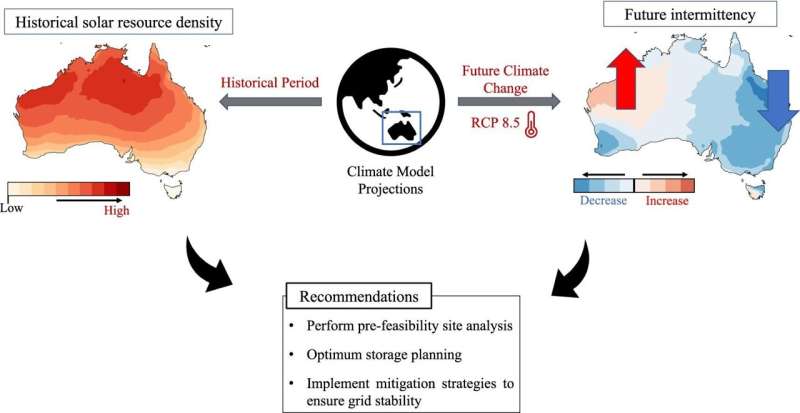
Credit: Solar Energy (2023). DOI: 10.1016/j.solener.2023.112039

Australia's renewable energy transition is well underway, but an impending shift in the reliability of solar due to climate change could impact generation capacity and the management of the electricity grid.

Modeling conducted by researchers from UNSW Sydney predicts changes in the availability of solar across different regions of Australia under a . The findings, published in the journal Solar Energy, have implications for future solar power infrastructure development in Australia, including the world's largest solar infrastructure energy network.

Australia is a prominent solar hotspot, with several notable large-scale grid-connected —or  (PV) plants—in operation or development. However, the sensitivity of solar power generation to weather-induced variability can limit its ability to deliver a consistent and dependable energy supply.

Managing grid stability due to inherent variability in solar energy generation due to factors like , seasonal cycles, and location—all of which will be impacted by future warming—is possible with proper forecasting, power storage and load controls. But, if left unmanaged, it can lead to power deficits that can result in outages or even complete grid failures.

"Modeling future changes in solar availability is crucial for maintaining stable power generation as Australia increases its reliance on large-scale solar," says Shukla Poddar, lead author of the study and a postdoctoral research fellow at the School of Photovoltaics and Renewable Energy Engineering. "As the climate warms, managing these weather-induced power fluctuations will be a growing challenge, so we need modeling to help better predict and prepare for these changing dynamics."

Future solar reliability in Australia

For the study, the researchers used regional climate model simulations to map changes in Australia's solar resource distribution and variability under a high emissions scenario—the climate trajectory Australia is currently tracking.

They found solar reliability may increase in regions of Eastern Australia by 2099. In particular, solar resource density, or irradiance, is expected to increase slightly, with fewer intermittent or lull periods (when power generation is insufficient due to unfavorable weather) and more clear sky days per year.

The findings also suggest solar reliability will decline over West Australia over the same period, with a slight decrease in availability, while intermittent periods may also increase. Episode length—the consecutive periods when solar is highly feasible for power generation—was also projected to decline, with the number of clear sky days also decreasing.

"Our study reveals Eastern Australia will experience an increase in solar resource availability and episode length in the future, indicating the probability of more stable and reliable future energy output," Poddar says. "This region is predicted to experience a reduction in the lulls and frequency of intermittent and overcast days in the future, highlighting reduced future intermittency.

"On the contrary, some regions in Western Australia may experience increased intermittency issues, a key challenge for Australia's future energy systems, and they will likely need to rely more heavily on energy storage solutions to ensure grid stability in the future."

Impacts on large-scale solar PV developments

As part of the study, the researchers also completed a future solar resource assessment of the SunCable and New England solar farms in Australia.

SunCable is developing the largest solar farm in the world in the Northern Territory, which will supply renewable energy to domestic and international markets. The New England solar farm, the second largest in Australia, is also under construction and, once complete, will generate a significant amount of electricity for New South Wales.

They found the New England solar farm site will have favorable conditions in the future to generate optimum PV power, with more clear-sky days and an expected net increase in the long-term power . However, the findings show the SunCable solar farm may experience an increase in intermittency issues in the future, suggesting the need for more energy storage systems and solar resource forecasting.

"Understanding the reliability of future solar generation can inform the design of these large-scale solar PV sites—where they should expand development and where they might need to invest more in storage technologies," says Associate Professor Merlinde Kay, co-author of the study and lecturer in the School of Photovoltaic and Renewable Energy Engineering.

The researchers say further studies are needed to determine how to complement solar PV in Australia with other renewables, especially as more weather extremes are likely to occur.

"The next step would be to conduct a synergy study of how  can complement solar in a future warmer climate, as we know hybrid systems can be advantageous for generating consistent energy supply when the sun isn't shining or when the wind isn't blowing," Kay says.

"We also need to look at how disruptive extreme events, such as bushfires, will impact renewable energy generation and grid operation moving into the future, given they're likely to increase in frequency and intensity."

More information: Shukla Poddar et al, Changes in solar resource intermittency and reliability under Australia's future warmer climate, Solar Energy (2023). DOI: 10.1016/j.solener.2023.112039


Journal information: Solar Energy 

Climate change may cause disruptions to solar generation in the future, modeling suggests