Lines of wounded at Myanmar hospital after powerful quake
- 'Help me' -
The Myanmar capital is some 250 kilometres (150 miles) south from the epicentre of the 7.7-magnitude shallow tremor, that hit northwest of the city of Sagaing on Friday afternoon, according to the United States Geological Survey.
A 6.4-magnitude aftershock hit the same area minutes later.
A team of AFP journalists were at the National Museum in Naypyidaw when the earthquake struck, with chunks of the ceiling falling and cracks running up the walls.
The road to one of the biggest hospitals in Naypyidaw was jammed with traffic.
As ambulance weaved between vehicles, and shouting paramedic pleaded to be allowed to get through to reach the care of doctors.
Those inside ran outside, many trembling and tearful, and frantically trying to call family members on their phones to check if they were alive.
Powerful tremors were also felt in neighbouring China and in Thailand, where buildings in the capital Bangkok were shaken violently.
Worapat Sukthai, deputy police chief of Bangkok's Bang Sue district, said he could hear the sound of people screaming for aid trapped in the debris after a 30-story under-construction tower block collapse.
"I heard people calling for help, saying help me," he told AFP. "We estimate that hundreds of people are injured but we are still determining the number of casualties."
"I fear many lives have been lost. We have never experienced an earthquake with such a devastating impact before."
Bangkok residents are used to tremors -- and know to find a safe space outside if possible -- but many said the force on Friday came as a shock.
"I was shopping inside a mall when I noticed some signs moving, so I quickly ran outside," said Attapong Sukyimnoi, a broker. "I knew I had to get to an open space -- it was instinct."
burs-pjm/hmn
© Agence France-Presse
Agence France-Presse
March 28, 2025

A hospital bed is pushed down a corridor. (Shutterstock)
by Joe STENSON with Chayanit ITTHIPONGMAETEE in Bangkok
A stream of casualties were rushed to the hospital in Naypyidaw -- some in cars, others in pickups, and others carried on stretchers, their bodies bloody and covered in dust after a huge quakeRows of wounded lay outside the emergency department of the 1,000-bed hospital in Myanmar's capital Naypyidaw on Friday, some writhing in pain and others in shock after a powerful earthquake.
A stream of casualties were brought to the hospital -- some in cars, others in pickups, and others carried on stretchers, their bodies bloody and covered in dust.
"This is a mass casualty area", a hospital official said, as they ushered journalists away from the treatment area.
The hospital itself was hit by the terrifying tremors, which buckled roads and ripped tarmac apart as the ground vibrated violently for around half a minute.
The hospital's emergency department was itself heavily damaged, a car crushed under the heavy concrete of its fallen entrance.
"Many injured people have been arriving, I haven't seen anything like this before," a doctor at the hospital told AFP.
"We are trying to handle the situation. I'm so exhausted."Some cried in pain, others lay still as relatives sought to comfort them, intravenous drips from their arms.
"Hundreds of injured people are arriving... but the emergency building here also collapsed," security officials at the hospital said.
Others sat stunned with their head in their hands, blood caking their faces and limbs.
Myanmar's military chief Min Aung Hlaing visited the hospital, surveying the wounded lying on stretchers.
March 28, 2025
A hospital bed is pushed down a corridor. (Shutterstock)
by Joe STENSON with Chayanit ITTHIPONGMAETEE in Bangkok
A stream of casualties were rushed to the hospital in Naypyidaw -- some in cars, others in pickups, and others carried on stretchers, their bodies bloody and covered in dust after a huge quakeRows of wounded lay outside the emergency department of the 1,000-bed hospital in Myanmar's capital Naypyidaw on Friday, some writhing in pain and others in shock after a powerful earthquake.
A stream of casualties were brought to the hospital -- some in cars, others in pickups, and others carried on stretchers, their bodies bloody and covered in dust.
"This is a mass casualty area", a hospital official said, as they ushered journalists away from the treatment area.
The hospital itself was hit by the terrifying tremors, which buckled roads and ripped tarmac apart as the ground vibrated violently for around half a minute.
The hospital's emergency department was itself heavily damaged, a car crushed under the heavy concrete of its fallen entrance.
"Many injured people have been arriving, I haven't seen anything like this before," a doctor at the hospital told AFP.
"We are trying to handle the situation. I'm so exhausted."Some cried in pain, others lay still as relatives sought to comfort them, intravenous drips from their arms.
"Hundreds of injured people are arriving... but the emergency building here also collapsed," security officials at the hospital said.
Others sat stunned with their head in their hands, blood caking their faces and limbs.
Myanmar's military chief Min Aung Hlaing visited the hospital, surveying the wounded lying on stretchers.
- 'Help me' -
The Myanmar capital is some 250 kilometres (150 miles) south from the epicentre of the 7.7-magnitude shallow tremor, that hit northwest of the city of Sagaing on Friday afternoon, according to the United States Geological Survey.
A 6.4-magnitude aftershock hit the same area minutes later.
A team of AFP journalists were at the National Museum in Naypyidaw when the earthquake struck, with chunks of the ceiling falling and cracks running up the walls.
The road to one of the biggest hospitals in Naypyidaw was jammed with traffic.
As ambulance weaved between vehicles, and shouting paramedic pleaded to be allowed to get through to reach the care of doctors.
Those inside ran outside, many trembling and tearful, and frantically trying to call family members on their phones to check if they were alive.
Powerful tremors were also felt in neighbouring China and in Thailand, where buildings in the capital Bangkok were shaken violently.
Worapat Sukthai, deputy police chief of Bangkok's Bang Sue district, said he could hear the sound of people screaming for aid trapped in the debris after a 30-story under-construction tower block collapse.
"I heard people calling for help, saying help me," he told AFP. "We estimate that hundreds of people are injured but we are still determining the number of casualties."
"I fear many lives have been lost. We have never experienced an earthquake with such a devastating impact before."
Bangkok residents are used to tremors -- and know to find a safe space outside if possible -- but many said the force on Friday came as a shock.
"I was shopping inside a mall when I noticed some signs moving, so I quickly ran outside," said Attapong Sukyimnoi, a broker. "I knew I had to get to an open space -- it was instinct."
burs-pjm/hmn
© Agence France-Presse
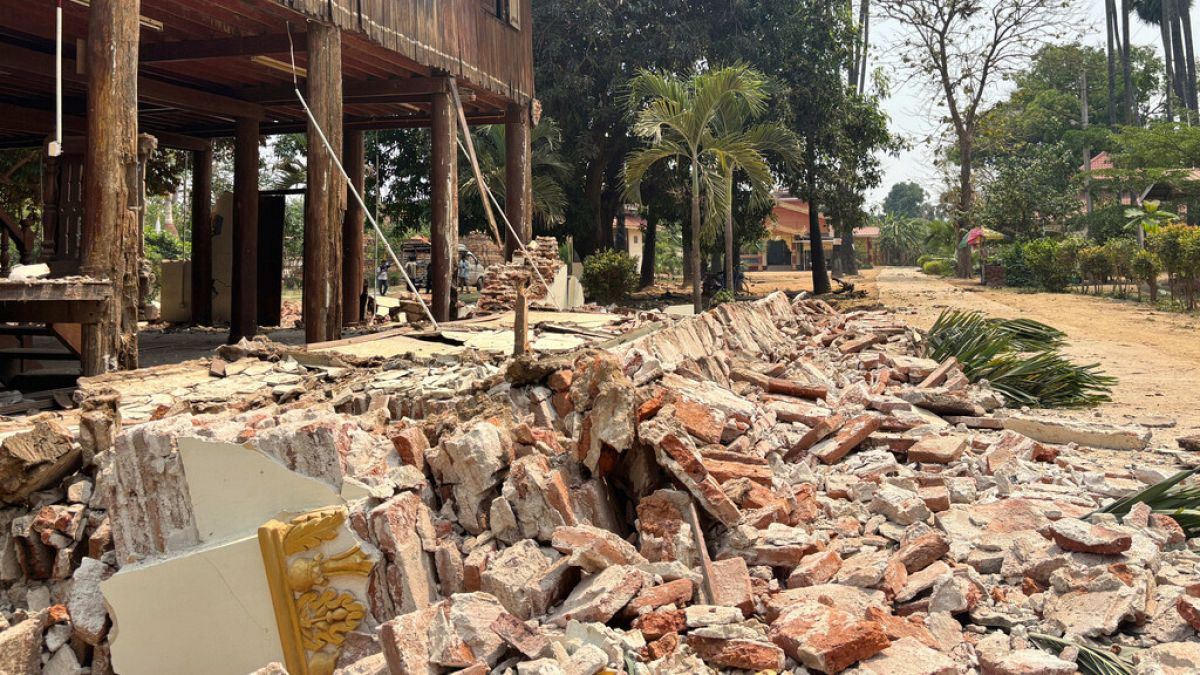
Copyright Chutima Lalit/Copyright 2025 The AP. All rights reserved.
VIDEO
By Tamsin Paternoster & AP
Published on 28/03/2025
Tremors from the powerful quake caused deaths and damages in the Thai capital of Bangkok, thousands of miles away from the earthquake's epicentre.
A strong 7.7 magnitude earthquake struck early afternoon in Myanmar on Friday, causing officials to declare a state of emergency in Myanmar and Bangkok, the capital of neighbouring Thailand.
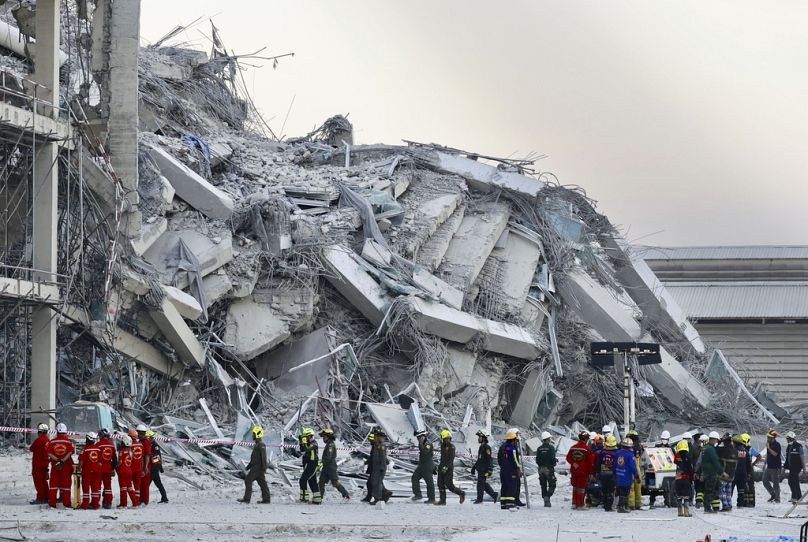
At least three people were killed and 90 construction workers remain missing after the quake caused a 30-storey building in the capital to collapse in Bangkok's Chatuchak Park area.
Seven were rescued from the rubble of the collapsed building, the National Institute for Emergency Medicine said in a Facebook post.
A video circulated on social media showed the multi-story structure sway and crumble into a cloud of dust as onlookers screamed and ran.
Thai authorities have declared a state of emergency in response to the major earthquake hitting the city, Prime Minister Paetongtarn Shinawatra said on Friday.
The US Geological Survey (USGS) said the earthquake was shallow with a depth of 10 kilometres. Its epicentre was near the Burmese city of Sagaing, close to Mandalay.
A second quake, with a magnitude of 6.4, shook the area 12 minutes later.
Tremors from the powerful quake caused deaths and damages in the Thai capital of Bangkok, thousands of miles away from the earthquake's epicentre.
A strong 7.7 magnitude earthquake struck early afternoon in Myanmar on Friday, causing officials to declare a state of emergency in Myanmar and Bangkok, the capital of neighbouring Thailand.
At least three people were killed and 90 construction workers remain missing after the quake caused a 30-storey building in the capital to collapse in Bangkok's Chatuchak Park area.
Seven were rescued from the rubble of the collapsed building, the National Institute for Emergency Medicine said in a Facebook post.
A video circulated on social media showed the multi-story structure sway and crumble into a cloud of dust as onlookers screamed and ran.
Thai authorities have declared a state of emergency in response to the major earthquake hitting the city, Prime Minister Paetongtarn Shinawatra said on Friday.
The US Geological Survey (USGS) said the earthquake was shallow with a depth of 10 kilometres. Its epicentre was near the Burmese city of Sagaing, close to Mandalay.
A second quake, with a magnitude of 6.4, shook the area 12 minutes later.
Rescuers work at the site a high-rise building under construction that collapsed after a 7.7 magnitude earthquake in Bangkok, Thailand, Friday, March 28, 2025. Wason Wanichakorn/Copyright 2025 The AP. All rights reserved
State of emergency in Myanmar
In Myanmar, state-run MRTV said the the military-run government declared a state of emergency across six regions and states.
Major General Zaw Min Tun, a military government spokesperson said blood was in high demand in the hospitals in earthquakes-hit areas, especially Mandalay, Sagaing, and Naypyitaw.
He urged blood donors to contact the hospitals as soon as possible.
The Red Cross said initial reports from the ground suggested the earthquake caused "significant damage", adding that damaged power lines were preventing their teams from reaching the affected Mandalay and Sagaing regions.
It is not yet known how many casualties there are as a result of the quake hitting the country, where many areas are not easily accessible and the government is embroiled in civil war after a coup in 2021.
AFP reported that the ruling miltary junta made a rare request for international humanitarian aid, leaving aid agencies scrambling to assess the humanitarian needs and work out how to reach the country, which is isolated from the outside world.
In the Saigaing region, a 90-year old bridge collapsed as sections of the highway connecting Mandalay to Yangon were damaged. In the capital Naypyitaw, religious shrines were damaged, with parts toppling to the ground.
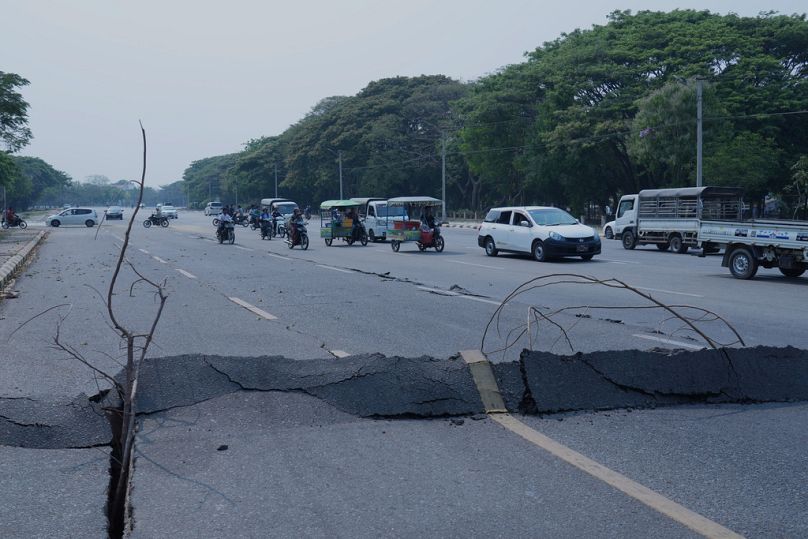
Vehicles make their way near a road damaged by an earthquake Friday, March 28, 2025, in Naypyitaw, Myanmar.Aung Shine Oo/Copyright 2025 The AP. All rights reserved.
The quake caused alarms to go off in buildings across Bangkok, and thousands of residents ran down the staircases of high-rise apartments and hotels onto the street. Videos on social media showed people gathering in the streets of the Thai capital.
The tremors were forceful enough to send water sloshing out of pools, some high up in high-rises, as the tremor shook.
Paul Vincent, a tourist visiting from England, was at a streetside bar when the quake struck.
“When I saw the building, oh my God, that’s when ... it hit me,” he said. “There was people crying in the streets and, you know, the panic was horrendous really.”
Thai Prime Minister Paetongtarn Shinawatra warned Bangkok residents to remain calm as the city prepared an emergency response.
“I’d like to ask everyone to stay calm and do not panic, but please be careful,” Shinawatra said, warning that there could be possible aftershocks.
More than 17 million people live in the greater Bangkok area, many of whom are in high-rise apartments.
The quake caused alarms to go off in buildings across Bangkok, and thousands of residents ran down the staircases of high-rise apartments and hotels onto the street. Videos on social media showed people gathering in the streets of the Thai capital.
The tremors were forceful enough to send water sloshing out of pools, some high up in high-rises, as the tremor shook.
Paul Vincent, a tourist visiting from England, was at a streetside bar when the quake struck.
“When I saw the building, oh my God, that’s when ... it hit me,” he said. “There was people crying in the streets and, you know, the panic was horrendous really.”
Thai Prime Minister Paetongtarn Shinawatra warned Bangkok residents to remain calm as the city prepared an emergency response.
“I’d like to ask everyone to stay calm and do not panic, but please be careful,” Shinawatra said, warning that there could be possible aftershocks.
More than 17 million people live in the greater Bangkok area, many of whom are in high-rise apartments.
Powerful earthquake rocks Myanmar and Thailand, killing at least 3 in Bangkok high-rise collapse
DAVID RISING and JINTAMAS SAKSORNCHAI
Fri, March 28, 2025
BANGKOK (AP) — A powerful earthquake rocked Myanmar and neighboring Thailand on Friday, killing at least three people in Bangkok and burying dozens when a high-rise building under construction collapsed. Footage shared on social media from Myanmar's second-largest city showed widespread destruction, raising fears that many were trapped under the rubble or killed.
The 7.7 magnitude quake, with an epicenter near Mandalay in Myanmar, struck at midday and was followed by a strong 6.4 magnitude aftershock.
The extent of death, injury and destruction — especially in Myanmar, which is embroiled in a civil war and where information is tightly controlled at the best of times — was not yet clear.
Myanmar's government said blood was in high demand in the hardest-hit areas. Images of buckled and cracked roads and damaged highways as well as the collapse of a bridge and dam raised further concerns about how rescuers would even reach some areas in a country already enduring a widespread humanitarian crisis.
Near Bangkok’s popular Chatuchak market, a 33-story building under construction, with a crane on top, crumpled into a cloud of dust, and onlookers could be seen screaming and running in a video posted on social media.
The sound of sirens echoed throughout central Bangkok and vehicles filled the streets, leaving some of the city’s already congested streets gridlocked. The elevated rapid transit system and subway shut down.
While the area where the quake struck is prone to earthquakes, they are usually not so big and it is rare for them to felt in the Thai capital, which sits on a river delta and is at moderate risk for quakes.
April Kanichawanakul, who works in an office building in Bangkok, initially didn’t even realize it was an earthquake, the first she’d ever experienced. “I just thought I was dizzy,” she said.
She and her colleagues ran downstairs from the 10th floor of their building and waited outside for a signal that it was safe to go back in.
Crane-topped building collapsed in a cloud of dust
In Bangkok, at least three people were killed in the building collapse and 90 were missing, according to Defense Minister Phumtham Wechayachai. He offered no more details about the ongoing rescue efforts but first responders said that seven people had been rescued so far from the area.
At least two of the dead were construction workers who were killed by falling rubble or debris, rescue worker Songwut Wangpon told reporters. The building was being built by the China Railway Construction Corporation for Thailand’s government auditor general.
Elsewhere, people in Bangkok evacuated from their buildings were cautioned to stay outside in case there were more aftershocks.
The U.S. Geological Survey and Germany’s GFZ center for geosciences said the earthquake was a shallow 10 kilometers (6.2 miles), according to preliminary reports. Shallower earthquakes tend to cause more damage.
Screaming and panic as buildings swayed
Bangkok's city hall declared the city a disaster area to facilitate the response. The greater Bangkok area is home to more than 17 million people, many of whom live in high-rise apartments.
“All of a sudden the whole building began to move. Immediately there was screaming and a lot of panic,” said Fraser Morton, a tourist from Scotland, who was in one of Bangkok's many malls.
“I just started walking calmly at first but then the building started really moving, yeah, a lot of screaming, a lot of panic, people running the wrong way down the escalators.”
Like Morton, thousands of people poured into Benjasiri Park from nearby shopping malls, high rises and apartment buildings along Bangkok’s busy Sukhumvit Road.
Many were on phones trying to reach loved ones as others sought shade from the hot early afternoon sun.
“I got outside and then looked up at the building and the whole building was moving, dust and debris, it was pretty intense,” Morton said. “Lots of chaos.”
Voranoot Thirawat, a lawyer working in central Bangkok, said her first indication that something was wrong came when she saw a light swinging back and forth. Then she heard the building creaking as it moved back and forth.
She and her colleagues ran down 12 flights of stairs. “In my lifetime, there was no earthquake like this in Bangkok,” she said.
Paul Vincent, a tourist visiting from England, was at a streetside bar when the quake struck.
“The next thing, everybody came on the street, so there was a lot of screaming and panicking, which obviously made it a lot worse,” he said.
As he came onto the street himself, he said he saw a high-rise building swaying and water falling from a rooftop pool.
“There was people crying in the streets and, you know, the panic was horrendous really,” he said.
Bridge and monastery collapse and dam bursts in Myanmar
In Mandalay, the earthquake reportedly brought down multiple buildings, including the Ma Soe Yane monastery, one of the largest in the city, and damaged the former royal palace. Meanwhile, Christian Aid said its partners and colleagues on the ground reported that a dam burst in the city, causing water levels to rise in the lowland areas in the area.
A video posted online showed robed monks in the street shooting video of the multistory monastery before it suddenly fell into the ground. It was not immediately clear whether anyone was harmed.
In the Sagaing region just southwest of the city, a 90-year-old bridge collapsed, and some sections of the highway connecting Mandalay and Myanmar’s largest city, Yangon, were also damaged.
The military seized power from the elected government of Aung San Suu Kyi in February 2021, and is now involved in a bloody civil war with long-established militias and newly formed pro-democracy ones.
Government forces have lost control of much of Myanmar, and many places are incredibly dangerous to access or simply out of reach for aid groups. More than 3 million people have been displaced by the fighting and nearly 20 million are in need, according to the United Nations.
The Red Cross said downed power lines added to challenges for their teams trying to reach several hard-hit areas.
“This disaster will have left people devastated and in need of drinking water, food and shelter," said Julie Mehigan, head of Asia, Middle East & Europe for Christian Aid. “Myanmar is one of the least developed countries in the world. Even before this heartbreaking earthquake, we know conflict and displacement has left countless people in real need.”
Myanmar’s government declared a state of emergency in six regions and states including the capital Naypyitaw and Mandalay. It was not clear what the declaration meant since the entire country has been under a state of emergency since 2021.
Residents in Yangon rushed out of their homes when the quake struck. In the capital Naypyitaw, the quake damaged religious shrines, sending parts toppling to the ground, and some homes.
Maj. Gen. Zaw Min Tun, the military government’s spokesperson, told state television MRTV that blood was in high demand in the hospitals in earthquakes-hit areas, especially Mandalay, Sagaing, and Naypyitaw. He urged blood donors to contact the hospitals as soon as possible.
Injuries reported in China
To the northeast, the earthquake was felt in Yunnan and Sichuan provinces in China and caused damage to houses and injuries in the city of Ruili on the border with Myanmar, according to Chinese media reports.
Videos that one outlet said it had received from a person in Ruili showed building debris littering a street and a person being wheeled in a stretcher toward an ambulance.
The shaking in Mangshi, a Chinese city about 100 kilometers (60 miles) northeast of Ruili, was so strong that people couldn’t stand, one resident told The Paper, an online media outlet.
_____
Adam Schreck, Haruka Naga, Jerry Harmer, Grant Peck and Penny Wang in Bangkok, Jamey Keaten in Geneva and Ken Moritsugu in Beijing contributed to this report.

Rescuers work at the site a high-rise building under construction that collapsed after a 7.7 magnitude earthquake in Bangkok, Thailand, Friday, March 28, 2025. (AP Photo/Wason Wanichakorn)ASSOCIATED PRESS

Hospital patients lay on beds outdoors after a 7.7 magnitude earthquake in Bangkok, Thailand, Friday, March 28, 2025. (AP Photo/Sakchai Lalit)ASSOCIATED PRESS

Rescuers carry an injured from the site of a high-rise building under construction that collapsed after a 7.7 magnitude earthquake in Bangkok, Thailand, Friday, March 28, 2025. (AP Photo/Sakchai Lalit)ASSOCIATED PRESS

A woman reacts as she watches rescuers at the site of a high-rise building under construction that collapsed after a 7.7 magnitude earthquake in Bangkok, Thailand, Friday, March 28, 2025. (AP Photo/Wason Wanichakorn)ASSOCIATED PRESS

A rescuer walks at the site of a high-rise building under construction that collapsed after a 7.7 magnitude earthquake in Bangkok, Thailand, Friday, March 28, 2025. (AP Photo/Sakchai Lalit)ASSOCIATED PRESS

Damaged pagodas are seen after an earthquake, Friday, March 28, 2025 in Naypyitaw, Myanmar. (AP Photo/Aung Shine Oo)ASSOCIATED PRESS

Rescuers work at the site of a high-rise building under construction that collapsed after a 7.7 magnitude earthquake in Bangkok, Thailand, Friday, March 28, 2025. (AP Photo/Sakchai Lalit)ASSOCIATED PRESS

Children walk near a damaged monastery compound after an earthquake, Friday, March 28, 2025 in Naypyitaw, Myanmar. (AP Photo/Aung Shine Oo)ASSOCIATED PRESS

Rescuers tend to injured from the site of a high-rise building under construction that collapsed after a 7.7 magnitude earthquake in Bangkok, Thailand, Friday, March 28, 2025. (AP Photo/Sakchai Lalit)ASSOCIATED PRESS

People who evacuated from buildings following earthquake in Bangkok, Thailand, Friday, March 28, 2025. (AP Photo/Chutima Lalit)ASSOCIATED PRESS

The bodies of victims of a high-rise building under construction that collapsed after a 7.7 magnitude earthquake lie on the ground in Bangkok, Thailand, Friday, March 28, 2025. (AP Photo/Wason Wanichakorn)ASSOCIATED PRESS

A crane is seen damaged on the facade of an under-construction building after a 7.7 magnitude earthquake in Bangkok, Thailand, Friday, March 28, 2025. (AP Photo/Sakchai Lalit)ASSOCIATED PRESS

People who evacuated from buildings following earthquake in Bangkok, Thailand, Friday, March 28, 2025. (AP Photo/Chutima Lalit)ASSOCIATED PRESS

Rescuers work at the site of a high-rise building under construction that collapsed after a 7.7 magnitude earthquake in Bangkok, Thailand, Friday, March 28, 2025. (AP Photo/Sakchai Lalit)ASSOCIATED PRESS

A bridge that connects two high-rises is seen damaged after a 7.7 magnitude earthquake in Bangkok, Thailand, Friday, March 28, 2025. (AP Photo/Sakchai Lalit)ASSOCIATED PRESS

Damaged pagodas are seen after an earthquake, Friday, March 28, 2025 in Naypyitaw, Myanmar. (AP Photo/Aung Shine Oo)ASSOCIATED PRESS

People take shelter outdoors after an earthquake shook nearby high-rises in Bangkok, Thailand, Friday, March 28, 2025. (AP Photo/David Cohen)ASSOCIATED PRESS

People who evacuated from buildings following earthquake in Bangkok, Thailand, Friday, March 28, 2025. (AP Photo/Chutima Lalit)ASSOCIATED PRESS

A Buddhist monk walks near a damaged building at a monastery compound after an earthquake, Friday, March 28, 2025 in Naypyitaw, Myanmar. (AP Photo/Aung Shine Oo)ASSOCIATED PRESS

Workers at the Ikea in a nearby high-rise shopping mall and others seek shelter in Bangkok's Benjasiri Park after an earthquake on Friday, March 28, 2025. (AP Photo/Adam Schreck)ASSOCIATED PRESS

Rescuers work at the site a high-rise building under construction that collapsed after a 7.7 magnitude earthquake in Bangkok, Thailand, Friday, March 28, 2025. (AP Photo/Wason Wanichakorn)ASSOCIATED PRESS

A damaged monastery is seen after an earthquake, Friday, March 28, 2025 in Naypyitaw, Myanmar. (AP Photo/Aung Shine Oo)ASSOCIATED PRESS
DAVID RISING and JINTAMAS SAKSORNCHAI
Fri, March 28, 2025
BANGKOK (AP) — A powerful earthquake rocked Myanmar and neighboring Thailand on Friday, killing at least three people in Bangkok and burying dozens when a high-rise building under construction collapsed. Footage shared on social media from Myanmar's second-largest city showed widespread destruction, raising fears that many were trapped under the rubble or killed.
The 7.7 magnitude quake, with an epicenter near Mandalay in Myanmar, struck at midday and was followed by a strong 6.4 magnitude aftershock.
The extent of death, injury and destruction — especially in Myanmar, which is embroiled in a civil war and where information is tightly controlled at the best of times — was not yet clear.
Myanmar's government said blood was in high demand in the hardest-hit areas. Images of buckled and cracked roads and damaged highways as well as the collapse of a bridge and dam raised further concerns about how rescuers would even reach some areas in a country already enduring a widespread humanitarian crisis.
Near Bangkok’s popular Chatuchak market, a 33-story building under construction, with a crane on top, crumpled into a cloud of dust, and onlookers could be seen screaming and running in a video posted on social media.
The sound of sirens echoed throughout central Bangkok and vehicles filled the streets, leaving some of the city’s already congested streets gridlocked. The elevated rapid transit system and subway shut down.
While the area where the quake struck is prone to earthquakes, they are usually not so big and it is rare for them to felt in the Thai capital, which sits on a river delta and is at moderate risk for quakes.
April Kanichawanakul, who works in an office building in Bangkok, initially didn’t even realize it was an earthquake, the first she’d ever experienced. “I just thought I was dizzy,” she said.
She and her colleagues ran downstairs from the 10th floor of their building and waited outside for a signal that it was safe to go back in.
Crane-topped building collapsed in a cloud of dust
In Bangkok, at least three people were killed in the building collapse and 90 were missing, according to Defense Minister Phumtham Wechayachai. He offered no more details about the ongoing rescue efforts but first responders said that seven people had been rescued so far from the area.
At least two of the dead were construction workers who were killed by falling rubble or debris, rescue worker Songwut Wangpon told reporters. The building was being built by the China Railway Construction Corporation for Thailand’s government auditor general.
Elsewhere, people in Bangkok evacuated from their buildings were cautioned to stay outside in case there were more aftershocks.
The U.S. Geological Survey and Germany’s GFZ center for geosciences said the earthquake was a shallow 10 kilometers (6.2 miles), according to preliminary reports. Shallower earthquakes tend to cause more damage.
Screaming and panic as buildings swayed
Bangkok's city hall declared the city a disaster area to facilitate the response. The greater Bangkok area is home to more than 17 million people, many of whom live in high-rise apartments.
“All of a sudden the whole building began to move. Immediately there was screaming and a lot of panic,” said Fraser Morton, a tourist from Scotland, who was in one of Bangkok's many malls.
“I just started walking calmly at first but then the building started really moving, yeah, a lot of screaming, a lot of panic, people running the wrong way down the escalators.”
Like Morton, thousands of people poured into Benjasiri Park from nearby shopping malls, high rises and apartment buildings along Bangkok’s busy Sukhumvit Road.
Many were on phones trying to reach loved ones as others sought shade from the hot early afternoon sun.
“I got outside and then looked up at the building and the whole building was moving, dust and debris, it was pretty intense,” Morton said. “Lots of chaos.”
Voranoot Thirawat, a lawyer working in central Bangkok, said her first indication that something was wrong came when she saw a light swinging back and forth. Then she heard the building creaking as it moved back and forth.
She and her colleagues ran down 12 flights of stairs. “In my lifetime, there was no earthquake like this in Bangkok,” she said.
Paul Vincent, a tourist visiting from England, was at a streetside bar when the quake struck.
“The next thing, everybody came on the street, so there was a lot of screaming and panicking, which obviously made it a lot worse,” he said.
As he came onto the street himself, he said he saw a high-rise building swaying and water falling from a rooftop pool.
“There was people crying in the streets and, you know, the panic was horrendous really,” he said.
Bridge and monastery collapse and dam bursts in Myanmar
In Mandalay, the earthquake reportedly brought down multiple buildings, including the Ma Soe Yane monastery, one of the largest in the city, and damaged the former royal palace. Meanwhile, Christian Aid said its partners and colleagues on the ground reported that a dam burst in the city, causing water levels to rise in the lowland areas in the area.
A video posted online showed robed monks in the street shooting video of the multistory monastery before it suddenly fell into the ground. It was not immediately clear whether anyone was harmed.
In the Sagaing region just southwest of the city, a 90-year-old bridge collapsed, and some sections of the highway connecting Mandalay and Myanmar’s largest city, Yangon, were also damaged.
The military seized power from the elected government of Aung San Suu Kyi in February 2021, and is now involved in a bloody civil war with long-established militias and newly formed pro-democracy ones.
Government forces have lost control of much of Myanmar, and many places are incredibly dangerous to access or simply out of reach for aid groups. More than 3 million people have been displaced by the fighting and nearly 20 million are in need, according to the United Nations.
The Red Cross said downed power lines added to challenges for their teams trying to reach several hard-hit areas.
“This disaster will have left people devastated and in need of drinking water, food and shelter," said Julie Mehigan, head of Asia, Middle East & Europe for Christian Aid. “Myanmar is one of the least developed countries in the world. Even before this heartbreaking earthquake, we know conflict and displacement has left countless people in real need.”
Myanmar’s government declared a state of emergency in six regions and states including the capital Naypyitaw and Mandalay. It was not clear what the declaration meant since the entire country has been under a state of emergency since 2021.
Residents in Yangon rushed out of their homes when the quake struck. In the capital Naypyitaw, the quake damaged religious shrines, sending parts toppling to the ground, and some homes.
Maj. Gen. Zaw Min Tun, the military government’s spokesperson, told state television MRTV that blood was in high demand in the hospitals in earthquakes-hit areas, especially Mandalay, Sagaing, and Naypyitaw. He urged blood donors to contact the hospitals as soon as possible.
Injuries reported in China
To the northeast, the earthquake was felt in Yunnan and Sichuan provinces in China and caused damage to houses and injuries in the city of Ruili on the border with Myanmar, according to Chinese media reports.
Videos that one outlet said it had received from a person in Ruili showed building debris littering a street and a person being wheeled in a stretcher toward an ambulance.
The shaking in Mangshi, a Chinese city about 100 kilometers (60 miles) northeast of Ruili, was so strong that people couldn’t stand, one resident told The Paper, an online media outlet.
_____
Adam Schreck, Haruka Naga, Jerry Harmer, Grant Peck and Penny Wang in Bangkok, Jamey Keaten in Geneva and Ken Moritsugu in Beijing contributed to this report.
Rescuers work at the site a high-rise building under construction that collapsed after a 7.7 magnitude earthquake in Bangkok, Thailand, Friday, March 28, 2025. (AP Photo/Wason Wanichakorn)ASSOCIATED PRESS
Hospital patients lay on beds outdoors after a 7.7 magnitude earthquake in Bangkok, Thailand, Friday, March 28, 2025. (AP Photo/Sakchai Lalit)ASSOCIATED PRESS
Rescuers carry an injured from the site of a high-rise building under construction that collapsed after a 7.7 magnitude earthquake in Bangkok, Thailand, Friday, March 28, 2025. (AP Photo/Sakchai Lalit)ASSOCIATED PRESS
A woman reacts as she watches rescuers at the site of a high-rise building under construction that collapsed after a 7.7 magnitude earthquake in Bangkok, Thailand, Friday, March 28, 2025. (AP Photo/Wason Wanichakorn)ASSOCIATED PRESS
A rescuer walks at the site of a high-rise building under construction that collapsed after a 7.7 magnitude earthquake in Bangkok, Thailand, Friday, March 28, 2025. (AP Photo/Sakchai Lalit)ASSOCIATED PRESS
Damaged pagodas are seen after an earthquake, Friday, March 28, 2025 in Naypyitaw, Myanmar. (AP Photo/Aung Shine Oo)ASSOCIATED PRESS
Rescuers work at the site of a high-rise building under construction that collapsed after a 7.7 magnitude earthquake in Bangkok, Thailand, Friday, March 28, 2025. (AP Photo/Sakchai Lalit)ASSOCIATED PRESS
Children walk near a damaged monastery compound after an earthquake, Friday, March 28, 2025 in Naypyitaw, Myanmar. (AP Photo/Aung Shine Oo)ASSOCIATED PRESS
Rescuers tend to injured from the site of a high-rise building under construction that collapsed after a 7.7 magnitude earthquake in Bangkok, Thailand, Friday, March 28, 2025. (AP Photo/Sakchai Lalit)ASSOCIATED PRESS
People who evacuated from buildings following earthquake in Bangkok, Thailand, Friday, March 28, 2025. (AP Photo/Chutima Lalit)ASSOCIATED PRESS
The bodies of victims of a high-rise building under construction that collapsed after a 7.7 magnitude earthquake lie on the ground in Bangkok, Thailand, Friday, March 28, 2025. (AP Photo/Wason Wanichakorn)ASSOCIATED PRESS
A crane is seen damaged on the facade of an under-construction building after a 7.7 magnitude earthquake in Bangkok, Thailand, Friday, March 28, 2025. (AP Photo/Sakchai Lalit)ASSOCIATED PRESS
People who evacuated from buildings following earthquake in Bangkok, Thailand, Friday, March 28, 2025. (AP Photo/Chutima Lalit)ASSOCIATED PRESS
Rescuers work at the site of a high-rise building under construction that collapsed after a 7.7 magnitude earthquake in Bangkok, Thailand, Friday, March 28, 2025. (AP Photo/Sakchai Lalit)ASSOCIATED PRESS
A bridge that connects two high-rises is seen damaged after a 7.7 magnitude earthquake in Bangkok, Thailand, Friday, March 28, 2025. (AP Photo/Sakchai Lalit)ASSOCIATED PRESS
Damaged pagodas are seen after an earthquake, Friday, March 28, 2025 in Naypyitaw, Myanmar. (AP Photo/Aung Shine Oo)ASSOCIATED PRESS
People take shelter outdoors after an earthquake shook nearby high-rises in Bangkok, Thailand, Friday, March 28, 2025. (AP Photo/David Cohen)ASSOCIATED PRESS
People who evacuated from buildings following earthquake in Bangkok, Thailand, Friday, March 28, 2025. (AP Photo/Chutima Lalit)ASSOCIATED PRESS
A Buddhist monk walks near a damaged building at a monastery compound after an earthquake, Friday, March 28, 2025 in Naypyitaw, Myanmar. (AP Photo/Aung Shine Oo)ASSOCIATED PRESS
Workers at the Ikea in a nearby high-rise shopping mall and others seek shelter in Bangkok's Benjasiri Park after an earthquake on Friday, March 28, 2025. (AP Photo/Adam Schreck)ASSOCIATED PRESS
Rescuers work at the site a high-rise building under construction that collapsed after a 7.7 magnitude earthquake in Bangkok, Thailand, Friday, March 28, 2025. (AP Photo/Wason Wanichakorn)ASSOCIATED PRESS
A damaged monastery is seen after an earthquake, Friday, March 28, 2025 in Naypyitaw, Myanmar. (AP Photo/Aung Shine Oo)ASSOCIATED PRESS
