Wednesday, April 16, 2025

U.S. judge presses Trump ad­min­is­tration on its refusal to return Kilmar Abrego Garcia

FELON POTUS CONTEMPTOUS OF COURT

Associated Press 
Maryland
Apr. 15, 2025


GREENBELT, Md. — A federal judge said Tuesday that she will order sworn testimony by Trump administration officials to determine if they complied with her orders to facilitate the return of Kilmar Abrego Garcia, who was mistakenly deported to a notorious El Salvador prison.

U.S. District Judge Paula Xinis in Maryland issued her order after Trump officials continually refused to retrieve Abrego Garcia, saying they defied a “clear” Supreme Court order.

She also disregarded Monday's comments by White House officials and El Salvador's president that they were unable to bring back Abrego Garcia, describing their statements as “two very misguided ships passing in the night.”

What You Need To Know
A federal judge says she will order sworn testimony by Trump administration officials to determine if they complied with her orders to facilitate the return of Kilmar Abrego GarciaHe was mistakenly deported to a notorious El Salvador prison last monthThe U.S. Supreme Court ordered the Trump administration to return him. But the administration has so far refusedIt claims he's in the MS-13 gang. Abrego Garcia's attorneys deny the allegations and say he was never charged with a crimeThe president of El Salvador also said he would not return Abrego Garcia, likening it to smuggling “a terrorist into the United States”

“The Supreme Court has spoken,” Xinis said, adding that what was said in the Oval Office on Monday “is not before the court.”

In her written order published Tuesday evening, Xinis called for the testimony of four Trump administration officials who work for U.S. Immigration and Customs Enforcement, the Department of Homeland Security and the State Department.

She expects the process to last about two weeks. Xinis wrote that Trump administration officials “have done nothing at all” toward returning Abrego Garcia. But, she wrote, they “remain obligated, at a minimum, to take the steps available to them toward aiding, assisting, or making easier Abrego Garcia’s release.”

The hearing came a day after White House advisers repeated the claim that they lack the authority to bring back the Salvadoran national from his native country. The president of El Salvador also said Monday that he would not return Abrego Garcia, likening it to smuggling “a terrorist into the United States.”

Abrego Garcia’s deportation has become a national flashpoint as President Donald Trump follows up on campaign promises of mass deportations, including to a notorious prison in El Salvador.

An attorney for Abrego Garcia said contempt proceedings could be the logical next step after two weeks of discovery. “This is still a win, and this is still progress," Rina Ghandi said. “We’re not done yet, though.”

Abrego Garcia's wife, Jennifer Vasquez Sura, said shortly before Tuesday's hearing that he was working hard to achieve the American dream for his family.

“That dream was shattered on March 12th when he was abducted and disappeared by the United States government in front of our 5-year-old-child,” she said. “Today is 34 days after his disappearance ... I will not stop fighting until I see my husband alive.”

Meanwhile, Democratic U.S. Sen. Chris Van Hollen of Maryland said he'll travel to El Salvador on Wednesday.

“My hope is to visit Kilmar and check on his wellbeing and to hold constructive conversations with government officials around his release,” Van Hollen said.

Abrego Garcia, 29, lived in the U.S. for roughly 14 years, during which he worked construction, got married and was raising three children with disabilities, according to court records.

A U.S. immigration judge had shielded Abrego Garcia from deportation to El Salvador in 2019, ruling that he would likely face persecution there by local gangs that had terrorized his family. He also was given a federal permit to work in the United States, where he was a metal worker and union member, according to Abrego Garcia’s lawyers.

But the Trump administration expelled Abrego Garcia to El Salvador last month anyway. Administration officials later described the mistake as “an administrative error” but insisted that Abrego Garcia was a member of the MS-13 in the U.S.

Abrego Garcia was never charged with a crime and has denied the allegations, which include being a member of MS-13 in Long Island, New York, where he has never lived.

U.S. District Judge Paula Xinis had ordered the Trump administration in early April to bring Abrego Garcia back. And the U.S. Supreme Court agreed on Thursday that the U.S. government must “facilitate” Abrego Garcia’s release.

But the White House has balked at trying to broker his return, arguing the courts can’t intrude on the president’s diplomacy powers.

Xinis ordered the U.S. on Friday to provide daily status updates on plans to return Abrego Garcia. The Trump administration responded Saturday that he was alive in the El Salvador prison. But it has only doubled down on its decision not to tell a federal court whether it has any plans to repatriate Abrego Garcia.

In its filing to the judge on Monday, the Trump administration repeated the statement made by El Salvador President Nayib Bukele.

“How can I smuggle a terrorist into the United States? Of course I'm not going to do it. The question is preposterous,” Bukele said.

In a filing with the U.S. District Court on Tuesday, Abrego Garcia's lawyers cited Thursday's order from the Supreme Court to facilitate his return.

“To give any meaning to the Supreme Court’s order, the Government should at least be required to request the release of Abrego Garcia,” the attorneys wrote. “To date, the Government has not done so.”

The attorneys also rejected the idea that the U.S. lacks the authority to retrieve him. They noted that the U.S. is paying El Salvador to hold prisoners, including Abrego Garcia, and “can exercise those same contractual rights to request their release.”

Bukele struck a deal under which the U.S. will pay about $6 million for El Salvador to imprison Venezuelan immigrants for a year. Trump has said openly that he would also favor El Salvador taking custody of American citizens who have committed violent crimes, which is likely illegal.
POSTMODERN GESTAPO

US Visa can­cel­la­tions sow panic for
 in­ter­na­tional students, with hundreds fearing de­por­tation


In this image taken from security camera video, Rumeysa Ozturk, a 30-year-old doctoral student at Tufts University, is detained by Department of Homeland Security agents on a street in Sommerville, Mass., Tuesday, March 26, 2025. (AP Photo)

BY Associated Press 
Washington, D.C.
 Apr. 15, 2025


WASHINGTON — At first, the bar association for immigration attorneys began receiving inquiries from a couple students a day. These were foreigners studying in the U.S., and they'd discovered in early April their legal status had been terminated with little notice. To their knowledge, none of the students had committed a deportable offense.

In recent days, the calls have begun flooding in. Hundreds of students have been calling to say they have lost legal status, seeking advice on what to do next.

“We thought it was going to be something that was unusual,” said Matthew Maiona, a Boston-based immigration attorney who is getting about six calls a day from panicked international students. “But it seems now like it’s coming pretty fast and furious.”

What You Need To Know
The speed and scope of the federal government’s efforts to terminate the legal status of international students have stunned colleges and universities across the countryFew corners of higher education have been untouched, as schools ranging from prestigious private universities, large public research institutions and tiny liberal arts colleges discover status terminations one after another among their student bodyAt least 600 students at more than 90 colleges and universities have had their visas revoked or their legal status terminated in recent weeks, according to an Associated Press review of university statements and correspondence with school officials

The speed and scope of the federal government's efforts to terminate the legal status of international students have stunned colleges across the country. Few corners of higher education have been untouched, as schools ranging from prestigious private universities, large public research institutions and tiny liberal arts colleges discover status terminations one after another among their students.

At least 600 students at more than 90 colleges and universities have had their visas revoked or their legal status terminated in recent weeks, according to an Associated Press review of university statements and correspondence with school officials. Advocacy groups collecting reports from colleges say hundreds more students could be caught up in the crackdown.
Students apparently targeted over minor infractions

Around 1.1 million international students were in the United States last year — a source of essential revenue for tuition-driven colleges. International students are not eligible for federal financial aid, and their ability to pay tuition often factors into whether they will be admitted to American schools. Often, they pay full price.

Many of the students losing their legal status are from India and China, which together account for more than half the international students at American colleges. But the terminations have not been limited to those from any one part of the world, lawyers said.

Four students from two Michigan universities are suing Trump administration officials after their F-1 student status was terminated last week. Their attorney with the American Civil Liberties Union, Ramis Wadood, said the students never received a clear reason why.

“We don’t know, and that’s the scary part,” he said.

The students were informed of the terminations by their universities via email, which came as a shock, Wadood said. The reason given was that there was a “criminal records check and/or that their visa was revoked,” Wadood said, but none of them were charged or convicted of crimes. Some had either speeding or parking tickets, but one didn’t have any, he said. Only one of the students had known their entry visa was revoked, Wadood said.

Students have filed similar lawsuits in several other states, arguing they were denied due process.

In New Hampshire, a federal judge last week granted a temporary restraining order to restore the status of a Ph.D. student at Dartmouth College, Xiaotian Liu, while he challenges the revocation of his visa.
In a break from past, feds cancel students' status directly

At many colleges, officials learned the legal immigration status of some international students had been terminated when staff checked a database managed by the Department of Homeland Security. In the past, college officials say, legal statuses typically were updated after colleges told the government the students were no longer studying at the school.

The system to track enrollment and movements of international students came under the control of Immigration and Customs Enforcement after 9/11, said Fanta Aw, CEO of NAFSA, an association of international educators. She said recent developments have left students fearful of how quickly they can be on the wrong side of enforcement.

“You don’t need more than a small number to create fear,” Aw said. “There’s no clarity of what are the reasons and how far the reach of this is.”

Her group says as many as 1,300 students have lost visas or had their status terminated, based on reports from colleges.

The Department of Homeland Security and State Department did not respond to messages seeking comment.

Foreigners who are subject to removal proceedings are usually sent a notice to appear in immigration court on a certain date, but lawyers say affected students have not received any notices, leaving them unsure of next steps to take.

Some schools have told students to leave the country to avoid the risk of being detained or deported. But some students have appealed the terminations and stayed in the United States while those are processed.

Still others caught in legal limbo aren't students at all. They had remained in the U.S. post-graduation on “optional practical training,” a one-year period — or up to three for science and technology graduates — that allows employment in the U.S. after completing an academic degree. During that time, a graduate works in their field and waits to receive their H-1B or other employment visas if they wish to keep working in the U.S.

Around 242,000 foreigners in the U.S. are employed through this “optional practical training.” About 500,000 are pursuing graduate degrees, and another 342,000 are undergraduate students.

Among the students who have filed lawsuits is a Georgia Tech Ph.D. student who is supposed to graduate on May 5, with a job offer to join the faculty. His attorney Charles Kuck said the student was likely targeted for termination because of an unpaid traffic fine from when the student lent his car to a friend. Ultimately, the violation was dismissed.

“We have case after case after case exactly like that, where there is no underlying crime,” said Kuck, who is representing 17 students in the federal lawsuit. He said his law firm has heard from hundreds of students.

“These are kids who now, under the Trump administration, realize their position is fragile,” he said. “They’ve preyed on a very vulnerable population. These kids aren’t hiding. They’re in school.”

Some international students have been adapting their daily routines.

A Ph.D. student from China at University of North Carolina at Chapel Hill said she has begun carrying around her passport and immigration paperwork at the advice of the university’s international student office. The student, who spoke on condition of anonymity for fear of being targeted by authorities, said she has been distressed to see the terminations even for students like her without criminal records.

“That is the most scary part because you don’t know whether you’re going to be the next person,” she said.
Trump tariffs unnerve locals in Irish ‘pharma’ hub


By AFP
April 11, 2025


Locals in Ringaskiddy, Ireland, where pharmaceutical giants like Johnson & Johnson have transformed the economy, worry the good times could end under Trump's tariff war - Copyright AFP/File Arun SANKAR

Peter MURPHY

Vast pharmaceutical factories pepper the green landscape in southern Ireland, but the wind turbines next to the plants outside Cork are in the eye of Donald Trump’s global trade storm.

The area around the village of Ringaskiddy and its port in Cork harbour has emerged in recent decades as a base for US pharma giants where products such as Pfizer’s Viagra pills are made and shipped off to the United States and worldwide.

Pharmaceuticals are now the motor of Ireland’s economy, accounting for around 100 billion euros ($114 billion) in 2024, almost half of all Irish exports, and up around 30 percent from the previous year.

The sector also provides an estimated 20,000 well-paid jobs in County Cork, most of them around Ringaskiddy and the neighbouring commuter town of Carrigaline, and flushes a corporate tax bounty into the Irish exchequer.

But local people are sweating that the good times could end as Ireland has found itself in the crosshairs of the US president’s tariff war.

Trump has warned repeatedly that pharmaceuticals are in his sights and that special tariffs for the sector are imminent.

Drug manufacturing “is in other countries, largely made in China, a lot of it made in Ireland… Ireland was very smart. We love Ireland. but we’re going to have that,” he said last month.

This week, Trump trained his eye on China and announced a 90-day tariff pause for the rest of the world, just hours after he said the pharma companies are “going to come back” to the United States due to tariffs, fuelling panicked uncertainty about the future in Cork.

“There’s a lot of stress out there,” Audrey Buckley, a councillor in Ringaskiddy, told AFP overlooking a construction site where a new motorway will connect the factories to the port.

“Parents are saying to me, ‘Oh my God, should my daughter buy her first home, she’s in the process of going through a mortgage. Will she have a job in a year’s time?'”

Buckley remembers “the excitement” when Pfizer first appeared in the 1970s, kickstarting the area’s development.

She finished school in the 1980s, a decade marked by economic depression and high unemployment in Ireland, when many young people were forced to emigrate to find work.

“Now many of us are thinking like, will our own children have to emigrate again?” she said.


– ‘Doom and gloom’ –


At Ringaskiddy’s village bar “The Ferry Boat Inn” — dubbed by locals “the FBI” — daily chatter among customers gravitates toward Trump’s latest manoeuvres, according to bartender Kelly Davis.

“If everything was to be uprooted and brought back to America it would send shockwaves through the village,” the 39-year-old told AFP between pulling pints of Cork’s locally made Murphy’s stout.

On her way home after work, Shirin Banjwani, an analytics developer at one of the US-owned plants, admitted to AFP near Ringaskiddy port that she was “worried” about losing her job.

But the 29-year-old, originally from India, who works for Thermo Fisher Scientific, said the size of the plants means it would “take like five to six years” for them to shift to the United States if it happens.

“If Trump is planning to do that, it will take a lot of time,” she said.

Six kilometres (3.7 miles) up the road, the population of Carrigaline has soared in line with employment growth at the factories over the decades.

New residential developments have mushroomed around the town, its population doubling to 20,000 in two decades, up from 1,000 in the early 1970s.

“This town used to be a village. Once the pharmaceuticals came, it changed everything. It has boomed,” said Betty O’Riordan, a “Tidy Towns” group volunteer painting a park bench.

“A trade war will affect everybody, all those people with mortgages and high-purchase cars, where are they going to go?” the 70-year-old retired civil servant told AFP.

The owner of a swanky restaurant on Carrigaline’s main street declined to comment, saying only that “there’s too much doom and gloom already, no need for me to add more”.

In Cork city’s UCC university, Seamus Coffey, an economics lecturer, cautioned against doom-mongering.

“I think those factories are here for the time being. They’ll see out their life cycle in Ireland,” Coffey told AFP in the university’s quadrangle.

“If tariffs were to become a permanent feature of global trade, and if there are changes, we’ll see it further down the line with pipeline decisions about next investments,” he said.
UNDER REPORTED TARIFF
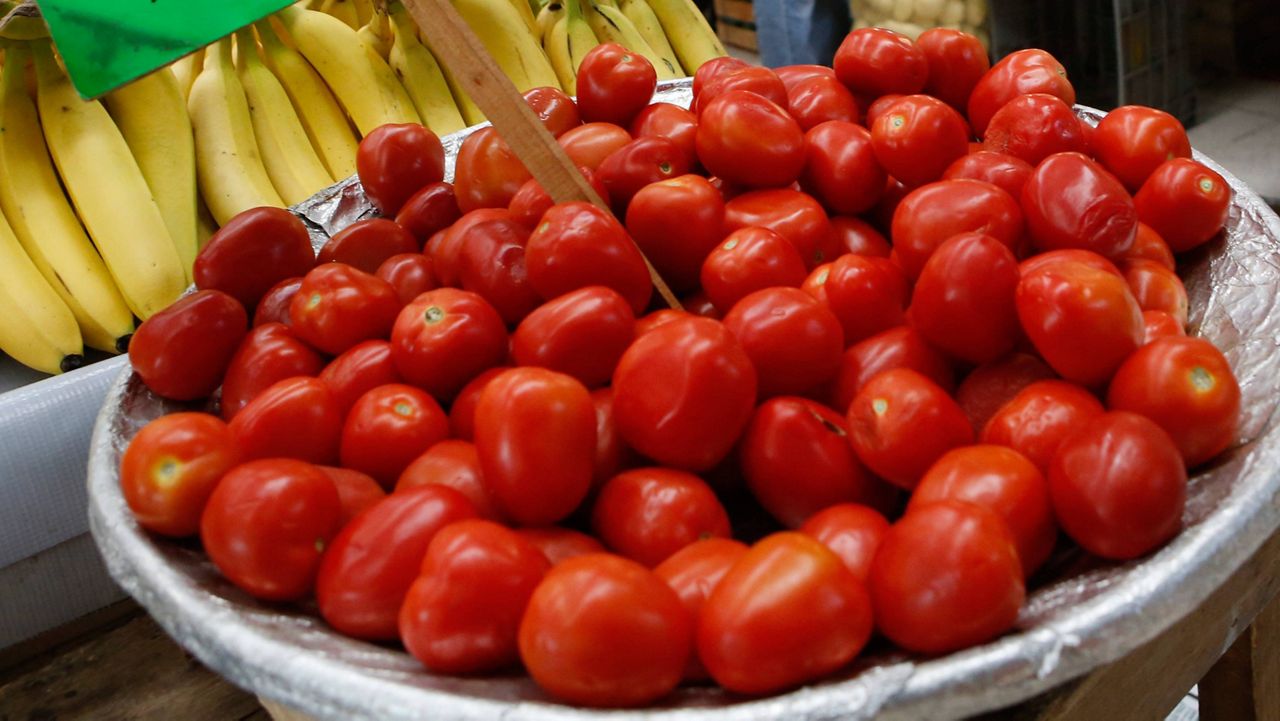
US says most tomatoes imported from Mexico to face 21% duty from July 14

OVER 50% OF TOMATOES SOLD IN U$ ARE FROM MEXICO

By Reuters
April 14, 2025


A seller organizes tomatoes at a stall in a street market in Mexico City, Mexico December 2, 2024 REUTERS/Raquel Cunha/File Photo

April 14 (Reuters) - The U.S. Commerce Department on Monday said most tomatoes imported from Mexico to the United States will face duties of 20.91% from July 14 as it withdraws from an agreement it said had failed to protect domestic tomato growers.
"This action will allow U.S. tomato growers to compete fairly in the marketplace," the department said in a release.

In 2019, Mexican tomato producers struck an agreement with President Donald Trump's first administration to avert an anti-dumping investigation and end a tariff dispute.

At the time, the United States said the agreement closed loopholes and included an inspection mechanism.

Reporting by Costas Pitas; Editing by Don Durfee


US government slapping 21 percent tariff on most tomatoes from Mexico

by Filip Timotija - 04/14/25 


The United States government announced that it plans to slap a nearly 21 percent tariff on most tomatoes coming from Mexico in the summer, arguing the current agreement has not “protected” U.S.-based tomato growers from “unfairly priced Mexican imports.”

The Commerce Department said on Monday that it plans to withdraw from the 2019 trade agreement with Mexico and that an “antidumping duty order” will be instituted on July 14.

“This action will allow U.S. tomato growers to compete fairly in the marketplace,” the Commerce Department said in a release on Monday.

During President Trump’s first White House term, the U.S. government struck an agreement with tomato producers from Mexico to prevent a possible 25 percent tariff on the commodity.

The 2019 deal included enforcement provisions, including an inspection mechanism to bar low-quality tomatoes from being imported and establishing prices for various types of the commodity.

In early 2019, during President Trump’s first term in the White House, the U.S. government threatened to withdraw from the existing agreement and levy duties against Mexico after complaints from growers in Florida who argued that Mexico City is performing price suppression of the crop and, therefore taking advantage of Washington.

Mexico, a major trading partner, is the U.S.’s largest importer of tomatoes, along with vegetables and fruits.

Mexico and the U.S. have been tangled in other disputes. Trump threatened earlier this year to levy additional tariffs against Mexico after the country missed the deadline to send over water to the U.S. from the Rio Grande River, stipulated by a 1944 treaty.

On Friday, Mexico’s President Claudia Sheinbaum said Mexico will make an “immediate” delivery of the water to the farmers in Texas.

THE HILL


Mexico threatens tariffs on meat in 
re­tal­i­ation for U.S. targeting its tomatoes with 21% duties this summer


Mexican tomatoes are displayed for sale at a produce stand in Mercado Medellin in Mexico City.
 (AP Photo/Rebecca Blackwell, File)

BY Christina Santucci and Associated Press Nationwide
Apr. 15, 2025
\

WASHINGTON, D.C. — Mexican leaders warned that they could retaliate with tariffs on some American meat, a day after the U.S. announced plans to impose a 21% “anti-dumping duty” on most tomatoes from Mexico starting in mid-July.

What You Need To Know
Mexico President Claudia Sheinbaum said Tuesday that her country could place tariffs on U.S. meats in response to duties announced on tomatoes from Mexico

“Mexico always has the possibility of applying sanctions in the case of the chicken or pork meat,” Sheinbaum said during a news conference

The Commerce Department said Monday that a 20.91% tariff would be placed on imports of most tomatoes from Mexico beginning July 14

The U.S. is Mexico’s top tomato export market with America importing $2.7 billion worth in 2023

Several elected officials from Florida cheered the planned tariff on tomatoes as a win for their state

“Mexico always has the possibility of applying sanctions in the case of the chicken or pork meat,” Mexican President Claudia Sheinbaum said during a news conference Tuesday.

Sheinbaum denied that her country sends unfairly priced tomatoes to their northern neighbor and said she hopes to reach an agreement with the Trump administration to avert the tomato tariff within the coming 90 days.

On Monday, the Commerce Department said the it intends to terminate a 2019 agreement made during President Donald Trump's first term that suspended an investigation into whether tomatoes from Mexico were being “dumped,” or sold in the U.S. at less than a “fair value.” The 2019 agreement averted tariffs on fresh tomatoes and chilled tomatoes.

The withdrawal is slated to go into effect July 14, at which point a tariff of 20.91% would be placed on imports of most tomatoes from Mexico.

“The current agreement has failed to protect U.S. tomato growers from unfairly priced Mexican imports, as commerce has been flooded with comments from them urging its termination. This action will allow U.S. tomato growers to compete fairly in the marketplace,” the department wrote in a news release Monday.

The U.S. is Mexico’s top tomato export market with America importing $2.7 billion worth in 2023, according to U.S. Department of Agriculture report. Nearly a quarter of the tomatoes produced that year were from the Sinaloa state.

Scheinbaum said she believes the U.S. would continue to import tomatoes from Mexico even if the tariff went into effect this summer, and predicted that salads and ketchup would then rise in price. “There is no substitute,” she said of her country’s crop.

Michael Strain, the director of Economic Policy Studies at the D.C.-think tank American Enterprise Institute, also contended that the move would make tomatoes more costly for Americans.

“It is astonishing that the Trump administration is intentionally trying to make tomatoes more expensive,” he wrote on X.

But, several Republican lawmakers from Florida cheered the planned tomato tariff as a win for their state. Sen. Rick Scott called the announcement “a major win for Florida farmers and growers across the country.”

Rep. Vern Buchanan said in his statement, “This decision finally opens the door to strong, enforceable trade remedies that will protect American jobs, strengthen our rural economy and ensure our farmers can compete and thrive.”

Florida ranked second to California in U.S. tomato production in 2023.
AGOA: US-Africa trade accord hangs in the balance


By AFP

April 11, 2025


The African Growth and Opportunity Act (AGOA) is a cornerstone of trade relations between the United States and African countries 
- Copyright POOL/AFP Andres MARTINEZ CASARES

Jean-Philippe CHOGNOT

The African Growth and Opportunity Act (AGOA), whose future is in doubt since Donald Trump returned to the White House, provides duty-free access to the United States for certain African products.

The accord is up for review in September and its disappearance could lead American importers to look for other sources.

The recent turmoil unleashed by Trump’s tariffs blitz has only added to the uncertainty over the fate of AGOA.


– Preferential terms –


The AGOA is a cornerstone of trading relations between the United States and African countries.

The preferential trading agreement was launched in 2000 under Democratic president Bill Clinton and allows duty-free access on certain conditions, including political pluralism, respect for human rights and the fight against corruption.

To date, some 30 of the 50 countries on the African continent benefit from the accord, which covers a wide range of products, from clothing to cars.

In 2023, $9.26 billion worth of goods were exported under the accord, of which $4.25 billion were products from the oil or energy sector, according to the United States International Trade Commission (USITC).


– In the balance –


Washington has not officially cancelled the AGOA, which is due for renewal in September, but there is “no clarity currently” on its status, director of the Africa programme at the Chatham House think tank, Alex Vines, told AFP.

“Given Trump’s scepticism of multilateral frameworks, AGOA’s continuation could be legitimately under threat,” Ronak Gopaldas, analyst at the Institute for Strategic Studies, Africa, wrote before Trump’s election.

It was last renewed in 2015 and, before the election, a cross-party law submitted in April proposed to renew it until 2041.


– Under threat –


If Trump decides to move against the AGOA he has several options.

He could simply not renew the accord in September, or just take out some countries such as South Africa, which he has targeted.

“President Trump could cite the clause in the AGOA, which says that beneficiaries have to maintain, or their activities have to be in line with US security and foreign policy interests,” said Richard Morrow, a researcher at The Brenthurst Foundation.

He could also exclude certain industrial sectors from the accord, such as cars, which he has often described as a “bellwether for the American economy”, he said.


– Biggest beneficiary –


South Africa is the biggest non-oil exporter in the accord, earning as much as $3.6 billion in 2023.

Within AGOA, Washington exempted South African cars from customs duties.

After precious metals, it is the country’s second biggest export earner to the United States, earning up to $1.88 billion, according to the South African tax authorities.

Not renewing AGOA could devastate the sector.

Billy Tom, president of the sector’s employers’ organisation, Naamsa, said 86,000 jobs are directly tied to the accord within car manufacturers, 125,000 when including their sub-contractors.

“I don’t think that South Africa has got a chance of the renewal” of AGOA, said Neil Diamond, president of the South African Chamber of Commerce in the United States.

The anti-Pretoria rhetoric has been led by Trump and South African native Elon Musk, the world’s richest man who dominates the president’s inner circle.

Washington has hit out at a recent South African expropriation law, which it claims discriminates against the white minority.

Pretoria has in particular come under fire from Washington for leading a case at the International Court of Justice accusing Israel of “genocidal” acts in its Gaza offensive, which Israel has denied.


– Textiles, oil, farm products –


In terms of non-oil exports, Kenya lags far behind South Africa with $509 million, followed by Madagascar with $339 million and Lesotho at $167 million, the three countries mainly selling textiles to the United States under the accord, according to the USITC.

Nigeria is the accord’s main oil and energy exporter, worth $3.7 billion in 2023.

Other countries, such as Ghana, mainly export farm products under the accord.
Trial of Tunisian opposition figures resumes, 6 on hunger strike


By AFP
April 11, 2025


Tunisia's National Salvation Front opposition coalition Ahmed Nejib Chebbi has called the accusations against the defendants 'wild fabrications' - Copyright AFP/File Arun SANKAR

The trial of dozens of Tunisian opposition figures resumed on Tuesday under tight security, with six detained defendants on hunger strike after they were barred from attending court in person.

Foreign diplomats were in court to monitor the trial of around 40 high-profile accused. They include activists, politicians, lawyers and media figures, some of whom have been vocal critics of President Kais Saied.

Saied, elected after Tunisia emerged as the only democracy from the Arab Spring, staged a sweeping power grab in 2021. Rights groups have since raised concerns over a rollback on freedoms.

The accused face charges including “plotting against the state security” and “belonging to a terrorist group”, according to lawyers, which could entail hefty sentences and even capital punishment.

Tunisia’s judiciary had ruled when the trial opened on March 4 that the defendants would only be allowed to attend Friday’s hearing remotely.

Six of them, including jurist Jawhar Ben Mbarek and a former leader of the Islamist party Ennahdha, Abdelhamid Jelassi, have gone on hunger strike to demand permission to attend the hearing in person, their defence team said.

“The defence asks that the hearing be suspended and the accused be brought before their lawyers,” said one of their legal counsel, Abelaziz Essid. “We cannot make our arguments under these conditions and we refuse to be false witnesses.”

According to an AFP journalist, security was tight at the entrance to the courtroom in the Tunisian capital.


– NGOs denied access –


Representatives of France, Canada, Germany the Netherlands and European Union attended the hearing.


Local NGOs were, however, not given access and only one relative of each accused was allowed entry.


Ahmed Nejib Chebbi, who heads the main opposition coalition the National Salvation Front and is also named in the case, called the accusations “wild fabrications”.

The defence lawyers say that Chebbi, along with several other defendants, is accused of holding contacts deemed suspicious with foreign diplomats.

Several of the defendants were arrested in February 2023, after which Saied labelled them “terrorists”.

Others, like Chebbi, have remained free pending trial, while some have fled abroad, according to the defence committee.


Human Rights Watch has dubbed the trial a “mockery” based on “abusive charges”.

In February, the leader of the Ennahdha party, Rached Ghannouchi, 83, was sentenced to an additional 22 years in prison for plotting against state security.

Ennahdha has been Tunisia’s main opposition party and the main rival to Saied.

The United Nations urged Tunisian authorities last month to bring “an end to the pattern of arrests, arbitrary detentions and imprisonment of dozens of human rights defenders, lawyers, journalists, activists and politicians”.

Tunisia’s foreign ministry at the time dismissed the UN statement with “astonishment” and denounced its “inaccuracies”.

“Tunisia can give lessons to those who think they are in a position to make statements,” it said.
‘Hard on the body’: Canadian troops train for Arctic defense


By AFP
April 11, 2025


A Canadian sailor peers over a ridge during Operation Nanook, the Canadian Armed Forces' annual Arctic training exercise, in Inuvik, Canada in February
 - Copyright AFP Cole BURSTON

Daphné LEMELIN

In normal conditions, Canadian Air Force helicopter pilot Jonathan Vokey uses the treeline to gauge his altitude. But in the Arctic, where the landing zone is an expanse of white snow, he has to adjust.

“Operating in the cold, it’s hard on the body, but it also can be challenging with the aircraft as well,” Vokey, an Air Force captain, told AFP during an exercise aimed at preparing Canadian troops to operate in the country’s extreme north, a region fast becoming a military priority.

Canada is making a significant push to boost its military strength in the Arctic, which accounts for 40 percent of its territory.

Arctic ice is melting as a result of climate change, opening up the region and increasing the risk of confrontation with rivals like Russia over the area’s natural resources, including minerals, oil and gas, as well as fresh water.

“If I was to boil it down: you can access the north now more easily than you have ever been able to. And I would say that that’s going to change even more drastically over the next 10, 20 years,” said Colonel Darren Turner, joint task force commander of Operation Nanook, the annual Artic training exercise established in 2007.


“Once a route is opened, they will come. And that is something that we need to have an interest in. That is something that we need to have the capabilities to interdict, to stop,” he told AFP.

That requires training more troops to operate in the region’s extreme conditions and deploy to three Arctic military hubs that the government plans to build.

Operation Nanook — the word for “polar bear” in an Inuit language — is central to that effort.

In a long tent pitched on a vast sheet of ice and snow, troops practiced diving into frigid water.

In another location, teams worked on detecting hostile activity with infrared imaging, a particular challenge in the Arctic where the cold can obscure thermal signatures.


– ‘A little different’ –


Dive team leader Jonathan Jacques Savoie said managing the brutal weather is key.

“The main challenge on Op. Nanook in this location is the environment. The environment always dictates how we live, fight and move in the field,” he said, noting the day’s temperature of -26 degrees Celsius (-14.8 Fahrenheit).

This year’s operation marked the first Arctic deployment for Corporal Cassidy Lambert, an infantry reservist.

She’s from the eastern province of Newfoundland and Labrador, where maritime Atlantic weather creates wet, damp winters.

The Arctic, she conceded, is “going to be a little different.”

“I don’t handle the cold too well, but I think I’ve prepped myself well enough,” she said.

Steven Breau, a rifleman with New Brunswick’s North Shore regiment, said troops are trained on a range of region-specific safety measures, like avoiding frostbite.

Sweat can also become a problem.

“It’s really important to stay dry, to take body heat into account. If you get too hot, you sweat. It gets wet, then it gets cold, then it freezes.”


– ‘Direct confrontation’ –


The surrounding frozen tundra does not immediately look like the next frontline in a looming global conflict.

But leaders in multiple countries have put a spotlight on the Arctic.

President Donald Trump has repeatedly threatened to annex Greenland, insisting the United States needs the autonomous Danish territory for its security.

And days after taking over as Canada’s Prime Minister last month, Mark Carney visited Iqaluit, in another part of the Canadian Arctic, to announce a multi-billion-dollar radar deal he said would be crucial to securing the nation’s sovereignty.

Briefing troops arriving for Operation Nanook, Major Andrew Melvin said a direct confrontation with Chinese or Russian forces was “highly unlikely” during the exercise.

But, he added, “it is possible that either the PRC (People’s Republic of China) or the RF (Russian Federation) intelligence services will seek to collect intelligence during the conduct of Op Nanook.”

For Colonel Turner, protecting the Arctic from hostile actors means safeguarding a region that is inseparable from Canadian identity.

“It’s a part of our raison d’etre… from a sovereignty perspective.”

Tuesday, April 15, 2025

Trump carves up world and international order with it


By AFP
April 12, 2025


Analysts say talks to end the war in Ukraine 'could resemble a new Yalta' - Copyright POOL/AFP Gavriil Grigorov

Fabien Zamora

By casting doubt on the world order, Donald Trump risks dragging the globe back into an era where great powers impose their imperial will on the weak, analysts warn.

Russia wants Ukraine, China demands Taiwan and now the US president seems to be following suit, whether by coveting Canada as the “51st US state,” insisting “we’ve got to have” Greenland or kicking Chinese interests out of the Panama Canal.

Where the United States once defended state sovereignty and international law, Trump’s disregard for his neighbours’ borders and expansionist ambitions mark a return to the days when the world was carved up into spheres of influence.

As recently as Wednesday, US defence secretary Pete Hegseth floated the idea of an American military base to secure the Panama Canal, a strategic waterway controlled by the United States until 1999 which Trump’s administration has vowed to “take back.”

Hegseth’s comments came nearly 35 years after the United States invaded to topple Panama’s dictator Manuel Noriega, harking back to when successive US administrations viewed Latin America as “America’s backyard.”

“The Trump 2.0 administration is largely accepting the familiar great power claim to ‘spheres of influence’,” Professor Gregory O. Hall, of the University of Kentucky, told AFP.

Indian diplomat Jawed Ashraf warned that by “speaking openly about Greenland, Canada, Panama Canal”, “the new administration may have accelerated the slide” towards a return to great power domination.

– The empire strikes back –

Since the end of the Cold War, the United States has posed as the custodian of an international order “based on the ideas of countries’ equal sovereignty and territorial integrity,” said American researcher Jeffrey Mankoff, of the Center for Strategic and International Studies.

But those principles run counter to how Russia and China see their own interests, according to the author of “Empires of Eurasia: how imperial legacies shape international security.”

Both countries are “themselves products of empires and continue to function in many ways like empires”, seeking to throw their weight around for reasons of prestige, power or protection, Mankoff said.

That is not to say that spheres of influence disappeared with the fall of the Soviet Union.

“Even then, the US and Western allies sought to expand their sphere of influence eastward into what was the erstwhile Soviet and then the Russian sphere of influence,” Ashraf, a former adviser to Indian Prime Minister Narendra Modi, pointed out.

But until the return of Trump, the United States exploited its position as the “policeman of the world” to ward off imperial ambitions while pushing its own interests.

Now that Trump appears to view the cost of upholding a rules-based order challenged by its rivals and increasingly criticised in the rest of the world as too expensive, the United States is contributing to the cracks in the facade with Russia and China’s help.

And as the international order weakens, the great powers “see opportunities to once again behave in an imperial way,” said Mankoff.

– Yalta yet again –

As at Yalta in 1945, when the United States and the Soviet Union divided the post-World War II world between their respective zones of influence, Washington, Beijing and Moscow could again agree to carve up the globe anew.

“Improved ties between the United States and its great-power rivals, Russia and China, appear to be imminent,” Derek Grossman, of the United States’ RAND Corporation think tank, said in March.

But the haggling over who gets dominance over what and where would likely come at the expense of other countries.

“Today’s major powers are seeking to negotiate a new global order primarily with each other,” Monica Toft, professor of international relations at Tufts University in Massachusets wrote in the journal Foreign Affairs.

“In a scenario in which the United States, China, and Russia all agree that they have a vital interest in avoiding a nuclear war, acknowledging each other’s spheres of influence can serve as a mechanism to deter escalation,” Toft said.

If that were the case, “negotiations to end the war in Ukraine could resemble a new Yalta,” she added.

Yet the thought of a Ukraine deemed by Trump to be in Russia’s sphere is likely to send shivers down the spines of many in Europe — not least in Ukraine itself.

“The success or failure of Ukraine to defend its sovereignty is going to have a lot of impact in terms of what the global system ends up looking like a generation from now,” Mankoff said.

“So it’s important for countries that have the ability and want to uphold an anti-imperial version of international order to assist Ukraine,” he added — pointing the finger at Europe.

“In Trump’s world, Europeans need their own sphere of influence,” said Rym Momtaz, a researcher at the Carnegie Endowment for Peace.

“For former imperial powers, Europeans seem strangely on the backfoot as nineteenth century spheres of influence come back as the organising principle of global affairs.”
MACEDONIA

Ex-ministers charged as probe into deadly club fire broadens


By AFP
April 12, 2025


19 people died in the blaze and nearly 200 other people were injured - Copyright AFP -

North Macedonia authorities said Saturday they had widened an investigation into a nightclub fire that killed 61 people, to include former ministers and officials.

The interior ministry said in a statement that, in coordination with the prosecutors, criminal charges had been filed against 19 people for “serious crimes against public security”.

They were under investigation over the March 16 fire that broke out during a hip-hop concert at the club in the eastern town of Kocani. One of Europe’s deadliest fires, the blaze also injured nearly 200 other people.

The 19 new suspects, according to the prosecutors, include notably former economy ministers, as the ministry officials and officials of the protection and rescue directorate.

They were all in office from 2012, when the club opened, until the blaze broke out in March.

They “did not act at all in line with the regulations on protection measures and thereby endangered lives of people and property on a large scale”, a public prosecutor’s office statement said.

Stage fireworks set off inside during the concert, which triggered a stampede for the exit, are thought to have caused the fire.

Local media reported that among of those arrested is the current minister without portfolio and the former head of the protection and rescue directorate.

A warrant had also been issued for the former economy minister, who is currently serving as an ambassador.

These latest developments brings the number of people under investigation to 52 and three companies.

Police arrested 33 people in the initial stages of the investigation, including seven police officers, a former economy minister and ministry officials as well as three former mayors of the town.
Myanmar marks new year festival mourning quake losses


By AFP
April 12, 2025


The Myanmar city of Mandalay is still devastated from last month's 7.7-magnitude quake - Copyright AFP Sai Aung MAIN

Lynn MYAT

Thousands marked the start of Myanmar’s water festival on Sunday in the ruins of last month’s earthquake, with the country’s most raucous holiday muted by the tragedy of the tremor.

The “Thingyan” festival typically celebrates Myanmar’s new year with water-splashing rituals symbolising cleansing and renewal, but the central cities of Mandalay and Sagaing lie devastated from the 7.7-magnitude quake.

Two weeks on from the disaster which killed more than 3,600, hundreds are still living in tent encampments peppered among pancaked apartment blocks, razed tea shops and demolished hotels.

Many still lack working latrines and need to queue for drinking water, and the weather forecast for heavy rains has them fretting over their makeshift homes.

Early on Sunday families were buying clay pots and plant sprigs customarily placed inside homes to welcome the new year — even though some had nowhere to put them.

“Everyone is in trouble this year,” said 55-year-old Ma Phyu, camping with nine family members north of Mandalay’s quake-damaged Royal Palace.

“I have to prepare the pot with the flowers because it is our tradition. But my heart is heavy.”

The children in her family had been ordered not to splash water in the street for fear their neighbours would criticise them for celebrating as the city mourns.

Myanmar’s ruling military junta has commanded the five-day festival to have no music or dance.

Since the March 28 quake Mandalay temperatures have soared up to a parching 44 degrees Celsius (111 Fahrenheit) while at night tent-dwellers are needled by mosquitos before rising at dawn to line up for aid.

More than 5,200 buildings have been destroyed according to official figures, while more than two million people are in need as a result of the earthquake, the UN says.

It has issued an emergency plea for $275 million, following US President Donald Trump’s evisceration of Washington’s aid budget which has already hobbled some UN operations in Myanmar.

The World Food Programme says it is being forced to cut off one million people from vital aid this month because donations have dried up.

Myanmar has been riven by a civil war following a 2021 coup which spurred mass poverty and displacement even before the quake.

The tremors were felt as far away as Bangkok, where a high-rise under construction collapsed and trapped dozens of workers.

Despite an announced ceasefire, monitors say Myanmar’s military has continued air strikes, while the junta has accused anti-coup guerillas and ethnic armed groups of maintaining their offensives.

“At a moment when the sole focus should be on ensuring humanitarian aid gets to disaster zones, the military is instead launching attacks,” said UN Human Rights Office spokeswoman Ravina Shamdasani in a statement this week.