Thursday, May 29, 2025

MISOGYNISTIC TOXIC MASCULINITY ONLINE

Influencer Tate brothers charged with rape and trafficking in the UK, prosecutors say

The charges were authorised in January last year but the Crown Prosecution Service said this is the first time it confirmed the two had been criminally charged in Britain.


Copyright AP Photo

By Gavin Blackburn with AP
Published on 28/05/2025 - 21:04 GMT+2

Influencer brothers Andrew and Tristan Tate have been charged in the United Kingdom with rape and other crimes, prosecutors have said.

The charges were authorised in January last year and news media at the time reported on arrest warrants issued against the brothers, dual US and British citizens who moved to Romania in 2016.

But the Crown Prosecution Service said this was the first time it confirmed the two had been criminally charged in Britain.

Andrew Tate, 38, faces 10 charges related to three women that include rape, actual bodily harm, human trafficking and controlling prostitution for gain.

Tristan Tate, 36, faces 11 charges related to one woman that include rape, human trafficking and actual bodily harm.

Andrew Tate and his brother Tristan, top left, arrive at a police station in Voluntari, 21 May, 2025AP Photo

A spokesperson for the two had no immediate comment when reached by The Associated Press.

The brothers are both former professional kickboxers who have millions of followers on social media.

Andrew is more well-known, having drawn a larger following with his unapologetic misogyny that has drawn boys and young men to the luxurious lifestyle he projects.

The Tates were arrested in Romania in late 2022 and formally indicted last year on charges that they participated in a criminal ring that lured women there, where they were allegedly sexually exploited.

Andrew Tate was also charged with rape. They have denied all the allegations in Romania.

Related

Romanian courts have issued an order to extradite the two to the UK once their court case is concluded in there, British prosecutors said.

The warrant issued by Bedfordshire Police for the siblings dates back to between 2012 and 2015.

The whereabouts of the brothers is not immediately clear.

They were photographed a week ago outside a police station in Voluntari, Romania, where they have to report regularly while facing charges there.
Slovakia’s central bank chief convicted of bribery and fined $225,000

WHITE COLLAR CRIME DOES NO TIME

By The Associated Press
Published: May 29, 2025 

Slovakia's central bank (NBS) governor Peter Kazimir during a press conference in Bratislava, June 29, 2020. (Martin Baumann/TASR via AP)

BRATISLAVA, Slovakia — Slovakia’s central bank chief, who is a member of the European Central Bank committee that decides monetary policy for 20 countries, was convicted of bribery and fined 200,000 euros (US$225,000) on Thursday.

The verdict against central bank Gov. Peter Kažimír was issued by Judge Milan Cisarik at the country’s Special Criminal Court in Pezinok.

Kažimír’s attorneys argued that he should have been acquitted because of the recent changes in Slovakia’s penal code, which reduced punishment for corruption and that recently ended a number of corruption cases and trials.

Kažimír wasn’t present at the court. He said in a statement that he would appeal. His six-year term in office expires on Sunday.

Kažimír was accused of paying a bribe of 48,000 euros ($54,000) at the turn of the year in 2017-18 to the head of the country’s tax office in connection with a tax audit of several private companies.

At the time, Kažimír was acquiring a luxury villa located in an upscale neighborhood of Bratislava, the capital, from the owner of the companies.

Kažimír, who pleaded not guilty, had previously said that he considered the charges to be illegal and fabricated.

The case dates to when Kažimír served as finance minister in the leftist government of populist Prime Minister Robert Fico from 2012 to 2019. He was a member of Fico’s Smer, or Direction, party before taking the central bank job.

Smer lost the 2020 general election and was replaced by a coalition government whose parties campaigned on an anti-corruption ticket.

Since that government took power, a number of people linked to Fico’s party faced prosecution in corruption scandals.

Kažimír was the first minister of Fico’s government to stand trial.

Slovakia is one of 20 countries that use the euro currency, and Kažimír is a member of the ECB’s governing council, its main decision-making body.

A number of people linked to the prime minister’s party faced prosecution in corruption scandals.

Fico returned to power for the fourth time in 2023 after his leftist party Smer won the Sept. 30 parliamentary election on a pro-Russia and anti-American platform.

In February 2024, lawmakers loyal to Fico’s new coalition government approved changes to the penal code and eliminated the office of the special prosecutor that deals with major crime and corruption.

The legislation faced sharp criticism at home and abroad while thousands of Slovaks repeatedly took to the streets to protest.


The changes include a reduction in punishments for corruption and some other crimes, including the possibility of suspended sentences, and a significant shortening of the statute of limitations.

The Associated Press
CRIMINAL CRYPTO  CAPITALI$M
Why ‘wrench attacks’ on wealthy crypto holders are on the rise

By The Associated Press
 May 28, 2025 

New York police officers arrest John Woeltz, May 23, 2025, in New York, who was charged with kidnapping, assaulting and holding a man against his will for several weeks in an upscale Manhattan town house.(AP Photo/Kava Gorna via AP)

The headline-grabbing tale of an Italian man who said he was kidnapped and tortured for weeks inside an upscale Manhattan townhouse by captors seeking his bitcoin highlights a dark corner of the cryptocurrency world: the threat of violence by thieves seeking digital assets.

The alleged attempted robbery is known as a “wrench attack.” It’s a name popularized by an online comic that mocked how easily high-tech security can be undone by hitting someone with a wrench until they give up passwords.

Wrench attacks are on the rise thanks in part to cryptocurrency’s move into mainstream finance, Phil Ariss of the crypto tracing firm TRM Labs said in a recent blog post.

“Criminal groups already comfortable with using violence to achieve their goals were always likely to migrate to crypto,” Ariss said.

Some of the crypto’s key characteristics help explain why wealthy individuals who hold a lot of digital assets can be ripe targets for such attacks.

The draw

Cryptocurrencies like bitcoin offer traders full control of their funds without the need for a bank or permission from a government to buy, sell or hold it. The trade-off is that if funds are lost or stolen, there can be no way to get them back.

Self-reliance is a key ethos of crypto. Securing and controlling one’s private keys, which are like passwords used to access one’s crypto holdings, is viewed as sacrosanct among many in the crypto community. A popular motto is “not your keys, not your coins.”

Transactions on the blockchain, the technology that powers cryptocurrencies, are permanent. And unlike cash, jewelry, gold or other items of value, thieves don’t need to carry around stolen crypto. With a few clicks, huge amounts of wealth can be transferred from one address to another.

In the case in New York, where two people have been charged, a lot of details have yet to come out, including the value of the bitcoin the victim possessed.
Crypto thefts

Stealing cryptocurrency is almost as old as cryptocurrency itself, but it’s usually done by hacking. North Korean state hackers alone are believed to have stolen billions of dollars’ worth of crypto in recent years.

In response to the threat of hacking, holders of a large amount of crypto often try and keep their private keys off the internet and stored in what are called “cold wallets.” Used properly, such wallets can defeat even the most sophisticated and determined hackers.

But they can’t defeat thieves who force a victim to give up their password to access their wallets and move money.

The case in New York is the latest in a string of high-profile wrench attacks. Several have taken place in France, where thieves cut off a crypto executive’s finger.

Mitigation

Experts suggest several ways to mitigate the threats of wrench attacks, including using wallets that require multiple approvals before any transactions.

Perhaps the most common way crypto-wealthy individuals try to prevent wrench attacks is by trying to stay anonymous. Using nicknames and cartoon avatars in social media accounts is common in the crypto community, even among top executives at popular companies.

Alan Suderman, The Associated Press
Why Apple doesn’t make iPhones in America – and probably won’t

By CNN
Published: May 28, 2025 at 6:45AM EDT

The iPhone 16 and iPhone 16 Plus smartphones at an Apple store in New York on May 23, 2025. (Yuki Iwamura/Bloomberg/Getty Images via CNN Newsource)

In 2011, then-U.S. president Barack Obama pressed Apple CEO Steve Jobs on what it would take to bring iPhone production to the United States, according to The New York Times.

Fourteen years later, U.S. President Donald Trump is resurfacing that question to current Apple CEO Tim Cook – and the stakes are a lot higher. Trump threatened a hefty 25 per cent tariff against Apple and other smartphone companies unless they manufacture phones sold in the U.S. stateside.

“I have long ago informed Tim Cook of Apple that I expect their iPhone’s that will be sold in the United States of America will be manufactured and built in the United States, not India, or anyplace else,” Trump posted on Truth Social on Friday. “If that is not the case, a Tariff of at least 25 per cent must be paid by Apple to the U.S.”

Earlier this month, Apple CEO Tim Cook said he expected the majority of U.S.-bound iPhones to be shipped from India.

Reviving U.S. manufacturing has been a tentpole goal of Trump’s presidency. Within the first three months of his second term, he went on a tariff blitz, promising to impose levies on nearly every product made abroad in an effort to boost jobs in the U.S. and rebalance what he saw as unfair practices by America’s trading partners.

But experts who spoke with CNN said making iPhones in the United States would upend the way Apple builds its most lucrative product. Moving iPhone production to the U.S. would mean shifting away from countries like China and India that have the highly specialized workforce and skills needed to produce the millions of iPhones that Apple ships each year. The result could mean price hikes or design changes for the iPhone, some analysts estimate.

“It just fundamentally doesn’t work,” said Dipanjan Chatterjee, vice president and principal analyst at market research firm Forrester.

Apple did not respond to CNN’s request for comment on whether it plans to shift iPhone production to the U.S.

China already has a sprawling system of plants tailored specifically for assembling electronics. Foxconn, Apple’s longtime iPhone assembly partner, employs 900,000 people in its peak season, although it’s unclear how much of that employment occurs in China and is related to iPhone work. Workers live in dormitories, making it easier to shift production plans with little notice, as Chatterjee points out. Production processes are highly specialized depending on the product; it’s not a “one size fits all” approach that’s easy to replicate.

“The expertise to make each of the components is something that has to be worked on for a long period of time,” said David Marcotte, senior vice president at international market research company Kantar.

There’s also the question of whether there’s enough demand for factory jobs in America. Manufacturing has been on the decline in the United States, with only 8 per cent of American workers holding jobs in that sector as of earlier this year compared to roughly 26 per cent in 1970, according to the Bureau of Labor Statistics,

And a lot has changed since 1970.

Carolyn Lee, executive director of the Manufacturing Institute, previously told CNN that “the job has very much changed” and that modern manufacturing roles involve skills like coding and data analytics.

Apple said in February that it plans to invest US$500 billion in growing its U.S. footprint over the next four years, which will go towards boosting its research and development efforts, opening a new facility to manufacture servers to support its Apple Intelligence software features and launching a Detroit academy to teach companies about smart manufacturing techniques and AI. Trump has declared this investment – along with a $100 billion commitment from Taiwan-based chipmaker TSMC to expand in the U.S. – a political win and a step towards onshoring more tech production.

But Apple’s academy will be for small-to medium-sized businesses, according to Apple’s press release, not training workers or building infrastructure to produce iPhones the way it is done in China or India.

Cook has acknowledged the gap in labor required to produce iPhones in the U.S. Speaking at a Fortune Magazine event in 2017, he described the manufacturing environment in China as providing a combination of “craftsman” skills, “sophisticated robotics” and “the computer science world.”


“That intersection, which is very rare to find anywhere, that kind of skill, which is very important for our business because of the precision and quality level that we like,” he said.

Mohit Kumar, CEO and founder of smart ring maker Ultrahuman, has firsthand experience shifting production of a tech product to the U.S. from India. Ultrahuman began producing its finger-worn health tracker in Texas in November after partnering with electronics manufacturer SVtronics. The smart ring company automated more tasks to avoid higher labor costs in the United States and hired workers that were trained in multiple steps of the process – such as casting and polishing rings – rather than just one of those steps, he told CNN.

The topic came up in April, with U.S. Commerce Secretary Howard Lutnick telling CNBC that Cook said Apple needs “robotic arms” to build iPhones in the United States at the same scale and precision as its facilities abroad.

Patrick Moorhead, founder and CEO of analysis firm Moor Insights & Strategy, thinks Apple could feasibly shift some iPhone production to the U.S. in five years. But that would involve automating some processes to account for the skill gap in America compared to China and India, he says. That could also involve changing the iPhone’s design to accommodate more automation, such as changing how certain components are glued together.

Many of Apple’s suppliers are based in China, so transitioning to the U.S. even just for assembly would mean shifting further away from critical components. Dan Ives, global head of technology research for Wedbush Securities, told CNN last month via email that an estimated 90 per cent of the iPhone’s production process takes place in China, although he says that number is closer to 40 per cent now that Apple has shifted more production to India. He has also estimated that making iPhones in the United States could triple the price of the device.

Apple is faced with a tough decision either way, says Forrester’s Chatterjee, despite Cook’s meeting with Trump last week and the $1 million donation he made to Trump’s inauguration, according to Axios.

“Because neither can you realistically, from an economic standpoint, bring production to the U.S., nor is it really tenable in this climate to say, ‘No, I won’t do that,’” he said. “So you’ve got to walk that fine line, that tightrope, for as long as you can.”
ACORN Canada

Tenant group pushes for climate protections in report highlighting extreme heat risks

By The Canadian Press
Published: May 28, 2025 

A cat sleeps in an apartment window beside an air conditioner in Burnaby, B.C. on August 5, 2023. THE CANADIAN PRESS/Darryl Dyck

A Canadian tenant advocacy group says nearly half the renters they surveyed don’t have air conditioning, as they press for protections from climate-fuelled extreme heat.

A report released by ACORN Canada says affordability was cited as the main barrier to access among the 44 per cent of surveyed tenants who don’t have air conditioning.

The group says it collected more than 700 responses to the online survey, which was sent to its database of members and tenant contacts.

“As governments and other actors intensify their efforts to combat climate change, it is critical that tenants have a seat at the table so that tenants’ needs and concerns are accounted for and housing strategies include tenant protections so as to not further worsen the housing situation,” said the report, released Wednesday.

Climate change, driven by the burning of fossil fuels, has cranked up temperatures across Canada and increased the likelihood of dangerous heat waves.

The report says just over half of respondents, mostly low- and middle-income renters, identified excessive summer heat as a top maintenance issue for their unit.

ACORN Canada has been pushing cities to bring in bylaws that would require landlords to keep their units below a maximum temperature threshold, similar to how they have to keep it heated when it’s cold.

“The weather and climate is changing and so we need to be prepared. We need to have an apartment that is healthy,” said Alejandra Ruiz Vargas, the group’s national president.

Toronto is among the cities exploring a maximum temperature bylaw. Council directed staff to report back with possible next steps later this year.

The number of days exceeding 30 degrees in Toronto could more than triple by mid-century, from about 20 days to 66 days, according to a staff report prepared for council.

Landlord groups have argued a maximum temperature bylaw would prompt building owners to pass on air conditioning costs to tenants through rent increases, which would create additional backlogs at provincial tribunals.


Tenant groups argue any maximum temperature bylaws should also be paired with government supports to ensure tenants are not saddled with additional costs.

Wednesday’s report calls on the federal government to implement a national energy poverty program, modelled after the Ontario Energy Support Program. The monthly benefit program is intended to help low-income tenants cover utility costs and some advocates have suggested it could be topped up in the summer to help cover the costs of running an air conditioner.

The ACORN report says federal efforts to decarbonize Canada’s homes and buildings have often overlooked tenants who tend to live in older and energy inefficient buildings.

About a third of surveyed tenants said they received a rent increase notice when their landlord carried out energy efficiency upgrades, the report said.

The report said retrofit incentives backed by the federal government should only be provided if landlords sign anti-eviction agreements and demonstrate how they would benefit the tenant.


The government has faced questions about whether public financing has been used by corporate landlords to justify rent hikes and extra utility costs.

In response, the previous federal government said any building upgrades financed by the Canadian Infrastructure Bank would, going forward, not be used as a rationale to increase rent. It also said the bank’s future loan agreements for multi-unit residential building retrofits would include provisions that limit a borrower’s ability to hike rents or impose additional utility costs on existing tenants.

The housing minister’s office did not immediately respond to questions Wednesday about the report.

This report by The Canadian Press was first published May 28, 2025.
Ontario to amend mining bill, add Indigenous economic zones amid First Nations uproar

By The Canadian Press
Published: May 28, 2025


Premier Doug Ford’s government is set to capitulate to some First Nation demands on a controversial mining bill, though it will not kill the proposed law outright despite the growing backlash.

Indigenous Affairs Minister Greg Rickford and Mining Minister Stephen Lecce said the province will amend Bill 5 to explicitly include duty to consult provisions throughout the legislation.

The bill, which seeks to speed up mining projects, was set to go through amendments Wednesday at committee as it moves toward becoming law.


The province has framed the omnibus bill, which critics say also guts protections for endangered and threatened species, as necessary to combat the instability created by U.S. President Donald Trump and his tariffs.

The new legislation would create so-called “special economic zones” where it can suspend provincial and municipal laws, but will also add in “special Indigenous economic zones” at the request of First Nations for projects they want fast-tracked.

The province is set to designate the Ring of Fire in northern Ontario as the first such zone, a move that has set off a firestorm of anger among First Nations, many of which have pledged to take the fight to the land and the courts.

But Rickford and Lecce said the province will not designate the Ring of Fire a special economic zone until it meaningfully consults with all First Nations in the area.

“We are going to enunciate explicitly in each one that the duty to consult is there and it will be upheld to the highest standards,” Rickford said.

“The aim is to make First Nations partners.”

Once the bill is passed — likely next week — Ford, Rickford and Lecce will meet immediately with First Nation leadership, they said.

Ford struck a softer tone Wednesday than he has previously.

“We’re always going to respect the duty to consult and their treaty rights,” he told CityNews. “We’re going to work with them and collaborate with them.”

He said the legislation was put forward because the country is in an “economic war” with Trump.

“We want prosperity for the First Nations communities right across our province,” he said.

First Nation chiefs have shown up en masse at Queen’s Park over the past week from the far reaches of northern Ontario to tell the politicians that the province is going about this in the wrong way. They say the government has already failed in its duty to consult.

On Wednesday, New Democrat Sol Mamakwa put forward a third motion to add committee hearings in northern Ontario in order to better hear from First Nations peoples. The government rejected that pitch.


“You cannot fulfil your duty to consult at the 11th hour,” he told committee.

“There was no free, prior or informed consent.”

Mamakwa met with Rickford and Lecce Wednesday morning and said he told the pair a “showdown” is coming.

“It’s a slap in the face when you try to do last-minute changes to appease the First Nations,” said Mamakwa, the lone First Nation member at Queen’s Park. He represents the riding of Kiiwetinoong in northwestern Ontario, where the Ring of Fire is located.

He said the government should have had language around the duty to consult in the bill from the start, after an extensive consultation process. He said he has heard nothing about Indigenous-led economic zones and has many more questions about it.

“That’s a dialogue that we need to have,” he said.

Ford has long talked about mining the Ring of Fire, which is said to be replete with critical minerals, and is located some 450 kilometres north of Thunder Bay, Ont.

The Chiefs of Ontario, which represent all 133 First Nations in the province, said the bill should be killed outright so they can be consulted from the start.

Their leader, Ontario Regional Chief Abram Benedict, met with Ford last week at the premier’s home, where he told him about the problems with the bill.

Benedict said First Nations are not against development or mining. In fact, they want to be part of major projects, but he said his member nations are furious about how the government has approached this.

That meeting touched off talks with numerous First Nation chiefs, in which the ministers said they planned to work together with them to create the regulations that will enforce the new law.

“We will not use the authorities like a special economic zone until we’ve meaningfully consulted,” Lecce said.

The ministers said they’ve received a number of great suggestions from First Nations.

Rickford and Lecce said there are large infrastructure projects they want to complete to help some remote First Nations get off diesel gas that they use for electricity generation.

They are also proposing to help build roads to connect communities to the provincial highway system, since climate change is wreaking havoc with winter ice roads the communities rely on to haul in all sorts of goods.

Rickford pointed to the government’s announcement last week that will triple the province’s amount of loan guarantees through a provincial Indigenous financing program, to the tune of $3 billion, as proof of Ontario’s commitment to economic reconciliation with First Nations.

This report by The Canadian Press was first published May 28, 2025.
Provinces ‘hold the key’ to unlocking homebuilding, new report argues

By The Canadian Press
 May 29, 2025 

A new report card gives poor grades to Canada's provinces on encouraging quality home construction. New housing construction is shown in Markham, Ont. on Wednesday, Oct. 16, 2024. THE CANADIAN PRESS/Chris Young

OTTAWA — While the federal government and cities across Canada are making strides on expanding the housing supply, the provinces still need to get serious about building quality homes, a new report released Thursday argues.

No province earned a grade higher than C+ in the report assembled by the Task Force for Housing and Climate, a non-governmental body that was struck in 2023 with backing from the philanthropic Clean Economy Fund.

The task force’s “report card” evaluated governments based on their policies for building homes quickly and sustainably.Provincial governments are a bottleneck to building the housing Canada needs, says report card

It gave the federal government the highest grade in the country — a B — while Alberta ranked at the bottom of the pile with a D+. The rest of the provinces’ scores were in the C range.

Mike Moffatt, the report’s author and founding director of the Missing Middle Initiative at the University of Ottawa, suggested that the provinces have thus far avoided “scrutiny” for their role in perpetuating the housing crisis, while Ottawa and the cities have taken the heat for red tape and high costs.


“Provinces really hold the key here. They have the most policy levers and, in many cases, they’ve actually done the least,” he said.

The task force is co-chaired by former Edmonton mayor Don Iveson and former deputy leader of the federal Conservatives Lisa Raitt. Prime Minister Mark Carney was one of the group’s members before becoming federal Liberal leader.

“Currently, no government is doing enough to get these homes built,” said Raitt in a statement accompanying the report.

The task force compiled its report card based on its evaluations of government policies to encourage factory-built housing, fill in market gaps, boost density, map high-risk areas and update building codes.

The report found plenty of variability even within provinces, said He said both Saskatchewan and Ontario are doing well on building away from high-risk areas but are falling short on increasing density.

The report gave British Columbia, Quebec and Prince Edward Island a score of C+ — the highest score received by any province.

Moffat said B.C.’s grade suffered because while it encourages density “on paper,” its slow permit approvals and high building costs frustrate development.

While Alberta is doing well on the pace of housing starts alone, he said, that’s mostly due to leadership at the municipal level in Calgary and Edmonton — not provincial policy.

Alberta Premier Danielle Smith said in the provincial legislature in November that the government was “not standing in the way of the private sector to build more affordable housing.” She said increasing housing supply would “automatically” bring down costs for Albertans.

Moffatt said Smith’s stance is “correct” — lowering barriers to development is critical to expanding the supply of affordable housing — but that’s “only part of the story.”


He said Alberta has to take “responsibility” for the housing demand it induces through its successful marketing campaign to lure Ontarians to the province.

Moffatt said the province also has to make sure homes are built sustainably and not in the path of wildfires, and can’t abdicate its responsibility for filling gaps in social housing.

“We need both. We need a strong, robust private sector to deliver housing, but we also need government to come in and fill in the gaps,” he said.

Moffatt said the provinces are falling behind on mapping flood plains and need to take responsibility for provincial legislation that leads to higher development charges.

He noted that the report card was based only on implemented policies and did not capture the impact of proposed legislation such as Ontario’s Bill 17, which is meant to speed up permits and approvals, simplify development charges and fast-track infrastructure projects.

The report said the federal government’s housing accelerator fund, which encourages municipalities to simplify zoning rules to get more shovels in the ground, has made progress but needs enforcement tools to keep cities accountable after they strike funding deals with Ottawa.

Moffatt said he hopes to use the report card framework to track progress on housing goals in the future, and to work on separate research to evaluate municipalities’ housing policies.

This report by The Canadian Press was first published May 29, 2025.

Craig Lord, The Canadian Press
Bell announces plans to open six AI data centres in B.C. as part of Bell AI Fabric

By The Canadian Press
Updated: May 28, 2025 

Bell signage is seen at BCE Inc., headquarters in Montreal on Wednesday, May 7, 2025. THE CANADIAN PRESS/Christopher Katsarov (Christopher Katsarov/The Canadian Press)

Bell Canada has announced it will open six artificial intelligence data centres in B.C. as part of a plan to create the largest AI compute project in Canada.

The Montreal-based telecom company, which has in recent years touted its intent to become more tech-focused, said the facilities will provide around 500 megawatts of hydroelectric-powered AI compute capacity.

AI compute refers to the technology that enables artificial intelligence systems to perform tasks, such as processing data and training machine-learning models.

The project, called Bell AI Fabric, will help support Canadian businesses and governments’ AI needs, ranging from strategy and applications development to infrastructure deployment, the company said.

Bell AI Fabric’s first seven-megawatt data centre is slated to open next month in Kamloops, in partnership with American AI inference provider Groq.


The company said Groq’s technology is designed to accelerate AI inference tasks, particularly for large language models — algorithms that use massive data sets to recognize, translate, predict or generate text and other content.

“Groq’s advanced LPU technology, combined with Bell’s extensive fibre infrastructure, is setting a new standard in AI inference,” Groq founder and CEO Jonathan Ross said in a press release.

“We’re excited to bring these capabilities to Canada, significantly enhancing performance and affordability for AI-driven applications.”

A second facility is planned to open in Merritt, B.C., by the end of this year.

Bell said an additional 26-megawatt data centre, being built in partnership with Thompson Rivers University, will open by the end of 2026, followed by another in 2027.

Two more AI data centres are in advanced planning stages, which will be designed for high-density AI workloads, with a total capacity of more than 400 megawatts. The company said future facilities planned across the country will take advantage of Bell’s real estate assets to add further capacity.

“Bell’s AI Fabric will ensure that Canadian businesses, researchers, and public institutions can access high-performance, sovereign and environmentally responsible AI computing services,” Bell president and CEO Mirko Bibic said in a press release.

“Through this investment, Bell is immediately bolstering Canada’s sovereign AI compute capacity, while laying the groundwork to continue growing our AI economy.”

Earlier this month, Bell launched a new tech services brand called Ateko, which unifies recently acquired tech companies FX Innovation, HGC Technologies and CloudKettle under a single umbrella.

The company said Ateko will help businesses streamline operations, cut costs and boost productivity using AI, and serves as a cornerstone of Bell’s ambition to build a $1-billion tech services business.

This report by The Canadian Press was first published May 28, 2025.


Companies in this story: (TSX:BCE)

Sammy Hudes, The Canadian Press

BNN Bloomberg, CTV News and CP24 are owned by Bell Media, which is a division of BCE.
Amazon’s in-car software deal with Stellantis fizzles: Reuters exclusive

By Reuters
Published: May 28, 2025 

An Amazon sign is shown at a location in San Francisco, Thursday, May 25, 2023. (AP Photo/Jeff Chiu)

DETROIT - Amazon’s deal with Stellantis to create in-car software that the companies hoped would transform the driving experience while bolstering their vehicle-tech credentials is “winding down,” the companies confirmed after a Reuters inquiry.

The Stellantis SmartCockpit project, which would rely on Amazon’s in-car technology, is the latest example of traditional automakers struggling to work with Silicon Valley to introduce more sophisticated vehicle software.

“Stellantis remains a valuable partner for Amazon, and the companies continue to work together on a range of initiatives,” the companies said in a statement, adding that the decision to end their joint work on SmartCockpit was mutual.

The project between the Seattle tech giant and the maker of Jeeps, Peugeots and Alfa Romeos was hailed by the CEOs of both companies when it was announced in 2022. The two planned to develop features that would make the cars feel like an extension of home by detecting the driver and personalizing settings such as the thermostat, navigation and even home automation, like turning on lights.

Stellantis had hoped Amazon’s software expertise would help the global automaker in the race against companies like Tesla and China’s BYD. And for Amazon it was meant to serve as a prototype for a wider rollout to more automakers.


In a January 2022 press release, Stellantis’s then-CEO Carlos Tavares said he hoped the partnership would help make the vehicles “the most wanted, most captivating place to be, even when not driving.”

Tavares left the automaker abruptly last year, and the company is expected to name his replacement soon. Stellantis has since tried to revive its slumping stock, which fell about 40 per cent in 2024, amid disappointing sales, especially in North America.

Automotive software has emerged as one of the most important, and difficult, areas for legacy automakers to nail. Much of what modern cars do today is dictated by code, including the feel of the brakes, infotainment system, and advanced driving-assistance features such as automated steering – for which automakers can charge subscription fees, unlocking significant revenue streams. Ford recently axed its next-generation electrical architecture due to ballooning costs around the technology.

Reuters couldn’t determine any singular reason the partnership on SmartCockpit ended. The companies said the shift “will allow each team to focus on solutions that provide value to our shared customers and better align with our evolving strategies.”

Relative newcomers, like Elon Musk’s Tesla, built electrical and software systems that can quickly deliver new features or fixes to customers at a lower cost to the company. Traditional carmakers, including Volkswagen and General Motors, have struggled to master these systems on their own, and have been poaching talent from Silicon Valley or forming partnerships in an effort to reverse that trend.

Unlike Tesla which has very little complexity across its smaller lineup of vehicles, Stellantis manages dozens of models across 14 brands and a maze of global suppliers, increasing the challenges around implementing new software.

SmartCockpit was initially planned to arrive in vehicles in late 2024 to early 2025. It was a part of what Stellantis called its ABC platform, which included its electrical architecture, called STLA Brain, and Autodrive driver-assistance system.

Under the agreement, Stellantis would pay Amazon for access to the software in each car, as well as other maintenance fees. As envisioned, Amazon would pay Stellantis incentive fees for things like drivers signing up for its music subscription service through the vehicles, two sources said.

The automaker also partnered with Amazon to use the tech company’s cloud business, called Amazon Web Services, to store and update data across its complex lineup. Stellantis will continue to rely on AWS, the companies said, and Alexa will also still be available in some Stellantis vehicles.

Stellantis could potentially continue work on the SmartCockpit with another operating system as its base, such as Google’s Android platform, people familiar with the matter said. Amazon hoped that the team’s work, internally called Digital Cabin or “Project Quatro,” would rival Google’s Automotive Services, the standard Android-based operating system used by many automakers, one of the sources said.

Most of Amazon’s Digital Cabin staff has been reassigned or left the company, one of the people said.


By Nora Eckert and Greg Bensinger, Reuters
Trump tariffs suffer staggering setback in U.S. court

One U.S. trade lawyer called this the most significant legal defeat of a president on trade policy in decades

Story by Alexander Panetta
CBC

A U.S. court delivered a sharp rebuke of President Donald Trump's trade policy on Wednesday, declaring he abused his authority and striking down many of his tariffs — at least for now.

The upshot for trading partners, including Canada: Certain specific tariffs on steel and aluminum remain in place, but gone, for now, are sweeping levies on entire countries.

The order by the Manhattan-based U.S. Court of International Trade quashes Trump's 10 per cent across-the-board tariff on most nations and his declaration of a fentanyl emergency to impose 25 per cent tariffs on numerous Canadian and Mexican goods.

The White House vowed to fight back with every available tool. This means an immediate appeal and Trump possibly turning to different legal weapons to fight his trade wars.

Nevertheless, this decision made history.

'By far the biggest decision in ages'

American courts tend to be deferential to presidents on trade policy, but Trump has tested their limits with a barrage of protectionist actions unlike anything in modern history.

One U.S. trade lawyer called this the most significant legal defeat of a president on trade policy in decades, with the possible exception of certain court setbacks for Richard Nixon.

"It's by far the biggest decision in ages," Scott Lincicome told CBC News. "It's a very big deal. The only question is how long it lasts."

He predicted fallout on several fronts. The court said the U.S. Constitution gives Congress exclusive authority to regulate commerce with other countries that is not overridden by the president's emergency powers to safeguard the economy.

It said Trump abused the 1977 International Emergency Economic Powers Act (IEEPA) to apply his fentanyl tariffs on Canada and Mexico, as well as his worldwide tariffs.

"We do not read IEEPA to delegate an unbounded tariff authority to the president," said the 49-page decision. "The challenged [tariffs] will be vacated and their operation permanently enjoined."

The court gave the administration 10 days to implement its order.

Rush to get goods across border

One of Lincicome's predictions is that some countries will now feel less urgency to negotiate tariff deals with Trump. Another prediction? Expect a gusher of goods to flow into the U.S. soon — especially at the land borders with Canada and Mexico — as importers take advantage of this potentially temporary lull in Trump's trade wars, pending a higher court decision.

"The June import stats are going to be wild," said Lincicome, vice-president of general economics at the Cato Institute, a Washington-based think-tank.


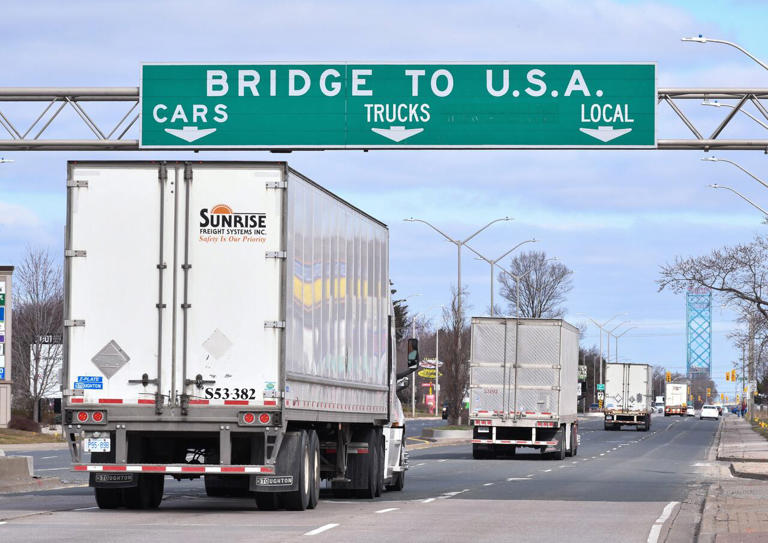
Transport trucks approach the Canada/U.S. border in Windsor, Ont., on March 21, 2020. Cross-border shipping is expected to surge in the wake of Wednesday's ruling. (Rob Gurdebeke/The Canadian Press)

"Particularly for Canadians, this stuff's just sitting on the other side of the border. It's going to be like the Flight of the Valkyries across the border."

That is, until, and if, Trump wins an appeal or he uses another legal tool, such as a 1974 trade law that allows temporary 150-day tariffs for less urgent matters.

The ruling came in a pair of lawsuits, one filed by the non-partisan Liberty Justice Center on behalf of five small U.S. businesses that import goods from countries targeted by the duties and the other by 13 U.S. states.

The companies, which range from a New York wine and spirits importer to a Virginia-based maker of educational kits and musical instruments, have said the tariffs will hurt their ability to do business. At least five other legal challenges to the tariffs are pending.
'Our laws matter'

Oregon Attorney General Dan Rayfield, a Democrat whose office is leading the states' lawsuit, called Trump's tariffs unlawful, reckless and economically devastating.

"This ruling reaffirms that our laws matter, and that trade decisions can't be made on the president's whim," Rayfield said in a statement.


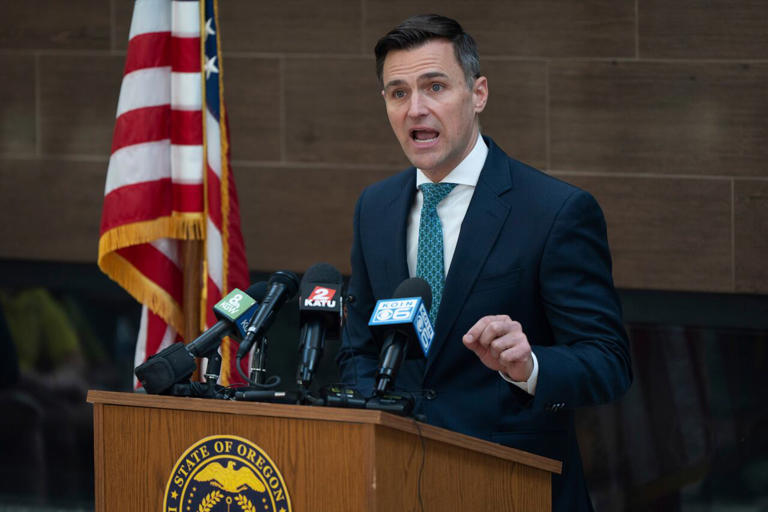
Wednesday's ruling reaffirmed that 'trade decisions can't be made on the president's whim,' said Oregon Attorney General Dan Rayfield, whose office led the lawsuit over the tariffs launched by 13 states. Here, he is pictured at a news conference at the Oregon Department of Justice office in Portland in April. (Jenny Kane/The Associated Press)

The White House promised to fight. Trump spokesman Kush Desai said unfair foreign trade had created historic and persistent deficits and decimated American communities, workers and defence manufacturing.

"It is not for unelected judges to decide how to properly address a national emergency," he said.

"President Trump pledged to put America First, and the administration is committed to using every lever of executive power to address this crisis."

In imposing the tariffs in early April, Trump called the trade deficit a national emergency that justified his 10 per cent across-the-board tariff on all imports, with higher rates for countries with which the United States has the largest trade deficits, particularly China.

Many of those country-specific tariffs were paused a week later. The Trump administration on May 12 said it was also temporarily reducing the steepest tariffs on China while working on a longer-term trade deal. Both countries agreed to cut tariffs on each other for at least 90 days.

Trump's on-and-off-again tariffs, which he has said are intended to restore U.S. manufacturing capability, have shocked U.S. financial markets.

The U.S. dollar rose against both the Swiss franc, a traditional currency safe haven, and the Japanese yen following the court decision.


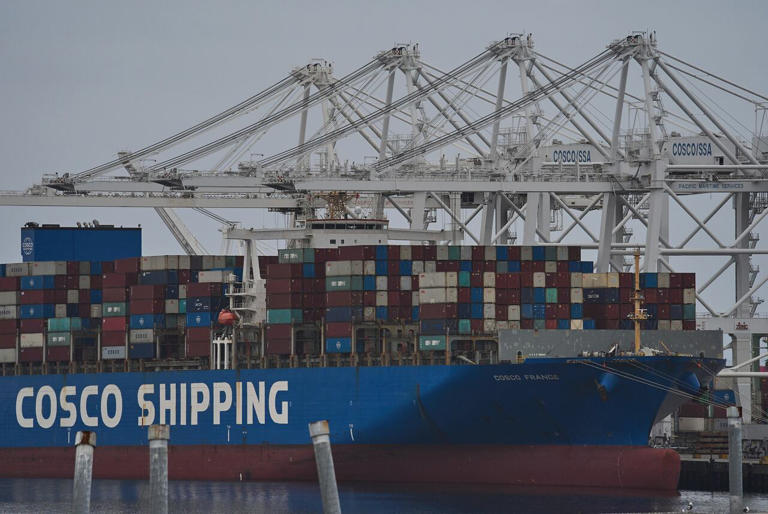
The Cosco Shipping France container ship moored at the Long Beach Container Terminal in the Port of Long Beach, Calif., in April. The court ruling could embolden the U.S.'s European trading partners and make them hesitant to enter into tariff negotiations. (Damian Dovarganes/The Associated Press)

Wednesday's decision can be appealed to the U.S. Court of Appeals for the Federal Circuit in Washington, D.C., and ultimately the U.S. Supreme Court.

Several Washington-based trade experts said the defeat casts a cloud over Trump's attempts to negotiate with other countries, including Canada. They said other countries may have less incentive to bargain.

"This decision throws the existing negotiations for a loop," said trade lawyer Simon Lester. "Foreign governments will have to reevaluate how they react to the Trump administration's trade demands."

Another Washington trade analyst said the coming days will be telling.

"The administration is likely in panic mode at the moment," said Inu Manak, a fellow at the Council on Foreign Relations.

"The very basis for all the negotiations they are undertaking has been jeopardized, so there is no incentive for any trading partner to continue negotiating with the United States until it is clear whether or not the tariffs will, in fact, be stopped in 10 days."

If the tariffs are, indeed, halted for a longer period, she said, Trump's aides will likely seek more targeted tools, such as the Section 232 tariffs used to penalize specific sectors, as Trump did with steel and aluminum.

The bottom line, Manak said: Trump's trade policy has been revealed to not only be "half-baked" but has also pushed the limits of presidential power too far.


Markets welcome court ruling against Trump’s tariffs as shares, U.S. dollar and oil gain

By The Associated Press
Published: May 29, 2025 

The screens show the Korea Composite Stock Price Index (KOSPI), left, the foreign exchange rate between U.S. dollar and South Korean won, center, and the Korean Securities Dealers Automated Quotations (KOSDAQ) are seen at a dealing room of Hana Bank in Seoul, South Korea, Wednesday, May 28, 2025. (AP Photo/Lee Jin-man)

Financial markets welcomed a U.S. court ruling that blocks President Donald Trump from imposing sweeping tariffs on imports under an emergency-powers law.

U.S. futures jumped early Thursday and oil prices rose more than $1. The U.S. dollar rose against the yen and euro.

The court found the 1977 International Emergency Economic Powers Act, which Trump has cited as his basis for ordering massive increases in import duties, does not authorize the use of tariffs.

The White House immediately appealed and it was unclear if Trump would abide by the ruling in the interim. The long term outcome of legal disputes over tariffs remains uncertain. But investors appeared to take heart after the months of turmoil brought on by Trump’s trade war.

The future for the S&P 500 was up 1.5% while that for the Dow Jones Industrial Average gained 1.2%.


In early European trading, Germany’s DAX gained 0.5% to 24,160.75. The CAC 40 in Paris jumped 0.9% to 7,860.67. Britain’s FTSE was nearly unchanged at 8,722.63.

Japan’s Nikkei 225 index jumped 1.9% to 38,432.98. American’s largest ally in Asia has been appealing to Trump to cancel the tariffs he has ordered on imports from Japan and to also stop 25% tariffs on steel, aluminum and autos.

The ruling also pushed the dollar sharply higher against the Japanese yen. It was trading at 145.40 yen early Thursday, up from 144.87 yen late Wednesday.

A three-judge panel ruled on several lawsuits arguing Trump exceeded his authority, casting doubt on trade policies that have jolted global financial markets, frustrated trade partners and raised uncertainty over the outlook for inflation and the global economy.

Many of Trump’s double-digit tariff hikes are paused for up to 90 days to allow time for trade negotiations, but the uncertainty they cast over global commerce has stymied businesses and left consumers wary about what lies ahead.

“Just when traders thought they’d seen every twist in the tariff saga, the gavel dropped like a lightning bolt over the Pacific,” Stephen Innes of SPI Asset Management said in a commentary.

The ruling was, at the least, “a brief respite before the next thunderclap,” he said.

Elsewhere in Asia, Hong Kong’s Hang Seng added 1.3% to 23,561.86, while the Shanghai Composite index gained 0.7% to 3,363.45.

Australia’s S&P/ASX 200 gained 0.2% to 8,409.80.

In South Korea, which like Japan relies heavily on exports to the U.S., the Kospi surged 1.9% to 2,720.64. Shares also were helped by the Bank of Korea’s decision to cut its key interest rate to 2.5% from 2.75%, to ease pressure on the economy.

Taiwan’s Taiex edged 0.1% lower, and India’s Sensex lost 0.2%.


On Wednesday, U.S. stocks cooled, with the S&P 500 down 0.6% but still within 4.2% of its record after charging higher amid hopes that the worst of the turmoil caused by Trump’s trade war may have passed. It had been roughly 20% below the mark last month.

The Dow industrials lost 0.6% and the Nasdaq composite fell 0.5%.

Trading was relatively quiet ahead of a quarterly earnings release for Nvidia, which came after markets closed.

The bellwether for artificial intelligence overcame a wave of tariff-driven turbulence to deliver another quarter of robust growth thanks to feverish demand for its high-powered chips that are making computers seem more human. Nvidia’s shares jumped 6.6% in afterhours trading.

Like Nvidia, Macy’s stock also swung up and down through much of the day, even though it reported milder drops in revenue and profit for the latest quarter than analysts expected. Its stock ended the day down 0.3%.

The bond market showed relatively little reaction after the Federal Reserve released the minutes from its latest meeting earlier this month, when it left its benchmark lending rate alone for the third straight time. The central bank has been holding off on cuts to interest rates, which would give the economy a boost, amid worries about inflation staying higher than hoped because of Trump’s sweeping tariffs.

In other dealings early Thursday, the yield on the 10-year Treasury rose to 4.52% from 4.47% late Wednesday.

U.S. benchmark crude oil gained $1.06 to $62.90 per barrel. Brent crude, the international standard, added $1.00 to $65.32 per barrel.

The euro slipped to $1.1280 from $1.1292.

Elaine Kurtenbach, The Associated Press