Sunday, June 29, 2025

Thousands of protesters demand Thai PM's resignation

Montira RUNGJIRAJITTRANON
Sat, June 28, 2025
AFP


Protesters rallied in Bangkok demanding Prime Minister Paetongtarn Shinawatra resign after a leaked diplomatic phone call stirred public anger over her leadership
MANAN VATSYAYANA/AFP

Thousands of anti-government protesters rallied in the Thai capital Bangkok on Saturday, demanding Prime Minister Paetongtarn Shinawatra resign after a leaked diplomatic phone call stirred public anger.

A Cambodian elder statesman leaked a call meant to soothe a border spat between the two nations in which Paetongtarn called him "uncle" and referred to a Thai military commander as her "opponent".

A key party abandoned Paetongtarn's coalition, accusing the 38-year-old dynastic premier of kowtowing to Cambodia and undermining Thailand's military, leaving her teetering with a slim parliamentary majority.

About 10,000 demonstrators jammed roads ringing the capital's Victory Monument, waving Thai flags and placards reading "Evil PM, get out".

One speaker took to the stage and shouted: "PM, you committed treason!"

The crowd was mostly senior-aged and led by veteran activists of the "Yellow Shirt" movement, which helped oust Paetongtarn's father Thaksin in the 2000s.

One of Thaksin's former allies, now among his harshest critics, was also a key organiser.

"I'm here to protect Thailand's sovereignty and to say the PM is unfit," said 70-year-old protester Seri Sawangmue, who travelled overnight by bus from the country's north to attend.

"After I heard the leaked call I knew I couldn't trust her," he told AFP. "I've lived through many political crises and I know where this is going. She's willing to give up our sovereignty."

Thailand has seen decades of clashes between the bitterly opposed "Yellow Shirts" who defend the monarchy and military, and the Thaksin-backing "Red Shirts", considered by their opponents a threat to the traditional social order.

Jamnong Kalana, 64, said she was once a "Red Shirt" but had changed her colours and was demanding the resignation of Paetongtarn, leader of the Pheu Thai party.

"I feel full of pain when I see a fellow Thai who doesn't love the country like I do," she said.

- Make-or-break court cases -


Mass protests have been uncommon in Thailand since 2021, when youth-driven demonstrations calling for monarchy reform ended with many leaders convicted under the country's strict lese-majeste laws.

Authorities said more than 1,000 police and 100 city officials had been deployed to the protest, which remained peaceful on Saturday afternoon.

The 62-year-old protester Santhiphum Iamjit was overcome with emotion.

"Our ancestors shed blood, sweat and tears for this land, but now politicians are ready to give it away for personal gain," the former bureaucrat tearfully told AFP.


Paetongtarn was visiting Thailand's flood-hit north but before departing Bangkok she told reporters: "It's their right to protest, as long as it's peaceful."

The prime minister has been battered by controversy and abandoned by her largest backer, the Bhumjaithai Party, after her phone call with Cambodia's ex-leader Hun Sen was leaked earlier this month.

Tensions between the countries have soared after a border dispute boiled over into violence last month which killed one Cambodia soldier.

Thailand's military has staged a dozen coups since the end of absolute monarchy in 1932 and politicians are usually careful not to antagonise the generals.

After calling a border region military commander her "opponent", Paetongtarn gave a contrite press conference where she issued a public apology flanked by military officials in a show of unity.

Her remaining coalition partners have not yet backed out of their pact.

But next week both Paetongtarn and her father face legal battles that could reshape Thailand's political landscape.

On Tuesday the Constitutional Court will decide whether to take up a petition by senators seeking her removal over alleged unprofessionalism.

That same day her father is set to stand trial on royal defamation charges linked to decade-old remarks to South Korean media.

Paetongtarn took office less than a year ago after her predecessor was disqualified by a court order and her father returned from exile after 15 years.

She is the fourth Shinawatra-linked figure to become prime minister following her father, aunt and uncle-in-law.

Thousands call for Thai PM's removal during Bangkok protests

Simon Corlett
Sat, June 28, 2025 
UPI


Protestors took to the streets of Bangkok Saturday, calling for the removal of Thailand’s prime minister Paetongtarn Shinawatra, less than a year after she was sworn into office. File Photo by Rungroj Yongrit/EPA-EFE

June 28 (UPI) -- Protestors took to the streets of Bangkok Saturday, calling for the removal of Thailand's prime minister, less than a year after she was sworn into office.

Demonstrators blocked streets in the country's capital city, taking issue with Prime Minister Paetongtarn Shinawatra's phone call with Cambodian leader Hun Sen.

The call was recorded and made public this week. In it, Shinawatra appears to be close with Hun, the former prime minister and ex-military officer who is the current head of the Cambodian Senate and the country's de facto leader.

Shinawatra has since apologized for the phone call, which took place because of a border dispute between the two countries.

Following the phone call, Thai officials sent a letter of protest to the Cambodian government.

Earlier this week, authorities closed Thailand's border to travelers looking to cross into Cambodia, following a dispute over scams. One Cambodian soldier has been killed in the rising tensions between the neighboring countries.

More than 6,000 people converged for the protests in heavy rain Saturday, Thai police reported.

Local media reported Saturday that Shinawatra reaffirmed the public's right to peacefully protest, in a country where previous rulers have been overthrown in military coups, including two of the prime minister's relatives.

Shinawatra became Thailand's youngest-ever elected leader when she was sworn into office last August at the age of 37.

The leader of the country's ruling Pheu Thai Party is the third member of her family to hold the title of Thai Prime Minister.

Her billionaire father Thaksin and aunt Yingluck both led the country during separate periods. The family made its money in the telecom industry.

Thaksin served as Thailand's prime minister from 2001 until 2006 when he was deposed by the military. He has had previous close ties with Hun and is set to face trial in the coming weeks over charges he insulted the Thai military.

Yingluck Shinawatra served as prime minister between 2011 and 2014 and was removed by a constitutional court.

Thousands demand Thai prime minister quit over border dispute

Panu Wongcha-um and Devjyot Ghoshal
Fri, June 27, 2025 
REUTERS 


Anti-government protest against Thailand's PM Shinawatra in Bangkok

Anti-government protest against Thailand's PM Shinawatra in Bangkok

Anti-government protest against Thailand's PM Shinawatra in Bangkok

Thailand's Prime Minister Paetongtarn Shinawatra looks during a press conference, in Bangkok

BANGKOK (Reuters) -Thousands of protesters rallied in the Thai capital Bangkok on Saturday to demand the resignation of Prime Minister Paetongtarn Shinawatra, piling pressure on a government at risk of collapse over a border dispute with neighbouring Cambodia.

In the largest such rally since the ruling Pheu Thai party came to power in 2023, crowds braved heavy monsoon rain to demonstrate against Paetongtarn, 38, who is also battling to revive a faltering economy and keep a fragile coalition together ahead of a potential no confidence vote next month.

"She should step aside because she is the problem," Parnthep Pourpongpan, a protest leader, said.

The latest dispute started with a skirmish between Thailand and Cambodia over a disputed patch of border territory in May. Thai nationalist groups called for Paetongtarn to go after she appeared to criticize a Thai army commander and kowtow to Cambodia's former leader, Hun Sen, in a leaked phone call with him.

Public criticism of the army is a red line in a country where the military has significant clout. Paetongtarn apologised for her comments after the call.

Parnthep, the protest leader, said many Thai people felt the prime minister and her influential father, Thaksin Shinawatra, were being manipulated by Hun Sen, a former ally of the family who has turned against them

'UNG ING, GET OUT'


Blocking the busy intersection at Victory Monument, a war memorial, crowds including many elderly people waved flags bearing Thailand's national tricolor.

“Ung Ing, get out,” the crowd occasionally chanted in unison, calling the premier by a nickname.

Thapanawat Aramroong, 73, said Paetongtarn’s comments about the army commander and seeming eagerness to please Hun Sen were unacceptable.

The demonstration was organised by the United Force of the Land, a coalition of largely nationalist activists who have rallied against other Shinawatra-backed governments over the last two decades.

In a statement read aloud before the crowds, the group said "the executive branch" and parliament were not working "in the interest of democracy and constitutional monarchy".

Remaining coalition partners should quit immediately, they said.

While past protests against the Shinawatras did not directly cause the downfall of those governments, they built up pressure that led to judicial interventions and military coups in 2006 and 2014.

Protester Somkhuan Yimyai, 68, said he did not want the military to end up staging a coup and that previous military takeovers had not "provided solutions for the nation in terms of solving corruption or the government's administration of the country."

ECONOMIC TURMOIL


The political turmoil in Thailand threatens to further damage the country's struggling economic recovery.

The prime minister now controls a slim majority coalition following the exit of former partner Bhumjaithai Party last week. Protesters on Saturday called for other coalition partners to quit.

Paetongtarn also faces judicial scrutiny after a group of senators petitioned the Constitutional Court and a national anti-graft body with a wide remit to investigate her conduct over the leaked phone call.

Decisions from either bodies could lead to her removal.

Hun Sen also launched an unprecedented public attack on Paetongtarn and her family, calling for a change of government, in an hours-long televised speech on Friday, which the Thai foreign ministry described as "extraordinary" while insisting that Thailand prefers to use diplomacy.


Big crowds gather in Hungarian capital to defy ban on Budapest Pride

Olivia Kemp, CNN
Sat, June 28, 2025


Protesters flood Hungary's capital for the annual LGBTQ+ rights march on Saturday in defiance of a government ban. - Lisa Leutner/Reuters


Beneath a blaze of rainbow flags and amid roars of defiance, big crowds gathered in the Hungarian capital Budapest for the city’s 30th annual Pride march – an event that, this year, is unfolding as both a celebration and a protest.

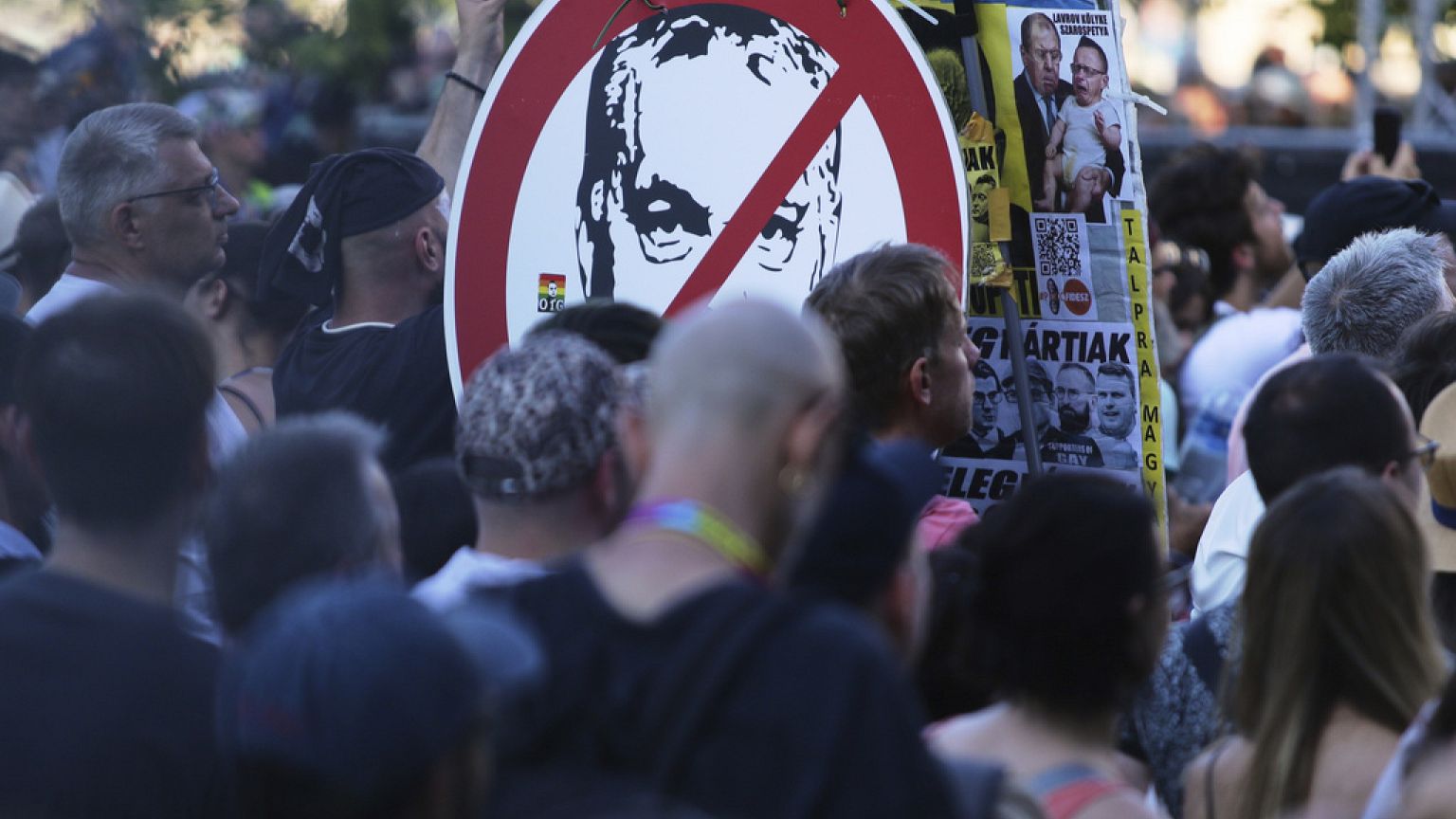
Moving through the capital in the sweltering heat, demonstrators carried signs reading “Solidarity with Budapest Pride” and waved placards bearing crossed-out illustrations of Prime Minister Viktor Orbán.

Music played from portable speakers as people of all ages joined the march – families with pushchairs, teenagers draped in capes, and older residents walking alongside activists.

From the city’s historic centre to its riverside roads, the procession swelled in numbers and noise – visibly reclaiming public space in defiance of a law designed to push them out.

The march proceeded in open defiance of a police ban imposed earlier this year under sweeping new legislation that prohibits LGBTQ+ events nationwide.


A participant celebrates during the Budapest Pride March in the Hungarian capital. - Lisa Leutner/Reuters


People take part in the parade in downtown Budapest. - Attila Kisbenedek/AFP/Getty Images

Eszter Rein Bodi was one of those who joined the massive crowds in Budapest on Saturday, telling Reuters: “This is about much more, not just about homosexuality … This is the last moment to stand up for our rights.”

Krisztina Aranyi, another marcher, told the news agency that “the right to assembly is a basic human right, and I don’t think it should be banned.”

She added, “Just because someone does not like the reason why you go to the street, or they do not agree with it, you still have the right to do so.”

Huge crowds turned out in the city for the parade, with many holding homemade banners aloft. One sign read “Transgender people are a blessing on this earth” while another banner read “Proud. United. Equal in every corner of the EU.”

At least 70 members of the European Parliament were expected to join the procession, officials told CNN in May.

Van Sparrentak, who is a Dutch MEP from the parliament’s “Greens/European Free Alliance” political group, told CNN that she will be attending Budapest Pride to “support the LGBTIQ+ community in Hungary, to let them know that they are not alone (and) to be visible as a community.”

“Pride is a protest, and if Orbán can ban Budapest Pride without consequences, every pride is one election away from being banned,” she continued.

In March, Hungarian lawmakers passed legislation barring Pride events and permitting the use of facial recognition technology to identify participants – measures campaigners say is illegal and part of a wider crackdown on the LGBTQ+ community.


Temporary cameras were installed along the path of the Budapest Pride march on Friday, months after legislation was passed allowing the use of facial recognition technology to identify participants. - Balint Szentgallay/NurPhoto/Getty ImagesMore

Orban welcomed the ban, which he said would outlaw gatherings that “violate child protection laws.” His government has pushed a strongly Christian and conservative agenda.

The ban sparked lively protests in Budapest in March, with organizers of the city’s Pride vowing to continue with the annual festival despite the new law and declaring: “We will fight this new fascist ban.”

A petition demanding police reject the ban has gathered over 120,000 signatures from supporters in 73 countries, urging authorities to “reject this unjust law” – believed to be the first of its kind in the EU’s recent history – and ensure that the march proceeded “unhindered and peacefully, free from discrimination, harassment, fear or violence.”

CNN’s Catherine Nicholls and Billy Stockwell contributed to this report.


Since Orban's return to power in 2010, the government has been steadily rolling back LGBTQ rights (Peter Kohalmi)Peter Kohalmi/AFP/AFP


Hungary's PM Orbán says Pride marched in  Budapest 'on the orders of Brussels'

Participants of the Budapest Pride March + 28.06.2025.
Copyright Rudolf Karancsi/Copyright 2025 The AP. All rights reserved.


By Euronews Hungary
Published on 

An unprecedented crowd of between 100- and 200-thousand people marched at the 30th Budapest Pride on Saturday. The Prime Minister said the event was "disgusting and shameful".

The international press estimates the number of participants in Saturday's event, the Budapest Pride march - which was, in fact, the outlawed Budapest Pride - at between 100- and 200,000.

One thing is for sure: the organisers broke the previous record of 35,000 by a considerable margin.

On Sunday, it was finally became clear how Viktor Orbán assessed the Saturday parade, as the Prime Minister. He had told the Pride organisers in February that they "should not bother" with their organisational efforts, as the government would not allow the event to take place.

Orders from Brussels?

The Prime Minister sent a message to the "Warriors' Club", an organisation close to his party Fidesz - which also reached the independent news website Index - in which he wrote that "Brussels has issued an order that there must be a Pride in Budapest. Their puppet politicians have carried out the order. This is proof of what life would be like if our country were not run by a national government defending our sovereignty. Orders from Brussels, puppet politicians in Budapest in hats, TISZA, [social democrat] DK and Karácsony [Mayor of Budapest] voters in the streets".

Orbán called the event itself "disgusting and shameful", pointing out that events such as drag performances, men in high heels or brochures on hormone therapy "do not fit into Hungarian culture". He added that "the 3.7 million voters of the 2022 gender vote" could "not be matched by the number of any demonstration".

Orbán - the king of Pride?

His main rival Péter Magyar did not miss the opportunity to react. The leader of the TISZA party said that "Viktor Orbán became the king of Pride in Europe yesterday, because no one else has ever managed to mobilise such a large crowd for a demonstration against himself by inciting hatred".

The opposition politician took full advantage and wrote in his post that "Orbán can no longer govern, public services are falling apart. The Hungarian railways stop running every weekend, the health care system is dying, people are living worse and worse and everyone is cutting their pennies." Recent polls have shown his party leading Fidesz by up to ten points. Parliamentary elections are expected to be held in April next year.

A clever trap?

The government officially tried to play down the massive event - and even spin it as a "clever trap" by Viktor Orbán, using it to reinforce his narrative that Pride marchers were a manipulated minority, but political scientist Gábor Török disagreed. According to him, "the clumsy ban and the police's legal manoeuvring" also indicated that events have taken a wrong turn for the government:

"Fidesz certainly did not miss the spectacle of today, the crowds, the distant images that almost resemble the Peace March - and of course the prominent role of Our Homeland," he said in his Facebok post.

By 20:00 on Saturday, police had arrested 36 people, one woman for criminal mischief and one man for possession of drugs. Two people were taken ill and a 15-year-old boy was injured when he fell from the railing he was climbing. The police called an ambulance as a safety measure, police.hu reported.


Budapest Pride defies ban as European politicians rally against Hungary’s crackdown

Budapest Pride defies ban as European politicians rally against Hungary’s crackdown
Budapest Pride defies ban as European politicians rally against Hungary’s crackdown / bne IntelliNews
By bne IntelliNews June 29, 2025

Budapest Pride went ahead on June 28 in defiance of a government ban, drawing the backing of more than 70 members of the European Parliament and several prominent European ministers, who travelled to the Hungarian capital to show their support for the LGBTQ+ community.

Between 100,000 and 200,000 mostly young people danced and sang their way from Pest to Buda in a powerful symbolic challenge to Hungarian Prime Minister Viktor Orbán’s illiberal rule.

Despite official warnings that participation in the event constituted a criminal offence, thousands of activists and citizens marched through the Hungarian capital in the baking summer weather. They were joined by European political leaders, including Spanish Culture Minister Ernest Urtasun, Dutch Education Minister Eppo Bruins and former prime ministers Elio Di Rupo of Belgium and Leo Varadkar of Ireland.

“This will undoubtedly be a historic event in the fight against authoritarian regimes,” said French MEP Chloé Ridel, who attended the march. “I am not afraid of the Hungarian police or the far-right activists emboldened by Viktor Orbán’s populist rhetoric; we are here to defend European values alongside the Hungarian citizens who have come to protest.”

The Hungarian government declared the event illegal under legislation passed in March, which bans public assemblies that “promote or display” LGBTQ+ identities, citing child protection concerns. In a letter addressed to embassies ahead of the march, Justice Minister Bence Tuzson warned that organising or attending the parade could result in criminal penalties. “The legal situation is clear,” he wrote. “Those who take part in an event prohibited by the authorities commit an infraction.”

Nonetheless, Budapest Mayor Gergely Karácsony defied the government and gave the march the go-ahead by designating it as a “city council-organised demonstration,” effectively bypassing the police permit requirement. The move allowed Pride organisers to hold their annual march, continuing a tradition that began in 1997, when Budapest became the first Eastern European capital to host a Pride parade.

While Prime Minister Orbán called on citizens not to attend, he said the government would not deploy force. “Hungary is a civilised country. We do not hurt each other,” he said in a press briefing. However, concerns remain over whether authorities may pursue fines or charges using facial recognition technology.

European Commission President Ursula von der Leyen, although not present, publicly supported the march in a video statement ahead of the event. “To the LGBTIQ+ community in Hungary and beyond: I will always be your ally,” she said.

For many attendees, the march was about more than LGBTQ+ rights. “Far beyond Pride itself or the curtailing of the rights of the LGBTQI community, I think it’s about Europe, it’s about the rule of law, and it’s about our core values as Europeans,” said Richárd Barabás, co-chair of Mayor Karácsony’s Green Party Párbeszéd.

Yet Hungary’s main opposition party, Tisza, led by Péter Magyar, avoided taking a position. Gay rights remain controversial topic in the conservative Hungarian society. “We refuse to walk into Orbán’s trap,” said MEP Zoltán Tarr, a close ally of Magyar. “He wants a moral outrage show so he can say: ‘Brussels is attacking Hungary again.’”

As the country heads toward elections in April 2026, Budapest’s Pride march underscored the deepening divide over civil liberties and Hungary’s place in the European project. Whether attendees will face legal repercussions in the weeks ahead remains uncertain, but the demonstration made clear that opposition to Orbán’s cultural agenda is both domestic and European.

The turnout was impressively high compared to the just 35,000 who took part last year, and was in part an anti-government protest. Many partygoers carried placards ridiculing Orban. T-shirts with Orban's image, in bright eyeshadow and lipstick, were everywhere.

Budapest Mayor Karacsony, who made the event possible, was ebullient amongst the revellers. "We don't exactly look as though we were banned!" he told the crowd in a short speech in front of the Budapest Technical University. "In fact, we look like we're peacefully and freely performing a big, fat show to a puffed-up and hateful power. The message is clear: they have no power over us!" Karacsony continued, the BBC reported.

The ban on the pride smacks of Russia’s authorities, which has similar anti-propaganda laws restricting gay rights. Hungary’s law was recently passed by Orban's Fidesz party, subordinating the freedom of assembly to a 2021 Child Protection law that equates homosexuality with paedophilia, nominally to prevent children being exposed.

Elsewhere in the capital, Orban attended the graduation ceremony of 162 new police and customs officers, and new officials of the National Directorate-General for Policing Aliens.

"Order does not come into being by itself; it must be created, because without it civilised life will be lost," Orban told the students and their families.

Police recently gained new powers to use facial recognition software, and participants now face possible fines of between $19 and $500 if prosecuted. However, thanks to Karacsony designating the event as a “demonstration”, for the time being the march is legal unless the courts rule otherwise.


Commissioner and MEPs in Budapest to challenge Orban’s Pride ban

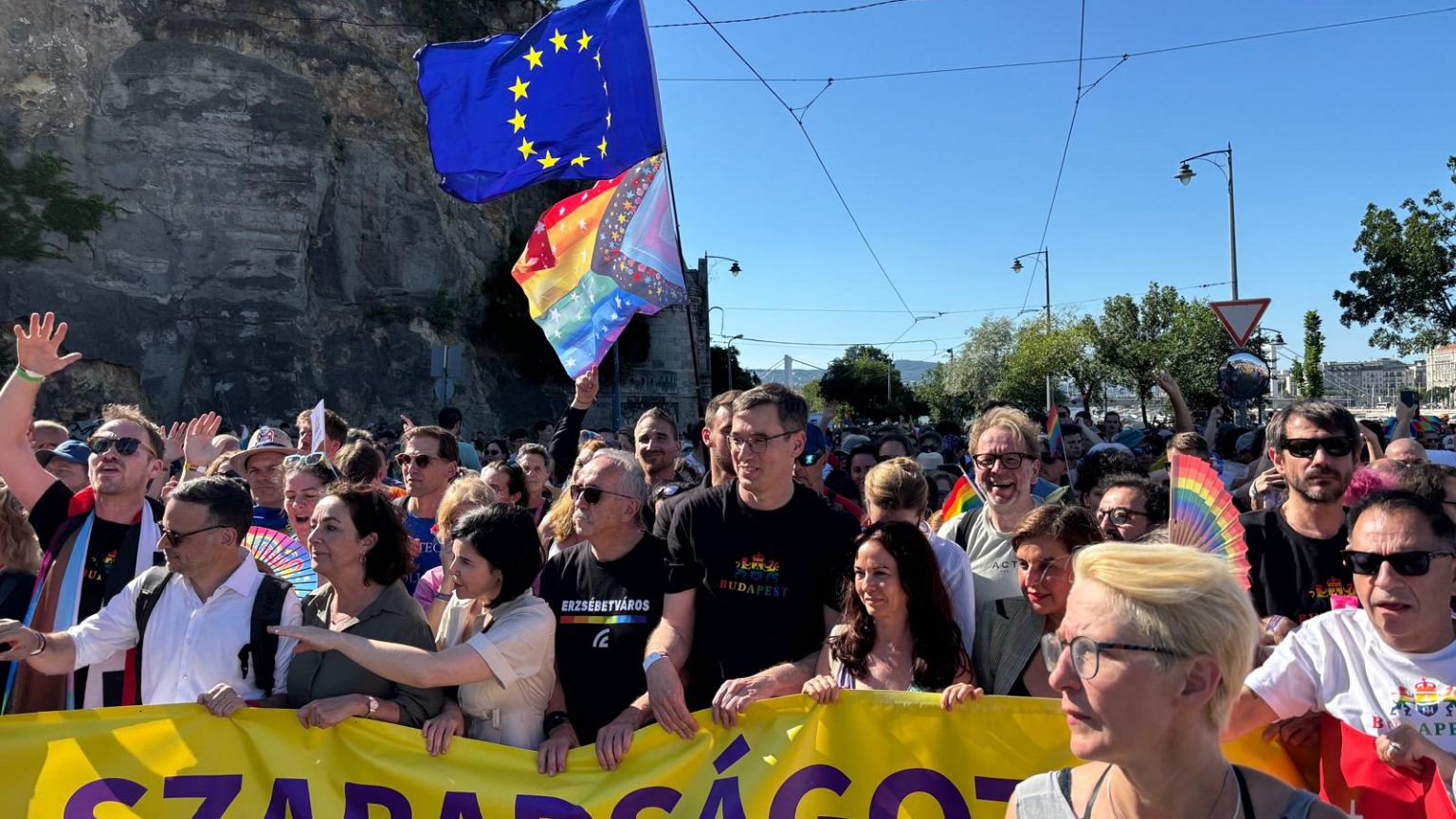
Gergely Karácsony, the mayor of Budapest, marching alongside MEPs
Copyright Euronews

By Romane Armangau & Laura Ingemarsson & Leticia Batista Cabanas
Published on 

Commissioner Hadja Lahbib and 70 MEPs travelled to Hungary to protest the banning of the Pride march - but opposition leader Peter Magyar was absent.

Around 70 MEPs from the liberal, green and left wing of the European Parliament joined the Belgian equality commissioner in Budapest on Saturday afternoon, as thousands of protestors marched through the Hungarian capital, waving rainbow and EU flags.

The MEPs were primarily from the liberal Renew Europe, Socialists & Democrats, the Left and Greens groups, joined by one Irish European People's Party (EPP) MEP, Maria Walsh.

Tens of thousands joined the march, with organisers claiming as many as 200,000 were on the streets.

“Long before I got into politics, and long before I leave, I’ll be showing up for Pride. For me and for my values, Pride is incredibly important. I only wish more were here, but I joined together with over 70 other MEPs from across political parties,” Walsh told Euronews.

“It’s not about one party versus the other party. It’s about one human being showing up for another,” she added, when quizzed on the fact that there was no EPP delegation with her.

“I would have preferred that more EPP people would have joined the event. I think it’s disappointing because this is an important mobilisation,” the President of Renew Europe, Valérie Hayer, told Euronews.

“We have noted, since the start of this term, that the EPP is wavering between the democratic forces and the extreme right. It’s a pity that the EPP doesn’t understand who their adversaries are," said French socialist MEP Emma Rafowicz.

A notable EPP absence was Hungarian opposition leader and MEP Peter Magyar. His centre-right party Tisza party is currently leading the governing Fidesz party in opinion polls for the 2026 parliamentary election.

Magyar was not in Budapest, avoiding taking a stance of the issue of the thorny issue of the Pride march, which a recent survey indicated divides opinion in the country, with 47% of Hungarians opposed to it taking place. 

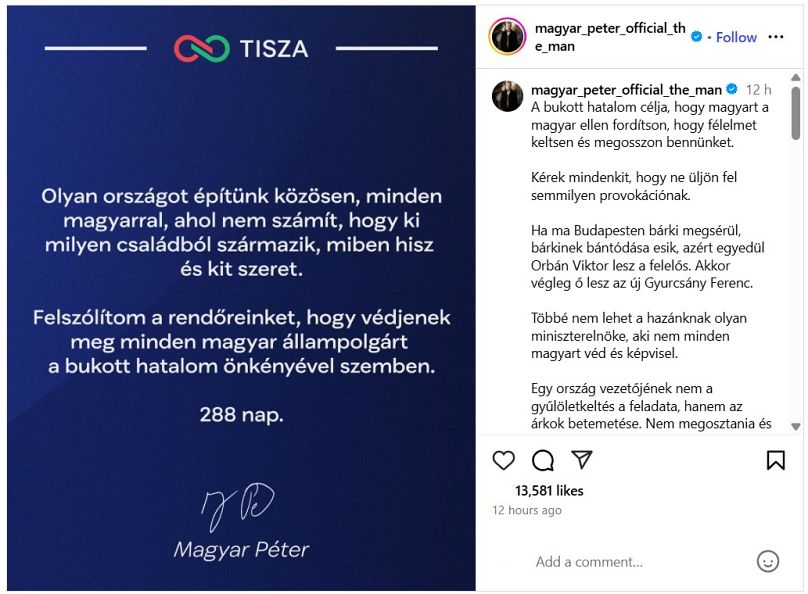
However, earlier in the day he called for a peaceful protest. “I ask everyone not to fall for any provocation. If anyone gets hurt today in Budapest, if anyone comes to harm, Viktor Orbán alone will be responsible,” Magyar posted to his social platforms.


Peter Magyar Post on InstagramPeter Magyar

European Commissioner for equality Hadja Lahbib held meetings with local civil society organisations on Friday. However, she did not show up at the march, telling Euronews that she instead would be attending meetings in the city.

Risking fines and jail time

In March, the Hungarian parliament approved a bill that in effect banned the gay pride march. As the legislation states, this event could violate Hungary's so-called child protection law, adopted earlier in the country, prohibiting any portrayal of same sex relationships for minors.

The European Commission views this as a violation of its community law and has referred the case to the European Court of Justice.

Conservative and far-right MEPs in the European Parliament defended Orbán's move to ban Pride events, saying the EU should not interfere in Hungary's internal affairs.

However, the mayor of Budapest, Gergely Karácsony from the Green party, allowed the parade to go ahead by re-labeling it as a ‘Day of Freedom’ celebration, officially organized by the city council. 

This legal loophole allowed the thousands of people to march through the streets of Budapest in sweltering heat, protesting not just the ban Pride ban, but Viktor Orban’s government generally. Alongside pride flags and the loud music, there were banners displaying the prime minister. 

“I am not a big fan of Pride events, but this extends beyond Pride. This is about freedom too, because Hungary, a European Union country, banning Pride, is simply not on," one attendee told Euronews of his motivations for attending.

Security was tight, with security cameras installed on lamp posts in the city centre and hundreds of police officers deployed at key spots of the parade, keeping watch over protesters and ensuring there were no clashes. 

Attendees were warned by the Hungarian Ministry of Justice that parade organisers risked up to a year in prison, and that those marching could be fined €500. The police have been encouraged by the government to use facial recognition technology to identify the attendees, although Karácsony insists that nobody will face punishment for their participation in the march.

Anti-LGBT protesters also assembled in Budapest

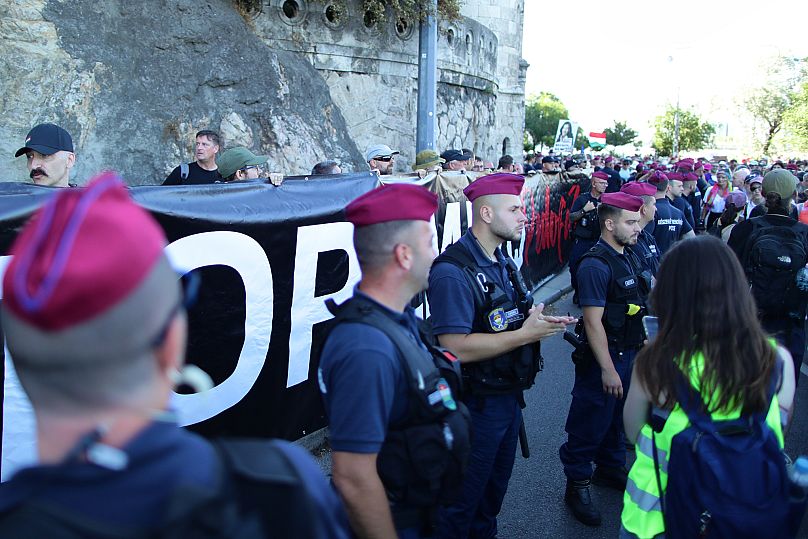
The nationalist 64 Counties Youth Movement held a legally sanctioned event on the same square in Budapest where Pride participants later gathered. Meanwhile, the Our Homeland Movement, a small far-right parliamentary party, organised a police-approved counter-march along the same route as the municipal Pride event.

However, during the day the far-right protest was blocked by a strong police presence to avoid conflict. 

Police form a line separating right wing protesters from the participants in the Pride march in Budapest, Hungary, Saturday, June 28, 2025.AP Photo/Rudolf Karancsi

No major incidents were reported by the evening, although Euronews witnessed a confrontation between a small group of the 64 Counties Youth Movement – holding a banner comparing LGBT people to paedophiles and the Pride March.

“We are here because we want to warn the people of Hungary about the LGBT paedophilia, it is a really danger for our children,” one anti-LGBT protester told Euronews.

Another anti-Pride protester tried to stop the march by standing in front of the truck leading the parade. He was jeered by the crowd and removed by the police. 


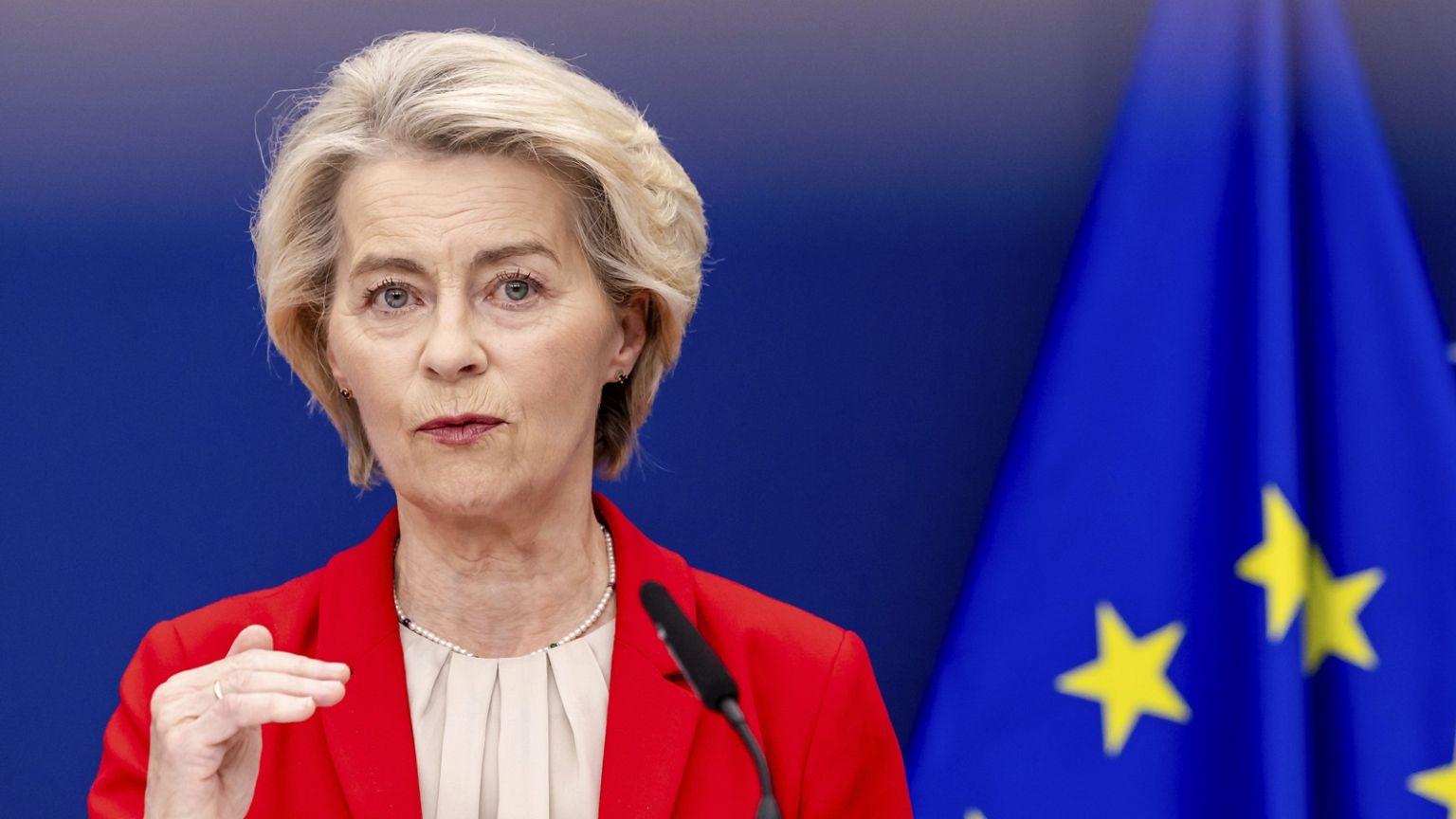
Von der Leyen calls on Hungary to lift controversial ban on Budapest Pride
Copyright Geert Vanden Wijngaert/Copyright 2025 The AP. All rights reserved.
By
Jorge LiboreiroPublished on 26/06/2025

"To the LGBTIQ+ community in Hungary and beyond: I will always be your ally," Ursula von der Leyen said in a video message.

Ursula von der Leyen has called on Hungary to lift the ban on the Budapest Pride and allow the march, scheduled to take place this weekend, to "go ahead without fear of any criminal or administrative sanctions against the organisers or participants".

The appeal represents her most direct intervention in the new showdown between the European Commission and Viktor Orbán's government.

"To the LGBTIQ+ community in Hungary and beyond: I will always be your ally. You have every reason to be proud," the president of the Commission said in a video message posted on social media on Wednesday evening.

"Europe is stronger and richer because of you. I am on your side. Today and every day."

In a highly controversial law approved in spring, the Hungarian parliament banned public events considered to be in breach of the Child Protection Act, which heavily restricts depictions of homosexuality and gender reassignment to underage audiences

The text allows authorities to use facial recognition tools to identify people who organise and attend forbidden events, leading to fines of up to 200,000 Hungarian forints (€485). If not paid, the penalties can be collected as taxes.

Based on the law, police later banned the celebration of Budapest Pride because it would take place "in the presence of persons under 18 years of age". The government suggested it could be alternatively held in an enclosed location, like a stadium.

The liberal mayor of Budapest, Gergely Karacsony, struck a defiant tone and announced the celebration of an umbrella event called "Day of Freedom" to bypass the prohibition.

"Budapest city hall will organise the Budapest Pride march as a local event on 28 June. Period," Karacsony said last week.

In her message, von der Leyen joined the cause, expressing her "full support and solidarity" to Hungary's LGBTIQ+ community.

"In Europe, marching for your rights is a fundamental freedom. You have the right to love who you want to love and be exactly who you are," she said.

"Our Union is one of equality and non-discrimination. These are our core values, enshrined in our treaties. They must be respected at all times, in all member states."

Orbán, who leads a self-described "illiberal" government and regularly engages in culture wars, replied almost immediately to her video.

"Dear Madam President, I urge the European Commission to refrain from interfering in the law enforcement affairs of Member States, where it has no role to play," he said.

"I also call on the Commission to focus its efforts on the pressing challenges facing the European Union—areas where it does have a clear role and responsibility, and where it has made serious mistakes in recent years, such as the energy crisis and the erosion of European competitiveness."

Von der Leyen and Orbán are set to meet on Thursday for an EU summit in Brussels.

The Commission has not yet announced legal action against Hungary but is analysing the elements of the new law, which touch upon various aspects. (The Child Protection Act is the subject of a separate case that has reached the European Court of Justice.)

Besides possible breaches of fundamental rights, the ban is also under scrutiny for its potential incompatibility with the Artificial Intelligence Act, which lays out strict limitations on how law enforcement can deploy facial recognition.

Due to the headline-making controversy surrounding the ban, the Budapest Pride is expected to attract a record number of international visitors to the Hungarian capital.

Hadja Lahbib, the European Commissioner for Equality, and a delegation of over 70 members of the European Parliament also plan to attend.

This article has been updated with more information.


Pride Month photos show celebrations around the world

Emily Mae Czachor
Sat, June 28, 2025


Pride Month photos show celebrations around the world

Wrapped in multicolored flags and waving protest signs, revelers across the globe have gathered throughout June for Pride events — a monthlong celebration of the LGBTQ community that also symbolizes an ongoing fight for equal rights and inclusion.

The roots of Pride Month stretch back to June 28, 1969, when a police raid on New York City's Stonewall Inn, a gay bar, led to several nights of clashes with the bar's LGBTQ patrons and others, which became known as the Stonewall Riots or Stonewall Uprising — a demonstration that's now considered the start of the LGBTQ rights movement. Marches took place in Manhattan, Chicago and San Francisco to mark the anniversary of Stonewall the following June, and, over time, it became an annual event in more and more cities. Pride Month first gained federal recognition in 1999 from then-President Bill Clinton.

Pride marches and festivals have been taking place throughout the month in different parts of the U.S. and around the world, and New York's 2025 Pride march, honoring the legacy of Stonewall, is scheduled for Sunday. Here is a look at some of the events from Washington, D.C., to Kathmandu and beyond.


People march in the L.A. Pride Parade on Hollywood Boulevard in Los Angeles on June 8, 2025. / Credit: Carlin Stiehl / Los Angeles Times via Getty Images

The 25th Anniversary Kentuckiana Pride Festival Parade was held on June 21, 2025 in Louisville, Kentucky. / Credit: / Getty Images

A heart-shaped sign with the colors of the Pride flag is seen near the Pike Place Market in Seattle, Washington, on June 25, 2025. / Credit: JUAN MABROMATA/AFP via Getty Images

Bella Bautista, a trans woman, attends the World Pride Parade on June 7, 2025, in Washington, D.C. / Credit: Jacquelyn Martin / AP


Participants ride motorcycles during the 2025 L.A. Pride Parade on June 8, 2025 in Los Angeles. / Credit: / Getty Images

Activists and allies marched for equality in the Motor City Pride Parade in Detroit on June 8, 2025. / Credit: Jim West/UCG/Universal Images Group via Getty Images

Spectators along Clarendon Street watch the Boston Pride Parade on June 14, 2025. / Credit: John Tlumacki/The Boston Globe via Getty Images

People march down Boylston Street at the Boston Pride Parade on June 14, 2025. / Credit: John Tlumacki/The Boston Globe via Getty Images


A motorcyclist and passenger zoom through the streets of Solvang, California, for the city's 2025 Pride parade. / Credit: George Rose/Getty Images

Activists and supporters of the LGBTQ community participate in a Pride walk in Kolkata, India, on June 22, 2025. / Credit: Bikas Das / AP

The Coliseum in Rome during the city's Pride parade on June 14, 2025. / Credit: Antonio Masiello / Getty Images

A demonstrator holds a sign that says


People wave umbrellas to form a monumental rainbow-colored flag in Zocalo Square as they take part in the LGBTQ+ Pride parade in Mexico City, June 22, 2025. / Credit: Mariana Hernandez Ampudia / REUTERSMore

Marchers carry rainbow flags at the Kentuckiana Pride Parade at Waterfront Park on June 21, 2025 in Louisville, Kentucky. / Credit: Sarah Anne Cohen/WireImage/Getty Images

The annual Pride Parade in Athens, Greece, on June 14, 2025. / Credit: ARIS MESSINIS/AFP via Getty Images

In Athens, a 2025 Pride parade attendee carries a sign that reads


A 2025 Pride procession passes the Holy Cross Church in Warsaw, Poland. The march brought together thousands of advocates for LGBTQ rights in a country where marked intolerance toward the community is largely attributed to the church's cultural influence. / Credit: Aleksei Fokin/SOPA Images/LightRocket via 


In Bosnia, the LGBTQ community and allies wave Pride flags and signage at Sarajevo's annual Pride parade on June 14, 2024. / Credit: ELVIS BARUKCIC/AFP via Getty Images

Attendees of the 7th Nepal Pride Parade wave carry a rainbow flag while marching through Kathmandu, Nepal, on June 14, 2025. / Credit: Subaas Shrestha/NurPhoto via Getty Images

A view of the streets of Mexico City's Zocalo, where rainbow-colored laser lights are projected to commemorate International Pride Month and Day. The goal is to combat and eradicate discrimination, racism, classism, homophobia, transphobia, and violence in all its forms that these groups face daily, in Mexico City, Mexico, on June 27, 2025. / Credit: Gerardo Vieyra/NurPhoto via Getty ImagesMore

People join the Pride Parade in Quezon City, Metro Manila on June 28, 2025. / Credit: JAM STA ROSA/AFP via Getty Images

People wave a rainbow EU flag as they take part in the Budapest Pride parade in Budapest downtown on June 28, 2025, as the capital's municipality organised this march by the LGBTQ community, celebrating freedom, in a move to circumvent a law that allows police to ban LGBTQ marches. / Credit: ATTILA KISBENEDEK/AFP via Getty Images

LGBTQ Pride can't be canceled

They tried hard, but... it came! Somehow or other, it came just the same!


Brent Hartinger and Michael Jensen
Creator of Brent and Michael Are Going Places
Updated Mon, June 9, 2025 


Pride — which is celebrated every June — means different things to different people. For some, it’s a celebration of hard-won rights and recognition for LGBTQ people. For others, it’s a party: a chance to see and be seen.

For many in the “older” generation, Pride has to do with the resilience and determination it took to make it through some pretty tough times.

Basically, we’re proud we survived all the crap that’s been thrown our way.

Honestly, most of us thought the worst of those hard times were behind us, at least in the United States.

Alas, it was not to be.

But if people think our community will now roll over and play dead, they know even less about us than we thought.

Since the two of us left the United States in 2017 to become digital nomads, we’ve now celebrated LGBTQ Pride all over the world — in cities as different as Istanbul, Sarajevo, and Oslo.

In Istanbul, which used to have the largest Pride parade in the Islamic world, Pride is now banned. Despite that, brave activists still march, using social media alerts to evade the police pursuing them with water-guns and tear gas.

In 2021, we joined them, and when the police finally caught up with us, we got tear-gassed right along with everyone else.


Things were better the following year in Sarajevo, Bosnia and Herzegovina.

But there was enough local opposition to LGBTQ rights that the Pride Parade was confined to a three-block stretch, carefully guarded by security.


Last year, we were in Oslo, Norway, for Pride, and the event was a joyous, city-wide celebration seemingly without any controversy at all. It made a nice change after Istanbul and Sarajevo.

(But sadly, two years before, a man killed two people and seriously wounded nine others in an attack on Oslo Pride, proving that hate knows no borders.)


In our travels, we’ve visited lots of other places where LGBTQ visibility is common, like Reykjavik, where the Rainbow Street, known locally as Skólavörðustígur, celebrates Pride year-round.


And London, where we visited Leadenhall Market, which stood in for Diagon Alley in one of the Harry Potter films; from 2021-2023, it hosted an installation showing the evolution of the Pride flag — perhaps a subtle dig at J.K. Rowling’s increasingly unbalanced anti-trans views.

On the other hand, in many of the other places we’ve visited, we’ve seen no signs of LGBTQ visibility at all. The more repressive and anti-democratic a place is, the more likely this is to be.

Which brings us back to America, which is definitely now at a crossroads when it comes to the treatment and visibility of its LGBTQ residents.

Yes, yes, it was such a sick burn by the Trump administration to propose renaming the S.S. Harvey Milk — a ship named after the famous civil rights leader — during Pride Month. And also to ban the flying of Pride flags on government buildings, and to openly pressure corporations to end their sponsorship of Pride events.

And, yes, the administration is now encouraging other countries to harass and intimidate their LGBTQ citizens too, including banning their Pride events.

This is having a real impact on this year’s Pride, with many events already canceled.

Sure, they can cancel events, but do these people really think they can cancel Pride?

Have these folks honestly never watched How the Grinch Stole Christmas?

Just like Christmas isn’t about packages, boxes, and bags, Pride isn’t about floats, music, and glitter.

It’s about a feeling — of pride, damn it!

Well, maybe it’s about pride and glitter. Because the world always needs a little bit of glitter — now more than ever.


Anyway, just like the Grinch couldn’t stop Christmas from coming, the forces of ignorance and repression can’t stop Pride from coming either.


They couldn’t stop it in Istanbul or Sarajevo, and they can’t stop it in America either.

It’s June, and news flash: It came! Somehow or other, it came just the same!

And now Pride is here.

Celebrate it — and feel it.

Happy Pride, Everyone! And here’s hoping for better times ahead.

Michael & Brent