Monday, December 15, 2025

The Root Causes of Senseless Violence

A view from the front of a college classroom amid fresh carnage both near and far.


Flowers and candles are seen at a makeshift memorial outside the Barus & Holley engineering building on the campus of Brown University, in Providence, Rhode Island on December 14, 2025. US authorities on Sunday detained a person of interest in the mass shooting at Brown University that left two people dead and nine others wounded, the latest in a long line of school attacks nationwide.
(Photo by Bing Guan / AFP via Getty Images)
Common Dreams


I write this from the front of a Columbia classroom in which about 60 first-year college students are taking the final exam for Frontiers of Science. Yes, it’s a Sunday, but the class is required of all Columbia College students and so having the exam on the weekend ensures that there won’t be conflicts with the exams for other courses they are taking. The 60 students in my classroom are a fraction of the nearly 740 taking the course this semester.

The exam began at 2 pm, less than 24 hours after the shooting at Brown University, and just hours after many of us learned about the shooting in Sydney, Australia. Given these devastating events, I offered this morning that anyone who was adversely affected could take the exam later in the week or take what at Columbia is called an incomplete, which means that they would take the final exam at the start of next semester and only then be assigned a grade. Only about two dozen students took this offer, some sharing personal stories about having close friends from childhood or high school among the victims at Brown. It makes sense that the high-achieving students that Columbia attracts would have high-achieving friends at Brown. Some also hail from Providence and have had impacted family members.

It’s hard to process now, as my students are going through a 30-page exam (there are lots of figures and tables in it, plus spaces for them to add their answers, but yes, it’s a long exam) the senselessness of mass shootings in general, with the one in a classroom full of primarily first-year college students going through a Saturday afternoon final exam review for Principles of Economics weighing heavily as I sit here. Many of the students in Frontiers of Science also take a course here named Principles of Economics. The parallel is heartbreaking. I cannot imagine what I would have done had a shooter walked in on the review I held just a few days ago. I don’t think any of us can, except for those who have experienced mass shootings themselves. Sadly, it seems that at Brown there are two students with such prior experiences.

As I look at my students, still busily working on the exam, and recall the joys I’ve experienced teaching them and getting to know them this semester, I feel that we owe them so much more than what’s on offer at the moment.

As is typical in American society, there will be thoughts and prayers, and arguments about gun control and how we haven’t done enough to ensure that the incomprehensible violence does not happen again. I was in my final year of college when Columbine happened in 1999. I remember seeing the news in the townhouse near the Caltech campus that I shared with three housemates. We were devastated then. More than 25 years after Columbine, the feeling of devastation is sadly familiar, but also insidious.

The fact that the second shooting of the weekend took place in Australia, a country with strict gun laws, complicates the debate somewhat, demonstrating that this is not just about gun control. Sure, more gun control in the US would help; after all, our rate of mass shootings per capita is far higher than in all of the other developed countries. But I think that the problem is far deeper than lack of gun control. The problem lies in having a state, a society, a world, in which violence is not only excused and sanctioned on a regular basis, but celebrated both as a matter of history, but also the present and the future.

We salute our troops, flaunt our deadliest weapons as a matter of pride, justify wars in the name of democracy, and applaud leaders who may have committed war crimes and belong in courtrooms rather than in polite society. Journalist Glenn Greenwald recently made this last point when discussing why so many young people are buying what Nick Fuentes is selling and not what many in the mainstream media would want them to buy.

It is a sick society that spends far more on the military than on diplomacy, education, its veterans, and infrastructure combined. In their recent book, The Trillion Dollar War Machine, William Hartung and Ben Freeman demonstrate not only that most of the defense budget ends up in the pockets of the arms manufacturers, but that the funds have also been allocated to projects that have put our troops in harm’s way. Our investment in the military is costly all around, while it elevates violence here and abroad as the ultimate arbiter of disputes and disagreements. The US President John F. Kennedy once said that we will have war as long as the conscientious objectors are treated as traitors, while people who kill during times of war are treated as heroes.

The pinnacle of this sickness is the possession of nuclear weapons, a constant threat to ourselves and our so-called adversaries, but also the rest of the world. The belief that nuclear weapons keep us safe runs deep through society, and elevates the risk of ultimate annihilation at any moment. Buried deep in this narrative is the justification of the atomic bombings as the tool that brought World War II to a close, while historical analysis demonstrates that Japan would have surrendered without its citizens being incinerated, blown apart, and sickened by the power unleashed from the atom. Justifying the murder of innocent civilians can only beget more violence in the long run, whether in Gaza, or at Brown, or at Bondi Beach.

There are more forms of sanctioned violence, including torture of prisoners, the death penalty, and the killing of suspects at the hands of police. As it is now, these examples send a message that even beyond war, violence and death are the answer. As shocking and horrifying as it is, it is perhaps not surprising that there are individuals, many likely with mental illness, that take this message to heart and commit senseless violence themselves.

As I look at my students, still busily working on the exam, and recall the joys I’ve experienced teaching them and getting to know them this semester, I feel that we owe them so much more than what’s on offer at the moment. Not only do they deserve not to be thinking of mass shootings while studying for their college exams, but they definitely deserve to inherit a world in which peace is sacrosanct and sanctioned violence is not the answer.


Our work is licensed under Creative Commons (CC BY-NC-ND 3.0). Feel free to republish and share widely.


Ivana Nikolić Hughes
Ivana Nikolić Hughes is President of the Nuclear Age Peace Foundation and a Senior Lecturer in Chemistry at Columbia University. Her work on ascertaining the radiological conditions in the Marshall Islands has been covered widely. Her writing has appeared in the Bulletin of Atomic Scientists, The Hill, Scientific American, The Diplomat, Truthout, Transcend Media Service, and elsewhere.
Full Bio >




Trump Admin Sued for Withholding Documents in President’s Scheme to ‘Pocket Taxpayer Money’

“If senior officials are processing this grift behind closed doors... that is not just bad optics, it is a direct threat to government integrity.”


People participate in a “No Kings” national day of protest in New York on October 18, 2025.
(Photo by Timothy A.Clary/AFP via Getty Images)


Brad Reed
Dec 15, 2025
COMMON DREAMS

A democracy advocacy organization is stepping up pressure on the federal government to release more information on President Donald Trump’s scheme to receive a $230 million payout from the US Department of Justice.

Democracy Forward on Monday filed a Freedom of Information Act (FOIA) complaint against the DOJ and the US Department of Treasury, alleging that both agencies have so far refused to turn over any records related to what the group describes as Trump’s “stunning effort to obtain a $230 million taxpayer-funded payout for investigations into his own misconduct.”

The group notes that it has already filed multiple FOIA requests over the last several weeks, and in response neither DOJ or Treasury has “produced a single substantial record or issued a legally required determination.”

The complaint asks courts to compel DOJ and Treasury “to conduct searches for any and all responsive records” related to Democracy Forward’s past FOIA requests, and also to force the government “to produce, by a date certain, any and all non-exempt responsive records,” and to create an index “of any responsive records withheld under a claim of exemption.”

Skye Perryman, president and CEO of Democracy Forward, said her organization’s lawsuit was a simple demand for government transparency.

“People in America deserve to know whether the Department of Justice is entertaining the president’s request to cut himself a taxpayer-funded $230 million check,” Perryman said. “If senior officials are processing this grift behind closed doors—including officials who used to represent him—that is not just bad optics, it is a direct threat to government integrity.”

Democracy Forward’s complaint stems from an October New York Times report that Trump was lobbying DOJ to fork over hundreds of millions of dollars to him as compensation for the purported hardships he endured throughout the multiple criminal investigations and indictments leveled against him.

Trump was indicted in 2023 on federal charges related to his mishandling of top-secret government documents that he’d stashed in his Mar-a-Lago resort, as well as his efforts to illegally remain in power after losing the 2020 presidential election. Both cases were dropped after Trump won the 2024 presidential election.

When asked about the DOJ payout scheme in the wake of the Times report, Trump insisted he would give any money paid out by the department to charity and asserted that he had been “damaged very greatly” by past criminal probes.

Perryman, however, insisted that Trump was not entitled to enrich himself off taxpayer funds.

“President Trump may think he can invoice people for the consequences of his own actions,” she said, “but this country still has laws, and we demand they be enforced.”
40+ Groups Urge Wikipedia to Oppose Co-Founders’ ‘Censorship on Gaza Genocide’

“Wales and Sanger must be stopped from trying to censor the Wikipedia ‘Gaza genocide’ entry that clearly documents Israel’s horrifying crime against humanity.”


An aerial view shows Palestinians walking through the ruins of destroyed buildings in Jabalia refugee camp, northern Gaza Strip, on February 5, 2025.
(Photo by Khalil Ramzi Alkahlut/Anadolu via Getty Images)


Brett Wilkins
Dec 15, 2025
COMMON DREAMS


More than 40 advocacy groups on Monday called on Wikipedia editors and the Wikimedia board of trustees to reject efforts by the web-based encyclopedia’s co-founders to censor the site’s entry on the Gaza genocide.

After months of internal debate, editors of the Wikipedia article titled “Allegations of genocide in the 2023 Israeli attack on Gaza” renamed the entry “Gaza genocide” in July 2024, reflecting experts’ growing acknowledgement that Israel’s annihilation and siege of the Palestinian exclave met the legal definition of the ultimate crime. The entry also notes that the Gaza genocide is not settled legal fact—an International Court of Justice case on the matter is ongoing—and that numerous experts refute the claim that Israel’s war is genocidal.

The move, and the subsequent addition of Gaza to Wikipedia’s article listing cases of genocide, sparked heated “edit wars” on the community-edited site—which has long been a target of pro-Israeli public relations efforts. In the United States, a pair of House Republicans launched an investigation to reveal the identities of the anonymous Wikipedia editors who posted negative facts about Israel.

“Israeli officials and pro-Israel organizations are attempting to hide the horrifying reality... by putting pressure on institutions like Wikipedia to engage in genocide denial.”

Wikipedia co-founders Jimmy Wales and Larry Sanger have intervened in the dispute, with Wales—a self-described “strong supporter of Israel”—publicly stating that the Gaza genocide entry lacked neutrality, failed to meet Wikipedia’s “high standards,” and required “immediate attention” after an editor blocked changes to the article.

“Wales and Sanger are using their roles as Wikipedia founders to bypass the normal editing and review process and introduce their
own ideological biases into an entry that has already undergone exhaustive vetting and review by Wikipedia editors, including thousands of edits and comments,” the 42 advocacy groups said in a letter to Wikimedia’s board and site editors.

“Their efforts deny the documented reality of Israel’s genocide in Gaza and contradict the broad consensus among genocide scholars, international human rights organizations, UN experts, and both Palestinian and Israeli human rights organizations,” the groups continue. “In doing so, Wales and Sanger are engaging in attempted censorship and genocide denial.”

The letters’ signers include the American Friends Service Committee, Artists Against Apartheid, Brave New Films, CodePink, Council on American Islamic Relations (CAIR), Democracy for the Arab World Now (DAWN), Doctors Against Genocide, MPower Change Action Fund, Peace Action, and United Methodists for Kairos Response.

Since the Hamas-led October 7, 2023 attack, Israel’s retaliatory obliteration and siege on Gaza—for which Israeli Prime Minister Benjamin Netanyahu and former Defense Minister Yoav Gallant are wanted by the International Criminal Court for alleged crimes against humanity and war crimes—have left more than 250,000 Palestinians dead, maimed, or missing. Around 2 million other Palestinians have been forcibly displaced, sickened, or starved in what hunger experts say is an entirely human-caused famine.

“The simple reality is that Israeli officials and pro-Israel organizations are attempting to hide the horrifying reality of Israel’s genocide in Gaza by pretending that there is a substantive debate and by putting pressure on institutions like Wikipedia to engage in genocide denial,” the groups’ letter asserts.

“Wales’ ‘both sides’ framework for denying the Gaza genocide,” the groups warned, “could also be used to legitimize Holocaust denial, denial of the Armenian genocide, or to platform ‘flat-earthers’ who deny the Earth’s spherical shape.”
STEPHEN MILLER'S WET DREAM

‘A Chilling Assertion’: Trump Officials Falsely Claim Citizens Must Carry Immigration Docs to Prove Their Status

“There is no legal requirement that US citizens carry papers or have proof of their citizenship on them,” said an attorney at the ACLU of Northern California.


Federal agents, including some with the US Border Patrol and a Bureau of Prisons worker, stop a resident and request to see his proof of citizenship on November 6, 2025, in Chicago, Illinois.
(Photo by Scott Olson/Getty Images)


Stephen Prager
Dec 15, 2025
C0MMON DREAMS

Federal law enforcement agencies are detaining US citizens who do not carry proof of their citizenship in what civil rights advocates describe as a flagrant violation of constitutional rights—and a top Trump administration official is claiming the government has the authority to do so.

A Somali-born Minnesota man was alarmed by the practice last Tuesday when immigration agents tackled him, handcuffed him, and arrested him, refusing to accept his REAL ID as proof of his legal residence in a video that was widely circulated on social media.


Senate Report Shares Stories of US Citizens Assaulted, Unconstitutionally Detained by DHS


The man, who identified only as Mubashir, was placed into a chokehold and forced to his knees in the snow on his way to get food in Minneapolis’ Cedar-Riverside neighborhood, which has a large Somali population.


As the Sahan Journal describes:
Mubashir said he told officers multiple times that he is a US citizen and asked if he could show them his ID. Officers ignored him, dragged him in the snow, and pushed him into a car as witnesses yelled and blew whistles, according to the video of his arrest.

The arrest occurred as federal agents walked into nearby businesses in the Somali-heavy neighborhood, questioning people and asking them to show their passports. Mubashir said he was in the car with officers for about 20 minutes, asking them repeatedly if he could show them his ID. They refused, he said.

According to the report, officers asked if they could photograph Mubashir to check whether he’s a US citizen—likely to run his information through a facial recognition application that the Department of Homeland Security (DHS) has acknowledged it uses during immigration stops, including on US citizens without their consent.

Mubashir declined to have his photo taken, asking: “How would a picture prove I’m a US citizen?”

He was later taken to a federal building that houses an immigration court and Immigration and Customs Enforcement (ICE) offices. Only after having his fingerprint taken was Mubashir allowed to present his ID and given permission to leave.

Officers refused to drop him back off at Cedar-Riverside, instead telling him to walk home more than seven miles in the midst of a snowstorm, which had led authorities to issue a weather advisory.

“I deserve to be here like anyone else—I’m a US citizen,” Mubashir said. “I can’t even step outside without being tackled—no question—because I’m Somali.”

“I apologize that this happened to you in my city, with people wearing vests that say ‘police.’ That’s embarrassing,” Minneapolis Police Chief Brian O’Hara said to Mubashir during a press conference on Wednesday.

According to legal experts, there is no requirement under US law that American citizens must be prepared to prove their citizenship at a moment’s notice.

In comments to KQED, a public radio station in San Francisco, earlier this month, Richard Boswell, a law professor at the University of California Law School, called it “most troubling” that US citizens have felt the need to carry their ID to avoid harassment.

“There is no reason why government officers can or should be questioning people about their citizenship without any reason to suspect that they are noncitizens who are here unlawfully,” he explained.

Under the Immigration and Nationality Act (INA), noncitizens must carry proof of their legal status, such as a green card or a foreign passport with stamps indicating a lawful visa.

About two dozen states require residents to identify themselves if stopped by law enforcement. But none require citizens to carry a physical ID at all times, except in specific cases, such as operating a motorized vehicle.

And, as Bree Bernwanger, a senior attorney at the ACLU of Northern California, explained, “there is no legal requirement that US citizens carry papers or have proof of their citizenship on them.” Unless police have reasonable suspicion that a person is in the US unlawfully, she said, “there shouldn’t be a reason to have to carry your papers, because immigration agents aren’t supposed to stop people or detain them.”


But as backlash rolled in from the video of Mubashir’s arrest, the man leading Trump’s mass deportation crusade, US Border Patrol Commander-at-Large Gregory Bovino, seemed to falsely suggest via social media that citizens are required to carry proof of their citizenship.

“One must carry immigration documents as per the INA. A REAL ID is not an immigration document,” he wrote in response to a post about Mubashir’s arrest, which noted his citizenship.

Jeremy Konyndyk, the president of Refugees International, responded that “in no way does the INA require citizens to carry immigration documents” and that Bovino is “just letting his jackboot thugs presumptively detain whomever they like.”


Immigration lawyer Jared McClain later noted on social media that, in response to a class-action suit arguing against indiscriminate workplace raids, Homeland Security Investigations (HSI) argued that an Alabama construction worker, who was kept in handcuffs even after presenting multiple REAL IDs to agents, had still not done enough to prove his citizenship, according to the federal officers.

“This is the official policy—not a one-off,” McClain said.

Aaron Reichlin Melnick, a senior fellow at the American Immigration Council, said the filing was “official confirmation that ICE HSI believes that it can, in fact, detain US citizens for immigration checks, and keep them handcuffed while they have their biometrics run.”

“That is a chilling assertion,” he said.

ProPublica found in October that at least 170 Americans have been detained by immigration agents, sometimes for days, with some having been “dragged, tackled, beaten, tased, and shot.”

But months after the report was published, top administration officials—including Homeland Security Secretary Kristi Noem—continue to emphatically deny that any US citizens have been detained during the second Trump administration.

At a House Homeland Security Committee hearing on Thursday, Noem abruptly left before Democrats could grill her on reports that citizens had been arrested, claiming she had to speak at a different committee hearing. Reports later found that the hearing had already been cancelled, leading to accusations that Noem misled Congress.

In response to Bovino’s assertion that REAL IDs are not immigration documents, Nicole Foy, a reporter at ProPublica, told the Border Patrol commander: “We’ve been trying to request an interview with you for months now about the enforcement operations you’re leading and the detention of US citizens.”

“Why does a US citizen need to carry immigration documents?” she asked. At press time, Bovino had not publicly responded to Foy’s question.

AT THE TURKISH BORDER  


Pilot fumes after near-collision with military plane as Trump ups pressure in Caribbean

Nicole Charky-Chami
December 15, 2025 
RAW ST0RY


U.S. Air Force C-17 Globemaster III approaches to land at the former Roosevelt Roads naval base in Ceiba, Puerto Rico on Dec. 11, 2025. REUTERS/Ricardo Arduengo

A pilot was fuming Monday after avoiding a near-collision midair with a military plane while President Donald Trump accelerated the pressure in the Caribbean.

A JetBlue pilot leaving the island of Curaçao for New York told air traffic controllers he had to change elevation after nearly crashing into a U.S. Air Force plane in the south Caribbean, The Washington Post reported.

“We almost had a midair collision up here,” the JetBlue pilot said in audio reviewed by The Post.

The military aircraft apparently “passed directly in our flight path,” the pilot said, who described how the military refueler did not identify its presence with a GPS transponder.

“We had to stop our climb,” the pilot said. “They don’t have their transponder turned on; it’s outrageous.”

The pilot said the aircraft was not sharing its location and was about 10 miles away — the altitude was unknown.

“We’ll do a report on our end, too, but they did not have their transponder turned on so there’s no way for you to have seen them,” the pilot said.

“Yes please, make your report so at least in that case you can get your authorities to be investigating that,” the controller told the pilot.

JetBlue has filed a report to the administration.

“Our crewmembers are trained on proper procedures for various flight situations, and we appreciate our crew for promptly reporting this situation to our leadership team,” according to a company statement.

The U.S. military has ramped up its operations off the coast of Venezuela in recent weeks as part of a broader strategy to pressure the government of Nicolás Maduro and support opposition forces seeking regime change. This military buildup includes increased patrols, naval exercises and the deployment of additional resources in the Caribbean, reflecting the Trump administration's confrontational approach to Venezuelan politics and its stated goal of countering what it characterizes as authoritarian governance and narcotics trafficking from the country.


Trump's own marquee bill blamed for soaring energy costs: 'Driving prices up'

Thomas Kika
December 15, 2025


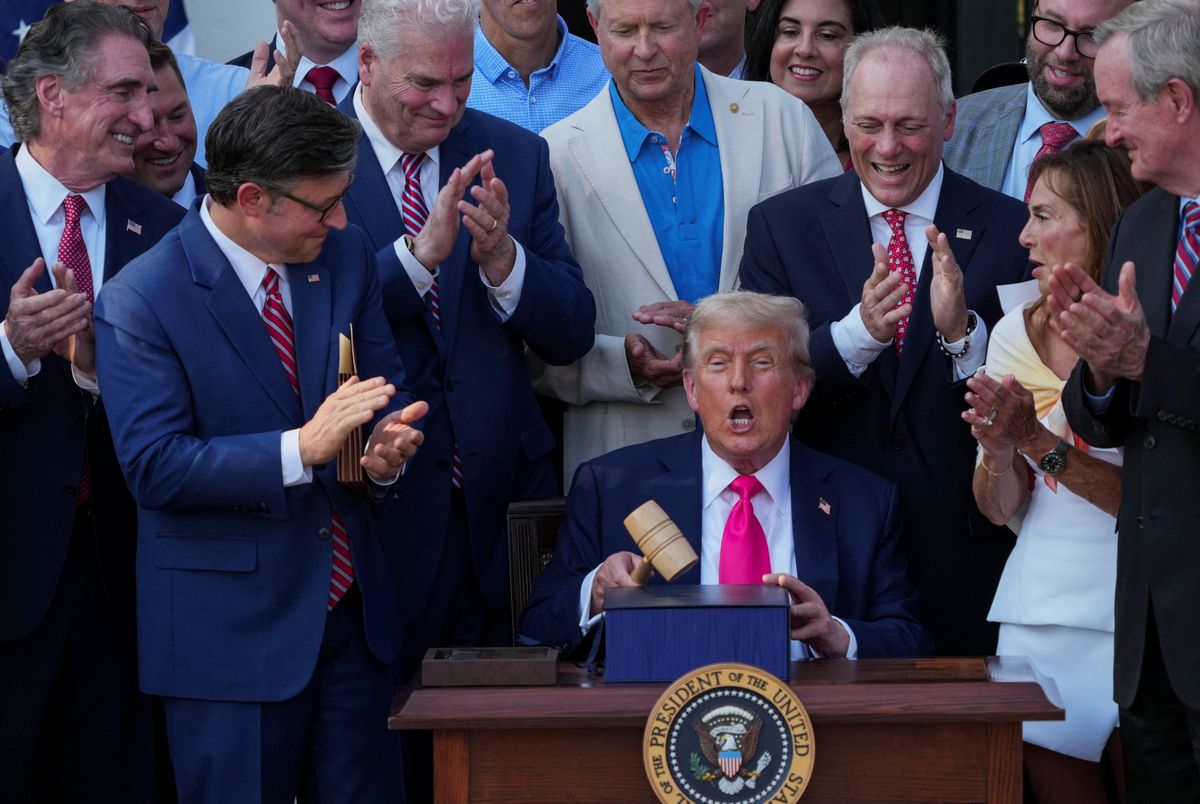
U.S. President Donald Trump uses a gavel after signing the sweeping spending and tax legislation, known as the "One Big Beautiful Bill Act," at the White House in Washington, D.C., U.S., July 4, 2025. REUTERS/Ken Cedeno

The cost-of-living has emerged as one of the biggest political headwinds facing Donald Trump in his second term, and according to a report from ABC News, his leadership has sent one particular cost soaring that will hit close to home, literally, for many: energy bills.

Citing new findings from a Democrat-aligned climate advocacy group, Climate Power, ABC News on Monday reported that energy bills across the US have increased by 13 percent since Trump returned to the White House in January. This analysis was based on data released by the U.S. Energy Information Administration.

The report laid the blame for this increase on a few factors, primarily citing Trump's "One Big Beautiful" federal funding bill, which he signed into law over the summer. According to Climate Power, this bill is "driving up utility costs and destroying jobs by removing cheaper, cleaner energy sources from the grid, all while funding new tax breaks for the oil and gas industries."

The report also estimated that, due to the new energy projects cut or delayed since Trump's return to the presidency, the US has lost out on 24,958.5 megawatts of planned energy generation. Trump's policies have notably targeted green energy projects, scaling them down significantly or eliminating them outright.

This loss of energy serves to exacerbate another issue driving up costs, according to Climate Power: the proliferation of power-hungry AI data centers. David Spence, a professor of energy law and regulation at the University of Texas, explained to ABC News that demand for energy is ballooning in 2025, and outpacing production "by a lot."

"We're just not able to bring new supply on as quickly as demand is growing, and that's driving prices up," Spence said.

The Trump administration has claimed, contrary to available evidence, that green energy sources drive up the cost of electricity prices. In fact, many green energy sources at a sufficient scale can produce notably cheap energy, with Australia set to offer homes three hours of free power a day thanks to a surplus of solar energy.

Trump has also claimed for years that wind power turbines cause cancer rates to increase in areas where they are built, and increase whale deaths when built offshore, despite no studies finding a credible link for either claim. A BBC News report indicated that Trump's opposition to wind turbines might have originated when 11 of them were constructed off the coast of his golf course in Scotland, a change in the coastal view he decried as "ugly."
MAGA senator exploits deadly Australia shooting to attack birthright citizenship
AND GUN CONTROL

David Edwards
December 15, 2025 
RAW STORY


A woman cries as she pays her respects at Bondi Pavilion to victims of a shooting during a Jewish holiday celebration at Bondi Beach, in Sydney, Australia, December 15, 2025. REUTERS/Hollie Adam

Sen. Tom Cotton (R-AR) called for an end to birthright citizenship and gun control laws after an attack on Jews in Australia, reportedly by two Muslim gunmen.

"When you look at the kind of violence that happened over the weekend in Australia, you had a man of Pakistani descent and a son who had been born in Australia and yet had not seemed to assimilate into their culture," Cotton told Fox News on Monday. "It's another reminder, too, about why birthright citizenship is not a good idea."

Cotton also blamed Australia's stringent gun control laws.


"Australia already has very strict gun control laws," he noted. "I'll be curious to know more about how these two men had licensed guns, especially since the Australian authorities have revealed that a few years back, the son was under investigation. How in the world were they allowed under Australia's very strict gun control laws?"

"It's also a reminder that gun control in the end is not a solution," Cotton added. "If nobody is allowed to have guns in a country, in the end, only the bad guys will have guns."


Trump's new 'Wall Street gold rush' comes 'crashing back to Earth': report

Alex Henderson
ALTERNET
December 15, 2025


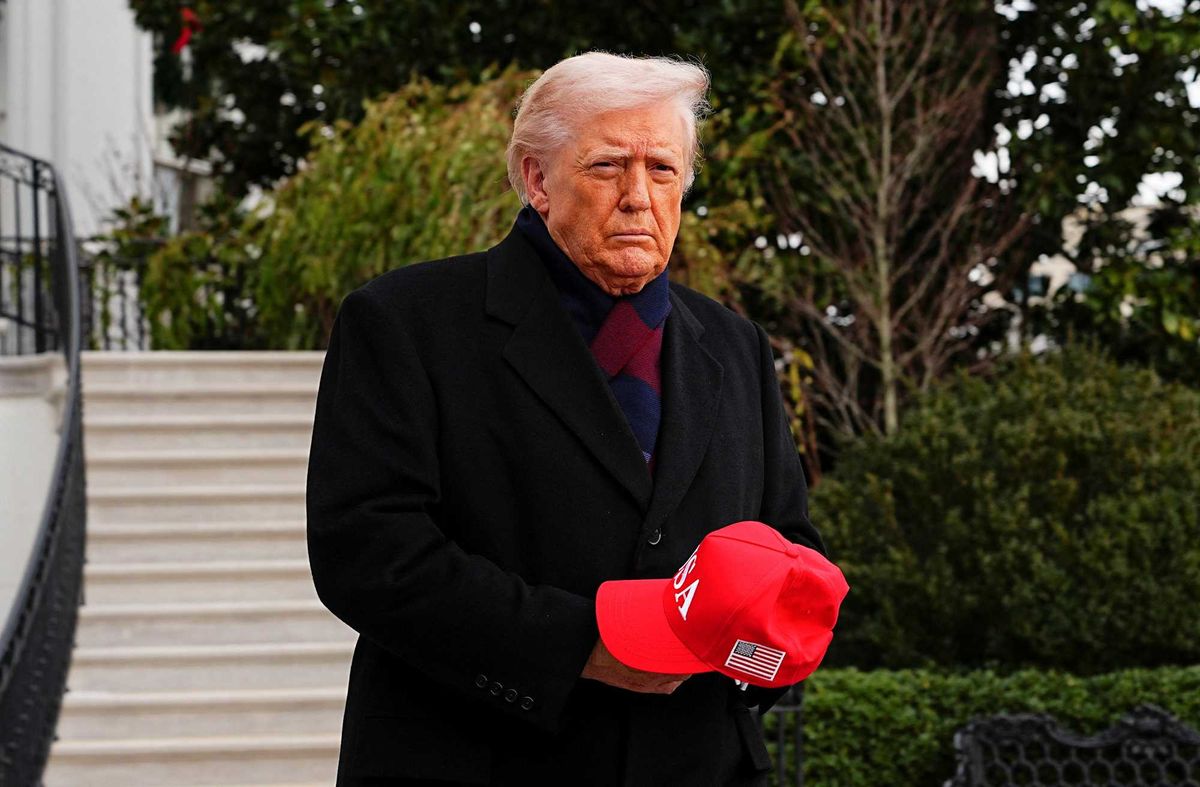
U.S. President Donald Trump holds a red cap before departing for the Army/Navy football game in Baltimore, at the White House in Washington, D.C., U.S., December 13, 2025.
  REUTERS/Aaron Schwartz

During his 2024 presidential campaign, Donald Trump aggressively expanded his outreach — picking up more support from Latinos, Generation Z, independents, swing voters and tech bros than he had enjoyed in 2016 or 2020. Trump, now almost 11 months into his second presidency, still brags about his relationships with the tech industry. But according to CNN's Matt Egan, not everyone who works in Silicon Valley or on Wall Street is benefiting from Trump's economic policies.

"Donald Trump's return to the White House set off a gold rush on Wall Street and in the crypto world," Egan reports in an article published Monday. "Companies and crypto projects linked to Trump and his family exploded in value as traders bet they would benefit from the president's return to power. The crash back to Earth for many of these assets reflects the fact that many of these bets were hard to make sense of in the first place."

Art Hogan, chief market strategist at B. Riley Wealth, told CNN, "Sometimes, irrational exuberance meets the brick wall of logic."

Egan notes that President Trump's company, Trump Media & Technology Group, "plunged below $11 a share on Friday, (December 12), leaving it down roughly 80 percent from the pre-election peak and worth less than $3 billion." And according to the CNN reporter, the Donald Trump meme coin "spiked to as high as $45.57 on January 19" but is now "trading at around $5.60" and has "lost 88 percent of its value from the peak."

Similarly, Egan points out, the Melania Trump meme coin "peaked at $8.48 on January 19" but is now "worth just 11 cents."

"More recently," Egan reports, "American Bitcoin, a bitcoin miner backed by Donald Trump Jr. and Eric Trump, debuted on the Nasdaq in September after merging with Gryphon Digital Mining. American Bitcoin's share price initially popped, climbing to as high as $9.31 on September 9. But those gains have since vanished amid a broader crypto pullback, and American Bitcoin dropped below $2 last week."

Egan continues, "Likewise, World Liberty Financial, a firm Trump and Steve Witkoff co-founded last year along with their sons, started trading a new token in September. It rose to 25 cents in late September but has yet to take off and on Friday fell to 14 cents."

Read Matt Egan's full CNN article at this link.
Canada's Grengine selected for NATO’s deep-tech accelerator advancing cyber-secure energy solutions


By Jennifer Kervin
DIGITAL JOURNAL
December 11, 2025


Photo by Benoît Deschasaux for Unsplash+

Canada’s innovation economy just earned a new global nod.

Edmonton-based Grengine has been chosen for NATO’s Defence Innovation Accelerator for the North Atlantic (DIANA) 2026 Challenge Programme. The clean energy company is part of the alliance’s largest-ever cohort of 150 innovators selected across ten challenge areas, including Energy and Power.

The accelerator connects deep-tech ventures with military end-users, mentors, and investors to fast-track solutions for the world’s most complex defence and security challenges. For Grengine, it’s a chance to show how a made-in-Canada technology can help solve a global problem: how to make energy systems both secure and sustainable.

“Being selected for DIANA — the world’s most competitive deep-tech accelerator — is an incredible honour,” says Connie Stacey, founder and CEO of Grengine. “This recognition from NATO validates the strategic importance of cyber-secure, resilient energy systems and affirms the global relevance of what we’re building at Grengine. For us, this is more than a milestone — it’s a mandate to help power and protect the systems that protect us. We’re proud to represent Canadian innovation on the world stage.”

The announcement comes almost a year after Grengine was part of a $6.7 million federal investment to boost business growth in Edmonton through PrairiesCan’s Business Scale-up and Productivity program.
Energy innovation meets security imperatives

Starting in January 2026, Grengine will receive contractual funding and access to DIANA’s network of accelerator sites and more than 200 test centres across NATO nations. Each company in the cohort will receive initial grant funding to advance solutions that can serve both defence and civilian markets.

Grengine will use the opportunity to further develop its modular, plug-and-play battery energy storage systems, technology built and manufactured in Alberta, to replace diesel generation, support renewable integration, and bring reliable green power anywhere.

James Appathurai, Interim Managing Director of NATO DIANA, says the accelerator’s mission is about turning innovation into action.

“DIANA’s mission is to find the most innovative companies, help them advance their solutions and grow their business, and get the technologies we need into the hands of NATO operators,” he says. “Over the next year, these innovators will accelerate breakthrough technologies that can help to transform how the Alliance defends against current and emerging threats.”

For Grengine, being aligned with DIANA’s Energy and Power challenge area reinforces how closely clean-energy innovation now ties to global resilience. The same systems that keep communities running after storms or grid failures can also power defence operations in austere or cyber-threatened environments.
From local innovation to global testbed

Grengine, formerly known as Growing Greener Innovations, has long framed energy access as a social issue as much as a technical one. Its mission to eliminate energy poverty and deliver ethical, sustainable power solutions now sits squarely inside NATO’s push to strengthen resilience across member nations.

Participation in DIANA will open doors to testing and validation sites across Europe and North America, along with mentorship from military and commercial experts. It marks another example of how NATO is engaging civilian innovators to solve defence-related challenges, signalling new opportunities for Canadian clean-tech firms positioned at the intersection of energy, cybersecurity, and infrastructure.
When clean energy becomes national security

Grengine’s selection highlights a growing shift in how innovation is defined.

Clean-energy technologies are no longer seen solely through the lens of climate goals. They’re increasingly part of national security strategy, and Canada’s innovators are helping shape that conversation.

By placing a Canadian company in NATO’s largest deep-tech accelerator cohort, DIANA underscores that the path to resilience runs through collaboration between civilian and defence sectors.

The challenge now is ensuring those breakthroughs don’t stop at validation, but scale into the systems that nations rely on.
Final shotsEnergy resilience is fast becoming a security priority.
Dual-use innovation is blurring the line between clean-tech and defence.
Canada’s global competitiveness will depend on how well it connects its innovators to these emerging systems of collaboration.


Written ByJennifer Kervin
Jennifer Kervin is a Digital Journal staff writer and editor based in Toronto.
EU 2035 combustion-engine ban review: what’s at stake


By AFP
December 12, 2025

European carmakers would like to be able to sell hybrid vehicles after 2035 - Copyright AFP Kirill KUDRYAVTSEV


Frédérique PRIS

The European Commission is expected to announce on Tuesday measures relaxing a 2035 ban on new petrol and diesel car sales.

While Europe’s embattled auto industry and its backers have lobbied hard for Brussels to relax the ban, they are divided on exactly what measures to take.


– Why the 2035 target date? –


In 2023, despite the reluctance of Germany, the commission announced a ban on sales of new vehicles powered by internal combustion engines from 2035. Hybrids that use a combination of combustion engines and battery power are also included.

The ban is a key measure to help attain the EU’s target of carbon neutrality by 2050.

The date is important as vehicles spend an average of 15 years on the road in the EU and thus would be expected to have largely stopped spewing planet-warming emissions by around 2050.

The 2023 announcement included a provision for a review in 2026 but, under pressure from carmakers and governments, the commission pushed forward announcing proposed adjustments to the end of 2025.

The proposals will go to the European Parliament for review.


– What adjustments are possible? –


For those against the ban, it’s no longer just a question of shifting the 2035 date, but of relaxing certain provisions.

Carmakers would like to see continued sales authorised for hybrids with rechargeable batteries or those equipped with range extenders (small combustion engines which recharge the battery instead of powering the wheels).

Germany supports this option as do eastern European nations where German carmakers have set up factories.

The ACEA association of European carmakers doesn’t criticise the goal of electrification, but it said “the 2035 CO2 targets for cars and vans are no longer realistic”.

Another possible means to add some flexibility would be boosting the use of alternative fuels such as those derived from agricultural crops and waste products.

Italy supports this option.

But environmental groups are opposed to any massive turn to crop-based biofuels as it would likely boost the use of pesticides and aggravate soil depletion, and they are also sceptical about what emissions reductions can actually be achieved.

Moreover, as a majority of biofuels are imported, the EU wouldn’t gain in autonomy, another objective of the shift to electric vehicles.


– Carmakers out of alignment? –


European carmakers — BMW, Mercedes, Renault, Stellantis and VW — are not always on the same page even if they all want the rules to be relaxed.

This is principally due to their varying progress in shifting to electric models.

The industry that has grown up around the electric car sector — such as battery manufacturers, recharge stations and electricity companies — wants to keep the 2035 target with no adjustments.

“Rolling back these objectives would undermine the EU’s energy sovereignty, industrial leadership, and climate credibility,” said the UFE, a trade group for French electricity industry firms.

France, along with Spain and the Nordic countries, has long called for keeping to the trajectory to shift to electric vehicles in order to not harm firms that have made investments in the transition.

Paris has indicated it is open to some flexibility on the condition of local content being favoured, which pleases suppliers which have also come under intense pressure from cheaper Chinese competition.


– Is there a risk in backsliding? –


Yes, according to experts.

“What is considered a short-term advantage may not be one in the long term,” said Jean-Philippe Hermine at the IDDRI think tank that focuses on the transition in the transport sector.

Bernard Jullien, an economist at the University of Bordeaux, said keeping several different technologies imposes extra costs for companies.

It can also create uncertainty for them if consumers adopt a wait-and-see attitude, he added.

“Between China and its electric vehicles and the oil that Saudi Arabia and the United States wants to sell us, is the right choice to stick with our old technology?” asked Diane Strauss, head of the French office of T&E, an advocacy group for clean transport and energy.