Thursday, January 22, 2026

Resistance Grows to Trump’s War Against Humanity


 January 22, 2026
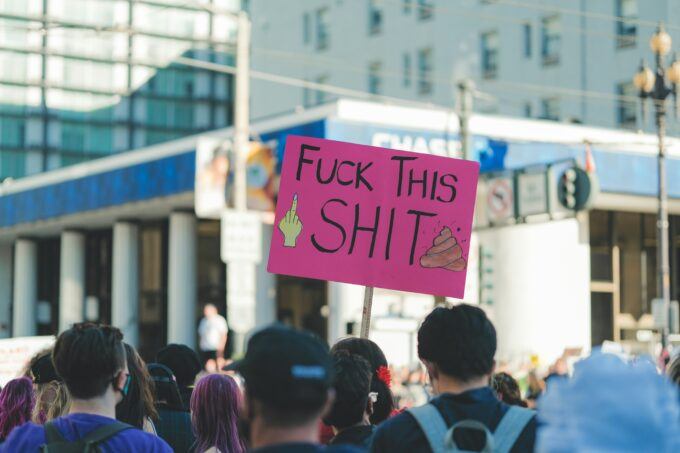
Image by Wayne Zheng

If there is any hope for humanity’s future, it is in the vision of the day when war criminals, authoritarians, fascists, and other enemies of democracy can no longer threaten the world with impunity.

We are far from that reality at present. As we enter a new year, global power remains decidedly in the grip of a status quo dominated by corporate politicians, war criminals, and financial elites. Led by President Trump, the worst of these political mobsters represent leadership on a moral caliber with history’s most malevolent barbarians.

In Minneapolis, the murder of Renée Good on January 8 by a federal ICE agent has rightly provoked an outpouring of popular grief, anger, and resistance. In turn, the Trump administration’s response makes it clear that even the pretense of accountability or expectation of due process are non-existent for this government. With even more federal agents flooded into Minneapolis in response, this lawless administration has made it clear it is at war with the American people.

Under a presidency led by a man with a reputation for lying about almost everything, President Trump has recreated his second administration in his own likeness. It took director of Homeland Security, Kristi Noem, only a couple hours after the shooting to brand Good a “domestic terrorist,” claiming the ICE agent acted in “self-defense” when she attempted to strike him with her vehicle. Noem also claimed Good had been stalking and impeding ICE’s activities “all day,” even though it was only just after 9:30 am when she was shot. She offered no evidence to support these charges.

In fact, ICE agents reportedly waited nearly three minutes before even calling 911 emergency services. Nor did they initiate CPR on Good or allow a doctor on the scene to assess her in the moments after the shooting. Instead, ICE agents briefly assessed Good and then left her bleeding and unattended until paramedics arrived several minutes later. It was more than 10 minutes before Good, who reportedly still had a pulse, received CPR from paramedics.

MAGA’s Hack Propaganda

Not surprisingly, President Trump and MAGA loyalists in the media and elsewhere quickly echoed Noem’s fantastical narrative. But anyone who watches video of the incident and thinks this victim-blaming is a closed case requiring no further investigation is just serving the cause of hack propaganda.

Incredulously, it took Homeland Security more than a week to claim the agent who shot Good, Jonathan Ross, had received medical treatment for “internal bleeding” in the torso after being hit by Good’s car. No corroborating evidence was offered in support of this claim. But what does this claim even mean? That Ross was slightly bruised after being bumped by Good’s car as she attempted to drive away? In videos of the incident Good is clearly turning her vehicle to the right (not toward Ross) as she attempted to drive away. Further, the ICE agent is plainly visible standing to the side of Good’s vehicle when he fired two more shots at her. Did Good also deserve to be shot in the face because she didn’t immediately comply with one agent’s order to exit her vehicle? Actually, the MAGA hive mind has no shortage of reasons to justify her murder. She was a “lesbian agitator” with pronouns in her bio, after all.

But not to worry. Vice President J.D. Vance has assured us the ICE agent who killed Good has “absolute immunity” from prosecution, a view many legal experts strongly refute. The Trumpified FBI has also barred Minnesota state criminal investigators from access to materials in the case, exposing the Trump administration’s utter disregard for both the law and the truth. Tellingly, the U.S. Department of Justice (DOJ) shows zero interest in even investigating the killing, a move that has prompted resignations of several federal prosecutors in Minnesota.

The litany of ICE atrocities in the past year are many. For months, these thugs have terrorized American neighborhoods, pursuing a mass deportation policy that is inhumane and racist. In the first nine months of 2025 alone, approximately 220,000 people were arrested by ICE officers. Despite the president’s bogus claim that the immigration crackdown is necessary to target murderers, rapists, and gang members, more than 75,000 of those arrested last year had no criminal record. Can Trump make the same claim?

Actually, available data does not distinguish detainees with serious legal offenses from those with minor violations. In many instances, being in the United States illegally is a civil violation or misdemeanor offense, not a felony. As of early December, there were about 65,000 or more persons being held in ICE detention facilities.

The shooting of Good is also not an isolated incident of government violence. In fact, since September, ICE agents have been involved in 11 shooting incidents. In Santa Ana, California, federal officers shot two people in the face with “less lethal” projectiles, causing permanent eye damage. In Minneapolis, federal agents deployed flash-bang devices and tear gas on a family with six children in their car who were driving home from a sports practice.

The exploding lawlessness of the Trump administration now constitutes a blatant threat to democratic and human rights everywhere. Indeed, it’s a sign of the urgency of our times that scheduled antiwar rallies across the United States on January 10 to oppose the recent U.S. military assault on Venezuela and kidnapping of President Nicolás Maduro and his wife Celia Flores, initiated by the Democratic Socialists of America (DSA) and the Party for Socialism and Liberation (PSL), had to be quickly amended to include a response to Good’s murder and the escalating threats from ICE.

Obviously, the military assault on Venezuela’s sovereignty was less about drugs and democracy than oil, power, and money. Maduro’s alleged complicity in narco-terrorism and weapons charges is only a specious pretext for an attack on a nation that just happens to have the world’s largest oil reserves. Venezuela’s real crime is that it operates independently of U.S. foreign policy, which under Trump’s crudely resurrected version of the Monroe Doctrine now constitutes an unforgiveable sin. Does anyone seriously believe Trump, who recently pardoned convicted former Honduran president Juan Orlando Hernandez of drug trafficking and weapons charges, actually cares about narcotrafficking?

With escalating threats now against Columbia, Cuba, Mexico, Denmark, Greenland, and Iran, there is little coherent or reasoned policy in this intensifying U.S. global aggression. But there is Trump’s need to distract the American people from his personal scandals and failures as a leader, and from the basic truth that he has absolutely nothing to offer to improve life for the majority of the people.

Gaza: Preface to a World Under Siege  

Of course, we should not be surprised at what is happening now in the United States. The preface to Trump’s wild assault on democratic and human rights, his unhinged violent imperialism, are just the logical next expression of two years of genocidal destruction unleashed upon the people of Gaza by the Israeli state. This was a campaign of pure evil facilitated with decisive military support from both the Biden and Trump administrations.

Ironically, in 2025 the president who thought he deserved the Nobel Peace Prize conducted military attacks on seven countries, and launched air assaults on alleged drug boats in the eastern Pacific and Caribbean. But don’t feel too sorry for Trump the Nobel loser. To thank him for bombing her country, Veneuelan right-wing coup plotter Maria Corina Machado has now given Trump her Nobel Prize. In his own name, Trump has also been awarded the Israel Prize by Israeli Prime Minister Netanyahu, a war criminal and fugitive from an international arrest warrant issued by the International Criminal Court.

These war criminals and obsequious grovelers before the American president can give each other all the awards they want, it won’t erase the moral censure they deserve. Whatever hope for this world exists belongs instead to the many millions of human beings who don’t support targeting Palestinian children for bullets to the head or chest, starving families, bombing hospitals and schools, the forced displacement of around 2 million people, and other crimes against humanity. They don’t believe 250,000 Palestinians deserved to die, to be maimed or left buried under rubble by a genocidal apartheid state. Nor do these many millions believe in kidnapping leaders of foreign states, bombing and threatening other nations with capricious indifference to their sovereignty, and ignoring international law.

The Trump presidency is an authoritarian cancer on what’s left of the body politic of democracy, led by the mendacious real estate blowhard turned politician and his hand-picked cabinet of sycophants, grifters, opportunists, and assorted incompetents. Watching Trump and MAGA politics in action over the past year is like viewing a film documentary in reverse motion, as established rights are undone and the rule of a lunkhead mob of far-right extremists takes over. For what it’s worth, Trump is already floating his interest in finding a way to subvert or even cancel this year’s mid-term elections. That’s the direction his addled extremism is going. 

Those who support the democratic and human rights of migrants and citizens, who oppose genocide and imperialist violence, are in a moment now that demands an escalation in mass action, solidarity, and resistance. Enough of the entrenched timidity of the Democratic leadership, many of whom remain hesitant even to curtail ICE funding. We need a mass united front built on grassroots organizing power, fueled by the activism, energy, and strength of unions, communities, students and everyone with a vested desire to stop ICE terror and the larger and growing authoritarian threat.

The call by labor and community leaders in Minneapolis for a general shutdown of the city on January 23—an “economic blackout”—to protest Good’s murder and the ongoing harassment, abductions, and violence by ICE is an important initiative. This means no school, no work, and no shopping. Significantly, the Minnesota Labor Regional Federation AFL-CIO has announced support for the Minneapolis Day of Truth and Freedom, demanding ICE leave Minnesota now and the agent who killed Renée Good be held legally accountable.

This call for justice represents a significant step toward building an ever more forceful campaign of popular mass resistance to the current threats to our democratic and human rights.

Mark T. Harris is a writer living in Portland, Oregon. He grew up a few blocks from the site of the old Lindlahr Sanitarium frequented by Eugene Debs in the Chicago suburb of Elmhurst. However, none of the teachers in the local schools ever spoke a word about Debs or the clinic. He does remember Carl Sandburg’s Elmhurst home, which was torn down in the 1960s to build a parking lot. Email: Harris@writersvoice.org


Resisting Trump’s Assault on Democratic Rights and the Sovereignty of Nations

Thursday 22 January 2026, by Kay Mann


Over the past several weeks, Trump’s attack on democratic rights in the US and violations of international law and the sovereignty of other countries have increased in scale and violence. On January 3, 2026, a massive aerial and naval force kidnapped Venezuelan president Nicholas Maduro and his wife Celia Flores, killing a hundred Venezuelans and Cubans in the raid, which was followed by the theft of 500 million barrels of Venezuelan oil by US naval forces. With supreme imperial arrogance, Trump claimed that the US will “run” Venezuela and is also threatening Columbia, Cuba, and most recently, Greenland in spite of it being part of Denmark, a NATO ally of the US since 1949.

The attack followed weeks of brutal extra-judicial killings of crews on supposed drug running boats near the Venezuelan coast and the Pacific. Then, on January 9, in the streets of freezing Minneapolis, Minnesota, an ICE agent coldly murdered an unarmed white US citizen Renee Goode, a 37 year old mother of two involved in non-violent immigrant support work. The numerous video recordings of Good’s murder helped make her the best known of at least thirty two people killed by ICE agents.

Linking the two seemingly disparate cases is the increasing use of violence against people of color at home and abroad and their allies on the basis of fictious accusations of narcotics smuggling. The naming of Stephen Miller, the neo-fascist commandant in charge of Trump’s racist immigration policy as one of the top Trump government officials in charge of immigration policy strikingly underscores the connection between the assault on Venezuela and the ICE murders.

Within hours of the attack on Venezuela emergency protests were held in several cities ranging from a few hundred to two thousand in New York city.

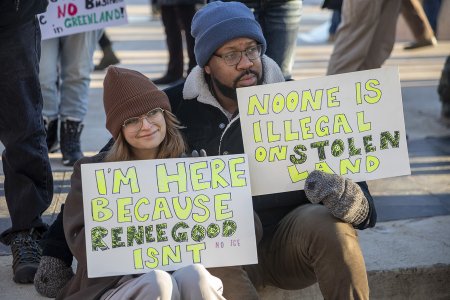
But it was the murder of Renee Goode that struck a nerve in the US population. Thousands of protests throughout the country were held to commemorate Good and demand the abolition of ICE. Polls show huge support for this demand. The government responded by accusing Good of hitting the ICE agent with her car, though videos clearly show that her car was moving away from the officer. The federal investigation into the shooting has excluded local Minneapolis officials and threatened an investigation into Goode’s widow’s ties with militant groups -activity protected by the US constitution. Jonathan Ross, the Christian nationalist ICE thug who murdered Good has not been charged and is not currently being investigated. The government responded by sending more ICE agents to Minneapolis and Trump threatened to invoke the rarely used eighteenth century Insurrection Act to send in regular military troops into the city.

There is a widespread sense that the city is occupied by a hostile force. Minneapolis’s Democratic mayor, Jacob Frey, and Democratic Governor Tim Waltz have used strong words to oppose ICE and demand it leave the city and state but have done little else.

ICE have been terrorizing cities and towns across the country for months now, but Trump has special hostility to Minnesota, a traditional liberal Democratic state with a rich history of labor struggle. Minneapolis, the state’s largest city is also home to a sizeable Somali population who has arrived in recent decades. One of them, Ilhan Omar is US representative of the state’s fifth district which covers most of Minneapolis. She is one of the four members of the “squad“ - four outspoken progressive women Democratic members of congress who Trump routinely attacks and threatens on social media. Trump has claimed that Ilhan, who is a US citizen “should be in prison” and deported.
Birth of a Social Movement

There were over 1,000 demonstrations held on January 10 to protest Good’s murder. Many, but not all, DSA chapters answered a call from the DSA national leadership to participate in the protests against the aggression against Venezuela.

The efforts to defend immigrants from ICE raids have all the markings of an authentic nascent social movement. Activists use classic tactics from the handbook of social protest - marches, rallies, the chanting of slogans, and creative original methods as well such as the blowing of whistles when ICE agents arrive in a neighborhood. Neighborhood organizations have been established throughout the country that organize shopping and transportation for immigrant families fearing ICE violence, arrest, and deportation.

These groups are made up of ordinary citizens, many of whom had not been involved in politics before seeing their neighbors and coworkers snatched by masked armed ICE officers. Rightwing journalists have been outraged at what they call “wine moms”-middle class suburban white women participating in neighborhood watch groups. In the case of Minneapolis, the center of current ICE protests, the network of support and mutual aid groups can be traced back to the George Floyd protests of 2020.

Groups from different parts of the country are beginning to relate to each other, sharing resources and tactics. For example, an ICE watch group on Chicago’s North Side, called Protect Rogers Park, helped train ICE watchers in Minneapolis. “Know your rights” cards can be seen in stores and restaurants in Mexican and other immigrant neighborhoods in many cities. Some schools in the city have chosen to close as a precaution against ICE raids. Activists have called for a city-wide general strike in Minneapolis on January 23. Tenant unions in LA and elsewhere have blended into the movement, further underscoring the deep implantation of the movement into working class lives and other struggles.

Such networks of mutual aid will connect with other existing movements laying the basis for larger and larger actions and strengthening the general anti-Trump movement. These are networks of working class solidarity that serve as a powerful resistance to Trump’s racist white Christian nationalism and give us a glimpse of the possibility of a democratic self-organized society.

21 January 2026

Attached documentsresisting-trump-s-assault-on-democratic-rights-and-the_a9377.pdf (PDF - 1.3 MiB)
Extraction PDF [->article9377]


Kay Mann is a Lecturer in Sociology at the University of Wisconsin at Stevens Point and a member of the Milwaukee branch of Solidarity.


Martin Luther King: A Revolutionary, Not A Saint


 January 22, 2026

“When I say poor, I don’t just mean black people.”

–Martin Luther King Jr.

“The true enemy is war itself.”

–Martin Luther King Jr.

For thirteen years he lived and worked with the knowledge that a violent death awaited him, that it might come at any moment from a knife thrust out of a crowd, a sudden gunshot, a bomb tearing him to pieces. His wife was plagued with nightmares about it.

Reminders were frequent: a shotgun blast through his front door, the bombing of his home, a dozen sticks of dynamite found smoldering on his porch, a razor-sharp Japanese letter-opener plunged into his chest by a crazy woman, and, of course, the regular late-night phone threats that began with, “Nigger . . . .”

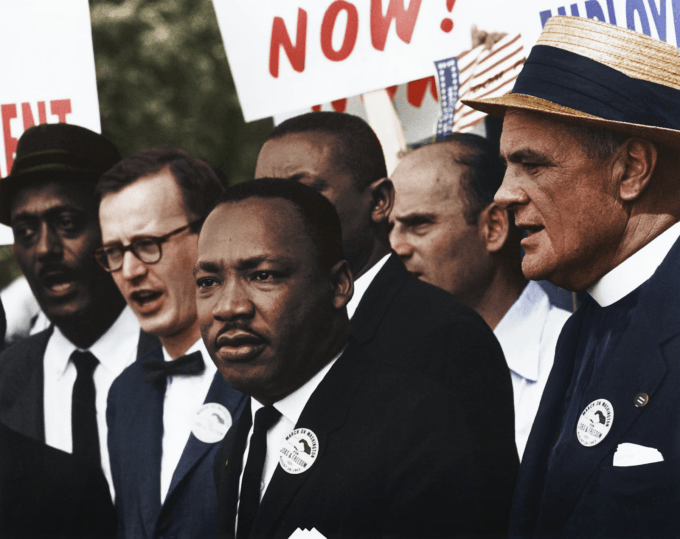
Prayer and a deep Christian faith dissipated his paralyzing fear, giving him the strength to act. His eloquence, soaring idealism, and amazing composure under relentless pressure inspired millions to act with him, leading to the fall of Jim Crow, and contributing to the collapse of public support for the Vietnam War, the most criminal military intervention in U.S. history.

Unfortunately, the public image of Dr. King handed down to us by our mind-managers bears only the faintest resemblance to the impassioned rebel he was in real life. These days Dr. King tends to be remembered as a reformist, African-American preacher who went to college to better himself, believed in God and his fellow man, and won a Nobel Prize for Peace, along with the admiration of both whites and blacks for his decency and non-violent reminders of the nation’s essential goodness. Lost completely are his feverish intensity, tactical brilliance, and anguished incomprehension of a society permeated by racism, exploitation, and deceit.

From the very beginning King was a political radical whose aspirations went far beyond reform, a Christian revolutionary who dedicated himself to creating a culture of social justice that would give substance to the freedom and equality the U.S. political system merely talked about. He opposed in principle “systems of oppression” like colonialism, imperialism, and segregation, and denounced capitalism for being “predicated on exploitation.” He saw racism not as a feudal anachronism of the Old South, but as anational problem implicating all Americans. He found all those isms incompatible with “the natural goodness of man and the natural power of human reason.”

Though he had gone to school in the North and only with reluctance returned to the South, he was never naive about the informal apartheid that characterized life above the Mason-Dixon line. (No one had wanted to rent to him during his student years in Boston.) As a pastor, he regularly traveled to the North years before the ghetto rebellions of the 1960s, plugging into activist structures pushing back against racist exclusion and police brutality.

One such visit was to Los Angeles in the wake of the police killing of Ron Stokes outside a Muslim mosque in 1962 (an event usually associated only with Malcolm X), where King supported locals calling for the ousting of openly racist Police Chief William Parker,* expressed zero tolerance for police brutality, and talked of the need to build black power, by which he meant blacks organizing themselves into a force for real democracy.

The year after the Stokes killing he visited Los Angeles multiple times to protest segregation, and did so again right before the Watts rebellion (1965), when he declared that Los Angeles schools were as segregated as those in Birmingham. In all, he made more than fifteen visits to the area prior to the black uprising, and followed up with another visit in the wake of that event, calling for a Civilian Complaint and Review Board to deal with police brutality, which proposal was angrily shot down by Mayor Sam Yorty, whose racial instincts weren’t all that different from Bull Connor’s.

King understood that blacks being manhandled by police was related to their being corralled into ghettos. Thus, he was deeply critical of California’s Proposition 14, passed in 1964 (supported by 75% of whites), which he called the “vote for ghettos” initiative, since it re-affirmed the practice of deeded covenants mandating that homes remain exclusively in the hands of white owners. Such deeds were common in the North, and King criticized Northern liberals for their hypocrisy in applauding the end of official segregation in the South while perpetuating an informal apartheid in the North.

When the Watts powder keg inevitably exploded, King was devastated by the destruction (thirty-four people were killed) and shocked at the attitude of residents, who cheered on the destruction of “their” communities.

“Burn, baby, burn,” they chanted, as store after store, building after building, was put to the torch and consumed by flames. In a sea of police roadblocks, broken plate glass, and strewn rubble, they cut the hoses of firemen battling the blaze and lobbed Molotov cocktails into the expanding inferno.

Though it may have looked like they were destroying their communities, in fact the residents were fighting for the resources to maintain them, and were, in any case, ironically conforming to the logic of their degraded capitalist environment: Looters loaded up cars with as much merchandise as they could carry off, surrounded by signs celebrating instant acquisition on easy terms.

According to Bayard Rustin, King was deeply affected by Watts, realizing more acutely than ever before the real depth of economic oppression, which overlapped with racism, but also went beyond it.  Having the right to sit at a lunch counter and order a hamburger, for example, meant little to those who lacked the money to pay for one.

With his usual amazing patience, King put himself to the task of explaining to those who thought that black grievances should have ended once civil rights legislation passed, that the urban uprisings in Harlem (1964), Watts (1965), and Newark and Detroit (1967), were caused by longstanding socially-sanctioned crimes committed against blacks, not by them. Building and housing codes were routinely violated to perpetuate slums, meager social allotments owed blacks were often slashed or denied them, and black civil rights didn’t even rise to a theoretical concern for police who brutalized them.

After seeing the devastation of Watts, King moved on to a fair housing campaign in Chicago with a renewed sense of urgency in 1966. He didn’t call the slums there “neglected areas,” nor did he describe its residents as “deprived” or “left behind,” code words the professional servant class uses to imply that mass poverty is somehow incidental to capitalism, when, in fact, it is characteristic of the system, since profit-takers are encouraged to “externalize” costs (i.e., make the public absorb them), among which mass poverty is especially prominent. King called the wretched Chicago ghettos a system of “internal colonialism,” comparing it to the exploitation of the Congo by Belgium. In charge of the system was Mayor Richard Daley and his corrupt regime, who loathed King for shining a public spotlight on their activities, at the same time finding it incomprehensible that he couldn’t be bought off.

Crazed mobs repeatedly turned out to scream racist obscenities and pelt Dr. King and his fellow marchers with bottles, rocks, cherry bombs, and lumps of coal. On a Sunday march a nun was struck in the head by a rock, and the crowd cheered when her wound began to bleed visibly. On a march through Marquette Park and Chicago Lawn Dr. King himself was felled by a fist-sized stone that slammed into his temple. A hurled knife missed him but struck another marcher. Stunned by the depravity, King confessed to reporters that he had “never seen – even in Mississippi and Alabama – mobs as hostile and hate-filled as I’ve seen in Chicago.”

Except for Operation Breadbasket, most people involved in the Chicago campaign ended up writing it off as a failure. Nevertheless, King was impressive, even convincing gang members to lay down their arms and peacefully march for change, but the massive resources needed to end slums in Chicago were being allocated to obliterate Vietnam, not deal with the tragic legacy of slavery at home. Meanwhile, King’s sincerity and eloquence were as powerful as ever. On a trip to rural Mississippi he spoke so movingly that a five-year-old-girl started sobbing and repeating over and over, “I want to go with him.”

After Watts and Chicago, King publicly stated the need for revolution: “I think you’ve got to have a reconstruction of the entire society, a revolution of values.”

More clearly than any other civil rights leader, King saw that racism abroad was related to racism at home, that freedom for American blacks was tied to self-determination for the Vietnamese people, then fighting to expel the United States from their country. He had already begun speaking out against the war starting in 1965, continuing to do so until his death, in spite of strong criticism from other leaders, a hostile press, and harassment by the FBI. When told he was alienating friends and supporters with his stance, King remained unmoved: “I am not a consensus leader.” “I don’t care who doesn’t like what I say about it.” “This madness must stop.”

He was especially gripped by the suffering of the children, but also protested that twice as many black soldiers as whites were dying as cannon fodder in an imperial war whose crimes rivaled those of the Nazis. Water and land were poisoned, harvests destroyed, and people tortured and murdered in staggering numbers, using funding that should have been allocated to ending poverty at home.

In his 1967 “Beyond Vietnam” speech, Dr. King called out the U.S. for being, “the greatest purveyor of violence in the world today,” and did not mince words about the form that violence was taking in Vietnam:

The peasants watched as we supported a ruthless dictatorship in South Vietnam which aligned itself with extortionist landlords and executed its political opponents. The peasants watched as we poisoned their water, bombed and machine-gunned their huts, annihilated their crops, and sent them wandering into the towns, where thousands of homeless children roamed the streets like animals, begging for food and selling their mothers and sisters to American soldiers. What do the peasants think as we test our latest weapons on them, as the Germans tested new medicine and tortures in Europe’s concentration camps? Where are the roots of the independent Vietnam we claim to be building? Is it among these voiceless ones? We have destroyed two of their most cherished institutions: the village and the family. We have inflicted twenty times as many casualties on them as have the Vietcong. We have destroyed their land and crushed their only non-Communist revolutionary political force – the Unified Buddhist Church. We have corrupted their women and children and killed their men. What liberators!

A year later he was cut-down by a bullet full in the face at the age of 39, leaving behind an astonishing list of achievements, all attained against the pressure of barbaric segregation in the South, horrendously complex racism in the North, a prolonged vilification campaign waged against him by the FBI, considerable jealousy on the part of other civil rights leaders, a savage imperial war that devoured the resources needed for social transformation, and a vengeful Lyndon Johnson.

In spite of such formidable obstacles, Dr. King reached more blacks, more Americans, and more citizens of the world, than any U.S. reform leader of the 20th century, and at a depth of understanding few leaders ever even entertain. Referring to King’s “Beyond Vietnam” speech, John C. Bennett, then president of the Union Theological Seminary, said that “there is no one who can speak to the conscience of the American people as powerfully as Martin Luther King.”

January 19 is the fortieth anniversary of the U.S. national holiday for Dr. King. This remembrance is a nice gesture, but if we are to truly honor him, we’ll have to establish the culture of social justice he struggled to create, in order to reign in a lawless U.S. government carrying us to utter destruction.

*Chief Parker explained the 1965 Watts uprising this way: “One person threw a rock and then, like monkeys in a zoo, others started throwing rocks.” (italics added) Taylor Branch, At Canaan’s Edge: America In The King Years 1965-68, (Simon and Schuster, p. 399)

Notes

MLK visits to Los Angeles, Theoharis interview

Racist housing covenants, see (Branch, p. 637)

Watts rebellion, description of . . . (Conot pps. 40, 99, 219, 239, 362, 364)

MLK can’t be bought . . . (Oates, p. 408)

Sobbing five-year-old girl wanting to go with MLK, (Oates, pps. 399-400)

MLK on Chicago mobs being most hate-filled he had ever seen, (Oates, p. 413)

MLK on the need for revolution .. . (Cone, p. 257)

MLK, “This madness must stop” . . .(Cone, p. 297)

MLK, “greatest purveyor of violence in the world today” (Cone, p. 237)

“Beyond Vietnam” excerpt (Oates, p. 435)

John C. Bennett quote, (Cone, p. 294)

Sources

Jeanne Theoharis, MLK Jr.’s Life of Struggle Outside The South, Counterpunch Radio, www.counterpunch.org

Conot, Robert E., Rivers of Blood, Years of Darkness, (Bantam, 1967)

James R. Ralph Jr., Northern Protest – Martin Luther King, Jr., Chicago, and the Civil Rights Movement,” (Harvard, 1993)

David J. Garrow, Bearing The Cross, (William Morrow, 1986)

Stephen B. Oates, Let The Trumpet Sound – The Life of Martin Luther King, Jr., (Harper & Row, 1982)

James H. Cone, Martin & Malcolm & America – A Dream or a Nightmare, (Orbis, 1991)

Taylor Branch, At Canaan’s Edge – America In The King Years 1965-68 (Simon & Schuster, 2006)

Michael K. Smith is the author of  The Madness of King George, and Portraits of Empire