Friday, March 06, 2026

Landslide at DR Congo coltan mine kills more than 200, including children

More than 200 people were killed on Tuesday in a landslide triggered by heavy rains at the Rubaya coltan mine in eastern Democratic Republic of Congo, the country's mining ministry said late Wednesday.


Issued on: 05/03/2026 - RFI

Survivors of a landslide at an open pit coltan mine in Rubaya are seen at home on 30 January, 2026. © AFP


The government of the Democratic Republic of Congo (DRC) reported more than 200 deaths, including those of around 70 children, in a statement released on Wednesday evening by the Ministry of Mines.


The landslide occurred on Tuesday afternoon, according to witnesses.

"The provisional death toll stands at more than 200 Congolese citizens, including approximately 70 child miners, and numerous injured who have been evacuated to medical facilities in Goma," the statement read.

These figures could not be confirmed with independent sources by news agencies AFP and Reuters.

The mine is in a remote region, approximately 70 kilometres west of Goma, the capital of the troubled North Kivu province in eastern DRC, to which humanitarian organisations do not have access and where there are no large-scale health facilities. Telecommunications are regularly cut off.

Rebel control


A senior figure from the AFC/M23 rebel group, which controls the mine, had earlier told Reuters that only five or six people had been killed.

Since its resurgence in late 2021, the anti-government group M23 – with the support of Kigali and the Rwandan army – has seized vast swathes of territory in eastern DRC, a region rich in natural resources and ravaged by conflict for three decades.

The Rubaya mine has been under the control of AFC/M23 since 2024, and DRC authorities have not been present since then.

"The damaged site is one of those where continued operation had been discouraged pending the securing of the area and the implementation of protective measures for miners. The incident is due to the heavy rains of the last few days," according to a second senior AFC/M23 figure.

The mine was recently added to a shortlist of mining assets being offered by the DRC's government to the United States under a minerals cooperation framework.

Precarious conditions

Rubaya produces between 15 and 30 percent of the world's coltan, a strategic mineral for the electronics industry.

Coltan is processed into tantalum, a heat-resistant metal that is in high demand for makers of mobile phones, computers, aerospace components and gas turbines.

It is widely mined in the DRC, which is estimated to hold at least 60 percent of the world's reserves.

Spotlight on Africa: the race for Africa's critical minerals

Thousands of miners work daily in the Rubaya mines, in precarious conditions and without safety measures, most often equipped with only shovels and a pair of rubber boots.

The landslide came a month after another disaster at the site at the end of January which killed "several" people according to an M23 official, but more than 200 according to the authorities in Kinshasa.

In recent days, fighting had intensified near the mining site, in a region where government forces have conducted attacks against the rebel group, including drone strikes.

(with newswires)

Mine collapses in eastern Congo, with official death toll disputed by M23 rebels


Military bases and trade routes leave Africa exposed to war fallout

Nairobi (AFP) – Africa hosts military bases within reach of Iranian missiles and is feeling the impact of rising oil prices and threats to shipping, as the continent again suffers from events largely beyond its control.


Issued on: 05/03/2026 - RFI

People walk by the flags of Israel and Somaliland between the capital city of Hargeisa and Port city of Berbera, in Somaliland, on 19 February, 2026. 
AFP - TONY KARUMBA

The continent is "structurally exposed" to the Middle East war, said Hubert Kinkoh, senior researcher at the CARPO think tank.

"Energy imports, foreign military bases, and its proximity to maritime chokepoints mean the war's effects reach African shores quickly."
Targets

The Horn of Africa includes possible targets for Iranian strikes, notably the 4,000 US military personnel at Camp Lemonnier in Djibouti.

It lies less than 100 miles (160 kilometres) from Yemen, where Houthi rebels have an arsenal of ballistic and anti-ship missiles, and drones, courtesy of Iran.

The Houthis have not engaged in the conflict despite vowing to do so, but have previously caused major trade disruption with attacks on Red Sea shipping during the Israel-Hamas war.

Somaliland, just south of Djibouti, could also be a target as it hosts a major port and military base at Berbera run by another Iranian enemy, the United Arab Emirates.

Israel recently became the only country to recognise Somaliland's independence from Somalia, and a Western diplomat told AFP that it may already have troops in Somaliland.

"Berbera is not a confirmed target, but its location (near the southern entrance to the Red Sea) leaves it vulnerable, particularly as Iran‑aligned groups widen the range of facilities they view as linked to US or allied operations," said Kinkoh.

Economic impact

Economically, the war is terrible timing for Africa, just as a weaker dollar and lower interest rates offered some breathing space for its many deeply indebted nations.

The war is disrupting global trade, diverting ships from the Suez Canal to the pricier route around the Cape, and hiking prices across the board, including for energy and food.

An oil producer like Nigeria might have benefited, but it locked in low prices for its exports in long-term contracts and remains a net importer of refined fuel because of its limited refining capacity.

Pump prices in Nigeria were up around 14 percent this week.

Nigerian think tank SBM Intelligence said the new crisis has exposed its government's "wait-and-see" approach to international affairs, which leaves its "economic interests subject to forces beyond our control" -- a criticism that could be levelled at many on the continent.

African economies also rely on remittances from the hundreds of thousands of migrant workers in the Gulf that are now threatened. Previous crises in the Middle East have revealed the near-total lack of evacuation planning or even emergency hotlines for them.

Diplomatic fallout

While some African countries have done too little, others are accused of over-reach.

South Africa is perhaps the most exposed diplomatically, having already riled the United States with its opposition to Israel, and hosted Iranian warships for naval exercises in January -- even if the government has since disavowed its involvement and said the military acted against presidential orders.

"South Africa will want to reinforce the signalling to the world that it is a non-aligned neutral actor. That is a message it's going to really struggle to sell, given that Iran was so active in the exercise," said Timothy Walker, of the Institute for Security Studies.

William Gumede, professor of public management at the University of Witwatersrand, said South Africa's geopolitical posturing was ill-advised and could now trigger US sanctions against members of the government.

"Our economy is so vulnerable... We do not have a luxury to try to grandstand globally," he said.

Geopolitics

In the longer term, the war is bound to play into the shifting geopolitics of the region, which have seen Turkey, Saudi Arabia, the United Arab Emirates and others expand their reach into Africa -- building ports and infrastructure, supplying drones, establishing military bases and drilling for oil, especially in east Africa.

Gulf powers have been accused of fomenting conflict in places like Sudan, Ethiopia and Somalia, and so some hope the new war may have positive consequences.

"A UAE forced to concentrate on defending its own airspace and territory may reduce its footprint in African conflicts, creating space for African-led peace processes to function more effectively," said SBM Intelligence.
With oil once again a weapon in the Middle East, is clean energy the key to peace?

By closing the Strait of Hormuz and attacking oil and gas facilities in Gulf countries, Tehran is driving up hydrocarbon prices. But renewable energy – largely dominated by China – is not immune to the effects of geopolitical tensions either.


Issued on: 05/03/2026 - RFI

The Strait of Hormuz is the only channel connecting the Gulf to the Arabian Sea. 
REUTERS - Dado Ruvic

Since the United States and Israel launched attacks on Iran on 28 February, prompting retaliation by Tehran, the price of crude oil has risen by around 13 percent.

Iran has made the Strait of Hormuz a cornerstone of its counter-offensive, blocking maritime traffic along the world's most vital oil export route.

Around 20 percent of the world's daily oil consumption passes through the strait, which connects the biggest Gulf oil producers – Saudi Arabia, Iran, Iraq and ​the United Arab Emirates – with the Gulf of Oman and the Arabian Sea.

The use of oil as a weapon of war is by no means new.

Following the 1973 Arab-Israeli War between Israel and neighbouring Arab countries, the Organization of the Petroleum Exporting Countries (OPEC) imposed an embargo on Israel’s allies. This triggered a sharp rise in oil prices, known as the first oil shock.

“Oil now appears to play an important role in the evolution of international relations, because it sheds a completely new light on the Middle East question,” said Abdelaziz Bouteflika, then foreign minister of OPEC member Algeria.

According to André Giraud, France’s industry minister at the time of the second oil shock – caused by the Islamic Revolution in Iran in 1979 – “oil is a raw material with strong diplomatic and military content”.

Iran also previously blocked the Strait of Hormuz during the Iran-Iraq war in the 1980s, when dozens of ships were sunk in the strait.

In September 2019, the Houthis in Yemen – supported and armed by Iran – also bombed a major Saudi oil installation.


The USS Abraham Lincoln aircraft carrier (L) transits the Strait of Hormuz on 19 November, 2019. AFP - ZACHARY PEARSON

'Peaceful' energy

“For Iran, the Strait of Hormuz is a strategic issue,” says Olivier Appert, an adviser at the Energy-Climate Centre of the French Institute of International Relations (IFRI). “It may be the weapon of the weak against the strong. It is not unprecedented, but it is still worrying.”

In response to Israeli-American bombings, Iran has struck Saudi Arabia’s largest refinery as well as gas facilities in Qatar, pushing up the price of liquefied natural gas (LNG).

While there's a pattern to targeting fossil energy infrastructure, renewables appear more sheltered from geopolitical tensions. Green energies such as solar and wind power have a more peaceful image. Once installed, solar panels are largely protected from geopolitical upheaval and sudden price spikes.

“Renewable energy is the guarantor of peace in the 21st century” wrote UN Secretary-General Antonio Guterres in an op-ed published in Le Monde after Russia’s full-scale invasion of Ukraine in February 2022.

Mideast war exposes fragile oil, gas dependency

Yet renewables are not immune to conflict – albeit of the commercial variety.

China holds many of the rare earth elements whose magnetic, optical and catalytic properties make key clean‑energy technologies more efficient and compact.

“The players are not the same, but as early as 2011 China decided to control rare earth exports to Japan,” Appert says. “China is very clearly using its monopolistic capacity to impose its views. Unfortunately, renewable energies also respond to highly significant geopolitical challenges.”

So could this latest surge in oil prices accelerate the energy transition?

In 1973, during the first oil shock, then French president Georges Pompidou said: “Let us save petrol, save electricity, save heating and my God, we will manage, I hope, to overcome the difficulties."

France had no oil at that time, but it did have ideas, and went on to launch a vast programme of nuclear power stations to produce low-carbon energy.

Fifty years later, Appert says the context is different, but the current crisis “justifies the need to reduce dependence on fossil fuels".

He warns, however, that "we must be careful not to fall back into dependence on China" – a far less visible and less spectacular conflict but an energy war nonetheless.
UNESCO raises alarm over heritage sites as bombing in Iran intensifies

The United Nations cultural body UNESCO has called on warring parties in the Middle East to respect international conventions protecting cultural property after Iran’s heritage-listed Golestan Palace was damaged in US-Israeli air strikes.


Issued on: 03/03/2026 - RFI


Damage to Golestan Palace in Tehran, after US and Israeli airstrikes, 2 March, 2026.
 © پاد / POD

The palace in Tehran was hit in an attack on Arag Square in the south of the city on Sunday evening, local media reported.

“Following the joint US-Israeli attack on Arag square in southern Tehran on Sunday evening, parts of the Golestan Palace... were damaged,” the ISNA news agency reported. It added that windows, doors and mirrors were hit by reverberations from blasts.

Iran’s Mehr news agency carried a similar report.


UNESCO warning

The former royal palace “was reportedly damaged by debris and the shock wave following an air strike to the Arag Square, located in the buffer zone of the site in the Iranian capital”, Unesco said in a statement late on Monday.

The UN cultural agency said it had “communicated to all parties concerned the geographical coordinates of sites on the World Heritage List as well as those of national significance, to avoid any potential damage”.

EU foreign ministers warn on impact of conflict in Iran after Khamenei's death

It also pointed to protections for cultural property set out in international conventions.

The Iranian presidential office’s information channel released video and images of the palace interior.

Afarin Emami, director of the Golestan Palace World Heritage Site, said there was significant damage to “architectural decorations, especially wooden elements, including doors, windows, and decorative moldings”.
Damage to Golestan Palace, Tehran after US-Israeli airstrikes, 2 March, 2026. © پاد / POD

War impact

He added that after the 12-day war, objects in the palace were collected and transferred to secure storage, and no damage was done to them.

Golestan Palace was the residence of the Qajar dynasty’s kings and was registered on the Unesco World Heritage List in July 2013.

The conflict started on Saturday when the United States and Israel launched attacks against Iran, killing supreme leader Ali Khamenei.

Iran has responded by targeting US allies in the Gulf region.

The US military said on Tuesday it had hit more than 1,250 targets in the first 48 hours of the war against Iran.

A fact sheet released by US Central Command, which is responsible for American forces in the region, said the targets included command-and-control centres, ballistic missile sites, Iranian navy ships and submarines, and anti-ship missile sites.

(with newswires)


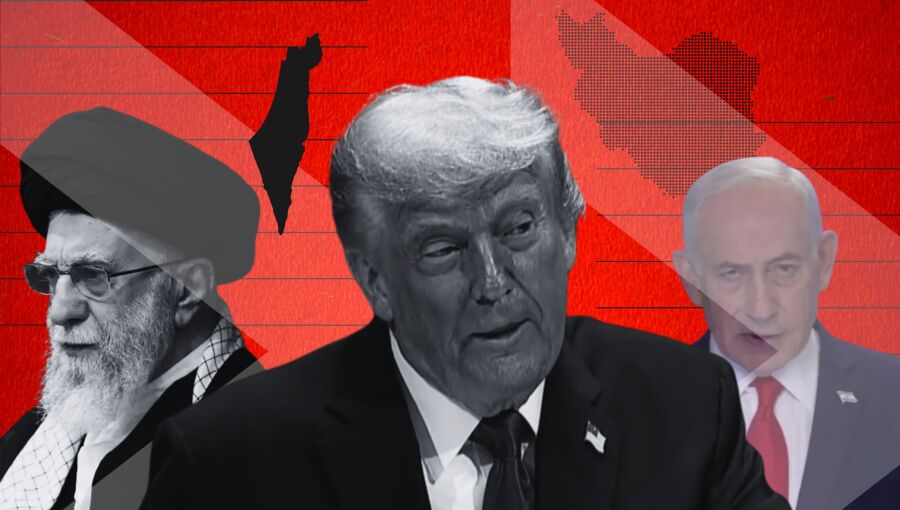
BONNER: The strategic vacuum at the heart of Operation Epic Fury

BONNER: The strategic vacuum at the heart of Operation Epic Fury
BONNER: The strategic vacuum at the heart of Operation Epic Fury / bne IntelliNews
By Michael Bonner bnm Tehran bureau March 6, 2026

No plan survives first contact with the enemy. That popular quotation is really a paraphrase of a somewhat more verbose statement by Prussian Field Marshal Helmuth von Moltke the Elder in 1871. It’s obviously true: events, like individuals and groups, are unpredictable and even well-executed plans have unforeseen and unforeseeable consequences. But what happens when there is apparently no plan?

Operation Epic Fury, the American and Israeli attack on Iran, is answering that question. Air supremacy was established in a matter of hours. The upper echelons of the government and military were rapidly slain along with Supreme Leader Ayatollah Ali Khamenei. All signs point to reiterated slaughter of their replacements indefinitely, as well as degradation of missile caches, launchers and other military installations.

Iran’s plan, if it has one, seems to revolve around creating as much chaos and confusion as possible.

The regime reacted by opening fire with drones and missiles not only on Israel but on their immediate neighbours also. More than 500 Iranian ballistic missiles and 2,000 drones have been flung across the Middle East. Not all have been aimed at American or Israeli military targets. A disproportionate number fell on civilian buildings and infrastructure in the UAE, Oman, Saudi Arabia, and Bahrain. Nato defences shot down a missile apparently aimed at Turkey.

This seems to be what Iranian Foreign Minister Abbas Araghchi implied by ‘Decentralized Mosaic Defense’. Whatever he meant by that, the indiscriminate missile and drone salvos look like a breakdown in command and control. Araghchi seemed to confirm that in an interview with Al Jazeera. Units were acting, he said, in an "independent and somewhat isolated" way, "based on general instructions given to them in advance".

Meanwhile, the Islamic Revolutionary Guard Corps (IRGC) have vowed to attack all ships passing through the Strait of Hormuz, the energy choke point in the Persian Gulf. And yet, Foreign Minister Araghchi claimed that Iran had no intention of closing the Strait. Shipping traffic there has practically ground to halt as a result of this apparent confusion.

The remnants of Iranian leadership may judge that inflicting damage throughout the region and making the Strait unusable will raise the cost of the war. Spreading the pain may be a way of pressurising America to back down. Such a judgements are dangerous and likely to backfire. Iranian aggression now threatens to unite the Gulf states with Israel and America, and may also invite a response from Nato if Turkey feels sufficiently menaced.

However, curtailing the war would not salvage the Iranian Regime. ‘Survival is victory’ is an oft-recurring trope applied to desperate, cornered regimes, but it is mistaken in this case. All the problems which provoked public protest at the end of 2025 are still there. In fact, currency devaluation, hyperinflation, mismanagement of water resources, and the collapse of agriculture are all worse now. The massacre of Iranian protesters earlier this year has further undermined the legitimacy of the Islamic Republic.

This brings us to American and Israeli aims. Destroying the Iranian regime’s military capabilities, including its ballistic missile arsenal, air defences, and nuclear facilities, are obvious goals which have been stated publicly many times. But then what?

US President Donald Trump has spoken vaguely of "regime change". He has also said that he would personally choose the next leader of Iran and that Iranian patriots should "take back" their country. In contrast, US Secretary of State for War, Pete Hegseth has disavowed regime change altogether while also insisted that the regime "sure did change".

We would naturally expect American public communications to leave room for strategic ambiguity and surprise. Recent alarming news about possible Kurdish and Baluch militants marching on Tehran may belong to the same pattern of misdirection and deception. But what is the end state supposed to look like? How will victory be recognised?

The Islamic Republic may well not recover from the murder of the Ayatollah and his circle — but only insofar as joint-rule by clerics and sadistic thugs will disappear and only the thugs will be left in charge. Then there will be a game of whack-a-mole, in which one cohort of Iranian leaders after another are murdered — a process which will only end when Americans grow tired of it. Or perhaps a senior Iranian general may sue for peace and try to make a deal with Trump.

A popular uprising against the Islamic Republic would certainly be the most desirable outcome. But no such thing seems likely to happen until senior members of the regime and the armed forces or paramilitary groups defect, stand down, or join forces with the people. And if such an outcome materialises, it may well owe more to good luck than any strategic plan. We will know soon enough.

Michael Bonner is a historian of Iran, Senior Fellow of the Aristotle Foundation for Public Policy, and author of In Defense of Civilization: How Our Past Can Renew Our Present. He holds a doctorate in Iranian history from the University of Oxford and is a contributing editor at the Dorchester Review.

MARINS: Iran's low cost-to-kill missile capacity gives it the upper hand in a long war
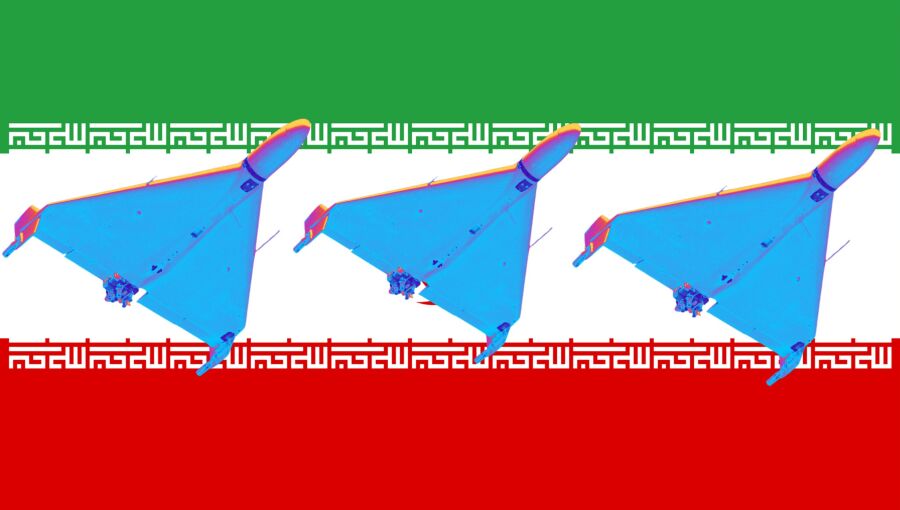
US and Iranian forces face a growing war of attrition as missile stockpiles, drone production and the cost of interception reshape the balance of the conflict. / bne IntelliNews
FacebookTwitterLinkedInTelegramFlipboardFeedly


By Patricia Marins in Rio de Janeiro March 6, 2026


Speculation is swirling over who will run out of missiles first: the US or Iran? The US has fired off five years’ worth of Tomahawk missiles in the first week of the war with Iran and announced a wind-down of the intensity of the attacks on March 5 to allow for a longer fight.

At the same time, Iran has released hundreds of missiles a day in the first few days of the conflict that began on February 28, but has also scaled back its assault in the last two days as its supplies also come under pressure.

Who can outlast the other and produce more missiles and drones in the meantime? One of the major asymmetries in this equation is each combatant's ability to produce new munitions. The US can only produce 100-200 Tomahawks a year at enormous expense, whereas Iran can mass-produce some 50,000 cheap drones a year at factories and has unknown quantities hidden.

Iran has been manufacturing missiles with ranges exceeding 300 km for nearly 40 years and has produced missiles capable of reaching Israel for at least 25 years.

In 1988, the Naze'at-10 reached speeds up to Mach 4 with a range of 130 km. That same year, the Shahab-1 was introduced, with a range of up to 300 km and re-entry speeds exceeding Mach 5. This was followed by the Shahab-2, which had a range of 500 km by the mid-1990s.

Iran’s retaliation over the past three days has exceeded the scale of the 12-day conflict in June 2025. In just three days, Iran has launched over 450 missiles and nearly 1,100 drones.

On the second day, Iran used fragmentation warheads with submunition dispersal during re-entry, a feature of advanced systems and new to the conflicts between Iran and Israel.

These submunition-loaded warheads are typically used on missiles with ranges over 1,000 km, such as the Shahab-3, Ghadr, Emad, Khorramshahr, and Sejjil. They can disperse 20 to 1,500 submunitions during or after re-entry. Israel has little defence against this type of munition.

Iranian launches will be hard to stop fully, with possible periods of reduced missile activity interspersed with heavier drone use.

If the US couldn’t halt launches from Yemen or Iraq, why expect success against Iran? They underestimated Iran and now risk humiliation with depleted interceptors, while Iran retains most of its launch capability.

This is the core of the cat-and-mouse game: US and Israeli drones patrol at high altitude, using Search and Rescue (SAR) and other sensor technology to detect heat or smoke from launches, mapping sites for bombings. Iran must then clear tunnels and patrol those areas to restart operations, now with higher risks.

However, Iran is three times larger than Ukraine, and Russia has not fully suppressed Ukrainian drone launches or aircraft operations in a much smaller territory. It is unrealistic to expect total suppression in Iran, though the scale could be reduced, leading Iran to rely more heavily on drones.

Cost-to-kill ratio

The US-Israeli allies began Operation "Epic Fury" with the classic "shock and awe" strategy – use overwhelming force to score a quick knockdown. The decapitation of the Islamic Republic was achieved with the death of Ayatollah Ali Khamenei on March 1, along with two dozen other senior figures. The intense bombardment of Iranian assets and positions is ongoing, but that first blitzkrieg phase may already be coming to an end.

Patriot missile supplies are limited, and although it maintains a very high interception rate, its $4mn price tag compared to the $30,000 cost of a Shahed drone yields a cost-to-kill ratio of 130:1.

The asymmetry is a strategic trap that works to Iran’s advantage. The barrage of Iranian missiles and drones in the first few days inflicted limited damage on the US and Israeli forces; however, they didn't need to do any damage. By launching massive swarms of low-cost "kamikaze" drones, Iran is not just aiming for physical targets but is systematically emptying Western missile magazines. For every $1mn Iran spends on a drone swarm, the US and its allies must spend upwards of $100mn to stop it.

From a standing start, Ukraine has built up a drone production capacity that can churn out 4mn drones in 2025 and rising and has the capacity to make 8mn if more investment were provided by allies. This year, Bankova hopes to raise total production to 7mn.

However, Ukraine’s drones are smaller-scale and less powerful, primarily used on the battlefield against Russian infantry. Iran specialises in larger long-range attack drones (such as the Shahed-136/238), which are closer to cruise missiles than the small FPV drones used on the battlefield in Ukraine and so more effective in the current conflict where there no US boots on the ground.

Iran’s production of Shahed drones is estimated at around 400 per day, but the lower production rate is due to their larger size, longer range, and greater sophistication. The Iranian version is perfectly suited to the conflict it is now engaged in.

While Ukraine has had to learn on the job, Iran has been working on its drone industry since missile production and development was excluded from the 2015 Joint Comprehensive Plan of Action (JCPOA) deal by the Obama administration to get the deal across the line.

As a result, Iran enjoys a significant cost-to-kill ratio advantage: a Tomahawk cruise missile costs $1.5mn-$2mn per missile, whereas a long-range Iranian missile costs about $20,000-$50,000 each, as written here previously in Bne IntelliNews.

The Tomahawks are at least 30-times more expensive than an Iranian drone. Iran’s drone production ratio per year to the US Tomahawk is even bigger: 750-times greater.

These differences mean that Trump’s call for the conflict be over in a month are not just a desirable political goal, they are a military imperative.

The US and the Gulf Cooperation Council (GCC) allies are reportedly already running low on interceptor ammo and there is talk of relocating air defence systems from the Indo-Pacific theatre to the Middle East.

The US is scrambling to "bend the cost curve" through initiatives like Replicator 2, which aims to mass-produce cheap, "attritable" interceptors, but these efforts are still playing catch-up to a rapidly evolving battlefield.

Ukrainian President Volodymyr Zelenskiy has also offered to step in with recently developed Ukrainian-made interceptor drones, but he is demanding a quid pro quo and expects Patriot missile ammo in exchange.

While the Pentagon has begun testing systems like the $35,000 LUCAS drone—a reverse-engineered clone of the Shahed—and Ukraine is successfully deploying $2,500 interceptor drones like the Octopus, Western procurement remains bogged down by decades of focus on high-end, exquisite technology, and the US has not launched mass production of any of these systems.

The Pentagon didn’t do its homework and launched Operation Epic Fury using the tactics from the last war, before it was ready to fight a modern drone-based war of attrition conflict.

“The US forces remain structurally unprepared for a sustained drone war where the winner isn't the one with the best technology, but the one who can afford to keep the lights on the longest,” Yuriy Boyechko, CEO of Hope For Ukraine.

India's Petronet LNG declares force majeure after QatarEnergy notice

India's Petronet LNG declares force majeure after QatarEnergy notice
/ Shaah Shahidh - Unsplash
By bno - Mumbai Office March 6, 2026

India’s biggest LNG importer, Petronet LNG (NSE: PETRONET), has received a Force Majeure notice from QatarEnergy (QE), and as a result, Petronet LNG has issued corresponding Force Majeure notices to companies that it supplies LNG to, the company said in a stock exchange filing on March 5.

Petronet’s offtakers include GAIL (NSE: GAIL), Indian Oil Corporation Limited (NSE: IOC) and Bharat Petroleum Corporation Limited (NSE: BPCL). The company added that the likely impact of Force Majeure, which is currently an ongoing event, cannot be estimated at this point of time.

“The company is closely monitoring the developments and will keep the stock exchanges informed of any material updates in this regard,” Petronet stated. The company operates two LNG import terminals in India at Dahej and Kochi. 

In light of the ongoing war in the Middle East region involving Iran and Israel, vessels are presently unable to safely transit through the Strait of Hormuz to reach Ras Laffan, the loading port of QatarEnergy.

A disruption at Qatar’s LNG plant, which supplies nearly 40–50% of India’s LNG imports, could result in a short-term supply shock for the domestic gas market, CNBCTV18 reported, citing JM Financial analyst Dayanand Mittal. Gas utilities such as Gujarat Gas and GAIL may come under pressure as a result of higher spot LNG prices and reduced transmission volumes.

Mittal said that the disruption may last about a month, potentially affecting earnings and gas supply across the sector.

GAIL in a separate filing said that due to supply restrictions imposed by Petronet, the allocation of LNG quantities to GAIL has been reduced to zero with effect from March 4. GAIL said it is currently assessing the situation with respect to any supply curtailment that may need to be imposed on its downstream customers. LNG supplies to GAIL from other suppliers are currently unaffected, it said.

Reuters has reported that GAIL and Indian Oil have already informed their customers about the reduction of gas supplies due to the Petronet Force Majeure. To offset the shortfall, companies including Indian Oil, GAIL and Petronet LNG are preparing to float spot tenders to secure additional cargoes, Reuters added. 

Less than half of Ukrainian refugees plan to return home - poll

Less than half of Ukrainian refugees plan to return home - poll
Fewer than half of Ukrainian refugees now say they intend to return home, according to a new survey, highlighting the deepening demographic crisis facing the country as the war with Russia drags on. / bne IntelliNews
By bne IntelliNews March 5, 2026

Fewer than half of Ukrainian refugees now say they plan to return home after the war with Russia, according to new survey data, as the country’s demographic crisis continues to escalate.

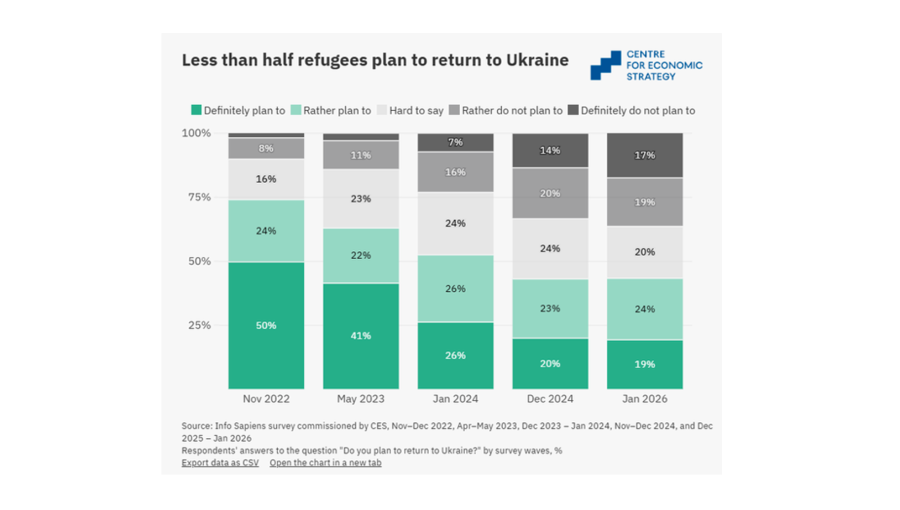
A poll conducted by Info Sapiens for the Kyiv-based Centre for Economic Strategy (CES) shows a steady decline in the share of refugees intending to go back to Ukraine since the early stages of the full-scale invasion in 2022.

The most recent survey, conducted between December 2025 and January 2026, found that only 43% of respondents said they either “definitely plan to return” or “rather plan to return”.

That compares with 74% in November 2022, when half of refugees surveyed said they “definitely plan to return” and a further 24% said they “rather plan to return”. The proportion has fallen consistently in subsequent surveys, reaching 63% in May 2023 and 52% in January 2024.

By early 2026, only 19% of respondents said they “definitely plan to return”, while 24% said they “rather plan to return”. At the same time, the share of refugees indicating they were unlikely to go back has risen markedly: 20% said they “rather do not plan to return” and 17% said they “definitely do not plan to return”. A further 20% said it was “hard to say”.

The findings underline Ukraine’s long-term demographic collapse as the war enters its fifth year. Ukraine is now suffering from the worst demographics in the world with mortality running at three times higher than fertility. The World Bank estimates the population will fall from 35mn pre-war to as low as 16mn by 2030, due to the higher death rates and lack of babies.

An estimate 5.6mn Ukrainians — many of them women and children — remain abroad, primarily in EU countries that granted temporary protection after Russia’s full-scale invasion in February 2022 and few intend to return should the war halt.

Researchers at the Centre for Economic Strategy warned that prolonged displacement risks turning temporary migration into permanent settlement, particularly as refugees establish employment, education and social ties in host countries.

The survey asked respondents: “Do you plan to return to Ukraine?” and tracked responses across multiple waves between November 2022 and January 2026. Analysts say the gradual shift in attitudes reflects both the duration of the conflict and uncertainty over Ukraine’s economic recovery and security environment once the war ends.

Ukrainian refugees face uncertain future as Poland scraps special status

Poland is ending the special status that gave Ukrainian refugees equal access to the labour market, social benefits and healthcare. The system expires on Thursday, meaning many will now face stricter rules to work or receive support.


Issued on: 05/03/2026 - RFI

Kajetan Wróblewski, a volunteer helping refugees arriving in Poland, advises Ukrainian refugees he receives to continue their journey to Finland, Denmark or Norway, where reception conditions for refugees are better than in Poland. © RFI / Adrien Sarlat

Four years after Russia’s large-scale invasion of Ukraine began, support from European neighbours along its border is weakening.

In Poland, the wave of solidarity seen in February 2022 has given way to a new policy towards Ukrainians.

From Thursday, their special refugee status will end, placing them on the same footing as other foreigners.

Political shift

Nationalist leader Karol Nawrocki campaigned for the presidency last August with the slogan: “Poland first, Poles first”, describing Ukrainians as “ungrateful” and “a burden on society”.

Amid growing anti-Ukrainian sentiment in Poland, he said the country needed to end “a completely incomprehensible and unacceptable situation” that allowed “foreigners to benefit from aid at taxpayers’ expense without contributing themselves”.

In September, Nawrocki vetoed a law that would have extended the special status, preventing parliament from renewing it.

Under the revised rules, Ukrainians must obtain work permits for employers who want to hire them. They will also lose access to social benefits and healthcare if they cannot prove they have a job.

The government of Prime Minister Donald Tusk defended the change.

“Most of those who reside in Poland work; their children go to school. We can therefore now gradually eliminate these extraordinary measures and move from temporary solutions to systemic ones,” the government said.

Poland’s new president brings hard line on refugees, abortion and rule of law


Employers worried

Marija Jakubowicz, who handles administrative formalities for refugees, said the change is bad news for both employers and Ukrainians.

“Employers no longer needed additional resources to hire Ukrainians. And Ukrainians were no longer forced to accept poor jobs or work for unscrupulous employers,” she told RFI’s correspondent.

Ukrainians make up 66 percent of the immigrant workforce in Poland. Employers’ associations say the new conditions will make it harder to hire workers they need.

Nadia lives in Poland with her two children and relies on the disability allowance received by her 16-year-old daughter, who has cerebral palsy. She says the support is not enough to cover medical treatment, including an operation on her daughter’s leg in January.

“After paying my rent, I have barely €200 left to live on. Of course, the assistance has to stop at some point. But I have nowhere else to go,” she said.

Ukrainian refugees in France face uncertainty as emergency protection phased out

Unable to work, Nadia has considered leaving Poland for what she called a more “generous” country. If she stays, she has one year to apply for a residence permit, something Ukrainians were previously exempt from.

Kajetan Wroblewski volunteers with an organisation helping refugees who continue to arrive in Poland.

Some newcomers hope similarities between Polish and Ukrainian will make integration easier. But Wroblewski says he often discourages them.

“It’s better to understand nothing in Finland but have a bed and food to eat than to sleep under a bridge in Poland,” he told RFI, criticising what he described as the state’s disengagement and public apathy.

According to a CBOS poll released in early January 2026, 46 percent of Poles now oppose accepting Ukrainian refugees, compared with 3 percent at the start of the war.

The survey’s authors say this is the worst result recorded since the poll began in 2014, after Russia annexed Crimea.

This article was partially adapted from the original version in French