It’s possible that I shall make an ass of myself. But in that case one can always get out of it with a little dialectic. I have, of course, so worded my proposition as to be right either way (K.Marx, Letter to F.Engels on the Indian Mutiny)
Friday, March 06, 2026
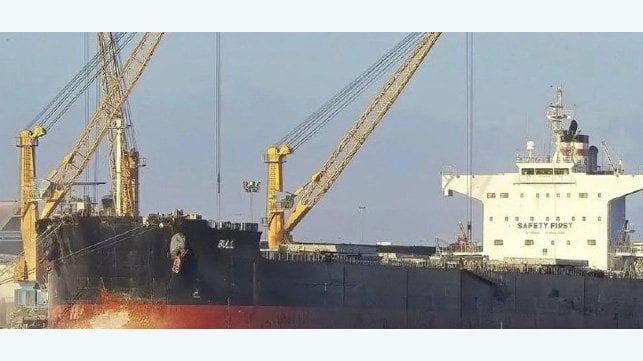
Bulker Struck by Russian Drone Departing Ukraine
Bulker was struck after loading and as it was departing Ukraine but continued its voyage (Oleg Kiper/Odesa Regional State Administration)
Ukrainian officials are reporting that another commercial vessel was struck in Russia’s ongoing campaign against the export operations and key ports. Russia escalated its attacks on Ukraine’s maritime infrastructure since late 2025, when Ukraine took credit for damaging tankers in the Black Sea inbound to export Russian oil. Vladimir Putin had threatened to cut Ukraine off from the sea.
The latest incident was reported late on March 4 and involved a Liberian-flagged bulker. The Seaports Administration of Ukraine reported the incident, which was also confirmed by Oleg Kiper of the Odesa Regional Administration.
A bulker named Bull (82,000 dwt) was loaded with a cargo of corn. It was departing the port of Chornomorsk when the Ukrainian said it was struck by a Russian drone.
The vessel sustained damage, but the details were not reported. Both the authority and Kiper said there were injuries among the crew and that Ukraine was offering assistance.
The captain of the bulker, which is owned and managed from Singapore, is reported to have declined assistance as well as an evacuation for what was reported in the news as one injured crewmember. The Port Authority later said it was informed that the vessel was continuing on its route through the Ukrainian Corridor heading to the Bosphorus Strait. The vessel had come from Spain and is believed to be returning to Spain with the cargo.
Over the past months, there have been reports of several vessels being struck while they were docked in the ports of the Odesa region. At least one was shown on fire, and port infrastructure and containers have also been damaged by the attacks.
Ukraine’s Economic Ministry has released data showing a nearly 25 percent decrease in grain exports since the current season began in July 2025. As of the beginning of March, it reported exports of 22.3 million tonnes of grains. The state-owned railway, however, reported in February that shipments of grains into the ports increased 5.5 percent. It said exports were being slowed by winter weather and damage to the port infrastructure.
Ukrainian Strike on Novorossiysk Also Damaged Russian Warships
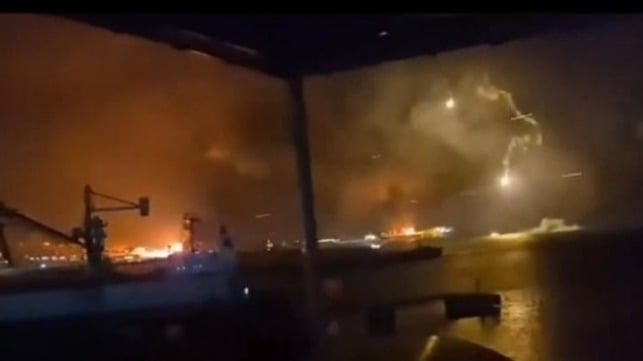
Antiaircraft fire and flares light the night during a previous Ukrainian strike on Novorossiysk, 2025 (Russian social media)
The recent Ukrainian strike on Novorossiysk caused damage to a Transneft oil loading terminal, and may also have extended to Russian Navy warships, according to Ukrainian sources.
Ukrainska Pravda reports that the Russian minesweeper Valentin Pikul was seriously damaged in the Sunday night attack, and the antisubmarine patrol vessels Yeysk and Kasimov were struck as well. Three Russian sailors were reported dead, and 14 more injured.
The strikes on the Black Sea Fleet add to previously-reported damage at the Sheskharis oil terminal in Novorossiysk's inner harbor, where six out of seven loading booms were reportedly damaged.
The attack was part of a long-running Ukrainian campaign to shut down Russia's oil exports from Black Sea loading terminals, thereby reducing Russian energy revenue, which funds the ongoing invasion. Ukraine has also hit terminals at Tuapse and Temryuk, along with the CPC single-point mooring terminal outside Novorossiysk's harbor entrance.
Ukraine has also struck the Black Sea Fleet repeatedly, first at Sevastopol and other Crimean ports, then in the Sea of Azov and the northeastern Black Sea. Novorossiysk is the fleet's final bastion, and most of the surviving hulls have retreated to the protected harbor. However, even this remote location is not immune: in December, Ukraine claimed to have hit the Kilo-class sub Varshavyanka at the naval pier in Novorossiysk using a submersible suicide drone. Varshavyanka and other vessels in the fleet have been used as launch platforms to attack Ukrainian cities with cruise missiles throughout the war.
The strikes at Novorossiysk parallel Ukraine's efforts to damage Russia-linked energy shipping at sea, notably the ultra-long-distance strike on the sanctioned LNG carrier Arctic Metagaz - perhaps the first attack ever to sink a vessel of this type.
As Energy Prices Rise, U.S. Green-Lights India's Purchases of Russian Oil
The receiving terminal at the Russian-controlled, EU-sanctioned Vadinar refinery in India, a leading buyer of Russian oil (Nayara / CC BY SA 4.0)
Under pressure to control oil prices amidst a closure of the Strait of Hormuz, the White House is backtracking on its efforts to pressure India into refusing Russian oil. In hopes of easing supply concerns, it is giving New Delhi temporary permission to increase the use of already-afloat Russian crude. "The waiver effectively acts as a green signal" for India to buy Russian oil at scale, Kpler analyst Sumit Ritolia told the Times.
The newly-promulgated rule from the Office of Foreign Asset Control is narrowly tailored: it waives all sanctions restrictions on the offloading of Russian crude in India, so long as the oil was loaded on a tanker before March 5. No other nations are allowed, and permission expires on April 4.
The move reconnects the close business relationship between Russian oil producers and Indian refiners, an arrangement which has played a major role in funding Russia's ongoing operations in Ukraine. In recent months the Trump administration has worked hard to push India out of buying Russian oil, going so far as to impose 50 percent tariffs on all Indian imports until New Delhi made a commitment to reduce Russian volumes; the policy objective was to apply more fiscal pressure to Moscow while talks on a Ukraine ceasefire were under way.
The administration cast the new Russian-oil waiver for India as a temporary change, with little fiscal effect on the invasion of Ukraine. "This deliberately short-term measure will not provide significant financial benefit to the Russian government as it only authorizes transactions involving oil already stranded at sea," said U.S. Treasury Secretary Scott Bessent. "This stop-gap measure will alleviate pressure caused by Iran’s attempt to take global energy hostage."
Some analysts suggested that the temporary concession was a rollback and a win for Moscow. "Trump [folds] on Russian oil sanctions," commented Bloomberg energy analyst Javier Blas. "Massive win for Putin."
In the immediate term, the move allows Indian refiners to tap the large volume of Russian oil that is sitting aboard shadow fleet tankers, idling and awaiting buyers. This floating storage reserve amounts to at least 30 million barrels of crude, and it will cushion the sudden shutdown of Gulf exports, which India relies upon heavily.
China is also a major buyer of Russian gray-market grades, but it is well-supplied. Thanks to heavy purchasing of Iranian and Russian oil at discount rates over the last few months, it has about 900 million barrels in storage, enough to cover nearly 80 days worth of import volume. Another 30 million barrels of Iranian oil is afloat in Asian waters and awaiting Chinese buyers, energy analyst Sun Jianan told Reuters earlier this week.
Sri Lanka denounces war deaths, houses Iran sailors
Colombo (AFP) – Sri Lanka on Friday denounced the toll of the Mideast fighting, as the nation opened its arms to over 200 Iranian sailors who sought help after a deadly torpedo strike on another of Iran's ships.
The crew were brought ashore Thursday and were being accommodated at a military camp near the capital Colombo and their ship, IRIS Bushehr, was under Sri Lankan control.
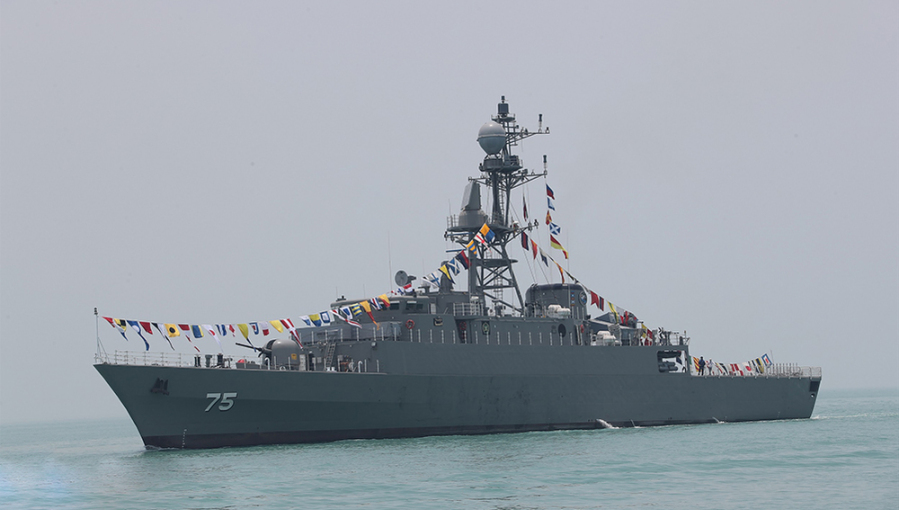
The vessel reported engine trouble and sought port entry after another Iranian vessel, IRIS Dena, was hit by a US torpedo off Sri Lanka's southern coast on Wednesday.
Washington later announced it carried out the attack, which killed at least 84 Iranian sailors aboard and left 64 more missing.
"Our approach is that every life is as precious as our own," Sri Lanka's President Anura Kumara Dissanayake wrote on X, and urged peace after the Israeli-US campaign led to Iranian retaliatory strikes.
Thirty-two sailors were rescued by the Sri Lanka Navy and were being treated at a hospital in the southern port city of Galle.
Wednesday's attack was the first military strike far outside the Middle East since the United States and Israel launched their war on Iran.
The US defence secretary said on Wednesday the strike was the first by a torpedo fired by an American submarine since World War II.
Sri Lanka not only granted permission for the second Iranian vessel, IRIS Bushehr, to enter its territorial waters on Thursday, but also evacuated its crew to a naval facility just outside Colombo.
"All our actions are aimed at saving lives and ensuring that humanity prevails," Dissanayake said.
In an address to the nation hours earlier, he said sheltering the sailors was the "most courageous and humanitarian course of action that a state can take".
"We jealously guard our non-aligned policy while ensuring that humanitarian values and the saving of lives remain our top priority."
Sri Lanka has remained neutral in the latest conflict. The United States is Sri Lanka's largest export market, while Iran is a key buyer of tea, the island's main export commodity.
A senior administration official said all but four sailors of 208-strong crew from IRIS Bushehr were taken in three Sri Lanka Navy craft and were being accommodated at a military camp near the capital.
"Our military is now in full control of the ship, which will be taken to Trincomalee," the official told AFP, referring to the port on the eastern side of the island, which is away from the main Colombo harbour.
The four Iranians remained aboard to assist Sri Lankan sailors, the official said.
Sri Lanka is a struggling economy dependent on International Monetary Fund(IMF) bailouts since 2023 after a financial crisis between 2019 and 2022 that peaked with the government defaulting on its sovereign debt.
With its small naval and coast guard fleet supported by an even tinier budget and workforce it is seen as a minor player in the Indian Ocean.
According to a televised address by Sri Lankan President Anura Kumara Dissanayake as cited by Times of India, the country’s navy has rescued the crew of a second Iranian warship IRIS Bushehr. The Sri Lanka Navy has taken control of the vessel and given it asylum in its northeastern port of Trincomalee.
IRIS Bushehr reportedly had a problem with one of its engines and requested assistance to which the Sri Lankan government agreed after a brief consultation with the vessel’s captain who was safely taken ashore with his crew.
The IRIS Bushehr was under threat of becoming a casualty in international waters of the Indian Ocean after her sister ship IRIS Dena was sunk by a US submarine using a Mk48 torpedo near Sri Lanka on March 4 2026.
Sri Lanka rescued 79 members of the Dena crew and gave them medical assistance. However over 100 crew members were unaccounted for and are believed lost with the ship.
Explaining his country’s position President Dissanayake said "We are not taking sides in this conflict, but while maintaining our neutrality we are taking action to save lives. No person should die in a war like this. Every life is equally precious".
Accounting for its small resource base and liabilities it is astonishing that Sri Lanka has taken this approach upstaging much larger littoral states like India which champions Humanitarian Assistance and Disaster Relief (HADR) as its major peacetime role.
In a statement issued late on March 5 the Indian Navy revealed that it had dispatched a long range maritime patrol aircraft likely a Boeing P8i, and two warships including “INS Tarangini which was operating in vicinity" and "was deployed for aiding the rescue efforts and arrived in search area by 1600 hr on 04 March 2026. By this time Search Aand Rescue(SAR) had been undertaken by Sri Lanka Navy and other agencies”.
The other Indian Navy ship “INS Ikshak has also sailed from Kochi to augment the search efforts and continues to remain in the area to search for missing personnel as a humanitarian measure for ship wrecked personnel”.
Ever since the 2004 Indian Ocean Tsunami, India has prided itself in being the first to rush aid with its naval vessels to any disaster hit country in the region including Sri Lanka.
In Delhi’s naval diplomacy and foreign policy circles it is often said with pride that Indian Naval vessels carry a special container with general purpose disaster relief aid supplies on their decks that can quickly be unloaded onto partner nation’s shores if the need arises.
In the past Indian warships have also rescued sailors and vessels in distress in its area of responsibility in the Indian Ocean littoral both alone and in conjunction with other countries’s forces and vessels.
China is curiously absent from the equation although its own littoral waters of the South and East China seas don’t directly put it in the path of the distressed Iranian vessels, however, Beijing has ambitions of challenging US hegemony and could have used the opportunity to showcase its blue water reach.
Who rules the seas? Torpedoed Iran ship brings focus underwater
Paris (France) (AFP) – A US submarine this week torpedoing an Iranian warship during the Middle East conflict raised the crucial question of who controls the seas during wartime.
The sinking of IRIS Dena on Wednesday in international waters off the coast of Sri Lanka killed at least 86 crew members, in what Iranian Foreign Minister Abbas Araghchi labelled an "atrocity".
It came after US-Israeli strikes on Iran on Saturday triggered war in the Middle East, with the Islamic republic launching retaliatory attacks across the region and beyond.
The US Navy had not torpedoed a ship since 1945.
Washington afterwards released what it said was periscope footage of the submarine firing on the ship, and an image of its hull almost vertical as it slipped below the surface.
The IRIS Dena "sank in less than 20 minutes", said Alessio Patalano, a professor at King's College London.
"It didn't stand a chance. The incident confirms the sophistication of the means of American undersea warfare."
Patalano said "submarine warfare has never gone away."
"It was just in the background because there hasn't been a confrontation between fleets since the 1980s," he added. 'Ultimate wartime weapon'
The most recent confirmed wartime torpedo attack dates back to 1982, when the British submarine HMS Conqueror sank the Argentine cruiser Belgrano during the Falklands War.
In 2010, South Korea's Cheonan corvette was torpedoed -- an attack Seoul attributed to North Korea, but which Pyongyang denied.
A European military source specialising in submarines and speaking on condition of anonymity explained that a torpedo explodes underneath a ship rather than upon contact with it.
The US attack on IRIS DENA killed at least 86 people on board
"It detonates a few metres below, creating a huge air bubble that lifts the vessel and breaks its main beam in two when it comes back down," the source said.
IRIS Dena's sonar range was probably too limited to have been able to detect the threat, they added.
The stealthy, invisible manoeuvres of a submarine, paired with its ability to fire torpedoes from dozens of kilometres away, make it "the ultimate wartime weapon", according to the source.
These capabilities can make a difference when surface combat between navies of similar standing is "symmetrical, with radars and missiles of roughly equivalent range".
Patalano said countries with a sophisticated underwater force enjoy an "objective advantage" in the event of a naval confrontation. 'We are everywhere'
Another European military source, also speaking anonymously, said conducting the attack far from the conflict's epicentre was a "show of force aimed at major rivals" such as China and Russia.
"Attacking this ship in international waters... means: 'We, the Americans, dominate the air, the sea and the undersea. We are everywhere, able to find you and destroy you.'"
Experts suggest that while Russia has neglected the modernisation of its surface fleet -- signalled by its setbacks in the Black Sea throughout its war with Ukraine -- it has made a point of investing in its submarine fleet.
China has been developing its navy and submarines for years.
US submarine forces commander Vice Admiral Richard Seif told an American congressional committee this week that China's "formidable" next-generation submarines "challenge the US Navy's longstanding undersea dominance".
Members of the Sri Lankan government confirmed during a session of parliament on Thursday, March 5, that an Iranian Navy supply ship, IRIS Bushehr (422), has made an urgent request for assistance and is seeking permission to dock in Sri Lanka. The request came after the sinking by the U.S. of the frigate Dena, and as Sri Lanka was conducting a search and rescue mission assisted by the Indian Navy.
The 3,300 dwt supply ship is believed to have been dispatched to resupply the Dena as the vessel was coming back from the Indian naval event. Commissioned in 1974, the vessel is 108 meters (354 feet) in length, with Sri Lankan government officials saying there are as many as 270 sailors and cadets aboard the vessel.
The request for urgent assistance and permission to dock in Sri Lanka came while the vessel was reported to be in international waters but within Sri Lanka’s EEZ. A minister told parliament the vessel remains outside Sri Lanka’s territorial waters, while the media reports said Sri Lankan President Anura Kumara Dissanayake was meeting with top government officials to decide what to do.
Some reports are saying the vessel, so far, has been denied permission to enter Sri Lanka’s waters, while another said after about 11 hours it was permitted to proceed to a point about 10 nautical miles off Colombo. Some reports said the ship was being denied docking privileges, while others said it was proposed that the ship would proceed to offload some of the people onboard, which is believed to include cadets, and that the ship would be placed at a secure dock in Colombo. One report suggested the ship would be interned for the remainder of the war.
Sri Lanka has condemned the American and Israeli hostilities and called for a diplomatic solution. It is reported to have consulted the Foreign Minister of Iran, but seeks to stay out of the war.
On Wednesday, Sri Lanka and India received the distress call from the frigate Dena after it was torpedoed. Reports placed the vessel between 20 and 50 nautical miles from the southern port of Galle. The Sri Lankan Navy responded and said the ship had sunk by the time it reached the scene. It reports that 32 Iranian sailors were rescued and taken under tight security to hospitals in Sri Lanka. They are reported to be suffering from burns, broken bones, and other less serious injuries.
Sri Lanka reports it recovered the bodies of Iranian sailors, with the media counts varying between 84 and 87, and is making diplomatic arrangements for their return to Iran. The Iranians said there were 130 aboard the Dena, but Sri Lanka said it believes there were 180 people aboard. It is continuing a search for as many as 60 people.
The Indian Navy said it dispatched a long-range maritime patrol aircraft to augment the efforts by the Sri Lankans. In addition, its vessel INS Taranigni was operating in the region and instructed to proceed to the location, where it arrived around 1600 local time on Wednesday. The INS Ikshak was also ordered to sail from Kochi, and a second long-range aircraft outfitted with a capability to drop rafts was placed on standby.
The Indian Government, on Thursday, is reported to have made a statement saying it will not be pulled into the war. It strongly denied rumors online and in the media that American forces were using Indian ports.
Seafarers can refuse to sail through Mideast Gulf region, main union says
Issued on: 05/03/2026 - 12:29 min
Seafarers have the right to refuse to sail on ships passing through the Middle East Gulf, including the Strait of Hormuz, after the threat level for the region was raised to its highest level, the leading labour union and shipping industry groups said on Thursday. FRANCE 24's Sharon Gaffney speaks with Michael Tamvakis, Professor of Commodity Economics and Finance at the Bayes Business School, City University London.
As the security situation in the Gulf region remains dangerous for vessel transits, industry voices differ on the question of whether vessels should stay out of the Strait of Hormuz for reasons of seafarer safety.
Transits of the strait are under direct threat from Iran, which has demonstrated a capability to hit vessels that attempt to make the run. Once past the strait and inside the Gulf, all inbound merchant ships remain within targeting distance and vulnerable to Iranian attack, from Kuwait to Dubai.
Blue-chip operators like Maersk and CMA CGM have cast their votes in favor of prudence and suspended calls in the Gulf region, thereby eliminating war risk for their seagoing personnel (except those already west of Hormuz, estimated to number about 20,000 personnel). On the other end of the spectrum, a handful of owners are asking their captains to make transits in and out. To be sure, seafarers have agency of their own and can decide whether to join such a voyage. Under IBF rules, crewmembers have a right to be informed of combat-zone hazards and a right to request repatriation - though it is a request that comes with its own risks.
So far, industry bodies have advised owners to weigh and manage war risks, not to avoid them - consistent with the varying opinions and business models of international shipowners. For VLCC owners, Mideast transits are now more lucrative than at any point in industry history. If the risk to crew is acceptable, a single voyage could pay for a third of the price of the ship.
"Seafarers continue to operate in a complex and uncertain environment, and their safety and wellbeing must remain a priority," said Intertanko and OCIMF in a joint statement Thursday. "Operational decisions should be based on thorough, company-led due diligence and comprehensive risk assessments . . . [and] the human element should be considered in decision-making."
The International Chamber of Shipping, which represents vessels of all classes, expressed concern and emphasized the obligation of nation-states to ensure safety.
"By no fault of their own, [seafarers'] lives are now tragically at risk. We call on all states to take the fundamental steps to ensure their safety," ICS' leadership said in a statement. "Freedom of navigation is crucial to global trade. All states must ensure the safe passage of merchant vessels, prioritizing the safety and welfare of the crew on board."
Some observers have called for private parties to take their own actions to ensure safety for crew.
"Stop trying to pass the Strait of Hormuz!" implored EOS Risk Group's Martin Kelly in a message Wednesday. "There have been at least 10 attacks against shipping in 72 hours. At least one person dead, and at least one ship abandoned. . . . Please, defer transit."
In Piraeus, the epicenter of the crude tanker industry, unionized seafarers have gone a step further. Protesters at the shipowners' union building near the harbor have spraypainted the sidewalk with the phrase "no sacrifice for profits and wars," according to Reuters. Their demand is nothing less than the swift and safe return of all seafaring personnel currently in the region - a demand which would require cessation of trading.
"We demand that all of our colleagues, currently in the dangerous Gulf area, the Gulf of Oman and the Red Sea, are evacuated and safely repatriated," said Angelos Galanopoulos, head of engineering crewmembers' union Stephenson.
This has been achieved by dint of a relatively small number of attacks on all classes of merchant shipping, with sufficient risk to life to call off further attempted transits for the time being, reinforced by an increase in premium rates to levels which in any case make transits in and out of the Gulf for the time being uneconomic.
Global trade flows can absorb a closure of one of the world’s busiest shipping channels for a short period of time. But pressure will be rising all the time, both to get oil and gas out of the Gulf and basic essentials into Gulf countries which are all highly import-dependent. The situation is exacerbated because while effectively a sea blockade is in place, there are also major restrictions on the air transport of goods.
So what’s the plan to get the Straits reopened?
Firstly, what is the threat which needs to be suppressed? The nature of the threat is much changed from the days during the Iran-Iraq war 50 years ago when military operations managed to keep the Straits open. The situation is much more akin to the recent Houthi Red Sea blockade – where Iranians IRGC advisers played a role in designing the scheme which the Houthis used to restrict, but not entirely eliminate traffic flows, using a mixture of mines, anti-ship cruise missiles, drones, speedboats armed with short-range weapons, and direct boardings from skiffs and helicopters.
That range of threats is analogous to what merchant mariners now face in the Straits, albeit with two differences: the Straits are longer and narrower, permitting use of a wider range of weapons and reducing the difficulties for Iran in identifying targets. The United States has already neutralized the other differentiator: use of frigates and corvettes, which the Houthis never had, and which the Iranians no longer have either.
US and Israeli attacks have by all accounts been very successful in detecting and destroying both permanent and mobile missile and drone launchers. But just as the entire Houthi armory was difficult to account for, and the Houthis retained the ability to launch drones and missiles even at the end of the campaign against them, it is likely that sufficient capability has been hidden away and dispersed to pose a continuing threat even if the bulk of the force has been destroyed. To maintain a credible threat, which could be as low as the ability to launch one or two attacks a day on shipping in the Straits, the Iranians only need to mask a small number of launchers. To entirely suppress the threat would be extremely difficult – but American planners know this, and could have a plan on how to achieve this.
A sanguine assessment however is that the Iranians will manage to retain for some time an ability to mount one-off attacks; this is certainly suggested by their willingness even after five days of war to extend their range of attacks, for example targets in Azerbaijan. To counter a persistent threat, there will be a need for active optical and electronic surveillance, with an immediate response capability, covering potential mobile launcher firing points along at least 250 miles of Iranian coastline and its hinterland, from Abu Musa in the West to Jask in the East.
A minesweeping capability, and the means to keep a swept channel clear, is also necessary. Shipping channels also have to be kept completely clear of small craft and fishing boats, which the Iranians could use both for cueing long-range attacks and for mounting close-quarter physical attacks. Lastly, one needs naval vessels to provide close-in electronic counter-measures, detection and intercept protection for merchant vessels making the transit.
It is difficult to envisage such a screen being maintained permanently, allowing use of the Traffic Separation Scheme channels as it operates in peacetime. It might be possible to provide largely effective protection on a convoy basis, and no doubt marine insurance cover could be put in place.
But critically, this could not be done unless merchant vessels acknowledged there would be some residual risk. Mariners took that sort of mortal risk in previous wars when the Merchant Navy tended to be manned by nationals of the nations doing the fighting. But with international crews on ships owned in one jurisdiction and flagged in another, this is not really an ask which owners and managers can any longer put to crews. If the price was right, some might sign up, but not for reasons of patriotism. 355
However, even a convoying arrangement embracing some acknowledged risk could not float unless there were sufficient naval vessels available to provide the convoy escorts, many more vessels than could be furnished by the United States alone. Keeping the Straits of Hormuz open will not feature highly on Israel’s strategic plan, focused narrowly as it always does on national survival and security. As yet, there are no signs of countries with navies of sufficient sophistication being ready to volunteer for the task. On the contrary, with the decommissioned HMS Lancaster symbolically tied up in Bahrain, some nations are actively walking away from assuming any responsibility for the safety and protection of merchant shipping on their registers or serving their economic interests.
Measuring the disparity between the threat and the capability response needed, it is reasonable to conclude that a military solution to opening up the Straits of Hormuz is not yet feasible. Given the confidence of U.S. CENTCOM commander Admiral Brad Cooper after five days of operations, that is likely to change. Until then, the only potential solution to the current closure of the Straits lies within the political and diplomatic realm, a possible product of a cessation of hostilities or ceasefire negotiations - but not one being countenanced by either side or even as yet being suggested by the Omanis, the region's perennial diplomatic intermediaries and peacemakers.
The opinions expressed herein are the author's and not necessarily those of The Maritime Executive.
Lloyd's Stands Ready to Work With U.S. on Insurance for Hormuz Transits
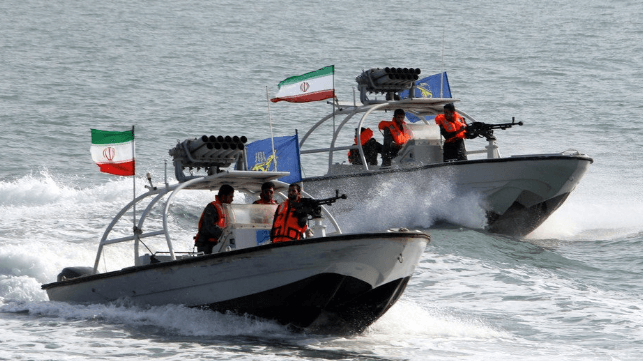
Iranian attack boats in an exercise in more peaceful times (Tasnim / IRGC)
War risk insurance remains available for shipping in the Strait of Hormuz and Arabian Gulf, according to Lloyd's of London, despite the decision of some underwriters and reinsurers to back out of the trade. The market is willing to work with the White House on a joint public-private venture to provide cover for shipping in the region, in hopes of kick-starting the energy trade through high-risk waters, Lloyd's Market Association CEO Sheila Cameron told the WSJ.
In a message Tuesday, Trump said that he would order the U.S. Development Finance Corporation (DFC) to provide "political risk insurance and guarantees" for shipping of all nations through the Gulf, at a "very reasonable price." Insurance industry insiders say that this plan would require exceptional amounts of capital, beyond the current resources of the DFC. Private war risk insurance for the Gulf is already available on the commercial market, brokers say, but at exceptionally high price levels - reflecting the high risk of an attack on vessels that defy Iran's closure of the Strait.
"The granting of war cover for the Persian Gulf and Red Sea is and will remain available under specific agreement on a single voyage basis as long as navigation is authorized by governments and flag states. In the current fast-paced situation, insurers will regularly re-examine their ability and willingness to that provide cover," the International Union of Marine Insurers said in a statement Friday.
VLCC spot rates are high enough to make such terms worthwhile for tanker owners, who stand to earn mid-six-figure sums per day for voyages from the Gulf region. One VLCC was reported on subjects at $700,000 per day on Friday, by far the highest rate ever recorded - beating a previous record set earlier this week.
But the insurance part of the equation can only solve the security of the owner's balance sheet; the physical security of the route is a matter decided by nation-states, and is still very much in question.
"As long as the security situation remains volatile, many shipowners may remain reluctant to transit the strait even if [U.S.] government-backed coverage becomes available," credit rating agency Morningstar told S&P.
Meanwhile, Iran's cargoes continue to sail. The LPG carrier Danuta I - sanctioned by the U.S. Treasury - transited the Strait of Hormuz fully laden with Iranian propane or butane on Friday, AIS tracking shows.
Insurance and Naval Escorts May Not be Enough to Reboot Gulf Shipping
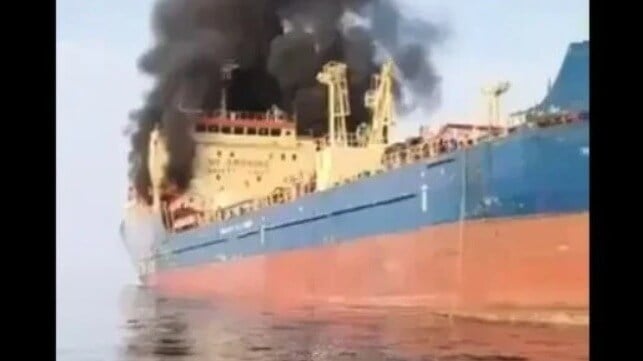
The small tanker Skylight burns after an Iranian strike (social media)
War risk at the Strait of Hormuz continues to deter shipowners from venturing near to Iran, and AIS-active traffic remains 90 percent below normal levels, according to MarineTraffic. Despite the hazards, a handful of owners are willing to make the run and join the 3,200-strong fleet inside of the high-risk zone of the Arabian Gulf.
"Stop trying to pass the Strait of Hormuz," security consultant Martin Kelly of EOS Risk Group implored shipowners. "There [have] been at least 10 attacks against shipping in 72 hours. At least one person dead, and at least one ship abandoned. . . . Please, defer transit."
Iran's strikes on shipping multiplied over the course of Tuesday and Wednesday, according to UKMTO. Six incidents were reported on March 3-4: a hit on the bulker Gold Oak off Fujairah, resulting in hull damage; a hit on the tanker Libra Trader off Fujairah, resulting in minor damage; a near-miss spotted by the container ship MSC Grace off Dubai; a close-in near miss on an unnamed vessel in the Gulf of Oman, nearly 140 nm offshore; a serious hit aboard the boxship Safeen Prestige in the Strait of Hormuz, resulting in a fire in the engine room and a decision to abandon ship; and (most recently) an apparent small-boat commando attack on a tanker 30 nm south of Kuwait, resulting in a blast and an oil spill.
A U.S. pledge to provide insurance for shipping in the region may help from a business standpoint, if it can be actualized, but improved physical security is likely a requirement for sustained commerce at scale. "Insurance may incentivize a few to start transiting but the Iranians will likely attack and then traffic will again cease transit," Odin head analyst Alpman Ilker told Argus Media.
Physical security have to await the resolution of the conflict. Odds of a naval escort mission appears limited given the intensity of ongoing combat in the Gulf region and the availability of resources. Most of the attacks to date have occurred far outside the Strait of Hormuz, at locations from Kuwait to Salalah. Any U.S. Navy assets tasked to escort duty would have to spend days in range of Iranian missiles and drones, requiring the crews to defend themselves as well as their convoys.
"The Red Sea precedent is instructive: 15 months of 'Operation Prosperity Guardian' escorts failed to restore commercial traffic despite 400 drones/missiles downed," commented analysts with SSY Global in a new research note. "[At Hormuz] physical geography favors the attacker. TSS lanes are two nm wide each direction; vessels transit at 10–12 knots and must turn at the narrowest point adjacent to Iranian islands. A destroyer can intercept missiles but cannot simultaneously sweep mines, counter drone-boat swarms from multiple bearings, and manage GPS disruption."
The shadow fleet tankers that serve Iran have no such security concerns, at least based on satellite imagery. The loading berths at Kharg Island are still running at full rate, according to TankerTrackers.com.
Hormuz Shutdown Could Also Affect Agriculture, Petchem and Mining Sectors
Much attention has been paid to the effects of the Strait of Hormuz shutdown on the oil and LNG markets, but there are half a dozen other commodities that will be affected in the weeks to come if a security solution isn't reached soon. The GCC states produce half of the world's traded sulfur, a large share of its phosphate, and much of its nitrogen fertilizers - all needed for industrial agriculture. They also supply methanol, ethane, propane, naphtha and other basic ingredients to chemical plants across East Asia.
Agricultural fertilizer may be the most prominent market affected, as the natural gas-rich region is a leading producer and exporter. The broader MENA region produces about half of the world's urea, critical for row crops. Gas giant QatarEnergy alone accounts for 14 percent of the global supply, and Iran accounts for another 10 percent.
Saudi Arabia is also a major exporter of elemental phosphate. Crop production for staples like wheat and corn is heavily dependent on these chemical fertilizer inputs, and planting season is coming in the northern hemisphere. Fertilizer markets in the U.S. are already reacting with price increases: urea has jumped by 70 percent in three months.
"Nitrogen/phosphate markets, the timing of the Strait reopening is everything. If the Strait opens quickly, production can continue and flows return," said fertilizer wholesale executive Josh Linville in commentary posted Wednesday. "However, the longer it draws out, the more likely production will be to stop for lack [of storage] space."
With the shutdown of the strait, exports of chemical feedstocks from the Gulf have also ceased. Chemical plants in some East Asian nations are already curtailing production because of the unpredictability of future feedstock deliveries. Yeochun NCC, a South Korean petchem plant operator, told its customers that it had declared force majeure on Wednesday because of a naphtha shortage, forcing it to reduce output at its plants to "minimum capacity" effective immediately. It is expecting long delays in naphtha shipments that were scheduled to arrive in March. Indonesian manufacturer Chandra Asri has announced similar production-slowdown steps.
The Gulf also accounts for half of the world's seaborne sulfur trade. A byproduct of petroleum processing in the region, it is used for making sulfuric acid - key to extracting phosphate for fertilizer and for refining copper, cobalt, nickel, lithium and gold ores. Prices have already been high for sulfur and are expected to rise, especially in African markets that are more dependent on Gulf suppliers.
Iran Threatens to Set Ships "On Fire" in Strait of Hormuz
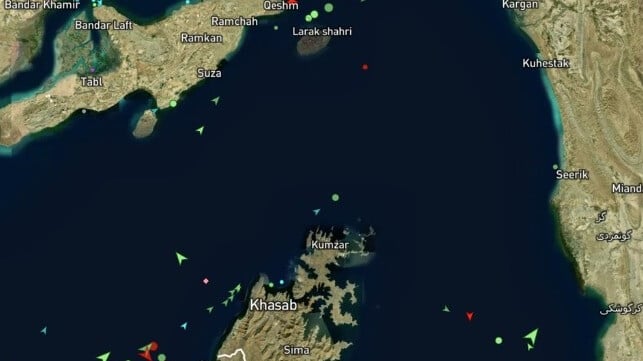
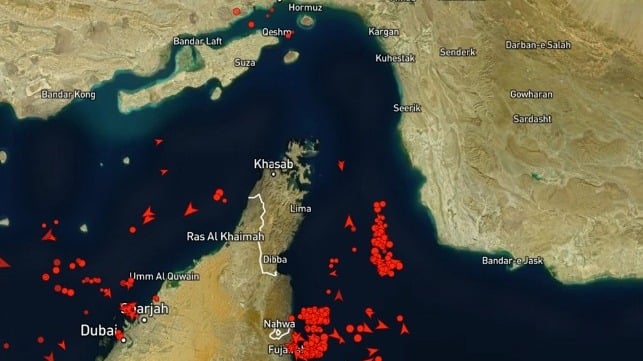
No tanker traffic broadcasting AIS inside the strait, 0030 hours local time, March 3 (MarineTraffic)
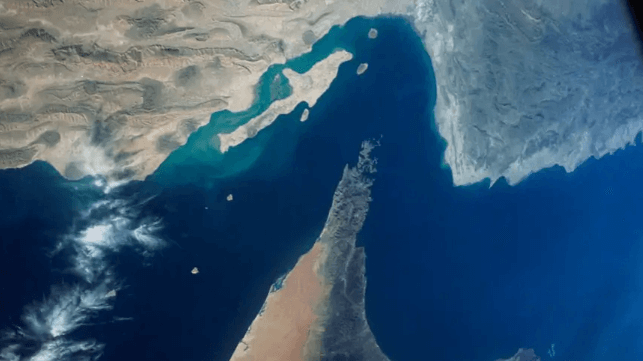
Iran's senior leadership has announced a full shutdown of the Strait of Hormuz and threatened to "set on fire" any vessels passing the blockade. Multiple leading P&I clubs have announced that they are suspending war risk insurance for transits of the strait effectively making the risk exposure too high for tanker owners to bear, and energy shipping traffic through the strategic waterway has ground to a near-halt. As of Monday night, maritime tracking platforms showed virtually no (disclosed) tanker transits through the TSS.
According to the FT, broking sources say that war risk insurers are pulling previously-arranged coverage for future transits of the Strait, transferring the full risk of an upcoming transit to the shipowner for the short voyage. The decision suggests that P&I clubs and reinsurers see so much uncertainty in Iranian attacks that they can't calculate an appropriate rate - even an exceptionally high rate, like the one percent of hull value charged for Ukraine-bound vessels during the peak of the Russian blockade.
"It is already evident that reinsurers’ appetite for war risk exposure is tightening, and in practical terms, it will result in reinsurers withdrawing capacity at short notice," said leading P&I club Skuld in a statement. "Against this backdrop, the association has therefore decided to issue the assureds with a notice of cancellation of the War Risk Cover."
The withdrawal of war risk coverage will take effect on March 5, 72 hours after notice was issued. It extends throughout the Arabian Gulf and the Gulf of Oman. Gard, NorthStandard, London P&I and the American Club have followed suit as well.
Basic P&I, FD&D and Excess Wark Risk are unaffected - but without baseline war risk cover, owners are unlikely to venture into an active combat zone.
Gard said that it was still working on the terms of a buy-back option for shipowners to reinstate their war risk coverage at an extra cost. For now, Gard is not offering reinstatement until after it has ironed out the terms it would like to receive.
Basic P&I, FD&D and Excess Wark Risk are unaffected - but without baseline war risk cover, owners are unlikely to venture into an active combat zone.
In another sign of the added risk and cost for owners who wish to operate in the broader region, the ITF and the Joint Negotiating Group (JNG) have designated Hormuz, the Arabian Gulf and most of the Gulf of Oman as a formal high risk area, triggering extra pay and certain extra rights for seafarers in the region. Owners are also advised to increase security preparedness to ISPS Level 3.
The list of crewmember benefits for this new designated warlike operations area (IBF High Risk Area) includes:
- a bonus equal to the basic wage for the duration of time in the zone
- double compensation for death and disability;
- and a right to refuse sailing, with repatriation at company’s expense plus two months' of wages.
The physical and financial risks for owners have added up to a suspension of traffic - for now. According to maritime data consultancy Windward, there were zero active tanker transits in the strait as of late Monday. "The Strait is technically open, but commercial tanker passage has effectively ceased," Windward said in a statement.
Maritime analysts have been quick to note that Iran is heavily dependent upon oil sales to China for revenue, and will not be able to afford to fully close the strait to its own tanker traffic - nor can it risk angering its only real customer. Chinese refiners also buy oil from Iraq, Kuwait and Saudi Arabia, and a shutdown of any duration for the GCC nations' tanker traffic would attract China's attention.