Sunday, March 29, 2026

HOW THE WORLD SAW IT
'No Kings' Protests Draw Millions Across US And Europe Against Trump Administration


The protests, the third in a series that began in 2025, focused on several key grievances: US involvement in the war with Iran, strict immigration policies including enforcement actions that have drawn criticism


Outlook News Desk
Curated by: Pritha Vahsishth
Published at: 29 March 2026 
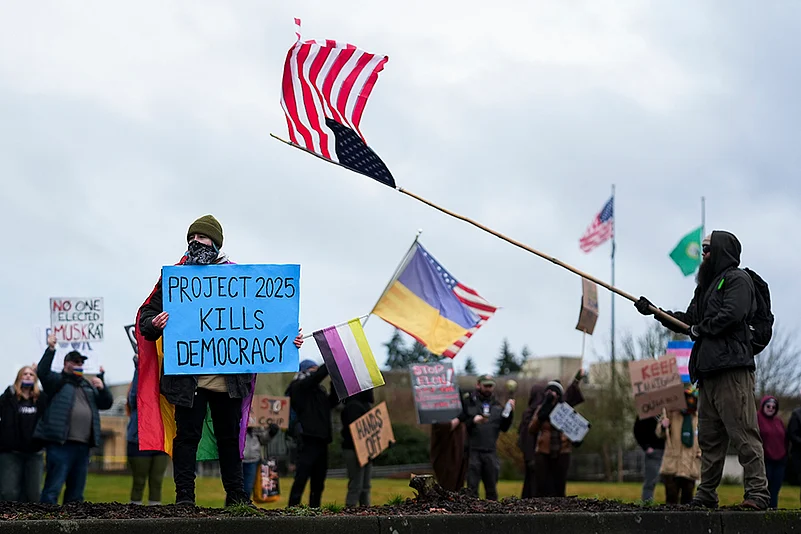

Protest near the Washington State Capitol building | Photo: AP/Lindsey Wasson


Summary of this article


Organizers claim millions participated in over 3,000 "No Kings" rallies held across all 50 US states and in more than a dozen countries including European cities like London, Paris, Berlin, and Rome, marking the third major wave of demonstrations since President Trump took office in 2025.


Protesters voiced opposition to the ongoing war with Iran, aggressive immigration enforcement, rising cost of living, and what they describe as authoritarian tendencies and expansion of executive power by the Trump administration.


The flagship event in Minnesota, headlined by Bruce Springsteen, drew large crowds at the State Capitol, while Republican officials dismissed the protests as "Hate America" or "Trump Derangement" events; turnout estimates vary, with previous rounds in 2025 drawing 5–7 million according to organizers.


Large-scale "No Kings" protests unfolded across the United States and parts of Europe, with organizers describing the day as one of the biggest mobilizations against the Trump administration to date. Demonstrations took place in more than 3,000 locations spanning all 50 states, from major cities like New York, Washington D.C., and Los Angeles to small towns and suburban areas. Solidarity events were also held in over a dozen countries, including rallies in London, Paris, Berlin, Madrid, and Rome, often organized by groups like Democrats Abroad.


The protests, the third in a series that began in 2025, focused on several key grievances: US involvement in the war with Iran, strict immigration policies including enforcement actions that have drawn criticism, and broader concerns over rising living costs and perceived overreach of presidential authority/


'Trump Is An Existential Threat': Robert De Niro Joins No Kings Protests; Jane Fonda, Bruce Springsteen & Others Attend
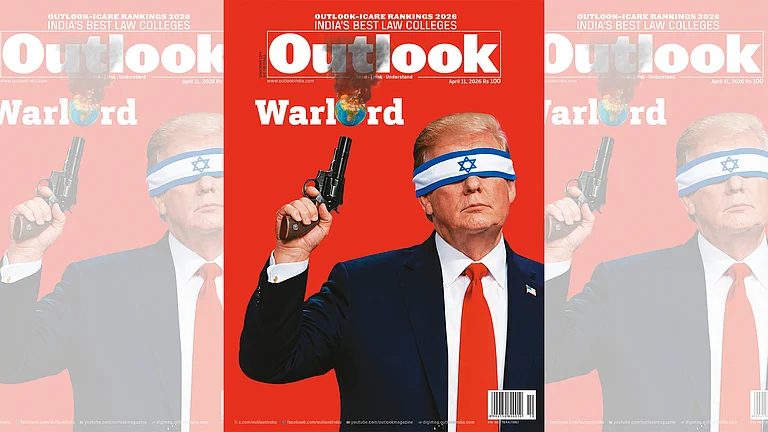
Outlook's Latest Issue: The Warlord With 'A Passion' For Peace

In Minnesota, which served as the flagship venue, thousands gathered at the State Capitol in St. Paul, where musician Bruce Springsteen performed to highlight local resistance to federal immigration measures. Protesters carried signs reading "Democracy Has No Kings" and chanted against what they called authoritarian rule.

Previous "No Kings" events reportedly drew millions , with organizers citing around 5 million in June 2025 and nearly 7 million in October 2025, and Saturday's turnout was expected to be significant, though independent verification of exact numbers remains challenging amid varying claims. Events remained largely peaceful, though some states had mobilized National Guard units as a precaution. In European cities, smaller but symbolic gatherings saw participants adapt messaging — using phrases like "No Tyrants" in monarchies such as the UK, Spain, and Sweden to avoid confusion.


Paris protesters join massive demonstrations against Trump across world on 'No Kings' day

Huge crowds of protesters rallied across the world, but mainly in the United States on Saturday against President Donald Trump, venting their fury over what they see as his authoritarian style of governing, his hardline immigration policies and the war with Iran.


Issued on: 29/03/2026 - RFI

A board during an anti-Trump rally, at “No King’s Day" at Place de la République, Paris, 28 March 2026. © Screenshot X

Organizers said "at least 8 million people gathered today at more than 3,300 events across all 50 states," from big cities and small towns. US authorities provided no national crowd estimate.

It was the third time in less than a year that Americans have taken to the streets as part of a grassroots movement called "No Kings," the most vocal and visual conduit for opposition to Trump since he began his second term in January 2025.

In New York, America's most populous city, tens of thousands of demonstrators rallied, including Oscar-winning actor Robert De Niro, a frequent Trump critic, who called the president "an existential threat to our freedoms and security."

Demonstrators rally in front of the Lincoln Memorial during the No Kings protest in Washington, Saturday, March 28, 2026. AP - Jose Luis Magana

Protests unfolded from Atlanta to San Diego, with Alaskans joining the mix later in the day.

"No country can govern without the consent of the people," 36-year-old military veteran Marc McCaughey told French press agency AFP in Atlanta, where thousands turned out.

"We're out here because we feel that the Constitution is under threat in a multitude of different ways. Things aren't normal. They aren't okay."

In the Michigan town of West Bloomfield, near Detroit, people braved below-freezing temperatures to protest.

And in the US capital Washington, thousands of marchers -- some carrying banners that blared "Trump Must Go Now!" and "Fight Fascism" -- flocked to the National Mall.

"He keeps lying and lying and lying and lying, and no one says anything. So it's a terrible situation we're in," 67-year-old retiree Robert Pavosevich told AFP.
Demonstrators hold up their banners as they march across the Memorial Bridge during a "No Kings" protest in Washington, Saturday March 28, 2026. AP - Jose Luis Magana


Trump himself was in Florida for the weekend.

The anti-Trump mood has spilled beyond US borders, with rallies Saturday in European cities including Paris, Amsterdam, Madrid and Rome, where 20,000 people marched under a heavy police presence. Hundreds of people also gathered at the Place de la République in Paris, including Americans who reside in France.

The first "No Kings" nationwide protest day came last June on Trump's 79th birthday and coincided with a military parade he organized in Washington. Several million people turned out, from New York to San Francisco.
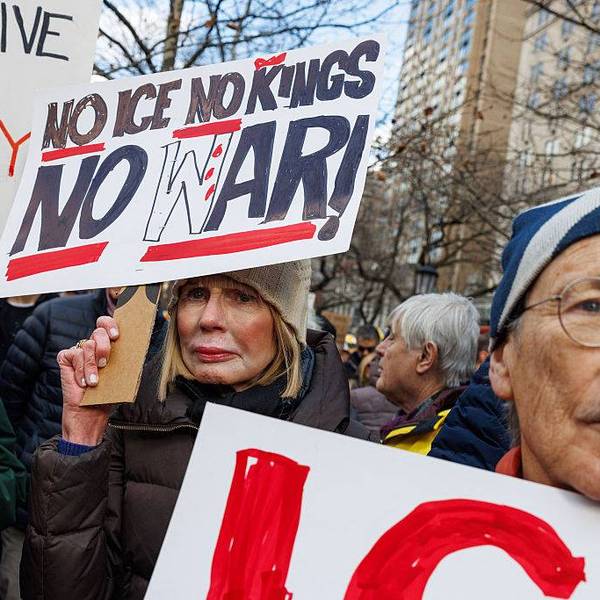
Des manifestants brandissent des pancartes sur lesquelles on peut lire « Non à la guerre » et « Non aux rois » lors d'une marche contre le fascisme organisée à l'occasion de la Journée iDemonstrators hold "No to War" and "No Kings" signs during an International Women’s Day march against fascism on Boston Common in Boston, Massachusetts, on March 8, 2026. © AFP - JOSEPH PREZIOSO


The second such protest, in October, drew an estimated seven million protesters, according to organizers, who said Saturday's events saw one million more participants and 600 additional demonstrations.

(With newswires)


‘No Kings!’ 8 Million Rally Against Trump in Largest Single-Day Protest in US History

In San Francisco, thousands of anti-Trump activists gathered on a local beach to form a human sign that read, “Trump must go now! No ICE, no wars, no lies, no kings.”
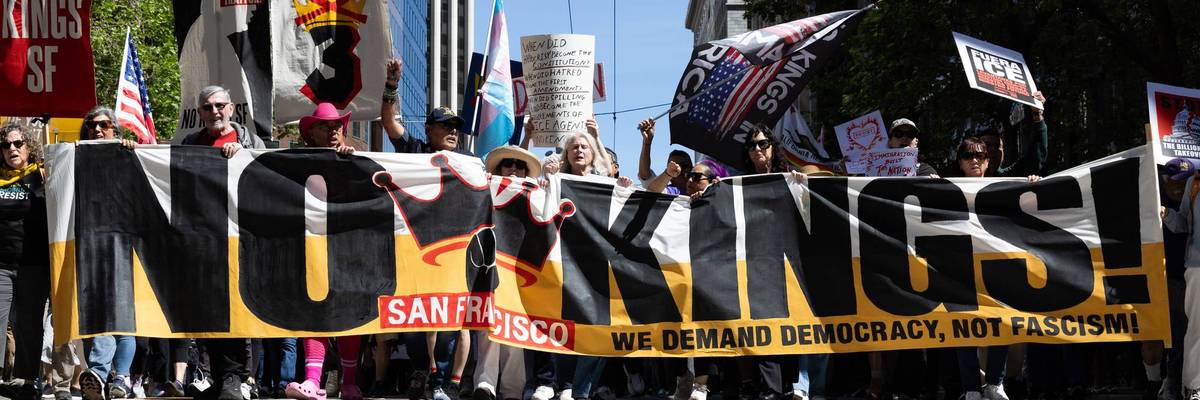

Demonstrators carry a “No Kings” banner along Market Street at a “No Kings” protest on March 28, 2026 in San Francisco, California. This is the third nationwide “No Kings” protest held against the Trump administration.
(Photo by Benjamin Fanjoy/Getty Images)


Brad Reed
Mar 28, 2026
COMMON DREAMS

Millions of American across all 50 states on Saturday rallied against President Donald Trump and his authoritarian agenda during nationwide No Kings protests.

The flagship No Kings rally in Minneapolis, which organizers Indivisible estimated drew over 200,000 demonstrators, featured speeches from Minnesota Gov. Tim Walz and US Sen. Bernie Sanders (I-Vt.), Rep. Ilhan Omar (D-Minn.), and actress Jane Fonda, as well as a special performance from rock icon Bruce Springsteen, who performed “Streets of Minneapolis,” a song he wrote in tribute of slain protesters Renee Good and Alex Pretti.
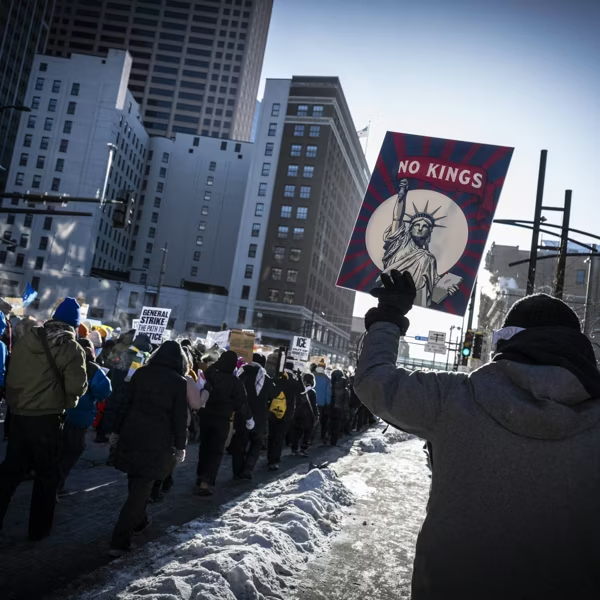


Organizers called it “the largest single-day nationwide demonstrations in US history,” with an estimate 8 million people coming out for events in communities and cities nationwide.

From major cities to rural towns that have never seen mobilizations like this before, protesters made clear that in America, we don’t do kings,“ the No Kings coalition said in a statement.

“This is what it looks like when a movement grows—not just in size, but in reach, in courage, and in more people who see themselves as part of this movement,” the organizers said. “The American people are fed up with this administration’s power grabs, an illegal war that Congress and the public haven’t approved, and the continued attempts to stifle our freedoms. We’re not waiting for change; we’re making it.”

The rally in Minneapolis was one of more than 3,300 No Kings events across the US and internationally, and aerial video footage showed massive crowds gathered for demonstrations in cities including Washington, DC, New York City, Boston, Philadelphia, Chicago, and San Diego.


In San Francisco, thousands of anti-Trump activists gathered on a local beach to form a human sign that read, “Trump must go now! No ICE, no wars, no lies, no kings.”


However, No Kings rallies weren’t just held in major US cities. In a series of social media posts, Indivisible co-founder Leah Greenberg collected photos and videos of No Kings events in communities including Arvada, Colorado, Madison, New Jersey, and St. Augustine, Florida, as well as international No Kings events held in London and Madrid.

Attendance estimates for Saturday’s No Kings protests were not available as of this writing. Polling analyst G. Elliott Morris estimated that the previous No Kings event, held in October, drew at least 5 million people nationwide, making it likely “the largest single-day political protest ever.”

Conservative icon: The public has finally taken power away from the elites


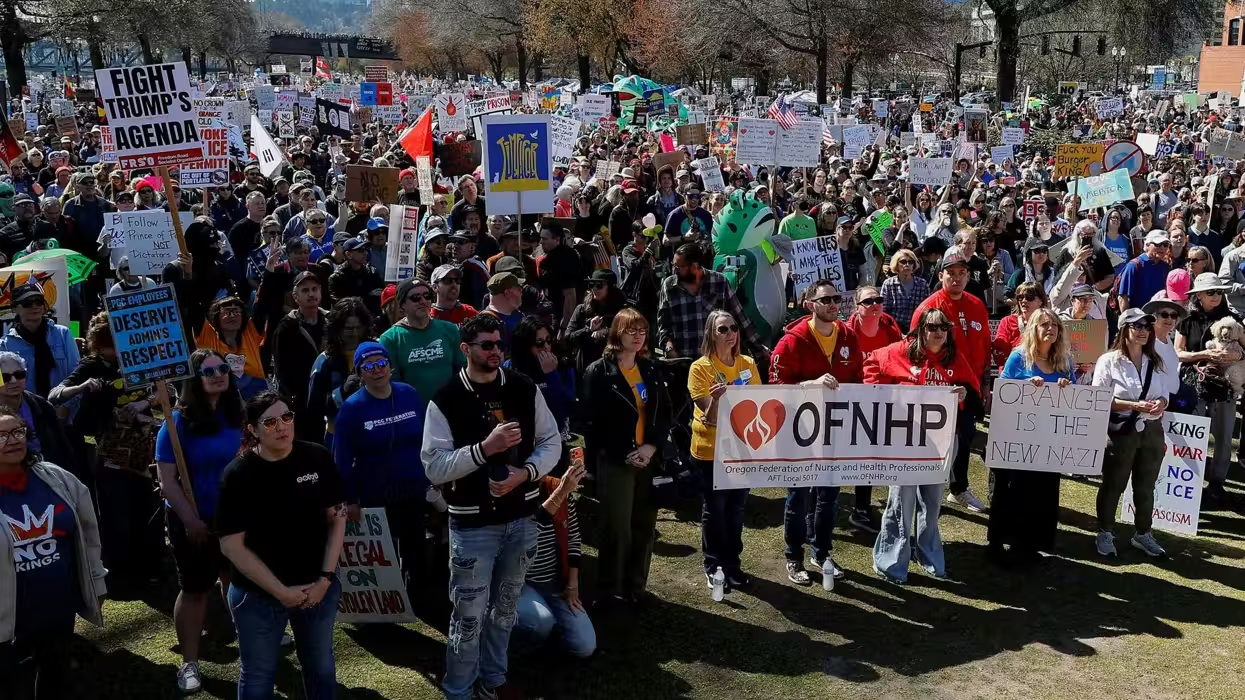
Demonstrators attend a "No Kings" protest against U.S. President Donald Trump's administration policies, in Portland, Oregon, March 28, 2026. REUTERS/John Rudoff

March 29, 2026 
ALTERNET

President Donald Trump is increasingly unpopular, as the No Kings protests demonstrate — and this means that right now “the public is leading the elites” in standing up for democracy, at least according to one conservative commentator.

“This all ends with enough of us saying no,” conservative commentator William Kristol said on his website The Bulwark on Sunday. “The bad news is that Trump is president for the next almost three years, and in the sense that we don't have a parliamentary system, his poll numbers could go down further and people could turn out even more.”

Kristol added, “But hopefully the elites — I feel like the public is now leading the elites by quite a lot. It's so striking, right? In terms of turning against Trump, you see it in the polls, but also in the turnout for 'No Kings.' And the elitist institutions are still accommodating Trump to a somewhat shocking degree.”

According to polling analyst G. Elliott Morris, an October No Kings event drew at least 5 million people all over America, marking it as the “largest single-day political protest ever.” Even though repeatedly claims he won the 2024 presidential election in a “landslide” (in fact he won the popular vote by roughly 1.5 percent, with less than a majority of 50 percent). MSNBC reporter Antonia Hylton found that one October event in New York City “far exceeded” the original estimated turnout of 200,000.

Kristol, despite being a lifelong conservative Republican, has repeatedly and emphatically criticized Trump for what he argues are the president’s assaults against American democracy. In February, as Trump continued dragging his feet on releasing the Jeffrey Epstein files and said he was “sad” at the arrest of the UK’s former Prince Andrew, Kristol wrote that “there is no evidence the Trump administration has any interest in seeing justice done, or any intention of having the truth come out. We have an executive branch that is on the side of the Epstein class, not the Epstein survivors.”

In February, Kristol praised Americans like Minneapolis residents who protected Trump’s ICE and its brutal deportation of immigrants.

“The American people are better than our current government,” Kristol said. “Civic spirit and enlightened patriotism are by no means dead in the United States. As the people of Minnesota have again reminded us.” He also argued that Trump administration officials do not understand the principles of the American revolution that they claim to honor.

“The administration in which Rubio serves pretends to celebrate that revolution, but hates the abstract truth which animated that revolution and which elevates it above merely another mundane struggle for power or profit,” Kristol said. “The Trump administration hates that fact because it is a reminder that there is more to life than power and profit. And it hates that truth precisely because it remains a stumbling block to tyranny and oppression.”

Kristol has also blisteringly denounced Trump’s rationale, or lack thereof, for declaring war against Iran earlier in March.

“Why did we go to war four days ago?” Kristol asked. “And why are we going to continue this war, apparently for weeks or longer? The Trump administration can’t answer either question.”


Anti-Trump protests outweigh supporter rallies - Statista
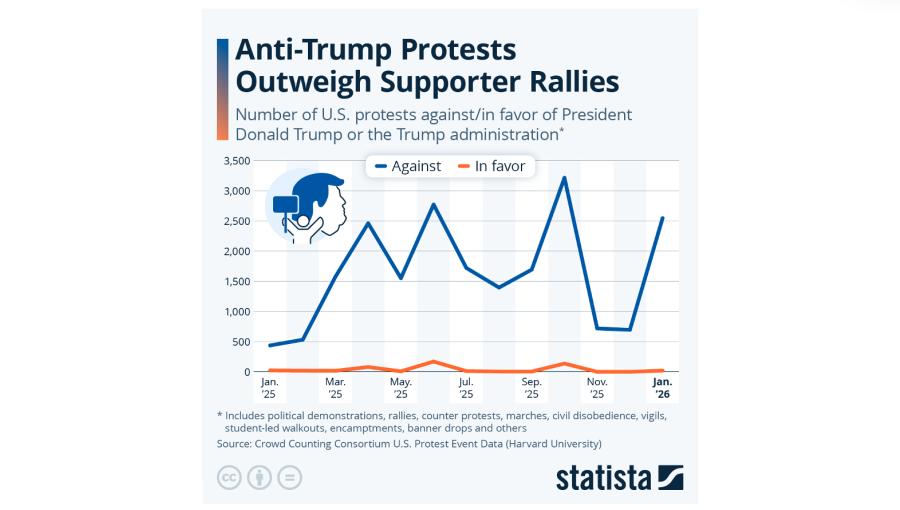
Anti-Trump protests outweigh supporter rallies - Statista
Anti-Trump protestors are far more active than pro-Trump supporters in the US. / bne IntelliNewsFacebook
By Katharina Buchholz for Statista March 28, 2026

Protests in the United States against President Donald Trump or the Trump administration by far outweigh rallies organized by Trump supporters, Statista reports.

This is according to data from the Crowd Counting Consortium at Harvard University. The number of protest actions counted spiked in April as well as in June and October of 2025, the latter two dates coinciding with the coordinated, U.S.-wide No Kings rallies that the consortium says were among the largest single-day protests in U.S. history with around 5 million and 7 million participants, respectively. In January of 2026, another spike was due to the National Shutdown or ICE Out protests against the conduct of Immigration and Customs Enforcement agents and the Trump administration's policies connected to the agency.

The CCC says that its numbers "rebut the narrative that there is 'no resistance' to the second Trump administration".

On this Saturday, another installment of the No Kings protest series that denounces authoritarian power grabs and their possibility in the U.S. under Donald Trump will take place. The event is projected to be the biggest anti-Trump protest ever as demonstrations are spreading across districts that voted for Trump in 2024 and even across the globe.

At the headline event in St. Paul, Bernie Sanders, Joan Baez, Bruce Springsteen and Jane Fonda will perform or speak. Across the United States, more than 3,000 separate protests are scheduled, about the same level as the October installment of the series.
 

You will find more infographics at Statista


Huge crowds protest against Trump in 'No Kings' rallies in the US and abroad


By Lucy Davalou with AP, AFP

Organisers said at least eight million people participated in more than 3,300 events across all 50 US states.

Millions of people took to the streets across the US - and to a lesser extent worldwide - on Saturday to protest against US President Donald Trump on a range of different issues, in what they see as his authoritatian style of governance, hardline immigration policies, climate change denial and the war with Iran.

Organisers said that at least eight million people took part in more than 3,300 events held in major cities, suburbs and rural areas.

Protests were mostly peaceful, but some arrests were reported in Los Angeles and Denver, according to local police.

It is the third time in less than a year that people protest in the US as part of a grassroots movement called "No Kings".

The first such nationwide protest day took place last June on Trump's 79th birthday and coincided with a military parade he organised in Washington. Several million people turned out, from New York to San Francisco. The second, in October last year, drew an estimated seven million protesters, according to organisers.
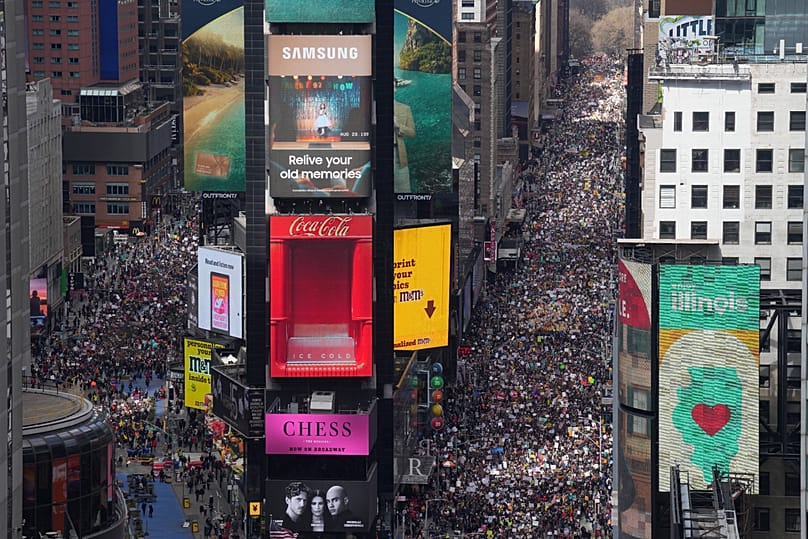
People attend a "No Kings" protest Saturday, 28 March, 2026, in New York.
People attend a "No Kings" protest Saturday, 28 March, 2026, in New York. AP Photo

In New York City, tens of thousands of people rallied on Saturday, including Oscar-winning actor Roberto De Niro who called the US President "an existential threat to our freedoms and security".
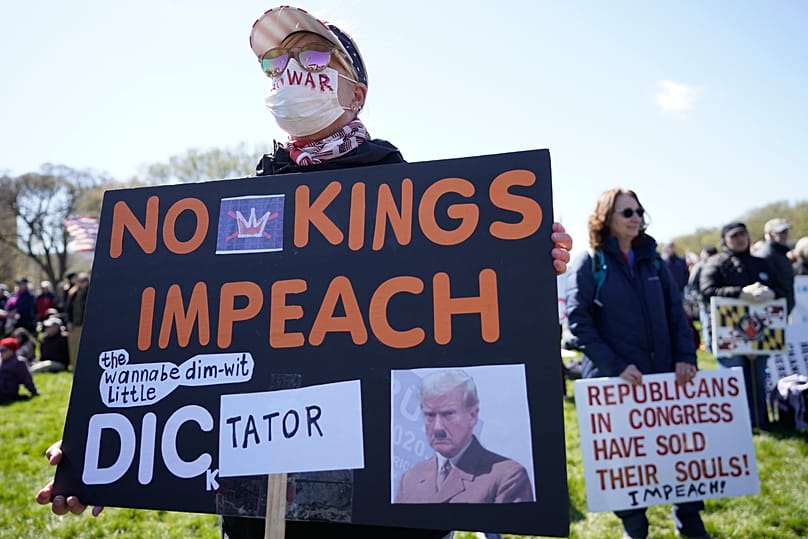
Demonstrators rally during the No Kings protest in Washington, Saturday, 28 March, 2026.
Demonstrators rally during the No Kings protest in Washington, Saturday, 28 March, 2026. AP Photo

In the US capital Washington, thousands of marchers - some carrying banners that blared "Trump Must Go Now" and "Fight Fascism" - flocked to the National Mall.

"He keeps lying and lying and lying and lying, and no one says anything. So it's a terrible situation we're in," one protester told news agency AFP.
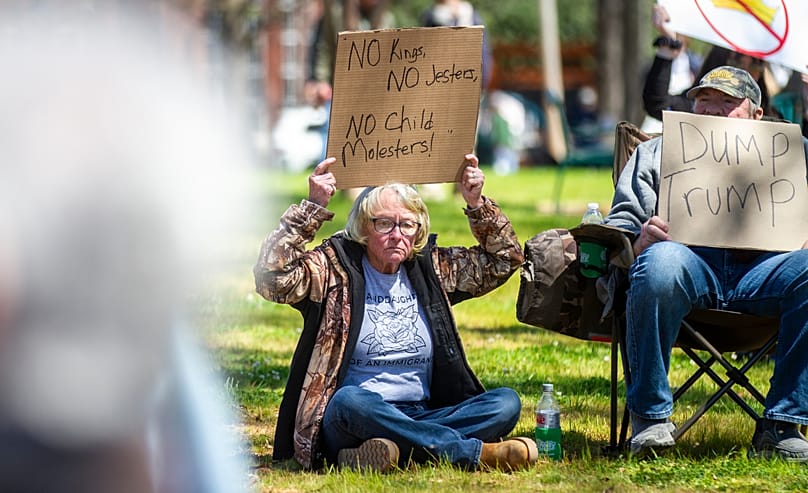
Demonstrators hold signs during the "No Kings" rally at Wilson Park in Florence, Ala, on Saturday, 28 March, 2026.
Demonstrators hold signs during the "No Kings" rally at Wilson Park in Florence, Ala, on Saturday, 28 March, 2026. AP Photo

A deeply divided country

The event highlighted the deep political divide that currently exists in the US. While Trump is largely worshipped within his "Make America Great Again" movement, he is equally disliked by his foes, who decry his penchant for ruling by executive decree, use of the justice system to prosecute opponents, as well as his repeated climate change denial and apparent obsession wih fossil fuels.

Many of his opponents are also unhappy about his scrapping of racial and gender diversity programmes and his flexing of US military power after campaigning as a man of peace who would avoid wars.

The White House dimissed the rallies, however, with a spokesperson describing them as being the product of "leftist funding networks" that lack true public support.

"The only people who care about these Trump Derangement Syndrome Therapy Sessions are the reporters who are paid to cover them," spokesperson Abigail Jackson added in a statement.

Those comments were echoed by the National Republican Congressional Committee, with a spokesperson saying "these Hate America Rallies are where the far-left’s most violent, deranged fantasies get a microphone."
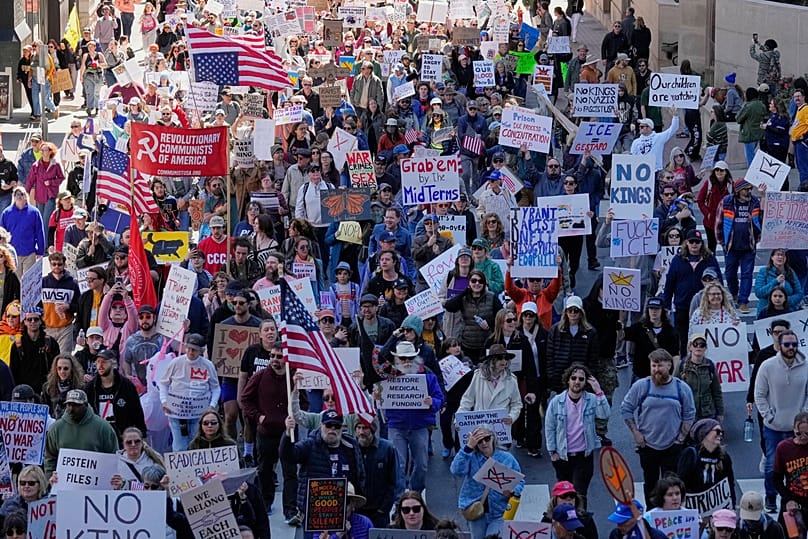
People march during a "No Kings" protest Saturday, 28 March, 2026, in Nashville, Tennessee.
People march during a "No Kings" protest Saturday, 28 March, 2026, in Nashville, Tennessee. AP Photo

Nevertheless, organisers say two thirds of those attending rallies on Saturday do not live in major cities, often Democratic strongholds in the US - a data point that has risen sharply since the last protest.

Europeans protest from afar

Rallies also took place in Europe on Saturday, with around 20,000 people marching under a heavy police presence in cities including Amsterdam, Madrid and Rome.

In Paris, several hundred people - mostly Americans living in France - along with French labour unions and human rights organisations, gathered at the Bastille.

“I protest all of Trump’s illegal, immoral, reckless and feckless endless wars,” said the Paris No Kings organiser, Ada Shen.

In Rome, thousands protested against the US and Israel's strikes on Iran, but also took the opportunity to also criticise Prime Minister Giorgia Meloni, who recently saw a referendum - which would have changed how Italy’s judiciary system works - fail.
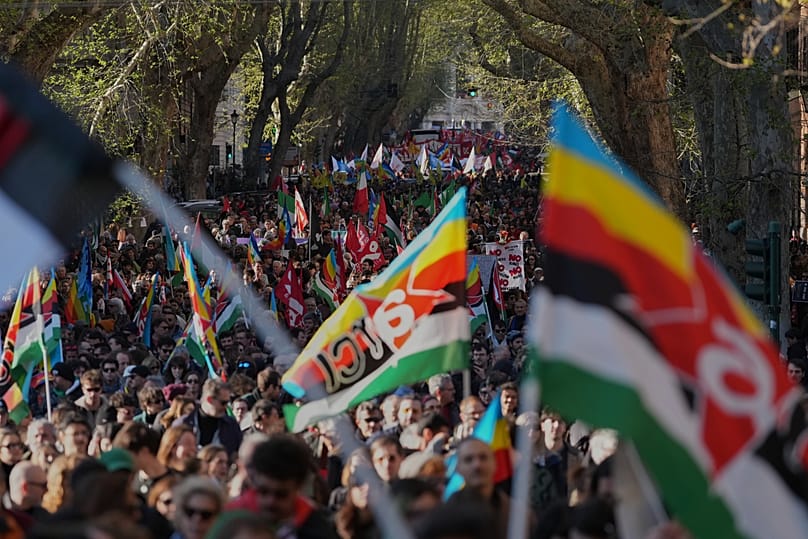
People take part in a national anti-war demonstration organized by "No Kings Italy movement" in Rome, Saturday, 28 March, 2026.
People take part in a national anti-war demonstration organized by "No Kings Italy movement" in Rome, Saturday, 28 March, 2026. AP Photo

In London, people also protested the war in Iran. Many also held banners reading “stop the far right” and “stand up to racism.”

The “No Kings” movement has emerged as the most visible and outspoken opposition to Trump since he began his second term in January 2025.

As the November midterm elections loom and the president's approval rating sinks below 40%, Republicans are in danger of losing control of both chambers of Congress.


Pope Leo XIV Says God ‘Does Not Listen’ To Prayers Of Those Who Wage War


Pope Leo XIV takes part in the traditional Palm Sunday procession in St. Peter's Square at the Vatican on March 29, 2026. | Credit: Daniel Ibáñez/EWTN


March 30, 2026 
 EWTN News
By Victoria Cardiel


Pope Leo XIV on Palm Sunday sharply condemned war and the use of religion to justify violence, saying during Mass in St. Peter’s Square that God “does not listen to the prayers of those who wage war.”

At the start of Holy Week, the pope tied the Church’s contemplation of Christ’s Passion to the suffering of people caught in today’s conflicts, especially Christians in the Middle East.

In his Palm Sunday homily, Leo repeatedly presented Christ as the “King of Peace,” contrasting Jesus’ meekness with the violence surrounding him as he entered into his Passion.

“We turn our gaze to Jesus, who reveals himself as King of Peace, even as war looms abounds him,” the pope said. “He remains steadfast in meekness, while others are stirring up violence.”


Leo said Christ “did not arm himself, or defend himself, or fight any war” but instead “revealed the gentle face of God, who always rejects violence.”

“Rather than saving himself, he allowed himself to be nailed to the cross, embracing every cross borne in every time and place throughout human history,” the pope said.

The pope then issued one of the strongest lines of his homily, rejecting any attempt to invoke God in support of armed conflict.

“Brothers and sisters, this is our God: Jesus, King of Peace, who rejects war, whom no one can use to justify war,” Leo said. “He does not listen to the prayers of those who wage war, but rejects them, saying: ‘Even though you make many prayers, I will not listen: your hands are full of blood.’”

The Palm Sunday liturgy, which opened Holy Week, began with the traditional procession in St. Peter’s Square with cardinals, bishops, priests, religious, and thousands of faithful carrying palms and olive branches.

In his homily, Leo reflected on Jesus’ entry into Jerusalem on a donkey rather than a war horse, saying the moment fulfilled the prophecy of a king who would “command peace to the nations.”

Recalling the Gospel account of Peter drawing a sword to defend Jesus, Leo cited Christ’s rebuke: “Put your sword back into its place, for all who take the sword will perish by the sword.”

The pope said that in the crucified Christ “we can see a crucified humanity.”

“In his wounds, we see the hurts of so many women and men today,” he said. “Above all, we hear the painful groans of all those who are oppressed by violence and are victims of war.”

“Christ, King of Peace, cries out again from his cross: God is love! Have mercy! Lay down your weapons! Remember that you are brothers and sisters!”

Following the Mass, Leo returned to the theme of war during the Angelus, praying in particular for Christians in the Middle East who have been prevented in some places from fully taking part in Holy Week rites.

“At the beginning of Holy Week, our prayers are more than ever with the Christians of the Middle East, who are suffering the consequences of a brutal conflict and, in many cases, are unable to observe fully the liturgies of these holy days,” he said.

“Just as the Church contemplates the mystery of the Lord’s Passion, we cannot forget those who today are truly sharing in his suffering. Their ordeal challenges all our consciences.”

The pope added: “Let us raise our prayer to the Prince of Peace that he may sustain the peoples wounded by war and open concrete paths to reconciliation and peace.”

Leo also remembered “the maritime workers who have fallen victim to the conflict,” adding: “I pray for the deceased, the wounded and their families. Land, sky and sea were all created for life and peace!”

He further called attention to migrants who died in the Mediterranean, saying: “Let us also pray for all the migrants who have died at sea, especially those who lost their lives in recent days off the coast of Crete.”

Near the end of his homily, the pope entrusted his plea for peace to the intercession of Mary, quoting the Servant of God Bishop Tonino Bello and praying that “the tears of all the victims of violence and pain will soon be dried up.”

He concluded the Angelus by asking the Virgin Mary to accompany the faithful through the days ahead.

“May she guide us during these holy days, so that we may follow Jesus, our Savior, with faith and love,” he said.

This story was first published in two parts by ACI Prensa, EWTN News’ Spanish-language news partner. It has been translated and adapted by EWTN News English.

EWTN News is the rebranding of the Catholic News Agency (CNA), following the decision by EWTN — which was launched as a Catholic television network in 1981 by Mother Angelica, PCPA — that brings CNA and its affiliated ACI international outlets under a single, unified identity. Previous CNA articles may be found by clicking here.


Hegseth has 'threatened' military chapl
ains who refuse to back his Iran war plans: report

Ewan Gleadow
March 29, 2026 
RAW STORY


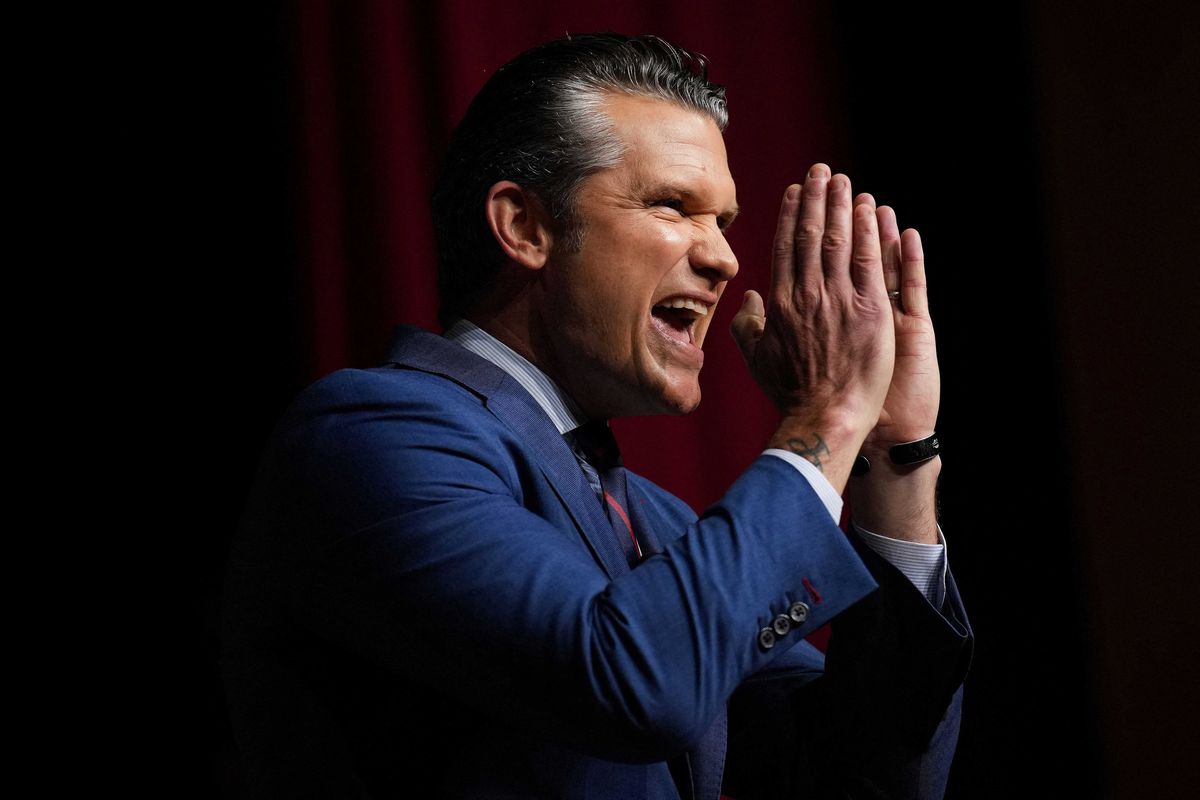
Pete Hegseth speaks to senior military leaders at Marine Corps Base Quantico, Virginia. Andrew Harnik/REUTERS

Defense Secretary Pete Hegseth has alienated a critical group within the military establishment — religious leaders and chaplains — by weaponizing Christianity to justify the Iran war and creating an atmosphere of fear for those who refuse to comply with his ideological demands.

According to Washington Post analyst Michelle Boorstein, Hegseth's inflammatory rhetoric at a recent Pentagon prayer service has triggered serious alarm among military chaplains and senior officials who view his approach as a dangerous departure from Pentagon norms.

At the prayer service, Hegseth invoked religious language to justify military violence, saying: "Let every round find its mark against the enemies of righteousness and our great nation. Give them wisdom in every decision … and overwhelming violence of action against those who deserve no mercy."

The language represents a troubling shift in how the Pentagon frames military operations, according to military leadership.

"The Pentagon's shift from previous historical norms is dangerous, according to multiple former high-ranking military officials, heads of chaplain corps, some veterans groups, current Pentagon staff and current officers," Boorstein wrote.

Retired Army Maj. Gen. Randy Manner, who trained hundreds of interfaith military chaplains and served as second-in-command at the National Guard from 2011 to 2012, has been hearing from active-duty chaplains about systematic retaliation.

"Manner said he has talked with 'dozens and dozens' of active-duty chaplains in recent weeks who say those who don't identify with Hegseth 'are being marginalized.' They feel they can't voice their concerns to their own superiors, and feel their work as the primary advocate for troops' spiritual, mental, and moral health is being threatened."

The situation has become dystopian. "I've had people tell me they're not included in staff meetings," Manner added.

Pentagon insiders describe the atmosphere as chilling. An anonymous Department of Defense source characterized the environment as "terrifying," noting that personnel working under Hegseth fear being punished or fired for failing to embrace his Christian nationalist worldview.

An unnamed member of a recent Joint Chiefs chairman's leadership team articulated the constitutional threat directly: "I don't approve of cramming your religious faith down people's throats, and when the top of the chain couches these operations in this hyper-Christian tone, it flies in the face of the freedom of religion that the Constitution enshrines and that our men and women in uniform sign up to defend."


Voters in Vance's hometown furious at Trump admin siding with 'horrible' polluter

Tom Boggioni
March 29, 2026 
RAW STORY


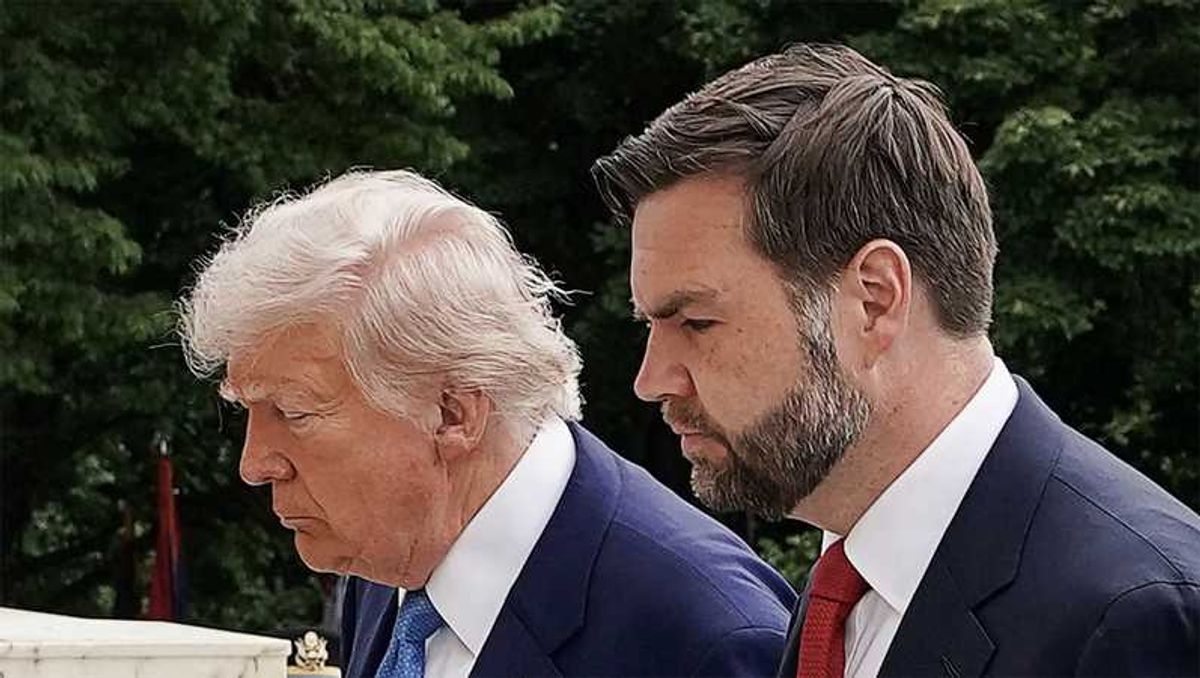
Donald Trump, JD Vance (Photo via Reuters)


The Donald Trump- JD Vance administration has sentenced Middletown, OhioVice President JD Vance's hometown — to decades of environmental devastation by canceling a $500 million federal grant that would have transformed a major steel plant into the world's cleanest industrial facility.

Instead, Cleveland-Cliffs is now planning to reline its aging blast furnace with coal and coke, locking the region into at least 15 to 18 more years of toxic pollution and the health consequences that come with it.

According to The Guardian's Stephen Starr, new permitting documents filed with the Ohio Environmental Protection Agency show the steel company is moving forward with a several-hundred-million-dollar investment to keep the fossil-fuel burning operation running indefinitely.

CEO Lourenco Goncalves has embraced the decision with Trump's own rhetoric. "Beautiful coal, beautiful coke," he announced to investors last summer, echoing the president's signature phrasing.

The No. 3 blast furnace, installed in the 1950s, consumes hundreds of thousands of tons of coke annually to produce around 3 million tons of raw steel per year.

The damage to the region will be catastrophic. Research from Industrious Labs estimates that over the 18 years following the furnace relining, the Middletown steel mill and its coke supplier, SunCoke Energy, will result in 810 to 1,476 premature deaths, 132,300 lost school days, and numerous other serious health ailments.

The facility is already the 11th worst carbon monoxide emitter in the United States, according to EPA data from 2020.

Local residents are already suffering. Vivian Adams, who moved to Middletown from Louisville just four years ago, has watched her six-year-old daughter's health collapse.

"My daughter was born prematurely so she already had lung issues, but it's gotten worse. She stays sick and coughing and can't breathe. She's had to go on everyday medication for her asthma, plus she has a rescue inhaler," Adams said.

The environmental contamination is inescapable. "The smell some days is absolutely awful," Adams said. "We sit on our chairs and there's a bunch of black stuff on them, on our vehicle, it's soot. It's on their toys, so you can't leave them outside."

The Biden administration had attempted to modernize the facility. The $500 million grant would have replaced the coke-burning infrastructure with a hydrogen-powered furnace that, according to some analyses, would have made Middletown the lowest greenhouse gas-emitting steel plant in the world.

Instead, Trump and Vance have prioritized fossil fuels over clean energy and human health in the vice president's own backyard.

‘Gave up my career to leak this’: UN delegate sounds alarm on nukes with desperate plea

the U.N. is actively preparing for the possibility of a nuclear weapon strike on Iran


Alexander Willis
March 29, 2026 
RAW STORY


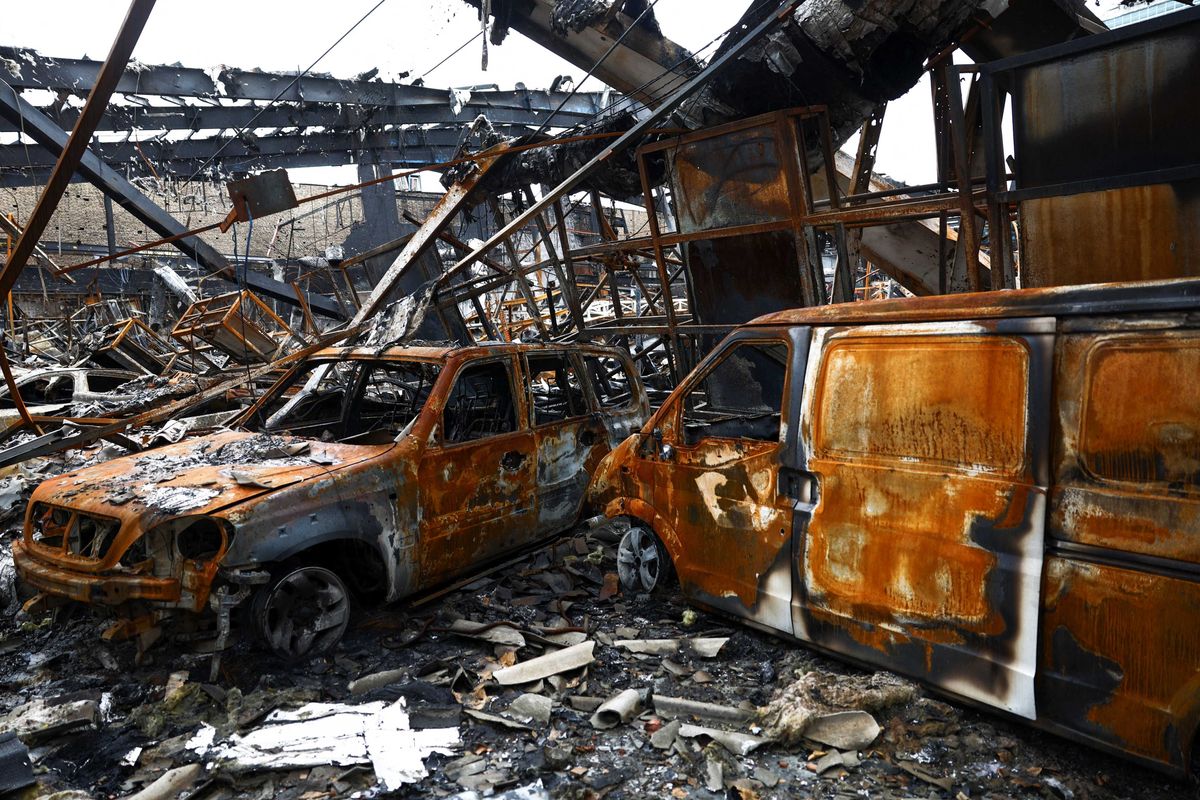
Burnt-out vehicles at the site of a car repair shop and dealership damaged by a strike, amid the U.S.-Israeli conflict with Iran, in Tehran, Iran, March 28, 2026. Majid Asgaripour/WANA (West Asia News Agency) via REUTERS ATTENTION EDITORS - THIS PICTURE WAS PROVIDED BY A THIRD PARTY

Mahamad Safa, formerly the permanent representative to the United Nations for a major human rights organization, resigned from his diplomatic positions on Friday to leak a dramatic claim, along with a desperate plea to the United States and elsewhere.

“I don't think people understand the gravity of the situation as the U.N. is preparing for possible nuclear weapon use in Iran,” Safa wrote in a statement shared on social media Sunday.

“I gave up my diplomatic career to leak this information. I suspended my duties so as not to be part of or a witness to this crime against humanity, in an attempt to prevent a nuclear winter before it is too late.”

According to Safa, the U.N. is actively preparing for the possibility of a nuclear weapon strike on Iran. The military onslaught on Iran from both the United States and Israel using traditional weapons has yet to produce results regarding the two countries’ stated war objectives; toppling the Iranian government and removing its ability to even acquire a nuclear weapon.

Traditional weapons have also failed to secure safe passage through the Strait of Hormuz – a crucial shipping channel through which 20% of the world’s oil trade flows – for U.S. and U.S.-aligned sea vessels.

As such, a nuclear weapon strike remains among the few escalatory measures the United States and Israel have yet to have employed, and, according to Safa, is now actively being considered.

“Yesterday, nearly ten million people protested ‘No Kings’ in the United States,” Safa continued. “The possibility of the use of nuclear weapons must be taken very seriously. It's dangerous. Act now. Spread this message worldwide. Take the streets. Protest for our humanity and future. Only the people can stop it. History will remember us.”


US conservatives divided over Republican support for Israel

Reuters Published March 29, 2026


People attend the Conservative Political Action Conference (CPAC) USA 2026 at the Gaylord Texan Resort and Convention Centre, in Grapevine, Texas, US on March 27. — Reuters


GRAPEVINE: When former Congressman Matt Gaetz opened his speech by aligning with a Republican faction “loyal to only one nation,” his message to the Conservative Political Action Conference was clear: It was a veiled swipe at perceived Israeli influence over US politicians, even without naming Israel outright.

A month into the US-Israeli war on Iran, Gaetz’s comments struck a discordant note at the annual CPAC event. They cut against calls for unity and exposed a growing Republican rift largely along generational lines, as younger conservatives increasingly question support for Israel. That scepticism reflects a broader distrust of military intervention among younger Republicans, fueled in part by conservative figures such as Tucker Carlson, whose allegations of excessive Israeli influence on US policy have drawn accusations that he is stoking antisemitism.

Carlson has repeatedly denied accusations of antisemitism. The Iran war, including Israel’s role in it, emerged as one of the main flashpoints at CPAC, which for decades has served as a central gathering for Republican politicians and activists.

Jack Posobiec, a conservative commentator and online influencer, said age 45 is a dividing line, with the younger cohort more likely to question the party’s steadfast support of Israel.

“People want to paint it off as if it’s antisemitism, but I don’t think that’s what it is,” Posobiec said. “It’s just a question of: Why? What is the purpose of this relationship? And I hear that a lot from young voters.” The issue has roiled the Democratic Party in recent weeks, with some lawmakers and primary candidates distancing themselves from the pro-Israel lobbying group AIPAC amid growing unease over Israel’s military actions.

Trump compared with biblical figure of Esther ‘who saved her people from annihilation in ancient Persia’

It is now exposing fault lines among Republicans as well, turning off young voters who helped propel Trump to victory in 2024 and potentially complicating the party’s efforts to defend slim majorities in the Senate and House of Representatives heading into November’s midterm elections.

Noah Bundy, 17, and Ryder Gerrald, 18, conservative friends from Georgia attending their first CPAC, said they opposed the war with Iran and questioned whether the military operation put Israel’s interests ahead of America’s. “I think they totally pushed us into a war with Iran,” Bundy said. “My whole family is military and none of us is really for it.” “Our younger generation, we don’t like Israel as much compared to the older generation,” said Gerrald. He said he would prefer redirecting US taxpayer dollars toward domestic priorities, rather than spending to bolster Israel’s military.

The party’s pro-Israel stance, however, resonates strongly with evangelicals — a pillar of Trump’s political base — and with older voters like Harry Strine III, an 83-year-old CPAC attendee who was wearing a red Make America Great Again hat.

“Israel is God’s people,” Strine said. “The US was founded on the Judeo-Christian belief. I guess I’m a traditionalist.” On the conferences opening day, Rev. Franklin Graham said that, by striking Iran to protect Israel, President Donald Trump was like the biblical figure of Esther, a Jewish queen who, according to scripture, was elevated by God to save her people from annihilation in ancient Persia.


Published in Dawn, March 29th, 2026

  THE EPSTEIN CLASS


Bank of America to pay $72.5m to settle Epstein suit

AFP Published March 29, 2026 


WASHINGTON: Bank of America has agreed to pay $72.5 million to settle a class action lawsuit alleging that the Bank facilitated a sex trafficking ring orchestrated by Jeffrey Epstein, court documents showed on Friday.


Bank of America said separately that while it continued to deny supporting Epstein’s crimes, “this resolution allows us to put this matter behind us and provides further closure for the plaintiffs.”

The suit, filed by an unidentified woman on behalf of herself and other alleged victims, claimed the bank’s executives “ignored red flags” about Epstein’s sex trafficking venture to provide him with banking and investment services.

The settlement, if approved in court, would avoid a potentially lengthy trial process and was deemed to be in the “best interests” of the plaintiffs. It was the latest bank to settle lawsuits from Epstein’s alleged victims, after a $75 million agreement by JP Morgan and a reported $75 million payment by Deutsche Bank, both in 2023.

Epstein, a billionaire hedge fund manager with a bevy of powerful and celebrity friends, was charged with sex trafficking of minors after being arrested in July 2019.

He had already been convicted in 2008 of soliciting sex from girls as young as 14. Epstein committed suicide while being held at Manhattan’s Metropolitan Correctional Center in August 2019.

His case has remained politically charged, with continuing disputes over the release of investigative records and the extent of his network. The US Justice Depa­rtment’s release of millions of files related to prosecutors’ investigations of Epstein in recent months has embroiled several high-profile executives and politicians.

Published in Dawn, March 29th, 2026


Digitalised war

Aasim Sajjad Akhtar 
Published March 27, 2026
DAWN


The writer teaches at Quaid-i-Azam University, Islamabad.


IT has been a month since the US and its Zionist outpost started dropping bombs on Iran. The imperial war machine has since killed thousands of Iranians and devastated one of the world’s oldest civilisations. Yet Iran still wages its own air war against the Gulf banana republics and Israel.

Tehran’s defiance has the backing of the vast majority of the world’s people. It may sustain an asymmetrical conflict with the biggest military force in history for the foreseeable future, especially if it retains control over the Strait of Hormuz. But whatever the outcome, this war confirms that we are hurtling fast towards an increasingly digitalised and dystopic abyss.

The very first bombs dropped by the US on Iran, which killed almost 200 schoolchildren in the south of the country, included those deployed through an AI system that integrated Anthropic’s Claude chatbot and Palantir’s Maven tool. We now know that the Trump administration appropriated the use of these AI products in contravention of US copyright and other domestic laws.

Of course, ‘law’ has basically become a meaningless word at the mercy of the US, Zionist, and many other military establishments all over the world. But outrage aside, many of us are unwittingly becoming party to the digitalisation of war, especially on ubiquitous social media platforms.

Take, for example, what happened in the subcontinent during the brief military conflict between India and Pakistan in 2025. That exchange between India and Pakistan was also largely an air war featuring the contrasting fortunes of both countries’ foreign-made fighter jets. But man-less surveillance drones sent deep into opposing territory also played a big role, generating mass frenzy about attacks on civilian populations.


We are hurtling fast towards an increasingly dystopic abyss.

TV media upped the ante further, and most prominent of all were the hundreds of millions of ordinary people effectively acting as state propagandists on social media. Given India’s huge size advantage, the echo chambers on that side of the border were far bigger, but the effect across the nation-state divide was similar.

More recently, the residents of the twin cities of Islamabad-Rawalpindi heard a loud bang, which was later confirmed to be the shooting down of a drone sent from across the Afghan border.

The news of its interception served to ratchet up already heightened anti-Afghan sentiment — prompting further policing of Afghan refugees in the country.


Today, the physical war on Iran is paralleled by all sorts of information manipulations playing out in more or less confusing ways. While the Gulf kingdoms are clearly aligned against Iran, there is also reason to believe that Tel Aviv has tried to deepen the divide between Tehran and Gulf capitals to serve its own endless war-making objectives. On the other hand, many well-meaning people in Pakistan and beyond continue to insist on projecting the idea a ‘Muslim ummah’ that doesn’t actually exist in practice, therefore inadvertently providing more fodder for narratives in the ‘clash of civilisations’ mould that ultimately benefits Trump, Netanyahu and even strongmen in our own countries.

The role of social media in and around the Palestinian genocide is also worth noting here; while pro-Palestinian voices in the digital space did all they could to expose war crimes and facilitate on-ground mobilisation after Oct 7, 2023, algorithmic manipulations on platforms owned by Zionist supporters — such as Elon Musk’s X — ensured that real and fake ac­­counts that toed a pro-Is­­r­ael line do­­minated the information war.

The larger point, however, is that one doesn’t have to be a white or Zio­nist supremacist to fall prey to the wider logics of digitalisation, including the way in which it is promoting the glorification of war. We already live in an age where exceptionally young children play gory video games where the objective is to shoot to kill. Drone warfare is eerily similar to a video game, with someone sitting far away operating a joystick or directing an AI chatbot to do target practice on real people. In an age of deepfakes and extreme emotive triggers on social media platforms, the conflation of real and virtual war games is a very real danger.

There are many wars beyond our own echo chambers in which AI, drones and other cutting-edge digital technology are increasingly being mobilised to wreak havoc against long-suffering populations. Think the Darfur region of western Sudan or Yemen. Or our own war-ravaged peripheries. If we are willing and able to see through the fog of digitalised war in Iran, then we have a responsibility to do so everywhere.

Published in Dawn, March 27th, 2026


Narrowing space
March 29, 2026 
DAWN

THE HRCP report Regulation or Restriction? is a telling account of the constraints faced by NGOs in Punjab. Its central finding is that civic space in Punjab has not been shut down outright, it has been quietly narrowed through bureaucratic, legal and financial pressures.

 The need for regulation is neither new nor unreasonable. States are entitled to ensure transparency, financial accountability and compliance with the law. Yet, as the report says, the challenge lies not only in the number of requirements — from Economic Affairs Division approvals to district permissions and security clearances — but in how they are applied. Even NGOs that comply with these procedures often face prolonged delays, repeated scrutiny or sudden interruptions in their work. Approvals can take months or years, bank accounts may be frozen, and projects stalled despite applications being in process. Rather than clear regulation, this creates a system where compliance does not guarantee the ability to operate. The result is an environment of uncertainty in which NGOs must devote increasing time and resources to navigating administrative hurdles, often at the expense of their core work. Rights-based organisations, particularly those working on governance and human rights, appear to face greater constraints than service-delivery groups. Many have scaled back advocacy, adopted safer programming, with some reshaping their work to avoid delays, scrutiny or disruptions, or, in some cases, ceased operations altogether. Women-led and minority-focused groups, already navigating social pressures, find themselves doubly constrained.

The consequences extend beyond individual groups. Civil society plays a vital role in democratic systems, amplifying citizen voices, informing policy and delivering services where the state cannot. When these actors operate amidst uncertainty, their work and the communities they serve are affected. Encouragingly, there are signs of partial easing, including judicial interventions and some procedural flexibility. Yet the longer-term effects — weakened networks and constrained funding — remain. The way forward lies in balance. The report calls for a rights-compliant legal framework grounded in legislation, alongside streamlined, time-bound approval processes and structured dialogue between government and civil society. It also stresses clearer oversight, accessible legal remedies, stronger coordination among NGOs, and more flexible donor support. A state that trusts its citizens leaves room for them to organise. Without that space, governance and society are diminished.

Published in Dawn, March 29th, 2026
Hotter urban future

Editorial 
Published March 29, 2026
DAWN

PAKISTAN is headed for a dangerous future, one that is not only characterised by rapid urbanisation but also rising heat. 

A new study by the University of Chicago’s Climate Impact Lab warns that the country could see a net increase of 51 temperature-related deaths per 100,000 peopleby 2050, placing it among those most severely affected by climate-driven mortality. The burden, however, will fall disproportionately on urban centres. Several Pakistani cities already appear among those most vulnerable globally. Faisalabad, Multan, Gujranwala, Lahore, Peshawar, Hyderabad, Rawalpindi and Islamabad are projected to experience steep rises in heat-related mortality. In some cases, the increases are startling. Faisalabad alone could see up to 9,400 additional deaths annually by mid-century. Across the world’s cities expected to see rising heat mortality, roughly one-third of the additional deaths may occur in Pakistan’s urban areas.

These projections reveal the perilous path Pakistan’s urban growth has taken. Cities have expanded rapidly but rarely with climate resilience in mind. Trees and open spaces have yielded to concrete, while dense housing and traffic congestion intensify the urban heat-island effect. Informal settlements, where millions live without adequate ventilation, water or electricity, are particularly vulnerable to extreme heat. Yet, as shown by cities elsewhere, targeted adaptation can significantly reduce heat deaths. Urban planning must prioritise green cover, shaded streets and parks that cool neighbourhoods. Building codes should encourage reflective materials, insulation and natural ventilation. Early warning systems, cooling centres and better emergency response can also save lives during heatwaves. Financing remains a critical constraint. Pakistan’s adaptation budget is limited, while much of the international climate finance promised has yet to materialise. Without stronger domestic planning, our cities will grow ever more dangerous. In a warming climate, the costs will ultimately be counted in human lives.

Published in Dawn, March 29th, 2026
Irresponsible targeting


Ahmer Bilal Soofi 
Published March 28, 2026 
DAWN

The writer is a former caretaker federal law minister and a public international law practitioner.


IT is very interesting that, over the years, the US has developed extensive target selection processes to handle combat challenges responsibly during the conflicts it has engaged in — whether under Chapter 7 of UN Charter or through regional arrangements like Nato, or unilaterally. The legal debate on the justification provided for wars started by US have been ongoing. Washington has not escaped criticism for its means and methods employed in these conflicts. However, the recent attacks on Iran shocked everyone for unhesitatingly choosing to target protected persons, civilian infrastructure, political leadership, a girls’ school, a naval ship with no belligerent intentions, factories, nuclear facilities, civilian apartment buildings, oil terminals, boats, the military and political leadership, scientists, engineers, and worse, negotiating officials themselves.

One recalls meeting members of the US JAG (law of war branch) and international humanitarian law experts numerous times at international conferences over the years. The interactions provided valuable insight into the institutional mechanisms of the State Department, Pentagon and the US attorney general’s office. All command levels in the US military must ensure that every strike, every use of ammunition, every target is legally cleared and a distinction made between civilian and combatant; the processes qualify the test of proportionality and make it absolutely necessary to achieve a particular military purpose.

The processes are based on the law of war as painstakingly laid down by experts in The Hague and Geneva in the earlier part of the 20th century. American lawyers supported the ratification of the 1949 Geneva Conventions and several other IHL instruments and the US government went ahead with it, thereby taking upon itself the duty to adhere to all the laws of war in any international armed conflict it engaged in or faced. Later, these commitments were codified by the government in the Law of War Manual spread over 1,100 pages. The US War Crimes Act, 1996, criminalises grave breaches of the Geneva Conventions, making individuals like members of the US armed forces, their field commanders and those up the chain directly liable.

It may sound unreal but the US army’s JAG branch engages around 4,000 to 5,000 lawyers who specialise in combat best practices and rules of engagement. These thousands of lawyers are trained in IHL principles. Additionally, hundreds of IHL specialists work for the joint staff legal offices and the JAG headquarters of the army, navy and air force. Additionally, around 500 lawyers work in 11 combatant commands operational across the globe. We are not counting the over 200 attorneys in the office of the legal adviser in the state and justice departments.


The norms of war are built on restraint, not reciprocity.

With this extraordinary combination of legal experts in various branches of the US government, in walks the defence secretary, whose office has now been rebranded as the Department of War. Waving his hands, he declares these laws and the defence department’s war manual are “stupid rules of engagement” — the very rules the US JAG had prepared, drafted and upgraded many times. He also authorises strikes that violate these rules of engagement and pushes for “violence of action” and announces “no quarter” for leaving combatants alive.


He is believed to have advised American soldiers to ignore legal guidance regarding combat limitation. Unfortunately, President Donald Trump is no less callous and keeps talking about ‘taking out’ (assassinating) Iran’s religious leadership, its political office-bearers and military commanders, not realising that his statements and those of his other colleagues are implicating the US state in a series of intentionally wrongful acts it is admitting itself. It has been rumoured that Israel or the US may explore the Samson option or use of nuclear weapon against Iran. The International Court of Justice had ruled in 1996 that it is not the possession but the actual use of nuclear weapons that is a grave violation of IHL as its effects are indiscriminate and lead to unnecessary sufferings. That verdict continues to hold the field.

The Iranian Red Crescent reports that over 85,000 civilian units have been damaged or destroyed. It would be like damaging or destroying the entire infrastructure of a city like Salt Lake City, Richmond or Newcastle upon Tyne.

The most regrettable part pertained to the negotiations, that were being carried out in utter bad faith — deceiving and attacking the Iranian side when it was less guarded on account of the negotiations. And this, not once but twice. Worse, the US and Israel killed many among the very leadership they were negotiating with. Iranians see in this a renewed obligation reminiscent of Bait-i-Rizwan where the believers vowed that war would be imposed as penalty for allegedly killing the envoy sent to the other side for negotiations.

It is reassuring that Iranian officials have relied on self-defence as stipulated in Article 51 of the UN Charter to frame their responses to attacks on Iranian soil. Iran argues it is entitled to strike targets (in particular, American bases) in the Gulf states, which are perceived as facilitating US or Israeli operations. Iran seems to rely on the right of self-defence alongside lawful reprisals that permit striking back though subject to strict conditions of proportionality, necessity and time lag, and aimed only at military objects.

Iran has also demanded compensation or reparation for damage inflicted by the US-Israel operations. There is a bilateral precedent. Following the 1979 Revolution and the subsequent hostage crisis, the Iran-United States Claims Tribunal was established in The Hague under the Algiers Accords. For decades, the Tribunal adjudicated claims by both governments and private parties, awarding compensation for expropriation, contract disputes, and violations of international law. The Tribunal’s existence demonstrates that Iran and the US already possess a functioning legal framework for compensation.

The norms of war are built on restraint, not reciprocity. Violations by one side (the US and Israel) do not free the other (Iran) from its obligations towards GCC states. Neither treaty law nor Islamic doctrine permits the abandonment of humanitarian protections. In a conflict where cycles of retaliation have too often overshadowed legal principle, the norm remains clear.

Published in Dawn, March 28th, 2026


The blue war

Aizaz Ahmad Chaudhry 
Published March 29, 2026
DAWN

The writer is former foreign secretary of Pakistan.


THE ongoing war in West Asia is yet another manifestation of the breakdown of the world order. The first blow to this rules-based world order had come from its own architect — the United States of America, when it invaded Iraq in 2003 pre-emptively and illegally, setting a precedent that has since been repeated. The war launched by the US and Israel against Iran on Feb 28 was also unilateral, illegal and without clearly defined goals. US President Donald Trump has offered varying reasons: to change the Iranian regime, decimate its nuclear capability, or fragment the country. Employing their military dominance, the US and Israel have bombed tens of thousands of targets in Iran, hoping the regime would fall. It did not.

Iran responded by first eliminating US air defence systems, using cheaper versions of its drones, and then firing more lethal missiles. The most impactful Iranian manoeuvre, however, came in the waters of the Persian Gulf, when it blocked the Strait of Hormuz. This narrow passage provides for 20 per cent of global oil and gas flows. The impact on oil and gas prices was immediate and steep, despite the release of strategic reserves by members of the International Energy Agency. The US is keen to lift this blockade, but is unable to do so alone. Iran is employing several military capabilities in the waters of the strait, including naval mines, anti-ship cruise missiles from coastal sites, fast-attack craft and submarines, and unmanned aerial vehicles.

Why has the US failed to unblock the Strait of Hormuz or prevail in this war? According to Harlan Ullman in Anatomy of Failure: Why America Loses Every War It Starts, American administrations have consistently failed to use sound strategic thinking before employing force, and also lack sufficient understanding of the circumstances of the target country. It appears that in this war as well, the Trump administration had not adequately planned how it would undo Iran’s blockade of the Strait of Hormuz. The US also miscalculated Iran’s resolve and military capabilities. Moreover, it probably did not factor in the support that Iran might receive from China and Russia.

The war has now entered its fifth week, with neither side backing down. The US is contemplating boots on the ground, which could potentially make Iran another Vietnam for the US. Further, any body bags going back to mainland America could have fatal political costs for Trump. If Israel or the US attack Iran’s oil production facilities, the refineries and reservoirs of the Gulf countries could come under Iranian attacks. Prudently, the Gulf countries have not yet entered the war, even though Israel would wish them to jump into the fray. American bases in the Gulf countries have proven to be insufficient to protect the Gulf states. Israel, too, is now feeling the heat of war with its cities under constant attacks. If a desperate Israel uses tactical nuclear weapons, Iran might extend the war from the Strait of Hormuz to the Bab al-Mandeb through the Houthis.


There are no good options left for the US except to end the war.

Clearly, there are no good options left for the US except to find a way to end the war. It has signalled its intent for talks, presumably through Pakistan. This could be an attempt to buy time to replenish the diminishing stocks of interceptors. Iran has also tabled five demands, which the US might find difficult to accept. If the war continues, the US could come under intense pressure from the Gulf countries and public opinion at home. It is quite possible that one fine morning, President Trump declares victory and ends the war. That would mean that Iran would also declare victory. The core problem of the region would rem­ain unresolved: the creation of a Pales­tinian state and an end to Israeli hegemony.

The enormous ma­­ritime implications of this war contain many lessons for Pakistan to lea­rn. First, Pakistan must continue its diplomatic pursuit of peace between Iran on one side and the US and Gulf countries, particularly Saudi Arabia, on the other. Our agreement with Saudi Arabia also de­­mands we play that role. Second, Pakistan must not enter the war on any side.

Third, Pakistan must keep itself prepared for turbulent times as India is continuing its Operation Sindoor through Afghanistan while the nature of warfare has totally changed. Fourth, while maintaining good ties with the US, Pakistan must not overlook the fact that China is its most reliable strategic partner. Fifth, Pakistan must make economic security its top priority besides defence. Dependence on donors shrinks foreign policy choices. Last but not least, Pakistan must focus on its maritime borders and upscale maritime diplomacy, linking up with likeminded countries to build an important layer of deterrence.


Published in Dawn, March 29th, 2026