Sunday, March 29, 2026

A Plea to the World: Do Not Allow Them to Normalize the Killing of Children!

If the killing of children in Gaza, Lebanon, Syria, Iran, and across the Middle East is normalized, then it will become just another accepted feature of war. And since “war is hell,” we will all move on.
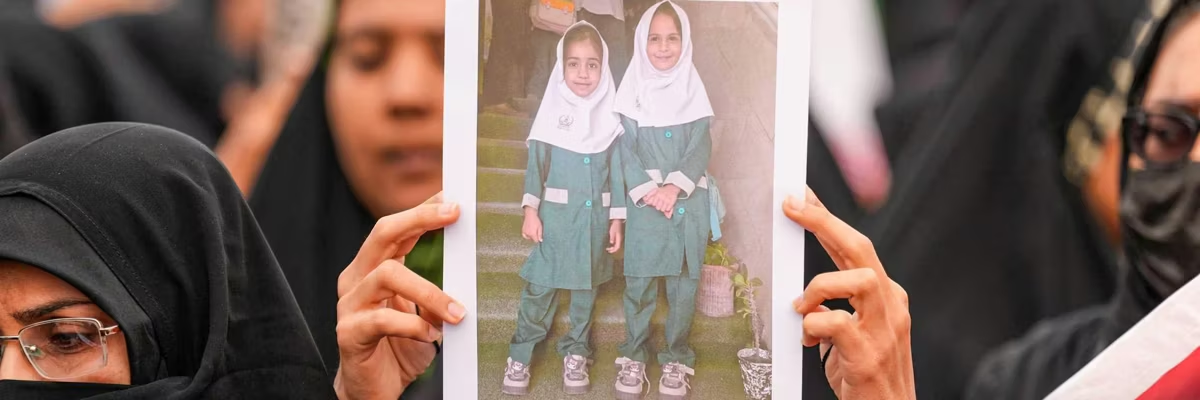

Mourners hold a portrait of a students during a funeral ceremony for children, who lost their lives after a primary school in IranĂ¢s Hormozgan province was targeted in US and Israeli attacks, on March 3, 2026 in Minab, Iran.
(Photo by Stringer/Anadolu via Getty Images

Ramzy Baroud
Mar 28, 2026
Common Dreams


Those who had the misfortune of growing up in a war zone require no explanation. War is hell, it is true—but for children, it is something else entirely: a confusing, disorienting fate that defies comprehension.

There are children who live only briefly, experiencing whatever life manages to offer them: the love of parents, the camaraderie of siblings, the fragile joys and inevitable hardships of existence.


‘Catastrophic,’ Says UNICEF: 1,100+ Children Killed or Wounded in Mideast Since US-Israel Launched Iran War


‘10 Classrooms Full of Children’: US-Israeli War Kills Hundreds of Iranian, Lebanese Kids

There are over 20,000 children in this category who have been killed in Gaza over the span of roughly two years, according to figures released by the Gaza Health Ministry and repeatedly cited by United Nations agencies. Some were born and killed within the same short time frame.

Others remain buried beneath the rubble of the destroyed strip. According to humanitarian and forensic experts cited by the United Nations Office for the Coordination of Humanitarian Affairs (OCHA), thousands of bodies are still missing under collapsed buildings, with recovery efforts hindered by the scale of destruction and lack of equipment. In some cases, extreme heat, fire, and the use of heavy explosive weaponry have rendered identification nearly impossible, meaning that many of these children may never be properly accounted for, let alone mourned at a grave.

None of us had any understanding of who these men were or why they were hurting the people who cared for us.

These children will not have graves to be visited. And if they do, many will have no living parents left to pray for them. But we will always do.

And then, there are those who are wounded and maimed—tens of thousands of them. Visiting Amro, the wounded son of a relative who perished along with his entire family in Gaza, I witnessed one of the most heartbreaking sights one could possibly endure: the wounded and maimed children of Gaza in a Turkish hospital.

There were a few teenagers, many without limbs. Hospital staff had adorned them with the beloved Palestinian keffiyeh. Those who could flashed the victory sign, and those who had no arms raised what remained of their limbs, as if to tell every wandering visitor that they stand for something deep and unyielding, that their losses were not in vain.

But then there were the little ones, who experienced trauma without fully comprehending even the magnitude of their tragedy. They stared in confusion at everyone—the unfamiliar faces, the incomprehensible languages spoken around them, the empty walls.

My nephew kept speaking of his parents, who were meant to visit him any day. They were both gone, along with his only brother.

I was in kindergarten in a refugee camp in Gaza when I witnessed my first military raid. The target was our school. I still recall our teachers pushing back against soldiers as they forced their way into the building. I remember them being physically assaulted, screaming at us to run toward the orchard.

We began running while holding hands with one another. We were all wearing matching red outfits with stickers on our faces—none of us had any understanding of who these men were or why they were hurting the people who cared for us.

If the killing of children in Gaza, Lebanon, Syria, Iran, and across the Middle East is normalized, then it will become just another accepted feature of war. And since “war is hell,” we will all move on, accepting that our children—anywhere in the world—now stand on the front lines of victimhood whenever it suits the calculations of war.

Everything we have said and done has failed Gaza, Lebanon, Syria, and much of our region.

I have thought about this often in recent years—during the devastation in Gaza, the wars across the region, and the killing of students at a school in the Iranian city of Minab.

Minab is not just an Iranian tragedy; it is our collective loss. Evidence from international investigations indicates that the strike on the Shajareh Tayyebeh school was not an accident, but the result of deliberate targeting within a broader military campaign.

Amnesty International concluded that the school building was directly struck with guided weapons. Investigations by major outlets, alongside US military sources, suggest the site had been placed on a target list despite being a functioning school. The result was devastating: children killed, families shattered, and yet another atrocity absorbed into the relentless rhythm of war.

The US administration may deny intent as often as it wishes. But we know that the killing of children is not incidental. It is evidenced in Gaza, where the scale alone defies any claim of accident. As UNICEF Executive Director Catherine Russell stated, “Gaza has become a graveyard for thousands of children.” That reality alone should end any debate.

I could pause here to tell you that all children are precious, that all lives are sacred, and that international law is unequivocal on this matter. I could invoke the Fourth Geneva Convention, which states that “protected persons… shall at all times be humanely treated,” and that violence against civilians is strictly prohibited.

Yes, I could do all of that. But I fear it would make little difference.

Everything we have said and done has failed Gaza, Lebanon, Syria, and much of our region. International law, once seen as a shield, has become little more than a point of departure for conversations about its ineffectiveness and hypocrisy.

Speaking to Palestinians about international law often generates not reassurance, but frustration and anger. So I will spare you that, too.

Instead, I want to make a call to the world.

A call on behalf of Amro, and the many others from our family who were killed, and the thousands more who perished; a call on behalf of the frightened children of the Flowers Kindergarten in my old refugee camp in Gaza: Please, do not allow them to normalize the killing of children.

Do not settle for indifference, or mere concern, or even moral outrage that is never followed by action.
French foreign minister condemns Israel killing of journalists in Lebanon

France's foreign minister said Sunday it would be "extremely serious" if Israel had deliberately targeted three journalists killed the previous day in a strike on south Lebanon.

Issued on: 29/03/2026 - RFI

A Lebanese journalist holds pictures of their colleagues, Fatima Ftouni and Ali Shoeib, at Martyrs’ Square in central Beirut during a protest against their killing from an Israeli strike that targeted their vehicle on a road leading to Jezzine in southern Lebanon on March 28, 2026. AFP - IBRAHIM AMRO

"If it is indeed confirmed that the journalists in question were deliberately targeted by the Israeli army, then this is extremely serious and a blatant violation of international law," Jean-Noel Barrot told public broadcaster France 3.

He said journalists in war zones "must never be targeted in theatres of war, including when they have links with parties to the conflict".

Ali Shoeib, a veteran correspondent for Hezbollah's Al Manar TV, Fatiman Ftouni of the pro-Hezbollah Al Mayadeen channel and her brother, cameraman Mohammad Ftouni, were all killed when their vehicle was hit in Jezzine in southern Lebanon.

Israel's military in a statement alleged that Shoeib "operated within the Hezbollah terrorist organisation under the guise of a journalist for the Al Manar network", without providing evidence.

It did not comment on the deaths of Ftouni and her brother.

Al Mayadeen said in a statement that in tribute to the journalists, Iran’s Islamic Revolution Guards Corps (IRGC) "announced wave 86 of Operation True Promise 4, dedicating the launch to their sacrifices,” which was "carried out in multiple phases, involving coordinated missile and drone strikes by its Aerospace and Naval Forces."

Meanwhile, the Washington DC-bades media watchdog Committee to Protect Journalists says it is investigating the attack, calling Lebanon "an increasingly deadly zone for journalists, despite their status as civilians who must not be targeted.”

We have seen a disturbing pattern in this war and in the decades prior of Israel accusing journalists of being active combatants and terrorists without providing credible evidence. Journalists are not legitimate targets, regardless of the outlet they work for, according to CPJ Regional Director Sara Qudah in a statement issued after the attack.
Revenge

Lebanon was pulled into the Middle East conflict when Tehran-backed Hezbollah fired rockets at Israel on March 2 in revenge for the killing of Iran's supreme leader in the opening salvo of the US-Israeli war against the Islamic republic.

Israel responded with large-scale airstrikes across Lebanon and a ground offensive in the south. Lebanese authorities say at least 1,189 people have been killed since the hostilities broke out.

Many Hezbollah flags were in evidence at the funeral in a temporary cemetery in Beirut's southern suburbs, where the group holds sway.

correspondents of French press agency AFP said hundreds of people attended the funeral, and the bodies of Shoeib and Fatima Ftouni were draped in their channels' logos and with bouquets of flowers.

"Fatima and Ali were heroes," a relative of Ftouni's who gave only his first name as Qassem told AFP.

"We will continue on this path, on this journey, even if we all become martyrs."

Ali Hashem, who had been close to Shoeib, said "losing them is very difficult", but "we will not be broken".

Lebanon's President Joseph Aoun condemned the killings as "a blatant crime".

French Foreign Minister Jean-Noel Barrot told public broadcaster France 3 on Sunday that journalists working in war zones "must never be targeted, including when they "have links with parties to the conflict".

"If it is indeed confirmed that the journalists in question were deliberately targeted by the Israeli army, then this is extremely serious and a blatant violation of international law," Barrot said.

Since the start of the previous hostilities between Israel and Hezbollah in 2023, which a November 2024 ceasefire sought to end, the CPJ has documented at least 11 Lebanese journalists and press workers killed by Israel.

In the Gaza Strip, where Israel fought a war against Palestinian armed group Hamas from October 2023 until a ceasefire last year, 210 Palestinian journalists and media workers have been killed by the Israeli military, the CPJ said.

(With newswires)

Hundreds attend funeral for Lebanese journalists killed in Israeli strike

Three journalists killed by an Israeli strike in the south of Lebanon on Saturday were laid to rest on Sunday near Beirut. The Israeli military accused one of the journalists of being a Hezbollah intelligence operative without providing evidence, and Lebanese authorities denounced a "war crime".


 29/03/2026 
By: FRANCE 24

A vigil for the slain journalists in Beirut, Lebanon on March 28, 2026.
 © Ibrahim Amro, AFP
01:34


The funeral for three journalists killed by an Israeli strike in the south of Lebanon on Saturday took place near Beirut on Sunday. Lebanese authorities called the attack a "blatant crime".

Ali Shoeib of Hezbollah's Al Manar channel and Fatima Ftouni of Al Mayadeen, seen as close to the Iran-backed movement, were killed in Jezzine, alongside Ftouni's brother, a cameraman.

READ MOREMiddle East war live: Loud blasts rock Tehran, Iran threatens US universities in the Gulf

The Israeli military confirmed killing Al Manar correspondent Ali Shoeib, accusing him of having "operated within the Hezbollah terrorist organisation under the guise of a journalist".


It did not comment on the deaths of Ftouni and her brother.

Lebanon was pulled into the Middle East war when Tehran-backed Hezbollah fired rockets at Israel on March 2 to avenge the killing of Iran's supreme leader in the opening salvo of the US-Israeli war against the Islamic republic.

Israel has responded with large-scale air strikes across Lebanon and a ground offensive in the south, with Lebanese authorities reporting at least 1,189 people killed since the hostilities broke out.

Shoeib was one of Al Manar's most prominent war correspondents, having covered Israeli attacks on Lebanon for decades.
Hundreds attend funeral

Many Hezbollah flags were in evidence at the funeral in a temporary cemetery in Beirut's southern suburbs, where the group holds sway.

AFP correspondents said hundreds of people attended the funeral, and the bodies of Shoeib and Fatima Ftouni were draped in their channels' logos and with bouquets of flowers.

"Fatima and Ali were heroes," a relative of Ftouni's who gave only his first name as Qassem told AFP.

"We will continue on this path, on this journey, even if we all become martyrs."

Ali Hashem, who had been close to Shoeib, said "losing them is very difficult", but "we will not be broken".

Lebanon's President Joseph Aoun condemned the killings as "a blatant crime".

French Foreign Minister Jean-Noel Barrot told public broadcaster France 3 on Sunday that journalists working in war zones "must never be targeted, including when they "have links with parties to the conflict".

"If it is indeed confirmed that the journalists in question were deliberately targeted by the Israeli army, then this is extremely serious and a blatant violation of international law," Barrot said.

Since the start of the previous hostilities between Israel and Hezbollah in 2023, which a November 2024 ceasefire sought to end, the Committee to Protect Journalists (CPJ) has documented at least 11 Lebanese journalists and press workers killed by Israel.

In the Gaza Strip, where Israel fought a war against Palestinian armed group Hamas from October 2023 until a ceasefire last year, 210 Palestinian journalists and media workers have been killed by the Israeli military, the CPJ said.
'Blatant crime'

Lebanese President Joseph Aoun condemned the killings, calling them "a blatant crime that violates all the norms and treaties under which journalists enjoy international protection in wars".

Prime Minister Nawaf Salam said the targeting of journalists was "a flagrant violation of international humanitarian law", while Information Minister Paul Morcos deemed the actions to be "war crimes".

A strike on central Beirut earlier this month killed Mohammad Sherri, Al Manar's political programmes director.

Several journalists were also killed and wounded during the previous round of hostilities between Israel and Hezbollah in 2023 and 2024.

At least five journalists were killed in Israeli strikes in the south in that conflict, including a correspondent for Al-Mayadeen TV and a cameraman for Al-Manar.

In October 2023, Reuters journalist Issam Abdallah was killed and six others wounded, including AFP journalists Dylan Collins and Christina Assi while covering the conflict near the Israeli border.

An independent AFP investigation concluded that two Israeli 120mm tank shells were fired from the Jordeikh area inside Israel.

(FRANCE 24 with AFP)
 

Assault on Journalists Shows How Israeli Military Acts ‘In Service of The Settler Movement’: CNN Reporter

“Messiah complexes, talk of revenge, and the use of force against journalists are just symptoms of what’s been happening to the army over the past three years,” said one Israeli journalist.


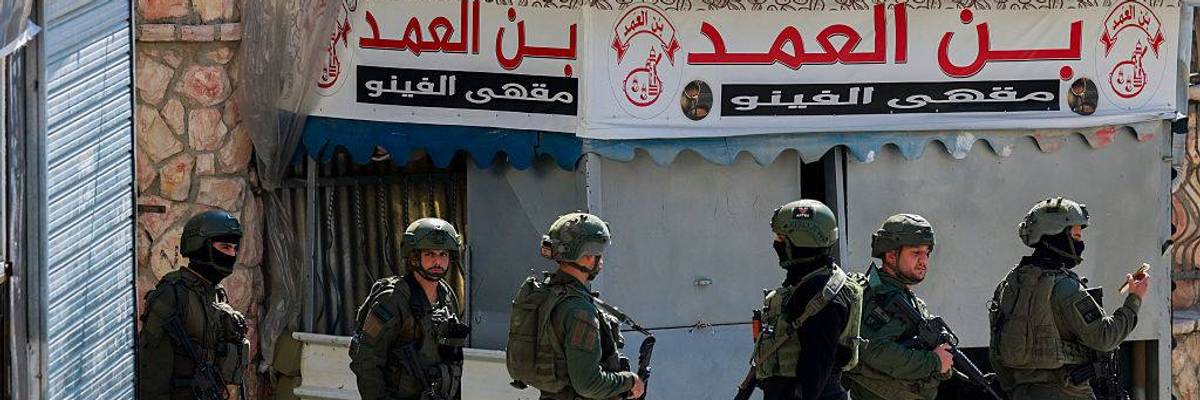
Israeli soldiers patrol astreet during a military operation in the Askar refugee camp in eastern Nablus, Israeli-occupied West Bank, on March 2, 2026.
(Photo by Jaafar ASHTIYEH / AFP via Getty Images)


Brad Reed
Mar 28, 2026
COMMON DREAMS

Soldiers in the Israel Defense Forces on Friday were caught on camera assaulting and detaining a crew of CNN journalists while they were reporting from the occupied West Bank.

A video of the incident posted on social media by CNN Jerusalem correspondent Jeremy Diamond shows the CNN crew walking near the Palestinian village of Tayasir, which in recent days has come under assault from Israeli settlers who established an illegal outpost in the area.

The crew are then accosted by armed members of the IDF, who order them to sit down. After the crew complies with their commands, the soldiers come to seize the journalists’ cameras and phones that are being used to record the incident.

A soldier then puts CNN photojournalist Cyril Theophilos in a chokehold and forces him to the ground. Writing about the assault later, Theophilos said that the soldier “pushed and strangled me,” adding that this kind of violence “is just a symptom of the IDF’s actions in the West Bank.”

According to Diamond, the CNN crew were subsequently detained for two hours. During that time, Diamond wrote, it became clear that the ideology of the Israeli settlers movement was “motivating many of the soldiers who operate in the occupied West Bank” and that the Israeli military regularly acts “in service of the settler movement.”

For instance, one IDF soldier acknowledged during conversations with the CNN crew that the settler outpost near Tayasir was unlawful under both international and Israeli law, but insisted “this will be a legal settlement... slowly, slowly.”

The soldier also said he wanted to exact “revenge” on local Palestinians for the death of 18-year-old Israeli settler Yehuda Sherman, who was killed last week by a Palestinian driver. Palestinians who witnessed Sherman’s killing have said that the driver was trying to stop Sherman from stealing sheep.

The IDF issued an apology to CNN over the incident, insisting that “the actions and behavior of the soldiers in the incident are incompatible with what is expected of IDF soldiers.”

However, this apology was deemed insufficient by Barak Ravid, global affairs correspondent for Axios.

“Apologies are not enough,” he wrote on social media. “There is a need for clear accountability. 99.9% of the time there is zero accountability.”

The soldiers’ actions also drew condemnation from Haaretz reporter Bar Peleg, who argued that problems in the IDF have only grown worse under the far-right government led by Prime Minister Benjamin Netanyahu.

“Messiah complexes, talk of revenge, and the use of force against journalists are just symptoms of what’s been happening to the army over the past three years,” Peleg said. “The chief of staff and the commanding general can write another thousand letters and wave flags all they want, but the process already seems irreversible.”

Palestinian human rights activist Ihab Hassan argued that incidents like the one captured by CNN are all too common for the IDF.

“The Israeli army arrests and assaults journalists, while settlers who commit horrific crimes against Palestinian civilians enjoy total impunity,” he wrote. “This is state-backed terrorism.”


“Price Tag” Attacks Part of Effort to Expand Israeli Settlements in West Bank

200 masked settlers descended on the West Bank on March 22, throwing Molotov cocktails and terrorizing Palestinians.
March 28, 2026

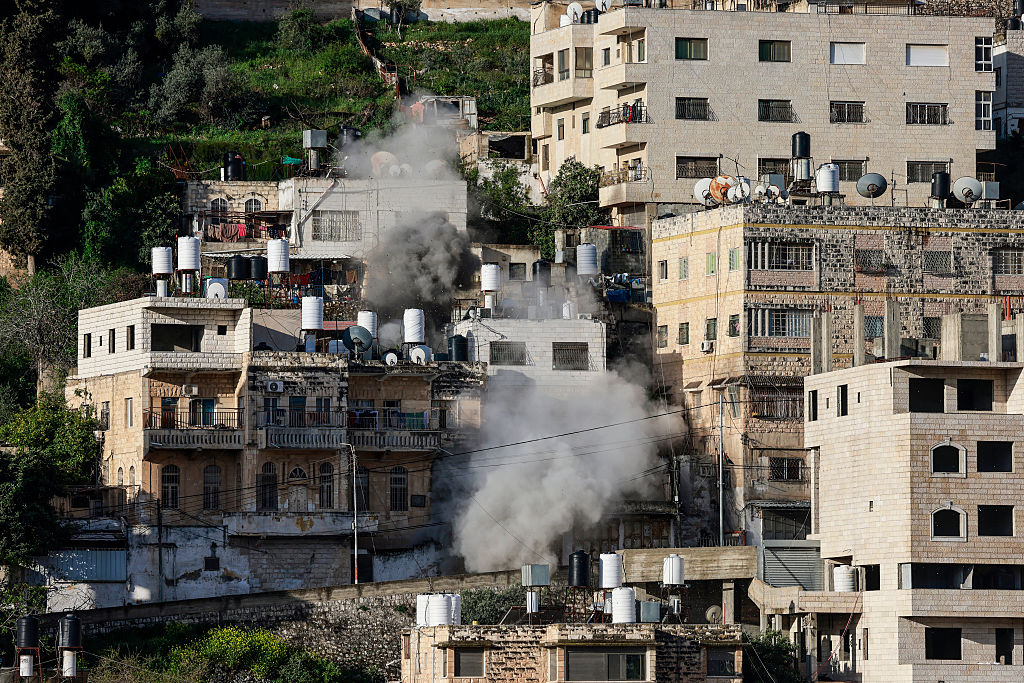
Israeli authorities demolish the house of Mahmoud al-Aqqad, a Palestinian man who was killed last year near Qalqilyah after reportedly killing an Israeli soldier, in the occupied West Bank city of Nablus, on March 28, 2026.Jaafar ASHTIYEH / AFP via Getty Images

Al-Funduqumiya, West Bank — On March 21, a Palestinian vehicle collided with an ATV near the village of Beit Imrin in the West Bank, killing the ATV driver.

Had it not been for the fact that the driver of the ATV was 18-year-old Yehuda Sherman of the illegal Israeli outpost of Shuva Yisrael Farms, the incident would likely have been handled as an ordinary traffic accident.

Instead, the day after the collision, Israeli settlers from a cluster of nearby outposts in the Homesh corridor — many of which do not even have names due to their recent establishment — launched a “price tag” attack on nearby Palestinian communities, including al-Funduqumiya, setting fire to vehicles and homes and injuring at least 10 Palestinians, according to the Palestinian Red Crescent Society.


“Price tag” attacks — incidents in which settlers target Palestinians in retaliation for violence by Palestinians against Israeli settlers or in response to efforts to interfere with settlement expansion — have been a feature of the Israeli settler movement since Israel’s 2005 disengagement from the West Bank and Gaza Strip and the 2006 destruction of the illegal settlement at Amona.

At that point, the settler movement — now led by an umbrella organization called the Yesha Council but originally under the leadership of the right-wing Gush Emunim movement — began adopting retaliatory attacks as a distinct policy to advance their goal of settling the entirety of the West Bank.


As the War on Iran Spirals On, Israel Further Blocks Movement Within West Bank
Without sirens or bomb shelters, Palestinians in the West Bank are witnessing the blowback to Israel’s war on Iran. By Theia Chatelle , Truthout March 5, 2026


According to documentation assembled by the Palestinian human rights group Al-Haq for Truthout, a group of at least 200 masked settlers entered al-Funduqumiya on the night of March 22. They, who hid inside their homes, fearing they would be killed.

These attacks in response to Sherman’s death form part of a broader wave of violence across the West Bank, according to the human rights organization B’Tselem. Israeli police are investigating and have not classified the incident as a homicide, but settlers have treated it as an intentional assault.

At Sherman’s funeral on March 22, in Elon Moreh, his father described his son’s death as a communal sacrifice and called on the Israeli government to dismantle the Oslo Accords, which established a framework for a two-state solution, and to expand Israeli settlements in the West Bank.

What distinguishes this attack from others in the recent wave is not its violence or the number of Palestinians injured, but where many of the settlers involved live. The Homesh corridor, near the Palestinian city of Nablus, is not new to Israeli settlement, but compared to other parts of the West Bank it has largely been spared large-scale expansion.

Homesh itself was one of four northern West Bank settlements evacuated as part of Israel’s 2005 disengagement from the West Bank and Gaza, in which Israel unilaterally withdrew all settlers and military presence from inside the territories. In statements ahead of the withdrawal, then-Prime Minister Ariel Sharon described the move as a “painful step for Israel,” but one intended to “improve Israel’s security situation.” While most attention focused on Gaza, the disengagement also included those four West Bank settlements. More than 8,000 Israelis left the Gaza Strip under the plan.

The settlements of Ganim and Kadim, located near Jenin — long a center of armed Palestinian activity — were two of the four settlements evacuated in the West Bank. Reporting at the time, in the aftermath of the Second Intifada, described life in these settlements as brutal for largely secular residents, who had moved there seeking lower housing costs and a life away from Israel’s coastal cities, in contrast to the increasingly ideological settlers who continued to establish outposts on nearby hilltops driven by a messianic vision of Jewish settlement in what they call “Judea and Samaria.”

The Israeli Knesset formally repealed parts of the disengagement law in 2023. Palestinian eyewitnesses from nearby communities said settlers moved quickly to reestablish a presence following the repeal. In December 2025, settlers, escorted by the Israeli military, held a Hanukkah menorah-lighting ceremony at the site of Ganim and Kadim.

Now that the four disengagement settlements have been formally approved for resettlement, nearby outposts have followed. From the hills of Sebastia (another Palestinian village that has repeatedly come under settler attack), Palestinian filmmaker and journalist Ahmad al-Bazz said the outposts, some still without names, have expanded noticeably.

“I was here a few weeks ago, and even since then, I can tell that the outposts have gotten larger,” he said, gesturing to a newly installed Israeli flag on one of the hilltops. “That wasn’t even there last time I was in Sebastia.”

Al-Bazz, who is from Nablus, has witnessed both the 2005 disengagement and the gradual return of settlements, along with the fear it has generated not only in Jenin, closest to Ganim and Kadim, but in Nablus as well.

During Operation Iron Wall, which saw the Israeli military forcibly depopulate the Jenin refugee camp in January 2025 and subsequently use it as a military base, the campaign has contributed to a willingness among settlers to return to the north. Residents have not been allowed to return or retrieve their belongings, and the military has carried out systematic demolitions of Palestinian homes, as documented by Forensic Architecture.

Ubai Aboudi, director of the Ramallah-based nonprofit the Bisan Center for Research and Development, offered a similar assessment, stating Palestinian villages near the newly established outposts are likely to face increasing settler attacks as settlers seek to assert control over the land.

“Israel is pushing the settlers in a coordinated effort that is supported by the Israeli government, protected by the Israeli Army and police, and enjoys impunity in burning the property of Palestinians, killing Palestinians, and going for the ultimate goal of driving Palestinians out of their lands.”

The recent wave of attacks is one sign of increasing Israeli resettlement in the Homesh corridor. According to B’Tselem researchers and reporting by Oren Ziv in +972 Magazine, settlers have nearly completed efforts to clear Israeli-controlled Area C of vulnerable Palestinian communities, particularly Bedouin communities at heightened risk of displacement. They are operating with financial and logistical support from the Israeli state, including weapons and vehicles distributed through Israel’s Ministry of National Security.

“We are talking about 58 Palestinian communities already being depopulated in the last 12 weeks, and this process is continuing,” said B’Tselem spokesperson Yair Dvir in an interview with Truthout. “What we are seeing now is that the settlers are about to finish the ethnic cleansing in Area C.”

Dvir said that while the area was not entirely free of settlements prior to the reestablishment of the disengagement settlements, their return signals a shift in priorities within the settlement movement, suggesting that earlier efforts to reshape Area C are largely complete.

“The settlers today also have their own representatives at all levels of the state, from the government to the army to the high courts,” Dvir said. “It’s something that now works together.”

The fact that many of the settlers involved in the recent wave of attacks originated from the Homesh corridor, he added, signals the potential for further escalation in settler violence in the northern West Bank.

Some U.S. lawmakers, including prominent pro-Israel Democrats, publicly condemned last week’s surge in settler attacks, labeling them “terrorism.” Since then, however, Israel has announced plans to establish 22 new settlements in the occupied West Bank.

“This is part and parcel of the bigger picture, which is to create a complete sense of insecurity for Palestinian communities so they can be driven entirely out of the West Bank,” Aboudi said.


Theia Chatelle


Theia Chatelle is a freelance journalist and photographer covering conflict, human rights, and displacement across the Middle East, Europe, and the United States. Based in Jerusalem, she reports on war and social movements, with a focus on human-interest storytelling and investigations into state power. Her work has appeared in The Forward, The Nation, Haaretz, and the Jewish Telegraphic Agency, among other outlets. Her photography has been published by MS NOW and USA Today, among others. Chatelle holds bachelor’s and master’s degrees in American Studies from Yale University. She was a 2025 fellow at the International Women’s Media Foundation and is an alumna of the Rory Peck Trust and the Type Media Center.
HOW THE WORLD SAW IT
'No Kings' Protests Draw Millions Across US And Europe Against Trump Administration


The protests, the third in a series that began in 2025, focused on several key grievances: US involvement in the war with Iran, strict immigration policies including enforcement actions that have drawn criticism


Outlook News Desk
Curated by: Pritha Vahsishth
Published at: 29 March 2026 


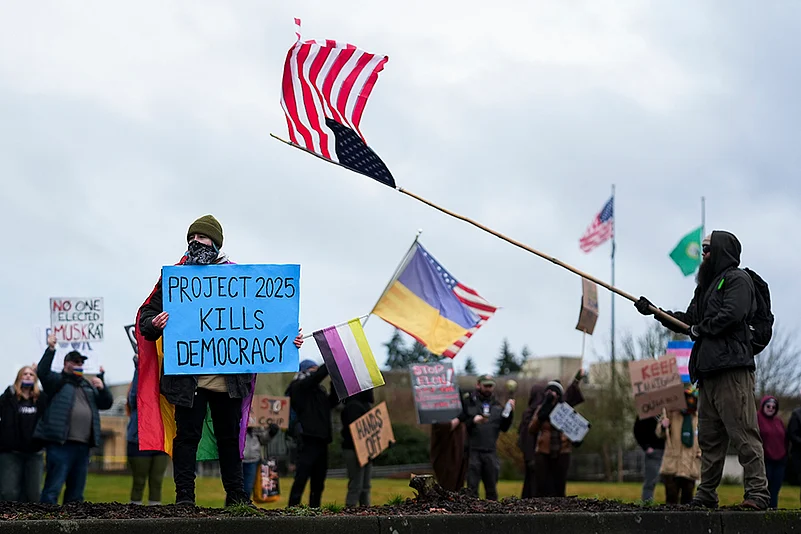
Protest near the Washington State Capitol building | Photo: AP/Lindsey Wasson


Summary of this article


Organizers claim millions participated in over 3,000 "No Kings" rallies held across all 50 US states and in more than a dozen countries including European cities like London, Paris, Berlin, and Rome, marking the third major wave of demonstrations since President Trump took office in 2025.


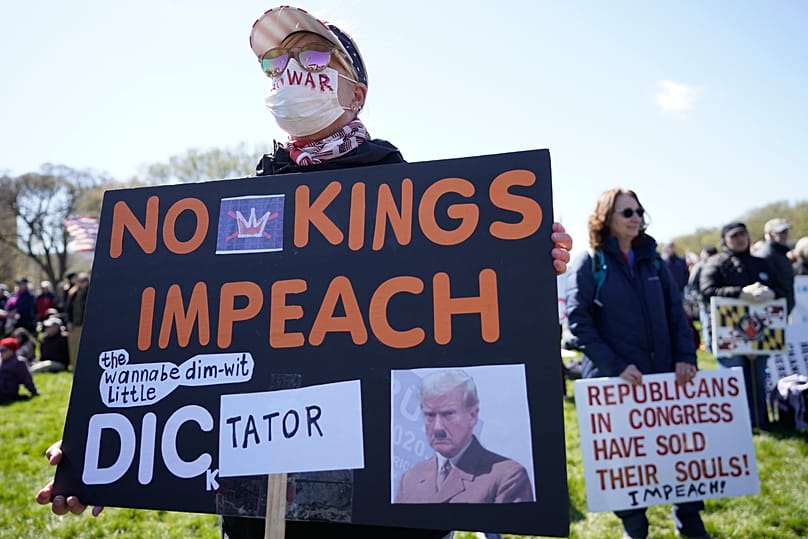
Protesters voiced opposition to the ongoing war with Iran, aggressive immigration enforcement, rising cost of living, and what they describe as authoritarian tendencies and expansion of executive power by the Trump administration.


The flagship event in Minnesota, headlined by Bruce Springsteen, drew large crowds at the State Capitol, while Republican officials dismissed the protests as "Hate America" or "Trump Derangement" events; turnout estimates vary, with previous rounds in 2025 drawing 5–7 million according to organizers.


Large-scale "No Kings" protests unfolded across the United States and parts of Europe, with organizers describing the day as one of the biggest mobilizations against the Trump administration to date. Demonstrations took place in more than 3,000 locations spanning all 50 states, from major cities like New York, Washington D.C., and Los Angeles to small towns and suburban areas. Solidarity events were also held in over a dozen countries, including rallies in London, Paris, Berlin, Madrid, and Rome, often organized by groups like Democrats Abroad.


The protests, the third in a series that began in 2025, focused on several key grievances: US involvement in the war with Iran, strict immigration policies including enforcement actions that have drawn criticism, and broader concerns over rising living costs and perceived overreach of presidential authority/


'Trump Is An Existential Threat': Robert De Niro Joins No Kings Protests; Jane Fonda, Bruce Springsteen & Others Attend

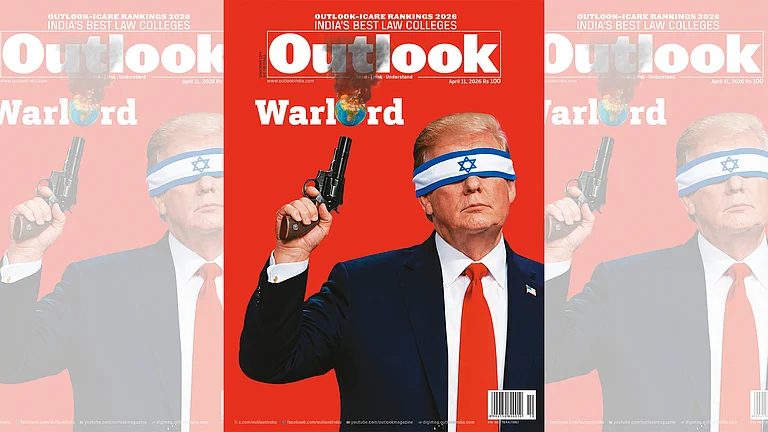
Outlook's Latest Issue: The Warlord With 'A Passion' For Peace

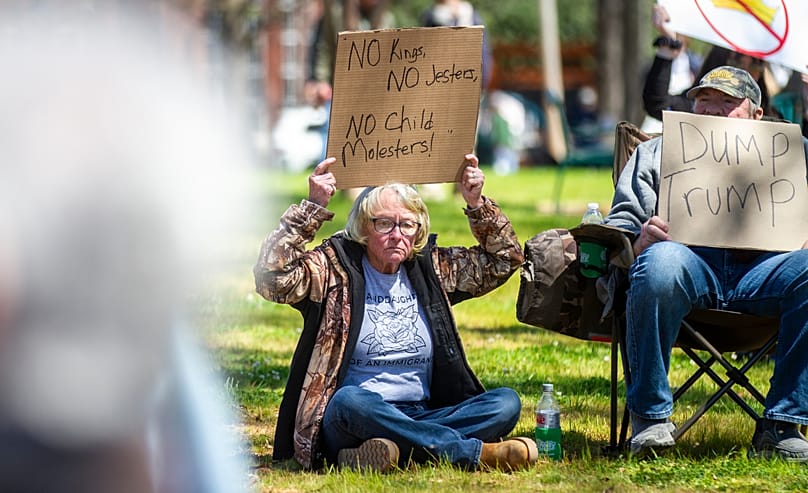
In Minnesota, which served as the flagship venue, thousands gathered at the State Capitol in St. Paul, where musician Bruce Springsteen performed to highlight local resistance to federal immigration measures. Protesters carried signs reading "Democracy Has No Kings" and chanted against what they called authoritarian rule.

Previous "No Kings" events reportedly drew millions , with organizers citing around 5 million in June 2025 and nearly 7 million in October 2025, and Saturday's turnout was expected to be significant, though independent verification of exact numbers remains challenging amid varying claims. Events remained largely peaceful, though some states had mobilized National Guard units as a precaution. In European cities, smaller but symbolic gatherings saw participants adapt messaging — using phrases like "No Tyrants" in monarchies such as the UK, Spain, and Sweden to avoid confusion.


Paris protesters join massive demonstrations against Trump across world on 'No Kings' day

Huge crowds of protesters rallied across the world, but mainly in the United States on Saturday against President Donald Trump, venting their fury over what they see as his authoritarian style of governing, his hardline immigration policies and the war with Iran.


Issued on: 29/03/2026 - RFI

A board during an anti-Trump rally, at “No King’s Day" at Place de la RĂ©publique, Paris, 28 March 2026. © Screenshot X

Organizers said "at least 8 million people gathered today at more than 3,300 events across all 50 states," from big cities and small towns. US authorities provided no national crowd estimate.

It was the third time in less than a year that Americans have taken to the streets as part of a grassroots movement called "No Kings," the most vocal and visual conduit for opposition to Trump since he began his second term in January 2025.

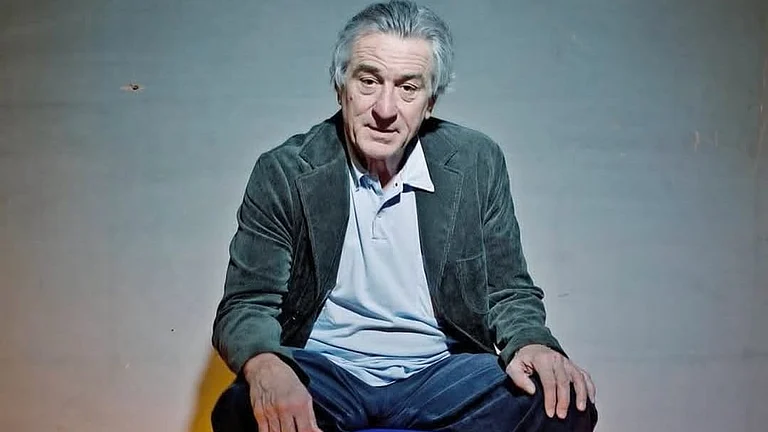
In New York, America's most populous city, tens of thousands of demonstrators rallied, including Oscar-winning actor Robert De Niro, a frequent Trump critic, who called the president "an existential threat to our freedoms and security."

Demonstrators rally in front of the Lincoln Memorial during the No Kings protest in Washington, Saturday, March 28, 2026. AP - Jose Luis Magana

Protests unfolded from Atlanta to San Diego, with Alaskans joining the mix later in the day.

"No country can govern without the consent of the people," 36-year-old military veteran Marc McCaughey told French press agency AFP in Atlanta, where thousands turned out.

"We're out here because we feel that the Constitution is under threat in a multitude of different ways. Things aren't normal. They aren't okay."

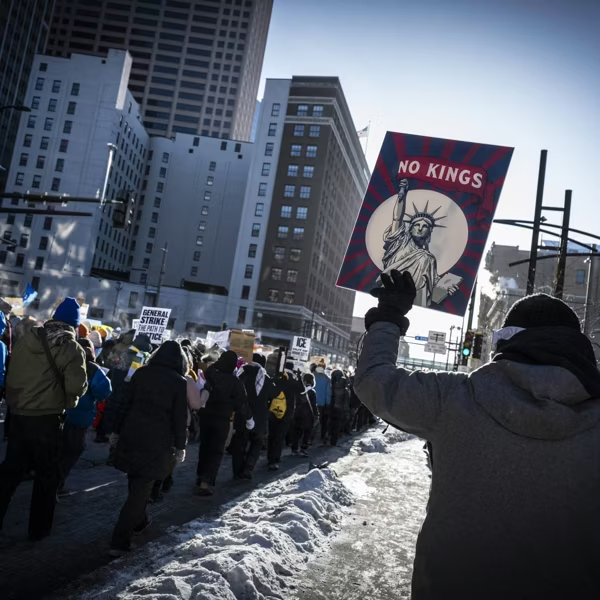
In the Michigan town of West Bloomfield, near Detroit, people braved below-freezing temperatures to protest.

And in the US capital Washington, thousands of marchers -- some carrying banners that blared "Trump Must Go Now!" and "Fight Fascism" -- flocked to the National Mall.

"He keeps lying and lying and lying and lying, and no one says anything. So it's a terrible situation we're in," 67-year-old retiree Robert Pavosevich told AFP.
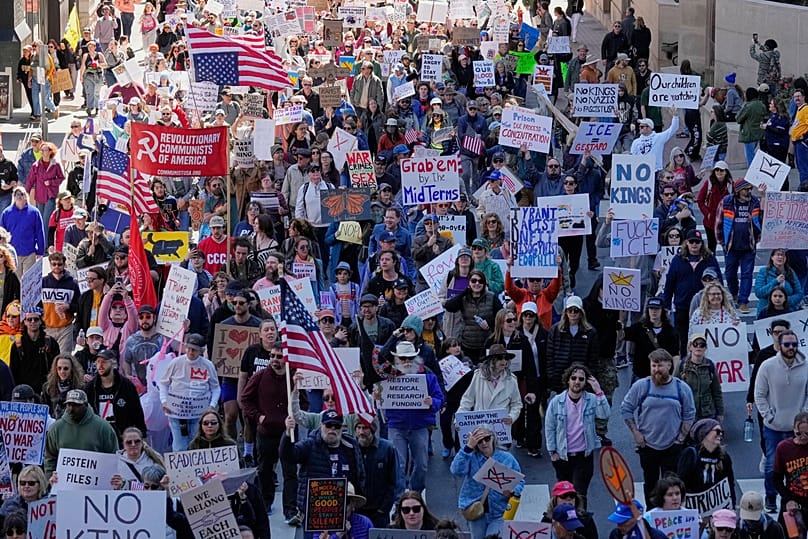
Demonstrators hold up their banners as they march across the Memorial Bridge during a "No Kings" protest in Washington, Saturday March 28, 2026. AP - Jose Luis Magana


Trump himself was in Florida for the weekend.

The anti-Trump mood has spilled beyond US borders, with rallies Saturday in European cities including Paris, Amsterdam, Madrid and Rome, where 20,000 people marched under a heavy police presence. Hundreds of people also gathered at the Place de la République in Paris, including Americans who reside in France.

The first "No Kings" nationwide protest day came last June on Trump's 79th birthday and coincided with a military parade he organized in Washington. Several million people turned out, from New York to San Francisco.
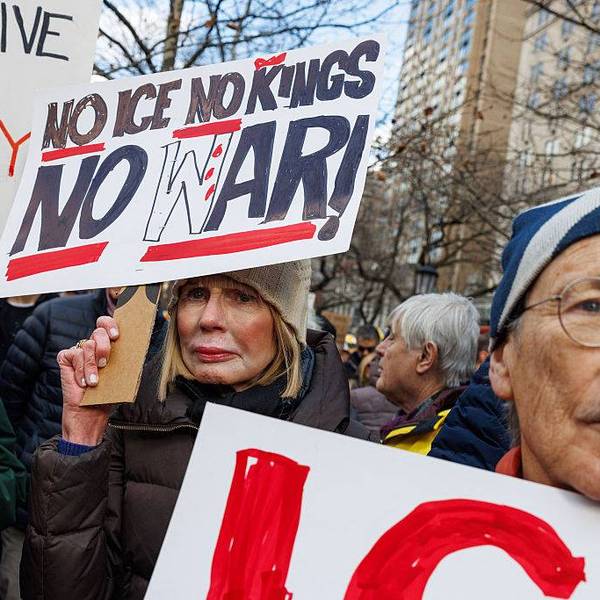
Des manifestants brandissent des pancartes sur lesquelles on peut lire « Non Ă  la guerre » et « Non aux rois » lors d'une marche contre le fascisme organisĂ©e Ă  l'occasion de la JournĂ©e iDemonstrators hold "No to War" and "No Kings" signs during an International Women’s Day march against fascism on Boston Common in Boston, Massachusetts, on March 8, 2026. © AFP - JOSEPH PREZIOSO


The second such protest, in October, drew an estimated seven million protesters, according to organizers, who said Saturday's events saw one million more participants and 600 additional demonstrations.

(With newswires)


‘No Kings!’ 8 Million Rally Against Trump in Largest Single-Day Protest in US History

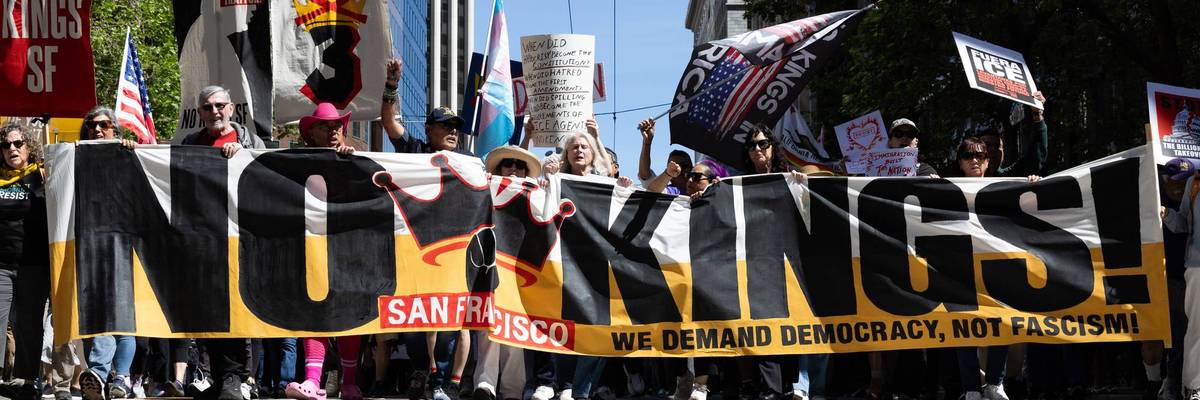
In San Francisco, thousands of anti-Trump activists gathered on a local beach to form a human sign that read, “Trump must go now! No ICE, no wars, no lies, no kings.”


Demonstrators carry a “No Kings” banner along Market Street at a “No Kings” protest on March 28, 2026 in San Francisco, California. This is the third nationwide “No Kings” protest held against the Trump administration.
(Photo by Benjamin Fanjoy/Getty Images)


Brad Reed
Mar 28, 2026
COMMON DREAMS

Millions of American across all 50 states on Saturday rallied against President Donald Trump and his authoritarian agenda during nationwide No Kings protests.

The flagship No Kings rally in Minneapolis, which organizers Indivisible estimated drew over 200,000 demonstrators, featured speeches from Minnesota Gov. Tim Walz and US Sen. Bernie Sanders (I-Vt.), Rep. Ilhan Omar (D-Minn.), and actress Jane Fonda, as well as a special performance from rock icon Bruce Springsteen, who performed “Streets of Minneapolis,” a song he wrote in tribute of slain protesters Renee Good and Alex Pretti.


Organizers called it “the largest single-day nationwide demonstrations in US history,” with an estimate 8 million people coming out for events in communities and cities nationwide.

From major cities to rural towns that have never seen mobilizations like this before, protesters made clear that in America, we don’t do kings,“ the No Kings coalition said in a statement.

“This is what it looks like when a movement grows—not just in size, but in reach, in courage, and in more people who see themselves as part of this movement,” the organizers said. “The American people are fed up with this administration’s power grabs, an illegal war that Congress and the public haven’t approved, and the continued attempts to stifle our freedoms. We’re not waiting for change; we’re making it.”

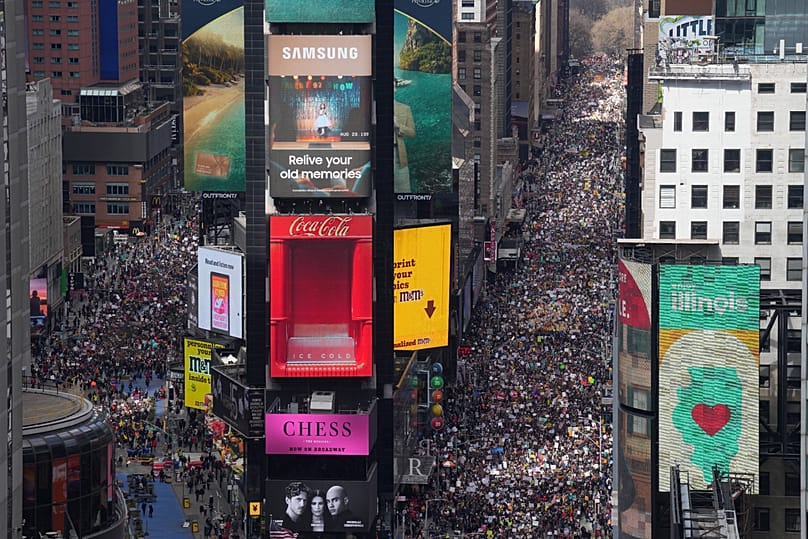
The rally in Minneapolis was one of more than 3,300 No Kings events across the US and internationally, and aerial video footage showed massive crowds gathered for demonstrations in cities including Washington, DC, New York City, Boston, Philadelphia, Chicago, and San Diego.


In San Francisco, thousands of anti-Trump activists gathered on a local beach to form a human sign that read, “Trump must go now! No ICE, no wars, no lies, no kings.”


However, No Kings rallies weren’t just held in major US cities. In a series of social media posts, Indivisible co-founder Leah Greenberg collected photos and videos of No Kings events in communities including Arvada, Colorado, Madison, New Jersey, and St. Augustine, Florida, as well as international No Kings events held in London and Madrid.

Attendance estimates for Saturday’s No Kings protests were not available as of this writing. Polling analyst G. Elliott Morris estimated that the previous No Kings event, held in October, drew at least 5 million people nationwide, making it likely “the largest single-day political protest ever.”


Conservative icon: The public has finally taken power away from the elites


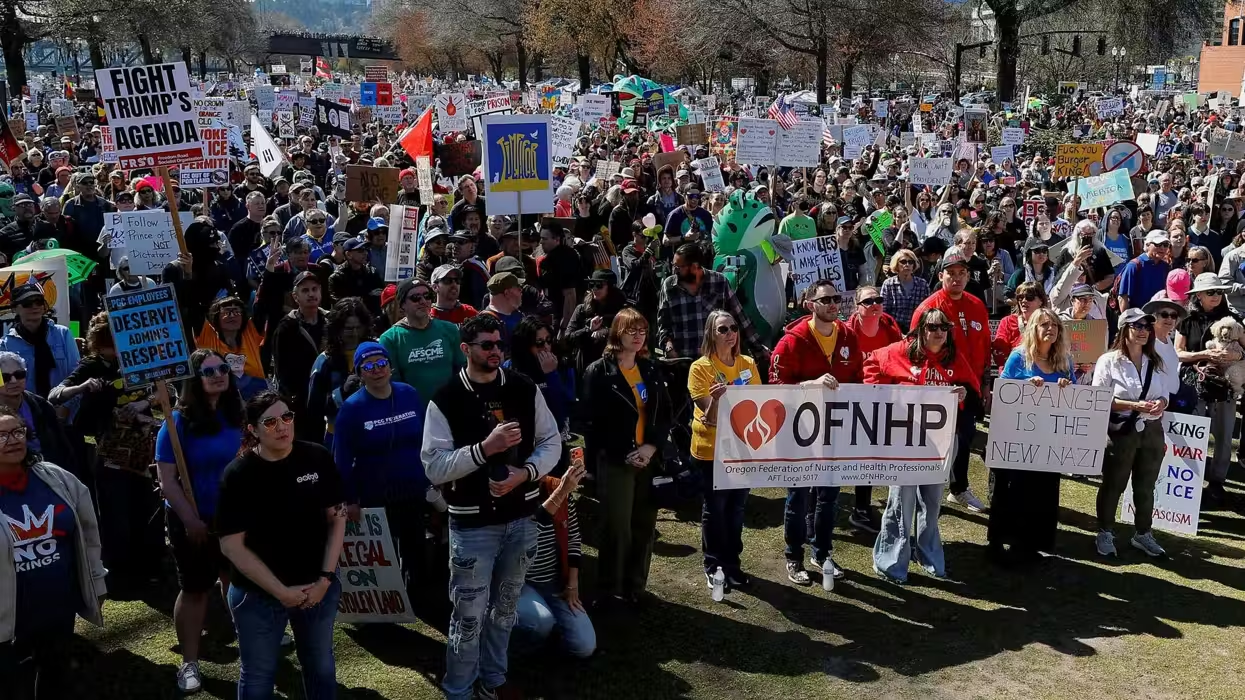
Demonstrators attend a "No Kings" protest against U.S. President Donald Trump's administration policies, in Portland, Oregon, March 28, 2026. REUTERS/John Rudoff

March 29, 2026 
ALTERNET

President Donald Trump is increasingly unpopular, as the No Kings protests demonstrate — and this means that right now “the public is leading the elites” in standing up for democracy, at least according to one conservative commentator.

“This all ends with enough of us saying no,” conservative commentator William Kristol said on his website The Bulwark on Sunday. “The bad news is that Trump is president for the next almost three years, and in the sense that we don't have a parliamentary system, his poll numbers could go down further and people could turn out even more.”

Kristol added, “But hopefully the elites — I feel like the public is now leading the elites by quite a lot. It's so striking, right? In terms of turning against Trump, you see it in the polls, but also in the turnout for 'No Kings.' And the elitist institutions are still accommodating Trump to a somewhat shocking degree.”

According to polling analyst G. Elliott Morris, an October No Kings event drew at least 5 million people all over America, marking it as the “largest single-day political protest ever.” Even though repeatedly claims he won the 2024 presidential election in a “landslide” (in fact he won the popular vote by roughly 1.5 percent, with less than a majority of 50 percent). MSNBC reporter Antonia Hylton found that one October event in New York City “far exceeded” the original estimated turnout of 200,000.

Kristol, despite being a lifelong conservative Republican, has repeatedly and emphatically criticized Trump for what he argues are the president’s assaults against American democracy. In February, as Trump continued dragging his feet on releasing the Jeffrey Epstein files and said he was “sad” at the arrest of the UK’s former Prince Andrew, Kristol wrote that “there is no evidence the Trump administration has any interest in seeing justice done, or any intention of having the truth come out. We have an executive branch that is on the side of the Epstein class, not the Epstein survivors.”

In February, Kristol praised Americans like Minneapolis residents who protected Trump’s ICE and its brutal deportation of immigrants.

“The American people are better than our current government,” Kristol said. “Civic spirit and enlightened patriotism are by no means dead in the United States. As the people of Minnesota have again reminded us.” He also argued that Trump administration officials do not understand the principles of the American revolution that they claim to honor.

“The administration in which Rubio serves pretends to celebrate that revolution, but hates the abstract truth which animated that revolution and which elevates it above merely another mundane struggle for power or profit,” Kristol said. “The Trump administration hates that fact because it is a reminder that there is more to life than power and profit. And it hates that truth precisely because it remains a stumbling block to tyranny and oppression.”

Kristol has also blisteringly denounced Trump’s rationale, or lack thereof, for declaring war against Iran earlier in March.

“Why did we go to war four days ago?” Kristol asked. “And why are we going to continue this war, apparently for weeks or longer? The Trump administration can’t answer either question.”


Anti-Trump protests outweigh supporter rallies - Statista

Anti-Trump protests outweigh supporter rallies - Statista
Anti-Trump protestors are far more active than pro-Trump supporters in the US. / bne IntelliNewsFacebook
By Katharina Buchholz for Statista March 28, 2026

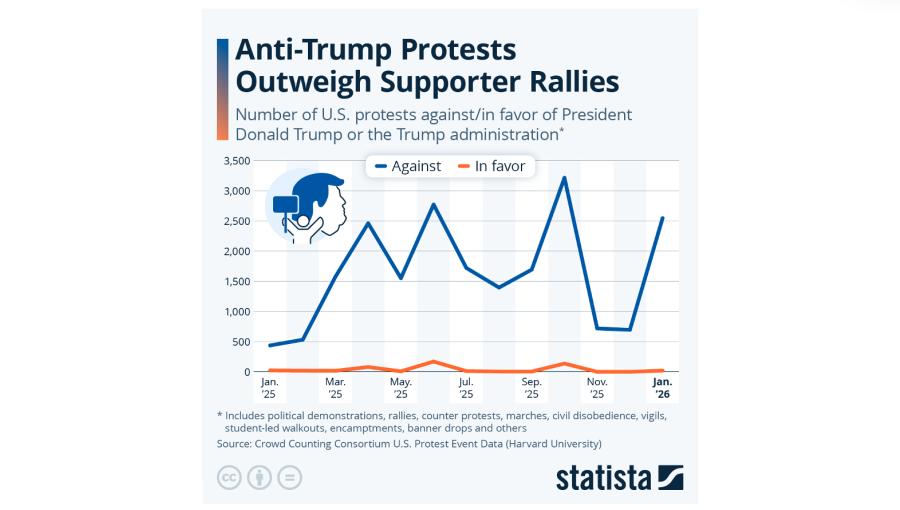
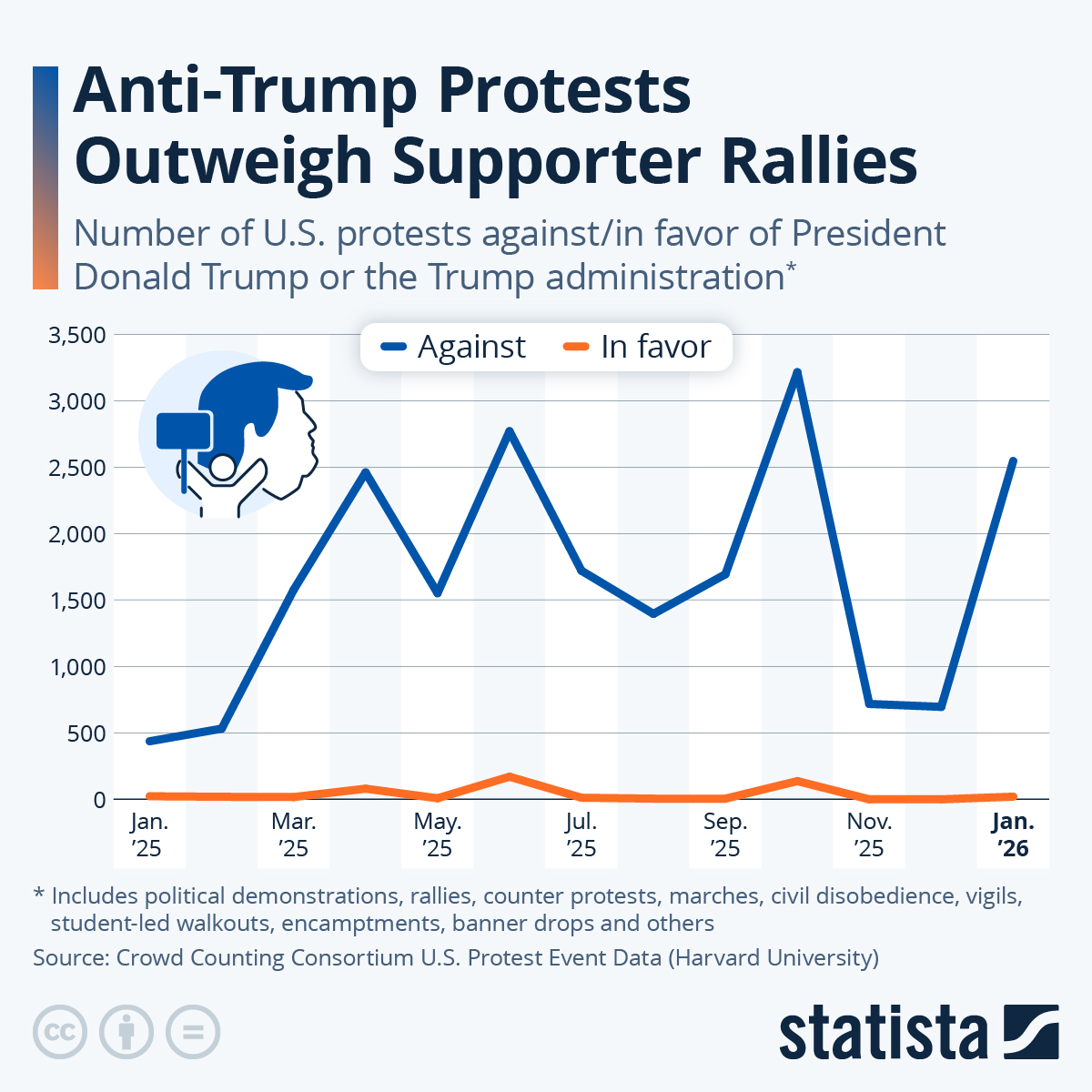
Protests in the United States against President Donald Trump or the Trump administration by far outweigh rallies organized by Trump supporters, Statista reports.

This is according to data from the Crowd Counting Consortium at Harvard University. The number of protest actions counted spiked in April as well as in June and October of 2025, the latter two dates coinciding with the coordinated, U.S.-wide No Kings rallies that the consortium says were among the largest single-day protests in U.S. history with around 5 million and 7 million participants, respectively. In January of 2026, another spike was due to the National Shutdown or ICE Out protests against the conduct of Immigration and Customs Enforcement agents and the Trump administration's policies connected to the agency.

The CCC says that its numbers "rebut the narrative that there is 'no resistance' to the second Trump administration".

On this Saturday, another installment of the No Kings protest series that denounces authoritarian power grabs and their possibility in the U.S. under Donald Trump will take place. The event is projected to be the biggest anti-Trump protest ever as demonstrations are spreading across districts that voted for Trump in 2024 and even across the globe.

At the headline event in St. Paul, Bernie Sanders, Joan Baez, Bruce Springsteen and Jane Fonda will perform or speak. Across the United States, more than 3,000 separate protests are scheduled, about the same level as the October installment of the series.


You will find more infographics at Statista


Huge crowds protest against Trump in 'No Kings' rallies in the US and abroad


By Lucy Davalou with AP, AFP

Organisers said at least eight million people participated in more than 3,300 events across all 50 US states.

Millions of people took to the streets across the US - and to a lesser extent worldwide - on Saturday to protest against US President Donald Trump on a range of different issues, in what they see as his authoritatian style of governance, hardline immigration policies, climate change denial and the war with Iran.

Organisers said that at least eight million people took part in more than 3,300 events held in major cities, suburbs and rural areas.

Protests were mostly peaceful, but some arrests were reported in Los Angeles and Denver, according to local police.

It is the third time in less than a year that people protest in the US as part of a grassroots movement called "No Kings".

The first such nationwide protest day took place last June on Trump's 79th birthday and coincided with a military parade he organised in Washington. Several million people turned out, from New York to San Francisco. The second, in October last year, drew an estimated seven million protesters, according to organisers.

People attend a "No Kings" protest Saturday, 28 March, 2026, in New York.
People attend a "No Kings" protest Saturday, 28 March, 2026, in New York. AP Photo

In New York City, tens of thousands of people rallied on Saturday, including Oscar-winning actor Roberto De Niro who called the US President "an existential threat to our freedoms and security".

Demonstrators rally during the No Kings protest in Washington, Saturday, 28 March, 2026.
Demonstrators rally during the No Kings protest in Washington, Saturday, 28 March, 2026. AP Photo

In the US capital Washington, thousands of marchers - some carrying banners that blared "Trump Must Go Now" and "Fight Fascism" - flocked to the National Mall.

"He keeps lying and lying and lying and lying, and no one says anything. So it's a terrible situation we're in," one protester told news agency AFP.

Demonstrators hold signs during the "No Kings" rally at Wilson Park in Florence, Ala, on Saturday, 28 March, 2026.
Demonstrators hold signs during the "No Kings" rally at Wilson Park in Florence, Ala, on Saturday, 28 March, 2026. AP Photo

A deeply divided country

The event highlighted the deep political divide that currently exists in the US. While Trump is largely worshipped within his "Make America Great Again" movement, he is equally disliked by his foes, who decry his penchant for ruling by executive decree, use of the justice system to prosecute opponents, as well as his repeated climate change denial and apparent obsession wih fossil fuels.

Many of his opponents are also unhappy about his scrapping of racial and gender diversity programmes and his flexing of US military power after campaigning as a man of peace who would avoid wars.

The White House dimissed the rallies, however, with a spokesperson describing them as being the product of "leftist funding networks" that lack true public support.

"The only people who care about these Trump Derangement Syndrome Therapy Sessions are the reporters who are paid to cover them," spokesperson Abigail Jackson added in a statement.

Those comments were echoed by the National Republican Congressional Committee, with a spokesperson saying "these Hate America Rallies are where the far-left’s most violent, deranged fantasies get a microphone."

People march during a "No Kings" protest Saturday, 28 March, 2026, in Nashville, Tennessee.
People march during a "No Kings" protest Saturday, 28 March, 2026, in Nashville, Tennessee. AP Photo

Nevertheless, organisers say two thirds of those attending rallies on Saturday do not live in major cities, often Democratic strongholds in the US - a data point that has risen sharply since the last protest.

Europeans protest from afar

Rallies also took place in Europe on Saturday, with around 20,000 people marching under a heavy police presence in cities including Amsterdam, Madrid and Rome.

In Paris, several hundred people - mostly Americans living in France - along with French labour unions and human rights organisations, gathered at the Bastille.

“I protest all of Trump’s illegal, immoral, reckless and feckless endless wars,” said the Paris No Kings organiser, Ada Shen.

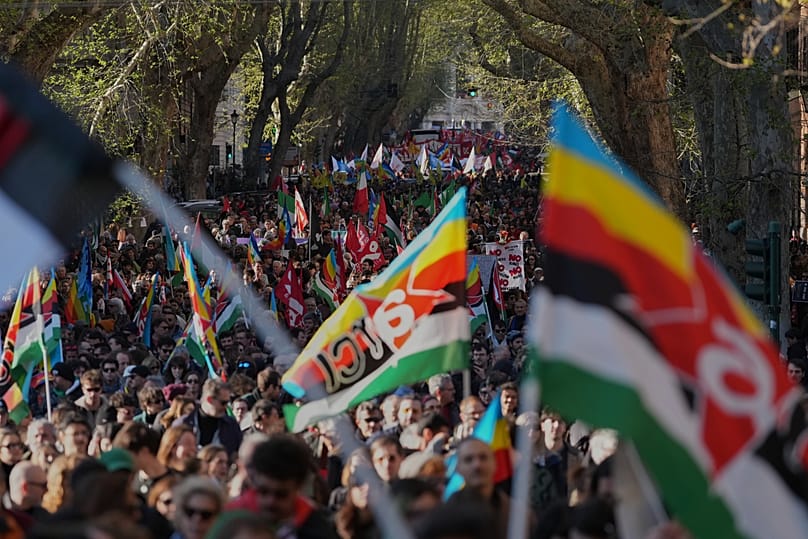
In Rome, thousands protested against the US and Israel's strikes on Iran, but also took the opportunity to also criticise Prime Minister Giorgia Meloni, who recently saw a referendum - which would have changed how Italy’s judiciary system works - fail.

People take part in a national anti-war demonstration organized by "No Kings Italy movement" in Rome, Saturday, 28 March, 2026.
People take part in a national anti-war demonstration organized by "No Kings Italy movement" in Rome, Saturday, 28 March, 2026. AP Photo

In London, people also protested the war in Iran. Many also held banners reading “stop the far right” and “stand up to racism.”

The “No Kings” movement has emerged as the most visible and outspoken opposition to Trump since he began his second term in January 2025.

As the November midterm elections loom and the president's approval rating sinks below 40%, Republicans are in danger of losing control of both chambers of Congress.